
 English
 русский
 Español
 Português


Xie Wenlan — Modular Bridge Project Sales Specialist
Large-Span Heavy-Load Reinforced Bailey Construction Support for Complex Infrastructure Projects
Content
- 1 1. The Role of Reinforced Bailey Construction Support
- 2 2. Product Overview
- 3 3. Double-Layer Structural Design for Heavy Loads
- 4 4. Advantages Compared with Conventional Temporary Supports
- 5 5. Applications in Infrastructure Construction
- 6 6. Engineering and Design Considerations
- 7 7. Manufacturing Process and Quality Strengths
- 8 8. Comparison with Other Temporary Structural Solutions
- 9 9. Installation Efficiency and Construction Management
- 10 10. Safety, Inspection, and Maintenance
- 11 11. International Manufacturing and Project Support
- 12 12. Selecting the Right Configuration
- 13 13. Why the Product Offers Competitive Value
- 14 14. Frequently Asked Questions
- 14.1 Q1: What is a reinforced Bailey construction support system?
- 14.2 Q2: What is the purpose of the double-layer design?
- 14.3 Q3: Can this system be used for waterway construction?
- 14.4 Q4: Is the product suitable for permanent bridges?
- 14.5 Q5: How quickly can the support be installed?
- 14.6 Q6: Can the system be customized?
- 14.7 Q7: What types of loads can it support?
- 14.8 Q8: How is the system transported?
- 14.9 Q9: What manufacturing standards are followed?
- 14.10 Q10: How should the support be maintained?
- 14.11 Q11: Can Zhonghai provide technical support?
- 14.12 Q12: Why choose a modular system instead of a custom welded frame?
- 15 15. Conclusion
- 16 References
- 17 Product: Large Span Heavy Load Super Bailey Construction Support
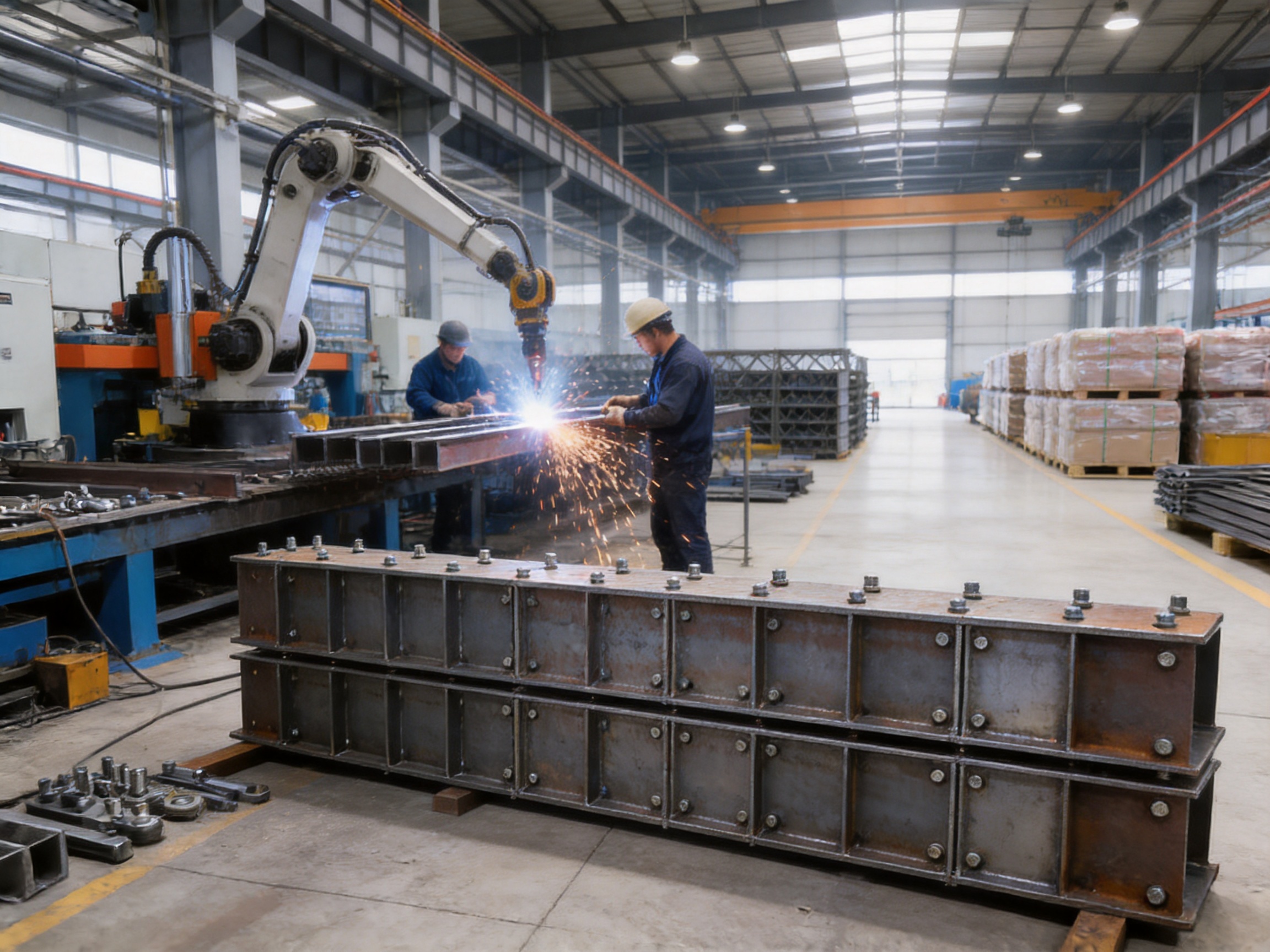
Modern infrastructure projects increasingly require temporary and semi-permanent structural systems that can carry substantial loads, adapt to difficult site conditions, and be installed within demanding construction schedules. Conventional temporary supports may not provide sufficient capacity, flexibility, or speed for large-span channels, elevated roadways, water conservancy works, railway construction, and emergency transportation infrastructure. A reinforced Bailey construction support system offers a practical solution by combining modular steel components, engineered connection details, rapid assembly, and adaptable structural configurations.
The large-span heavy-load super Bailey construction support developed for the Lion Rock Channel Project in Guangzhou is an example of how modular bridge technology can be adapted beyond traditional vehicle bridge applications. Its double-layer structural arrangement improves overall load-bearing performance and stability while retaining the assembly advantages associated with Bailey-type systems. The design is intended for complex construction environments in which temporary works must support heavy equipment, formwork, construction materials, access platforms, launching operations, or other project-specific loads.
Jiangsu Zhonghai Bridge Equipment Co., Ltd. manufactures customized Bailey bridge systems, modular steel bridges, construction support equipment, and engineered structural components for infrastructure projects in China and international markets. Through engineering design, standardized fabrication, automated welding, quality management, and project-oriented technical support, the company provides structural solutions intended to improve safety, construction efficiency, and cost control.
1. The Role of Reinforced Bailey Construction Support
Construction support structures are essential during the period between initial site preparation and completion of a permanent facility. They may be used to support temporary decks, working platforms, formwork, steel beams, concrete operations, lifting equipment, or construction traffic. In waterway and channel projects, the support system may also need to cross an obstruction or create a stable working zone above water, excavation areas, or active transportation routes.
A support system must do more than simply carry a nominal vertical load. It must remain stable under uneven loading, vibration, wind, construction movement, braking forces, impact effects, and possible variations in foundation settlement. It should also allow engineers and contractors to respond to changing site conditions without requiring a completely new structure for every stage of the project.
Bailey-type construction systems are well suited to these requirements because they use prefabricated panels and modular components that can be connected into different spans, widths, and structural arrangements. Standardized components make transportation and inventory management easier, while bolted assembly allows many operations to be completed without extensive site welding. When additional capacity is needed, the system can be reinforced through multiple trusses, layered configurations, supplementary bracing, strengthened connections, or customized support details.
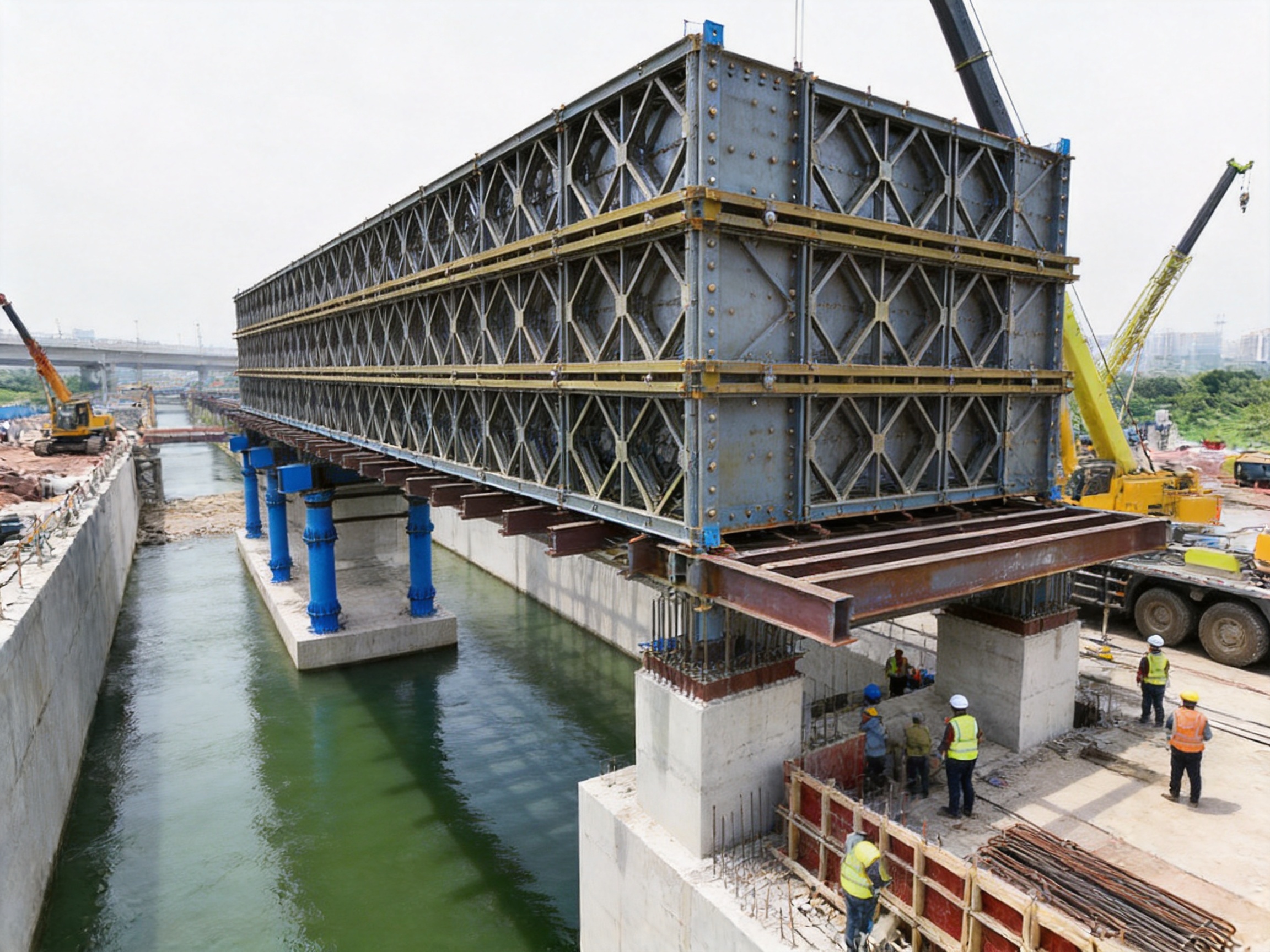
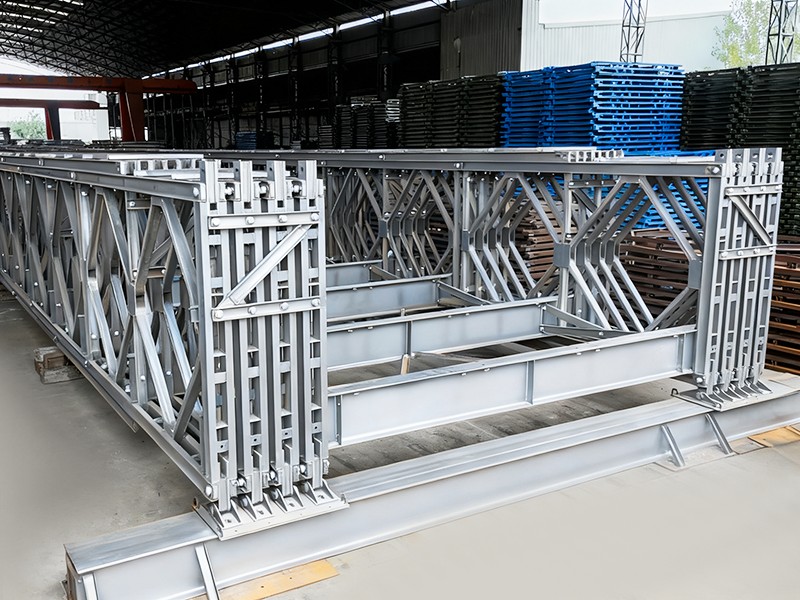
The reinforced system supplied for the Lion Rock Channel Project demonstrates the use of a double-layer arrangement to address large-span and heavy-load requirements. Instead of relying on a single plane of truss panels, the structure uses two structural layers working together to improve stiffness, load distribution, and resistance to deformation. This approach is particularly valuable when the temporary support must carry concentrated loads or maintain serviceability over a considerable span.
2. Product Overview
The product is a custom large-span heavy-load Bailey construction support system developed for demanding temporary works. It belongs to the broader family of modular steel bridge and truss-support equipment, but its design purpose is specifically related to construction support rather than only normal road or pedestrian traffic.
The system may be configured according to span length, support conditions, working width, construction sequence, imposed load, available lifting equipment, and site access. Its modular nature allows the main support structure to be assembled from repeatable steel units, while project-specific engineering can be applied to the connection areas, support points, deck arrangement, bracing system, and auxiliary components.
Key characteristics include:
• A reinforced double-layer structural configuration for improved load-bearing performance.
• Modular Bailey-type components that support efficient transportation and assembly.
• Adaptability to large-span construction support applications.
• Structural stability suitable for complex construction environments when properly designed, erected, and inspected.
• Fast installation compared with many fully welded temporary structures.
• Compatibility with customized dimensions, loading conditions, and project constraints.
• Reusable steel components that can support future projects after suitable inspection and maintenance.
• Integration with engineered steel fabrication and project-specific technical documentation.
The system is not intended to replace engineering verification. Every application should be assessed according to actual loads, span, support conditions, foundation capacity, wind exposure, construction sequence, and applicable standards. The value of the product lies in its engineered modular platform, which gives contractors and designers a reliable starting point for developing a safe and efficient temporary works solution.
3. Double-Layer Structural Design for Heavy Loads
The most distinctive feature of this construction support is the double-layer structural design. In a conventional single-layer truss arrangement, the main load path is concentrated within one vertical truss plane or one principal assembly of panels. This may be sufficient for moderate loading conditions, but large spans and concentrated construction loads can create greater bending, deflection, connection stress, and lateral stability demands.
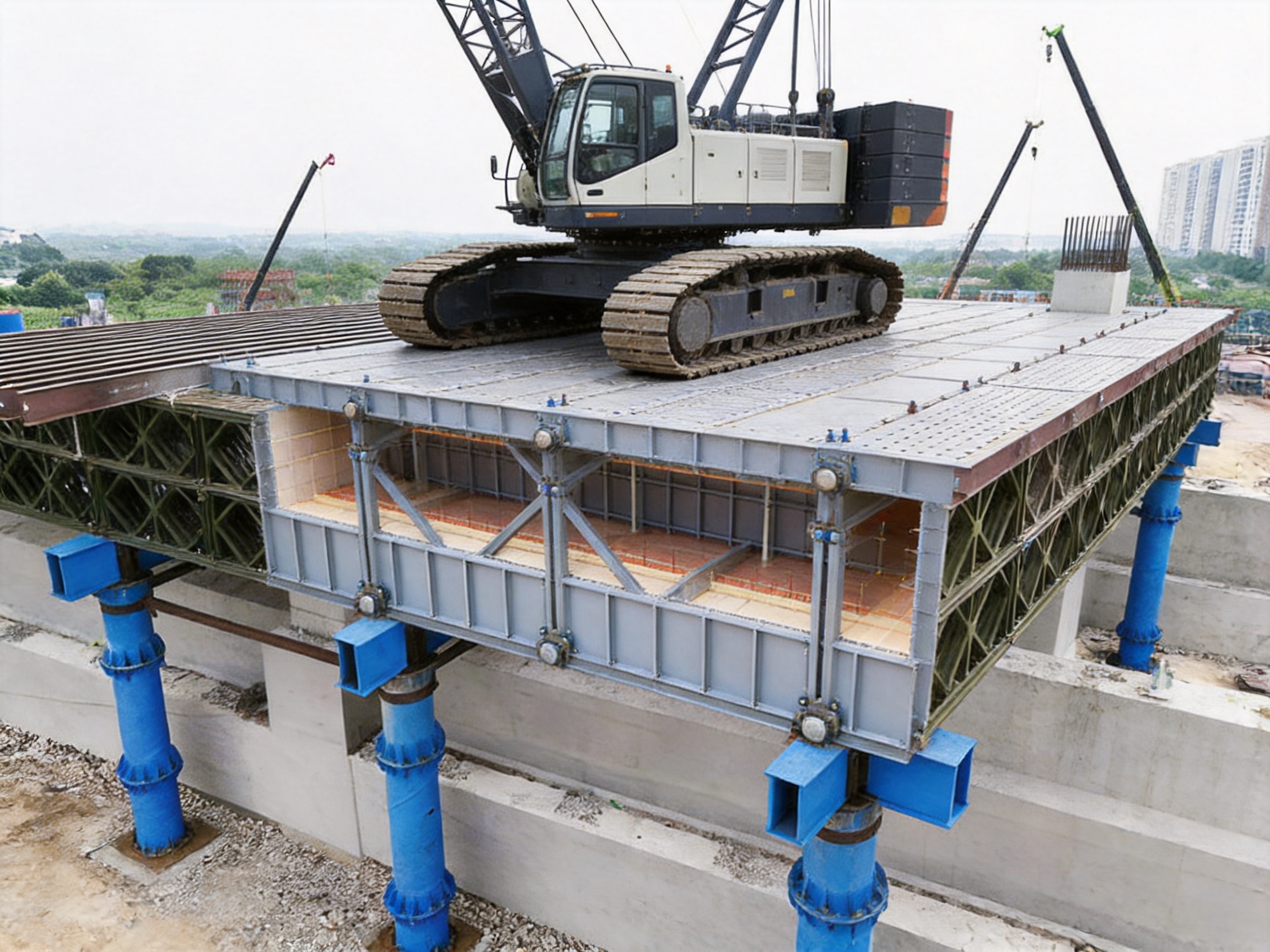
A double-layer structure introduces an additional level of structural depth and redundancy. Depending on the engineering configuration, the upper and lower layers can work together through transverse connections, vertical members, diagonal bracing, and load-distribution elements. This creates a more integrated support frame and can improve the way loads are transferred from the working surface to the main supports.
The benefits of this arrangement may include higher resistance to vertical deformation, improved distribution of concentrated loads, greater torsional stability, and better control of local stress concentrations. It can also provide a more stable base for temporary decks, formwork, launching equipment, or construction machinery.
For large-span applications, stiffness is as important as strength. A structure that technically carries the load but deflects excessively may cause difficulties for formwork alignment, concrete placement, equipment operation, or worker access. Excessive movement can also increase secondary stresses and reduce confidence in the temporary works. The additional structural depth of a double-layer Bailey support can help engineers manage these serviceability concerns more effectively.
The double-layer design may also provide a practical advantage during staged construction. If the project requires different load conditions at different stages, the structural system can be evaluated for each stage and adjusted through supplementary bracing, temporary strengthening, or changes to the supported working platform. This flexibility is important in channel projects and other infrastructure works where construction loads can change significantly as the project progresses.
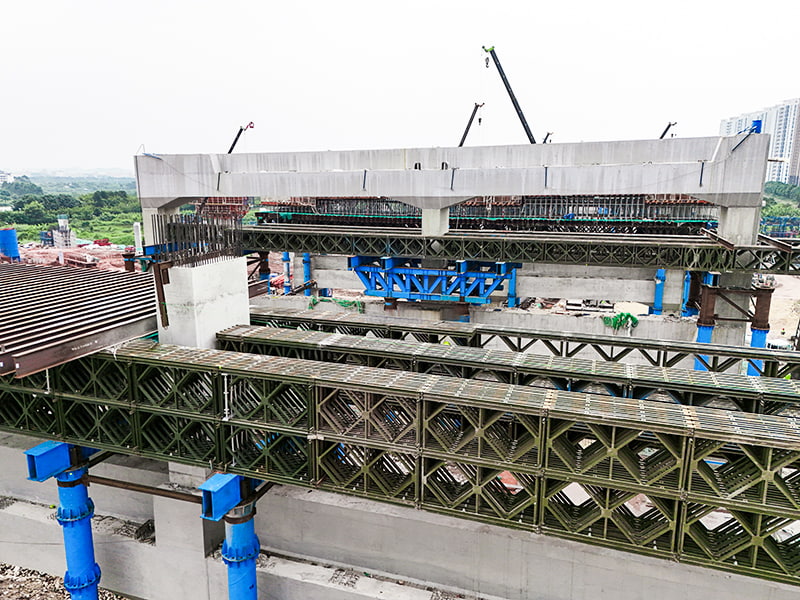
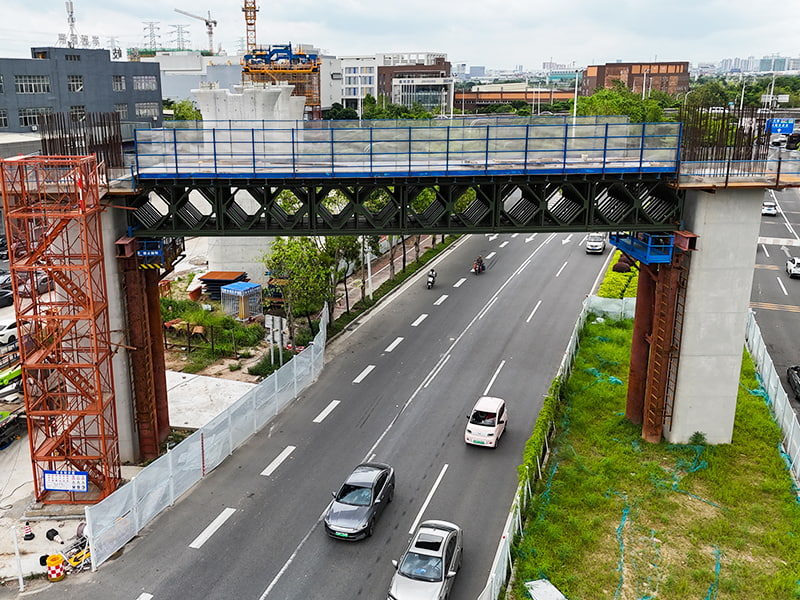
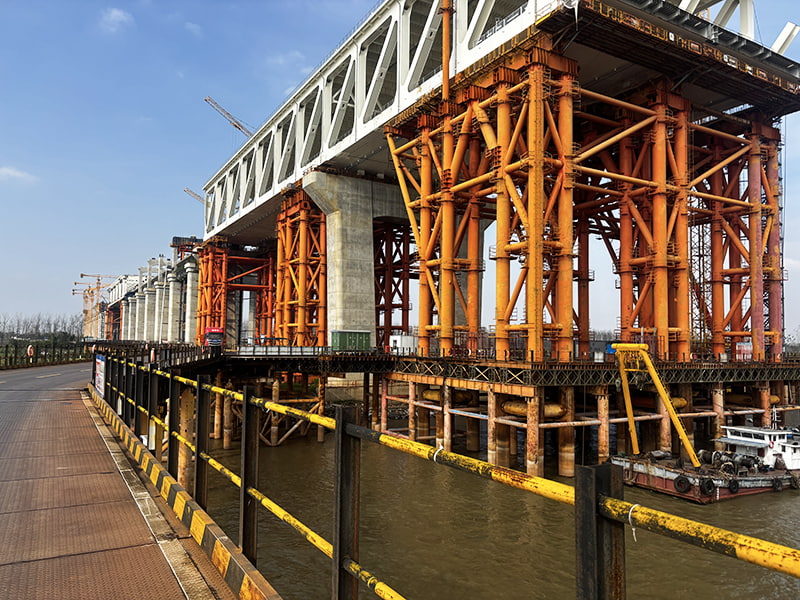
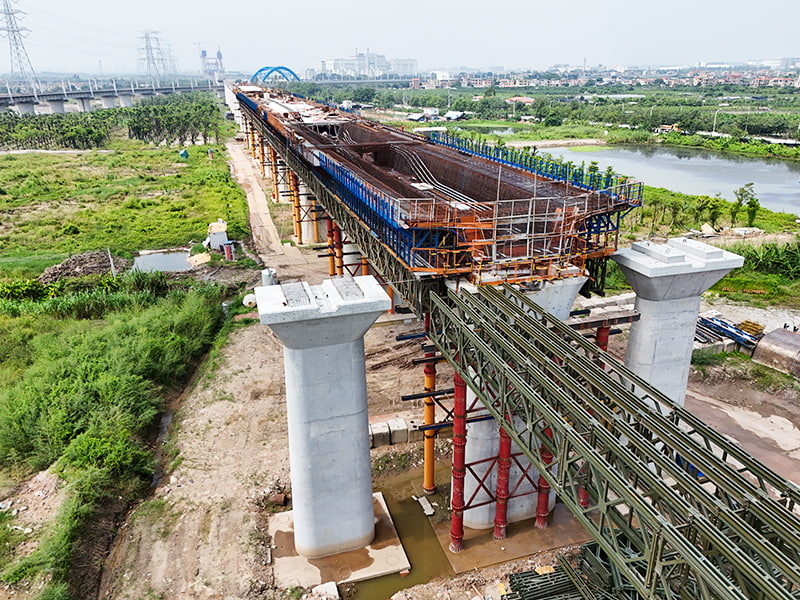
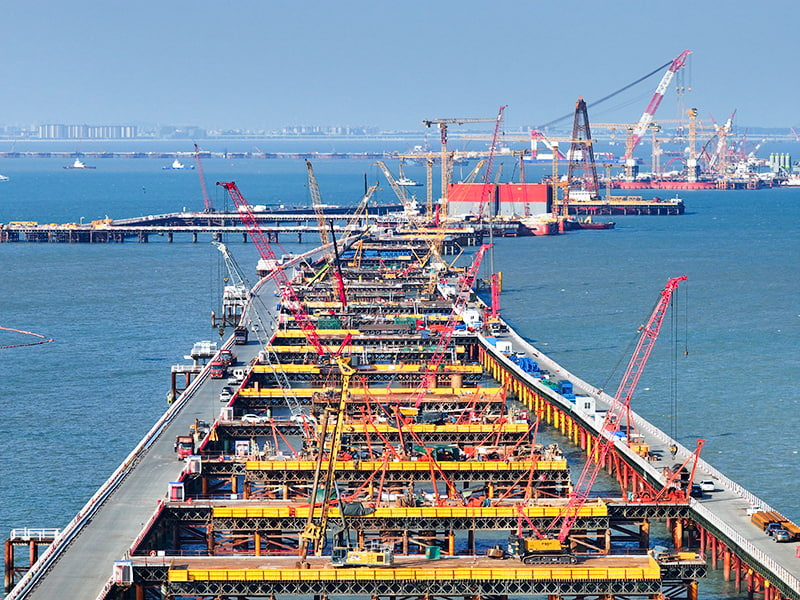
Large Span Heavy Load Super Bailey Construction Support
4. Advantages Compared with Conventional Temporary Supports
4.1 Higher Adaptability for Large-Span Applications
Many temporary supports are designed for a narrow range of spans and loads. When the span increases or when heavy construction equipment is introduced, conventional systems may require extensive redesign, additional columns, or a completely different structural solution. A modular Bailey construction support system provides a broader design platform because panels and support components can be arranged in various combinations.
The reinforced double-layer configuration further expands the usable range of the system. It can be engineered for large-span conditions where a single-layer arrangement may not provide the required stiffness or load distribution. This does not mean that every double-layer system automatically carries every heavy load; rather, it gives the structural engineer more capacity and configuration options within the design process.
4.2 Faster Assembly and Installation
Construction schedules often depend on the speed at which temporary works can be installed. Delays in support construction can affect excavation, formwork, concrete placement, equipment access, and the start of permanent works. Bailey systems use prefabricated components that can be delivered to the site ready for assembly.
Bolted panel connections and standardized accessories reduce the amount of cutting, drilling, and site welding. In suitable conditions, components can be assembled on the ground and moved into position through incremental launching, lifting, or other approved erection methods. This can reduce work at height, simplify site coordination, and shorten the period during which the construction area is occupied by temporary works operations.
The faster installation capability is especially valuable for transportation infrastructure, channel projects, emergency access routes, and sites with limited working hours. A shorter installation period can reduce traffic disruption, waterway interference, labor requirements, and exposure to changing weather conditions.
4.3 Reusable and Economical Components
Temporary structures can represent a significant portion of a project’s indirect cost. A system that is used only once and then discarded may increase material consumption and waste. Modular Bailey components are designed around reuse. After dismantling, components can be inspected, repaired if necessary, stored, and redeployed for another project or another stage of the same project.
Reusability contributes to life-cycle value. The initial investment may support multiple applications, particularly when the manufacturer maintains standardized component dimensions and provides appropriate inspection guidance. Reuse also reduces the need to fabricate a completely new temporary structure for every contract.
Economic performance depends on many factors, including transportation distance, installation method, site access, rental or purchase terms, required reinforcement, foundation preparation, and dismantling conditions. Nevertheless, modularity generally offers a strong basis for controlling project costs because it combines repeatable manufacturing with flexible field application.
4.4 Improved Construction-Site Flexibility
Complex infrastructure sites rarely remain unchanged throughout the construction period. Access routes may move, foundation elevations may vary, equipment may change, and the temporary support may be required for different tasks at different times. A modular system can be more easily adapted than a rigid one-piece structure.
Engineers may select different panel combinations, support arrangements, deck widths, bracing patterns, or auxiliary steel members according to the project requirements. If the construction plan changes, the modular system can often be modified within the limits of its approved engineering design rather than being completely abandoned.
4.5 Lower Dependence on Extensive Site Fabrication
Site fabrication is affected by weather, worker availability, welding quality, access restrictions, and local safety conditions. By completing a large proportion of fabrication in a controlled factory environment, the product reduces the amount of complex structural work required at the project site.
Factory production also improves dimensional consistency. Properly manufactured panels and connection components fit together more predictably, which helps installation crews maintain alignment and reduces the need for unplanned field modifications.
5. Applications in Infrastructure Construction
5.1 Channel and Waterway Projects
Large-span construction support is particularly useful in channel works, water conservancy projects, flood-control construction, and bridge-related waterway operations. A temporary support may be required to create a working platform across a channel or to support construction operations while keeping part of the waterway available.
The Lion Rock Channel Project in Guangzhou provides a relevant example. The project required a customized reinforced support arrangement capable of addressing large spans and heavy construction loads. The double-layer Bailey structure supplied a stable temporary framework for the project’s construction requirements while supporting an efficient installation plan.
Waterway environments create special challenges. The structure may be exposed to humidity, wind, current, fluctuating water levels, limited access, and difficult foundation conditions. The design must therefore consider corrosion protection, temporary foundations, lateral restraint, erection stability, flood conditions, and emergency access. A modular steel system enables the support configuration to be planned around these constraints.
5.2 Road and Highway Construction
Road construction projects may require temporary crossings, work platforms, equipment access routes, or support structures for elevated sections. A Bailey construction support can help maintain access while permanent structures are being built or repaired. It may also support temporary traffic arrangements in areas where a conventional detour would be too long or costly.
For highway applications, the system must be assessed for vehicle loads, impact risks, traffic management, horizontal forces, clearance, and connection durability. The modular nature of the support makes it suitable for phased construction, but the final configuration must always be based on project-specific calculations and traffic requirements.
5.3 Railway and Multi-Span Construction
Railway construction often involves strict alignment, clearance, and work-window requirements. Temporary supports may assist with bridge erection, construction over existing routes, launching operations, or access across difficult terrain. Because modular panels can be assembled in stages, they may support construction methods designed to minimize disruption to railway operations.
Projects involving multiple spans may use piers, towers, or temporary support points between modular sections. The configuration must be designed to address differential settlement, vibration, lateral restraint, and the sequence of loading as each section is erected or removed.
5.4 Emergency and Disaster-Response Infrastructure
After floods, earthquakes, landslides, or other disasters, temporary access is often needed before permanent reconstruction can begin. Modular steel bridge systems are valuable in these situations because their components can be transported, assembled, and deployed relatively quickly.
Although emergency applications often prioritize speed, safety remains essential. Site teams must verify foundation conditions, water levels, debris risks, access for cranes or lifting equipment, and the expected traffic load. A reinforced construction support system can help create temporary access or support emergency works when the site requires greater capacity than a basic modular bridge arrangement can provide.
5.5 Industrial and Commercial Construction
Industrial facilities, logistics centers, energy projects, and large commercial developments may need temporary steel supports for heavy lifting, equipment installation, concrete works, or access over existing facilities. The system can be configured around restricted working areas and integrated with other temporary steel components.
In industrial settings, project managers may value the system’s combination of high load capacity, predictable fabrication, and rapid assembly. Modular components can also help reduce interference with permanent production areas or existing plant operations.
6. Engineering and Design Considerations
A reinforced Bailey construction support system should be designed as a complete temporary works structure rather than evaluated only by the nominal strength of individual panels. The overall engineering review should consider the interaction between the main trusses, deck or support beams, bracing, foundations, connections, and construction loads.
6.1 Load Assessment
Potential loads may include the self-weight of the support system, formwork, concrete, reinforcement steel, construction machinery, stored materials, workers, temporary platforms, lifting operations, wind, impact, braking, vibration, and accidental loading. The load combination depends on the construction method and the applicable design code.
Concentrated loads require particular attention. A crawler crane, concrete pump, material transporter, launching frame, or heavy lifting device may apply loads at localized points rather than distributing them evenly across the full span. The support deck and transverse members must transfer these loads into the main structural layers without excessive local stress.
6.2 Span and Deflection
Span length affects bending moments, reactions, lateral stability, and deflection. In a large-span arrangement, even a structurally adequate support may require additional stiffness to maintain the alignment of the supported work. The engineering design should define acceptable deflection limits for the specific construction activity.
For concrete work, deflection control can be important because it influences finished elevations and the geometry of permanent elements. For equipment access, excessive movement may affect operator confidence and machine stability. The double-layer structure provides additional options for managing these issues, subject to calculation and detailing.
6.3 Foundation and Bearing Conditions
The capacity of the support system cannot exceed the capacity of its foundations and bearing points. Reactions from a large-span heavy-load structure may be substantial, particularly when the load is uneven or when the support is exposed to lateral forces. The site team must verify soil conditions, bearing pressure, settlement, scour risk, and the ability of temporary foundations to resist sliding or overturning.
Where foundations are located near water, excavation, or unstable ground, additional measures may be necessary. These may include reinforced concrete footings, steel grillages, piles, ground improvement, rock anchors, or temporary retaining arrangements. The modular superstructure must be coordinated with these foundation systems.
6.4 Lateral Stability and Bracing
Vertical load capacity alone does not guarantee structural safety. Wind, equipment movement, eccentric loading, construction impact, and uneven settlement can create lateral or torsional effects. Transverse bracing, sway bracing, lateral restraints, and secure connection to the support points may be required.
The double-layer arrangement can improve structural depth and stability, but it must be properly tied together. Inadequate transverse connections may prevent the two layers from acting as an integrated system. Erection-stage stability must also be considered because the structure may be more vulnerable before all bracing and deck elements are installed.
6.5 Erection and Dismantling Sequence
The construction sequence affects the forces in the temporary support. A system that is stable after completion may be unstable during partial assembly or dismantling. Engineering plans should identify lifting points, temporary bracing, launching requirements, crane positions, access routes, and exclusion zones.
Experienced contractors generally assemble modular panels in controlled stages, inspect each connection, install required bracing, and confirm alignment before applying full construction loads. Dismantling should follow a planned reverse sequence and should not begin until supported loads and adjacent structures have been safely released.
7. Manufacturing Process and Quality Strengths
The performance of a modular steel support system depends heavily on manufacturing quality. Structural calculations establish the required capacity, but the finished product must also meet dimensional, material, welding, coating, and connection requirements. Jiangsu Zhonghai Bridge Equipment Co., Ltd. combines engineering design with industrial-scale fabrication to produce modular bridge and support components for infrastructure projects.
7.1 Engineering Design Integration
The manufacturing process begins with understanding the project application. Important information may include the required span, design load, support arrangement, deck width, construction method, site limitations, delivery conditions, and expected service period. Engineering personnel can then develop a suitable modular configuration and identify components requiring customization.
Integrating design and fabrication helps reduce the risk of producing components that are difficult to assemble or transport. It also allows connection details, bracing locations, lifting points, and reinforcement requirements to be coordinated before production begins.
7.2 Standardized Modular Production
Standardization is a major advantage of Bailey-type systems. Repeatable panel dimensions, connection locations, and accessory interfaces improve manufacturing efficiency and make field assembly more predictable. Standardized components can also be cataloged, inspected, and reused more easily.
At the same time, a standardized base system does not prevent customization. The manufacturer can combine standard modules with reinforced members, special support frames, customized deck components, or project-specific connection details. This balance between standardization and customization is important for large-span heavy-load work.
7.3 Automated Welding and Precision Fabrication
Welding quality influences the strength, fatigue resistance, dimensional accuracy, and durability of steel bridge components. Automated welding can provide more consistent welding parameters and repeatable production results than uncontrolled manual operations. It can also improve productivity for repetitive structural members.
Precision steel fabrication includes cutting, forming, fit-up, welding, correction, drilling, finishing, and inspection. Controlling these operations within a structured production workflow helps maintain alignment and connection compatibility among different modules. It also reduces the likelihood of excessive field adjustment.
7.4 Material and Process Control
Appropriate steel materials should be selected according to the design requirements, applicable standards, environmental exposure, and expected loading conditions. Material certificates, incoming inspection, traceability, and controlled storage support consistent product quality.
Process control may include dimensional inspection, weld appearance checks, non-destructive testing where required, bolt and connection verification, coating inspection, and final assembly checks. The precise inspection plan depends on the project specification and relevant standards.
7.5 Surface Protection and Durability
Temporary steel structures may be exposed to rain, humidity, water spray, dust, mud, and chemical contaminants. Surface preparation and protective coating help reduce corrosion during transport, storage, erection, and use. The coating system should be selected according to the environment and expected service period.
For structures used in coastal or waterway environments, corrosion protection deserves particular attention. Components should be inspected after use, especially at connection areas, edges, drainage locations, and places where coating may have been damaged during assembly. Maintenance and repair extend the usable life of reusable modular steel components.
7.6 Factory Testing and Documentation
Reliable project delivery requires more than physical production. Technical drawings, component schedules, installation instructions, inspection records, packing lists, and quality documents help the contractor assemble the system correctly. Clear documentation is particularly important when the project involves international transportation or local installation teams.
Jiangsu Zhonghai Bridge Equipment Co., Ltd. supports project delivery through integrated engineering, manufacturing, quality management, and technical services. Its production capabilities are intended to serve transportation, water conservancy, military logistics, disaster relief, and international development projects.
8. Comparison with Other Temporary Structural Solutions
| Evaluation factor | Reinforced Bailey construction support | Conventional fixed temporary steel frame | Light-duty modular support |
|---|---|---|---|
| Load capacity potential | High when configured with multiple or double-layer trusses and project-specific reinforcement | Can be high, but depends on extensive individual design and fabrication | Generally intended for lower or moderate loads |
| Large-span adaptability | Strong adaptability through modular panel combinations and added structural depth | Possible, but may require substantial custom fabrication | Often limited by component capacity and stiffness |
| Installation speed | Fast relative to fully fabricated site-built frames because many components are prefabricated | May require significant site welding, cutting, and fitting | Usually fast, subject to lower capacity limits |
| Reuse potential | High, subject to inspection, maintenance, and suitability for the next application | Often limited because members may be cut or customized for one project | High, but capacity may restrict future applications |
| Transportation | Efficient because components are modular and packable | May involve oversized or irregular members | Generally efficient |
| Customization | Can combine standard components with engineered reinforcement and special details | Highly customizable but often at higher fabrication cost | Usually limited to the manufacturer’s standard range |
| Best-suited applications | Large-span, heavy-load, staged, emergency, and complex construction support | Highly specialized permanent or temporary frames | Light platforms, access systems, and smaller temporary works |
| Cost-control potential | Supported by standardized production, shorter installation, and component reuse | May have higher labor and fabrication costs | Economical for light-duty projects but not always suitable for heavy loads |
This comparison is a general guide rather than a substitute for engineering selection. A conventional fixed steel frame may be preferable for a unique geometry or a permanent application, while a light-duty modular system may be sufficient for a small platform. The reinforced Bailey support becomes especially attractive when the project requires a combination of high capacity, large-span performance, rapid deployment, and future reuse.
9. Installation Efficiency and Construction Management
The installation efficiency of a Bailey support system is influenced by both the product and the construction plan. Components must arrive in a logical sequence, lifting equipment must be selected according to site conditions, and the erection team must understand the approved drawings and temporary stability requirements.
Before assembly, the contractor should confirm the foundation elevations, bearing locations, access route, component inventory, lifting capacity, weather conditions, and exclusion zones. A pre-assembly inspection can identify damaged components or missing connection hardware before the main erection operation begins.
Ground-level assembly may be used where the site provides sufficient space. In other situations, modular sections can be assembled progressively or launched into position. The selected method should consider the available crane capacity, waterway clearance, overhead restrictions, nearby traffic, and the risk of uncontrolled movement.
Bolted connections should be installed according to the approved procedure. Connection components must be correctly positioned, and bolts should be tightened using the specified method. Improvised drilling, heating, cutting, or welding of primary structural members should not be undertaken without engineering approval.
Once the structure is erected, the contractor should inspect alignment, bearing conditions, bracing, connections, deck components, access facilities, and protective measures. The support should not be loaded until the responsible technical personnel confirm that the required erection stage has been completed.
Shorter installation time can produce benefits beyond labor savings. It may reduce the duration of waterway occupation, minimize disruption to traffic, reduce the time workers spend at height, and allow permanent construction activities to begin earlier. These schedule advantages can improve the overall economic performance of the project.
10. Safety, Inspection, and Maintenance
Temporary structures often experience demanding conditions and frequent changes in loading. A formal inspection program is therefore necessary throughout the project. Inspections should take place before initial loading, after significant weather events, following impact or abnormal movement, and at regular intervals during use.
10.1 Inspection of Primary Components
Panels, chords, diagonals, vertical members, transverse beams, bracing, deck supports, and bearing components should be checked for visible deformation, cracks, corrosion, unauthorized modification, loose connections, and damage from handling. Particular attention should be given to areas exposed to repeated equipment movement or concentrated loads.
10.2 Connection Inspection
Bolted connections are central to the performance of a modular system. Inspectors should verify that the correct bolts, nuts, washers, pins, and locking devices are installed. Missing or improperly secured connection hardware can compromise the load path even when the primary steel members appear undamaged.
10.3 Monitoring During Use
Depending on the project risk level, monitoring may include visual checks, survey measurements, settlement observations, deflection measurements, vibration review, or load monitoring. Warning signs may include unexpected noise, visible movement, bearing displacement, cracking of adjacent foundations, or changes in alignment.
10.4 Maintenance and Reuse
After dismantling, components should be cleaned, sorted, inspected, and stored in a way that prevents further damage. Bent members, damaged holes, excessive corrosion, or defective welds should be evaluated by qualified personnel before reuse. Coating repairs and replacement of damaged hardware help maintain the reliability of the system.
Because modular components may be reused in different configurations, each new application requires a fresh engineering review. A component that was suitable for one span and loading arrangement may not be suitable for another without additional reinforcement or a revised configuration.
11. International Manufacturing and Project Support
Infrastructure projects frequently involve international procurement, multilingual technical coordination, and delivery to locations with different construction practices. A manufacturer must therefore provide more than a product catalogue. It should be able to coordinate engineering information, production schedules, packing, shipping preparation, documentation, and technical communication.
Jiangsu Zhonghai Bridge Equipment Co., Ltd. is located in Zhenjiang, Jiangsu Province, an industrial and transportation center with access to manufacturing resources and logistics networks. The company serves clients in transportation, water conservancy, military logistics, disaster relief, and international development.
The company’s stated product scope includes modular steel bridges, Bailey bridge systems, customized steel components, bridge erection and construction support equipment, automated welding, and precision steel fabrication. This combination allows customers to source both standardized bridge components and specialized structural assemblies from one engineering and manufacturing partner.
Its project experience includes coastal engineering in the Maldives, temporary access bridges for the Shenzhen–Zhongshan Corridor, structural components for the Hangzhou Expo Center, multi-span Bailey bridges for the Lalin Railway, and emergency bridge deployments in multiple regions. Such experience demonstrates the broad application range of modular steel systems, although each project still requires independent design verification and site planning.
12. Selecting the Right Configuration
Customers considering a reinforced Bailey construction support should prepare a clear technical brief. The more complete the project information, the more accurately the manufacturer can recommend a configuration and estimate production requirements.
Important information includes the required clear span, total structure length, working width, design load, load position, equipment type, deck arrangement, support elevation, foundation conditions, water level, wind exposure, access limitations, installation method, service period, and dismantling plan.
It is also useful to identify whether the system will carry construction traffic, support stationary equipment, act as a working platform, support formwork, or provide a temporary crossing. Different functions create different load combinations and detailing requirements.
Where the project contains several construction stages, the customer should describe each stage separately. A support system may carry lightweight formwork during one phase and heavy equipment during another. The design should address the most demanding combination and confirm whether any temporary strengthening or configuration change is required between stages.
Environmental conditions should also be discussed. Coastal exposure, high humidity, chemical contamination, freezing temperatures, flood risk, and abrasive dust can affect material protection and maintenance. The coating system, storage procedure, inspection frequency, and replacement hardware should be selected accordingly.
13. Why the Product Offers Competitive Value
The competitive value of the large-span heavy-load super Bailey construction support comes from the combination of structural reinforcement, modular flexibility, manufacturing discipline, and project-oriented service. A competitor may offer standard Bailey panels, but a successful large-span application often requires more than a stock component list. It requires the ability to understand the construction method, coordinate the double-layer arrangement, manufacture compatible components, and support the contractor during implementation.
The reinforced design addresses the performance gap between standard light or medium-duty modular supports and heavily customized fixed steel frames. It offers greater structural depth and load-distribution potential while preserving the transport and assembly benefits of a modular system.
The product can also reduce dependence on extensive site fabrication. Factory-produced components are easier to inspect, organize, and install than a collection of irregular steel members fabricated under changing site conditions. This improves schedule predictability and may reduce the risk of inconsistent workmanship.
Another competitive advantage is the potential for reuse. A well-maintained modular system can support multiple projects, allowing owners, contractors, rental companies, and infrastructure agencies to build a long-term inventory of adaptable structural components.
Finally, the manufacturer’s integrated capabilities support a more complete procurement process. Customers can discuss design requirements, structural fabrication, quality control, delivery preparation, and construction support with one specialized bridge equipment supplier rather than coordinating unrelated vendors for each activity.
14. Frequently Asked Questions
Q1: What is a reinforced Bailey construction support system?
A reinforced Bailey construction support system is a modular steel temporary works structure assembled from prefabricated truss panels, connection components, bracing, support members, and related accessories. It is designed to support construction loads, working platforms, formwork, equipment, access routes, or temporary crossings. Reinforcement may include multiple truss lines, double-layer arrangements, additional bracing, strengthened connections, or customized steel members.
Q2: What is the purpose of the double-layer design?
The double-layer design increases structural depth and provides additional options for load distribution, stiffness, and stability. It is particularly useful for large spans or concentrated heavy loads. The final capacity depends on the complete engineering configuration, including panel type, connection details, bracing, support conditions, and load combinations.
Q3: Can this system be used for waterway construction?
Yes. The system is suitable for selected channel, water conservancy, flood-control, and waterway construction applications when designed for the site conditions. Water level, current, flood risk, foundation capacity, corrosion exposure, and erection access must be assessed before installation.
Q4: Is the product suitable for permanent bridges?
Bailey-type systems are commonly used for temporary, semi-permanent, emergency, and modular bridge applications. Whether a specific configuration is suitable for permanent use depends on the design code, loading requirements, durability provisions, maintenance plan, and approval requirements of the project authority.
Q5: How quickly can the support be installed?
Installation time depends on span, configuration, foundation readiness, component quantity, lifting equipment, weather, access, and workforce experience. Prefabricated modular components and bolted connections can reduce site fabrication and support a faster installation process than many fully custom welded temporary frames.
Q6: Can the system be customized?
Yes. The modular base can be combined with project-specific reinforcement, double-layer arrangements, support frames, deck systems, bracing, and connection details. Customers should provide complete information about span, loading, equipment, foundation, environment, and construction sequence so the configuration can be engineered appropriately.
Q7: What types of loads can it support?
Potential loads may include construction machinery, formwork, concrete, reinforcement steel, materials, workers, temporary platforms, lifting equipment, and controlled construction traffic. The allowable load must be established through project-specific structural calculations rather than by assuming a universal capacity.
Q8: How is the system transported?
Modular panels and accessories can generally be packed and transported more efficiently than large irregular steel frames. The exact packing plan depends on component dimensions, shipment method, destination, lifting limitations, and site access. Proper packing also protects connection components and coated surfaces during transit.
Q9: What manufacturing standards are followed?
The company states that its high-strength modular bridge systems are produced in accordance with ASTM, EN, and applicable national specifications. The specific standard, material grade, welding procedure, coating requirement, and inspection plan should be agreed in the project documentation before production.
Q10: How should the support be maintained?
Maintenance includes regular inspection of steel members, connections, bracing, bearings, deck components, coatings, and foundation conditions. Components should be checked after unusual weather, impact, excessive movement, or changes in loading. After dismantling, all parts should be cleaned, inspected, repaired if necessary, and stored correctly before reuse.
Q11: Can Zhonghai provide technical support?
Jiangsu Zhonghai Bridge Equipment Co., Ltd. integrates engineering design, manufacturing, quality management, delivery coordination, and on-site support services. The exact scope of technical assistance should be confirmed for each project, including design documents, installation guidance, inspection requirements, and commissioning support.
Q12: Why choose a modular system instead of a custom welded frame?
A modular system may offer faster assembly, easier transportation, lower site fabrication requirements, greater reuse potential, and more flexible configuration. A custom welded frame may still be preferable for unique geometries or permanent structures. The correct choice depends on the project’s structural, schedule, logistical, and economic requirements.
15. Conclusion
The large-span heavy-load reinforced Bailey construction support developed for the Lion Rock Channel Project represents a practical application of modular steel engineering to complex temporary works. Its double-layer structural design provides a stronger and more stable platform for demanding construction conditions while retaining the assembly efficiency, transportation convenience, and reuse potential of Bailey-type systems.
For channel projects, road and railway construction, emergency access, industrial works, and other infrastructure applications, the system can help contractors create reliable temporary support without relying entirely on slow, site-intensive fabrication. Its value is further strengthened when the manufacturer provides integrated engineering, precision fabrication, automated welding, quality management, documentation, and project support.
Jiangsu Zhonghai Bridge Equipment Co., Ltd. combines modular bridge manufacturing with customized steel fabrication and construction support expertise. Through standardized production and project-specific reinforcement, the company can serve customers seeking safe, efficient, and economical structural solutions for global infrastructure and emergency response projects.
As with all temporary structures, successful performance depends on correct engineering, proper foundations, approved erection procedures, qualified inspection, and disciplined maintenance. When these requirements are addressed, a reinforced modular Bailey construction support system can provide a dependable solution for large-span and heavy-load construction challenges.
References
1. Project information supplied for the reinforced Bailey construction support used in the Lion Rock Channel Project, Guangzhou.
2. Jiangsu Zhonghai Bridge Equipment Co., Ltd. company information and product profile.
3. General principles of modular steel bridge design, temporary works engineering, and construction-stage structural stability.
4. ASTM structural steel, welding, fabrication, and quality-control practices applicable to modular steel components.
5. EN standards and related engineering practices for steel structures, bolted connections, temporary works, and execution quality.
6. Standard engineering procedures for the inspection, maintenance, dismantling, storage, and reuse of modular bridge components.
Product: Large Span Heavy Load Super Bailey Construction Support


We respond quickly to all international requests and provide technical support when needed.
Product Category
Bailey Bridge/Modular Bridge Modular Steel Bridge Pedestrian Bridge Modular Pipe Bridge Truss Bridge Steel StructureContact Us

+86-511-84522866
+86-13921582699

zhwm@zjql.com

Building 1,83#, dantu New Town, Yanjiang Road, Dantu District, Zhenjiang, Jiangsu, China
Copyright © Jiangsu Zhonghai Bridge Equipment Co., Ltd. All
Rights
Reserved
China bailey bridge for sale
bailey bridge supplier from china
