
 English
 русский
 Español
 Português


Xie Wenlan — Modular Bridge Project Sales Specialist
High-Strength Galvanized Modular Bailey Bridges for Rapid Infrastructure Deployment
Content
- 1 What Is a CB100 Modular Bailey Bridge?
- 2 Core Design Features
- 3 Performance Advantages Compared with Conventional Alternatives
- 4 Applications Across Infrastructure and Emergency Projects
- 5 Advanced Manufacturing and Engineering Capabilities
- 6 Company Strengths and Integrated Project Support
- 7 Installation, Commissioning, and Reuse
- 8 Maintenance and Lifecycle Management
- 9 How to Select the Right Configuration
- 10 Frequently Asked Questions
- 10.1 What is the main advantage of the CB100 Bailey Bridge?
- 10.2 Is the bridge suitable for permanent use?
- 10.3 Can the bridge be used in coastal areas?
- 10.4 What vehicle loads can the bridge support?
- 10.5 Can the bridge be relocated?
- 10.6 Does galvanized steel eliminate maintenance?
- 10.7 How long does installation take?
- 10.8 Can the bridge carry construction equipment?
- 10.9 What should buyers request from the manufacturer?
- 10.10 Why is manufacturer experience important?
- 11 Conclusion
- 12 References
- 13 Product: CB100 Bailey Bridge High Strength Galvanized Truss-Type Modular Bailey Bridge
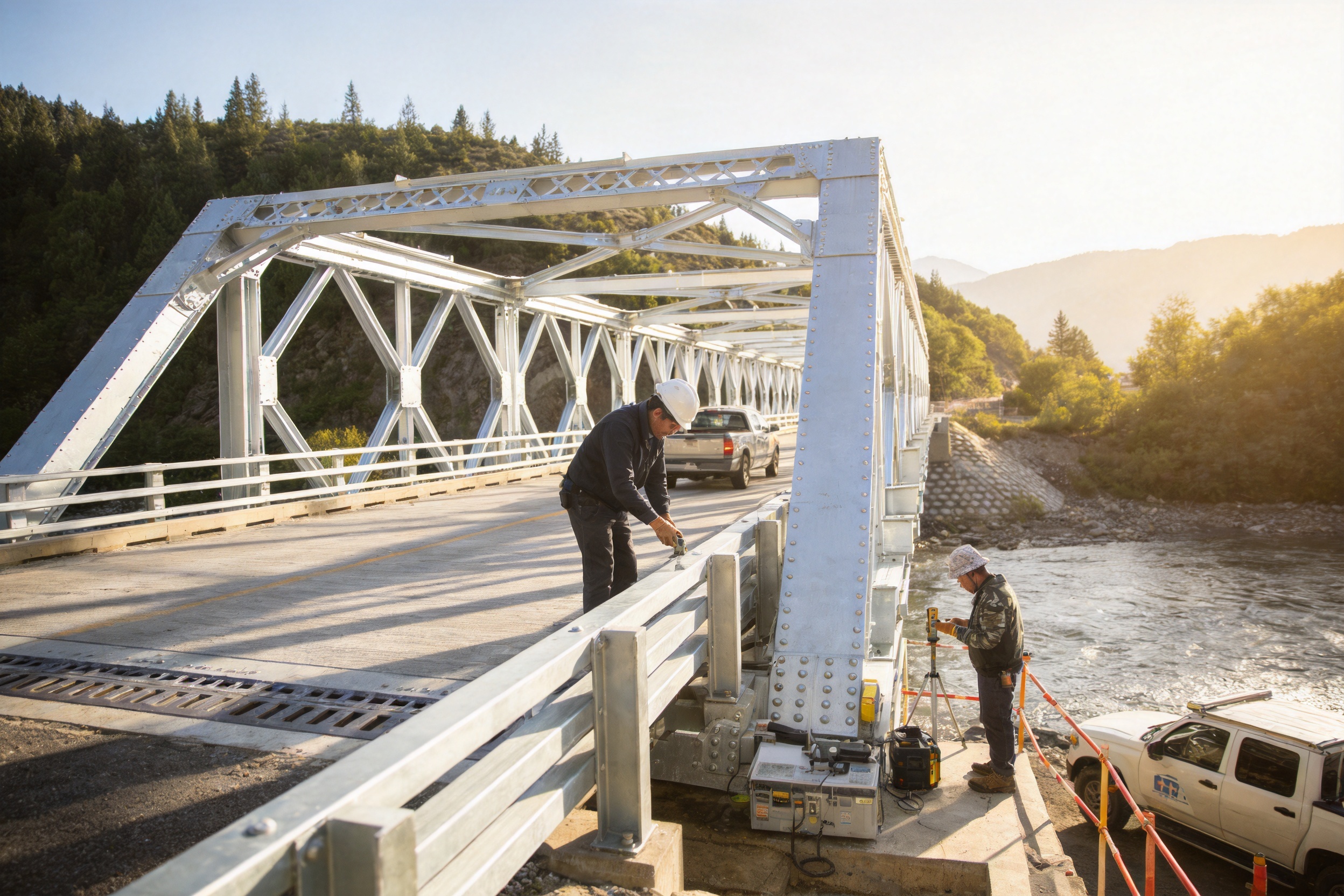
Modular bridge systems are essential wherever reliable access must be created quickly, safely, and economically. Construction sites, emergency-response operations, coastal developments, temporary transportation routes, water-conservancy projects, and remote infrastructure programs all require bridge solutions that can adapt to changing conditions. In these applications, a bridge must do more than carry a specified load. It must also be practical to transport, straightforward to assemble, resistant to environmental exposure, easy to inspect, and capable of being dismantled and reused.
The CB100 Bailey Bridge is a high-strength galvanized truss-type modular steel bridge developed for these demanding requirements. Based on the widely recognized 321-type modular bridge configuration, it combines a standardized panel system with a durable galvanized steel structure. Its design supports rapid deployment while providing the structural stability expected from a permanent-quality engineered bridge system.
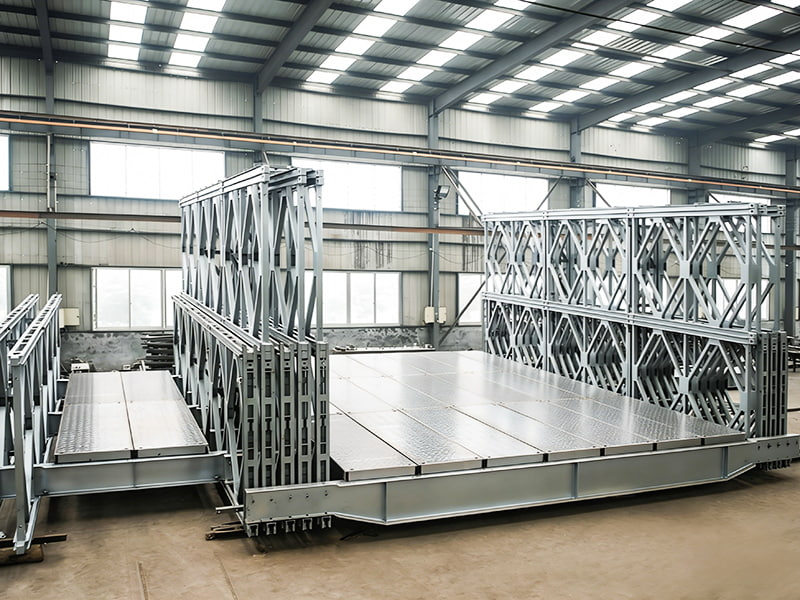
Unlike conventional bridges that require extensive site fabrication, heavy civil works, and long construction schedules, the CB100 system is assembled from interchangeable prefabricated components. The panels, transoms, stringers, deck elements, bracing members, and connection accessories are manufactured in a controlled factory environment and transported to the installation site. This approach reduces on-site cutting, drilling, welding, and adjustment, helping contractors control both schedule and construction risk.
Another important feature is the use of high-strength galvanized steel. The protective zinc coating helps resist corrosion caused by moisture, rain, salt spray, and other outdoor conditions. Because the galvanizing process is completed before delivery, the bridge can be installed without waiting for field painting or extensive coating work. The resulting structure can reduce future maintenance requirements, particularly in applications where rust removal and repainting would be difficult or expensive.
This article examines the design characteristics, advantages, applications, manufacturing capabilities, engineering value, installation process, and selection considerations associated with the CB100 modular Bailey Bridge. It also explains why a specialized manufacturer with integrated engineering, fabrication, quality management, and support capabilities can provide greater value than a supplier offering only basic steel components.
What Is a CB100 Modular Bailey Bridge?
A Bailey bridge is a prefabricated modular bridge formed from repeating structural panels and standardized connecting components. The modular arrangement allows bridge length, width, load configuration, and support conditions to be adapted according to project requirements. Instead of manufacturing an entirely different bridge for every span, the same family of components can be combined into multiple structural layouts.
The CB100 is a truss-type modular bridge associated with the 321-type Bailey bridge configuration. Its main load-bearing elements are assembled into side trusses. These trusses work together with transverse members, longitudinal members, bracing, and deck components to distribute vehicle or pedestrian loads toward the supports. The complete system provides a balance between structural efficiency, transportability, and erection speed.
The term “CB100” identifies a specific modular bridge configuration offered for engineered applications. The exact span, width, roadway arrangement, deck system, support condition, and load capacity should be confirmed through project calculations. Depending on the intended use, the system may be configured for temporary traffic, construction access, emergency passage, industrial logistics, or other controlled applications.
The bridge is suitable for projects requiring compliance with recognized vehicle loading standards, including HS-15, HS-20, HS-25, HL-93, and Caterpillar-50 load requirements. These references indicate that the bridge can be engineered for a range of traffic and equipment conditions. However, final structural selection must always be based on span, vehicle configuration, traffic frequency, foundation conditions, wind exposure, seismic considerations, and other site-specific parameters.
Because the bridge is modular, its components can be manufactured in batches, stocked for future use, and rearranged for different projects. This offers a major advantage to contractors, government agencies, disaster-response organizations, and infrastructure operators that need flexible bridge assets rather than single-use structures.
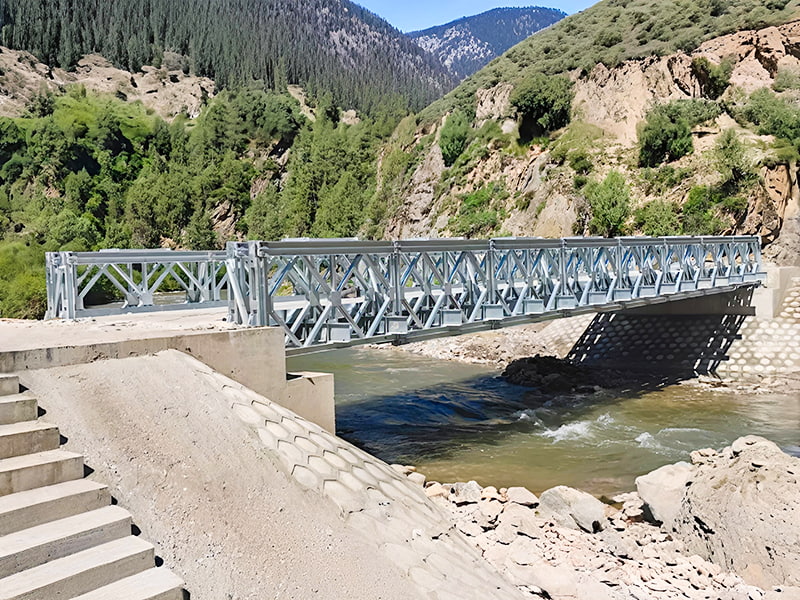
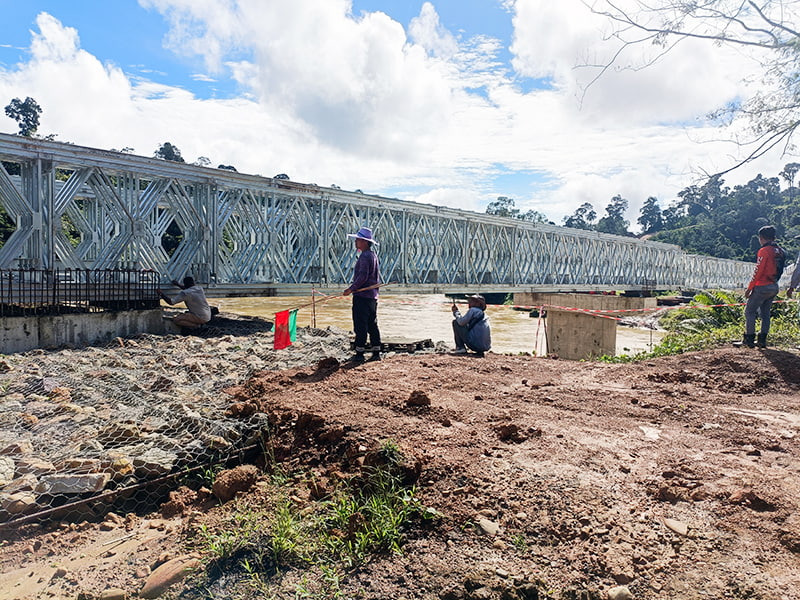
CB100 Bailey Bridge High Strength Galvanized Truss-Type Modular Bailey Bridge
Core Design Features
High-Strength Structural Steel
The CB100 bridge uses high-strength steel for its main structural components. The use of suitable structural steel helps the bridge carry significant loads while keeping individual components manageable for transport and assembly. High-strength material also supports efficient truss design, allowing the bridge to achieve an effective strength-to-weight ratio.
Material selection affects more than the bridge’s theoretical capacity. It influences fatigue performance, connection behavior, dimensional stability, fabrication quality, and long-term reliability. A professional manufacturing process therefore includes material verification, controlled cutting, accurate forming, qualified welding, and systematic inspection before components are released for shipment.
Galvanized Corrosion Protection
The bridge’s galvanized finish is one of its most important distinguishing characteristics. Galvanizing places a protective zinc layer over exposed steel surfaces. This coating acts as a physical barrier and provides sacrificial protection if the steel surface is scratched or locally damaged.
For bridges used outdoors, corrosion protection is essential. Rainwater, humidity, soil contact, road splash, industrial pollutants, and marine salt can gradually deteriorate unprotected steel. In coastal areas, the risk is even greater because salt-laden air accelerates corrosion. A galvanized bridge can provide more dependable protection than a basic untreated or inadequately coated steel structure.
The galvanized coating also reduces the dependence on regular painting programs. Painting may still be appropriate in certain environments or for specific aesthetic and protection requirements, but the initial galvanized layer provides a durable baseline of corrosion resistance. This can reduce maintenance interruptions and help preserve the bridge’s appearance and structural condition throughout repeated deployment cycles.
Interchangeable Modular Components
Component interchangeability is central to the Bailey bridge concept. Standardized panels and connection details allow replacement parts to be produced and supplied without redesigning the entire bridge. If an individual member is damaged during transportation, installation, or service, it can generally be replaced with a compatible component rather than requiring extensive field reconstruction.
Interchangeability also improves inventory management. A project owner can maintain a stock of standardized panels, transoms, braces, deck members, and accessories for different bridge arrangements. The same inventory may support a short emergency crossing today and a longer construction access bridge in the future, subject to engineering verification.
Truss-Based Structural Efficiency
The truss arrangement transfers loads through a combination of axial forces in interconnected members. This helps reduce the amount of material required compared with some solid-girder solutions, while maintaining a strong and stable load path. The open truss profile also permits individual components to be inspected more easily than concealed structural members.
A truss bridge can be assembled in repeated bays, enabling the structure to span obstacles such as rivers, drainage channels, roadways, rail corridors, and construction excavations. The system can be adapted to single-span or multi-span layouts when suitable piers, bearings, and foundations are provided.
Convenient Assembly and Disassembly
The CB100 system is designed for practical field assembly. Standardized joints and prefabricated members reduce the amount of specialized work required at the installation site. Depending on the bridge arrangement and local conditions, components may be moved into position by cranes, lifting equipment, launching methods, or other approved erection techniques.
Once a temporary project is complete, the bridge can be dismantled, inspected, packed, transported, and reused. This recoverable design is especially valuable for contractors and public agencies that manage multiple projects over several years. The bridge becomes a reusable infrastructure asset instead of a one-time installation.
Performance Advantages Compared with Conventional Alternatives
Many bridge solutions can satisfy a basic span or load requirement, but not all provide the same combination of delivery speed, flexibility, durability, and lifecycle value. The CB100 modular Bailey Bridge is advantageous because it addresses the complete project cycle rather than focusing only on the initial structural calculation.
Faster Deployment
Conventional cast-in-place bridges often require extensive formwork, reinforcement installation, concrete curing, and site coordination. Welded site-built steel bridges may require large quantities of field fabrication and coating work. By contrast, a modular Bailey bridge arrives as prefabricated components that can be assembled after supports and foundations are ready.
This can significantly shorten the period during which a roadway, worksite, railway, or emergency route is disrupted. Faster deployment is particularly important after floods, earthquakes, landslides, storms, or other events where communities and emergency teams cannot wait for a conventional construction program.
Lower Site Dependence
A modular bridge places more of the manufacturing process in a controlled factory environment. This reduces dependence on local weather, site welding conditions, temporary workshops, and variable labor availability. It also makes quality assurance more consistent because key operations are performed using established production procedures and dedicated equipment.
Reduced site dependence is useful in remote regions, mountainous areas, islands, coastal zones, and emergency locations where access to skilled fabrication crews or large permanent facilities may be limited.
Reduced Environmental Disruption
Because the bridge can be assembled rapidly and with limited site fabrication, the installation period may create less noise, waste, traffic disruption, and disturbance to surrounding land than some conventional alternatives. The exact environmental effect depends on foundations, access roads, lifting operations, and local regulations, but modular construction generally supports a more controlled site program.
When the bridge is temporary, its ability to be removed and reused can also reduce the amount of permanent material left at the site. This is valuable for temporary bypasses, construction crossings, festival access, disaster relief, and seasonal transportation routes.
Improved Corrosion Resistance
An untreated steel bridge may require frequent painting and rust-control work, especially in humid or coastal environments. A galvanized bridge begins its service life with a factory-applied corrosion protection layer that covers exposed steel surfaces before installation. The coating helps reduce the risk of early deterioration and reduces the frequency of certain maintenance activities.
This advantage is particularly meaningful for bridges located over water, in coastal regions, in areas with heavy rainfall, or at sites where inspection and maintenance equipment is difficult to mobilize. Galvanizing does not eliminate the need for inspection, but it can make the maintenance program more manageable.
Strong Reuse Value
A temporary bridge can become expensive if it must be discarded after one project. The modular CB100 approach supports repeated use. Components can be disassembled after completion, checked for damage, stored, and redeployed. This provides a lower total cost of ownership when compared with single-purpose structures that have limited recovery value.
Reuse also supports sustainable procurement. Rather than purchasing a new bridge for every temporary crossing, organizations can build a modular inventory and use it across multiple projects. Standardized components make planning, replacement, and future expansion easier.
| Evaluation Factor | CB100 Galvanized Modular Bridge | Conventional Site-Built Steel Bridge | Temporary Cast-in-Place Bridge |
|---|---|---|---|
| Delivery format | Prefabricated modular components | Project-specific fabricated members | Materials and formwork assembled on site |
| Installation speed | Rapid assembly after supports are prepared | Usually requires longer field fabrication | Dependent on formwork, reinforcement, and curing |
| Reusability | High, subject to inspection and engineering approval | Usually limited | Generally low |
| Corrosion protection | Factory-applied galvanizing | Often paint or project-specific coating | Depends on embedded and exposed materials |
| Component replacement | Standardized interchangeable parts | May require custom fabrication | Repairs can be difficult after construction |
| Site fabrication demand | Relatively low | Moderate to high | High during construction |
| Best-fit applications | Temporary access, emergency routes, construction, coastal and remote projects | Permanent project-specific infrastructure | Short-term works where local construction resources are readily available |
Applications Across Infrastructure and Emergency Projects
Construction Access Bridges
Large infrastructure projects often need temporary crossings before permanent roads and bridges are complete. A CB100 bridge can provide access for construction vehicles, material deliveries, cranes, and project personnel. Its modular structure can be configured to suit changing work phases and removed when the permanent transportation network becomes operational.
Construction access bridges are frequently required over drainage channels, temporary excavations, rivers, utility corridors, and existing roads. The bridge can help maintain logistics continuity while reducing the need to construct a fully permanent crossing at an early stage of the project.
Emergency and Disaster Relief
Floods, earthquakes, landslides, storms, and other disasters can damage or destroy existing bridges. A modular bridge offers emergency agencies a practical method of restoring access. Because components can be transported in sections and assembled with local lifting equipment, the system is suitable for urgent response operations where speed and reliability are equally important.
Emergency applications may include access for ambulances, rescue teams, relief vehicles, utility crews, and community transportation. The final load arrangement must be selected according to the vehicles expected to use the bridge, the available supports, and the condition of the surrounding ground.
Coastal and Marine-Influenced Areas
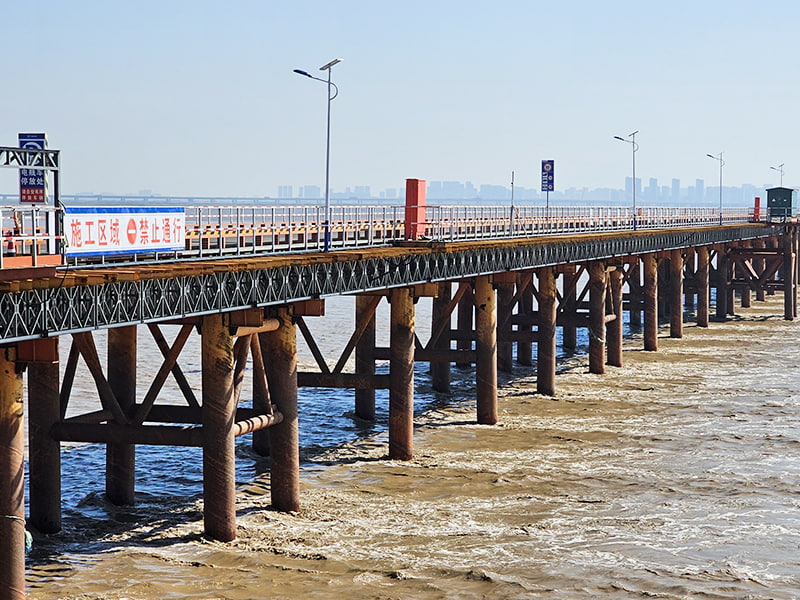
Coastal regions place severe demands on steel structures. Salt spray and high humidity accelerate corrosion, while wind and tidal conditions can complicate maintenance. The galvanized finish of the CB100 bridge provides an important layer of protection for coastal construction, temporary access, island logistics, and water-related infrastructure.
Galvanizing is not a replacement for correct drainage, detailing, inspection, or site-specific corrosion engineering. Nevertheless, it gives project planners a stronger starting point than untreated steel and can reduce the frequency of surface maintenance in difficult environments.
Water-Conservancy Projects
Water-control facilities, channels, reservoirs, pumping stations, and flood-management works often require temporary or semi-permanent crossings. Modular bridges can provide access during staged construction without demanding a permanent roadway in every location. The bridge may be used for equipment movement, maintenance access, or temporary public traffic, depending on its design and traffic management plan.
Military and Strategic Logistics
Military logistics and strategic infrastructure often require transportable bridge systems that can be deployed, recovered, and redeployed. The modular format supports inventory flexibility and rapid installation. The ability to use standardized components can simplify training, spare-part management, and operational planning.
Railway and Corridor Development
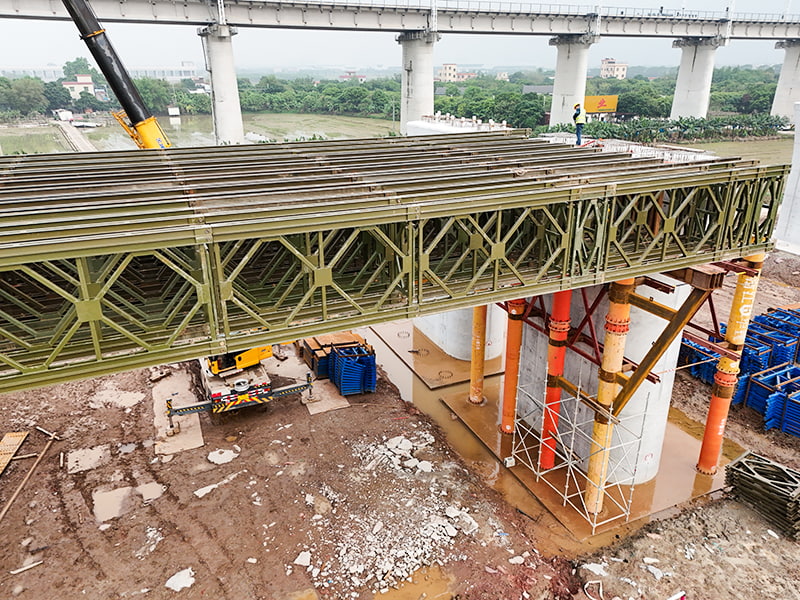
Major railway and highway projects may involve long construction corridors with numerous temporary crossings. A modular Bailey bridge can support access over waterways, unfinished road cuts, and other obstacles. Its prefabricated nature allows the bridge to be moved as construction advances, helping contractors maintain access across a changing project landscape.
Pedestrian and Light-Use Crossings
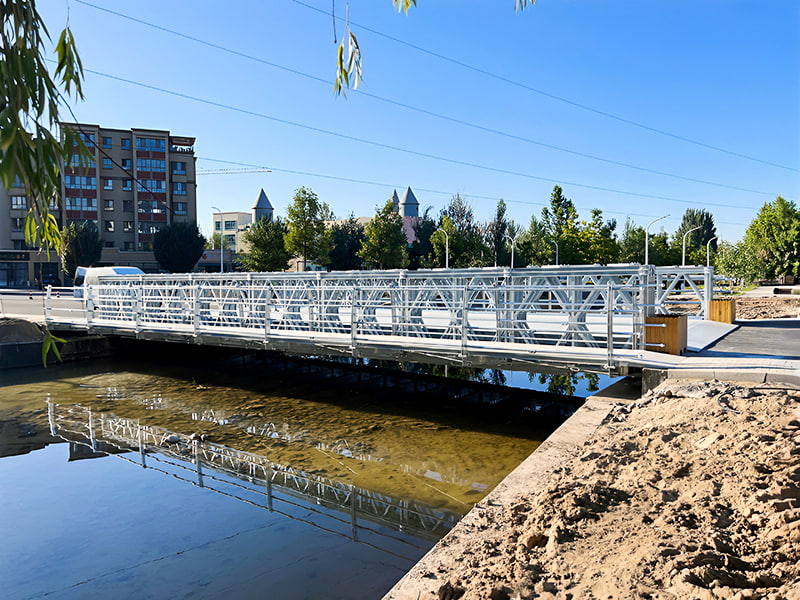
Although the CB100 system is capable of being engineered for vehicle loads, modular bridge concepts can also support pedestrian or controlled light-use crossings when configured with appropriate decking, handrails, barriers, and safety features. The intended use must be clearly defined so that the structure, deck surface, guard systems, and access ramps meet the relevant requirements.
Advanced Manufacturing and Engineering Capabilities
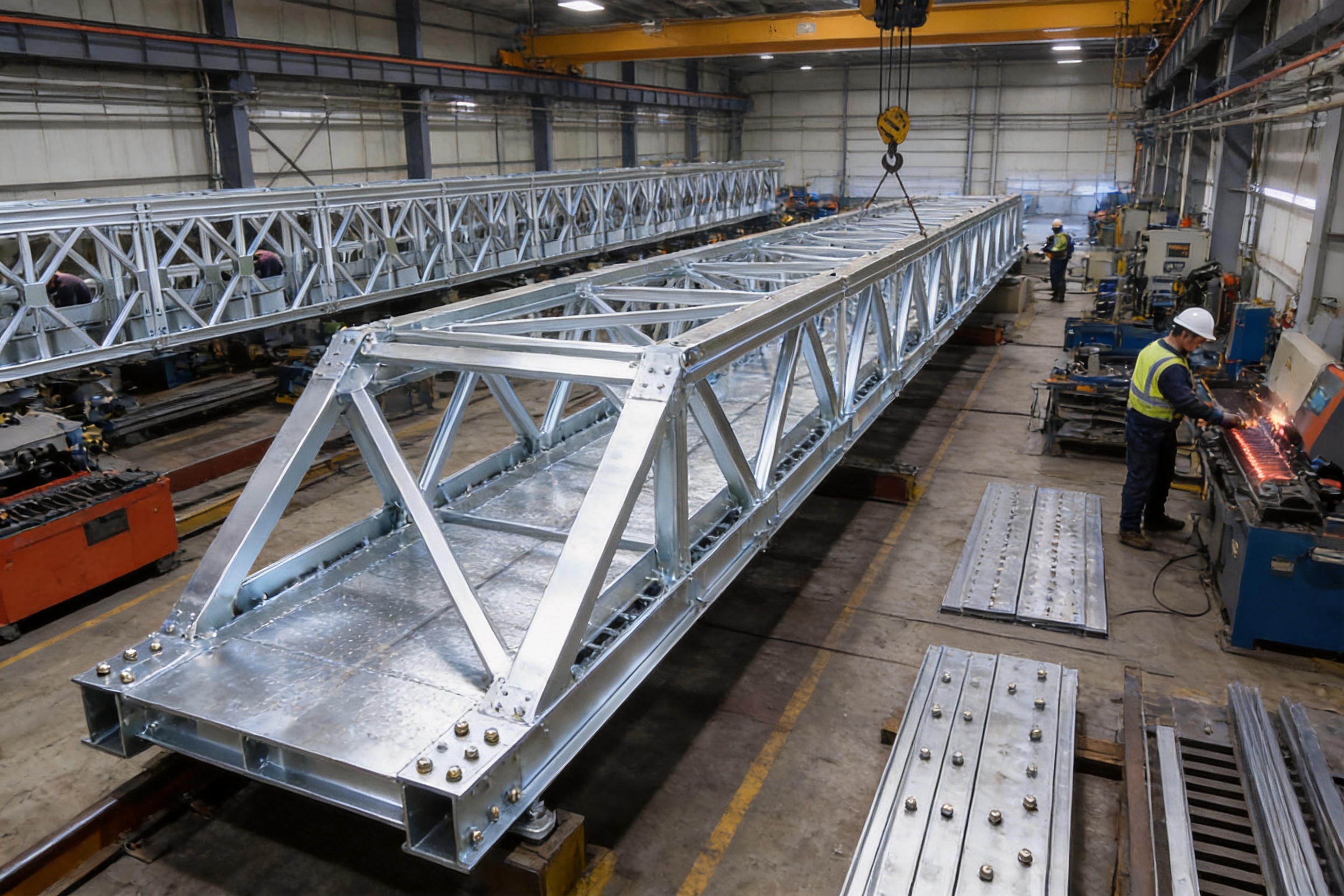
The performance of a modular bridge depends not only on its design but also on the accuracy and consistency of its production. Jiangsu Zhonghai Bridge Equipment Co., Ltd. combines engineering design, precision manufacturing, quality management, and project support in one industrial workflow. This integrated model helps reduce the gap between design intent and delivered structure.
Engineering Design and Configuration
Before production, the bridge configuration must be matched to the project’s span, width, load, support conditions, erection method, and service environment. Engineering teams can evaluate the required panel arrangement, reinforcement level, deck system, bracing, bearing details, approach connection, and temporary works.
A modular bridge is not simply a collection of identical panels. Its safety and performance depend on how the components are arranged and how the bridge interacts with its supports. Engineering review is therefore essential for determining whether a single-span, multi-span, reinforced, or specially braced configuration is appropriate.
Automated Welding
Welding quality influences the strength, fatigue resistance, dimensional accuracy, and service life of structural bridge components. Automated welding systems can provide more consistent travel speed, heat input, weld profile, and repeatability than uncontrolled manual production. Automation is especially valuable for repeated components manufactured in significant quantities.
Automated welding does not remove the need for qualified personnel. Welding procedures, material compatibility, joint preparation, inspection requirements, and operator qualifications must still be controlled. The benefit is that established welding parameters can be repeated more consistently across a production batch.
Precision Steel Fabrication
Precision fabrication includes accurate cutting, drilling, forming, fit-up, welding, finishing, and dimensional inspection. Modular bridges depend on close coordination between components because panels and connection holes must align during field assembly. Small dimensional errors repeated across multiple parts can create significant installation difficulties if they are not identified at the factory.
Modern fabrication workflows use standardized drawings, production instructions, measuring equipment, jigs, fixtures, and inspection records. These controls help ensure that components are produced consistently and that replacement parts remain compatible with the original system.
Standardized Production Workflows
Standardization is one of the strongest advantages of an experienced modular bridge manufacturer. A repeatable workflow can cover raw-material receipt, identification, cutting, forming, welding, surface preparation, galvanizing, inspection, packing, and shipment. Each stage can be linked to documented quality requirements.
Standardized processes also improve delivery planning. Once the bridge arrangement is approved, the manufacturer can prepare a bill of materials, production schedule, inspection plan, packing list, and installation documentation. This reduces uncertainty for international buyers and project managers coordinating multiple suppliers.
Quality Management
Quality management for modular steel bridges should address materials, dimensions, welds, coating condition, markings, packaging, and documentation. Typical controls may include material certificates, visual inspection, dimensional checks, weld inspection, coating verification, trial assembly where appropriate, and final release review.
The objective is not only to identify defective parts. It is also to create traceability and consistency. When each component can be identified and matched with production records, the owner has better information for installation, maintenance, inspection, and future reuse.
Galvanizing and Surface Protection
Galvanizing requires proper surface preparation, immersion control, drainage design, and post-treatment inspection. Steel surfaces must be sufficiently clean for the zinc coating to bond effectively. Component geometry must also be considered so that trapped air, liquids, or gases do not interfere with the process.
After galvanizing, components should be handled in a way that avoids unnecessary coating damage. Packing, lifting, stacking, and transport arrangements are therefore part of the overall quality process. Any field damage identified during installation should be assessed and repaired using an approved method suitable for the galvanized system.
International Standards and Project Adaptability
The manufacturer serves projects that may be subject to ASTM, EN, and national specifications. International projects often involve different design codes, loading standards, documentation formats, and inspection expectations. A capable supplier must be able to clarify these requirements before production rather than treating every project as a standard catalogue order.
Compliance is project-specific. Buyers should provide the applicable bridge code, vehicle loading standard, corrosion environment, design life, inspection requirements, and documentation expectations during the inquiry stage. This allows the engineering team to prepare a configuration that is appropriate for the actual project rather than relying on generalized assumptions.
Company Strengths and Integrated Project Support
Jiangsu Zhonghai Bridge Equipment Co., Ltd. is based in Zhenjiang, Jiangsu Province, an important industrial and transportation center in China. Its location supports access to manufacturing resources, transportation networks, engineering talent, and export logistics. The company has developed its business around modular steel bridges, Bailey bridge systems, engineered steel components, and bridge-related construction support equipment.
The company’s capabilities extend beyond basic fabrication. Its services include engineering design, precision steel production, automated welding, quality management, bridge erection support, and customized component manufacturing. This integrated approach is valuable because bridge projects often involve technical questions that cannot be resolved by a product catalogue alone.
A supplier with engineering capability can help evaluate span arrangements, load requirements, deck options, connection details, temporary works, and installation sequencing. A supplier with manufacturing capability can translate the approved design into repeatable components. A supplier with project support capability can help the buyer coordinate delivery, assembly, inspection, and future reuse.
The company has supported infrastructure and emergency-response applications in China and abroad. Its project experience includes coastal engineering in the Maldives, temporary access bridges associated with major corridor construction, structural components for exhibition and public facilities, multi-span Bailey bridge applications for railway development, and flood-response bridge deployments.
These project types demonstrate the practical range of modular bridge systems. A bridge intended for a coastal project may require particular attention to corrosion protection. A railway construction application may demand strict logistics planning and repeated relocation. A flood-response project may prioritize speed, transportability, and rapid inspection. Experience across different environments helps a manufacturer understand these varying priorities.
Installation, Commissioning, and Reuse
Pre-Installation Planning
Successful installation begins before the components arrive. The project team should confirm the span, clear width, deck elevation, approach alignment, support locations, foundation capacity, lifting equipment, traffic controls, and erection sequence. The site should be surveyed for obstacles, overhead lines, underground services, water levels, access limitations, and ground instability.
Temporary works must be designed with the same seriousness as the bridge itself. Launching noses, temporary supports, lifting frames, working platforms, falsework, and construction access routes should be reviewed by qualified personnel. Weather conditions, wind limits, water flow, and visibility may also influence the erection schedule.
Component Inspection
Upon delivery, components should be checked against the packing list and inspected for transport damage. Particular attention should be given to connection holes, panel edges, welded areas, bracing members, deck components, lifting points, and galvanized surfaces. Any discrepancy should be recorded before assembly begins.
Because the bridge is modular, correct component identification is important. Panels and accessories should be organized in the order required for erection. Proper storage prevents components from becoming contaminated with soil, standing water, chemicals, or other materials that could damage the coating or complicate assembly.
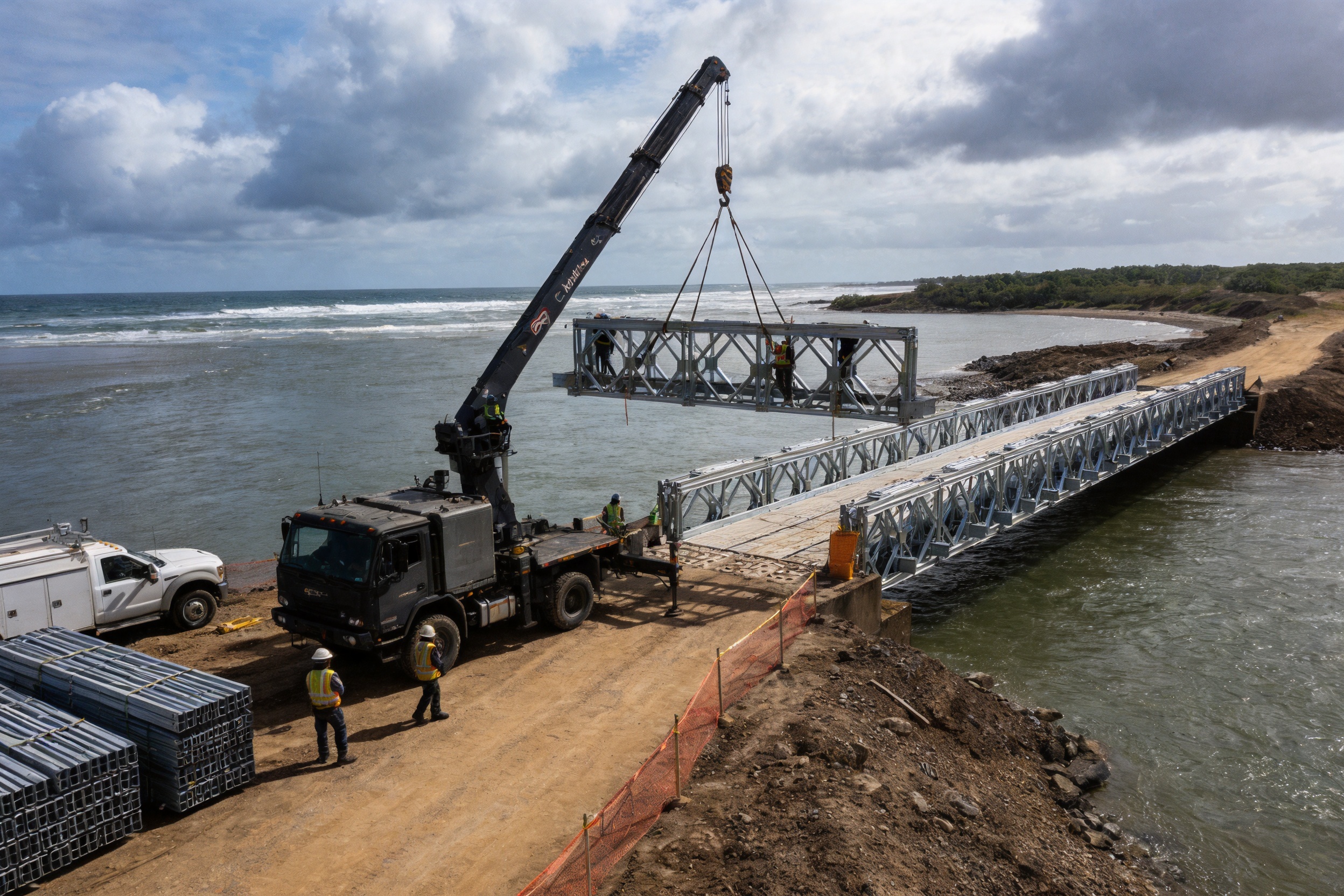
Assembly and Erection
Assembly normally follows an approved sequence based on the selected bridge arrangement and erection method. Panels are connected, bracing is installed, transoms and stringers are positioned, and deck elements are secured. The sequence must control stability at every stage because a partially assembled truss does not have the same behavior as a completed bridge.
Connection pins, bolts, clips, and other fastening elements should be installed according to the engineering documentation. Components must not be forced into alignment through uncontrolled impact or unauthorized modification. If a connection does not fit, the cause should be investigated rather than corrected by cutting, enlarging holes, or field welding without approval.
Deck and Safety Systems
The deck system should be selected for the intended traffic. Vehicle bridges may require steel decking, timber components, asphalt surfacing, anti-skid treatment, wheel guides, approach transitions, and traffic barriers. Pedestrian applications may require a suitable walking surface, handrails, toe boards, lighting, and controlled access.
Safety features are not optional accessories. They must be considered as part of the complete bridge system. Approach ramps, drainage, signage, speed limits, load-control signs, and inspection access all influence how safely the bridge operates.
Inspection Before Opening
Before the bridge is opened to traffic, a qualified inspection should confirm that the structure has been assembled according to the approved drawings. The inspection should cover alignment, support conditions, connections, bracing, deck installation, barriers, approach transitions, coating damage, and signs of distortion.
Where required, load testing, trial traffic, or controlled commissioning may be carried out under the direction of the responsible engineer or authority. The bridge should not be opened simply because assembly appears complete. Operational approval must be based on the project’s technical and regulatory requirements.
Disassembly and Future Deployment
When a temporary bridge is no longer required, disassembly should follow a controlled reverse sequence. The bridge must be cleared of traffic, stabilized, and dismantled in a manner that avoids uncontrolled movement or component damage. Each part should be inspected, cleaned, identified, and stored for future use.
A reuse program should record the number of deployment cycles, observed damage, repairs, coating condition, and any changes to the components. This information helps determine whether a panel or accessory remains suitable for service and supports more reliable planning for the next project.
Maintenance and Lifecycle Management
Galvanizing reduces corrosion risk, but no steel bridge should be treated as maintenance-free. Regular inspection remains necessary to identify mechanical damage, coating wear, connection problems, deck deterioration, settlement, drainage issues, and unauthorized overloading.
Inspection frequency should reflect the bridge’s environment and usage. A heavily trafficked bridge in a coastal area requires more attention than a lightly used bridge in a dry inland environment. Special inspections may be necessary after flooding, impact, exceptional vehicle loading, severe storms, or unusual vibration.
Connections should be checked for looseness, deformation, wear, or missing components. Deck members should be examined for cracking, excessive wear, slipping hazards, and drainage problems. Galvanized surfaces should be monitored for abrasion or local damage, particularly near supports, vehicle barriers, lifting points, and areas exposed to repeated contact.
Small defects should be addressed before they become larger problems. Approved repair procedures may include cleaning, zinc-rich repair materials, component replacement, fastener replacement, drainage correction, or structural evaluation. Unauthorized welding or drilling should be avoided because it can affect the design assumptions and corrosion protection.
Lifecycle management is also connected to documentation. Owners should retain the original configuration drawings, load information, inspection records, repair history, component inventory, and deployment records. This information is especially important when a modular bridge is moved to a new site with different span or loading conditions.
How to Select the Right Configuration
The correct CB100 configuration depends on more than the desired bridge length. Buyers should provide a complete technical brief covering the following factors:
First, define the clear span and overall bridge length. The distance between supports, required approach geometry, waterway clearance, and construction tolerances should be clearly identified.
Second, define the traffic and loading requirements. Information should include vehicle type, axle loads, wheel spacing, traffic frequency, emergency vehicles, construction equipment, and whether pedestrian or mixed traffic will be permitted.
Third, identify the required bridge width and deck arrangement. A single-lane bridge, two-lane bridge, pedestrian walkway, or service crossing will require different layouts and safety features.
Fourth, describe the environmental conditions. Coastal exposure, humidity, industrial pollution, freeze-thaw cycles, flooding, wind, seismic activity, and temperature variation can all affect design and maintenance planning.
Fifth, confirm the erection method and available equipment. The manufacturer should know whether cranes, launching equipment, forklifts, barges, temporary supports, or manual assembly methods will be used.
Sixth, establish the intended service period and reuse plan. A bridge needed for several weeks may be managed differently from a bridge expected to remain in service for multiple years or be redeployed repeatedly.
Finally, identify the governing standards and approval process. The selected configuration should be supported by appropriate drawings, calculations, material information, inspection documents, installation guidance, and operating limitations.
Frequently Asked Questions
What is the main advantage of the CB100 Bailey Bridge?
Its main advantage is the combination of modular assembly, high-strength steel, galvanized corrosion protection, and component interchangeability. This allows the bridge to be transported, assembled, dismantled, and reused with less site fabrication than many conventional bridge options.
Is the bridge suitable for permanent use?
The CB100 system can be used for temporary, semi-permanent, or other engineered applications depending on the project design, environment, maintenance plan, and approval requirements. The intended service period and loading conditions must be evaluated by qualified engineers before the bridge is classified for a particular use.
Can the bridge be used in coastal areas?
Yes. Its galvanized steel construction provides useful corrosion protection for coastal and marine-influenced environments. Coastal projects still require proper drainage, inspection, handling, and site-specific corrosion assessment because galvanizing does not eliminate all environmental risks.
What vehicle loads can the bridge support?
The system can be engineered to meet load requirements associated with HS-15, HS-20, HS-25, HL-93, and Caterpillar-50 standards. The actual allowable configuration depends on span, width, reinforcement, support conditions, deck arrangement, and other project parameters.
Can the bridge be relocated?
Yes. Relocation is one of the principal benefits of a modular Bailey bridge. After disassembly, components can be inspected, packed, transported, and reassembled in a new configuration, provided that the new project receives an appropriate engineering review.
Does galvanized steel eliminate maintenance?
No. Galvanizing reduces corrosion-related maintenance but does not remove the need for regular inspection. Connections, decks, supports, barriers, drainage, alignment, and localized coating damage must still be monitored and maintained.
How long does installation take?
Installation time depends on span, bridge width, site access, foundation readiness, erection method, equipment, weather, and workforce. The modular format can significantly reduce assembly time compared with site-built alternatives, but a project-specific erection schedule should be prepared after reviewing the complete site conditions.
Can the bridge carry construction equipment?
It can be designed for construction vehicles and equipment when the expected axle loads, wheel spacing, total weight, speed, and traffic frequency are included in the engineering review. Operators must observe the approved load limits and traffic controls.
What should buyers request from the manufacturer?
Buyers should request a technical proposal, configuration drawings, load information, material and coating details, component list, inspection documentation, packing information, installation guidance, and any required calculations or certificates. The exact documentation package depends on the project’s governing standards and approval requirements.
Why is manufacturer experience important?
Experienced manufacturers understand that bridge performance depends on design, fabrication, coating, logistics, assembly, and maintenance together. An integrated supplier can help coordinate these stages, reduce compatibility risks, and provide more practical support than a company that only sells individual steel parts.
Conclusion
The CB100 high-strength galvanized modular Bailey Bridge is designed for projects that require speed, strength, durability, and flexibility in one system. Its 321-type truss arrangement provides a proven modular structural concept, while galvanized high-strength steel improves resistance to demanding outdoor conditions. Interchangeable components simplify assembly, replacement, dismantling, transportation, and future reuse.
Compared with many conventional site-built alternatives, the bridge can reduce field fabrication, shorten deployment schedules, limit environmental disruption, and provide stronger lifecycle value. These advantages make it suitable for construction access, emergency response, coastal engineering, water-conservancy projects, railway and highway development, military logistics, and controlled pedestrian or service crossings.
The value of the bridge is strengthened by the manufacturing and engineering capabilities behind it. Jiangsu Zhonghai Bridge Equipment Co., Ltd. integrates design, precision fabrication, automated welding, quality management, galvanizing, logistics coordination, and project support. This integrated process helps ensure that standardized components are accurate, compatible, durable, and ready for practical field deployment.
For buyers, the most important step is to treat the bridge as an engineered system rather than a collection of catalogue components. Span, traffic, load, environment, support conditions, erection method, service period, and future reuse should all be evaluated before production. With the correct configuration and professional installation, the CB100 modular bridge can provide a dependable connection where conventional construction would be too slow, too inflexible, or too difficult to maintain.
References
1. Modular Bridge Engineering Principles, technical reference literature for prefabricated truss bridge systems.
2. Structural Steel Design Standards, guidance on strength, stability, connections, fatigue, and serviceability.
3. Hot-Dip Galvanizing Practice, reference material covering surface preparation, coating formation, inspection, handling, and repair.
4. Highway Bridge Load Standards, guidance related to HS-15, HS-20, HS-25, HL-93, and heavy equipment loading requirements.
5. Temporary Works and Bridge Erection Safety Guidelines, reference material for lifting, launching, temporary support, traffic control, and commissioning.
6. International Standards for Steel Fabrication and Welding, reference guidance for material control, welding procedures, inspection, dimensional accuracy, and quality documentation.
7. Manufacturer technical information for high-strength galvanized 321-type modular Bailey bridge systems.
Product: CB100 Bailey Bridge High Strength Galvanized Truss-Type Modular Bailey Bridge


We respond quickly to all international requests and provide technical support when needed.
Product Category
Bailey Bridge/Modular Bridge Modular Steel Bridge Pedestrian Bridge Modular Pipe Bridge Truss Bridge Steel StructureContact Us

+86-511-84522866
+86-13921582699

zhwm@zjql.com

Building 1,83#, dantu New Town, Yanjiang Road, Dantu District, Zhenjiang, Jiangsu, China
Copyright © Jiangsu Zhonghai Bridge Equipment Co., Ltd. All
Rights
Reserved
China bailey bridge for sale
bailey bridge supplier from china
