
 English
 русский
 Español
 Português


Xie Wenlan — Modular Bridge Project Sales Specialist
CB100 Triple-Row Single-Layer Reinforced Bailey Bridge for Fast, Flexible Infrastructure
Content
- 1 Understanding the CB100 Triple-Row Single-Layer Configuration
- 2 Advantages of a Triple-Row Reinforced Bailey Bridge
- 3 Performance Compared with Conventional Bridge Alternatives
- 4 Corrosion Protection for Guangdong and Similar Environments
- 5 Advanced Manufacturing and Engineering Strengths
- 6 Applications of the Product
- 7 Installation Planning and Erection Considerations
- 8 Loading Standards and Project-Specific Design
- 9 Safety, Inspection, and Long-Term Operation
- 10 Why the Manufacturing Partner Matters
- 11 Procurement Checklist for a CB100 Bridge
- 12 Frequently Asked Questions
- 12.1 What is a CB100 Bailey bridge?
- 12.2 What does triple-row single-layer reinforced mean?
- 12.3 Can this bridge support three lanes?
- 12.4 Which loading standards can be considered?
- 12.5 Is the bridge suitable for humid or rainy climates?
- 12.6 Can the bridge be used as a permanent structure?
- 12.7 How quickly can a Bailey bridge be installed?
- 12.8 Can the bridge be dismantled and reused?
- 12.9 What information should be supplied for a quotation?
- 12.10 Does the manufacturer provide engineering support?
- 13 Conclusion
- 14 References
- 15 Product: CB 100 Bailey Bridge Triple-Row Single-Layer Reinforced Painted Bailey Bridge
Modern infrastructure projects increasingly require bridge systems that can be delivered quickly, assembled efficiently, and adapted to changing site conditions. Temporary roads, emergency crossings, construction access routes, rural transport connections, industrial logistics corridors, and military or disaster-response operations all demand structures that combine strength with speed. The CB100 triple-row single-layer reinforced Bailey bridge is designed to address these requirements through a modular steel configuration, reinforced truss arrangement, corrosion-resistant painted finish, and flexible engineering options.
This bridge belongs to the CB100, also commonly identified as 321-type, Bailey bridge family. Its modular design is based on prefabricated steel components that can be transported to a project site and assembled with a controlled amount of equipment and labor. Unlike many permanent bridge systems that require extensive casting, long curing periods, or complex site fabrication, a modular Bailey bridge can shorten the construction schedule while maintaining a high level of structural organization.
The featured configuration uses three rows of Bailey panels in a single-layer reinforced arrangement. This structure is intended to provide additional load-bearing capability compared with a basic single-row arrangement, while preserving the core advantages of modular erection. The design can be adapted to vehicle traffic requirements and may be engineered around recognized loading standards such as HS-15, HS-20, HS-25, HL-93, and Track-50, subject to project-specific calculations and approval.
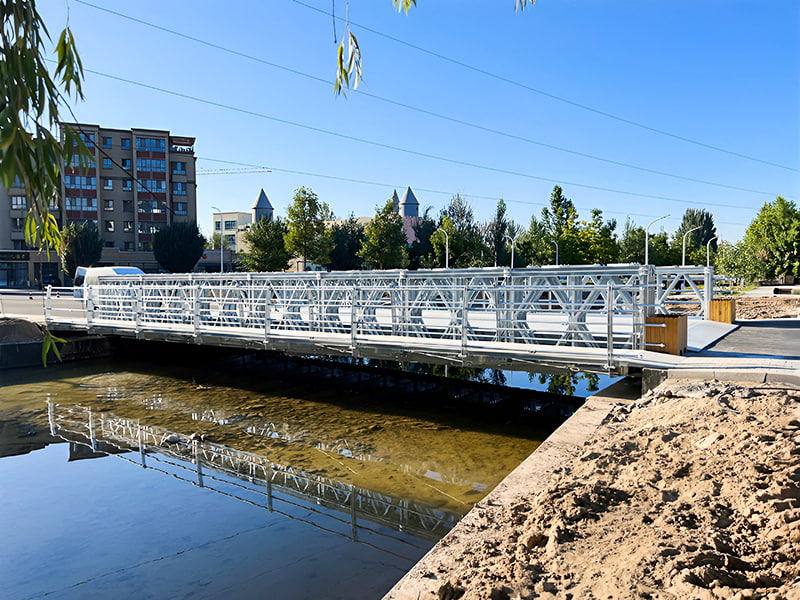
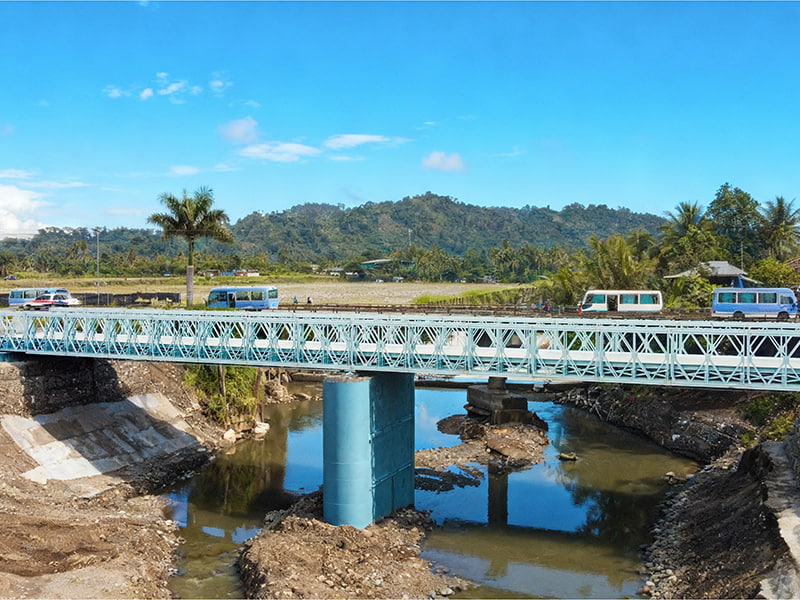
For projects in warm and humid environments, the painted corrosion-resistant treatment is particularly important. The featured bridge is located in Guangdong, where elevated humidity, seasonal rainfall, airborne contaminants, and prolonged exposure to moisture can accelerate steel corrosion. A properly prepared and coated steel surface helps reduce environmental deterioration and supports a longer service life when combined with correct drainage, inspection, maintenance, and site management.
The bridge is manufactured by Jiangsu Zhonghai Bridge Equipment Co., Ltd., a Chinese engineering and production company specializing in modular steel bridges, Bailey bridge systems, customized steel components, and supporting structural equipment. The company integrates engineering design, steel fabrication, automated welding, quality management, and project support to serve infrastructure, water conservancy, emergency response, transportation, military logistics, and international development applications.
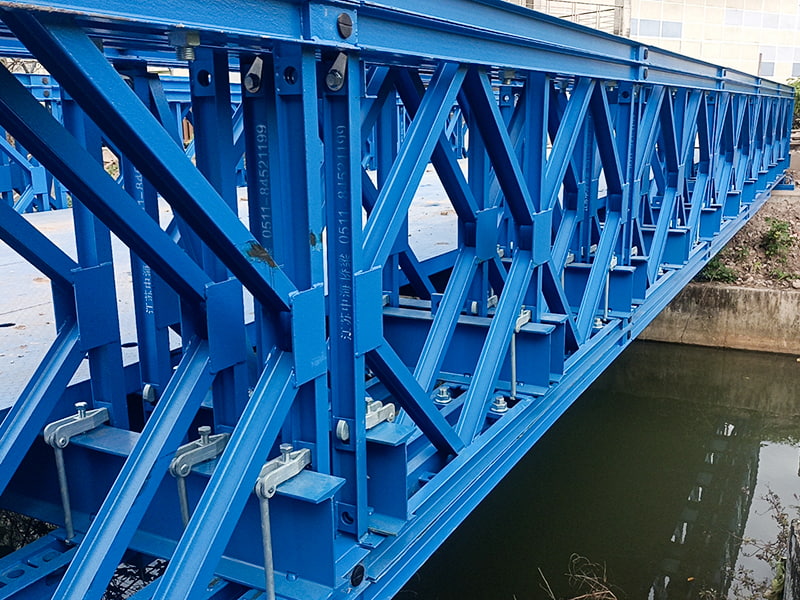
CB 100 Bailey Bridge Triple-Row Single-Layer Reinforced Painted Bailey Bridge
Understanding the CB100 Triple-Row Single-Layer Configuration
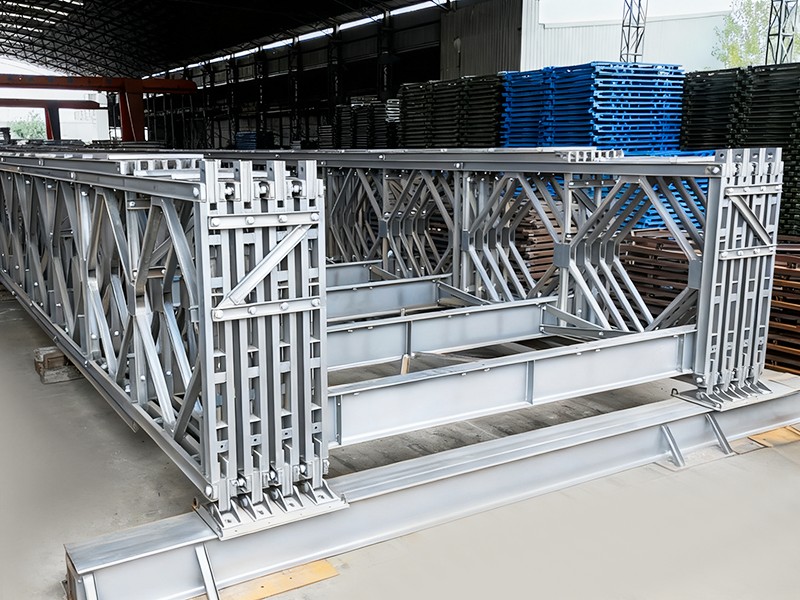
A Bailey bridge is a prefabricated modular truss bridge assembled from standardized panels and connecting components. The panels form the primary side trusses, while transoms, stringers, bracing members, decking, ramps, bearings, and connection hardware complete the bridge system. Because the main components are produced in a controlled factory environment, the bridge can be planned, manufactured, inspected, transported, and assembled through a repeatable process.
The CB100 designation identifies a particular modular bridge system and its associated component arrangement. In many engineering markets, the 321-type Bailey bridge is recognized as a widely used modular steel bridge format. Although terminology may vary between countries and suppliers, the underlying principle remains consistent: prefabricated truss panels are connected to form a bridge span that can be configured for different lengths, widths, traffic conditions, and load requirements.
In a single-layer arrangement, the panels are placed in one vertical level along each side of the bridge. The featured product adds reinforcement by using three panel rows across the bridge structure. This triple-row arrangement increases the quantity of connected truss components contributing to the load path. The result is a robust configuration suitable for projects that require greater structural capacity than a basic single-row bridge can provide.
The term “single-layer” does not mean that the bridge is lightly built. It describes the vertical arrangement of the panel truss system. Reinforcement is achieved through the number and organization of panel rows, cross members, bracing elements, and connection details. The final capacity depends on span length, roadway width, deck system, support conditions, material grade, connection behavior, dynamic effects, foundation conditions, and the design load used by the project engineer.
A three-lane configuration also affects the overall bridge design. It can be used where the project requires a broad traffic passage, multiple traffic lanes, or a wider operational platform. The exact usable roadway width, lane arrangement, shoulder provision, pedestrian space, barrier layout, and deck loading must be determined through project-specific design. The modular concept makes these changes more practical than they would be in a fully cast-in-place structure.
Primary structural elements
The main structural elements of the bridge generally include Bailey panels, panel pins, transoms, stringers, bracing frames, sway braces, end posts, deck units, approach ramps, bearings, guardrails, and connection accessories. Each component contributes to a complete load path from the vehicle deck through the trusses, bearings, substructure, and foundations.
Bailey panels form the sides of the truss and are connected longitudinally to create the span. Panel pins provide the main connection between adjacent panels. Transoms extend across the bridge and support the stringers or deck units. Stringers distribute traffic loads to the transoms. Bracing components control lateral movement and help the bridge resist wind, vibration, and construction-stage instability.
Decking is selected according to the traffic type, expected wheel loads, environmental conditions, and maintenance strategy. A bridge intended for regular heavy vehicles may require a stronger steel deck arrangement than a bridge designed for light service vehicles. Guardrails and edge protection are also essential, particularly for a three-lane configuration where traffic interaction and lateral clearance must be carefully managed.
Advantages of a Triple-Row Reinforced Bailey Bridge
The principal advantage of the CB100 triple-row single-layer reinforced bridge is the balance between structural performance and modular construction. A conventional heavy bridge may offer substantial strength but require extended engineering, fabrication, transport, and construction periods. A light temporary bridge may be quick to install but unsuitable for demanding traffic. A reinforced Bailey system occupies a practical middle ground by providing a substantial steel truss structure while retaining the speed and flexibility of prefabricated assembly.
Improved load-bearing capability
The triple-row arrangement supplies a greater amount of truss material within the primary load-bearing system than a basic single-row layout. When properly designed, connected, and supported, the additional panel rows can help the bridge accommodate higher traffic loads, broader roadway arrangements, or longer service requirements. This makes the configuration suitable for projects where a standard light modular bridge would not provide sufficient capacity.
Load-bearing performance is not determined by panel quantity alone. It depends on the complete structural system, including steel grade, panel geometry, connection quality, deck construction, span length, bearing arrangement, lateral bracing, and foundation behavior. For this reason, a professional design calculation should confirm the bridge’s allowable loading, deflection, fatigue performance, braking effects, wind actions, and seismic requirements where applicable.
Efficient assembly and reduced site work
Factory-produced modules reduce the amount of cutting, drilling, welding, and fitting required at the project site. The majority of the structural components arrive ready for controlled assembly. This can reduce dependence on extensive temporary workshops and limit the amount of specialized equipment required during erection.
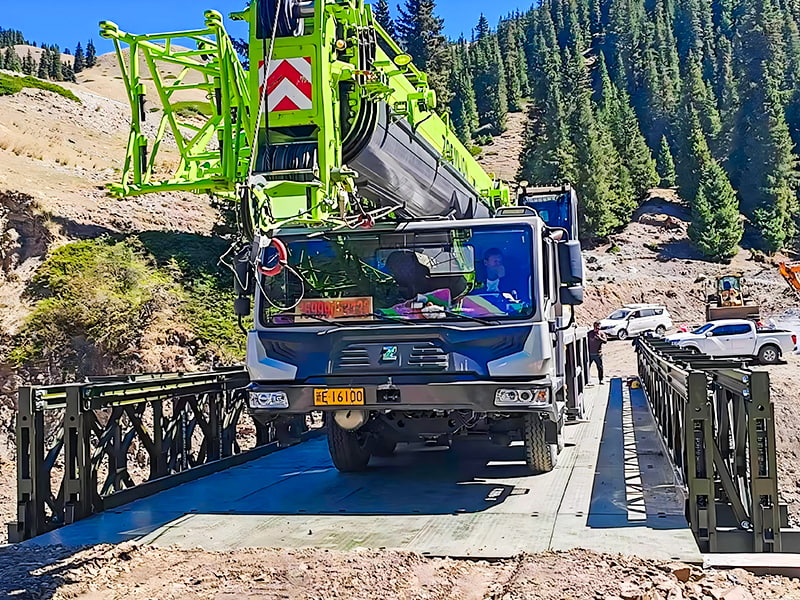
For emergency and remote projects, this characteristic is highly valuable. Site conditions may be difficult, access may be limited, and construction crews may need to work under severe time pressure. A modular bridge can be assembled using organized sequences and lifting equipment appropriate to the site. In some applications, launching methods can be used to move the assembled bridge across a gap, reducing the need for large cranes on both sides of the crossing.
Adaptability to different project conditions
Bailey bridge components can be configured for different span lengths, roadway widths, reinforcement levels, and access conditions. The same basic family of components can support temporary construction access, emergency replacement routes, industrial crossings, rural transportation, and permanent or semi-permanent infrastructure, provided that the selected configuration is engineered for its intended use.
This flexibility is an important advantage over rigid, one-purpose bridge designs. If a project changes during construction, modular components may allow adjustments to the bridge layout without redesigning the entire structure from the beginning. Additional reinforcement, modified approaches, alternate decking, or different traffic-control arrangements may be considered as part of the engineering process.
Transport and logistics benefits
Because the bridge is divided into standardized components, transportation can be planned around available trucks, containers, lifting equipment, and access roads. Individual panels and accessories are easier to handle than large welded bridge sections. This is useful for sites where road capacity, turning radius, or port handling limitations prevent the movement of oversized elements.
Modular transportation also provides practical advantages for emergency stockpiling. Bridge components can be stored in a warehouse or regional depot and dispatched when required. A government agency, contractor, humanitarian organization, or infrastructure operator can maintain a component inventory for flood response, landslide recovery, temporary detours, or replacement of damaged crossings.
Potential cost control
Modular bridge construction can help control overall project costs through shorter installation periods, reduced site fabrication, lower labor requirements, and repeated use of standardized components. The economic advantage is especially significant when a bridge must be installed rapidly or when the project has limited access to skilled welding and heavy construction facilities.
Cost performance should be evaluated across the full project life cycle. The purchase price of the steel structure is only one factor. Transport, foundations, erection equipment, traffic management, protective coating, inspection, maintenance, dismantling, and relocation all affect the final cost. A properly planned modular bridge can offer strong value because many of its components can be reused or reconfigured for future projects.
Suitability for warm and humid climates
The featured bridge uses a paint-based corrosion-resistant process. In warm and humid climates, coating protection can reduce direct contact between the steel surface and moisture or corrosive contaminants. This is particularly relevant in regions with heavy rainfall, high relative humidity, coastal exposure, or frequent wet-dry cycles.
Paint protection is most effective when it is treated as part of a complete corrosion-control program. Surface preparation, coating selection, application thickness, curing conditions, edge treatment, inspection, and repair procedures all influence performance. The bridge should also be designed and maintained to avoid water traps, blocked drainage, persistent mud accumulation, and damage caused by impact or abrasion.
Performance Compared with Conventional Bridge Alternatives
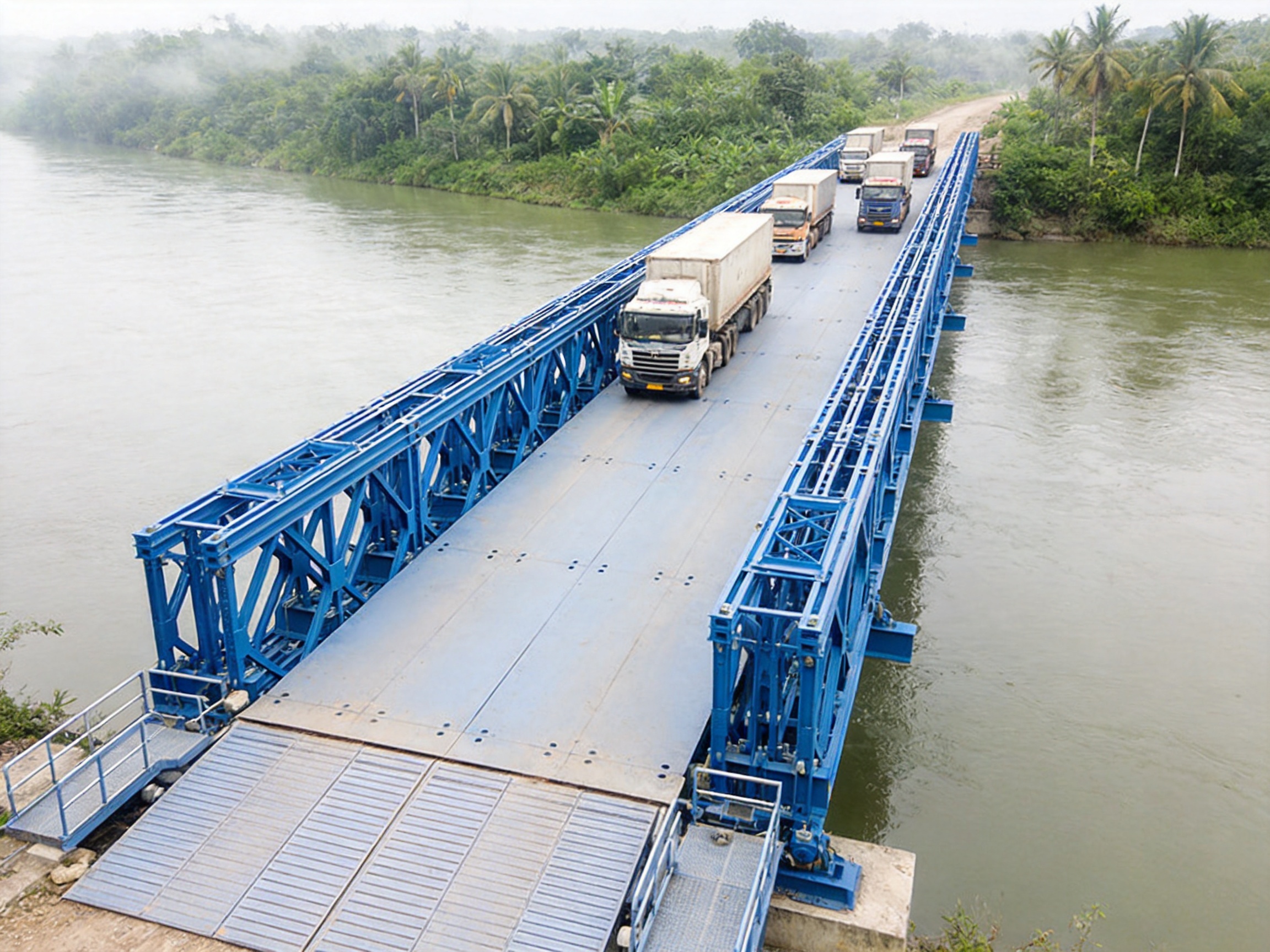
Every bridge technology has a suitable application range. The CB100 triple-row reinforced Bailey bridge is not intended to replace every permanent concrete, steel girder, arch, or cable-supported bridge. Its competitive advantage comes from its combination of adequate structural capacity, modularity, installation speed, and reusability.
Compared with cast-in-place concrete bridges
Cast-in-place concrete bridges can provide excellent durability and stiffness, but they generally require extensive formwork, reinforcement placement, concrete delivery, curing time, and site access. These requirements can make them difficult to use where a route must be opened quickly or where weather conditions are unpredictable.
A modular steel bridge can often be assembled after foundation preparation without waiting for a long concrete curing period for the superstructure. It can also be dismantled or relocated more easily. For temporary roads, emergency bypasses, and construction access, these benefits may outweigh the advantages of a permanent concrete structure.
Compared with conventional welded steel bridges
Large welded bridge sections may provide a highly integrated structure, but they can create significant transportation and lifting challenges. Oversized components may require special permits, heavy cranes, reinforced temporary roads, and expanded staging areas. Factory-welded modular panels are smaller and easier to move, store, and replace.
The standardized nature of a Bailey system can also simplify spare-parts management. A damaged or worn component may be replaced with an equivalent module rather than requiring extensive field repair. This is particularly useful for operators managing multiple bridges or maintaining emergency response inventories.
Compared with lightweight temporary crossings
Some temporary crossings are designed primarily for pedestrians, light vehicles, or short-term construction access. They may not provide the load-bearing capacity or roadway width required for heavy transport, multiple lanes, or demanding logistics operations. The triple-row reinforced configuration is a stronger alternative for projects requiring a more substantial traffic platform.
However, the bridge must be selected according to actual traffic data. A three-lane bridge carrying heavy trucks, construction machinery, or rail-related loads requires detailed engineering. The product’s ability to be designed around HS-15, HS-20, HS-25, HL-93, and Track-50 loading concepts provides a useful basis for adaptation, but the final design must confirm the applicable standard and load combination.
Compared with permanent modular bridge systems
Permanent modular bridge systems may include more complex deck assemblies, enhanced architectural finishes, or specialized fatigue and durability provisions. The CB100 system is attractive when a project prioritizes rapid delivery, proven modular assembly, practical structural performance, and flexible reuse. It may serve as a temporary, semi-permanent, or long-term bridge depending on the design, protective treatment, inspection regime, and project authority requirements.
| Evaluation factor | CB100 triple-row reinforced Bailey bridge | Typical cast-in-place concrete bridge | Large welded steel bridge sections |
|---|---|---|---|
| Construction method | Prefabricated modular assembly | Formwork, reinforcement, concrete placement, and curing | Factory or site welding of large structural elements |
| Installation speed | Generally fast after foundations and logistics are prepared | Often slower because of curing and extensive site work | Dependent on transport, lifting, and field joining |
| Transport flexibility | Individual panels and accessories are relatively manageable | Concrete materials are delivered to the site | Large components may require special transport |
| Reuse potential | High when components are properly maintained | Limited after completion | Usually limited compared with modular panels |
| Site fabrication demand | Low to moderate, depending on deck and foundation work | High during construction | Moderate to high for field connections |
| Configuration flexibility | High through panel combinations and reinforcement levels | Usually fixed after construction | Moderate, but changes may require redesign and fabrication |
| Best-fit applications | Emergency, temporary, industrial, rural, and rapid-access bridges | Long-life permanent infrastructure with stable construction access | Permanent or semi-permanent projects with heavy lifting capability |
Corrosion Protection for Guangdong and Similar Environments
Steel bridge durability depends strongly on environmental exposure. Guangdong’s warm and humid climate can create conditions favorable to corrosion, especially when steel surfaces remain wet for long periods. Rainfall, condensation, coastal salt, industrial pollutants, and accumulated dirt may intensify corrosion risks.
The painted corrosion-resistant process applied to the featured bridge is intended to create a protective barrier between the steel and the surrounding environment. A coating system can slow corrosion initiation and reduce the rate of deterioration, provided that the steel is properly prepared and the coating remains intact.
Important stages of coating protection
Surface preparation is the first critical stage. Oil, grease, rust, mill scale, dust, and other contaminants must be removed according to the specified preparation standard. Abrasive blasting or another approved preparation method may be used to create a suitable surface profile for coating adhesion.
After preparation, the selected primer and finish system should be applied under controlled conditions. The coating manufacturer’s requirements for temperature, humidity, dew point, mixing, application thickness, and curing time should be followed. Corners, welds, bolt areas, cut edges, and connection zones require particular attention because these locations may be more vulnerable to coating discontinuity or mechanical damage.
Factory application offers an important quality advantage over uncontrolled field painting. The manufacturer can establish repeatable procedures, use dedicated equipment, control environmental conditions, and inspect coating thickness before shipment. Any coating damage caused during transport or erection should be repaired promptly using a compatible repair system.
Maintenance after installation
Even a high-quality coating system requires periodic inspection. Maintenance teams should check the bridge for scratches, impact damage, peeling, blistering, rust staining, loose fasteners, blocked drainage, and corrosion around connections. High-risk areas should be cleaned and repaired before corrosion spreads beneath the coating.
In coastal or industrial environments, routine washing may help remove salt and contaminants. Drainage paths should remain open, and mud or vegetation should not be allowed to remain against the steel. The bridge’s service life depends on the combination of factory protection, correct erection, proper use, and an organized inspection schedule.
Advanced Manufacturing and Engineering Strengths
The performance of a modular bridge is closely linked to the quality of its manufacturing process. Standardized components must be dimensionally consistent so that panels, pins, transoms, bracing members, and deck systems can be connected without excessive adjustment. A reliable supplier therefore needs more than steel-processing capacity; it needs engineering control, production discipline, inspection capability, and project coordination.
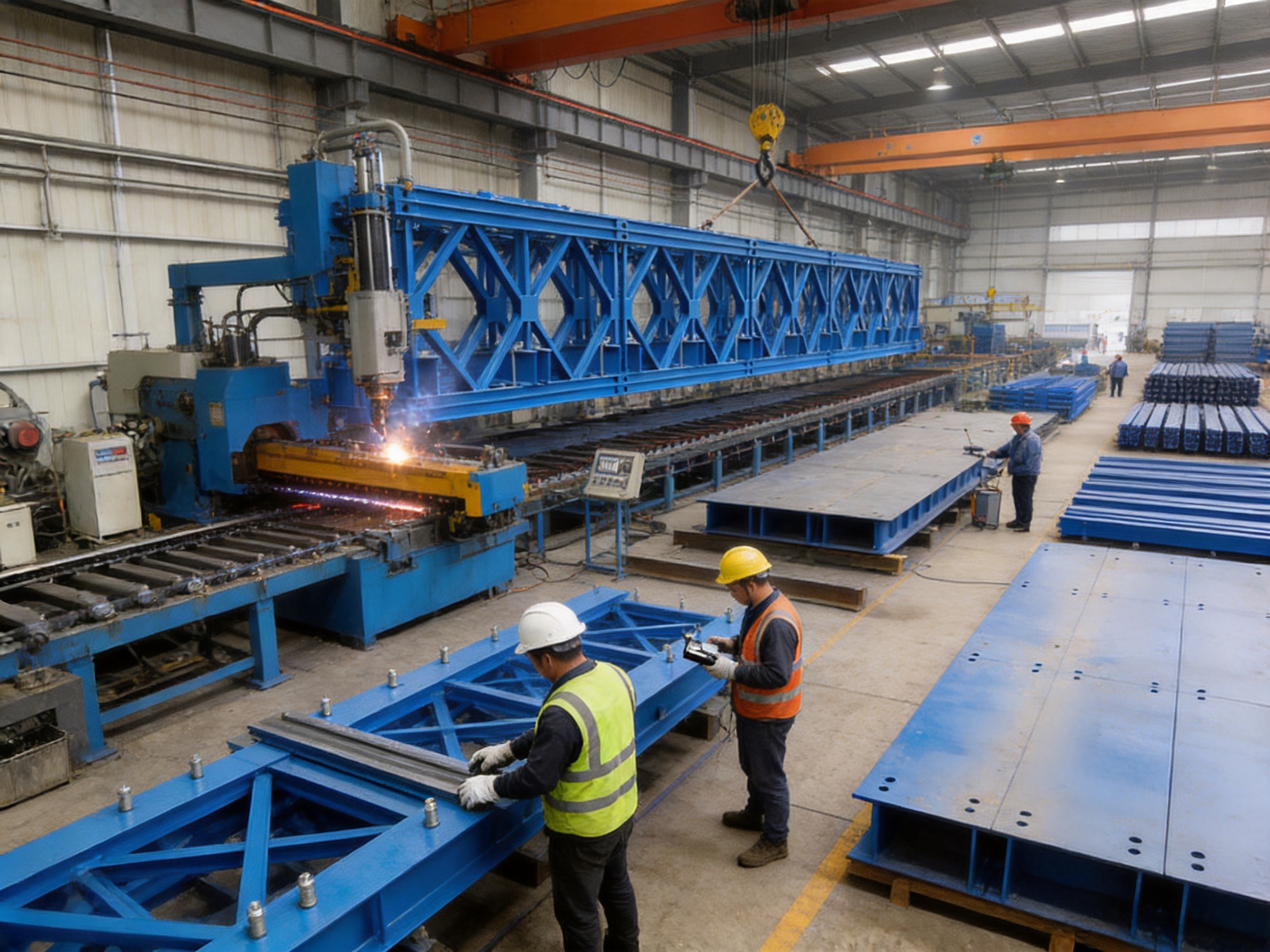
Jiangsu Zhonghai Bridge Equipment Co., Ltd. combines engineering design, precision manufacturing, quality management, automated welding, and structural steel fabrication. This integrated approach allows the manufacturer to manage the product from concept and configuration through fabrication, inspection, delivery, and technical support.
Engineering design and customization
Each bridge project has different requirements. Span length, roadway width, traffic type, terrain, foundation arrangement, construction method, climate, and expected service period all influence the final design. The manufacturer’s engineering role is to translate these requirements into a practical modular configuration.
Customization may involve the number of panel rows, reinforcement level, deck type, end-post arrangement, approach ramps, guardrails, bearings, connection accessories, corrosion-protection system, and erection method. This project-oriented approach is more valuable than simply supplying a standard component package without considering the site conditions.
Engineering review should include structural analysis, connection checks, serviceability evaluation, erection-stage stability, transport planning, and foundation interface requirements. For projects involving heavy vehicles or railway-related loading, dynamic effects, braking forces, impact factors, and fatigue considerations should be addressed by qualified engineers.
Automated welding and precision fabrication
Automated welding can improve consistency in repeated production operations. Compared with uncontrolled manual fabrication, automated or semi-automated processes can help maintain stable welding parameters, predictable bead geometry, and repeatable production quality. This is especially important for modular bridge parts that are manufactured in series and must fit together accurately.
Precision steel fabrication includes material cutting, forming, drilling, welding, dimensional inspection, surface preparation, and coating. Each stage affects the next. Accurate cutting supports correct assembly; correct assembly supports reliable welding; reliable welding supports dimensional stability; and controlled surface preparation supports coating performance.
Production planning can also reduce variation between batches. Standardized work instructions, qualified welding procedures, calibrated equipment, inspection records, and traceable material documentation help establish a more controlled manufacturing environment. These practices are important when bridge systems are supplied for international infrastructure projects where documentation and quality verification are essential.
Standardized factory workflows
The company operates standardized workflows supported by industrial-scale manufacturing capacity. A standardized workflow may include project review, design confirmation, bill-of-material preparation, material procurement, incoming inspection, component fabrication, welding inspection, trial assembly where required, surface treatment, final inspection, packaging, and shipment.
This approach provides several advantages. It helps coordinate production schedules, supports repeatable component quality, reduces avoidable rework, and improves communication between engineering and manufacturing teams. It also makes it easier to manage customized projects without losing the benefits of standardized modular production.
Quality management and specification support
The manufacturer states that its modular bridge systems are produced to support ASTM, EN, and national specifications. The applicable standard depends on the project location, contract documents, material requirements, design loads, and approval authority. A responsible procurement process should identify these requirements before production begins.
Quality management should cover both materials and workmanship. Steel certificates, welding records, dimensional reports, coating inspection records, fastener documentation, and packing lists can support project traceability. Depending on the contract, additional inspections such as non-destructive testing, load testing, trial assembly, or third-party verification may be required.
International delivery and project support
Modular bridges are often supplied across borders, creating challenges related to packaging, customs documentation, transport sequencing, site access, and local erection capability. Zhonghai’s experience serving domestic and international projects supports a delivery model that considers more than factory production.
The company’s reported project experience includes coastal engineering in the Maldives, temporary access bridges associated with the Shenzhen–Zhongshan Corridor, structural components for the Hangzhou Expo Center, multi-span Bailey bridges for the Lalin Railway, and flood-response or emergency bridge deployments in multiple regions. These applications reflect the broad operating range of modular bridge technology, from planned infrastructure to urgent deployment.
Applications of the Product
Emergency and disaster-response bridges
Floods, landslides, earthquakes, storms, and infrastructure failures can isolate communities and disrupt supply chains. A modular bridge can restore access more rapidly than a conventional permanent replacement when the immediate priority is reopening a route. The triple-row reinforced configuration is suitable for situations where emergency vehicles, construction equipment, relief trucks, and regular traffic require a stronger crossing.
Emergency bridge planning should include pre-approved assembly procedures, stockpiled components, trained crews, transport arrangements, foundation concepts, and traffic-control plans. The value of a modular bridge is maximized when these elements are prepared before a disaster occurs.
Construction access and temporary detours
Large infrastructure projects frequently require temporary crossings for workers, materials, equipment, and construction vehicles. A CB100 bridge can provide access across rivers, drainage channels, excavations, existing roads, or difficult terrain while the main project continues.
Because the bridge can be dismantled after use, it may be moved to another work zone or retained for future construction phases. This reduces the need to purchase separate structures for every temporary crossing and can improve the utilization of the project’s temporary works budget.
Rural and regional transportation
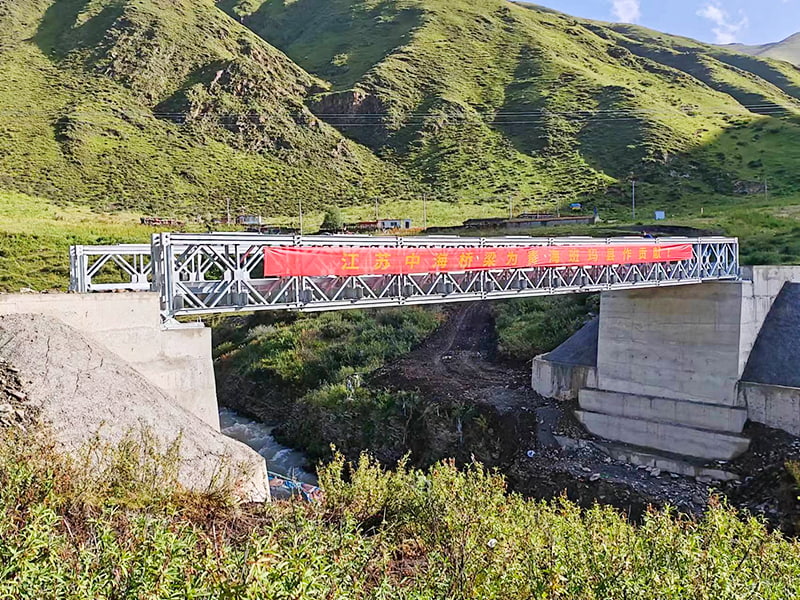
Remote communities may need a bridge that can be delivered through limited road networks and installed without a large permanent construction base. Modular components can be transported in manageable loads, and the bridge can be adapted to the available crossing geometry.
Before installation, the project owner should assess approach roads, seasonal water levels, flood debris, foundation soil, vehicle types, axle loads, pedestrian needs, and maintenance access. A well-designed modular bridge can provide an efficient regional connection while a long-term infrastructure program is being developed.
Industrial and logistics crossings
Industrial sites, mining operations, warehouses, ports, energy projects, and manufacturing facilities often require internal bridges to connect work areas or cross pipelines, drainage routes, rail tracks, and service corridors. The triple-row configuration can be considered where heavy trucks, loaders, cranes, or repeated industrial traffic create demanding loading conditions.
Industrial bridge design should account for unusual vehicle geometries, concentrated wheel loads, turning movements, impact risk, chemical exposure, dust, vibration, and operating hours. Deck reinforcement, barriers, signage, and inspection intervals should be matched to the operating environment.
Water conservancy and flood-control projects
Water conservancy projects may require temporary or semi-permanent access over canals, flood channels, reservoirs, and construction diversions. A modular bridge can be installed in stages and adjusted as the project’s water-management conditions change.
Hydraulic conditions are particularly important. Engineers must evaluate scour, water velocity, debris impact, seasonal water levels, foundation erosion, and the possibility of floating objects striking the bridge. The bridge superstructure is only one part of a successful crossing; the supporting works must be designed for the water environment.
Installation Planning and Erection Considerations
Successful bridge installation begins with a detailed site survey. The survey should establish the crossing width, bank elevations, ground conditions, water level, access roads, available staging areas, overhead restrictions, utility locations, and required traffic clearances. These factors determine whether the bridge can be assembled directly over the gap, launched from one bank, or lifted into position in sections.
Foundation preparation is essential. Bearings and supports must be level, aligned, stable, and capable of transferring the calculated reactions into the ground. Temporary foundations may be suitable for short-duration projects, while permanent or semi-permanent use may require concrete abutments, piles, retaining structures, or engineered embankments.
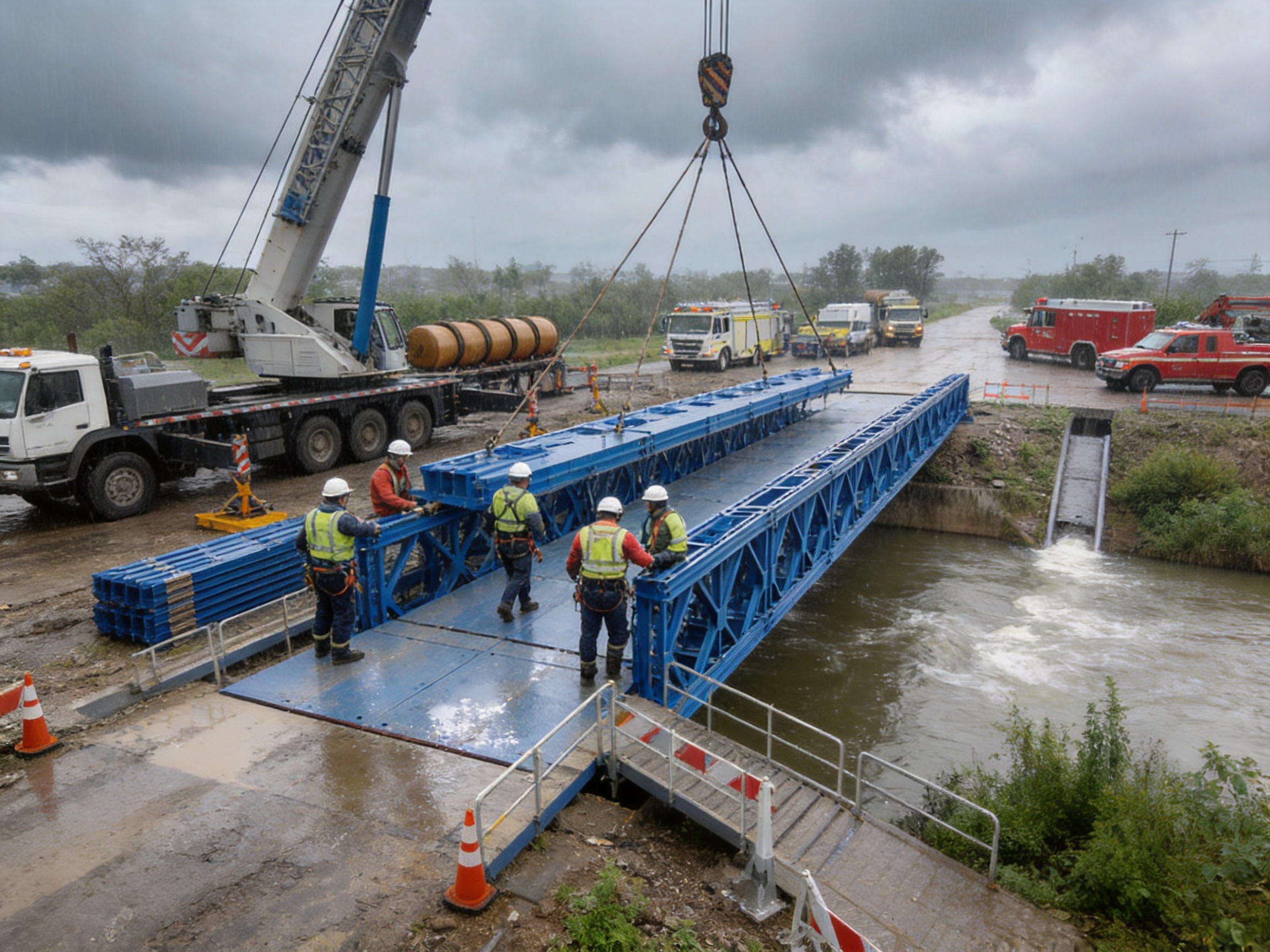
Assembly should follow an approved erection sequence. Panels must be positioned and connected correctly, pins must be fully secured, transoms and stringers must be installed in the specified order, and bracing must be completed before the structure is exposed to significant wind or traffic loads. The erection team should use lifting and temporary support methods appropriate to the bridge size and site conditions.
Launching can be advantageous when crane access is restricted. In a typical launching concept, the bridge is assembled on rollers or a launching nose and pushed or pulled across the gap. The temporary condition can produce different forces from those present during normal service, so the launching sequence must be checked separately. The final bridge should not be opened to traffic until alignment, connections, deck installation, barriers, and inspection requirements are complete.
Traffic opening should be controlled. The bridge should display its maximum permitted load, speed limits, lane restrictions, clearance information, and any requirements for escorted or one-way traffic. For a three-lane bridge, traffic management is especially important because simultaneous vehicle movements may produce greater dynamic and lateral effects.
Loading Standards and Project-Specific Design
The featured CB100 bridge can be designed to suit loading concepts such as HS-15, HS-20, HS-25, HL-93, and Track-50. These designations represent different traffic or vehicle loading requirements used in various engineering contexts. They should not be treated as interchangeable labels. The project engineer must identify the governing standard, load model, safety factors, load combinations, and approval requirements.
HS-15, HS-20, and HS-25 are commonly associated with highway vehicle loading classifications. HL-93 is a highway live-load model used in bridge design under particular standards. Track-50 may relate to railway or track-loading requirements in specific project contexts. The actual bridge configuration, deck system, and support arrangement must be verified for the selected loading condition.
Design review should consider:
• Dead load from panels, transoms, stringers, decking, barriers, and utilities.
• Live load from vehicles, pedestrians, construction equipment, or rail-related traffic.
• Impact and dynamic amplification effects.
• Braking, acceleration, centrifugal, and collision forces.
• Wind load during construction and normal operation.
• Thermal movement and expansion bearing requirements.
• Seismic actions where relevant to the location.
• Flood, debris, scour, and hydraulic forces.
• Fatigue effects under repeated heavy traffic.
• Serviceability limits for deflection, vibration, and user comfort.
• Temporary conditions during assembly, launching, and dismantling.
A bridge supplier can provide configuration data, component information, and technical support, but the project’s responsible engineer and approval authority must confirm the final design. This division of responsibility helps ensure that the selected bridge is appropriate for its actual site and operating conditions.
Safety, Inspection, and Long-Term Operation
Safety begins with correct design and continues through transportation, erection, opening, and maintenance. The bridge should be inspected after installation to confirm panel alignment, pin installation, bracing, deck seating, bearing contact, barrier attachment, approach transitions, and drainage. Any discrepancy should be corrected before traffic is permitted.
Routine inspection should identify structural or environmental changes. Inspectors should look for loose or missing connection components, bent members, cracks, corrosion, coating damage, deck wear, excessive vibration, settlement, bearing movement, approach erosion, and impact damage. Inspection frequency should be increased after floods, abnormal vehicle events, severe storms, or unusually heavy traffic.
Operators should keep records of inspection dates, measured defects, repair work, traffic incidents, coating maintenance, and load restrictions. These records help identify trends and support decisions about repair, reinforcement, replacement, or relocation.
Overloading is a serious risk for any modular bridge. Posted load limits must be respected, and traffic control should prevent unauthorized heavy vehicles from entering the structure. Where traffic is intense or loads vary significantly, weighing procedures, axle controls, speed management, and lane restrictions may be appropriate.
Approach roads also influence safety. Abrupt level changes, weak embankments, poor drainage, and inadequate transitions can create impact forces that are more damaging than the normal vehicle load. Proper approach slabs, ramps, retaining works, and surface maintenance should therefore be treated as part of the bridge project rather than as separate minor details.
Why the Manufacturing Partner Matters
Choosing a modular bridge supplier involves more than comparing panel prices. The supplier must be able to interpret the project requirements, recommend an appropriate configuration, maintain dimensional consistency, control welding and coating quality, package components securely, and provide useful technical documentation.
Jiangsu Zhonghai Bridge Equipment Co., Ltd. presents itself as an engineering-oriented manufacturer rather than a simple trading company. Its product scope includes modular steel bridges, Bailey bridge systems, customized steel components, bridge erection and construction support equipment, automated welding, and precision steel fabrication. This broader capability can simplify procurement when a project requires both the bridge structure and related steelwork or construction support.
The company’s location in Zhenjiang, Jiangsu Province, places its operations within an important industrial and transportation region. Its reported manufacturing approach combines industrial-scale production, standardized workflows, technical expertise, and international delivery coordination. These characteristics are relevant to buyers seeking repeatable production and support for overseas infrastructure projects.
An integrated manufacturer can also reduce communication gaps. When engineering, fabrication, quality control, and delivery planning are coordinated within one organization, design changes can be reviewed more efficiently. Questions about panel arrangements, coating systems, deck options, packaging, or erection procedures can be directed to teams familiar with the actual product.
For large or technically demanding projects, buyers should request drawings, design data, material certificates, coating specifications, inspection plans, quality records, installation manuals, spare-parts lists, and warranty terms. Independent verification may also be required by the project owner, consultant, lender, or local authority.
Procurement Checklist for a CB100 Bridge
A clear procurement brief helps the manufacturer propose the correct bridge configuration. The buyer should provide the required span or spans, roadway width, number of lanes, design vehicle, maximum axle load, intended service period, site location, environmental exposure, foundation concept, installation method, and expected delivery schedule.
The buyer should also clarify whether the bridge is temporary, semi-permanent, or permanent; whether pedestrian access is required; whether utilities will be attached; whether the bridge must be relocated; and whether the project requires compliance with ASTM, EN, national, railway, highway, or owner-specific standards.
Questions about coating should include the surface preparation standard, primer and finish system, target dry-film thickness, color, repair method, inspection procedure, and expected maintenance cycle. In coastal or industrial areas, a more advanced coating system may be appropriate depending on the exposure category.
Logistics planning should cover component weights, package dimensions, loading sequence, container or truck requirements, unloading equipment, storage protection, and spare components. The packaging method should protect machined connection areas, coated surfaces, pins, bolts, deck units, and smaller accessories from damage or loss during transportation.
The erection plan should identify the required cranes, rollers, jacks, temporary supports, lifting points, launching equipment, labor qualifications, safety controls, and inspection hold points. If local crews will perform the installation, technical training or on-site support may be requested as part of the supply contract.
Frequently Asked Questions
What is a CB100 Bailey bridge?
A CB100 Bailey bridge is a modular steel truss bridge system assembled from prefabricated panels and supporting components. The CB100 designation is associated with a 321-type Bailey bridge family in many markets. It can be configured for different spans, widths, reinforcement levels, and traffic requirements.
What does triple-row single-layer reinforced mean?
Triple-row refers to the use of three rows of Bailey truss panels in the primary structural arrangement. Single-layer describes the vertical level of the panel truss. Reinforced means that the configuration provides additional structural capacity compared with a basic arrangement, subject to engineering verification of the complete bridge system.
Can this bridge support three lanes?
The featured product is described as a three-lane single-layer reinforced Bailey bridge. The exact roadway width, lane configuration, deck design, barriers, and allowable traffic arrangement must be confirmed through project-specific engineering. Three-lane operation should not be assumed without checking the design calculations and local traffic requirements.
Which loading standards can be considered?
The product can be designed to suit loading concepts such as HS-15, HS-20, HS-25, HL-93, and Track-50. The governing standard must be selected according to the project location, traffic type, contract requirements, and approval authority. Final capacity should be confirmed by qualified engineers.
Is the bridge suitable for humid or rainy climates?
The featured bridge uses a paint-based corrosion-resistant treatment intended to improve protection in warm and humid environments such as Guangdong. Long-term performance also depends on surface preparation, coating quality, drainage, inspection, cleaning, repair, and correct use.
Can the bridge be used as a permanent structure?
A modular Bailey bridge may be used for temporary, semi-permanent, or longer-term applications when it is designed, protected, inspected, and maintained for the required service conditions. The project owner and engineer must determine whether the bridge meets local requirements for the intended service period and traffic demands.
How quickly can a Bailey bridge be installed?
Installation time depends on span length, bridge width, foundation readiness, transport access, erection equipment, weather, crew experience, and the selected assembly or launching method. Modular components can reduce site work, but a safe installation still requires planning, inspection, and controlled construction procedures.
Can the bridge be dismantled and reused?
One of the key advantages of modular bridge systems is the potential for dismantling and reuse. Components should be inspected after removal, cleaned, repaired if necessary, and stored correctly. Reuse must be supported by a new engineering review for the next site and loading condition.
What information should be supplied for a quotation?
Useful information includes span length, number of spans, roadway width, number of lanes, design loads, traffic type, site location, environmental conditions, foundation information, preferred deck system, corrosion-protection requirements, installation method, delivery destination, and project schedule.
Does the manufacturer provide engineering support?
The manufacturer’s stated capabilities include engineering design, precision fabrication, quality management, automated welding, and bridge erection or construction support equipment. The exact scope of technical support should be confirmed in the quotation and contract, including drawings, calculations, installation guidance, and on-site assistance.
Conclusion
The CB100 triple-row single-layer reinforced painted Bailey bridge offers a practical solution for projects requiring substantial modular bridge capacity, rapid assembly, transportation flexibility, and potential reuse. Its three-row configuration is designed to provide stronger structural performance than a basic modular arrangement, while the single-layer truss format preserves the straightforward assembly principles associated with Bailey bridge systems.
Its painted corrosion-resistant treatment is particularly relevant to warm and humid regions. When supported by proper surface preparation, controlled factory application, regular inspection, drainage management, and timely repairs, the coating can help protect the steel from environmental deterioration.
The bridge’s ability to be engineered around loading concepts such as HS-15, HS-20, HS-25, HL-93, and Track-50 makes it adaptable to a broad range of vehicle and infrastructure requirements. However, the final bridge capacity and service classification must always be confirmed through project-specific structural calculations and local approvals.
The manufacturing strengths of Jiangsu Zhonghai Bridge Equipment Co., Ltd. support the product’s value proposition. Its combination of modular bridge engineering, automated welding, precision steel fabrication, standardized production workflows, quality management, and international project experience provides buyers with an integrated source for bridge systems and related structural components.
For emergency response, construction access, industrial logistics, rural connectivity, water conservancy, and temporary transport routes, the CB100 triple-row reinforced system can offer a faster and more adaptable alternative to conventional bridge construction. The best results come from treating the bridge as a complete engineered system that includes the superstructure, foundations, approaches, corrosion protection, erection method, traffic controls, inspection program, and long-term maintenance strategy.
References
1. Manufacturer-provided product information for the CB100 triple-row single-layer reinforced painted Bailey bridge.
2. Manufacturer-provided company information concerning modular steel bridge engineering, fabrication, automated welding, and international project support.
3. General principles of modular truss bridge design, prefabricated steel construction, and temporary bridge erection practice.
4. Applicable highway, railway, structural steel, welding, coating, and bridge inspection standards specified by the project owner and local approval authority.
5. Project-specific structural calculations, geotechnical reports, hydraulic studies, coating specifications, erection plans, and inspection records.
Product: CB 100 Bailey Bridge Triple-Row Single-Layer Reinforced Painted Bailey Bridge


We respond quickly to all international requests and provide technical support when needed.
Product Category
Bailey Bridge/Modular Bridge Modular Steel Bridge Pedestrian Bridge Modular Pipe Bridge Truss Bridge Steel StructureContact Us

+86-511-84522866
+86-13921582699

zhwm@zjql.com

Building 1,83#, dantu New Town, Yanjiang Road, Dantu District, Zhenjiang, Jiangsu, China
Copyright © Jiangsu Zhonghai Bridge Equipment Co., Ltd. All
Rights
Reserved
China bailey bridge for sale
bailey bridge supplier from china
