
 English
 русский
 Español
 Português


Xie Wenlan — Modular Bridge Project Sales Specialist
CB 200 Double-Row Single-Layer Reinforced Galvanized Bailey Bridge for Heavy-Duty Forestry Transport
Content
- 1 Project Overview and Application Background
- 2 Structural Configuration of the CB 200 Bailey Bridge
- 3 Advantages for Logging Truck Transportation
- 4 Galvanization and Corrosion Resistance
- 5 Manufacturing Strengths Behind the Bridge System
- 6 Standards, Quality Management, and Project Support
- 7 Installation and Construction Advantages
- 8 Comparison with Alternative Bridge Solutions
- 9 Benefits of Working with an Experienced Manufacturer
- 10 Inspection, Maintenance, and Service-Life Considerations
- 11 Environmental and Community Value
- 12 Why This Project Represents a Strong Modular Bridge Solution
- 13 Recommended Project Evaluation Checklist
- 14 Questions and Answers
- 14.1 What is the main application of this CB 200 Bailey bridge?
- 14.2 What does the double-row, single-layer configuration mean?
- 14.3 Why was a four-lane layout selected?
- 14.4 How does galvanization benefit the bridge?
- 14.5 Is the bridge suitable for all heavy vehicles?
- 14.6 Can modular bridge components be transported to remote sites?
- 14.7 Can the bridge be moved or reused in the future?
- 14.8 What manufacturing capabilities support this product?
- 14.9 Which standards can be considered for production?
- 14.10 What maintenance does a galvanized Bailey bridge require?
- 14.11 Why is manufacturer support important during erection?
- 15 Conclusion
- 16 References
- 17 Product: CB 200 Bailey Bridge Double-Row Single-Layer Reinforced Galvanized Bailey Bridge
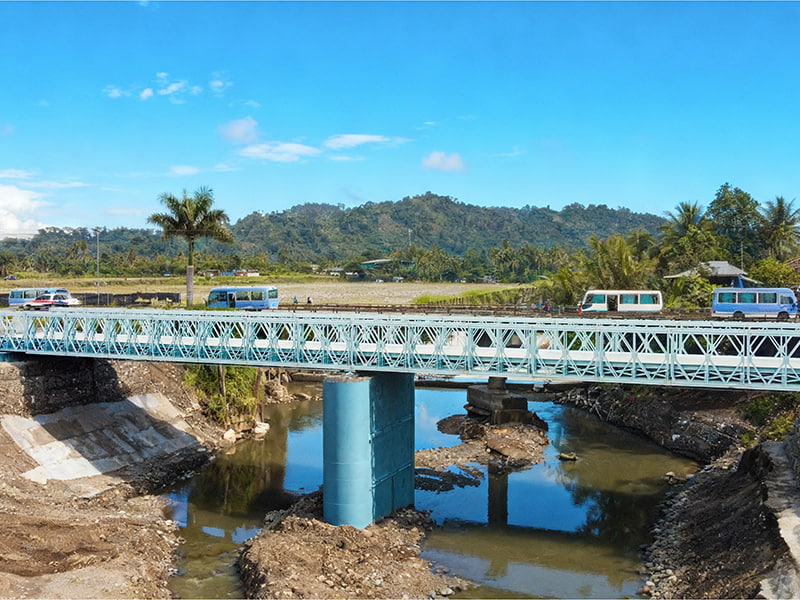
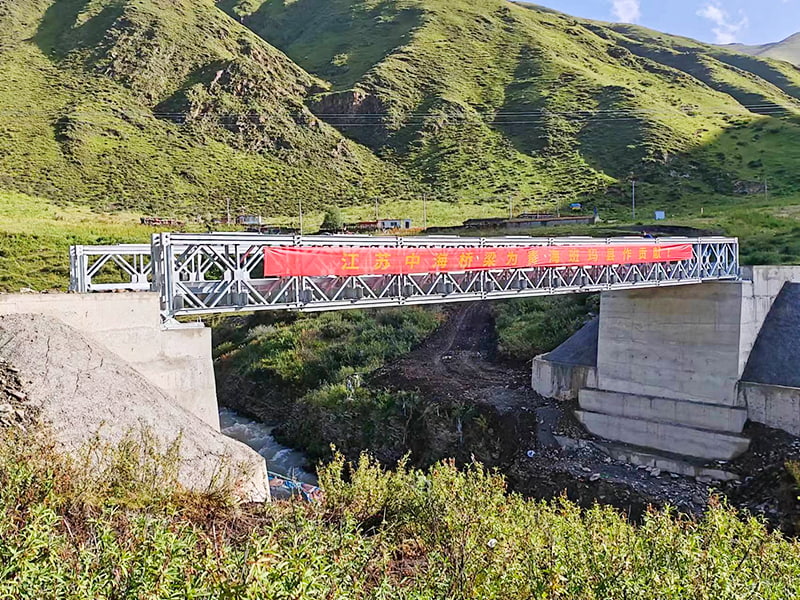
Modern forestry operations depend on reliable transportation routes that can remain functional in demanding terrain and difficult weather. When forests are separated from processing centers by rivers, uneven ground, temporary work zones, or damaged access roads, a modular bridge can provide a faster and more adaptable solution than a conventional permanent bridge. The CB 200 Bailey bridge described in this article was developed for precisely this type of requirement. Installed in Malaysia, the bridge has a total length of 106 meters and uses a four-lane, single-layer reinforced configuration designed specifically for logging truck traffic.
The project combines the practical advantages of a modular steel bridge with the durability benefits of galvanization and corrosion-resistant treatment. Its double-row structural arrangement provides additional load-carrying capacity and stability, while the single-layer layout supports efficient transportation and erection. Rather than serving as a simple temporary crossing, the bridge functions as a strategically important transportation link for forestry companies operating in a high-temperature, rainy, and humid environment.
This article examines the bridge’s configuration, engineering value, manufacturing characteristics, corrosion protection, construction benefits, and suitability for heavy-duty applications. It also explains why experienced modular bridge manufacturing, standardized production, precision steel fabrication, and technical support are essential when a bridge must be delivered quickly and perform reliably under challenging conditions.
Project Overview and Application Background
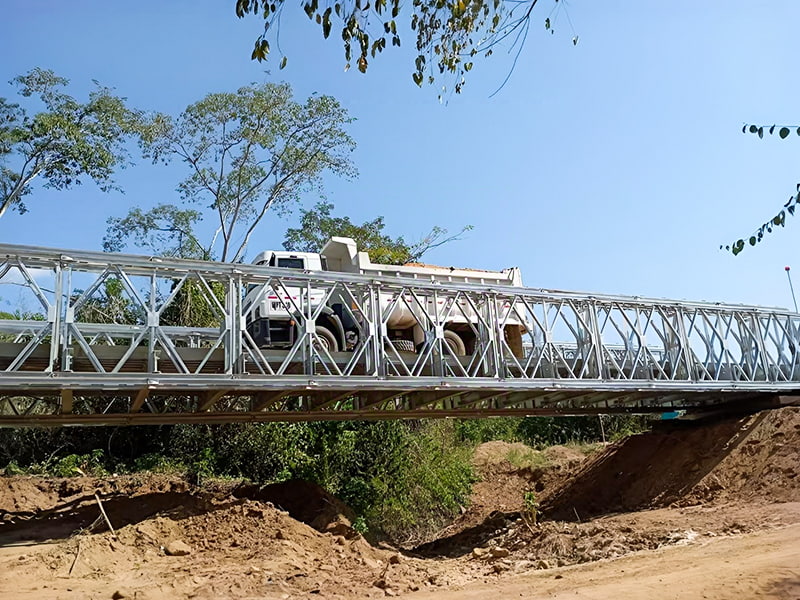
The Malaysian project consists of a 106-meter CB 200 Bailey bridge configured as a four-lane, single-layer reinforced structure. Its primary users are logging trucks, which place substantially greater demands on a bridge than ordinary passenger vehicles. Timber trucks may operate at high gross weights, carry unevenly distributed loads, and travel repeatedly across the same route over long periods. These conditions require a bridge system with adequate structural strength, dependable connections, stable alignment, and durable surface protection.
The bridge was installed in a forest area where transportation access was a major factor in the productivity of local forestry operations. Before the route was opened, the movement of timber was more difficult and costly. Delays caused by unsuitable roads, seasonal rainfall, or disconnected access routes could reduce the efficiency of harvesting and delivery. By creating a direct and dependable crossing, the modular bridge helped connect the forest transportation network with downstream logistics and processing routes.
The bridge was not designed merely for occasional emergency use. Its configuration reflects the need for repeated heavy vehicle traffic and continuous service. The four-lane arrangement increases traffic capacity and can help reduce waiting time when trucks operate in both directions. The reinforced double-row arrangement enhances the bridge’s ability to handle the project’s heavy-load requirements, subject to the final design load, span arrangement, foundation conditions, and approved construction documents.
Malaysia’s climate was another important design consideration. High temperatures, frequent rainfall, and high humidity can accelerate corrosion, especially on steel bridges exposed to water, mud, condensation, and organic material from the surrounding forest. Galvanization and corrosion-resistant treatment therefore form a central part of the bridge’s long-term performance strategy. The protective system helps reduce the risk of premature steel deterioration and lowers the frequency of maintenance associated with exposed steelwork.
Structural Configuration of the CB 200 Bailey Bridge
Double-Row Load-Bearing Arrangement
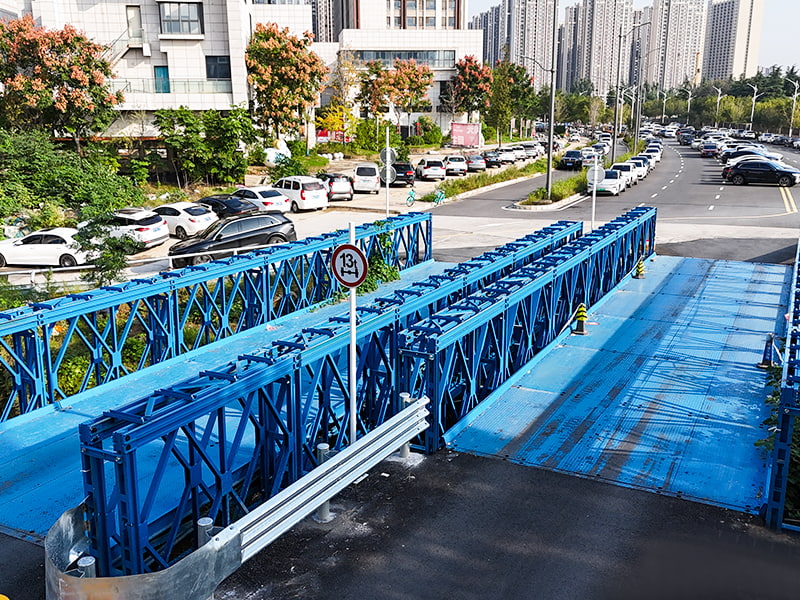
The double-row configuration uses two parallel rows of modular truss panels in the main structural system. This arrangement increases the quantity of steel participating in the load path and provides a stronger framework for heavy-duty service than a basic single-row arrangement. The truss panels are connected using standardized components, allowing the bridge to be assembled into a continuous structural system without requiring every member to be fabricated as a unique part on site.
A double-row system can also contribute to improved lateral stability when it is properly connected with transoms, bracing, deck components, sway bracing, and other required structural accessories. These elements work together to distribute vehicle loads, resist horizontal forces, maintain the geometry of the bridge, and support safe traffic operation. The final behavior of the bridge depends on the complete engineered system rather than on the truss panels alone.
For forestry transportation, this configuration is particularly valuable because truck loads may be high and repetitive. The bridge must resist vertical vehicle effects as well as dynamic effects caused by vehicle movement, braking, acceleration, uneven loading, and surface irregularities. A reinforced double-row system offers a practical way to address these demands while retaining the modular advantages of a Bailey bridge.
Single-Layer Bridge Layout
The bridge uses a single-layer configuration, meaning that the main truss arrangement is organized in one vertical level rather than being stacked into a double-layer or multi-level truss height. A single-layer bridge generally requires fewer structural components than a stacked configuration and can simplify transportation, erection, inspection, and maintenance.
Single-layer modular bridges are often selected when the design load, span length, clearance conditions, and construction method can be satisfied without increasing the truss depth. They can provide an efficient balance between structural performance and material use. For the Malaysian forestry project, the single-layer format supported rapid deployment while the reinforced double-row arrangement addressed the high traffic demands.
The suitability of a single-layer bridge must always be verified through engineering calculations. Factors such as span length, support conditions, vehicle classification, lane arrangement, wind exposure, impact effects, seismic conditions, and approach geometry influence the final design. A modular bridge manufacturer with design and fabrication capability can adapt the panel arrangement, deck system, bracing, and support details to the project’s specific requirements.
Four-Lane Traffic Capacity
The four-lane arrangement is one of the project’s most notable operational features. Forestry routes often experience concentrated traffic, with multiple trucks arriving from harvesting areas and moving toward a processing or storage destination. A bridge with insufficient width may require one-way scheduling, manual control, or long vehicle queues. The four-lane layout provides a wider traffic platform and is better suited to a high-volume logistics route.
Traffic capacity is not determined by width alone. The approach roads, turning areas, deck surface, guardrails, signage, vehicle speed, and operational controls must all be coordinated. Nevertheless, the four-lane bridge configuration creates a strong foundation for efficient movement. It can support separated or organized traffic flows and reduce conflicts between incoming and outgoing vehicles, depending on the site’s operating plan.
For timber transportation, improved traffic flow can have a direct financial effect. Reduced waiting time helps trucks complete more trips within a working period, while fewer interruptions can improve fuel efficiency and labor utilization. A reliable crossing also reduces the likelihood that trucks will need to use longer alternative routes or stop operations during periods of heavy rainfall.
Advantages for Logging Truck Transportation
Designed Around Heavy-Duty Use
Logging trucks differ from ordinary road vehicles in both weight and operating conditions. They may carry long, dense, and unevenly distributed timber loads. Their tires and suspension systems transmit repeated forces to the bridge deck, and their operating routes may include mud, gravel, water, and debris. A bridge intended for these vehicles must be designed as a working industrial asset rather than as a light-duty pedestrian or local access structure.
The CB 200 project was developed with these characteristics in mind. Its reinforced structural arrangement provides a suitable platform for an engineered heavy-load solution. The bridge’s modular truss system distributes vehicle actions through the deck and into the main panels, bracing, bearings, and supports. When the system is correctly designed and erected, the result is a controlled load path capable of supporting repeated transportation activity.
The bridge’s performance is also supported by the use of standardized components. Standardization helps ensure that compatible panels, pins, transoms, bracing elements, deck units, and connection components are produced according to an established system. This reduces the risk associated with improvised field modifications and makes it easier to inspect, replace, or extend parts during the bridge’s service life.
Improved Route Reliability
Forestry operations are highly sensitive to transportation interruptions. If a bridge is unavailable, timber may remain at the harvesting site, trucks may be forced to wait, and processing facilities may receive inconsistent deliveries. In remote areas, an interruption can affect an entire chain of operations because alternative routes are often limited or nonexistent.
A modular steel bridge can improve route reliability by providing a dedicated crossing that is engineered for the intended vehicle class. The bridge can also be integrated into a broader transportation plan that includes approach road improvements, drainage management, inspection procedures, and traffic control. The result is not simply a physical connection across an obstacle; it is a more predictable logistics corridor.
In the Malaysian project, the bridge quickly opened a transportation route in a forest area. This helped forestry companies move timber more efficiently while controlling transportation costs. The bridge therefore delivered value beyond its structural function. It supported production continuity, reduced logistical uncertainty, and helped local forestry activities operate more effectively.
Operational Efficiency and Cost Control
The economic value of a modular bridge is often measured through its total project cost rather than its initial purchase price alone. A bridge that can be manufactured quickly, transported in manageable sections, erected with organized procedures, and maintained using replaceable components may offer a lower overall cost than a more complex solution.
The CB 200 system supports this approach through modular production and assembly. Factory-manufactured panels and components can be prepared before they arrive at the project site. This reduces the amount of heavy fabrication required in remote or environmentally sensitive locations. Faster assembly can reduce equipment rental, labor, traffic interruption, and exposure to changing weather conditions.
Once the route is open, the bridge can help control operating costs by shortening travel distances and improving truck utilization. In forestry applications, even modest reductions in turnaround time can be significant when multiplied across many trucks and repeated journeys. A bridge that supports stable, predictable logistics may therefore contribute to savings throughout the entire supply chain.
Galvanization and Corrosion Resistance
Importance in Tropical Environments
Steel bridges operating in tropical climates face a combination of environmental factors that can accelerate corrosion. Rainwater can remain on horizontal surfaces, high humidity can prolong wetness, and elevated temperatures may intensify chemical reactions. Mud, vegetation, organic acids, and road contaminants can further increase exposure on lower members and deck components.
In a forest environment, bridge components may also be exposed to leaves, branches, soil, and standing water. These materials can collect around connections and drainage areas if the bridge is not regularly cleaned and inspected. A well-designed corrosion protection system therefore needs to be supported by suitable detailing, drainage, maintenance access, and operational care.
Role of Galvanization
Galvanization provides a protective zinc layer over steel surfaces. The coating acts as a barrier between the steel and the surrounding environment. It can also provide sacrificial protection in localized areas where the coating is damaged, helping to reduce the speed at which corrosion reaches the underlying steel.
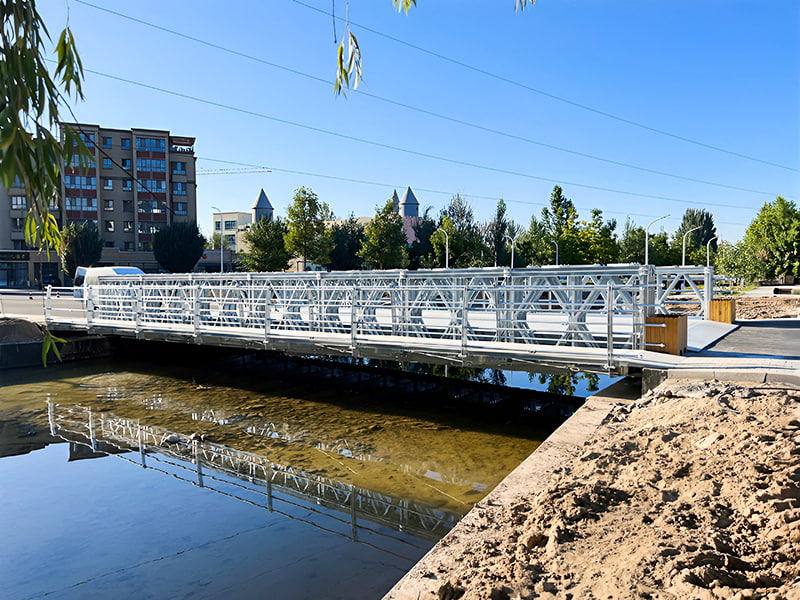
For a modular bridge exposed to frequent rain and high humidity, galvanized treatment can extend the useful service period and reduce maintenance requirements compared with unprotected steel. It is especially valuable for modular components that may be transported, handled, assembled, and exposed to changing site conditions. The protective treatment helps preserve the condition of panels, bracing, connection areas, and other exposed structural members.
Galvanization does not eliminate the need for inspection. Connection interfaces, cut edges, damaged areas, drainage locations, deck surfaces, and parts exposed to abrasion should still be checked regularly. However, it creates a stronger baseline for durability and provides additional protection in an environment where ordinary painted steel may require more frequent attention.
Corrosion-Resistant Treatment as Part of a System
The project description identifies both galvanization and corrosion-resistant treatment. These measures should be viewed as part of a complete durability system that includes material selection, surface preparation, coating quality, drainage, detailing, transportation protection, and maintenance procedures. A bridge’s long-term performance depends on how these factors work together.
Factory-controlled surface preparation is particularly important. Steel surfaces must be cleaned and prepared before protective treatment so that the coating can bond effectively and provide consistent coverage. Controlled production conditions can reduce contamination, uneven application, and handling damage. After treatment, components should be inspected and packaged in a manner that limits impact during storage and transportation.
For forestry routes, maintenance personnel should keep deck drainage clear, remove accumulated soil and organic debris, monitor areas subject to vehicle impact, and repair any damaged protective coating according to the manufacturer’s procedures. These relatively simple measures can significantly increase the value of the original corrosion protection investment.
Manufacturing Strengths Behind the Bridge System
Integrated Engineering and Production
A modular bridge is only as reliable as the relationship between its design, materials, fabrication, quality control, and site support. Jiangsu Zhonghai Bridge Equipment Co., Ltd. integrates engineering design, precision manufacturing, quality management, and on-site support within its service model. This integrated approach is important because it reduces the separation between the person designing the structure and the team producing its components.
When engineering and fabrication are closely coordinated, design information can be translated into manufacturing drawings, cutting plans, welding procedures, inspection requirements, and assembly instructions with fewer communication gaps. It also becomes easier to identify practical production issues before components reach the construction site. For modular systems, dimensional accuracy is particularly important because individual panels and connection parts must fit together consistently.
The company focuses on modular steel bridges, Bailey bridge systems, customized steel components, bridge erection and construction support equipment, automated welding, and precision steel fabrication. This range of capabilities allows projects to be handled as complete structural systems rather than as isolated product orders.
Industrial-Scale Manufacturing Capacity
Industrial-scale manufacturing offers several advantages over purely site-based fabrication. Factory production can use repeatable workstations, dedicated equipment, controlled material handling, established inspection points, and organized storage systems. These conditions support consistent quality across large quantities of similar bridge components.
For a 106-meter, four-lane bridge, the number of panels, transoms, bracing members, deck units, fasteners, and ancillary components can be substantial. A manufacturing organization with standardized workflows can coordinate these items more efficiently than a small ad hoc fabrication operation. Proper production planning also helps reduce missing components, mismatched parts, and unnecessary delays during erection.
Industrial capacity is especially valuable when a client needs a bridge quickly. Manufacturing can proceed in parallel with site preparation, foundation work, transport planning, and construction organization. This parallel approach can shorten the overall project schedule, provided that engineering approvals, procurement decisions, and site conditions are coordinated in advance.
Automation and Standardized Workflows
Automation can improve repeatability in cutting, welding, drilling, handling, and inspection. Automated welding equipment, when used with qualified procedures and appropriate supervision, can provide consistent weld dimensions and reduce variations caused by manual work. It can also improve production efficiency for repeated structural members and components.
Standardized workflows provide a framework for controlling each manufacturing stage. Typical stages may include material receipt, identification, cutting, forming, drilling, fit-up, welding, surface preparation, galvanization or coating, dimensional inspection, assembly verification, packaging, and dispatch. The exact process depends on the component and project requirements, but the principle remains the same: each step should be defined, documented, and checked.
Automation does not replace engineering judgment or quality personnel. Instead, it gives skilled teams more consistent tools and helps reduce avoidable variation. The strongest manufacturing systems combine automated equipment with experienced technicians, welding supervision, inspection procedures, traceability, and final verification.
Precision Steel Fabrication
Precision is essential in a modular bridge because the components are designed to connect repeatedly through standardized interfaces. Holes must be positioned accurately, panel dimensions must remain within specified tolerances, and welded assemblies must maintain their intended geometry. Small inconsistencies can become more significant when many components are assembled over a long bridge length.
Precision fabrication supports smoother erection and reduces the need for corrective work on site. It also helps ensure that pins, bolts, deck units, and bracing elements can be installed as intended. In remote forestry areas, avoiding field rework is particularly important because additional equipment, skilled labor, and replacement parts may be difficult to obtain.
Quality control should include dimensional checks, visual inspection, weld inspection where required, coating or galvanization inspection, and verification of component identification. Proper records can help the project team track the production status of each batch and confirm that the delivered bridge corresponds to the approved design.
Standards, Quality Management, and Project Support
The company’s manufacturing approach is intended to support products that comply with ASTM, EN, and applicable national specifications. The correct standard depends on the project location, contract documents, engineering design, and client requirements. A responsible bridge supplier should confirm the applicable standards before manufacturing and provide documentation appropriate to the project.
Compliance is not limited to a statement on a product brochure. It involves material requirements, structural calculations, welding practices, dimensional tolerances, protective treatment, inspection, documentation, and site procedures. Clients should review the technical submittal, drawings, load calculations, quality records, and installation instructions with the responsible engineer or project authority.
Technical support is another important strength. Modular bridge projects may require assistance with span selection, lane arrangement, panel configuration, deck design, support conditions, erection sequencing, temporary works, and transport planning. The more challenging the site, the more valuable early technical coordination becomes.
For the Malaysian project, the bridge’s value came from matching the structural configuration to the operating conditions. The manufacturer’s role included more than supplying steel panels. It involved understanding heavy logging truck traffic, the four-lane requirement, the tropical climate, the need for rapid route opening, and the importance of controlling long-term operating costs.
Installation and Construction Advantages
Modular Delivery to Difficult Locations
Remote forestry areas often have limited road access, restricted staging space, and challenging terrain. Large fully assembled bridge sections may be difficult or impossible to transport to such locations. Modular bridge components solve this problem by dividing the structure into manageable units that can be delivered using ordinary or specially arranged transport equipment.
Panels and other components can be shipped in batches, stored near the work area, and assembled according to the erection plan. This approach reduces the need for oversized transport and can make it easier to adapt the delivery sequence to site conditions. It also allows the construction team to begin preparing supports and approaches while bridge components are in transit.
Efficient Erection
Bailey bridge systems are known for their ability to be assembled using repetitive connection methods. Depending on the project design and site conditions, erection may use cranes, launching noses, temporary supports, lifting equipment, or a combination of methods. The appropriate method must be determined by qualified engineers and construction personnel.
The modular approach can shorten the period during which the crossing is unavailable. This is valuable in forestry operations, where every additional day without a route can affect harvesting schedules, truck allocation, labor planning, and delivery commitments. Efficient erection also reduces the time that workers and equipment are exposed to weather, unstable ground, and other site hazards.
Although modular assembly is efficient, it should never be treated as an informal process. Correct panel orientation, pin installation, bracing, deck placement, bolt tightening, bearing alignment, and connection inspection are essential. A detailed erection manual and site supervision help ensure that the bridge achieves the structural condition assumed in the design.
Adaptability for Future Requirements
One of the key advantages of a modular bridge system is adaptability. Forestry routes can change as harvesting areas move, production volumes increase, or new access requirements emerge. A modular bridge may be dismantled, relocated, extended, strengthened, or reconfigured when supported by an appropriate engineering assessment and compatible components.
This adaptability can improve the return on investment. A conventional structure designed for one fixed location may have limited usefulness if the transportation network changes. A modular system, by contrast, can potentially serve multiple phases of an infrastructure program. Its components can remain valuable beyond the original project when they are maintained, inspected, and stored correctly.
Comparison with Alternative Bridge Solutions
| Evaluation Factor | CB 200 Modular Bailey Bridge | Conventional Cast-in-Place Bridge | Basic Temporary Crossing |
|---|---|---|---|
| Deployment speed | Factory-produced modules support organized and comparatively rapid erection. | Usually requires extensive formwork, concrete curing, and site operations. | May be quick to install but often has lower capacity or limited durability. |
| Heavy truck suitability | Can be engineered in a reinforced double-row configuration for demanding traffic. | Can provide high capacity but may require a longer and more complex construction program. | Depends strongly on the specific system and may not suit repeated logging truck loads. |
| Site logistics | Components can be transported in manageable sections. | Requires larger quantities of materials, equipment, and site access. | May use simple components but can have limited structural flexibility. |
| Adaptability | Modular parts may be reconfigured or reused after engineering review. | Generally fixed to the original location and design. | Often adaptable but may not support long-term heavy traffic. |
| Climate protection | Galvanization and corrosion-resistant treatment support use in humid environments. | Durability depends on concrete quality, reinforcement protection, drainage, and maintenance. | Protection varies widely and may be insufficient for tropical exposure. |
| Maintenance approach | Individual modular parts can be inspected, maintained, and potentially replaced. | Repairs may require more extensive civil works and traffic closures. | May require frequent replacement or repair if not designed for continuous service. |
| Project economics | Can reduce construction time, route interruption, and remote-site fabrication requirements. | May be economical for permanent sites but can have higher initial time and construction demands. | May have low initial cost but higher operational limitations. |
The comparison does not mean that a modular Bailey bridge is the best choice for every project. Permanent bridges, concrete structures, steel girder bridges, and other systems may be preferable depending on span, design life, environmental conditions, traffic intensity, aesthetics, foundation limitations, and local regulations. The advantage of the CB 200 system is its combination of heavy-duty capability, modular construction, corrosion protection, and deployment efficiency for a demanding logistics application.
Benefits of Working with an Experienced Manufacturer
Choosing a bridge supplier involves more than comparing panel prices. The supplier’s ability to interpret the project requirements, prepare an appropriate design, fabricate consistent components, protect the steel, organize delivery, and support erection can have a major effect on the final result.
An experienced manufacturer can identify important questions at the beginning of the project. These questions may include the required design vehicle, lane width, total span, number of spans, support elevation, foundation type, flood level, wind conditions, deck surface, guardrail arrangement, construction equipment, traffic control, and maintenance expectations. Early clarification helps prevent late changes that could affect cost and schedule.
A manufacturer with both modular bridge and precision fabrication capabilities can also provide customized structural components when standard parts alone are not sufficient. This may include special deck units, approach structures, support frames, connection details, lifting devices, or other steelwork required for a complete installation.
International project experience is another practical advantage. Export projects require coordination of packaging, documentation, shipping, customs, delivery schedules, and local construction conditions. A supplier accustomed to international delivery can help reduce administrative and logistical uncertainty, particularly when the bridge is destined for a remote location.
Inspection, Maintenance, and Service-Life Considerations
Even a galvanized modular bridge requires a planned inspection and maintenance program. Inspections should be carried out at intervals appropriate to the traffic intensity, climate, bridge age, and project requirements. Heavy logging traffic and tropical exposure justify particular attention to deck components, connections, bearings, bracing, drainage, and areas vulnerable to impact.
Inspectors should look for loose or damaged fasteners, deformation, unusual movement, cracking in welded areas, coating damage, corrosion deposits, blocked drainage, deck wear, damaged guardrails, and settlement or movement at the approaches. Any issue that could affect structural safety or traffic control should be assessed by a qualified professional before the bridge continues normal operation.
Cleaning is especially important in forest environments. Mud, leaves, branches, and other organic matter can retain moisture against steel surfaces. Removing these materials helps the galvanized and corrosion-resistant treatment perform as intended. Drainage paths should remain open so that rainwater does not pond on the deck or around structural connections.
Traffic management also contributes to service life. Enforcing the approved vehicle weight, speed, lane use, and clearance limits reduces unnecessary stress and impact. If truck types or loading conditions change, the bridge should be re-evaluated rather than assumed to have unlimited capacity.
Because the bridge uses modular components, maintenance can focus on individual elements when necessary. Damaged deck units, bracing members, connection hardware, or protective areas may be repaired or replaced according to the approved procedure. This can be more efficient than repairing a monolithic structure, although replacement work still requires proper engineering review and construction control.
Environmental and Community Value
A reliable bridge can deliver environmental benefits when it reduces unnecessary detours, repeated road damage, and inefficient truck movements. Shorter routes may reduce fuel consumption and vehicle operating time. Better access can also allow forestry companies to organize transportation more carefully, reducing congestion and unnecessary idling around narrow crossings.
At the same time, infrastructure in forest areas must be planned responsibly. Approach roads, drainage, embankments, and bridge supports should be designed to minimize erosion and protect nearby waterways. Construction activities should follow local environmental requirements, and the bridge should be operated in a way that limits accidental discharge of fuel, lubricants, timber debris, and other contaminants.
The bridge’s value to the local community can extend beyond commercial timber movement. Improved access may support emergency response, maintenance teams, local workers, and other users, subject to the approved traffic plan. A stable crossing can strengthen connections between remote production areas and regional transportation networks.
Why This Project Represents a Strong Modular Bridge Solution
The Malaysian CB 200 project demonstrates how a modular steel bridge can be tailored to a specific industrial need. The bridge is not defined by one feature alone. Its value comes from the combination of a 106-meter total length, four-lane capacity, single-layer reinforced design, double-row structural arrangement, heavy-duty logging truck application, galvanized protection, and suitability for a tropical environment.
Compared with a basic light-duty modular crossing, the reinforced configuration is better aligned with repeated heavy traffic. Compared with a conventional bridge requiring extensive site construction, the modular format can reduce deployment time and simplify transportation to a remote forest area. Compared with unprotected steel, galvanization and corrosion-resistant treatment provide a stronger defense against humidity and rainfall.
The manufacturing foundation is equally important. Automated welding, standardized workflows, precision steel fabrication, quality management, and integrated engineering support help transform the modular concept into a dependable physical structure. These capabilities support dimensional consistency, component compatibility, efficient production, and more predictable project delivery.
For clients evaluating a similar project, the most important lesson is that bridge selection should begin with the operating requirements. Vehicle loads, traffic volume, climate, span, site access, construction schedule, maintenance resources, and future use should all be considered together. When these factors are matched with an appropriate modular configuration and a qualified manufacturing partner, a Bailey bridge can become a durable and economically effective part of a demanding transportation network.
Recommended Project Evaluation Checklist
Engineering Requirements
Define the design vehicle, maximum gross load, axle arrangement, lane width, traffic direction, desired service life, span length, support elevation, flood conditions, wind exposure, and any seismic or special environmental requirements. Confirm whether the bridge will carry ordinary road vehicles, logging trucks, military vehicles, construction equipment, or mixed traffic.
Site and Construction Requirements
Review access roads, available staging areas, foundation conditions, water levels, ground stability, lifting equipment, temporary works, construction personnel, and expected weather during erection. Determine whether components can be delivered directly to the site or must be transferred through a smaller access route.
Durability Requirements
Specify the corrosion protection system, drainage arrangements, inspection access, cleaning requirements, expected exposure to mud and organic debris, and procedures for repairing coating damage. In tropical regions, durability planning should be included from the beginning rather than added after fabrication.
Commercial and Delivery Requirements
Confirm the scope of supply, engineering documents, testing and inspection records, packaging, shipping responsibilities, spare parts, erection support, training, warranty provisions, and after-sales service. A clear scope helps prevent misunderstandings between the manufacturer, contractor, consultant, and owner.
Questions and Answers
What is the main application of this CB 200 Bailey bridge?
The bridge was developed for heavy-duty forestry transportation, especially repeated logging truck traffic. The Malaysian project uses a 106-meter bridge to create a reliable route through a forest area and support efficient timber movement.
What does the double-row, single-layer configuration mean?
The double-row arrangement places two parallel rows of modular truss panels in the main load-bearing system. The single-layer designation refers to the vertical arrangement of the truss rather than a stacked double-layer configuration. Together, these features provide a reinforced structure while maintaining the efficiency of a modular bridge.
Why was a four-lane layout selected?
The four-lane layout supports higher traffic capacity and can improve the movement of logging trucks in both directions. It helps reduce waiting and operational conflicts, although the final traffic arrangement must follow the approved design and site management plan.
How does galvanization benefit the bridge?
Galvanization applies a protective zinc layer to steel surfaces. It helps shield the steel from rain, humidity, and other corrosive conditions and can provide sacrificial protection if localized surface damage occurs. Regular inspection and maintenance remain necessary.
Is the bridge suitable for all heavy vehicles?
Suitability depends on the approved engineering design. The project was specifically developed for logging truck traffic, but any new vehicle type, heavier load, unusual axle arrangement, or change in operating conditions should be reviewed by a qualified bridge engineer before use.
Can modular bridge components be transported to remote sites?
One of the principal benefits of modular construction is that the bridge is divided into manageable components. Panels and accessories can be transported in sections and assembled near the final location, which is useful where access for large preassembled structures is limited.
Can the bridge be moved or reused in the future?
Modular bridge systems can often be dismantled, relocated, extended, or reconfigured. However, any change in span, load, support condition, or traffic use requires engineering assessment, component inspection, and approval before reuse.
What manufacturing capabilities support this product?
The manufacturer combines engineering design, industrial-scale production, automated welding, standardized workflows, precision steel fabrication, quality management, corrosion protection, and project support. These capabilities help maintain consistency across the large number of components required for a modular bridge.
Which standards can be considered for production?
The company states that its factory supports products complying with ASTM, EN, and applicable national specifications. The exact standards must be selected according to the project’s location, contract requirements, design basis, and approval authority.
What maintenance does a galvanized Bailey bridge require?
Maintenance should include regular inspection of truss panels, pins, bolts, bracing, deck units, bearings, guardrails, drainage, approaches, and protective surfaces. Mud, leaves, and other debris should be removed, and any impact or coating damage should be repaired according to approved procedures.
Why is manufacturer support important during erection?
Correct erection requires accurate sequencing, connection installation, bracing, deck placement, alignment, and inspection. Manufacturer support can help the construction team follow the intended design, resolve component questions, and avoid unsafe field modifications.
Conclusion
The CB 200 double-row single-layer reinforced galvanized Bailey bridge provides a practical solution for heavy-duty forestry transportation in a demanding tropical environment. Its 106-meter length and four-lane configuration address the need for high-capacity movement, while the reinforced modular structure is suited to repeated logging truck traffic. Galvanization and corrosion-resistant treatment strengthen the bridge’s durability in conditions characterized by heat, rainfall, and high humidity.
The project also illustrates the broader advantages of working with an integrated modular bridge manufacturer. Engineering design, automated welding, precision steel fabrication, standardized production, quality management, international delivery, and site support all contribute to the final performance of the bridge. These capabilities help ensure that the structure is not only fast to deploy but also consistent, maintainable, and adaptable.
For forestry companies, infrastructure contractors, public agencies, and emergency-response organizations, a modular bridge can offer a valuable balance between strength, speed, flexibility, and cost control. When the bridge configuration is carefully matched to the vehicle loads, site conditions, climate, and construction plan, it can become a dependable connection that supports both immediate transportation needs and long-term regional development.
In the Malaysian forest project, the bridge opened an important transportation route, improved timber logistics, and supported the continued development of the local forestry industry. Its combination of heavy-load capability, four-lane capacity, corrosion protection, and factory-controlled manufacturing makes it a strong example of how modular steel bridge technology can solve complex access and transportation challenges.
References
1. Project description for the 106-meter Malaysian CB 200 Bailey bridge, including its four-lane single-layer reinforced configuration and logging truck application.
2. Manufacturer-provided technical information on modular steel bridges, Bailey bridge systems, precision steel fabrication, automated welding, and construction support equipment.
3. Manufacturer-provided company information regarding engineering design, quality management, international delivery, and production according to ASTM, EN, and applicable national specifications.
4. General principles of modular steel bridge design, fabrication, erection, inspection, and maintenance for temporary and permanent transportation infrastructure.
5. General technical guidance on hot-dip galvanization, zinc-based corrosion protection, surface preparation, coating inspection, and maintenance of exposed steel structures.
6. General engineering practice for heavy-vehicle bridge loading, modular truss systems, bridge erection planning, traffic management, and remote-site construction.
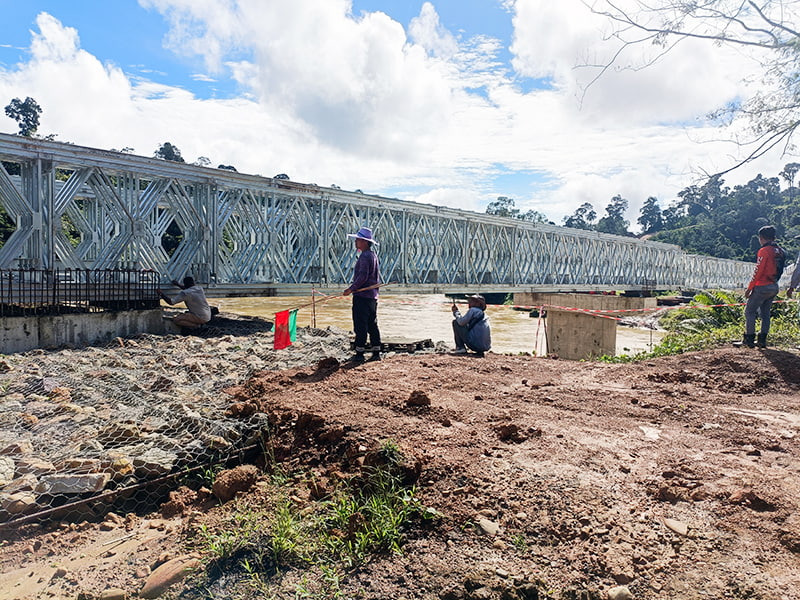
CB 200 Bailey Bridge Double-Row Single-Layer Reinforced Galvanized Bailey Bridge
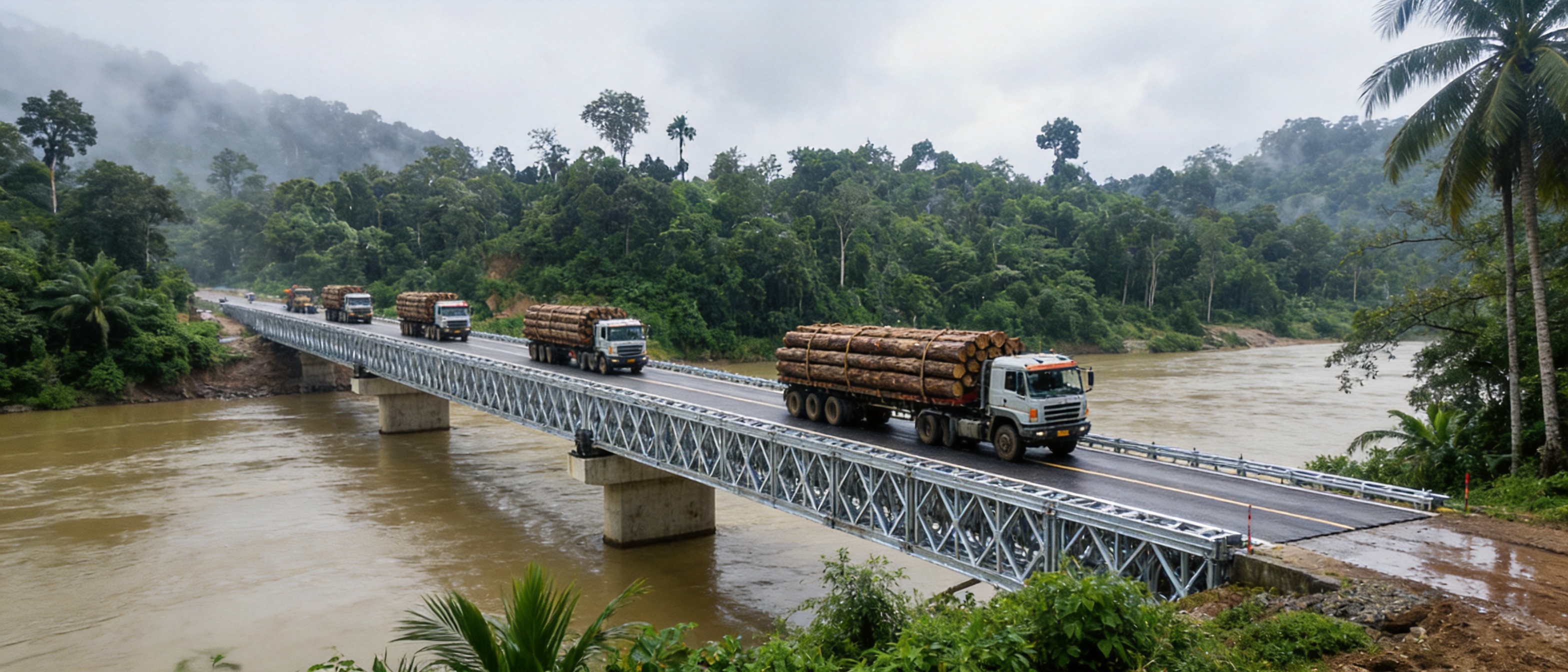
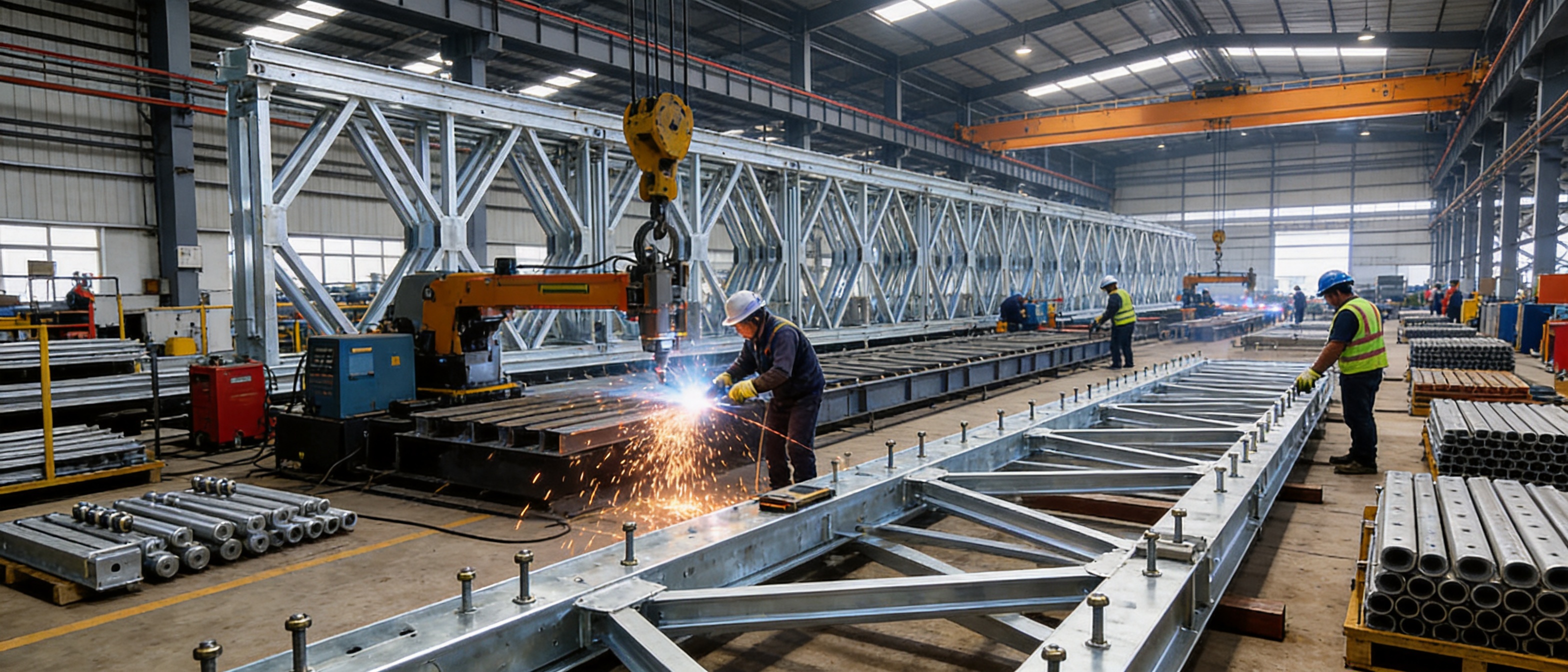
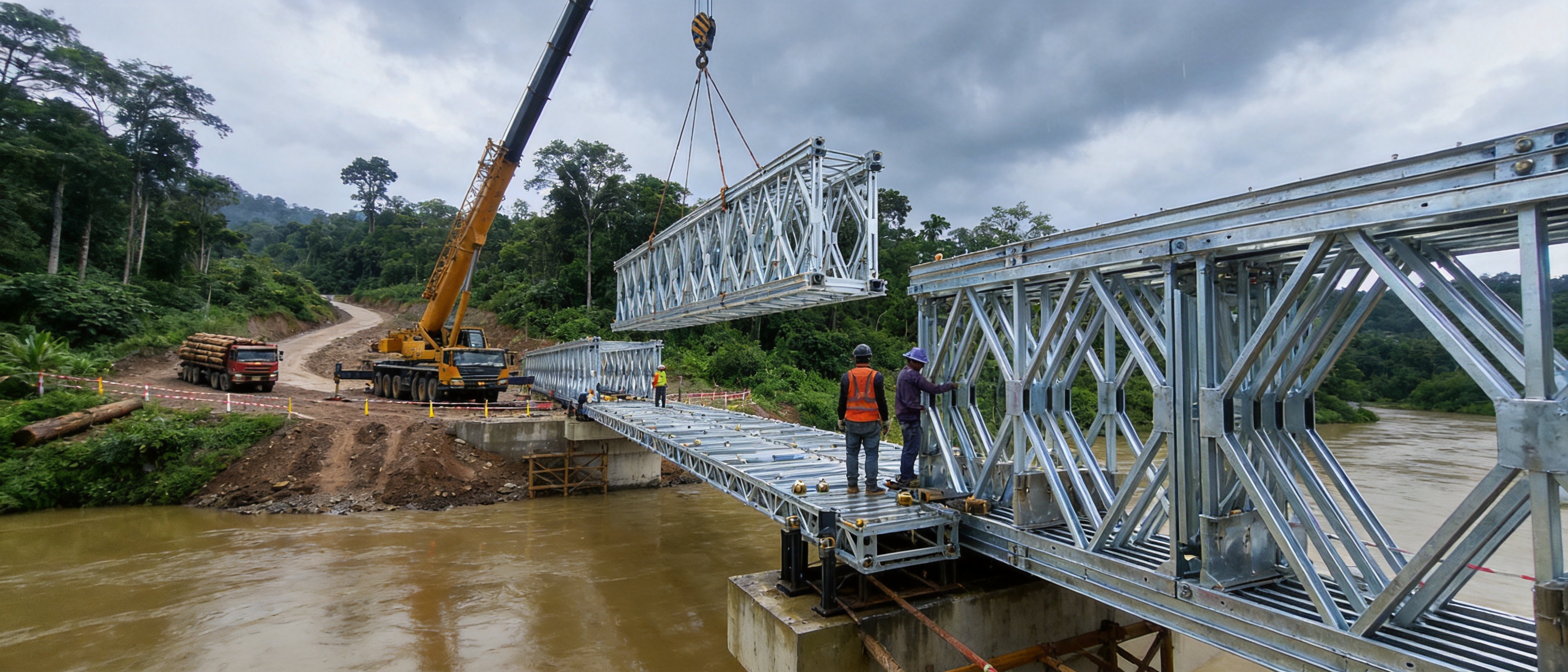
Product: CB 200 Bailey Bridge Double-Row Single-Layer Reinforced Galvanized Bailey Bridge


We respond quickly to all international requests and provide technical support when needed.
Product Category
Bailey Bridge/Modular Bridge Modular Steel Bridge Pedestrian Bridge Modular Pipe Bridge Truss Bridge Steel StructureContact Us

+86-511-84522866
+86-13921582699

zhwm@zjql.com

Building 1,83#, dantu New Town, Yanjiang Road, Dantu District, Zhenjiang, Jiangsu, China
Copyright © Jiangsu Zhonghai Bridge Equipment Co., Ltd. All
Rights
Reserved
China bailey bridge for sale
bailey bridge supplier from china
