
 English
 русский
 Español
 Português


Xie Wenlan — Modular Bridge Project Sales Specialist
CB 450 Four-Row Single-Layer Reinforced Galvanized Bailey Bridge: Large-Span Modular Steel Bridge Solution
Content
- 1 Introduction
- 2 Product Overview
- 3 Structural Configuration and Engineering Value
- 4 Applicable Load Standards
- 5 Hot-Dip Galvanizing and Corrosion Protection
- 6 Factory Pre-Assembly and Manufacturing Accuracy
- 7 Advantages Compared with Conventional Competitor Solutions
- 8 Applications of the CB 450 Bridge
- 9 Company Manufacturing Strengths
- 10 Transportation, Site Assembly, and Erection Planning
- 11 Quality Control and Lifecycle Management
- 12 Environmental and Economic Benefits
- 13 Recommended Project Evaluation Criteria
- 14 Why the CB 450 Is a Competitive Modular Bridge Choice
- 15 Q&A
- 15.1 What is the CB 450 Bailey Bridge?
- 15.2 What is the maximum span of the bridge?
- 15.3 What load can the CB 450 carry?
- 15.4 What does four-row single-layer reinforced mean?
- 15.5 Is the bridge suitable for heavy construction equipment?
- 15.6 Why is hot-dip galvanizing important?
- 15.7 What are the benefits of factory pre-assembly?
- 15.8 Can the bridge be reused or relocated?
- 15.9 Which load standards can the bridge meet?
- 15.10 Does the manufacturer provide engineering support?
- 15.11 Where is the company located?
- 15.12 What information is needed for a quotation?
- 16 Conclusion
- 17 References
- 18 Product: CB 450 Bailey Bridge Four-Row Single-Layer Reinforced Galvanized Bailey Bridge
Introduction
Modern infrastructure projects often require bridge systems that can be delivered quickly, assembled efficiently, and adapted to demanding site conditions. Permanent bridges may take considerable time to design, fabricate, transport, and construct, while emergency access routes, temporary logistics corridors, construction crossings, and remote transportation links frequently require a faster and more flexible solution. Modular steel bridges address these challenges by combining standardized components, repeatable engineering, efficient transportation, and rapid field erection.
The CB 450 Bailey Bridge Four-Row Single-Layer Reinforced Galvanized Bailey Bridge is designed for projects that require a combination of long-span capability, high load-bearing performance, corrosion resistance, and practical installation. With a maximum span of up to 81 meters and a rated load-bearing capacity of up to 80 tons, this bridge system is positioned for demanding transportation and infrastructure applications. Its four-row single-layer reinforced configuration provides additional structural strength compared with lighter modular bridge arrangements, while hot-dip galvanizing improves resistance to environmental exposure.
The bridge is independently developed and manufactured by Jiangsu Zhonghai Bridge Equipment Co., Ltd., a Chinese producer specializing in modular steel bridges, Bailey bridge systems, engineered structural components, and bridge construction support equipment. The company combines engineering design, precision fabrication, quality management, factory pre-assembly, and project support to deliver bridge systems for transportation, water conservancy, military logistics, disaster relief, and international infrastructure projects.
This article examines the structure, performance, manufacturing process, application value, and competitive advantages of the CB 450 bridge. It also explains how factory pre-assembly, hot-dip galvanizing, standardized modular design, and engineering support contribute to a dependable bridge solution for projects with demanding schedule and performance requirements.
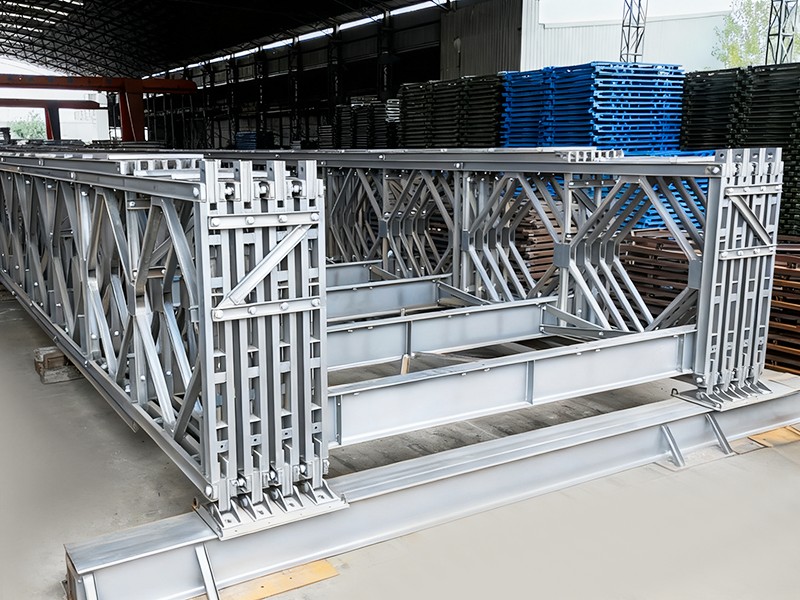
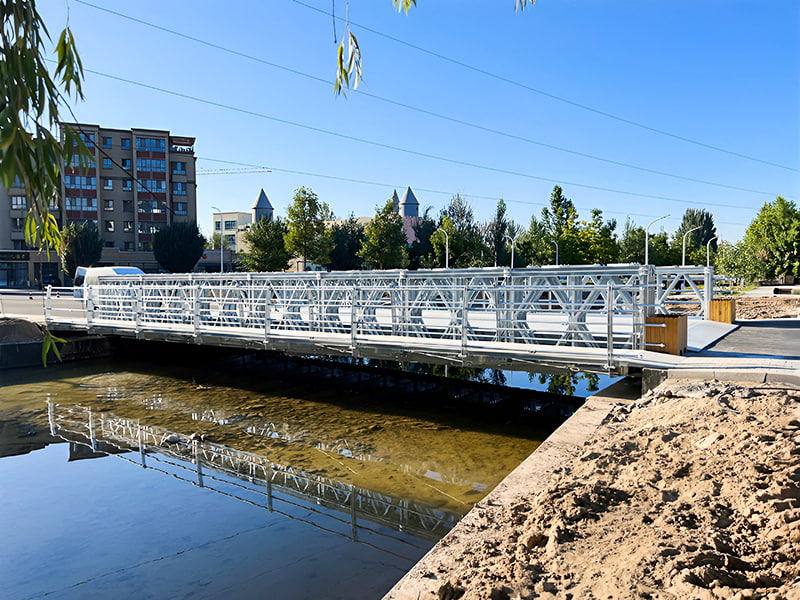
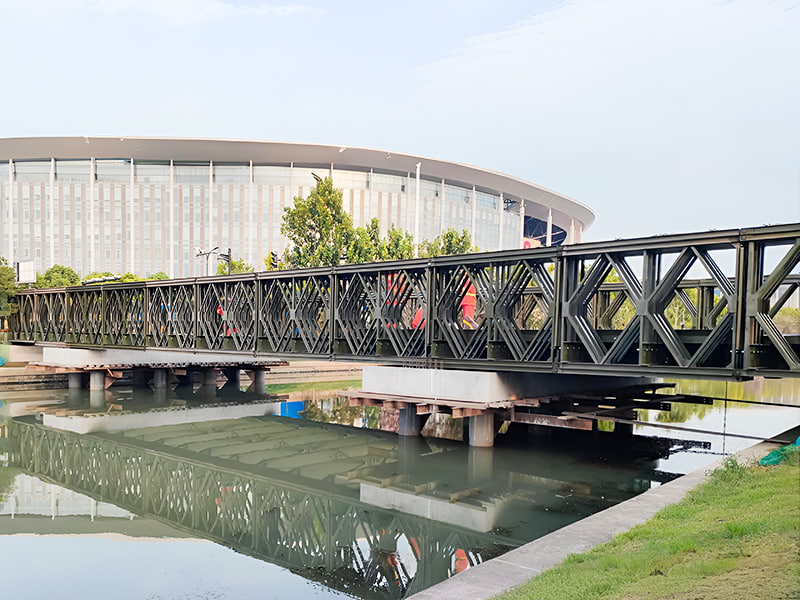
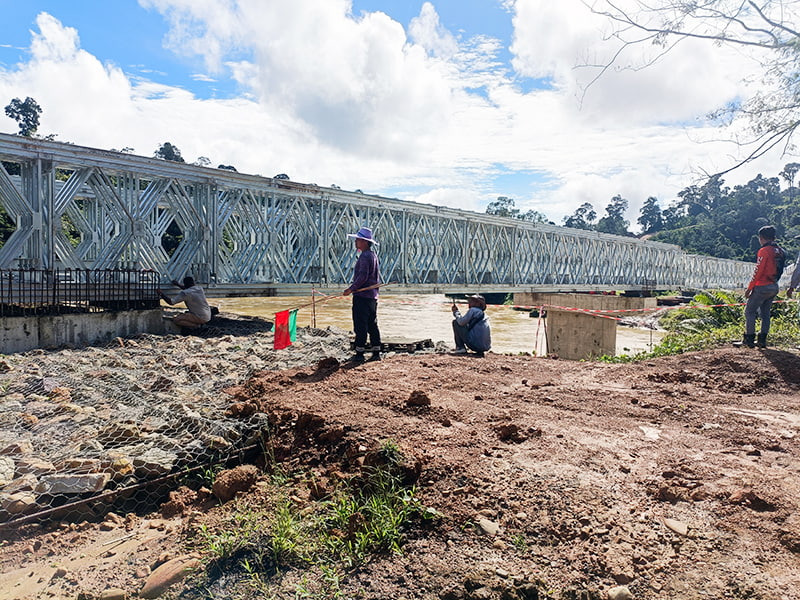
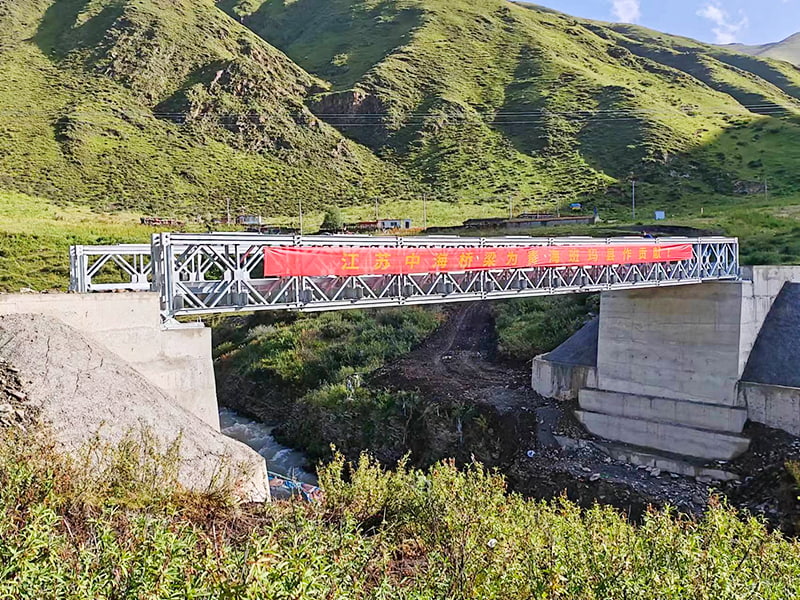
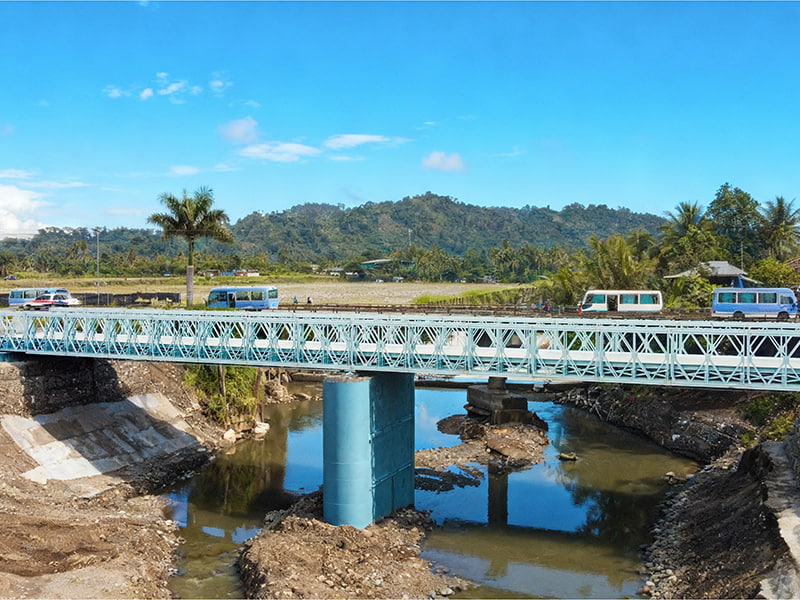
CB 450 Bailey Bridge Four-Row Single-Layer Reinforced Galvanized Bailey Bridge
Product Overview
The CB 450 is a modular Bailey bridge system built around a four-row single-layer reinforced structural arrangement. A Bailey bridge is generally assembled from prefabricated steel panels, connecting members, transoms, stringers, bracing components, deck elements, and related accessories. These standardized parts can be transported in manageable units and connected at the project site using established erection methods.
The four-row arrangement increases the effective structural width and distributes operational loads across more panel lines than a basic two-row configuration. The single-layer reinforced design maintains a relatively straightforward assembly concept while adding reinforcement for higher capacity and longer spans. This balance is important for projects that need stronger performance without moving to an unnecessarily complicated multi-level bridge structure.
The CB 450 configuration is particularly suitable for situations in which a bridge must support heavy vehicles, construction equipment, emergency response vehicles, or other significant moving loads. Its maximum span of 81 meters provides a practical solution for crossing rivers, channels, ravines, temporary construction zones, and other obstacles where intermediate supports may be difficult or undesirable.
The bridge is also available with hot-dip galvanized steel protection. Galvanizing places a durable zinc coating over exposed steel surfaces, creating a barrier against moisture and atmospheric corrosion. The zinc layer also provides sacrificial protection if the surface is locally damaged. This treatment is valuable for bridges installed in humid, rainy, coastal, industrial, or otherwise aggressive environments.
Because the system is modular, the bridge can be configured for different project conditions. The final structural arrangement, foundation design, deck layout, approach works, vehicle clearance, and load rating must be confirmed through project-specific engineering. However, the standardized product platform allows the manufacturer and project team to begin from a proven modular system rather than developing every component from the beginning.
Principal Product Characteristics
The main product characteristics of the CB 450 include the following:
• Four-row single-layer reinforced structural configuration.
• Maximum span of up to 81 meters, subject to engineering conditions and site requirements.
• Load-bearing capacity of up to 80 tons under the applicable design arrangement.
• Hot-dip galvanized anti-corrosion treatment.
• Factory pre-assembly with high manufacturing and connection accuracy.
• Modular components designed for transportation and rapid site assembly.
• Compatibility with different load requirements, including HS-15, HS-20, HS-25, HL-93, and Crawler-50 standards.
• Suitability for temporary, semi-permanent, emergency, construction, and selected permanent access applications.
Structural Configuration and Engineering Value
Four-Row Load Distribution
A key advantage of the CB 450 is its four-row panel arrangement. In a modular bridge, the main truss panels form the primary load-carrying system. Increasing the number of panel rows allows the bridge to distribute wheel loads and global bending effects across a broader structural assembly. This can improve the bridge’s ability to accommodate heavy traffic and demanding span conditions when compared with a simpler arrangement designed for lighter service.
The four-row configuration is especially valuable where vehicle loads are concentrated or where construction equipment imposes substantial axle and wheel reactions. By sharing the load among multiple structural lines, the bridge can achieve a stronger and more stable system while preserving the advantages of prefabricated construction.
Load distribution is influenced by many factors, including panel geometry, cross-bracing, transom spacing, deck stiffness, connection behavior, support conditions, vehicle position, dynamic impact, and lateral stability. For this reason, the four-row design should not be viewed only as an increase in material quantity. It is an integrated structural arrangement that must be correctly assembled and connected to achieve its intended performance.
Single-Layer Reinforced Design
The single-layer reinforced arrangement provides a practical compromise between strength, assembly simplicity, and transportation efficiency. A multi-level truss may provide additional depth and capacity, but it can also require more components, more complex erection procedures, greater lifting requirements, and increased site coordination. The CB 450’s single-layer reinforced approach is intended to provide significant structural performance while keeping the erection concept comparatively direct.
For contractors and infrastructure authorities, this balance can reduce the number of specialized operations required at the worksite. Modular components can be laid out, inspected, connected, and launched or lifted according to an approved erection plan. The simplified configuration may also make maintenance inspection and replacement activities more manageable over the bridge’s service life.
Large-Span Capability
A maximum span of 81 meters places the CB 450 in a useful category for crossings where conventional short modular bridges are insufficient. Long-span capability can reduce the need for temporary piers or riverbed supports. This is important in waterways with strong flow, unstable sediment, environmental restrictions, navigation requirements, or limited access for foundation construction.
Reducing intermediate supports can also simplify site logistics. Fewer supports may mean less underwater work, fewer obstructions to water flow, reduced interference with navigation, and less equipment working inside the crossing area. In construction and emergency applications, these benefits can shorten the time required to establish a usable route.
The actual achievable span depends on design loading, support conditions, wind exposure, seismic requirements, deck arrangement, deflection limits, approach geometry, and the selected erection method. The stated 81-meter capability should therefore be treated as a product-level maximum rather than a universal span for every load case. A qualified engineering review is necessary before fabrication and installation.
High Load-Bearing Capacity
The CB 450 is specified with a load-bearing capacity of up to 80 tons. This makes it appropriate for projects where ordinary passenger traffic is not the only design consideration. Heavy trucks, cranes, loaders, construction vehicles, military logistics vehicles, emergency equipment, and industrial transport may all require a stronger bridge system than a standard pedestrian or light-vehicle crossing.
High load-bearing capacity is particularly valuable during infrastructure construction. A temporary bridge may need to carry excavation equipment, concrete delivery vehicles, steel components, earthmoving machinery, or oversized project supplies. If the crossing is under-designed, construction operations may be delayed or forced to use longer detours. A stronger modular bridge can help maintain the movement of materials and equipment between work zones.
Load capacity must always be evaluated together with traffic frequency, dynamic effects, lane arrangement, vehicle dimensions, braking forces, lateral loads, fatigue considerations, and local regulations. The bridge manufacturer can support the selection of an appropriate configuration, but the final design should be approved by the responsible project engineer.
Applicable Load Standards
The CB 450 can meet various load requirements, including HS-15, HS-20, HS-25, HL-93, and Crawler-50 standards, depending on the selected arrangement and project-specific engineering. These designations represent different approaches to evaluating vehicle or crawler loading. Their application varies by country, authority, road classification, and project type.
HS load models are commonly associated with highway truck loading concepts, while HL-93 is widely used in bridge design practice for highway live-load evaluation. Crawler-50 is relevant to projects involving tracked equipment or crawler-type construction machinery. The ability to design around multiple load requirements gives the bridge greater flexibility for international and cross-sector applications.
For an owner or contractor, this flexibility has several benefits. The same basic modular bridge platform may be adapted to a local design code or a client’s specified loading standard. This can simplify procurement for projects in different countries and reduce the need to source entirely different bridge systems for different load environments.
| Design or Product Item | CB 450 Bridge Characteristic | Project Significance |
|---|---|---|
| Structural arrangement | Four-row single-layer reinforced | Supports higher load distribution and improved structural capacity |
| Maximum stated span | Up to 81 meters | Suitable for larger crossings and locations where intermediate supports are undesirable |
| Maximum stated capacity | Up to 80 tons | Supports heavy vehicles, construction equipment, and emergency logistics |
| Surface protection | Hot-dip galvanized steel | Improves resistance to moisture and atmospheric corrosion |
| Manufacturing method | Factory fabrication and high-precision pre-assembly | Improves dimensional consistency and helps reduce site installation uncertainty |
| Load references | HS-15, HS-20, HS-25, HL-93, and Crawler-50 | Allows adaptation to different project loading requirements |
| Product type | Modular steel Bailey bridge | Enables transport, staged assembly, and flexible project deployment |
Load standards should not be selected solely from a product brochure. The responsible designer must verify the applicable code, load combinations, impact factors, lane arrangements, serviceability limits, and safety factors. Zhonghai’s engineering and technical team can use project data to help determine the correct panel arrangement, deck system, reinforcement, and support configuration.
Hot-Dip Galvanizing and Corrosion Protection
Steel bridges are exposed to rain, condensation, splash water, mud, airborne salts, industrial pollutants, and cycles of wetting and drying. Without appropriate protection, these conditions can cause corrosion in primary members, connections, deck components, and secondary bracing. Corrosion reduces cross-sectional area, affects connection performance, increases maintenance requirements, and can shorten service life.
Hot-dip galvanizing is a widely used method for protecting steel components. In a typical process, fabricated steel parts are cleaned, chemically treated, immersed in molten zinc, cooled, and inspected. The resulting metallurgically bonded zinc coating provides both barrier protection and sacrificial protection. The coating isolates steel from the atmosphere, while zinc can preferentially corrode if a small exposed area of steel is scratched or locally damaged.
Galvanizing is especially useful for modular bridge systems because many components may be repeatedly handled during transport, storage, erection, disassembly, and relocation. A robust protective coating helps reduce the effect of normal handling and outdoor exposure. It can also be more practical than relying only on repeated site painting, particularly for emergency bridges or temporary crossings that must be installed rapidly.
For coastal and island projects, corrosion resistance is a major factor in lifecycle cost. Salt-laden air can accelerate corrosion on unprotected steel, increasing inspection and repainting requirements. A hot-dip galvanized bridge provides an additional layer of protection from the beginning of its service period. The exact service life of the coating depends on coating thickness, environmental exposure, drainage, contact conditions, maintenance, and local atmospheric classification.
Galvanizing does not eliminate the need for inspection. Drainage paths should remain clear, standing water should be avoided, connections should be monitored, and areas of mechanical damage should be repaired according to the manufacturer’s recommendations. Proper handling and storage are also important to preserve the coating before installation.
Factory Pre-Assembly and Manufacturing Accuracy
One of the most important advantages of the CB 450 is that the bridge has been pre-assembled with high precision in the factory before shipment to the Sichuan project site. Factory pre-assembly allows the manufacturer to verify component fit, connection alignment, dimensional consistency, and assembly sequence in a controlled environment.
Bridge components produced entirely as separate units may appear correct individually but can reveal alignment or tolerance issues when assembled at the project site. Correcting such issues in the field can require additional labor, equipment, modifications, or schedule adjustments. Pre-assembly provides an opportunity to identify and resolve potential problems before the bridge reaches the construction location.
During factory pre-assembly, technicians can check panel connections, bracing positions, transom interfaces, deck support points, and other critical details. The process also helps confirm that the components match the approved drawings and that the erection sequence is practical. Where necessary, the factory team can record component identification marks, prepare packing lists, and organize shipments according to the planned installation stages.
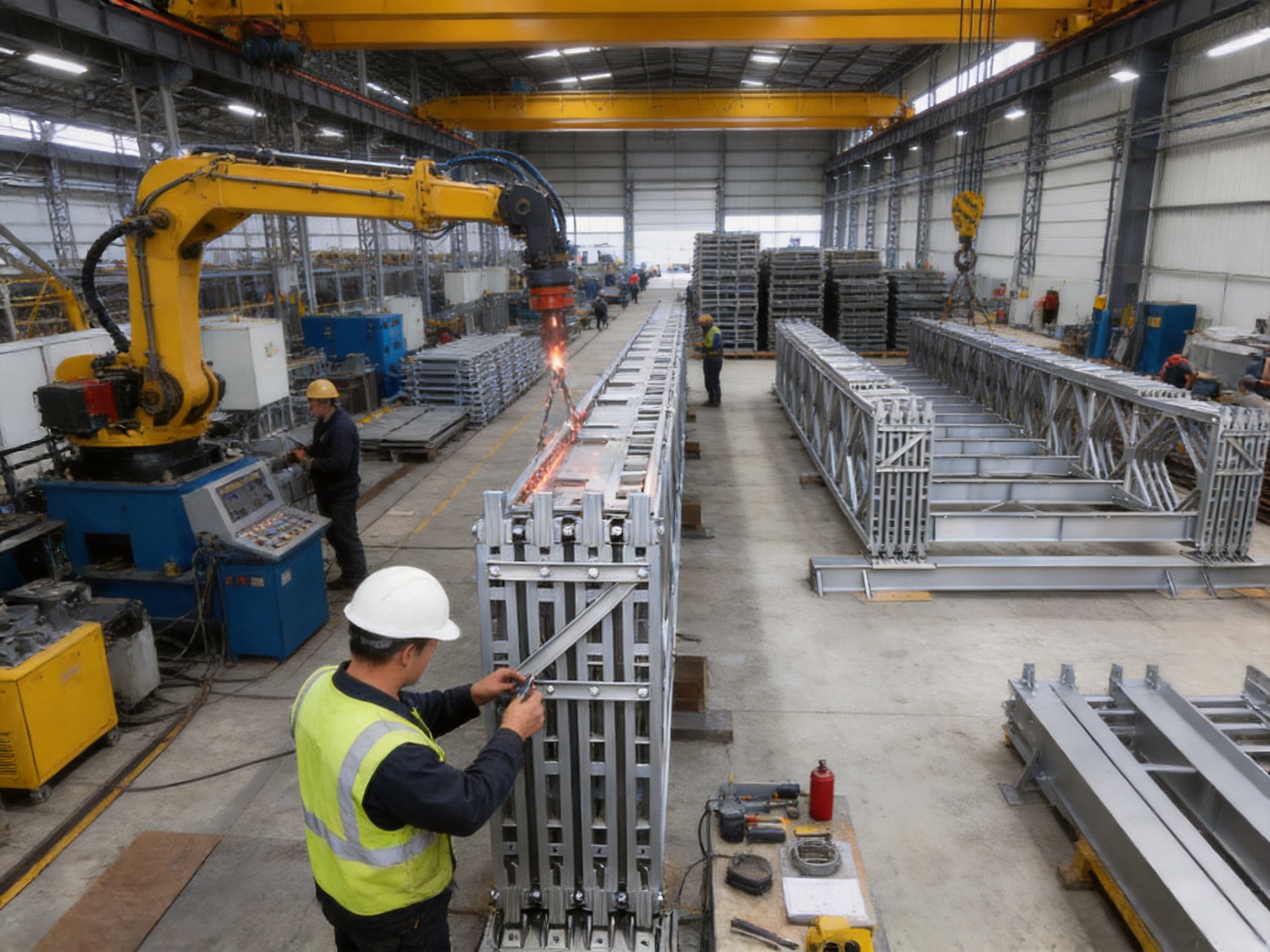
High-precision fabrication is supported by standardized drawings, controlled cutting, accurate drilling, automated welding, dimensional inspection, and documented quality procedures. These processes reduce variation between components and improve interchangeability. Interchangeability is a central benefit of modular bridge construction because it allows damaged or worn components to be replaced without redesigning the complete bridge.
Engineering Design and Digital Preparation
The manufacturing process begins with engineering. Project information may include span length, road width, vehicle type, design speed, required load model, environmental conditions, foundation arrangement, clearance requirements, erection method, and expected service duration. Engineers use this information to select the appropriate modular configuration and prepare fabrication documents.
Computer-aided design and digital detailing help control member geometry, connection locations, plate dimensions, stiffener positions, and component interfaces. Digital preparation also supports material takeoff, production planning, nesting optimization, and quality documentation. By coordinating engineering and manufacturing information before production begins, the company can reduce errors caused by inconsistent drawings or incomplete material records.
Material Preparation
Material preparation is an important stage in the production of a structural steel bridge. Steel plates, sections, tubes, fasteners, and other materials are selected according to the approved design and technical requirements. Materials should be identified and traceable so that the production team can confirm their grade, quantity, and inspection status.
Controlled cutting ensures that plates and sections match the required dimensions. CNC cutting equipment can improve repeatability and reduce manual measurement errors. Edges may be prepared for welding, and cut components can be marked for identification and later assembly. Accurate material preparation contributes directly to the fit-up quality of welded and bolted assemblies.
Automated and Controlled Welding
Welding quality affects the strength, fatigue performance, and durability of bridge components. Zhonghai’s manufacturing capabilities include automated welding and standardized production workflows. Automation can provide more consistent weld placement, travel speed, heat input, and deposition compared with fully manual production, particularly for repetitive structural components.
Automated welding does not replace engineering control or inspection. Welding procedures must be selected for the materials and joint geometry, and operators must be trained to supervise equipment, manage fit-up, and respond to irregular conditions. Visual inspection, dimensional inspection, and additional non-destructive testing may be applied according to the project specification and quality plan.
Controlled welding also helps reduce distortion. Excessive distortion can make components difficult to assemble and can introduce unwanted stresses or alignment problems. The use of fixtures, planned welding sequences, controlled heat input, and post-weld inspection helps maintain the intended geometry of panels, beams, and connection assemblies.
Dimensional Inspection and Trial Fitting
Dimensional inspection verifies that fabricated components meet the approved tolerances. Important checks may include overall length, width, height, hole spacing, diagonal dimensions, connection alignment, weld size, plate thickness, and straightness. Inspection records provide evidence that the components were produced according to the technical documentation.
Trial fitting is particularly valuable for modular bridges. It confirms that parts designed to connect in the field can be assembled without excessive adjustment. Trial fitting may be performed for complete bridge sections, representative bays, or critical connection groups, depending on the project requirements. The resulting information can be used to improve packing plans, installation instructions, and field quality control procedures.
Galvanizing and Final Inspection
After fabrication and inspection, steel components may be prepared for hot-dip galvanizing. Surface cleaning is essential because oil, mill scale, rust, paint, and other contaminants can prevent the zinc from bonding properly. Vent and drain provisions may also be required for hollow or enclosed sections to support safe and effective immersion.
Following galvanizing, the coating is visually examined for continuity, coverage, excessive buildup, bare areas, runs, lumps, or other conditions that could interfere with assembly. Critical connection surfaces and bolt interfaces receive special attention. Components are then identified, organized, protected during handling, and prepared for shipment.
This integrated manufacturing sequence—from engineering and material preparation through welding, pre-assembly, galvanizing, inspection, and shipment—gives the CB 450 a significant quality advantage over bridge systems assembled with limited factory verification.
Advantages Compared with Conventional Competitor Solutions
Faster Project Deployment
Compared with conventional cast-in-place or fully site-fabricated bridges, the CB 450 can reduce the amount of work required at the project location. Major structural components are manufactured in advance, transported to the site, and assembled using a planned modular process. This is particularly beneficial when a route must be restored quickly after flooding, landslides, earthquakes, or other disruptions.
Factory production can continue while foundations, approaches, or site access works are being prepared. This parallel workflow may shorten the overall project schedule. In contrast, a bridge built primarily through site fabrication may require more weather-dependent operations and may be affected by limited access, temporary workshops, or inconsistent field conditions.
Lower Site Labor Requirements
Modular construction transfers many complex manufacturing activities from the project site to a controlled factory. Cutting, welding, galvanizing, trial fitting, marking, and quality inspection can be performed before delivery. The site team can then focus on foundations, bearings, assembly, launching, deck installation, safety controls, and final inspection.
Reduced site fabrication can lower labor intensity and reduce the need for specialized welding facilities at remote locations. It may also improve safety by limiting hot work and heavy fabrication activities near waterways, traffic routes, unstable slopes, or emergency response areas.
Better Quality Consistency
Factory production provides stable access to lifting equipment, measurement tools, welding equipment, inspection personnel, and material storage. Controlled conditions generally make it easier to maintain consistent production quality than in an open construction environment. The CB 450’s factory pre-assembly adds another layer of verification by demonstrating how components fit before shipment.
Consistency is especially important when multiple bridge sections or multiple projects are produced from the same modular system. Standardized parts can be inspected according to repeatable procedures, and production records can be maintained for traceability.
Improved Corrosion Resistance
Many low-cost bridge systems rely on basic paint protection or are delivered with minimal surface treatment. While paint systems can be effective when correctly specified and maintained, they may require periodic recoating and can be vulnerable to damage during transport and assembly. Hot-dip galvanizing provides a more integrated protective layer and is advantageous where access for future maintenance is limited.
The galvanized CB 450 can therefore offer a stronger lifecycle proposition in humid, coastal, rainy, or industrial environments. The bridge remains subject to normal inspection and maintenance requirements, but its initial corrosion protection is designed to reduce exposure-related deterioration.
Adaptability and Reusability
Unlike many single-purpose bridge structures, a modular Bailey bridge can be configured, extended, disassembled, relocated, or stored for later use, provided that the components remain within their design condition and are inspected before reuse. This adaptability is important for government agencies, contractors, military logistics organizations, disaster-response teams, and infrastructure owners that manage changing access needs.
A bridge may first serve as a temporary construction crossing, later be relocated to an emergency access route, and eventually be used for a rural transportation project. Modular reuse can improve asset utilization and reduce the need to purchase a completely new bridge for every project.
International Engineering Flexibility
The ability to address HS-15, HS-20, HS-25, HL-93, and Crawler-50 load requirements supports projects in different markets. A supplier that understands multiple design references can better coordinate with international consultants, contractors, government agencies, and development organizations.
Zhonghai states that its products are manufactured through workflows aligned with ASTM, EN, and national specifications. The applicable standard must be confirmed for each project, but this manufacturing orientation demonstrates an ability to work within varied technical environments rather than relying on a single local configuration.
Applications of the CB 450 Bridge
River and Channel Crossings
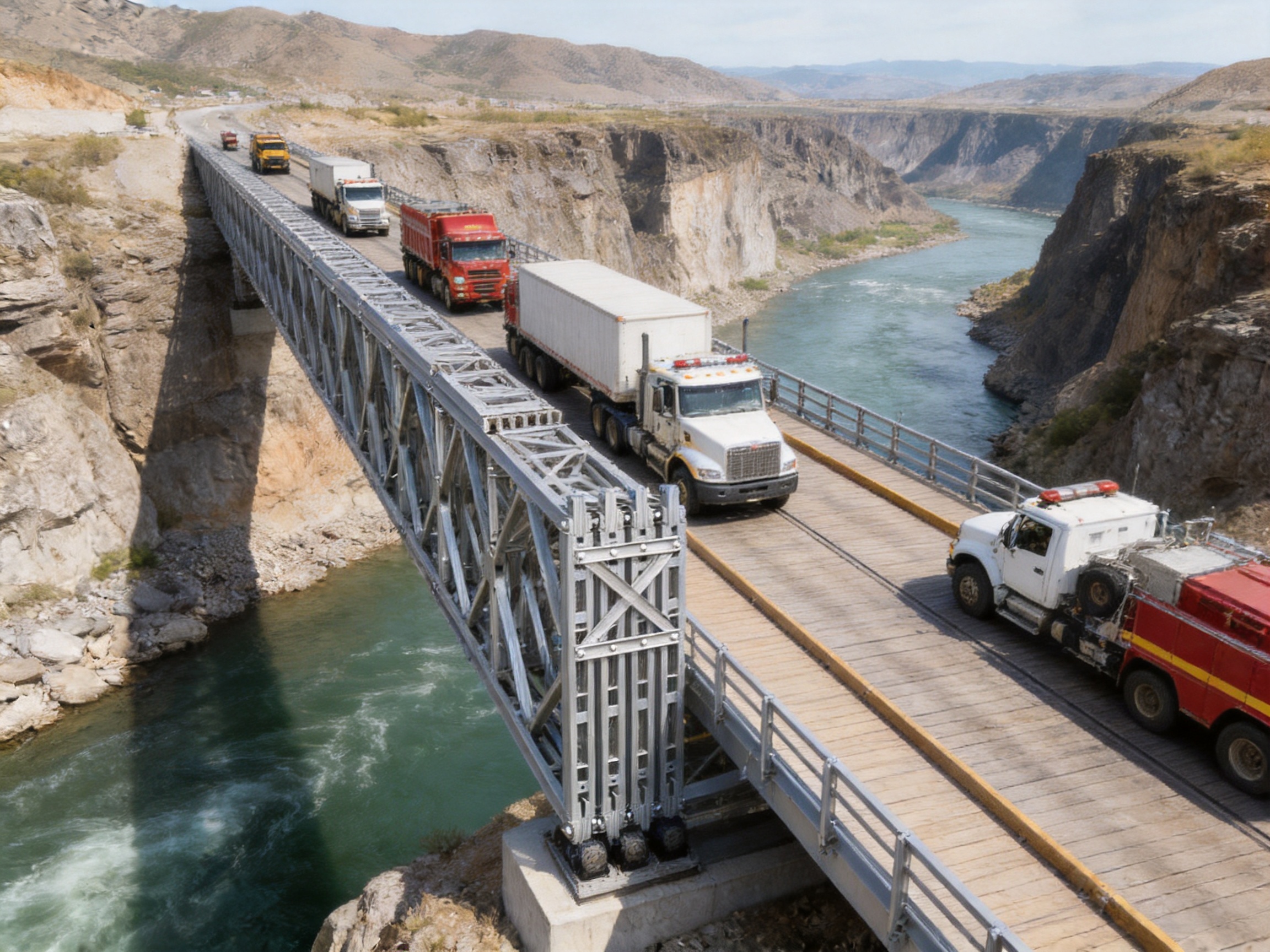
The bridge can be used for river, canal, drainage channel, and floodplain crossings where a rapid and strong connection is required. Its long-span capability may reduce the number of supports placed in or near the water. This can simplify construction and reduce the impact on water flow, navigation, and the surrounding environment.
For seasonal rivers and flood-prone locations, the bridge should be designed with appropriate hydraulic clearance, scour protection, approach stabilization, and foundation resilience. The modular superstructure can provide a practical connection, but the foundations and approaches remain essential to overall bridge safety.
Construction Access
Large construction projects often require temporary crossings for moving equipment, personnel, and materials. A permanent road may not yet be available, while the project’s internal logistics demand a reliable route. The CB 450 can provide a robust temporary access bridge for road, railway, industrial, water conservancy, and energy projects.
Its 80-ton capacity can support equipment that would exceed the limits of lighter temporary bridges. The bridge can also be planned around a construction sequence, allowing the contractor to maintain access while other structures are being built.
Emergency and Disaster Response
After floods, earthquakes, landslides, bridge failures, or severe storms, restoring transportation is often an urgent priority. A modular bridge can be transported in components and assembled once the site has been cleared and foundations or supports have been prepared. The CB 450 is suitable for emergency response scenarios where heavy vehicles and rescue equipment must cross an obstacle.
Emergency deployment requires more than bridge components. It also requires transport planning, lifting equipment, trained personnel, site surveys, temporary traffic management, and a clear erection procedure. The manufacturer’s experience in emergency bridge deployments can help project teams coordinate these supporting activities.
Military and Strategic Logistics
Military logistics and strategic transportation may require bridges that can be deployed rapidly and carry heavy vehicles. Modular bridges are valuable because their components can be transported through constrained routes and assembled with organized field operations. The CB 450’s reinforced four-row configuration and high load capacity make it relevant to demanding logistics applications.
Military or strategic projects may also require special considerations related to mobility, concealment, redundancy, transport packaging, rapid recovery, and deployment under difficult environmental conditions. These requirements should be addressed through project-specific engineering and operational planning.
Rural and Remote Infrastructure
Remote communities, mountainous areas, island regions, and developing infrastructure corridors may lack the equipment and resources needed for conventional bridge construction. A modular steel bridge can reduce the amount of concrete, formwork, and specialized site fabrication required. Components can be shipped by road, container, vessel, or a combination of transport methods, depending on the location.
In rural projects, the bridge can support agricultural transport, public services, emergency access, and regional economic development. The final design should consider local vehicle types, maintenance capacity, seasonal weather, drainage, road width, pedestrian safety, and future traffic growth.
Company Manufacturing Strengths
Jiangsu Zhonghai Bridge Equipment Co., Ltd. is based in Zhenjiang, Jiangsu Province, an important industrial and transportation area in China. The company specializes in modular steel bridges, Bailey bridge systems, custom steel components, bridge erection and construction support equipment, automated welding, and precision steel fabrication.
The company’s manufacturing model integrates engineering design, production, quality management, and project support. This integration is important for bridge projects because design decisions directly influence fabrication, transportation, assembly, and maintenance. A supplier that handles only one stage may leave coordination gaps between engineering drawings and field construction. An integrated manufacturer can review these stages together.
Industrial-Scale Production
Industrial-scale production enables the company to organize production planning, material procurement, component fabrication, inspection, storage, and dispatch in a coordinated way. Standardized workflows can improve production predictability and help manage large orders or multiple project schedules.
For international buyers, production capacity is a major procurement consideration. A bridge supplier must be able to provide not only an individual bridge but also reliable documentation, packing, labeling, replacement components, and delivery coordination. Industrial organization reduces the risk that a project will depend on improvised fabrication or uncertain component availability.
Engineering and Customization
Although Bailey bridge systems use standardized components, bridge projects are rarely identical. Span length, road width, load model, approach conditions, deck height, foundation type, site access, and erection method can all vary. Zhonghai’s engineering capability allows the modular system to be adapted to project-specific requirements while retaining standardized production benefits.
Customization may include structural configuration, deck arrangement, access components, connection details, corrosion protection, transport packaging, temporary works, and installation support. All modifications should be reviewed and approved through formal engineering documentation to ensure that the final system performs as intended.
International Project Experience
The company reports experience supporting projects in China and abroad, including coastal engineering in the Maldives, temporary access bridges for the Shenzhen–Zhongshan Corridor, structural components for the Hangzhou Expo Center, multi-span Bailey bridges for the Lalin Railway, and flood-response and emergency bridge deployments in multiple regions.
Experience across different project types can improve a manufacturer’s understanding of environmental exposure, site logistics, client documentation, and cross-border delivery. Coastal projects emphasize corrosion resistance, railway projects require strict coordination and dimensional control, and emergency projects place greater importance on speed and deployment planning. These varied conditions can strengthen the company’s ability to support future bridge applications.
Transportation, Site Assembly, and Erection Planning
Modular bridge construction begins with careful logistics. Components must be grouped, marked, protected, and loaded in an order that supports efficient site handling. The shipment plan should account for component weight, dimensions, lifting points, road restrictions, customs requirements, storage conditions, and the expected erection sequence.
At the site, the construction team should confirm the foundation or support geometry before bridge assembly begins. Bearings, support seats, abutments, temporary launching noses, rollers, cranes, winches, lifting devices, and safety barriers must be prepared according to the approved method statement. The work area should be surveyed for overhead obstructions, underground utilities, water levels, traffic interfaces, and unstable ground.
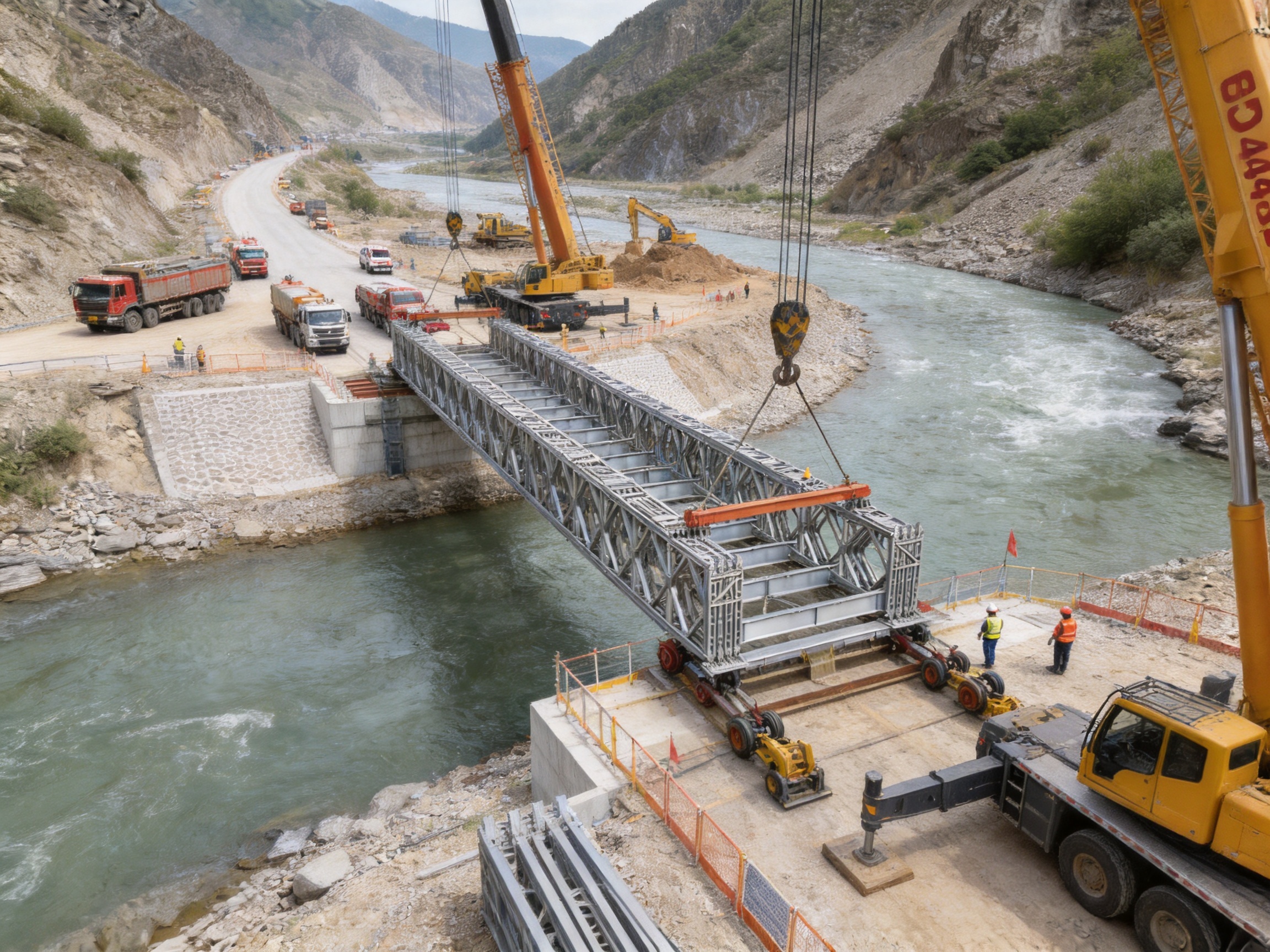
Depending on the site, the bridge may be assembled on one side and launched across the gap, assembled in sections and lifted into position, or erected through a combination of these methods. The selected approach depends on span, access, available equipment, water conditions, terrain, and traffic control requirements.
Launching can be beneficial where crane access is limited. The bridge is assembled behind an abutment or on an approach platform and moved longitudinally across the gap. A temporary launching nose may help control the cantilever during the operation. Lifting can be efficient where cranes with adequate capacity and reach are available. In either case, temporary stability is critical, and the erection sequence must be engineered rather than improvised.
After the main truss structure is positioned, the team installs deck components, bracing, approach transitions, guardrails, expansion provisions, drainage details, and traffic-control equipment. A final inspection checks bolt tightening, panel connections, deck seating, bearing conditions, clearances, alignment, protective coating damage, and load restrictions.
Quality Control and Lifecycle Management
Quality control should cover the entire bridge lifecycle, not only the final factory inspection. At the manufacturing stage, quality management includes material identification, welding control, dimensional inspection, galvanizing checks, pre-assembly, and shipment verification. At the site, it includes foundation inspection, component identification, erection monitoring, connection inspection, and commissioning.
Before opening the bridge to traffic, the project team should verify that the installed bridge matches the approved design. This includes checking span, deck width, support positions, bracing, loading signs, vehicle clearance, approach transitions, and safety barriers. If the bridge is intended for heavy traffic, a controlled proof or operational inspection may be required under the relevant authority’s procedures.
Routine inspection should focus on high-stress areas, panel connections, bolts, deck components, bearings, bracing members, expansion interfaces, drainage paths, and regions exposed to impact or standing water. Galvanized surfaces should be monitored for mechanical damage, local corrosion, or coating deterioration. Any repairs should follow an approved procedure that is compatible with the original protection system.
Modular bridges offer a maintenance advantage because individual components can often be accessed, identified, and replaced more easily than portions of a monolithic structure. However, replacement parts must match the original specification, and changes to the structural arrangement should be reviewed by qualified engineers.
Environmental and Economic Benefits
The CB 450 can provide environmental benefits by reducing the need for extensive temporary works, minimizing site fabrication, and potentially avoiding multiple intermediate supports in waterways. Faster installation can shorten the duration of construction disturbance. A reusable modular bridge may also generate less waste over multiple projects than a single-use temporary structure.
Steel components can be recovered, inspected, repaired, and reused when a temporary bridge is dismantled. This supports a more circular approach to infrastructure assets. The galvanized finish may extend serviceability and reduce the frequency of major coating work, although lifecycle performance depends on inspection and maintenance practices.
Economically, the bridge can reduce indirect costs associated with long detours, construction delays, interrupted logistics, and emergency transportation restrictions. The value of a modular bridge is therefore not limited to its purchase price. Schedule reliability, reduced site labor, reuse potential, transport efficiency, and maintenance requirements all influence the total project cost.
A proper comparison with competing solutions should evaluate the complete lifecycle. Important factors include design and engineering, foundations, transport, erection equipment, labor, traffic management, corrosion protection, inspection, dismantling, storage, relocation, and replacement components. A lower initial price may not provide the lowest total cost if the bridge requires extensive field modification or frequent repainting.
Recommended Project Evaluation Criteria
Before ordering a CB 450 bridge, owners and contractors should prepare a project information package. This package should include the required span, roadway width, design load, traffic type, expected service duration, environmental conditions, support elevations, clearance requirements, access restrictions, and preferred erection method.
The buyer should also confirm whether the bridge is intended for temporary, semi-permanent, or permanent use. Temporary use may place greater emphasis on rapid deployment and reusability, while permanent use may require additional detailing for drainage, fatigue, inspection access, utilities, barriers, and long-term maintenance.
Important technical questions include:
• What is the required clear span and total bridge length?
• What vehicles and equipment must cross the bridge?
• Which national or international load standard applies?
• Is the site exposed to salt spray, high humidity, industrial pollution, or frequent flooding?
• Can the bridge be assembled on one side and launched, or must it be lifted into place?
• What cranes, rollers, winches, transport vehicles, and temporary works are available?
• What foundation and abutment conditions exist?
• Are there restrictions related to navigation, water flow, environmental protection, or railway operations?
• What inspection, maintenance, disassembly, and relocation plan will be used?
Providing complete information at the beginning helps the manufacturer prepare a more accurate technical proposal and reduces the risk of late changes. It also makes it easier to compare the CB 450 fairly with other modular bridge systems.
Why the CB 450 Is a Competitive Modular Bridge Choice
The competitive value of the CB 450 comes from the combination of characteristics rather than from one specification alone. Its four-row single-layer reinforced arrangement provides a stronger modular platform for heavy loads. Its 81-meter maximum span supports larger crossings. Its stated 80-ton capacity expands the range of vehicles and equipment that can use the bridge. Its galvanized finish improves environmental durability. Its factory pre-assembly supports accurate installation and reduces site uncertainty.
Many bridge buyers must choose between a light temporary bridge that is easy to deploy but limited in capacity and a heavy conventional bridge that offers strength but requires longer construction and greater site resources. The CB 450 is intended to occupy the practical middle ground: a prefabricated modular system with substantial load capacity and long-span performance while retaining the logistics and installation advantages of modular construction.
The product also benefits from the manufacturer’s integrated capabilities. Engineering, automated welding, precision steel fabrication, galvanizing coordination, pre-assembly, inspection, packaging, and project support are connected within one supply chain. This can simplify communication and improve responsibility throughout the procurement process.
For international buyers, the company’s experience with different load standards and project environments is another advantage. A supplier familiar with transportation infrastructure, water conservancy, emergency response, coastal exposure, railway access, and industrial steel fabrication can offer more than components alone. It can contribute to the complete bridge solution from design coordination through delivery and installation support.
Q&A
What is the CB 450 Bailey Bridge?
The CB 450 is a modular steel Bailey bridge with a four-row single-layer reinforced configuration. It is designed for large-span and heavy-load applications and can be adapted for temporary, emergency, construction, logistics, and selected permanent infrastructure projects.
What is the maximum span of the bridge?
The maximum stated span reaches 81 meters. The usable span for a specific project depends on the required load model, support arrangement, deck configuration, stability requirements, deflection limits, environmental conditions, and erection method.
What load can the CB 450 carry?
The bridge has a stated load-bearing capacity of up to 80 tons. The final allowable loading must be confirmed through project-specific engineering, including vehicle type, axle arrangement, dynamic effects, traffic frequency, and applicable regulations.
What does four-row single-layer reinforced mean?
The description refers to a bridge arrangement using four parallel rows of primary modular truss panels in a single structural layer, with reinforcement designed to improve capacity and stability. The configuration distributes loads across multiple panel lines while maintaining a practical modular assembly concept.
Is the bridge suitable for heavy construction equipment?
Yes, the bridge is intended for applications involving heavy vehicles and equipment, subject to the approved design. The Crawler-50 load reference is also listed among the applicable load requirements. The project engineer must verify the dimensions, axle or track loads, turning behavior, and operational restrictions of the equipment.
Why is hot-dip galvanizing important?
Hot-dip galvanizing protects steel with a bonded zinc coating that provides barrier and sacrificial protection. It is particularly useful in humid, rainy, coastal, industrial, and flood-prone environments. Galvanizing reduces corrosion risk but does not remove the need for inspection, drainage management, and repair of damaged areas.
What are the benefits of factory pre-assembly?
Factory pre-assembly allows the manufacturer to verify fit, alignment, connection accuracy, component identification, and erection sequence before shipment. This can reduce field adjustment, improve installation efficiency, and identify problems while the bridge is still in a controlled production environment.
Can the bridge be reused or relocated?
As a modular system, the bridge can generally be disassembled and reused or relocated when the components remain suitable for service. Before reuse, all parts should be inspected for damage, corrosion, deformation, excessive wear, and connection condition. Any revised arrangement must be reviewed by qualified engineers.
Which load standards can the bridge meet?
The product information identifies HS-15, HS-20, HS-25, HL-93, and Crawler-50 requirements. The appropriate standard and bridge arrangement must be selected according to the project’s jurisdiction, traffic conditions, design code, and owner requirements.
Does the manufacturer provide engineering support?
Jiangsu Zhonghai Bridge Equipment Co., Ltd. integrates engineering design, manufacturing, quality management, and on-site support. The company can coordinate technical requirements such as span, loading, modular configuration, fabrication, delivery, erection, and construction support.
Where is the company located?
The company is located at Building 1, 83#, Dantu New Town, Yanjiang Road, Dantu District, Zhenjiang, Jiangsu, China. Its location in an established industrial and transportation region supports manufacturing, logistics, and international delivery operations.
What information is needed for a quotation?
A quotation normally requires the span, bridge length, clear roadway width, design load, vehicle types, site location, environmental conditions, support elevations, expected service duration, corrosion protection requirements, delivery destination, and preferred erection method. Site drawings, photographs, and geotechnical information can further improve quotation accuracy.
Conclusion
The CB 450 Four-Row Single-Layer Reinforced Galvanized Bailey Bridge is designed to meet the growing demand for modular bridge systems that combine rapid deployment with substantial structural performance. Its four-row reinforced configuration supports higher load distribution, while the maximum span of 81 meters makes it suitable for crossings that exceed the practical range of lighter modular bridges. A stated capacity of up to 80 tons allows the system to serve heavy transportation, construction, emergency, and logistics applications.
The hot-dip galvanized finish adds an important durability advantage, especially in wet, coastal, industrial, and flood-prone environments. Factory pre-assembly with high precision helps verify the fit and alignment of components before shipment, reducing uncertainty during site erection. These features distinguish the bridge from basic temporary systems that may offer lower capacity, less corrosion protection, or limited factory verification.
Jiangsu Zhonghai Bridge Equipment Co., Ltd. strengthens the product through integrated engineering, automated welding, precision fabrication, quality control, modular design, international project experience, and construction support. Its manufacturing approach allows the bridge to be adapted to different load requirements, including HS-15, HS-20, HS-25, HL-93, and Crawler-50 references.
For owners, contractors, governments, emergency agencies, and infrastructure developers, the CB 450 offers a practical way to establish strong and dependable connections while controlling construction time and site complexity. The most successful projects will combine the bridge system with careful site investigation, appropriate foundations, engineered erection procedures, effective traffic management, and a planned inspection program.
When evaluated across performance, durability, installation, reusability, logistics, and lifecycle cost, the CB 450 provides a competitive modular steel bridge solution for demanding infrastructure and emergency response requirements.
References
1. Product technical information for the CB 450 Four-Row Single-Layer Reinforced Galvanized Bailey Bridge, Jiangsu Zhonghai Bridge Equipment Co., Ltd.
2. Company information and manufacturing profile of Jiangsu Zhonghai Bridge Equipment Co., Ltd.
3. General principles of modular steel bridge design, fabrication, transportation, and field erection.
4. Highway bridge live-load concepts associated with HS-15, HS-20, HS-25, and HL-93 design references.
5. Technical principles of hot-dip galvanizing and zinc-based corrosion protection for fabricated steel structures.
6. General quality-control practices for structural steel fabrication, welding, dimensional inspection, and factory pre-assembly.
7. Engineering considerations for temporary bridges, emergency access bridges, construction crossings, and reusable modular bridge systems.
Product: CB 450 Bailey Bridge Four-Row Single-Layer Reinforced Galvanized Bailey Bridge

We respond quickly to all international requests and provide technical support when needed.
Product Category
Bailey Bridge/Modular Bridge Modular Steel Bridge Pedestrian Bridge Modular Pipe Bridge Truss Bridge Steel StructureContact Us

+86-511-84522866
+86-13921582699

zhwm@zjql.com

Building 1,83#, dantu New Town, Yanjiang Road, Dantu District, Zhenjiang, Jiangsu, China
Copyright © Jiangsu Zhonghai Bridge Equipment Co., Ltd. All
Rights
Reserved
China bailey bridge for sale
bailey bridge supplier from china
