
 English
 русский
 Español
 Português


Xie Wenlan — Modular Bridge Project Sales Specialist
CB100 Triple-Row Single-Layer Reinforced Painted Bailey Bridge: Modular Strength for Demanding Transport Projects
Content
- 1 1. Product Overview and Engineering Purpose
- 2 2. Main Configuration and Structural Characteristics
- 3 3. Advantages in Comparison with Conventional Bridge Solutions
- 4 4. Corrosion Protection for Warm and Humid Environments
- 5 5. Manufacturing Strengths and Production Capabilities
- 6 6. Construction and On-Site Assembly Benefits
- 7 7. Applications Across Transportation and Infrastructure Projects
- 8 8. Load Design and Project Customization
- 9 9. Why Manufacturing Expertise Matters to Buyers
- 10 10. Inspection, Maintenance, and Long-Term Operation
- 11 11. Installation Planning and Technical Support
- 12 12. Sustainability and Resource Efficiency
- 13 13. Procurement Considerations for International Projects
- 14 14. Competitive Position of the CB100 Solution
- 15 15. Recommended Evaluation Process
- 16 16. Frequently Asked Questions
- 16.1 What is the CB100 Triple-Row Single-Layer Reinforced Bailey Bridge?
- 16.2 Why is the bridge described as a three-lane bridge?
- 16.3 What does the single-layer reinforced design mean?
- 16.4 Can the bridge be used in humid or coastal regions?
- 16.5 Which loading standards can the bridge accommodate?
- 16.6 Is the bridge suitable for emergency deployment?
- 16.7 Can the bridge be dismantled and reused?
- 16.8 What information is needed for a quotation?
- 16.9 Does the manufacturer provide customized bridge solutions?
- 16.10 What manufacturing capabilities support this product?
- 16.11 Can the bridge be supplied for international projects?
- 16.12 What maintenance does a painted modular bridge require?
- 17 17. Conclusion
- 18 References
- 19 Product: CB 100 Bailey Bridge Triple-Row Single-Layer Reinforced Painted Bailey Bridge
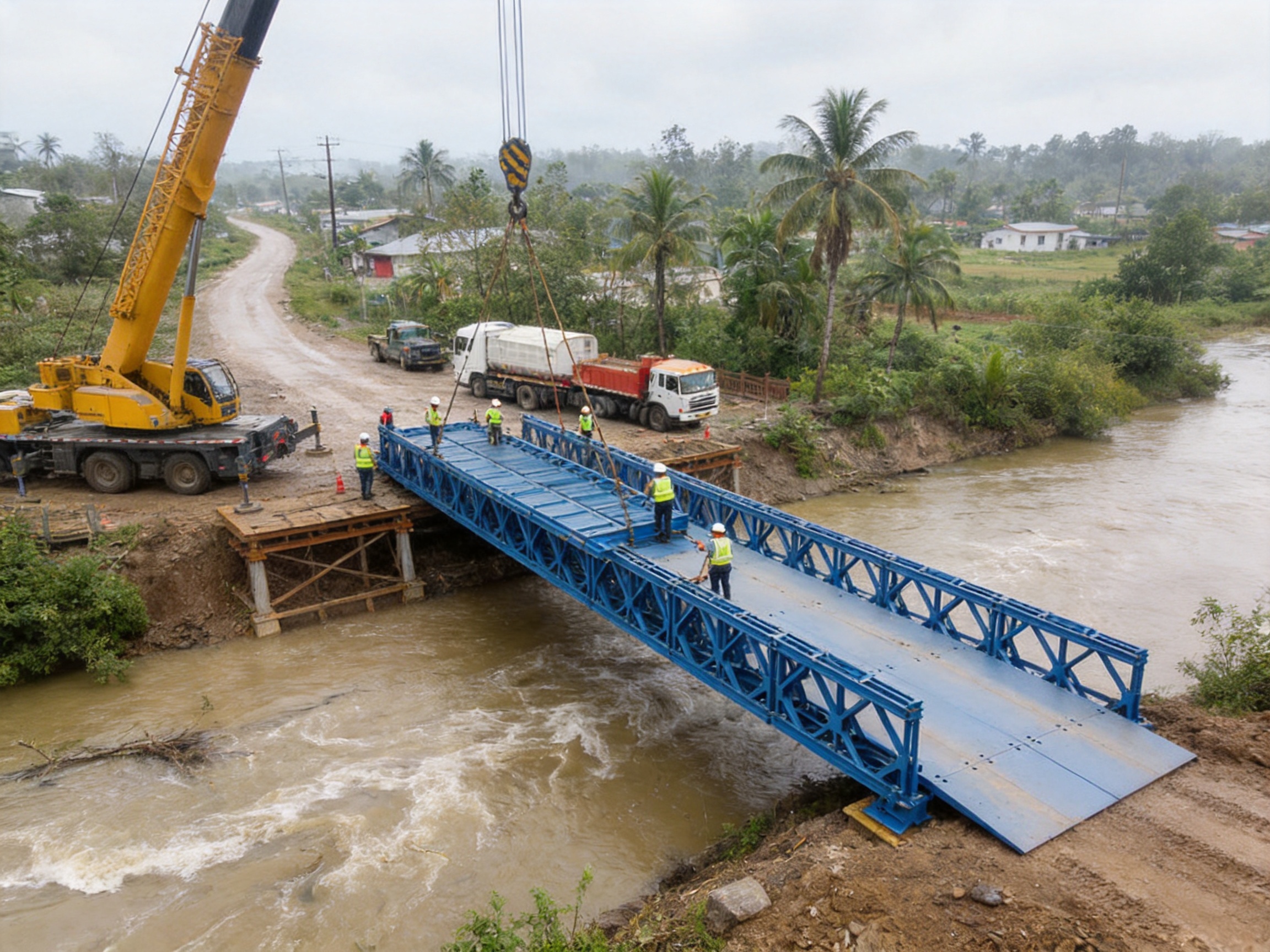
Modern infrastructure projects increasingly require bridge systems that can be delivered quickly, assembled efficiently, and adapted to changing site conditions. Whether the application involves emergency transportation, temporary construction access, rural connectivity, military logistics, water conservancy, or permanent infrastructure support, the bridge must provide more than basic crossing capability. It must combine structural reliability, practical installation, corrosion resistance, transport efficiency, and compatibility with recognized load requirements.
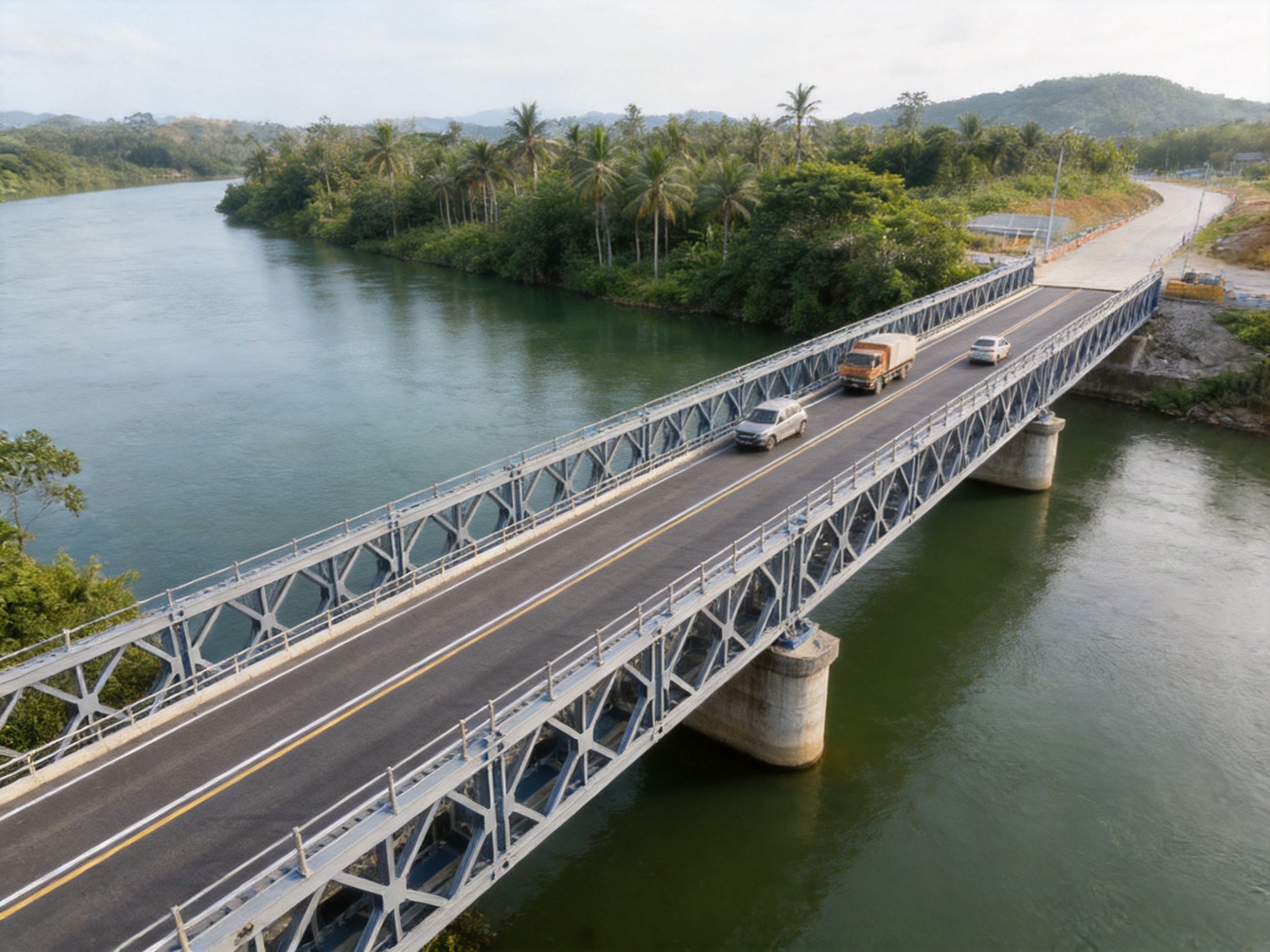
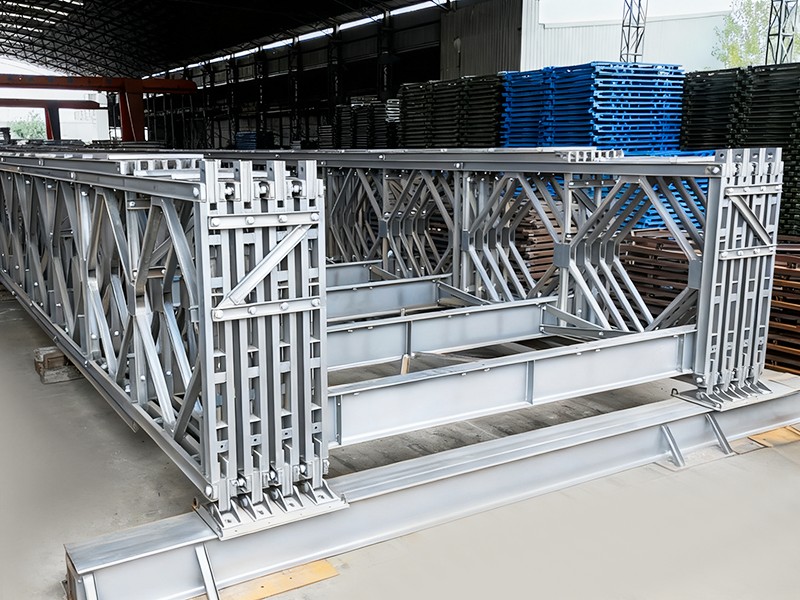
The CB100 Triple-Row Single-Layer Reinforced Painted Bailey Bridge is designed around these priorities. Located in Guangdong, this project uses a three-lane, single-layer reinforced configuration with a paint-based corrosion-resistant treatment. The design provides a practical balance between load-bearing capacity, construction speed, material efficiency, and adaptability. Its modular steel components can be transported to challenging locations and assembled on site with a controlled construction process, reducing the need for complex permanent works and minimizing disruption to traffic or surrounding operations.
As a representative CB100 or 321-type Bailey bridge solution, the structure is suitable for projects that require a strong and flexible modular bridge system. It can be configured according to span, traffic arrangement, site geometry, approach conditions, and engineering requirements. The three-lane layout is particularly useful where traffic capacity is a major consideration, while the single-layer reinforced arrangement maintains a comparatively efficient structural profile and supports rapid erection.
The bridge is manufactured by Jiangsu Zhonghai Bridge Equipment Co., Ltd., a Chinese producer specializing in modular steel bridges, Bailey bridge systems, engineered steel components, automated welding, precision fabrication, and construction support equipment. The company combines engineering design, standardized manufacturing, quality management, and project support to serve transportation, water conservancy, military logistics, disaster relief, and international infrastructure projects.
1. Product Overview and Engineering Purpose
A Bailey bridge is a modular steel bridge system made from standardized components that can be transported, connected, and erected in a wide range of configurations. Its defining feature is the use of prefabricated panels and associated structural elements rather than a bridge deck manufactured as one indivisible unit. This modular principle offers substantial advantages when the project site is remote, access is restricted, construction time is limited, or future relocation may be required.
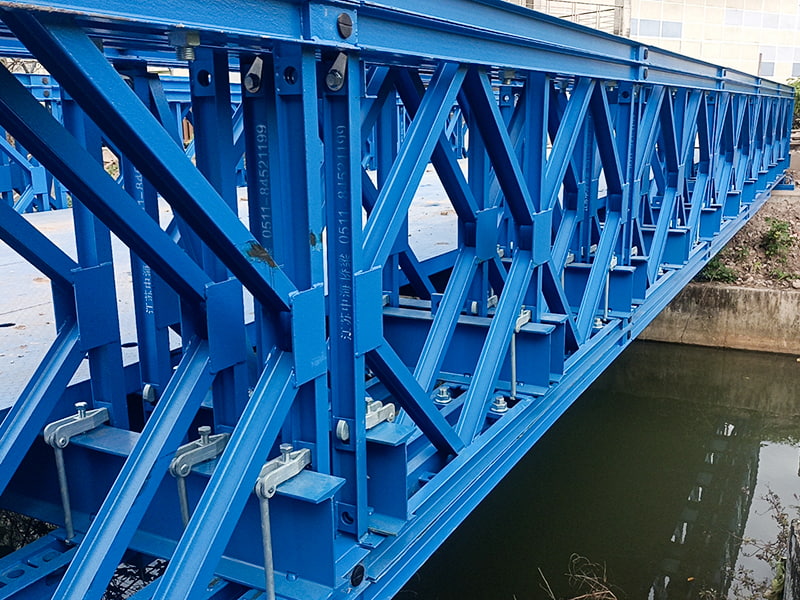
The CB100 bridge applies this modular concept to a reinforced three-lane, single-layer structure. The “triple-row” arrangement refers to the use of three longitudinal rows of connected truss panels, increasing the overall structural capacity and supporting the requirements of a wider or more heavily trafficked crossing. The single-layer format keeps the bridge profile relatively compact while allowing the system to be reinforced for demanding service conditions.
The project is located in Guangdong, where high humidity, rainfall, coastal influence, and warm temperatures can accelerate steel corrosion if protective measures are not properly selected and maintained. For this reason, the bridge uses a paint-based corrosion-resistant process. The coating acts as a protective barrier between the steel surface and the surrounding atmosphere, helping reduce the effects of moisture and environmental exposure.
The bridge is intended to support vehicle traffic and can be engineered around common loading references such as HS-15, HS-20, HS-25, HL-93, and Track-50, subject to the final design, span arrangement, support conditions, and project-specific calculations. These references represent different vehicle, highway, or tracked-load requirements. The ability to adapt the bridge design to recognized loading standards gives project owners a practical basis for selecting an appropriate configuration.
Unlike a standardized bridge product that can only be supplied in one fixed arrangement, the CB100 system can be customized for different construction environments. Span length, roadway width, reinforcement arrangement, deck configuration, access facilities, and protective treatment may be considered during the engineering stage. This flexibility makes the product useful for both planned infrastructure and rapidly organized emergency projects.
2. Main Configuration and Structural Characteristics
Three-Lane Traffic Capacity
The three-lane configuration is one of the most important characteristics of this bridge. A multi-lane arrangement can support a higher traffic volume than a narrow single-lane crossing and can improve the efficiency of construction logistics, industrial transport, emergency response, and regional access. Where vehicles must pass in both directions or where one lane must remain available for controlled traffic while another is used for special operations, a three-lane platform offers greater operational flexibility.
Three-lane bridge solutions are also valuable for temporary detours. During the construction or rehabilitation of a permanent bridge, a modular replacement must often handle traffic without creating long delays. A wider deck can accommodate traffic management plans, controlled vehicle movement, maintenance access, or staged operations. The actual operating arrangement should always be determined by the traffic engineer and project safety plan, but the wider structure provides a useful foundation for these decisions.
Single-Layer Reinforced Arrangement
A single-layer Bailey bridge has a compact structural profile and a relatively straightforward erection sequence. However, the single-layer arrangement must be carefully designed when the bridge is expected to carry higher traffic volumes or substantial vehicle loads. The CB100 product addresses this requirement through a reinforced triple-row configuration, which increases the quantity and distribution of truss support along the bridge width.
This arrangement offers an efficient alternative to simply increasing the bridge height or using a heavier multi-layer structure for every application. A single-layer reinforced bridge may require fewer vertical structural components, can be easier to inspect visually, and may reduce the complexity of lifting and connecting work. It can also be advantageous where overhead clearance, transportation restrictions, or rapid assembly are important considerations.
The final structural behavior depends on span length, panel connections, deck components, lateral bracing, wind conditions, support geometry, and applied loads. Therefore, the reinforced configuration should be treated as an engineered system rather than as a one-size-fits-all product. Zhonghai’s design and fabrication capabilities allow the configuration to be adjusted to meet the requirements of a specific site.
CB100 and 321-Type Modular Compatibility
The product belongs to the CB100 or 321-type Bailey bridge category. This type of bridge is widely recognized for its modular panel construction, practical assembly method, and ability to support different span and loading arrangements. Standardized components simplify procurement, handling, storage, replacement, and future expansion.
Modularity is especially valuable for contractors and infrastructure agencies that need to maintain an inventory of bridge components. Panels, transoms, bracing members, deck elements, and connection accessories can be organized for repeated use across multiple projects. A bridge system that can be reused or reconfigured may produce a lower total lifecycle cost than a project-specific structure that has no value after its initial application.
Component standardization also helps improve manufacturing consistency. When parts are designed around repeatable dimensions and connection details, the factory can use controlled production procedures, dedicated fixtures, automated welding equipment, and inspection checkpoints. This contributes to more predictable product quality and makes site assembly easier for trained erection teams.
3. Advantages in Comparison with Conventional Bridge Solutions
Faster Construction and Reduced Site Disruption
One of the main advantages of a modular Bailey bridge over a conventional cast-in-place concrete bridge is the reduced amount of work required at the bridge site. Concrete bridges generally require extensive formwork, reinforcement installation, concrete placement, curing time, and weather-dependent scheduling. A modular steel system can be fabricated in advance, delivered as components, and assembled after the foundations or supports are prepared.
This does not mean that a Bailey bridge eliminates all civil works. The project still requires suitable abutments, piers where applicable, bearing arrangements, approach roads, drainage, and traffic safety measures. However, the superstructure assembly is more industrialized and can proceed with fewer wet trades. This is particularly beneficial where the bridge must be opened quickly after a flood, landslide, storm, or other disruptive event.
Compared with a bespoke welded structure fabricated entirely at the project site, the CB100 system can also reduce the amount of field cutting, drilling, and adjustment. Standardized modules arrive ready for controlled connection, allowing crews to focus on positioning, bolting, alignment, bracing, and deck installation. The result is a more repeatable erection sequence and improved control over construction time.
Transport and Logistics Efficiency
Large permanent bridge sections can be difficult or expensive to move through narrow roads, mountainous regions, islands, construction corridors, or areas with damaged transportation infrastructure. Bailey bridge components are comparatively compact and can be transported separately. This makes it possible to deliver a bridge in stages and use ordinary or project-appropriate transport equipment for many applications.
Modular transportation also provides logistical resilience. If a project location is accessible only through a temporary road or if transport capacity changes during construction, smaller components can be scheduled according to the actual availability of vehicles and lifting resources. In emergency applications, multiple component packages can be dispatched to several locations without requiring a single oversized transport operation.
Adaptability to Different Site Conditions
Conventional bridge designs are often optimized for one site and one final configuration. The CB100 system is more adaptable because its components can be arranged for different spans, widths, reinforcement levels, and support conditions. This makes it suitable for rivers, irrigation channels, road crossings, construction sites, temporary detours, and areas where the final infrastructure plan may evolve.
Customization is particularly important when actual site conditions differ from preliminary assumptions. A project may encounter an unexpected foundation constraint, a revised traffic forecast, a changed water level, or a need for greater clearance. A modular bridge supplier with engineering and fabrication capacity can review the project and adapt the configuration rather than forcing the customer to select an unrelated bridge type.
Reusability and Lifecycle Value
A modular steel bridge can often be dismantled, transported, stored, and reassembled when the original temporary crossing is no longer needed. This creates a reuse opportunity that is not available with most cast-in-place temporary structures. Government agencies, contractors, and disaster-response organizations can maintain bridge inventories and deploy components as requirements change.
Reusability can reduce material waste and improve the economic value of the initial investment. It also supports a more flexible infrastructure strategy. A bridge purchased for emergency access may later be reassigned to a construction detour, agricultural road, mining access route, or regional development project, provided that the components remain within their design and maintenance requirements.
Efficient Structural Performance
The reinforced triple-row configuration provides a substantial structural system without requiring the full mass and complexity of some conventional alternatives. Steel offers a high strength-to-weight ratio, which helps the bridge carry significant loads while keeping individual components manageable for transport and erection.
Compared with a narrow single-lane modular bridge, the three-lane CB100 arrangement provides greater usable width and operational capacity. Compared with an unreinforced single-layer arrangement, the triple-row reinforcement improves the structural reserve available for vehicle traffic, subject to engineering verification. Compared with a completely custom temporary bridge, the standardized system benefits from established component relationships and repeatable production procedures.
4. Corrosion Protection for Warm and Humid Environments
Steel bridge performance depends not only on structural design but also on protection against corrosion. In warm and humid regions, moisture can remain on exposed surfaces for long periods. Rainfall, condensation, airborne pollutants, salt-laden air, and standing water may further increase corrosion risk. A suitable coating system is therefore an important part of the bridge specification.
The CB100 bridge in Guangdong uses a paint-based corrosion-resistant treatment. This process is intended to create a barrier that limits direct contact between the steel and the surrounding environment. Proper surface preparation, coating selection, application thickness, curing conditions, and inspection all influence the effectiveness of the protection system.
A paint-based system offers several practical benefits. It can be applied to complex steel components, refreshed during maintenance, and adapted to different project requirements. Damaged areas can generally be identified through visual inspection and repaired without replacing an entire panel. The coating color can also support inspection and identification of surface defects, although the specific coating system should be selected according to exposure conditions and technical specifications.
For coastal or highly exposed environments, the project owner should define the required durability level, surface preparation standard, primer and topcoat compatibility, dry-film thickness, edge treatment, and maintenance schedule. Protective coatings are not a substitute for good drainage and proper detailing. Water traps, crevices, damaged fasteners, and debris accumulation should be minimized through design and routine inspection.
The Guangdong project demonstrates how a modular bridge can be adapted to local climate conditions rather than supplied with a generic finish. This type of environmental customization is an important advantage when comparing bridge suppliers. A manufacturer that understands the relationship between climate, coating systems, transportation, erection, and maintenance can provide a more complete solution than a company that only sells unmodified steel panels.
5. Manufacturing Strengths and Production Capabilities
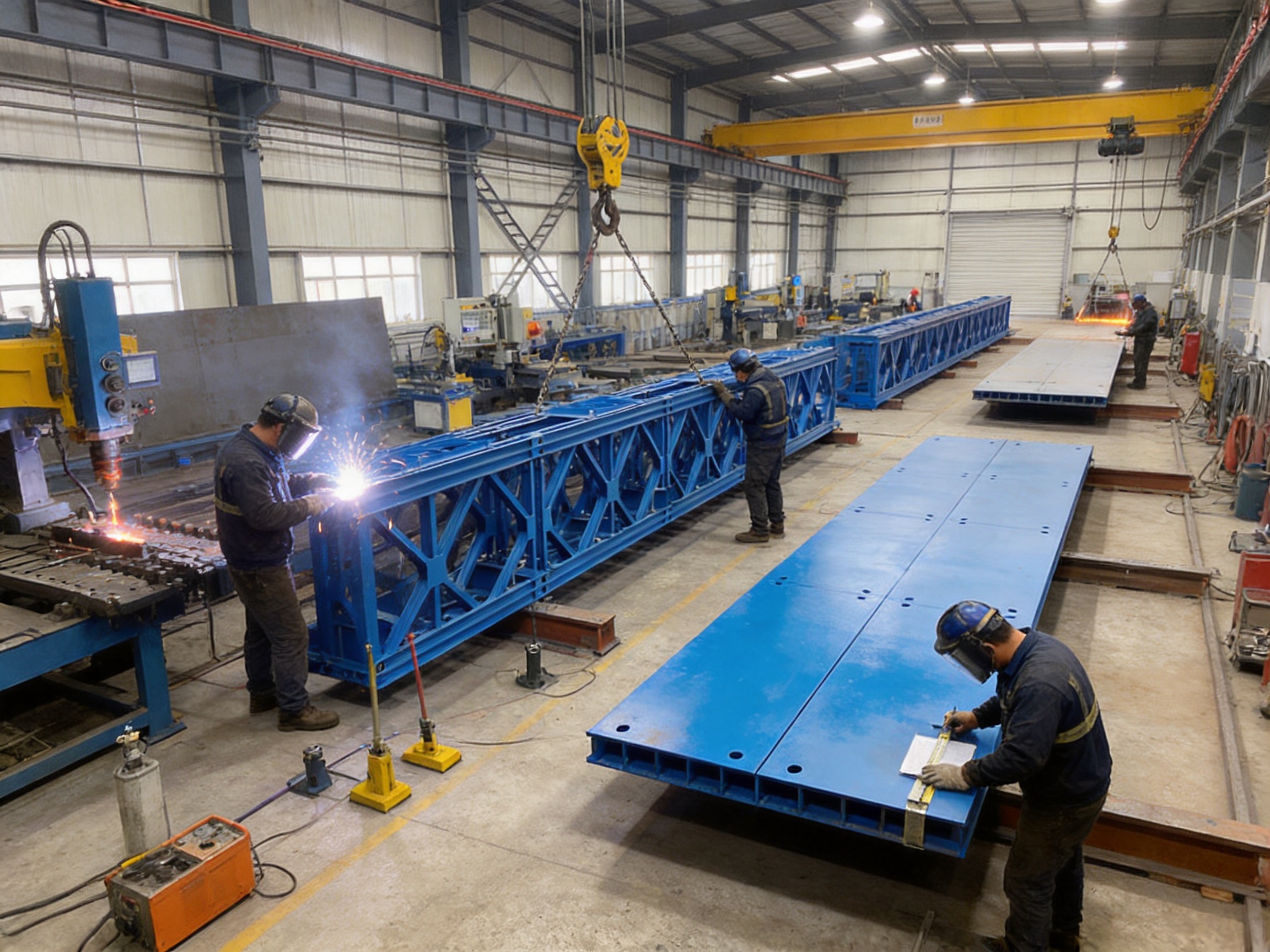
The performance of a modular bridge begins at the factory. Even a well-established bridge concept can produce unreliable results if the manufacturing process lacks dimensional control, welding consistency, material traceability, or inspection discipline. Zhonghai’s production approach integrates engineering design, precision manufacturing, quality management, automated welding, and standardized workflows.
Engineering Design Integration
Design and manufacturing are closely connected in modular bridge production. Component geometry, connection locations, weld access, lifting points, transport limitations, and erection sequence must be considered together. An engineering team that understands fabrication can develop components that are not only structurally sound but also practical to manufacture and install.
For the CB100 bridge, engineering review may include the required span, roadway width, vehicle loading, support arrangement, lateral stability, deck system, wind conditions, approach geometry, and corrosion environment. The manufacturer can then prepare production drawings and fabrication information that guide the factory and support later site assembly.
This integrated approach helps reduce the risk of design details that are difficult to produce or install. It also improves communication between the client, designer, manufacturer, and contractor. When modifications are required, the engineering and production teams can coordinate changes more efficiently.
Automated Welding and Consistent Fabrication
Automated welding is one of the important capabilities used in modern steel bridge manufacturing. Compared with uncontrolled manual welding alone, automated processes can provide more consistent welding speed, heat input, and bead placement when used with suitable fixtures and qualified procedures. Consistency is especially important for repeated modular components, where small variations can accumulate during assembly.
Automated welding does not eliminate the need for skilled technicians. Operators must prepare joints, set equipment parameters, monitor the process, manage fit-up, and carry out inspections. Manual welding remains useful for complex areas, repairs, and locations that cannot be reached by automated equipment. The combination of automation and experienced personnel allows the factory to use efficient production methods without sacrificing flexibility.
For structural bridge components, welding procedures should be selected according to the material grade, joint design, thickness, loading requirements, and applicable standards. Visual inspection and additional non-destructive testing may be applied as required by the project specification. Consistent fabrication improves the fit of panels, braces, and connection components during field erection.
Precision Steel Fabrication
Precision fabrication is essential for modular systems because components must connect correctly at the construction site. Dimensional accuracy affects panel alignment, bolt installation, deck placement, bracing fit, and the overall geometry of the completed bridge. Factory-controlled cutting, drilling, forming, and assembly help reduce the need for field modification.
Standardized workflows allow the production team to repeat the same operations across multiple components. Work instructions, fixtures, templates, measuring equipment, and inspection records can be used to improve repeatability. This is particularly valuable for bridge systems supplied in large quantities or for projects where multiple spans must be assembled from interchangeable modules.
Quality Management
Quality management should cover the entire product lifecycle, from raw material procurement to final shipment. Important controls may include material certificates, incoming inspection, welding procedure qualification, welder competency, dimensional inspection, coating inspection, bolt and accessory verification, final assembly checks, and packaging review.
A structured quality system also supports traceability. Components can be identified by production batch, drawing number, or inspection record so that the project team can confirm what was manufactured and how it was checked. Traceability is useful during installation, maintenance, repair, and future reuse.
Zhonghai’s stated manufacturing approach is aligned with internationally oriented production. The company reports that its factory uses advanced automation and standardized workflows to produce high-strength modular bridge systems in accordance with ASTM, EN, and national specifications. The applicable standard should always be confirmed for each project, but the ability to work across different specification environments is valuable for international customers.
6. Construction and On-Site Assembly Benefits
The modular nature of the CB100 bridge supports a planned erection process. Components can be delivered to the site, checked against packing lists and drawings, organized in assembly zones, and installed according to a defined sequence. This approach is more efficient when the contractor prepares lifting equipment, temporary supports, tools, labor, access roads, and safety controls in advance.
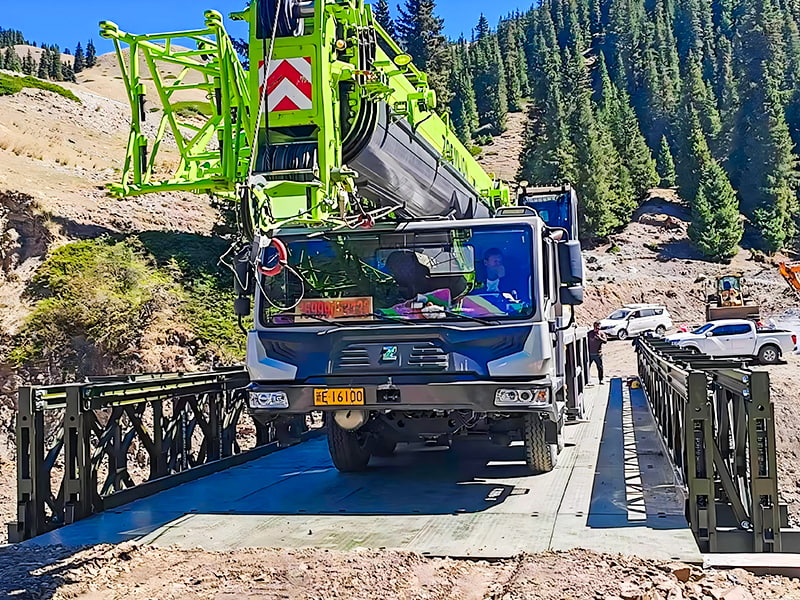
Depending on the span and site conditions, bridge panels may be assembled on one side of the crossing and launched or lifted into position. Other projects may use cranes, temporary trestles, or staged assembly from the supports. The appropriate method depends on water depth, river flow, site access, available equipment, overhead restrictions, and the weight of assembled sections.
Because the product is based on modular components, the construction team can divide the work into manageable activities. These may include foundation preparation, bearing installation, panel assembly, bracing installation, transom placement, deck installation, handrail installation, approach connection, alignment, and final inspection. This division helps contractors plan labor and equipment more effectively.
Field assembly can also reduce the duration of road or waterway closures. A shorter installation period means fewer interruptions to local traffic, commercial operations, emergency services, and surrounding communities. For construction detours, the bridge may allow the main project to continue while a permanent crossing is being repaired or replaced.
Safety remains a fundamental requirement. The bridge should be erected by qualified personnel using approved drawings and procedures. Temporary stability, lifting operations, bolt tightening, working at height, fall protection, exclusion zones, and weather conditions must be managed throughout the assembly process. The modular design supports efficient construction, but it does not remove the need for disciplined engineering supervision.
CB 100 Bailey Bridge Triple-Row Single-Layer Reinforced Painted Bailey Bridge
7. Applications Across Transportation and Infrastructure Projects
Emergency and Disaster-Response Bridges
Floods, earthquakes, landslides, typhoons, and other disasters can damage roads and isolate communities. A modular bridge can restore access more quickly than a permanent reconstruction project because the steel superstructure can be manufactured or stored in advance. The CB100 system is suitable for emergency logistics where vehicles, relief supplies, rescue equipment, and construction machinery must cross a damaged route.
The three-lane layout can be valuable in emergency areas where traffic demand is irregular but intense. Relief convoys, heavy equipment, local vehicles, and repair crews may need to share the crossing. A wider platform provides more options for controlled movement, although the bridge operator should establish appropriate speed, weight, lane, and traffic-management rules.
Construction Detours
Infrastructure construction often requires an existing bridge or roadway to be closed temporarily. A modular Bailey bridge can serve as a bypass while the permanent structure is widened, repaired, or replaced. The bridge may be installed quickly, operated during the main construction period, and removed when the original route is reopened.
Its reusable nature can lower the cost of repeated detour projects. Contractors may move the bridge to a new location after the first project is completed, making the equipment part of a broader construction fleet rather than a single-use asset.
Rural and Regional Connectivity
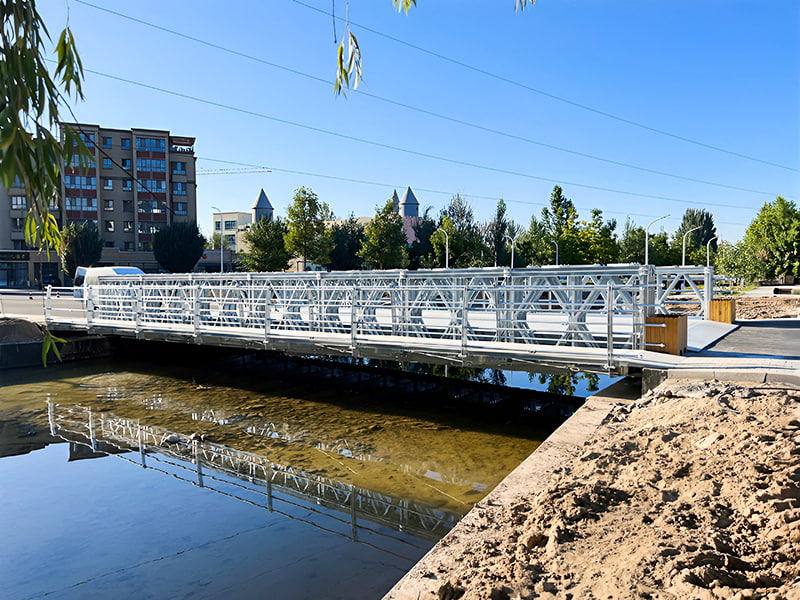
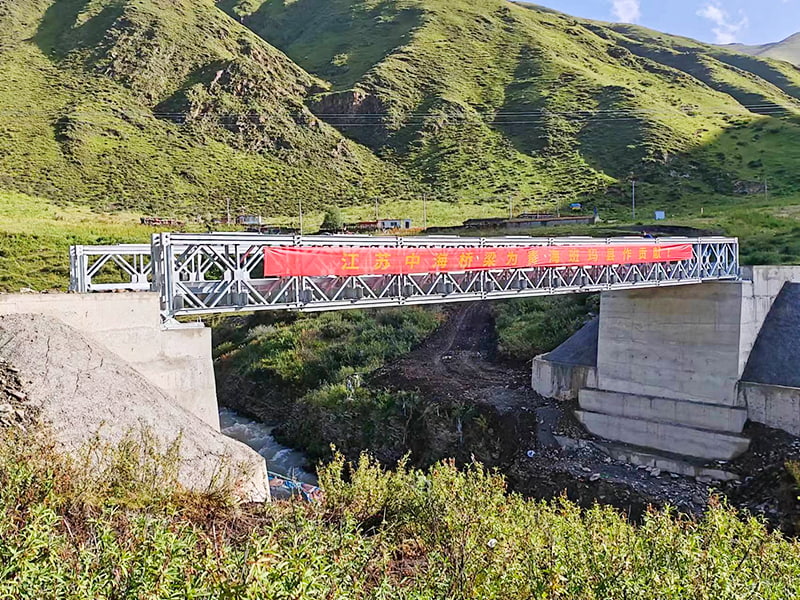
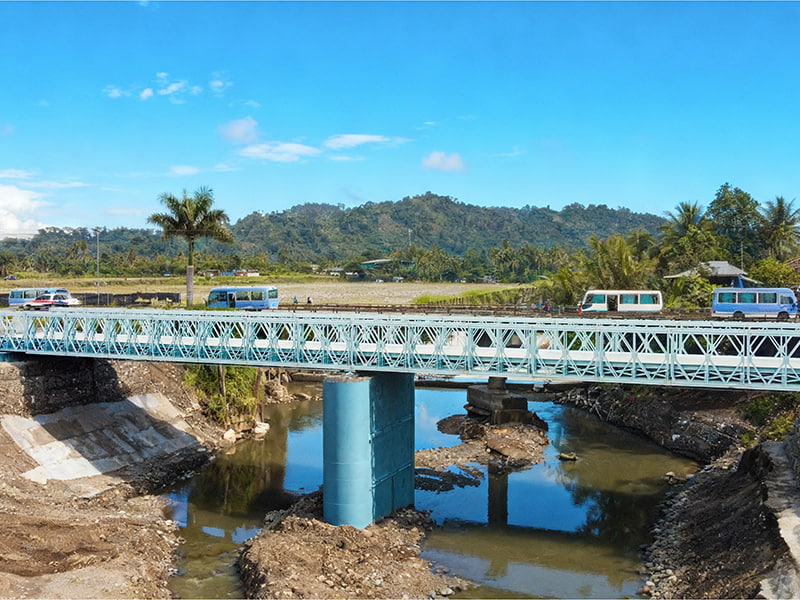
In rural areas, a modular bridge can connect communities separated by rivers, drainage channels, or seasonal waterways. The bridge’s adaptable configuration allows engineers to respond to different crossing lengths and traffic conditions. It can support agricultural vehicles, service trucks, passenger vehicles, and local commercial traffic when designed for the applicable loads.
For regional development programs, modular bridges can help provide access while more permanent infrastructure is being planned or funded. They may also serve as interim structures during phased development, allowing transportation links to open earlier and support economic activity.
Water Conservancy and Industrial Access
Water conservancy projects often require temporary access across canals, reservoirs, flood channels, and construction zones. A modular steel bridge can provide access for excavators, cranes, concrete trucks, maintenance teams, and inspection personnel. Its components can be installed around the project schedule and removed or relocated as the water-control works progress.
Industrial sites, mines, ports, energy projects, and large manufacturing facilities may also require temporary or semi-permanent crossings. The bridge can be customized around vehicle loads, site restrictions, approach geometry, and environmental exposure. A painted corrosion-resistant finish is useful in many industrial environments, provided that the coating specification corresponds to the actual exposure conditions.
Military and Strategic Logistics
Military logistics and strategic transportation require bridge systems that can be deployed, relocated, and adapted with limited delay. Modular bridge components support organized storage and rapid mobilization. The CB100 system can be engineered for vehicle traffic and may be configured for demanding logistical requirements, subject to project-specific design verification.
In these applications, transport packaging, assembly procedures, component identification, field repair, and operational flexibility are often as important as the nominal bridge capacity. A manufacturer with experience in modular systems can support these requirements through standardized component production and technical documentation.
8. Load Design and Project Customization
Bridge selection should be based on the actual loads and operating conditions expected during the project. The CB100 bridge can be designed to suit loading references such as HS-15, HS-20, HS-25, HL-93, and Track-50. These designations may correspond to different highway vehicle models, heavy-load conditions, or tracked vehicle requirements depending on the applicable standard and project interpretation.
The bridge supplier and project engineer should confirm the intended load model, vehicle dimensions, axle spacing, lane arrangement, impact factors, braking forces, wind loads, seismic conditions, pedestrian requirements, and any special construction loads. It is not sufficient to select a load designation without reviewing how the bridge will actually be used.
Customization may include bridge length, roadway width, panel arrangement, reinforcement level, deck type, curb and handrail arrangement, access ramp, bearing design, surface treatment, and color. Additional features may be considered for pedestrian safety, utility support, inspection access, lighting, drainage, or traffic control.
Customization is a major advantage over competing products that are offered only as fixed packages. A fixed bridge may appear simple to purchase, but it can create problems if its width, load rating, corrosion protection, or support arrangement does not fit the project. A configurable system allows the client to purchase a solution that is closer to actual requirements and may reduce unnecessary material or redesign work.
| Project Requirement | CB100 Modular Response | Practical Benefit |
|---|---|---|
| High traffic volume | Three-lane bridge configuration | Greater traffic capacity and more flexible traffic management |
| Demanding vehicle loads | Triple-row, single-layer reinforced structure | Improved load-bearing potential within a compact bridge profile |
| Warm and humid climate | Paint-based corrosion-resistant treatment | Barrier protection against moisture and environmental exposure |
| Remote or restricted site | Transportable modular components | Easier delivery, staged logistics, and reduced oversized transport needs |
| Short construction schedule | Prefabricated panels and standardized connections | Faster on-site assembly than many conventional construction methods |
| Future relocation | Bolted, reusable modular system | Potential for dismantling, storage, and reassembly |
| Different engineering standards | Design support for ASTM, EN, national, and project specifications | Better adaptability for domestic and international projects |
9. Why Manufacturing Expertise Matters to Buyers
Purchasing a modular bridge is not only a matter of comparing panel prices. The supplier’s engineering depth, manufacturing control, project experience, documentation, and after-sales support directly influence the project outcome. A low initial quotation can become expensive if components do not fit, coating quality is inconsistent, technical drawings are incomplete, or replacement parts are difficult to obtain.
Zhonghai’s broader product range includes modular steel bridges, Bailey bridge systems, customized steel components, bridge erection and construction support equipment, automated welding, and precision steel fabrication. This range indicates that the company can support more than the supply of individual bridge panels. It can participate in the design, fabrication, and implementation of an integrated bridge solution.
The company’s location in Zhenjiang, Jiangsu Province, places it within an important industrial and transportation region. Access to manufacturing resources, logistics networks, skilled labor, and industrial supply chains supports large-scale production and international delivery. This is important for customers who require repeat orders, multiple bridge packages, or coordinated delivery to different project locations.
Experience across different project categories also strengthens the supplier’s ability to understand practical site requirements. Zhonghai reports involvement in coastal engineering in the Maldives, temporary access bridges for the Shenzhen–Zhongshan Corridor, structural components for the Hangzhou Expo Center, multi-span Bailey bridges for the Lalin Railway, and flood-response and emergency bridge deployments in multiple regions.
These project categories involve different challenges. Coastal engineering demands attention to environmental exposure. Major transportation corridors require coordination, reliability, and construction planning. Railway-related projects demand careful control of geometry and load conditions. Emergency deployments require speed and logistical flexibility. Experience across these environments can help the manufacturer provide more informed recommendations for new customers.
10. Inspection, Maintenance, and Long-Term Operation
Although modular bridges are designed for efficient assembly, they require regular inspection and maintenance. Routine checks should cover deck condition, panel members, connection bolts, bracing, bearings, expansion areas, drainage, handrails, approach transitions, and coating condition. The frequency of inspection should reflect traffic intensity, climate, exposure, bridge importance, and local regulations.
In warm and humid areas, particular attention should be paid to locations where water or dirt can accumulate. Coating damage should be repaired promptly to prevent localized corrosion from developing beneath the protective system. Areas around bolt heads, connection plates, welds, edges, and drainage outlets may require closer observation.
Bolted connections should be inspected according to the approved maintenance procedure. Loose or damaged fasteners can affect structural performance and should be addressed by qualified personnel. Any modification, drilling, cutting, or welding performed after delivery should be reviewed by the responsible engineer because uncontrolled changes can affect the original design assumptions.
Traffic management is also part of bridge maintenance. The operating authority should enforce the approved vehicle weight, speed, lane, and clearance restrictions. Overloaded vehicles, impact damage, excessive braking, and unauthorized modifications can reduce the service life of any modular bridge.
A well-maintained painted steel bridge can provide dependable service for temporary, semi-permanent, or permanent applications. The modular design can make repairs more manageable because individual components may be inspected, replaced, or refurbished without dismantling the entire bridge, depending on the nature and location of the damage.
11. Installation Planning and Technical Support
Successful bridge installation begins before the components reach the site. The project team should confirm the final span, support elevations, foundation capacity, approach alignment, transportation route, assembly area, lifting equipment, workforce, weather conditions, and safety plan. Early coordination allows the manufacturer to prepare appropriate drawings, component lists, erection guidance, and packaging arrangements.
The assembly site should provide enough space to organize panels and accessories in the correct sequence. Components should be protected from unnecessary contact with standing water, mud, chemicals, and construction debris. A clear inventory process helps confirm that all required items have arrived before erection begins.
Temporary works are another important consideration. Depending on the erection method, the project may need temporary trestles, launching noses, rollers, lifting frames, cranes, guide beams, or temporary bracing. These items should be designed or selected by competent engineers and checked for the expected construction loads.
Once the bridge is positioned, the final alignment, bearing contact, connection status, deck installation, bracing, and approach transitions should be inspected. A formal opening inspection should confirm that the bridge has been assembled according to the approved design and that operational restrictions are clearly communicated to users.
Technical support from the supplier can improve this process. Zhonghai’s integrated engineering and manufacturing model enables the company to provide design coordination and construction support in addition to fabrication. For overseas customers, effective technical communication, documentation, packing lists, installation guidance, and remote support can be especially valuable.
12. Sustainability and Resource Efficiency
Modular steel bridge systems can contribute to resource efficiency through reuse, repairability, and controlled manufacturing. A bridge that can be dismantled and moved may avoid the need to manufacture a new structure for every temporary crossing. Standardized components can also be maintained as an inventory and deployed repeatedly.
Factory fabrication may reduce material waste compared with uncontrolled site fabrication. Cutting plans, repeatable component dimensions, and production controls can support more efficient use of steel. Automated welding and standardized workflows may also reduce rework, which saves material, labor, and energy.
Steel components can be repaired, refurbished, and eventually recycled at the end of their useful life. The actual environmental performance depends on transportation distance, foundation work, coating materials, maintenance, and the number of reuse cycles. Nevertheless, the modular principle provides a strong basis for lifecycle-oriented infrastructure planning.
For project owners, sustainability should be evaluated beyond the initial purchase price. A reusable bridge with accessible replacement components may offer better long-term value than a disposable temporary structure. The CB100 system’s standardized and relocatable characteristics support this type of lifecycle assessment.
13. Procurement Considerations for International Projects
International customers should provide detailed project information when requesting a quotation. Important data includes the required clear span, overall bridge length, roadway width, traffic lanes, design vehicle, expected daily traffic, bridge elevation, waterway conditions, environmental exposure, foundation concept, approach road geometry, delivery location, and preferred coating system.
The buyer should also confirm the desired scope of supply. A complete package may include main truss panels, transoms, bracing, deck units, bearings, handrails, ramps, bolts, tools, launching equipment, spare parts, technical drawings, packing lists, and installation support. Clearly defining the scope helps avoid gaps between the bridge supplier and the civil contractor.
Documentation is especially important when a bridge is being imported. Customers may require material certificates, welding records, coating reports, dimensional inspection records, packing documents, installation manuals, structural calculations, and compliance statements. The required documents depend on the destination country, project owner, engineer, and applicable standard.
Lead time should be discussed early. Standard modular components may be available within a different schedule from customized components or special coating systems. Production planning, inspection, packing, and sea or land transportation all influence the delivery date. A manufacturer with an organized production system can help the customer establish a realistic schedule.
For repeat infrastructure programs, customers may benefit from framework agreements, standard component inventories, spare-part planning, and training for local erection teams. These arrangements can reduce future procurement time and make the bridge system more valuable across multiple projects.
14. Competitive Position of the CB100 Solution
The CB100 Triple-Row Single-Layer Reinforced Painted Bailey Bridge competes through a combination of structural capacity, traffic width, environmental adaptation, modularity, and manufacturing support. Some suppliers may focus primarily on low-cost standard panels. Others may offer highly customized bridges at a higher cost or with longer production periods. The CB100 system seeks to provide a practical middle ground: a standardized modular platform with enough flexibility for project-specific engineering.
Its three-lane arrangement distinguishes it from narrow single-lane bridge packages when traffic capacity is important. Its reinforced triple-row structure offers an upgraded configuration compared with basic single-layer solutions. Its paint-based corrosion-resistant treatment responds to the requirements of warm and humid environments such as Guangdong. Its modular construction supports transportation, rapid erection, future relocation, and component replacement.
The supplier’s competitive advantage also comes from manufacturing depth. Advanced automation, precision steel fabrication, engineering design, standardized workflows, and international project experience provide a stronger foundation than simple trading or component resale. Customers can communicate with a manufacturer capable of reviewing requirements, producing customized components, and supporting field implementation.
Cost control is another practical benefit. Modular production can reduce project costs through repeatable fabrication, shorter site assembly, reduced temporary disruption, and potential reuse. The most economical solution is not always the bridge with the lowest purchase price; it is the system that delivers the required performance with manageable installation, maintenance, and lifecycle expenses.
15. Recommended Evaluation Process
Before ordering a CB100 bridge, the project owner should complete a structured evaluation. First, define the bridge function: emergency, temporary detour, construction access, permanent regional crossing, industrial connection, or another purpose. Second, determine the traffic and load requirements. Third, confirm the site geometry and environmental conditions. Fourth, select the appropriate reinforcement, deck, coating, and support arrangement.
The next step is to review engineering documents and manufacturing capabilities. The buyer should ask whether the supplier can provide structural calculations, fabrication drawings, material documentation, coating specifications, inspection records, installation guidance, and after-sales support. It is also useful to confirm the supplier’s experience with comparable spans, traffic conditions, climate exposure, and delivery destinations.
Finally, the project team should compare total project value. This includes the bridge package, foundations, transport, cranes, erection labor, traffic control, coating maintenance, spare parts, dismantling, relocation, and final removal if the bridge is temporary. A modular bridge often performs best when these lifecycle factors are considered together rather than when the decision is based only on the initial steel price.
16. Frequently Asked Questions
What is the CB100 Triple-Row Single-Layer Reinforced Bailey Bridge?
It is a modular steel bridge system using a single-layer reinforced truss arrangement with three longitudinal rows of panels. The configuration is intended to provide greater structural capacity and a wider traffic platform than a basic narrow Bailey bridge, while retaining the transport and assembly benefits of modular construction.
Why is the bridge described as a three-lane bridge?
The bridge is designed with a three-lane traffic arrangement. This provides increased usable width and allows the project team to develop more flexible traffic-management plans. The final lane operation, vehicle restrictions, and safety controls must be determined according to the approved project design.
What does the single-layer reinforced design mean?
Single-layer refers to the vertical arrangement of the main truss system, while reinforced refers to the additional structural arrangement used to increase load-bearing performance. The triple-row configuration distributes support across the bridge width and is engineered according to the required span and loading conditions.
Can the bridge be used in humid or coastal regions?
Yes, the bridge can be specified with a paint-based corrosion-resistant treatment suitable for warm and humid environments. The coating system should be selected according to the actual exposure, and regular inspection, cleaning, drainage control, and touch-up maintenance are necessary for long-term performance.
Which loading standards can the bridge accommodate?
The product can be designed to suit load references such as HS-15, HS-20, HS-25, HL-93, and Track-50, subject to project-specific engineering. Customers should provide the applicable national standard, vehicle model, axle loads, lane arrangement, impact requirements, and other design parameters before final approval.
Is the bridge suitable for emergency deployment?
Yes. Its modular components can be transported separately and assembled on site, making the system suitable for emergency access, flood response, disaster relief, and temporary route restoration. Site foundations, temporary works, equipment, labor, and safety procedures must still be prepared appropriately.
Can the bridge be dismantled and reused?
Modular Bailey bridge components are generally suitable for dismantling, storage, inspection, and reassembly. Reuse depends on the condition of the components, the results of inspection, the new design requirements, and any applicable engineering approval.
What information is needed for a quotation?
The supplier normally needs the clear span, total length, traffic width, number of lanes, design load, bridge elevation, support conditions, site location, environmental exposure, deck requirements, coating preference, delivery terms, and installation-support requirements. Drawings, photographs, survey data, or preliminary site layouts can improve quotation accuracy.
Does the manufacturer provide customized bridge solutions?
Yes. The CB100 system can be adapted in terms of span, width, reinforcement, deck arrangement, corrosion protection, accessories, and support details. Customization should be reviewed through engineering calculations and approved drawings before production.
What manufacturing capabilities support this product?
The manufacturer integrates engineering design, precision steel fabrication, automated welding, standardized production workflows, quality management, and construction support. These capabilities help improve component consistency, connection accuracy, documentation, and delivery coordination.
Can the bridge be supplied for international projects?
Yes. The manufacturer serves domestic and international infrastructure projects and reports experience with projects in transportation, coastal engineering, railway construction, flood response, and emergency access. International customers should confirm applicable standards, export documents, inspection requirements, packaging, and installation support during procurement.
What maintenance does a painted modular bridge require?
Maintenance should include inspection of the coating, truss panels, bolts, bracing, deck, bearings, drainage, handrails, and approach transitions. Damaged coating should be repaired promptly, and any loose or damaged structural connection should be addressed by qualified personnel.
17. Conclusion
The CB100 Triple-Row Single-Layer Reinforced Painted Bailey Bridge provides a balanced solution for projects that require strength, traffic capacity, rapid installation, environmental protection, and future flexibility. Its three-lane arrangement supports higher operational demand than narrow modular bridge configurations, while the reinforced single-layer structure maintains a practical and relatively efficient profile.
The paint-based corrosion-resistant treatment is particularly relevant to warm and humid regions such as Guangdong. When combined with suitable drainage, inspection, cleaning, and maintenance, the coating helps protect the steel system from environmental exposure. The modular construction method supports staged delivery, efficient site assembly, relocation, component replacement, and reuse.
Its value is strengthened by the manufacturing capabilities of Jiangsu Zhonghai Bridge Equipment Co., Ltd. The company combines engineering design, automated welding, precision fabrication, standardized workflows, quality management, and project support. Its experience across modular bridge systems, railway projects, coastal engineering, transportation corridors, water conservancy, and emergency response enables it to address both standard and customized requirements.
For infrastructure owners, contractors, government agencies, and international engineering partners, the CB100 system offers more than a collection of steel panels. It represents an integrated bridge solution that can be engineered around real site conditions, produced under controlled factory procedures, transported efficiently, assembled with a planned sequence, and maintained throughout its service life. When the project requires a dependable and adaptable modular crossing, this reinforced painted Bailey bridge is a strong candidate for evaluation.
References
1. Product information for the CB100 Triple-Row Single-Layer Reinforced Painted Bailey Bridge, Guangdong project.
2. Company information and manufacturing profile of Jiangsu Zhonghai Bridge Equipment Co., Ltd.
3. General engineering principles for modular steel bridge design, fabrication, erection, inspection, and maintenance.
4. ASTM structural steel, welding, coating, and bridge-related specification references, as applicable to project requirements.
5. EN structural steelwork, execution, corrosion protection, and bridge engineering references, as applicable to project requirements.
6. Highway and transportation bridge loading references, including HS-series and HL-93 design models.
7. Guidance materials concerning Track-50 tracked-vehicle loading and modular military bridge applications.
8. General practices for steel surface preparation, protective coating application, dry-film inspection, and maintenance in humid and coastal environments.
Product: CB 100 Bailey Bridge Triple-Row Single-Layer Reinforced Painted Bailey Bridge

We respond quickly to all international requests and provide technical support when needed.
Product Category
Bailey Bridge/Modular Bridge Modular Steel Bridge Pedestrian Bridge Modular Pipe Bridge Truss Bridge Steel StructureContact Us

+86-511-84522866
+86-13921582699

zhwm@zjql.com

Building 1,83#, dantu New Town, Yanjiang Road, Dantu District, Zhenjiang, Jiangsu, China
Copyright © Jiangsu Zhonghai Bridge Equipment Co., Ltd. All
Rights
Reserved
China bailey bridge for sale
bailey bridge supplier from china
