
 English
 русский
 Español
 Português


Tang Yuwei — International Bailey Bridge Sales Manager
Large-Span Heavy-Load Railway Super Bailey Construction Support
Content
- 1 1. The Role of Heavy-Duty Construction Support in Railway Engineering
- 2 2. Product Overview and Main Configuration
- 3 3. Structural Advantages of the Super Bailey Panel System
- 4 4. Advantages Compared with Conventional Temporary Support Solutions
- 5 5. Railway Bridge and Tunnel Applications
- 6 6. Manufacturing Process and Production Strengths
- 7 7. Engineering Design Considerations
- 8 8. Installation, Operation, and Maintenance
- 9 9. International Manufacturing and Project Support Capability
- 10 10. Why This Product Is Suitable for Major Infrastructure Projects
- 11 11. Selection Guidance for Buyers and Contractors
- 12 12. Frequently Asked Questions
- 12.1 Q1: What is the primary purpose of this super Bailey construction support?
- 12.2 Q2: What is the maximum span of the system?
- 12.3 Q3: Can the system carry 900 tons in every installation?
- 12.4 Q4: What are the dimensions of the main super Bailey panels?
- 12.5 Q5: What makes this system different from a light-duty Bailey bridge?
- 12.6 Q6: Can the support be used over roads, rivers, or excavations?
- 12.7 Q7: Is the system reusable?
- 12.8 Q8: What manufacturing capabilities support the product?
- 12.9 Q9: Which standards can be considered during production?
- 12.10 Q10: Does the supplier provide installation support?
- 12.11 Q11: What information should be supplied for a quotation?
- 12.12 Q12: Can the system be customized?
- 13 13. Conclusion
- 14 References
- 15 Product: Large Span Heavy Load Railway Super Bailey Construction Support
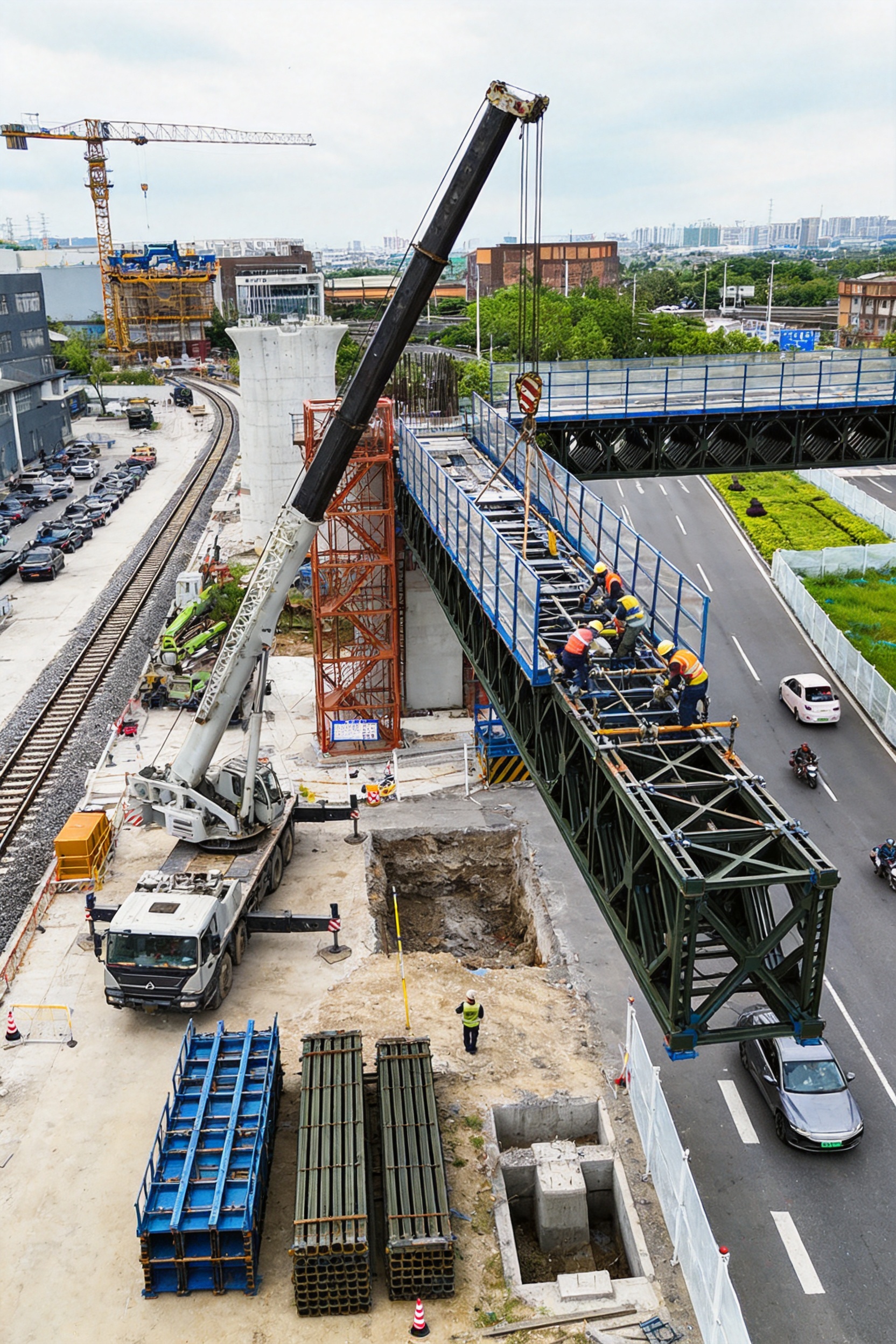
Railway construction increasingly requires temporary and semi-permanent support systems that can carry exceptional loads while maintaining stability over considerable spans. Bridge rehabilitation, tunnel construction, track replacement, viaduct erection, launching operations, and heavy equipment access all depend on support structures that can be installed efficiently, adapted to difficult site conditions, and removed or reused after the project is completed. The Large-Span Heavy-Load Railway Super Bailey Construction Support has been developed to address these demanding requirements with a high-capacity modular steel system designed for major railway engineering projects.
Based on advanced 4 m × 2 m super Bailey panels, this construction support system combines the flexibility of modular bridge technology with the strength required for heavy railway construction. Its single-span configuration can reach a total length of up to 39 meters, while its maximum load capacity can reach 900 tons under suitable engineering conditions and approved design parameters. This combination of long-span capability, high load resistance, modular assembly, and controlled manufacturing makes the system suitable for projects where conventional temporary supports may be too weak, too complicated, or too slow to deploy.
The system is intended for demanding construction environments rather than ordinary pedestrian access or light temporary crossings. It can support heavy machinery, prefabricated components, steel assemblies, construction materials, lifting operations, and other temporary loads associated with large railway bridges and tunnels. Its modular design allows project engineers to configure support arrangements according to span, load distribution, site geometry, working height, and construction sequence.
Manufactured by Jiangsu Zhonghai Bridge Equipment Co., Ltd., the system benefits from integrated engineering design, precision steel fabrication, automated welding, quality management, and project support capabilities. These strengths enable the manufacturer to provide more than individual panels or standard components. The company can supply an engineered support solution that includes structural planning, component production, quality control, delivery coordination, and technical assistance for installation and use.
1. The Role of Heavy-Duty Construction Support in Railway Engineering
Railway projects place unusual demands on temporary structures. Construction sites may need to maintain strict alignment, control deformation, accommodate large lifting equipment, and support loads that are significantly greater than those encountered in ordinary road or pedestrian bridge applications. A temporary support system may also need to remain stable while construction activities change the distribution of forces from one stage to another.
During the construction of a railway bridge, for example, temporary supports may be required beneath girders, segmental assemblies, launching equipment, formwork, or track-related structures. During tunnel work, support systems may be used to carry equipment, materials, temporary platforms, or access arrangements over excavated sections and other obstacles. In river crossings and complex terrain, the support system may need to span an open area while minimizing the number of intermediate foundations.
These requirements create a need for a structural system with several qualities at the same time:
• High load-bearing capacity for heavy construction equipment and materials.
• Adequate span capability to reduce the need for piers or temporary obstructions.
• Modular components that can be transported, assembled, adjusted, and reused.
• Reliable connection details capable of transferring shear, bending, and axial forces.
• Controlled manufacturing tolerances that support efficient field assembly.
• Adaptability to different construction sequences and site conditions.
• Documented quality management and engineering support.
A standard light-duty temporary bridge may not be suitable for these conditions. The Large-Span Heavy-Load Railway Super Bailey Construction Support is designed specifically for the higher end of the temporary support market. Its purpose is to provide a dependable load path between the construction load and the foundations or supporting ground while maintaining practical installation and removal procedures.
2. Product Overview and Main Configuration
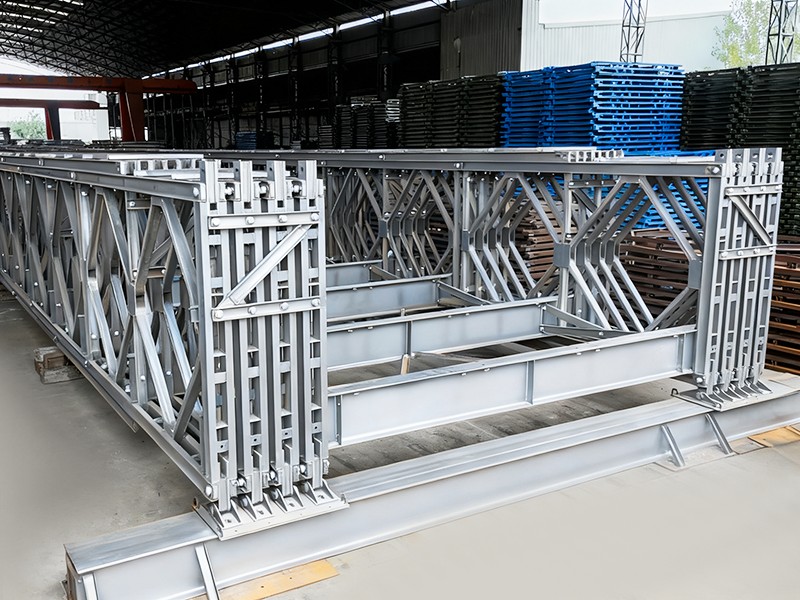
The system uses 4 m × 2 m super Bailey panels as its principal modular structural units. These larger panels provide a strong and repeatable framework for assembling a long-span support arrangement. Compared with smaller or lighter panel systems, the super Bailey format is intended to deliver greater structural depth, improved stiffness, and higher load capacity for major construction applications.
The product is configured as a single-span construction support system with a maximum total length of approximately 39 meters. A single-span arrangement can be especially valuable when the construction area below must remain open. It can reduce interference with river channels, roadways, railway alignments, excavation zones, work platforms, and equipment movement routes.
Under properly engineered conditions, the system can accommodate a maximum load of up to 900 tons. The actual permitted capacity depends on factors such as span length, load position, support conditions, lateral restraint, foundation performance, connection arrangement, wind exposure, construction sequence, and applicable design standards. Therefore, the 900-ton figure should be understood as a maximum project-dependent capacity rather than an automatic rating for every installation.
| Item | Product Information | Engineering Significance |
|---|---|---|
| Product type | Heavy-duty modular Bailey construction support | Suitable for temporary support and major construction operations |
| Primary panel size | 4 m × 2 m super Bailey panel | Provides a larger modular structural unit for high-capacity applications |
| Structural arrangement | Single-span configuration | Helps keep the area below open and reduces dependence on intermediate supports |
| Maximum stated span | Up to 39 m | Supports large-span construction requirements |
| Maximum stated load | Up to 900 tons | Can accommodate heavy machinery, materials, and construction assemblies when engineered correctly |
| Primary application | Railway bridges, tunnels, and major infrastructure projects | Designed for complex, high-load construction environments |
| System character | Modular, reusable, and configurable | Supports transport efficiency, project adaptability, and future reuse |
The configuration can be adapted through changes in panel arrangement, bracing, support details, bearing conditions, deck or working platform arrangements, and load distribution elements. Each project should be reviewed by qualified structural engineers so that the final system matches the actual design loads and site conditions.
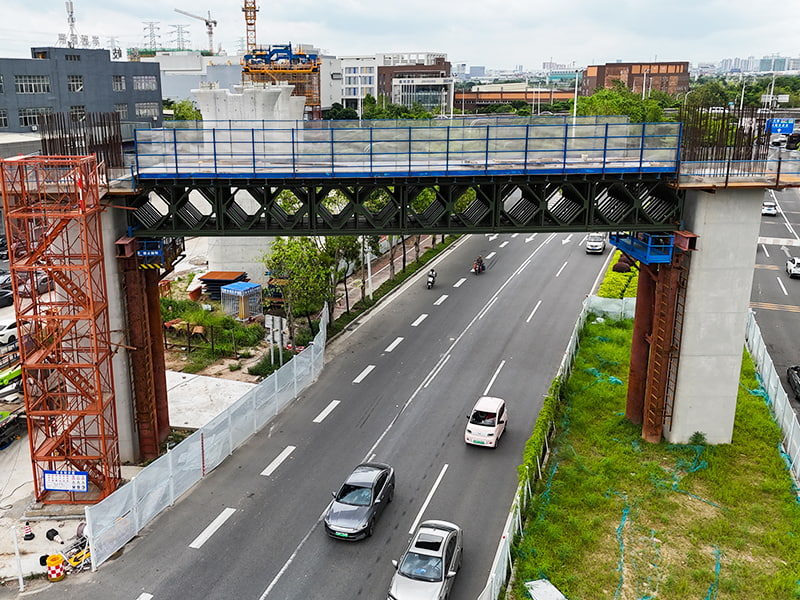
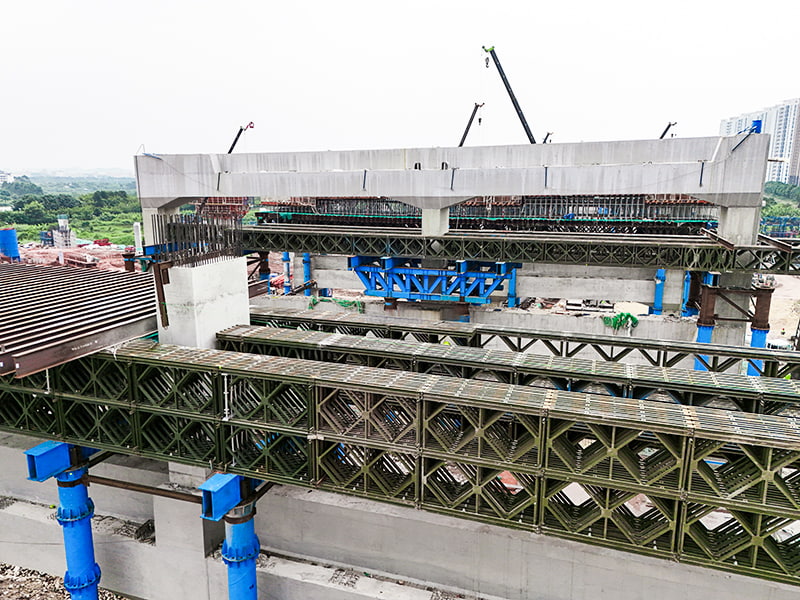
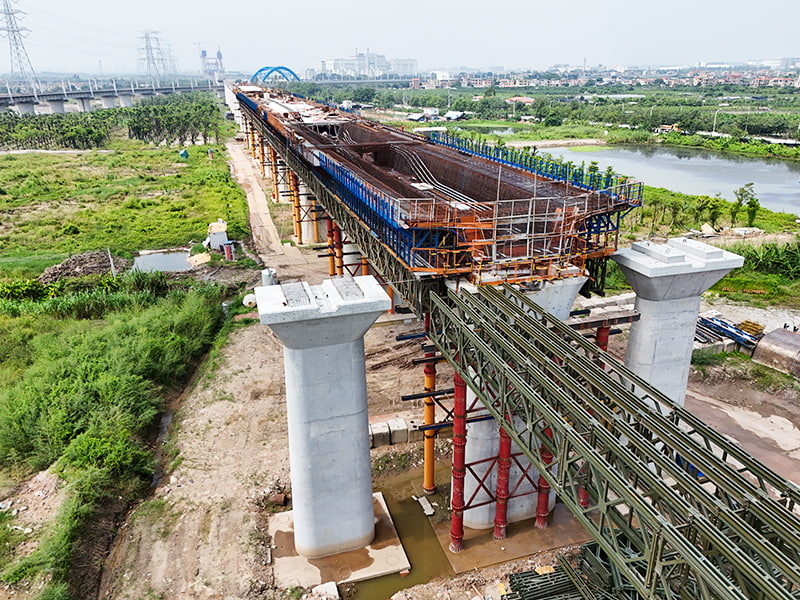
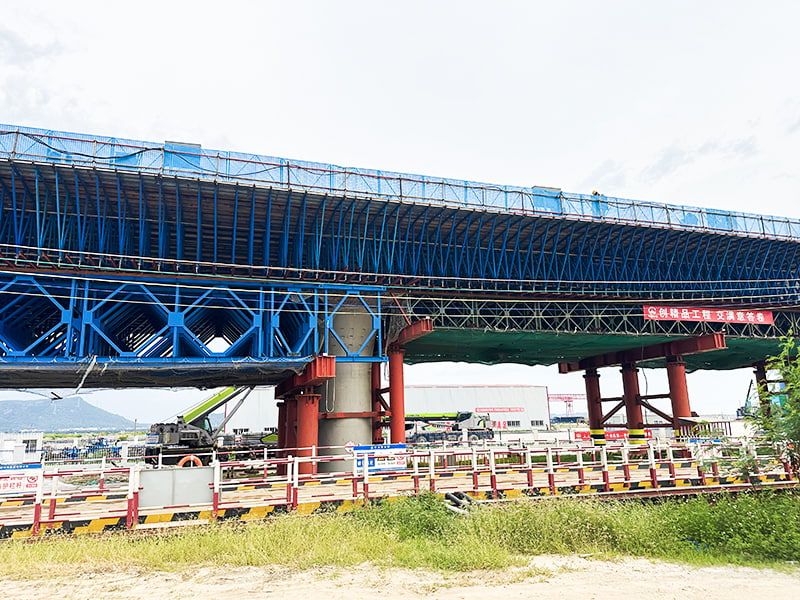
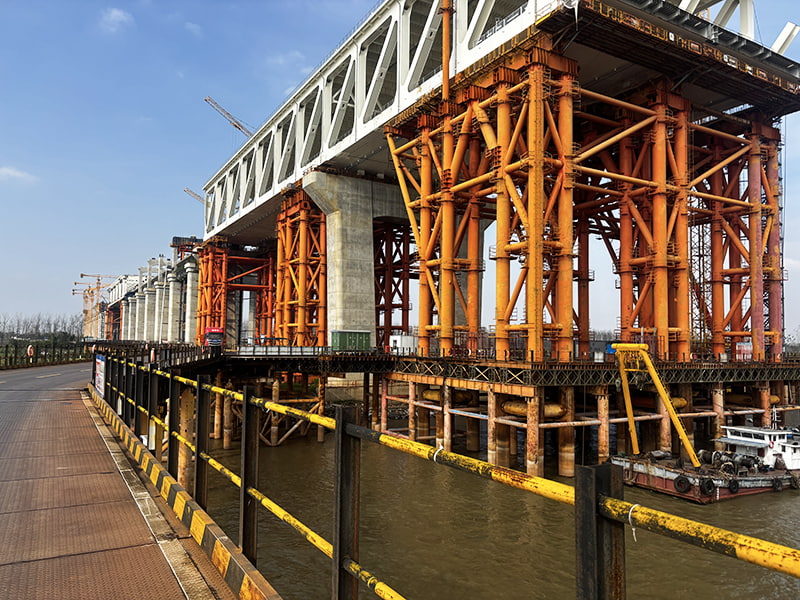
Large Span Heavy Load Railway Super Bailey Construction Support
3. Structural Advantages of the Super Bailey Panel System
3.1 High Capacity Through Modular Structural Depth
The 4 m × 2 m super Bailey panel is designed to provide more structural depth and stiffness than a light modular panel. Structural depth is important because it can improve resistance to bending and reduce deflection under heavy loads. In long-span applications, excessive deflection can affect construction accuracy, equipment operation, load distribution, and worker safety. A deeper panel system can help create a more stable support arrangement when combined with suitable bracing and bearing conditions.
The system’s modular geometry also creates a regular load path. Repeated panels work together through pins, bolts, bracing members, and other connection components. This organized arrangement makes it possible to calculate and inspect the support system using defined structural assumptions rather than relying on improvised field assembly.
3.2 Long Single-Span Capability
A span of up to 39 meters can provide a major practical advantage on sites where intermediate supports are undesirable. Temporary piers placed in a river, excavation, roadway, or active work zone can increase construction complexity and introduce additional risks. They may obstruct material movement, interfere with environmental controls, or require separate foundation work.
By using a single-span arrangement, the support system can help preserve a clear working area beneath the structure. This can be valuable for railway bridge construction, where heavy vehicles and lifting equipment may need to move through the area. It can also be useful for tunnel approaches, water conservancy structures, and emergency works where access conditions change quickly.
3.3 Heavy Load Resistance
The stated maximum load capacity of up to 900 tons positions the product for applications beyond ordinary temporary access. The support can be engineered for large construction loads such as bridge segments, launching gantries, heavy cranes, formwork systems, steel assemblies, precast components, and stockpiled materials. The ability to carry heavy loads over a substantial span may reduce the need for multiple smaller support structures and can simplify the overall construction layout.
Heavy-load performance depends on more than the strength of the main panels. Bearings, foundations, lateral bracing, transverse distribution, connection hardware, lifting points, temporary restraints, and construction-stage stability all contribute to the final capacity. One advantage of an engineered modular system is that these elements can be considered together during design rather than treated as separate, unrelated site components.
3.4 Reusability and Project Flexibility
Modular steel panels are intended to be assembled and disassembled using repeatable procedures. After one project is completed, components may be inspected, repaired if necessary, transported, and configured for another application. This reusability can lower the lifecycle cost of temporary works and reduce material waste compared with one-time fabricated support frames.
Reusability is particularly valuable for contractors working on railway networks, infrastructure programs, disaster-response projects, and repeated bridge rehabilitation operations. A stock of modular components can be deployed to different locations, subject to engineering verification and component inspection. The same basic technology may support different spans, load cases, and site arrangements when sufficient panels and accessories are available.
4. Advantages Compared with Conventional Temporary Support Solutions
Temporary support solutions range from cast-in-place concrete piers and fabricated steel towers to scaffolding systems, proprietary launching equipment, and individually designed steel frames. Each approach has appropriate applications. The Large-Span Heavy-Load Railway Super Bailey Construction Support offers particular advantages where rapid modular deployment, high capacity, and clear-span performance are important.
4.1 Compared with Cast-In-Place Temporary Piers
Cast-in-place concrete supports can provide substantial capacity, but they generally require foundation preparation, reinforcement installation, formwork, concrete placement, curing time, and later demolition. These activities may extend the construction schedule and create additional waste. They can also be difficult to use in waterways, environmentally sensitive areas, or locations with restricted access.
A modular steel support system can reduce the amount of wet construction work. Factory-produced components arrive at the site ready for assembly, allowing the installation team to focus on foundations, bearings, lifting, bolting, pinning, and bracing. The system can also be removed more efficiently after use, which may be important when the site must be restored or returned to service.
4.2 Compared with Improvised Steel Frames
Improvised steel frames may appear economical at first, but their performance can be difficult to predict. Differences in material grade, welding quality, connection geometry, corrosion condition, and dimensional accuracy may create uncertainty. A non-standard frame may also require significant site modification before it can be used safely.
Standardized super Bailey panels provide a more controlled basis for engineering and inspection. Repeated components, defined connection details, and established assembly methods help reduce variation. This does not eliminate the need for project-specific design, but it provides a more reliable starting point than assembling an unverified frame from miscellaneous steel members.
4.3 Compared with Light-Duty Modular Panels
Light modular bridge panels are often suitable for pedestrian bridges, emergency access routes, small vehicles, and moderate spans. They may not provide the structural depth or connection capacity required for heavy railway construction loads. Using a light-duty system beyond its intended application can result in excessive deflection, connection overstress, or inadequate stability.
The super Bailey configuration is designed for the opposite end of the application range. Its larger panels and heavy-duty arrangement are intended to support major loads over longer spans. This makes it a more appropriate choice for heavy bridge construction equipment and large temporary support operations, provided that the system is properly designed and installed.
4.4 Compared with Fully Proprietary Systems
Some temporary works depend on proprietary equipment with specialized components, dedicated erection tools, and limited supplier availability. These systems can be effective but may involve higher rental costs, longer lead times, or more complex logistics when deployed internationally.
A modular Bailey-based system offers a familiar structural concept with standardized components and flexible configuration options. Its components can be produced, shipped, assembled, and reused across different markets. This can be advantageous for contractors seeking a durable and adaptable solution that is not restricted to a single project methodology.
5. Railway Bridge and Tunnel Applications
5.1 Bridge Girder and Segment Support
During railway bridge construction, the support system can be used beneath girders, precast segments, steel assemblies, or temporary launching arrangements. It can provide a stable working platform while permanent bridge elements are positioned and connected. The large span allows the support to cross roads, waterways, existing tracks, or construction openings with fewer obstructions below.
Where bridge elements are delivered in stages, the support system can be designed for changing load positions. Engineers may evaluate concentrated wheel loads, lifting reactions, temporary storage loads, impact factors, and unbalanced loading during erection. The modular structure can then be arranged with appropriate transverse distribution and lateral restraint.
5.2 Tunnel Construction Support
Tunnel and underground projects often involve restricted access, variable ground conditions, and the need to move heavy equipment across open excavations or construction zones. A long-span temporary support can help create a stable route for materials, machinery, formwork, and construction operations without placing multiple supports inside the working area.
In tunnel approaches, the support may also be used as a temporary platform for construction logistics. It can assist with moving reinforcement, steel members, precast linings, concrete equipment, or mechanical systems. The final configuration must account for ground movement, vibration, water conditions, clearance, and the interaction between the support and excavation support system.
5.3 Railway Rehabilitation and Replacement Work
Railway rehabilitation projects frequently take place in locations where the railway must remain partially operational or where construction windows are short. A modular support system can be assembled in advance, transported in manageable sections, and installed during planned work periods. Its rapid erection potential may reduce disruption to existing infrastructure.
The system can support temporary platforms, lifting operations, replacement bridge components, construction machinery, and temporary track-related works. Because the components are reusable, the same equipment may be deployed for several rehabilitation locations along a railway corridor.
5.4 Emergency and Disaster-Response Construction
Floods, landslides, earthquakes, and other emergencies can damage railway bridges and access routes. In these situations, the ability to deliver a high-capacity modular support system can be critical. The product’s modular nature allows components to be transported by standard logistics methods and assembled with locally available lifting and erection equipment, subject to site conditions.
Emergency use still requires engineering review. Damaged foundations, unstable riverbanks, debris impact, scour, wind, and restricted access can all influence the support arrangement. However, a standardized high-capacity modular system can provide a faster starting point than designing and fabricating a completely new temporary structure after a disaster.
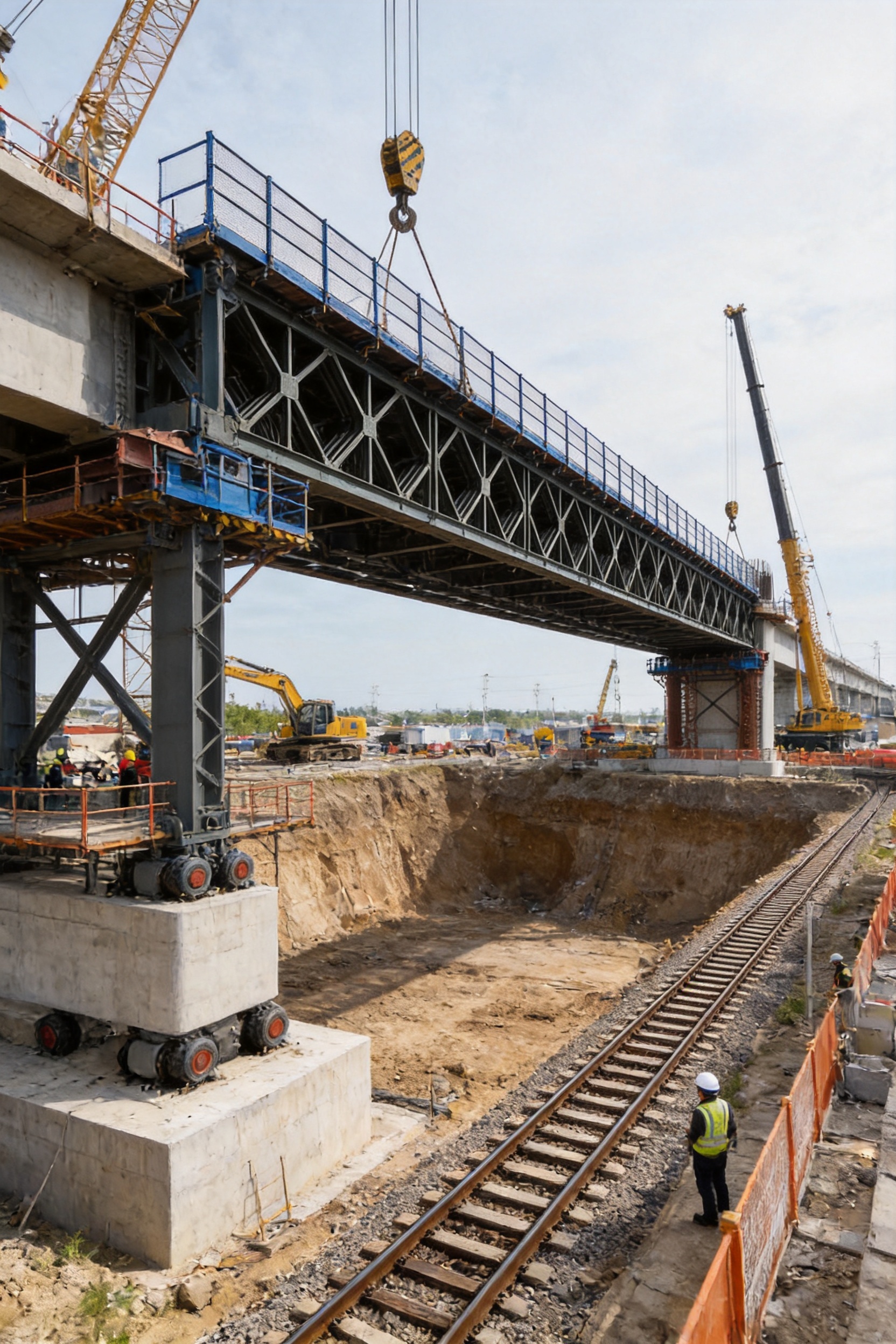
6. Manufacturing Process and Production Strengths
The performance of a heavy modular support system begins with manufacturing quality. Structural panels must meet dimensional requirements, connection components must fit accurately, and welded joints must achieve consistent strength. A manufacturer with integrated production capabilities can control more of these factors than a supplier that only assembles or resells externally produced components.
6.1 Engineering Design and Production Planning
The manufacturing process begins with engineering review and production planning. Product drawings, material specifications, connection details, welding requirements, inspection points, and packing arrangements are coordinated before fabrication begins. This preparation helps ensure that the finished components correspond to the intended structural configuration.
For customized projects, the production team can evaluate span requirements, panel quantities, bracing arrangements, transport limitations, support conditions, and expected loading. The objective is to provide components that are compatible with the project’s construction method instead of delivering a generic product without considering field requirements.
6.2 Material Control
High-strength structural steel is selected according to the required mechanical properties, weldability, thickness, environmental conditions, and applicable standards. Material certificates and identification procedures help maintain traceability from incoming steel to finished components.
Material control is especially important for modular systems because repeated components may be used across multiple projects. Consistent material properties support predictable structural calculations and help ensure that replacement or additional components are compatible with the original system.
6.3 Precision Cutting and Forming
Steel plates and sections are cut and formed using controlled production equipment. Accurate cutting supports proper fit-up, while controlled forming helps maintain the geometry of the panel and its connection interfaces. Dimensional consistency is essential because small errors can accumulate when multiple panels are assembled across a long span.
Precision production also reduces the need for field modification. Drilling, slotting, and connection preparation can be completed under factory conditions, where equipment and inspection procedures are more controlled than on a temporary construction site.
6.4 Automated and Controlled Welding
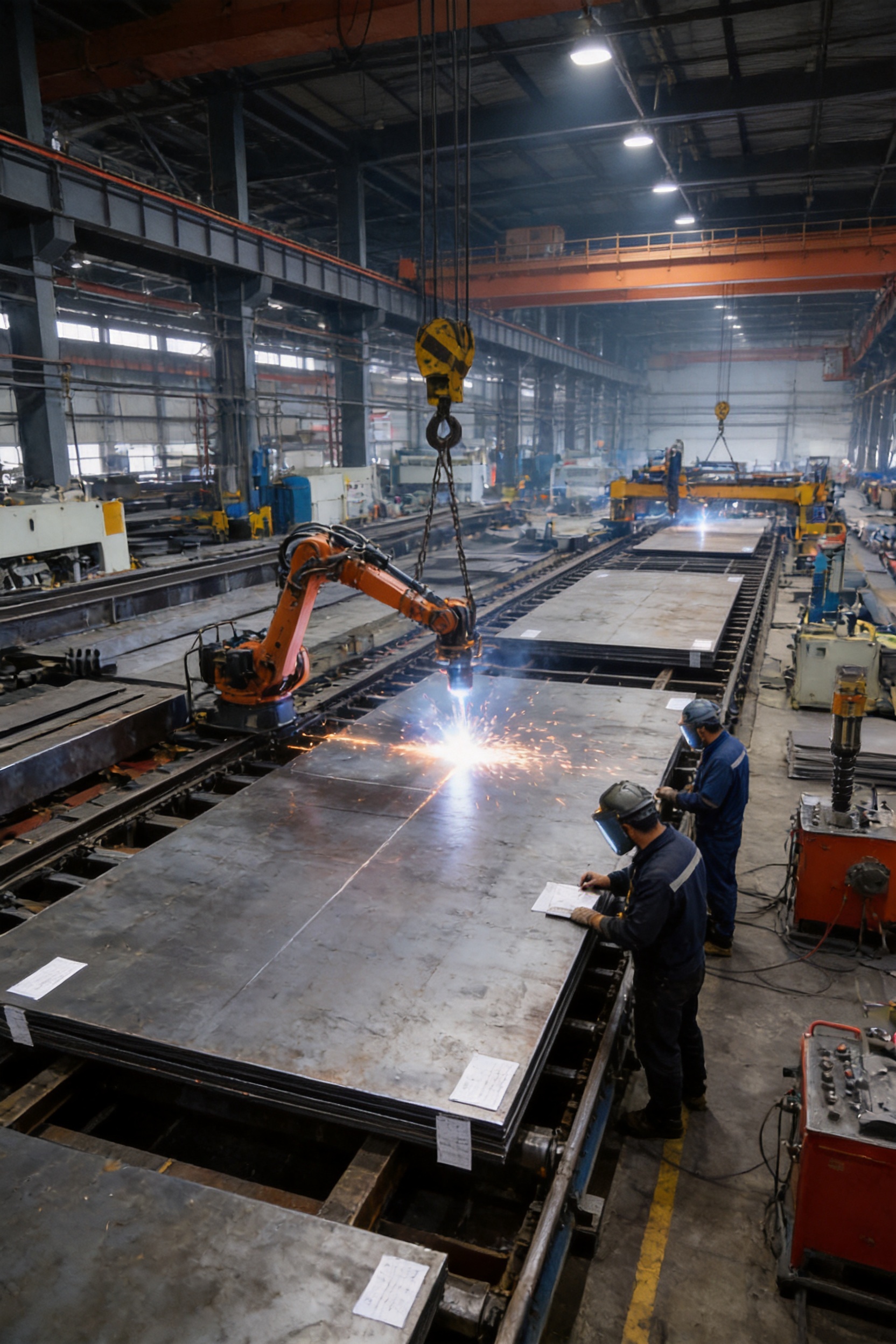
Welding is a central part of modular steel panel production. The company uses automated welding and standardized fabrication workflows to improve consistency in weld size, penetration, alignment, and appearance. Automation can reduce variations caused by manual handling and improve repeatability for large production quantities.
Automated welding does not replace engineering judgment or inspection. Welding procedures must be selected according to material type, thickness, joint design, and applicable standards. Operators, welding personnel, and inspection staff must work within defined quality procedures. Where required, visual inspection, dimensional inspection, non-destructive testing, and repair procedures can be incorporated into the production plan.
6.5 Assembly Verification
Before shipment, representative panels and components can be checked for fit, alignment, connection compatibility, and dimensional accuracy. Trial assembly or controlled inspection helps identify issues that might otherwise appear during field erection. This is especially important for large support systems containing many repeated panels, pins, bolts, bracing members, bearings, and accessories.
Assembly verification also supports the preparation of installation instructions. Clear component identification, packing lists, drawings, and erection sequences help the site team locate the correct parts and follow the intended construction method.
6.6 Surface Protection and Durability
Temporary support systems are exposed to moisture, dust, handling damage, construction chemicals, and changing weather conditions. Surface preparation and protective coatings can improve resistance to corrosion during storage, transport, assembly, and operation.
The appropriate coating system depends on the project environment and expected service duration. Components used in humid, coastal, industrial, or flood-prone locations may require additional protection. Inspection of coating condition should continue after delivery because lifting, bolting, and field handling can damage painted surfaces.
6.7 Quality Management and Standards
The manufacturing operation follows standardized workflows and quality management practices intended to support compliance with ASTM, EN, and applicable national specifications. The precise standard selection depends on the project contract, country, structural design basis, and client requirements.
Quality management may cover material purchasing, welding procedure control, dimensional inspection, component identification, non-conformance handling, coating inspection, final documentation, and shipping preparation. These processes give clients greater confidence that the delivered system is supported by repeatable manufacturing controls rather than isolated workshop practices.
7. Engineering Design Considerations
A high-capacity modular support system must be designed for the complete construction stage, not only for the final static load. Engineers should consider permanent and temporary loads, load combinations, construction equipment movement, impact, wind, temperature, vibration, eccentricity, and possible accidental conditions.
7.1 Load Distribution
Heavy construction loads may be concentrated at wheels, lifting points, bearings, jacks, or temporary supports. Load distribution beams, deck plates, transverse members, or other spreading elements may be required to transfer these forces into the main Bailey panels. The arrangement should prevent local overstress and ensure that the panels work together as intended.
7.2 Deflection and Alignment
Deflection limits should be established according to the construction activity. Excessive movement can affect bridge alignment, lifting accuracy, formwork geometry, equipment operation, and worker safety. A system may have adequate ultimate strength but still be unsuitable if service-stage deflection is too large.
Precamber, jacking, bearing adjustment, and staged loading may be considered where appropriate. These measures must be included in the engineering plan and monitored during erection and use.
7.3 Lateral Stability
Long-span support systems require reliable lateral restraint. Wind, eccentric loading, moving equipment, vibration, and construction impacts can create lateral forces that are not represented by vertical load calculations alone. Cross-bracing, sway bracing, guide systems, tie members, temporary anchors, and properly designed bearings may all be required.
7.4 Foundations and Bearings
The support system can only perform as designed if the foundations and bearings can transfer the reactions safely. Foundation settlement, uneven support, sliding, rotation, scour, and inadequate bearing areas can compromise the entire structure. Ground investigation and foundation verification should therefore be included in the project plan.
7.5 Erection and Removal Sequence
Construction-stage stability may differ from the stability of the fully assembled system. Engineers should evaluate lifting points, temporary bracing, partially assembled panels, equipment access, wind limits, and the sequence for installing pins, bolts, and deck elements. Removal should be planned with the same care as erection, particularly when loads are transferred back to permanent structures or when the support is located above active work areas.
8. Installation, Operation, and Maintenance
Installation generally begins with site preparation, foundation verification, delivery inspection, component sorting, and bearing placement. Panels and bracing members are then assembled according to the approved erection drawings. Depending on site conditions, assembly may take place on the ground before launching, or components may be lifted and connected progressively.
All pins, bolts, bracing members, deck elements, restraints, and safety accessories should be installed according to the design documentation. Field modifications should not be made without engineering approval. Cutting, drilling, welding, or removing structural members can significantly alter the system’s behavior.
Before loading, the completed support should be inspected for correct geometry, connection installation, bearing contact, lateral restraint, foundation condition, coating damage, and clearance. A controlled proof or verification procedure may be required by the project engineer or governing authority.
During operation, the support should be monitored for unusual deflection, settlement, vibration, connection movement, corrosion, impact damage, or changes in the surrounding ground. Loads should remain within the approved design envelope. Equipment operators should follow defined travel routes and speed limits where vehicles or lifting equipment use the support.
After completion of the construction operation, the system should be unloaded in a controlled manner. Components should be inspected, cleaned, repaired if necessary, and stored in a dry and organized condition. Proper maintenance extends the useful life of the panels and supports future deployment on other projects.
9. International Manufacturing and Project Support Capability
Jiangsu Zhonghai Bridge Equipment Co., Ltd. is based in Zhenjiang, Jiangsu Province, an important industrial and transportation center in China. The company specializes in modular steel bridges, Bailey bridge systems, engineered structural components, bridge erection equipment, automated welding, and precision steel fabrication.
Its integrated business model combines engineering design, manufacturing, quality management, delivery coordination, and on-site support. This approach is valuable for international clients because large modular systems involve more than fabrication alone. Export packaging, component identification, technical documentation, loading plans, delivery scheduling, and installation guidance all affect project success.
The company’s production capabilities are supported by industrial-scale manufacturing facilities and standardized workflows. These resources enable the production of repeated structural components while maintaining consistency across different orders. The company can also support customized configurations for transportation, water conservancy, military logistics, disaster relief, and international development projects.
Past project experience includes coastal engineering in the Maldives, temporary access bridges for the Shenzhen–Zhongshan Corridor, structural components for the Hangzhou Expo Center, multi-span Bailey bridges for the Lalin Railway, and emergency bridge deployments in multiple regions. These applications demonstrate experience with different environments, project scales, and infrastructure requirements.
For buyers, the ability to work with one integrated supplier can reduce coordination between separate designers, fabricators, and field support providers. It can also improve communication when technical changes occur during the project. The supplier can review manufacturing feasibility, confirm component requirements, and align production with the construction schedule.
10. Why This Product Is Suitable for Major Infrastructure Projects
The Large-Span Heavy-Load Railway Super Bailey Construction Support combines several characteristics that are difficult to achieve in a single temporary works solution. It offers long-span capability, high load resistance, modular assembly, factory-controlled manufacturing, and the potential for repeated reuse.
Its 4 m × 2 m super Bailey panels are suited to large structural arrangements, while the single-span design can preserve space beneath the support. The maximum stated span of 39 meters provides a practical option for crossing broad construction openings, and the maximum stated load capacity of up to 900 tons supports heavy railway construction activities when verified by project-specific design.
The product also offers advantages in procurement and lifecycle management. Standardized panels can be produced in batches, transported using organized packing methods, and inspected before installation. After the original project, the components can potentially be reused in another configuration. This supports a more efficient approach to temporary construction assets and can provide long-term value for contractors and infrastructure owners.
Compared with lighter modular systems, improvised steel frames, and labor-intensive cast-in-place supports, the system provides a balanced combination of capacity and practicality. It is not simply a collection of steel panels; it is a configurable construction support platform that can be engineered around a project’s loads, span, site conditions, and erection method.
11. Selection Guidance for Buyers and Contractors
Before ordering a super Bailey construction support system, the project team should prepare the basic technical information required for engineering review. This normally includes the required span, support elevations, maximum loads, load positions, equipment dimensions, construction sequence, site access, foundation conditions, environmental exposure, and expected operating period.
The buyer should also identify applicable design codes, inspection requirements, coating expectations, delivery location, packaging limitations, erection equipment, and available installation personnel. If the system will be used internationally, local regulatory requirements and customs documentation should be addressed early.
A qualified supplier can then help develop a component schedule, general arrangement, connection details, bracing plan, foundation reaction information, erection method, inspection checklist, and maintenance guidance. Early coordination reduces the risk of ordering an arrangement that is technically strong but difficult to transport or install.
For high-load applications, the client should request confirmation of material grades, welding procedures, inspection methods, dimensional tolerances, coating specifications, component identification, and documentation included with the shipment. These details are important for project approval and future reuse.
12. Frequently Asked Questions
Q1: What is the primary purpose of this super Bailey construction support?
The system is designed to provide temporary or construction-stage support for large railway and infrastructure projects. It can support heavy machinery, bridge elements, construction materials, formwork, lifting operations, and other substantial loads over a long span.
Q2: What is the maximum span of the system?
The stated maximum total length for the single-span configuration is up to 39 meters. The final usable span depends on the structural design, support arrangement, load case, foundation conditions, bracing, and applicable safety requirements.
Q3: Can the system carry 900 tons in every installation?
No. Up to 900 tons is the maximum stated capacity under suitable engineered conditions. The allowable load for a specific project must be verified by qualified engineers based on span, load distribution, support reactions, lateral stability, foundations, construction sequence, and governing standards.
Q4: What are the dimensions of the main super Bailey panels?
The primary panels are identified as 4 m × 2 m super Bailey panels. These larger modular units are intended for high-capacity and long-span construction support applications.
Q5: What makes this system different from a light-duty Bailey bridge?
The super Bailey construction support is designed for substantially heavier construction loads and larger structural demands. Its panel dimensions, structural depth, bracing requirements, and configuration are intended for major railway and infrastructure works rather than light pedestrian or ordinary access applications.
Q6: Can the support be used over roads, rivers, or excavations?
It may be suitable for these locations when the project-specific design addresses clearance, foundation conditions, water flow, scour, traffic protection, environmental requirements, and lateral stability. The final use must be reviewed and approved by the responsible engineering team.
Q7: Is the system reusable?
Yes. Its modular steel components are designed for disassembly, inspection, transport, and reconfiguration. Reuse depends on the condition of the components, inspection results, repair requirements, and compatibility with the next project’s design loads.
Q8: What manufacturing capabilities support the product?
The manufacturer integrates engineering design, precision steel fabrication, automated welding, quality management, standardized production workflows, coating processes, assembly verification, and international delivery support.
Q9: Which standards can be considered during production?
The manufacturing operation supports ASTM, EN, and applicable national specifications. The exact standards used for a project should be confirmed during the technical and contractual review because requirements vary by country, client, and application.
Q10: Does the supplier provide installation support?
The company provides technical and project support associated with modular bridge systems and construction equipment. The scope should be confirmed for each order and may include drawings, component schedules, erection guidance, packing information, and on-site assistance where required.
Q11: What information should be supplied for a quotation?
Useful information includes the required span, maximum loads, load locations, support elevations, site conditions, intended application, delivery location, required standards, construction schedule, and preferred installation method. Equipment details and foundation information are also helpful for accurate engineering.
Q12: Can the system be customized?
Modular systems can generally be configured through changes in panel quantities, bracing, support details, bearing arrangements, deck elements, and accessories. Customization must be based on an approved engineering design and should not involve unauthorized field alterations.
13. Conclusion
The Large-Span Heavy-Load Railway Super Bailey Construction Support is a specialized modular steel solution for the most demanding stages of railway and infrastructure construction. Its 4 m × 2 m super Bailey panels, single-span arrangement, maximum span of up to 39 meters, and maximum stated capacity of up to 900 tons make it suitable for heavy bridge, tunnel, rehabilitation, emergency, and major civil engineering applications.
Its principal advantages include high load resistance, long-span performance, modular installation, reduced dependence on intermediate supports, reusability, and adaptability to changing construction requirements. Compared with light-duty panels, improvised frames, and some labor-intensive temporary support methods, it offers a more structured and controllable basis for heavy construction operations.
The product’s value is strengthened by integrated manufacturing capabilities. Engineering design, material control, precision cutting, automated welding, assembly verification, surface protection, quality management, and international project support help produce a system that is consistent and practical for field use.
Successful application depends on project-specific engineering. Load capacity, deflection, foundation reactions, lateral stability, erection sequence, environmental conditions, and inspection requirements must all be evaluated before the support is placed into service. When these factors are properly addressed, the system can provide a safe, efficient, and reusable support platform for complex railway and infrastructure projects.
References
1. Product technical information for Large-Span Heavy-Load Railway Super Bailey Construction Support, including panel dimensions, span capability, load capacity, and intended applications.
2. Company manufacturing and capability information concerning modular steel bridges, Bailey bridge systems, structural components, automated welding, precision fabrication, quality management, and international project support.
3. American Society of Civil Engineers. Structural engineering principles for temporary works, construction-stage loading, stability, and load combinations.
4. American Institute of Steel Construction. Steel construction guidance relating to material selection, connections, fabrication, erection, inspection, and structural stability.
5. European Committee for Standardization. European structural steel design and execution principles applicable to fabricated steel structures and temporary construction works.
6. International Organization for Standardization. Quality management principles for manufacturing, inspection, traceability, and supplier control.
7. General engineering practice for modular bridge erection, temporary support design, foundation verification, construction-stage monitoring, and reusable steel structure maintenance.
Product: Large Span Heavy Load Railway Super Bailey Construction Support


We respond quickly to all international requests and provide technical support when needed.
Product Category
Bailey Bridge/Modular Bridge Modular Steel Bridge Pedestrian Bridge Modular Pipe Bridge Truss Bridge Steel StructureContact Us

+86-511-84522866
+86-13921582699

zhwm@zjql.com

Building 1,83#, dantu New Town, Yanjiang Road, Dantu District, Zhenjiang, Jiangsu, China
Copyright © Jiangsu Zhonghai Bridge Equipment Co., Ltd. All
Rights
Reserved
China bailey bridge for sale
bailey bridge supplier from china
