
 English
 русский
 Español
 Português


Tang Yuwei — International Bailey Bridge Sales Manager
Customized Large-Span Super Bailey Construction Support for Heavy-Duty Projects
Content
- 1 What Is a Bailey Construction Support System?
- 2 Project-Specific Design for the Zhangzhou Dongshan Project
- 3 Large-Span Capability and Heavy-Load Performance
- 4 Anti-Corrosion Coating and Outdoor Durability
- 5 Manufacturing Process and Production Strength
- 6 Advantages Over Conventional Temporary Support Methods
- 7 Comparison with Alternative Support Solutions
- 8 Applications in Infrastructure and Construction
- 9 Installation and Site Management
- 10 Quality, Standards, and Engineering Responsibility
- 11 Why Choose a Specialized Manufacturer?
- 12 Economic and Operational Benefits
- 13 Environmental and Sustainability Considerations
- 14 Procurement Guidance for International Buyers
- 15 Product Specification Summary
- 16 Maintenance and Reuse Strategy
- 17 Safety Considerations
- 18 Conclusion
- 19 Questions and Answers
- 19.1 What is the main purpose of this customized Bailey construction support system?
- 19.2 What panel sizes are included in the Zhangzhou Dongshan Project system?
- 19.3 Why are the panels painted different colors?
- 19.4 Can the system be used for different load classifications?
- 19.5 Can the Bailey construction support be customized?
- 19.6 What makes this system different from an improvised steel support frame?
- 19.7 Is the system suitable for coastal or humid environments?
- 19.8 Can the components be reused on another project?
- 19.9 What manufacturing capabilities support the product?
- 19.10 What information should a buyer provide when requesting a quotation?
- 19.11 Does the supplier provide a complete structural design for every project?
- 19.12 How should the support system be inspected during use?
- 20 References
- 21 Product: Customized Large Span Super Bailey Construction Support
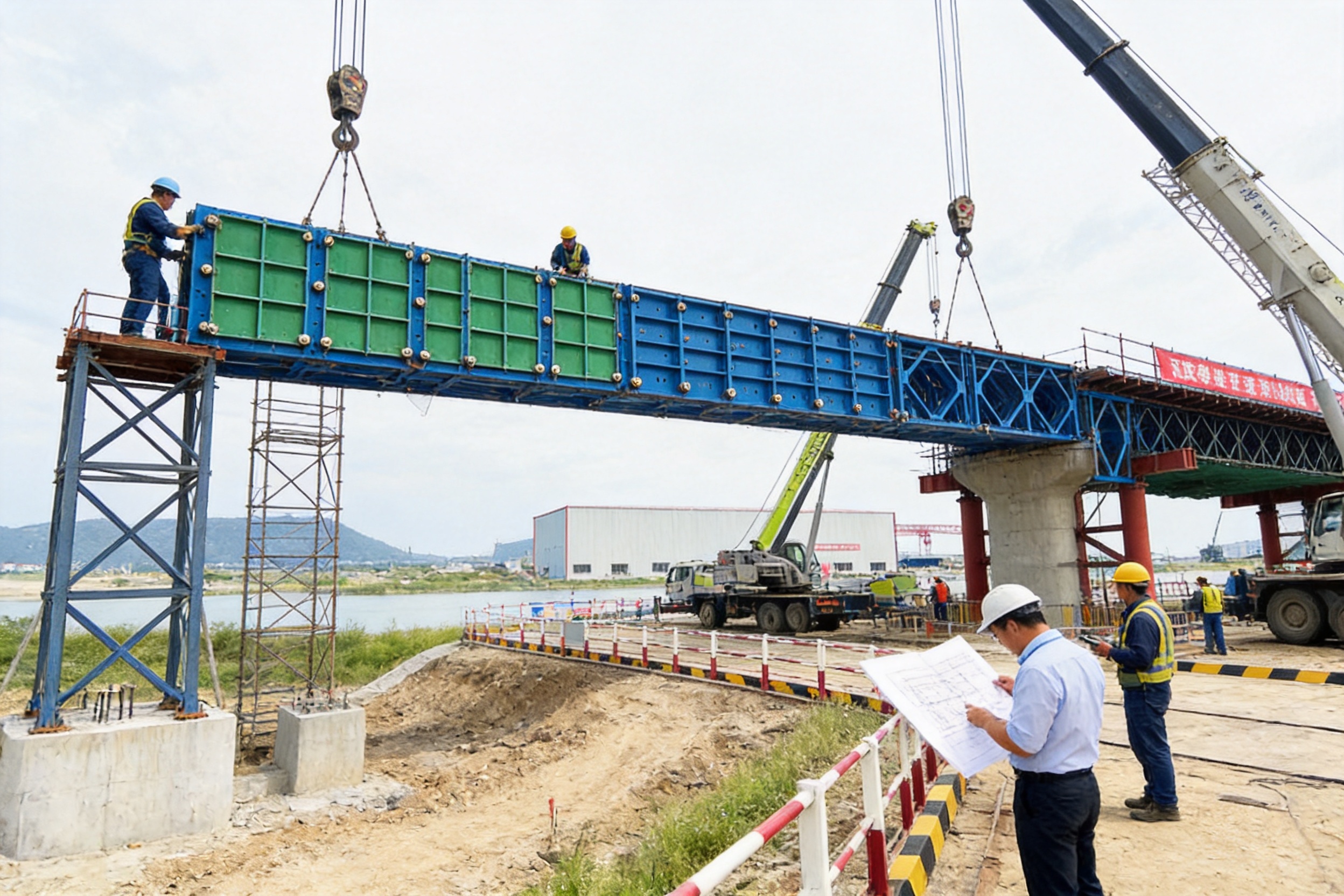
Large-span construction projects require temporary support systems that combine high load capacity, structural stability, rapid installation, and dependable performance in difficult outdoor environments. Conventional temporary works may be adequate for short spans or moderate loads, but they can become inefficient when a project involves substantial construction equipment, complex site conditions, long support distances, or demanding schedule targets. The Customized Large-Span Super Bailey Construction Support system developed for the Zhangzhou Dongshan Project addresses these challenges through a modular steel solution engineered for heavy-load construction and long-span applications.
Based on the established principles of Bailey bridge engineering, this construction support system uses standardized modular panels, robust connections, carefully selected steel components, and project-specific configuration. The result is a versatile temporary or semi-permanent support structure that can be adapted to different site requirements while maintaining the advantages of prefabricated construction. It is designed for load-bearing scenarios including HS-15, HS-20, HS-25, HL-93, and Track-50, providing a practical solution for infrastructure contractors, bridge builders, civil engineering companies, and emergency construction teams.
The system is distinguished by its customized Bailey panels, including 3 m × 1 m green-painted panels and 3 m × 6 m blue-painted panels. The combination of different panel dimensions and clearly differentiated coating colors supports efficient site organization, visual identification, and installation management. More importantly, the panels are engineered for large-span and heavy-load support, offering a higher level of structural capability than many ordinary temporary support arrangements.
Manufactured by Jiangsu Zhonghai Bridge Equipment Co., Ltd., the system reflects an integrated approach that combines engineering design, precision fabrication, quality control, surface treatment, and project support. The company specializes in modular steel bridges, Bailey bridge systems, customized steel components, construction support equipment, automated welding, and precision steel fabrication. This combination of technical and manufacturing capabilities allows the product to be developed around a project’s actual structural and operational needs rather than relying solely on a fixed, one-size-fits-all configuration.
What Is a Bailey Construction Support System?
A Bailey construction support system is a modular steel framework used to carry construction loads, support bridge components, provide temporary access, assist with launching and erection, or stabilize structures during different phases of a project. It is based on prefabricated panels and connecting members that can be assembled into beams, towers, frames, trestles, or other support arrangements.
Unlike traditional cast-in-place temporary supports, modular Bailey systems are manufactured before reaching the construction site. This reduces the amount of cutting, drilling, welding, and adjustment required in the field. Components can be transported in manageable units and assembled with standard connection methods. Once a project is completed, the system may be dismantled, relocated, reconfigured, or stored for future use.
The core value of this method lies in standardization combined with flexibility. Standardized modules allow fast production, replacement, and installation, while the overall system can be configured for different spans, elevations, load conditions, and site layouts. For large-span projects, panels can be arranged in multiple rows, strengthened through additional bracing, or combined with support towers and other structural components.
Bailey construction support is used in a wide range of applications, including bridge construction, elevated roadwork, railway projects, water conservancy works, temporary platforms, heavy equipment support, river crossings, industrial construction, disaster-response operations, and temporary access structures. The system can also be adapted for construction stages in which permanent bridge components have not yet achieved their final self-supporting condition.
Project-Specific Design for the Zhangzhou Dongshan Project
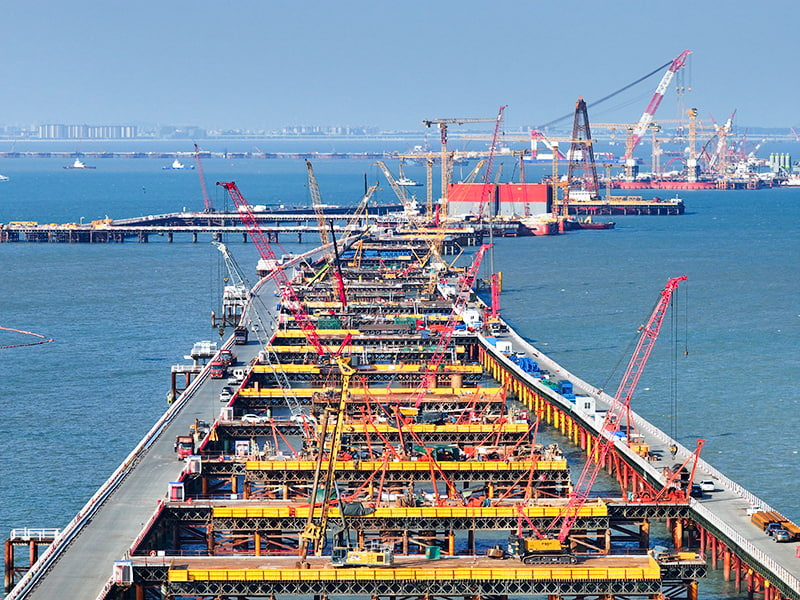
The Zhangzhou Dongshan Project required a construction support system capable of carrying substantial loads over a large span while maintaining stability under demanding outdoor conditions. Instead of supplying a standard configuration without modification, the manufacturer developed a customized solution based on the project’s requirements.
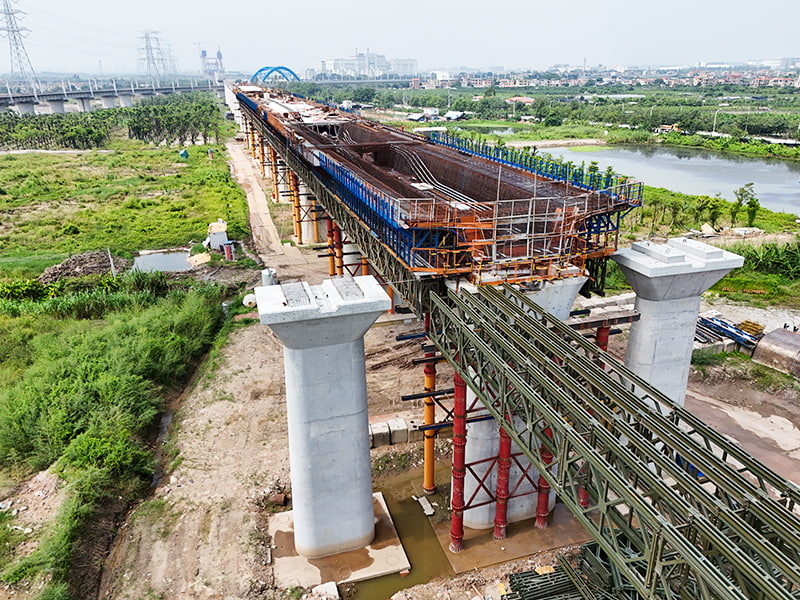
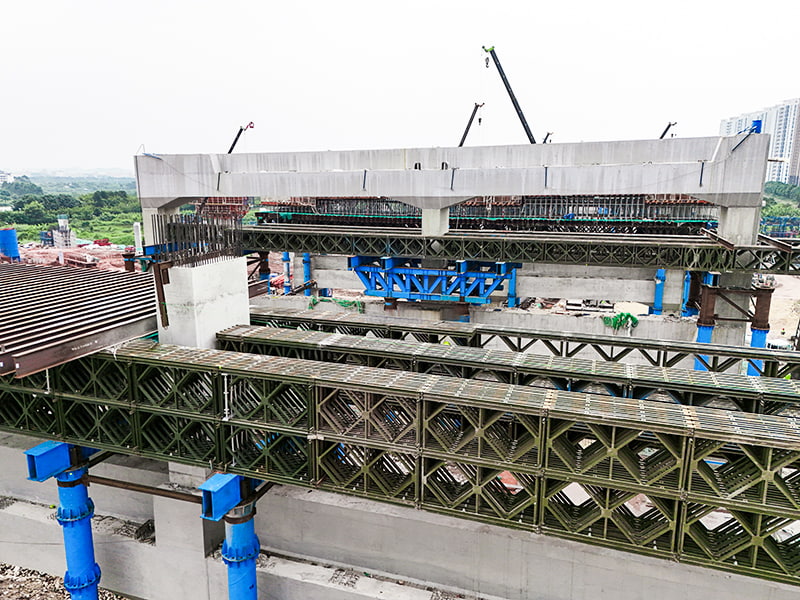
The supplied system features specially crafted Bailey panels in two principal formats: 3 m × 1 m green-painted panels and 3 m × 6 m blue-painted panels. The use of different panel sizes allows the support arrangement to be adapted to structural geometry, connection requirements, and site-specific installation sequences. Each panel can serve as part of a larger modular assembly, with the final system configured according to span, load path, support spacing, and construction-stage requirements.
The color distinction is also a practical engineering feature. Green and blue coatings enable site teams to identify different component groups more quickly during delivery, sorting, assembly, inspection, and dismantling. On a busy construction site, where large quantities of similar steel members may be distributed across multiple work areas, visible color coding can reduce handling errors and improve coordination among supervisors, installers, and equipment operators.
Customization may include panel dimensions, connection details, reinforcement arrangements, surface protection, support spacing, bracing layout, and component quantities. These parameters can be reviewed against the required construction loads and the intended erection procedure. A project-specific approach helps avoid both under-designed supports and unnecessary material consumption caused by excessive standardization.
The system is suitable for load-bearing scenarios associated with HS-15, HS-20, HS-25, HL-93, and Track-50. These design references represent different levels and categories of roadway or railway loading. The actual capacity of an installed system depends on configuration, span, support conditions, bracing, connection quality, foundation performance, and the applicable design calculations. For this reason, load classification should be considered together with a complete engineering assessment rather than treated as a standalone product label.
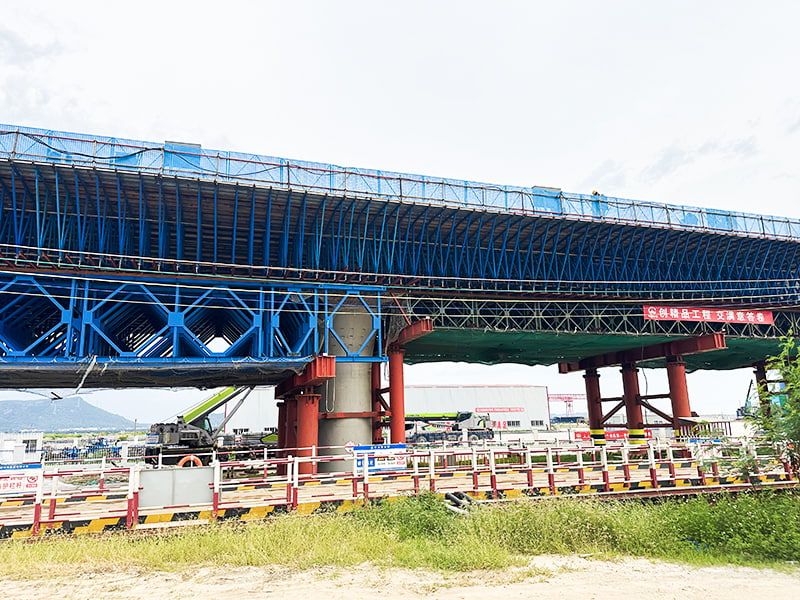
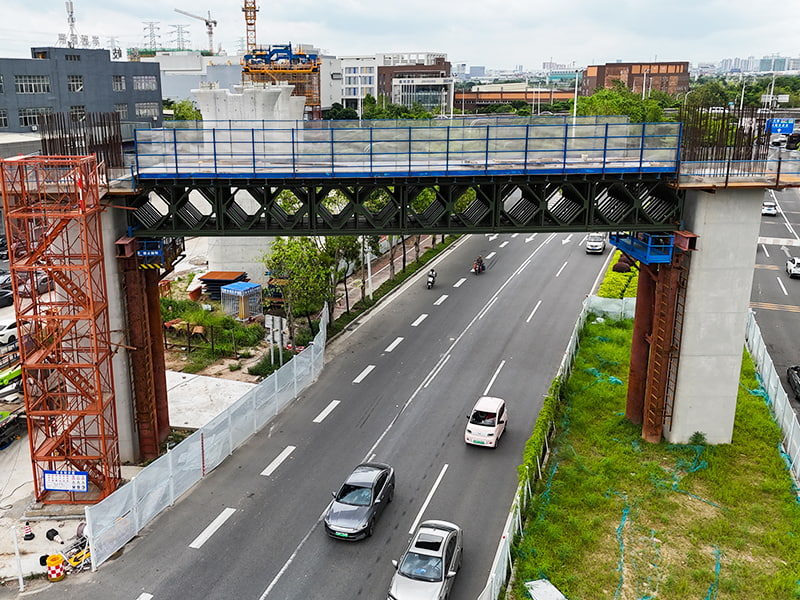
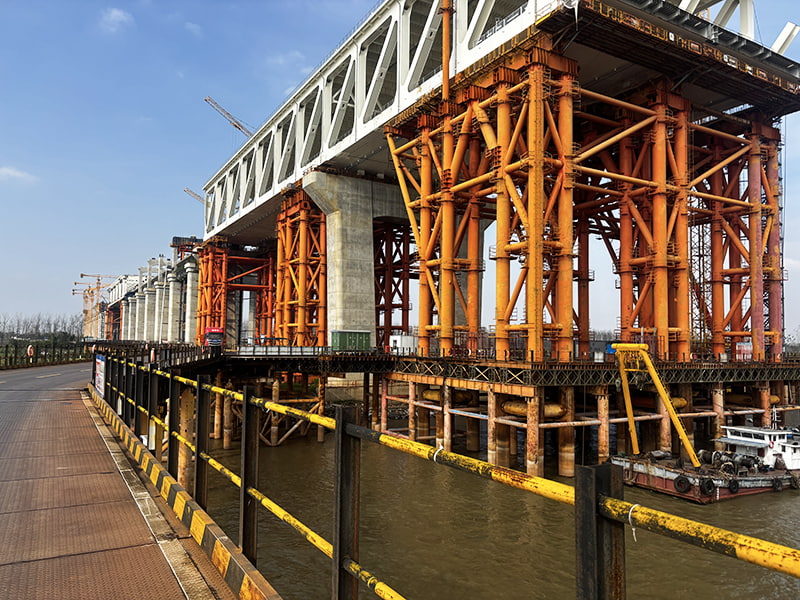
Customized Large Span Super Bailey Construction Support
Large-Span Capability and Heavy-Load Performance
Large-span temporary works create several structural challenges. As span increases, bending moments, deflection, lateral instability, connection forces, and sensitivity to support settlement may also increase. A system that performs adequately over a short distance may require additional panels, reinforcement, bracing, or support towers when used for a longer span.
The Customized Large-Span Super Bailey Construction Support system is designed to address these conditions through a modular structural arrangement capable of carrying heavy construction loads. The assembly may be configured with multiple panel lines, transverse connections, longitudinal bracing, vertical supports, and other strengthening components. This provides a continuous and coordinated load path from the supported structure through the Bailey framework and into the foundations or bearing points.
Heavy-load support is especially important when construction equipment, formwork, precast elements, reinforcing materials, temporary works, or partially completed bridge sections must be supported before the permanent structure reaches its final strength. The system helps distribute these loads across multiple steel members rather than concentrating them at isolated points.
For contractors, this can improve construction planning. A stable support structure allows cranes, transport equipment, formwork systems, and work platforms to operate with greater confidence. It may also reduce the need for repeated site modifications, which can cause delays and increase labor costs. When the support arrangement is correctly engineered and installed, the construction team can work according to a more predictable sequence.
Large-span performance does not depend only on the strength of individual panels. It also depends on the interaction of the complete system. Panel alignment, pin and bolt connections, lateral bracing, transverse restraint, support settlement, foundation bearing capacity, and construction-stage loading all influence performance. A professional modular support supplier therefore needs to consider the complete assembly rather than simply selling individual components.
Typical Load-Bearing Considerations
Several load categories may need to be assessed when planning a Bailey construction support system. These include the self-weight of the temporary structure, permanent bridge components temporarily carried by the system, construction equipment, workers and materials, impact or dynamic effects, wind loads, temperature effects, eccentric loading, and possible horizontal forces generated during construction operations.
Where railway or heavy transport loading is involved, the design may also consider repeated loading and vibration. For road-related applications, vehicle categories such as HS-15, HS-20, HS-25, and HL-93 may be referenced as part of the project design criteria. Track-50 may be used where heavier railway-related loading conditions are relevant. The governing standard and design method should always be confirmed by the project engineer and local authorities.
The modular system provides a flexible basis for these evaluations. Additional panel rows, stronger bracing, closer support spacing, and improved foundation arrangements can be incorporated where required. This adaptability is an important advantage over temporary systems that are limited to one fixed span or load range.
Anti-Corrosion Coating and Outdoor Durability
Temporary construction support structures are often exposed to harsh conditions. Rain, humidity, salt-laden air, mud, dust, sunlight, temperature changes, and contact with construction chemicals can accelerate corrosion. This is particularly important for projects located near coastlines, rivers, wetlands, ports, or areas with frequent rainfall.
The supplied Bailey panels use an exclusive anti-corrosion coating designed to improve protection against rust and environmental deterioration. The coating provides two functions: it protects the steel surface and creates clear visual color differentiation. The green and blue finishes make the components easier to manage while helping preserve their serviceability in complex outdoor construction environments.
Corrosion protection contributes to the long-term value of modular equipment. When steel components are properly protected, inspected, cleaned, and stored, they can remain suitable for repeated deployment. This is important for contractors that operate across multiple projects and expect temporary works equipment to provide value beyond a single installation.
Surface treatment also supports safer inspection. A uniform coating makes scratches, peeling, impact marks, and exposed steel easier to identify during routine checks. Site personnel can monitor whether any area requires touch-up painting, cleaning, or further technical evaluation. Such maintenance practices help prevent small coating defects from developing into more serious corrosion problems.
Although a protective coating improves durability, it does not eliminate the need for inspection. Cut edges, connection holes, welded areas, contact surfaces, and locations exposed to trapped water should receive particular attention. After dismantling, components should be cleaned, dried, checked for deformation, and stored in a manner that limits moisture accumulation.
Manufacturing Process and Production Strength
The performance of a modular steel support system begins with manufacturing quality. The strength of the final structure depends not only on design calculations but also on the accuracy of raw material selection, cutting, forming, welding, drilling, assembly, coating, and inspection. Small deviations in hole positions, panel geometry, weld quality, or connection dimensions can affect installation efficiency and structural behavior.
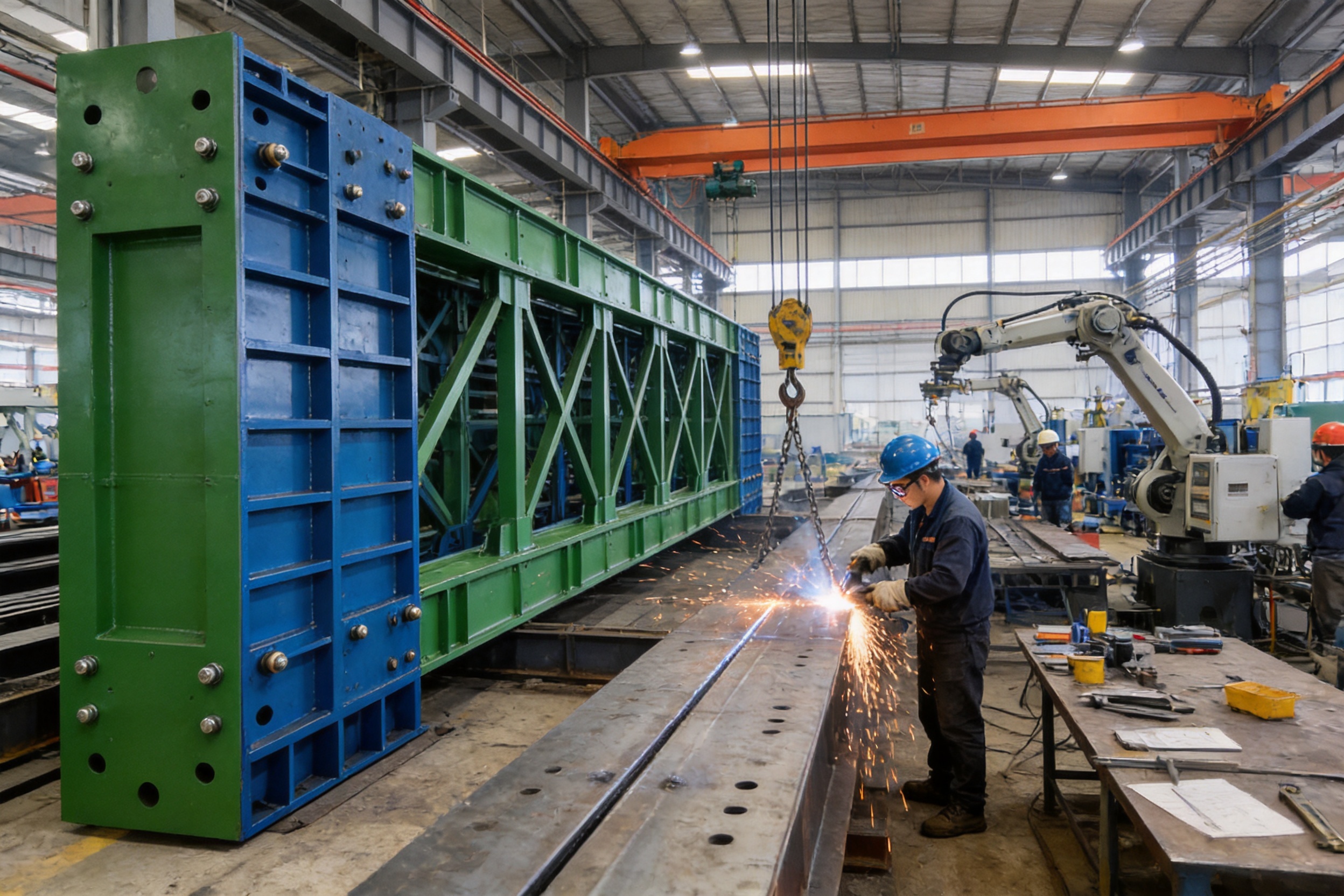
Jiangsu Zhonghai Bridge Equipment Co., Ltd. integrates engineering design, precision manufacturing, quality management, and project support. Its production activities cover modular bridge systems, Bailey bridge components, customized steel structures, automated welding, and precision steel fabrication. This integrated capability allows engineering requirements to be translated into controlled manufacturing procedures.
Engineering Review and Production Planning
Before fabrication begins, project requirements are reviewed to identify span conditions, load scenarios, support locations, installation sequence, transport limitations, coating requirements, and applicable standards. Drawings and production documents can then be prepared for the required panel dimensions and supporting members.
For a customized large-span support system, production planning is especially important. The manufacturer must consider whether panels will be used independently, in parallel rows, in vertical combinations, or with supplementary bracing. Component quantities must be matched to the intended configuration so that the delivered package supports an efficient erection sequence.
Engineering review also helps identify potential conflicts between the support system and other construction activities. Clearance for cranes, concrete placement, reinforcement installation, transport vehicles, temporary utilities, and inspection access may need to be incorporated into the layout.
Steel Material Preparation
Steel preparation typically begins with material verification, plate or section cutting, edge treatment, and dimensional inspection. Consistent material quality helps ensure that panels and connecting members perform predictably under load. Materials should be traceable through the production process so that documentation and inspection records can be maintained.
Precision cutting reduces dimensional variation and supports accurate assembly. Where automated equipment is used, repeatability can be improved across large production batches. Correct edge preparation is also important for welded areas, since an appropriate joint profile supports sound fusion and reduces the risk of incomplete penetration or other weld defects.
Automated and Controlled Welding
Welding is one of the most important manufacturing processes for steel bridge components. The company’s automated welding and precision fabrication capabilities help produce consistent welds across repeated panel assemblies. Automated welding can improve productivity, reduce variation, and maintain more stable welding parameters than uncontrolled manual processes.
Controlled welding requires suitable procedures, qualified personnel, correct consumables, proper joint preparation, and appropriate inspection. Welded components may be checked for visual quality, dimensional accuracy, deformation, and, where required by the project specification, non-destructive testing. Managing heat input and welding sequence can help limit distortion and preserve the geometry of the finished panel.
For modular components, dimensional consistency is essential because panels must connect smoothly in the field. A panel that is structurally strong but dimensionally inaccurate can slow assembly and create difficulties at connection points. Precision fabrication therefore contributes to both structural performance and installation productivity.
Drilling, Connection Fabrication, and Assembly Checks
Bailey systems rely on accurately positioned connection holes, pins, bolts, stiffeners, and bracing interfaces. These features must be manufactured to tight tolerances so that components can be assembled without excessive force or unauthorized field modification.
Factory assembly checks may be used to confirm panel alignment, connection fit, component identification, and overall dimensional compliance. Trial assembly can reveal problems before shipment, when corrections are faster and less expensive than changes made at the construction site.
Clear component marking and color coding further support installation. The 3 m × 1 m green panels and 3 m × 6 m blue panels can be grouped and identified during loading, shipping, and site assembly. This is valuable when the project involves multiple work fronts or a tight erection schedule.
Surface Treatment and Coating Control
After fabrication and preparation, steel surfaces are treated to remove contaminants and improve coating adhesion. The coating process should be controlled for surface cleanliness, application uniformity, drying conditions, and final thickness according to the project requirements.
The green and blue finishes serve as a visual management system in addition to their protective function. A well-controlled coating improves resistance to moisture and corrosion while providing a consistent appearance across the delivered components. Coating records and inspection results can form part of the product quality documentation.
Final Inspection and Shipment Preparation
Before shipment, components may be checked for dimensions, weld appearance, coating condition, connection completeness, identification marks, and packaging security. Shipment planning is important because modular panels and accessories must arrive in an order that supports efficient unloading and assembly.
Proper packaging helps prevent damage during transportation. Connection pins, bolts, bracing members, and smaller accessories should be organized to reduce loss and simplify inventory checks. Panels should be loaded in a manner that limits impact, abrasion, and unnecessary coating damage.
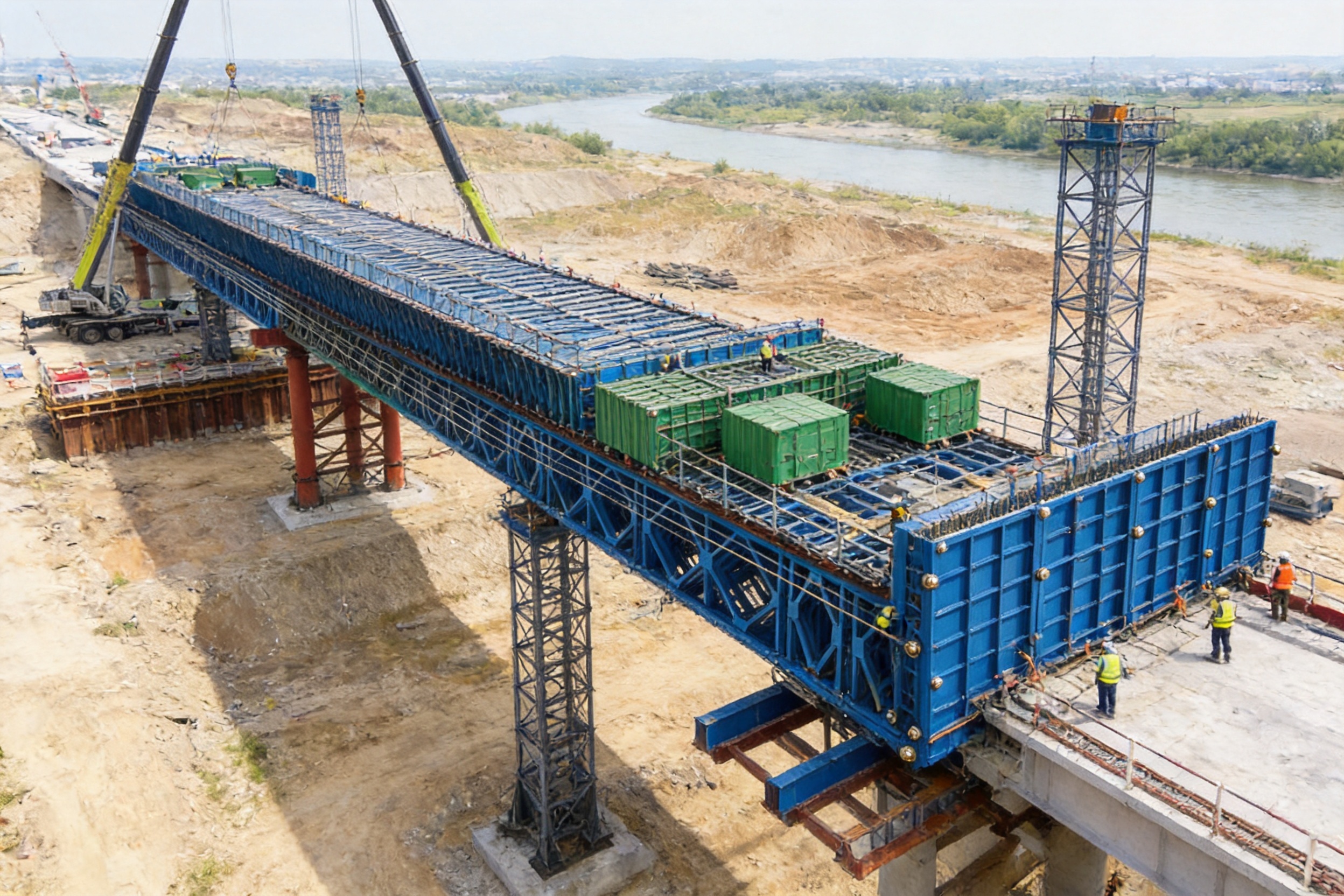
Advantages Over Conventional Temporary Support Methods
The Customized Large-Span Super Bailey Construction Support system offers several advantages compared with conventional cast-in-place temporary supports, improvised steel frames, and fixed-purpose support equipment.
Faster Site Assembly
Prefabricated modular panels reduce the amount of fabrication required at the construction site. Instead of building a temporary support frame from raw steel, crews can assemble prepared components using established connection procedures. This can shorten the preparation period and make the construction sequence more predictable.
Faster assembly is particularly valuable when a project must maintain traffic, avoid extended river obstruction, work within a limited seasonal window, or coordinate with multiple subcontractors. A shorter installation period can reduce indirect costs associated with access control, equipment rental, labor mobilization, and site occupation.
Adaptability to Different Spans and Loads
A standard modular system can be expanded or reinforced through changes in panel arrangement, support spacing, bracing, and structural configuration. This provides greater flexibility than a temporary structure designed for one exact geometry.
For projects with changing construction stages, the same components may be reconfigured as the work progresses. A system initially used as a support beam may later be adapted for a temporary platform, access structure, or another bridge-related task, subject to engineering review.
Reduced Field Welding and Cutting
Factory fabrication improves consistency and reduces dependence on field welding. Field welding can be affected by weather, access limitations, worker positioning, contamination, and variable site conditions. Limiting these activities can improve installation efficiency and reduce quality-control challenges.
Reduced cutting and drilling also help preserve the designed structural properties of the components. Unauthorized field modification may weaken members or compromise corrosion protection. A modular system with properly manufactured connections minimizes the need for such alterations.
Reusable Investment
Unlike many temporary works that are dismantled and discarded after one project, modular Bailey components can be reused when maintained correctly. This can improve the total economic value of the equipment for contractors, rental providers, government agencies, and emergency-response organizations.
Reusability also supports sustainability. Repeated deployment extends the useful life of the steel, reduces material waste, and limits the need to fabricate new temporary structures for every project. The system’s modular nature makes it easier to replace individual damaged components rather than discard the entire assembly.
Clear Onsite Management
Color-coded panels provide a simple method of visual organization. Green and blue components can be assigned to different structural roles, installation stages, or work zones. This may reduce sorting time and help supervisors identify whether the correct components are being used in the intended locations.
Visual differentiation is particularly useful when panels are stored in open yards, transported between locations, or assembled under time pressure. It can also support inventory management after dismantling.
Improved Durability in Outdoor Conditions
The anti-corrosion coating provides a protective barrier against rust and environmental exposure. This is a valuable advantage over untreated or poorly protected steel frames, especially in humid, coastal, and rainy environments. Better surface protection can reduce maintenance requirements and help preserve the strength and appearance of the components.
Internationally Oriented Manufacturing
The manufacturer serves infrastructure, transportation, water conservancy, military logistics, disaster relief, and international development projects. Its products have supported projects in China and abroad, including coastal engineering in the Maldives, temporary access bridges for the Shenzhen–Zhongshan Corridor, structural components for the Hangzhou Expo Center, multi-span Bailey bridges for the Lalin Railway, and emergency bridge deployments in multiple regions.
Experience across different project environments can help a supplier understand the practical concerns of international delivery, documentation, packaging, engineering coordination, and site support. This is an important distinction compared with suppliers that only provide standard steel parts without broader project experience.
Comparison with Alternative Support Solutions
| Evaluation factor | Customized Bailey construction support | Conventional cast-in-place temporary support | Improvised steel framing | Fixed-purpose support equipment |
| Site preparation | Prefabricated components reduce field fabrication | Often requires extensive onsite construction | Depends heavily on field cutting and welding | Usually requires prepared foundations and fixed dimensions |
| Configuration flexibility | Panels and bracing can be arranged for different spans and loads | Usually designed for one specific geometry | Flexible but dependent on field engineering quality | Limited to the equipment’s designed range |
| Installation speed | Generally fast when components and foundations are ready | Often slower because concrete, curing, and formwork are required | Variable and dependent on site labor | Can be fast but may require specialized equipment |
| Reuse potential | High when inspected and maintained properly | Low after demolition | Variable and often limited | Moderate, depending on design |
| Corrosion protection | Factory-applied protective coating with color identification | Depends on temporary steel treatment | Often inconsistent unless professionally coated | Depends on manufacturer and maintenance |
| Project customization | Suitable for customized panels, bracing, and support layouts | Highly customizable but labor-intensive | Customizable but may lack standardized quality control | Usually less adaptable |
| Inventory management | Color coding and standardized modules simplify identification | Most materials are project-specific | Identification can be difficult | Depends on equipment labeling |
This comparison does not mean that one support method is appropriate for every project. Site conditions, design loads, construction duration, foundation arrangements, environmental restrictions, and local regulations must all be considered. However, modular Bailey support is often attractive when speed, adaptability, reuse, and heavy-load performance are important at the same time.
Applications in Infrastructure and Construction
Bridge Construction and Erection
The system can be used to support bridge components during erection, launching, formwork installation, deck construction, and other temporary stages. It may provide support beneath beams, girders, deck units, or construction platforms while permanent structural elements are being installed or connected.
For long-span or multi-stage bridge work, modular supports can be repositioned or reconfigured as the construction front advances. This may reduce interference with permanent works and support a staged construction strategy.
Temporary Access and Work Platforms
Construction sites often need temporary access for workers, vehicles, cranes, and material transport. A Bailey-based structure can provide a stable route or elevated working platform where permanent access is unavailable or where existing terrain cannot support conventional roads.
In water conservancy and coastal construction, temporary access may be required across channels, drainage areas, tidal zones, or soft ground. The ability to assemble steel components away from the most difficult work area can simplify logistics and reduce disturbance to the surrounding environment.
Railway and Heavy Transport Projects
Railway construction can involve significant loads, strict alignment requirements, and restricted working windows. A modular support structure may be used in temporary crossings, construction staging areas, equipment support, or bridge erection operations. Where Track-50 or comparable heavy railway loading is considered, detailed design verification is required to confirm the appropriate panel arrangement and foundation system.
Emergency and Disaster Response
Floods, earthquakes, landslides, storms, and other disasters can damage permanent roads and bridges. Modular steel systems can be transported and assembled more quickly than many permanent structures, helping restore access for emergency vehicles, relief supplies, construction machinery, and local communities.
The system’s reusable nature and standardized components make it suitable for emergency stockpiles. Government agencies and relief organizations can maintain modular bridge equipment for rapid deployment, provided that inspection, inventory, and training programs are kept up to date.
Industrial and Specialized Construction
Industrial facilities may require temporary platforms, support frames, pipe crossings, maintenance access, or heavy equipment routes. A modular support system can be adapted for such applications when the structure is designed around the required loads, clearances, environmental exposure, and operating conditions.
For modular pipe bridge applications, the steel framework may support temporary or permanent pipe crossings across roads, drainage channels, or uneven terrain. The arrangement must account for pipe weight, fluid contents, thermal movement, maintenance access, and any imposed horizontal forces.
Installation and Site Management
Successful performance depends on proper installation as much as on factory quality. Before assembly, the project team should confirm the foundation or bearing conditions, support locations, access routes, component inventory, lifting equipment, erection sequence, and safety procedures.
Ground conditions are particularly important for large-span supports. Uneven settlement can introduce unexpected forces, reduce alignment, and affect load distribution. Bearing areas should be prepared according to the engineering design, with suitable foundations, mats, concrete pads, piles, or other support measures where necessary.
Components should be inspected when they arrive. The inspection should look for transport damage, bent members, damaged connection holes, missing pins or bolts, coating defects, and incorrect quantities. Damaged components should be isolated and evaluated before use.
During assembly, panels must be aligned correctly and connected according to the approved drawings. Bracing should be installed as the structure progresses rather than postponed until the end. Temporary stability during erection is essential because a partially assembled frame may not have the same strength or lateral resistance as the completed system.
Lifting operations should be planned around the weight and geometry of individual components. Workers should use suitable personal protective equipment and maintain controlled exclusion zones around suspended loads. Communication between crane operators, riggers, and assembly crews should be clear and continuous.
After assembly, a final inspection should verify panel alignment, connection installation, bracing, support contact, elevation, clearances, coating condition, and any required instrumentation. The structure should not be loaded beyond its approved construction-stage capacity.
Recommended Management Practices
Assign an experienced supervisor to coordinate installation and inspection.
Maintain a component inventory based on panel size, color, identification mark, and intended location.
Use approved drawings and erection procedures rather than relying on informal site modifications.
Inspect pins, bolts, bracing, bearing points, and foundation conditions at regular intervals.
Monitor settlement, displacement, unusual vibration, coating damage, and visible deformation.
Control vehicle speed and equipment movement when traffic or construction machinery operates on or near the support system.
Remove mud, standing water, concrete residue, and corrosive substances from steel surfaces where practical.
Record inspections and corrective actions so that the structure’s condition can be tracked throughout the project.
Quality, Standards, and Engineering Responsibility
Modular bridge and construction support systems must be designed and used in accordance with the project’s governing standards, local regulations, and approved engineering documentation. The manufacturer’s stated load scenarios provide an important reference, but actual capacity must be established for the specific configuration and site conditions.
Relevant considerations may include steel grade, allowable stress or limit-state design, connection capacity, buckling resistance, lateral stability, fatigue, wind, seismic effects, temperature, foundation bearing, settlement, and construction-stage behavior. The designer should also consider accidental impact, eccentric loading, dynamic effects, and load combinations required by the applicable standard.
Jiangsu Zhonghai Bridge Equipment Co., Ltd. reports that its factory uses advanced automation and standardized workflows to produce high-strength modular bridge systems that comply with ASTM, EN, and national specifications. This standards-oriented manufacturing approach supports international project requirements and provides a framework for consistent quality management.
Compliance is not limited to a product’s appearance. It includes material documentation, welding control, dimensional tolerances, coating procedures, inspection records, traceability, and the ability to provide technical information for project review. A supplier with engineering and manufacturing integration is better positioned to respond when a project requires changes, additional calculations, or customized components.
Why Choose a Specialized Manufacturer?
Purchasing a large-span construction support system from a specialized manufacturer offers advantages over sourcing unrelated steel products from a general fabricator. A specialist understands the connection logic, modular dimensions, erection requirements, load paths, and recurring inspection needs associated with Bailey-type structures.
Jiangsu Zhonghai Bridge Equipment Co., Ltd. combines product manufacturing with engineering support. Its focus includes modular steel bridges, Bailey bridge systems, customized steel components, bridge erection equipment, automated welding, and precision steel fabrication. This range allows the company to support both standard product orders and customized infrastructure requirements.
The company is located in Zhenjiang, Jiangsu Province, an industrial and transportation hub with access to manufacturing resources and logistics networks. Its production background supports project delivery for domestic and international customers. The company’s experience includes transportation, water conservancy, military logistics, disaster relief, and international development applications.
A specialized manufacturer can also help clients select a practical configuration. The discussion may include required span, load classification, panel arrangement, support spacing, bracing, coating, transport dimensions, installation equipment, and anticipated reuse. This technical dialogue helps ensure that the supplied components match the project’s actual objectives.
For overseas customers, manufacturing and delivery capability are equally important. International projects may require careful packaging, documentation, communication across time zones, compliance with specified standards, and coordination with local contractors. Consistent export experience can reduce uncertainty in these areas.
Economic and Operational Benefits
The initial purchase price is only one part of the cost of a temporary support system. Contractors should also evaluate transportation, onsite labor, installation duration, equipment rental, maintenance, dismantling, storage, and possible reuse. A modular solution can provide value by reducing field work and supporting repeated deployment.
Faster installation may reduce the time that cranes, access roads, traffic diversions, or temporary land occupations are required. If the support system can be assembled using standard procedures, training and supervision may also be more efficient across different projects.
Reusability is another major economic advantage. A contractor can move the components to future bridge, road, railway, water conservancy, or emergency-response projects. Individual panels or accessories can be inspected and replaced as necessary, allowing the broader inventory to remain useful.
Maintenance costs may also be controlled through protective coating and planned inspections. Color-coded components simplify inventory management and reduce the time required to identify, count, and sort materials. This is especially useful for organizations that maintain large quantities of temporary bridge equipment.
From an operational perspective, modularity creates options. The same basic inventory can support different span lengths, elevations, and construction sequences when an engineer approves the configuration. This flexibility can be more valuable than a lower-cost system that cannot be adapted to changing project conditions.
Environmental and Sustainability Considerations
Steel modular systems can support more sustainable temporary construction when they are reused and properly maintained. Factory production allows materials to be processed efficiently, while repeated deployment reduces the need for new temporary structures. At the end of their service life, steel components can also be recovered and recycled.
Compared with extensive cast-in-place temporary works, a prefabricated system may reduce onsite concrete consumption, demolition waste, and disturbance to the surrounding ground. This can be beneficial near rivers, wetlands, agricultural land, and environmentally sensitive areas.
Environmental performance still depends on responsible project management. Coating materials, cleaning agents, damaged steel, packaging, and construction waste should be handled according to applicable regulations. Foundations and access routes should be designed to limit unnecessary disturbance and facilitate restoration after dismantling.
Procurement Guidance for International Buyers
International buyers should provide sufficient technical information when requesting a quotation for a customized Bailey construction support system. Important details include required span, support height, design loads, load combinations, bridge or structure geometry, foundation conditions, operating environment, installation method, transport limitations, and desired coating system.
The buyer should also clarify whether the system is intended for temporary construction support, equipment access, a temporary bridge, a pipe crossing, a railway-related application, or another purpose. Different applications may require different deck arrangements, bracing, safety barriers, access provisions, or inspection procedures.
It is advisable to request general arrangement drawings, component lists, material information, connection details, coating information, inspection records, and installation guidance. Where the system will be used in a regulated project, the buyer should identify the required design standards at the quotation stage.
Delivery planning should address container or break-bulk shipment, component packaging, unloading equipment, storage conditions, customs documentation, and the sequence in which components are needed onsite. A well-organized delivery can prevent delays even when the manufacturing schedule has been completed on time.
Customers should also confirm the scope of technical support. Depending on the project, support may include configuration advice, shop drawings, calculation assistance, erection guidance, inspection recommendations, and communication with the local engineering team.
Product Specification Summary
| Item | Product information |
| Product type | Customized Bailey construction support system |
| Primary application | Large-span, heavy-load construction support |
| Project reference | Zhangzhou Dongshan Project |
| Special panel formats | 3 m × 1 m green-painted panels and 3 m × 6 m blue-painted panels |
| Load scenarios | HS-15, HS-20, HS-25, HL-93, and Track-50, subject to project-specific engineering verification |
| Surface protection | Anti-corrosion coating for improved rust resistance and outdoor durability |
| Structural function | Temporary or staged support for heavy construction loads and long-span applications |
| Manufacturing capabilities | Precision steel fabrication, automated welding, standardized production, and quality management |
| Customization options | Panel configuration, support arrangement, bracing, connection details, coating, and project-specific components |
| Potential sectors | Bridge construction, transportation, railway, water conservancy, industrial works, logistics, and emergency response |
Maintenance and Reuse Strategy
A maintenance program should begin when the components are first received. Panels and accessories should be checked for damage, accurately recorded, and stored off the ground where possible. Drainage should be provided to prevent water from collecting around steel members and connection areas.
During use, inspections should be scheduled after initial loading, severe weather, accidental impact, significant construction changes, and periods of unusual vibration. Inspectors should look for bent members, loose or missing connections, unexpected movement, foundation settlement, coating failure, and corrosion at concealed or difficult-to-access locations.
After dismantling, the components should be cleaned and inspected before being returned to storage. Concrete, soil, salt, and chemical residue can retain moisture and accelerate corrosion. Damaged coating should be repaired using a compatible system, and severely deformed or cracked components should be removed from service until assessed.
Organized storage is easier when components are color coded and marked. Green and blue panels can be separated by size and type, while pins, bolts, bracing, and accessories can be placed in labeled containers. A digital or paper inventory can record condition, location, repair history, and project usage.
These practices protect the investment and help ensure that the system performs reliably when redeployed. Reuse should never be automatic; each new project requires a fresh engineering review to confirm that the available components and their condition are suitable for the proposed application.
Safety Considerations
Safety planning must cover design, fabrication, transport, erection, loading, inspection, and dismantling. A modular system is efficient only when the installation team understands the correct sequence and the limitations of partially assembled structures.
Workers should be protected from falls, suspended loads, pinch points, sharp edges, and moving equipment. Access paths and working platforms should be maintained in safe condition. Where the structure carries vehicles or heavy machinery, traffic control, speed limits, load restrictions, and communication procedures should be established.
Weather conditions can affect stability and installation safety. High winds may create risks during panel lifting, while rain can reduce access and increase the likelihood of slipping. Flood levels, tide movement, and water flow should be monitored where the structure is installed near a river, channel, or coastal area.
Any change to the approved configuration should be reviewed by the responsible engineer. Removing bracing, relocating supports, adding equipment, or changing load distribution without approval can create unsafe conditions. Clear documentation and disciplined site management are essential to protect both workers and the structure.
Conclusion
The Customized Large-Span Super Bailey Construction Support system provides a strong and adaptable solution for construction projects that require reliable temporary support over substantial spans. Developed for the Zhangzhou Dongshan Project, the system combines specially crafted 3 m × 1 m green-painted panels and 3 m × 6 m blue-painted panels with an anti-corrosion coating, modular assembly, and heavy-load structural capability.
Its advantages include rapid prefabricated installation, configuration flexibility, reuse potential, visual component identification, reduced field fabrication, and improved resistance to outdoor corrosion. The system is suitable for a variety of load-bearing scenarios, including HS-15, HS-20, HS-25, HL-93, and Track-50, provided that the final arrangement is verified through project-specific engineering.
The product also demonstrates the value of working with a specialized manufacturer. Jiangsu Zhonghai Bridge Equipment Co., Ltd. combines engineering design, automated welding, precision steel fabrication, standardized manufacturing workflows, quality management, and international project experience. This integrated capability supports customized solutions rather than generic products that may not match the demands of a large-span construction site.
For infrastructure contractors, bridge builders, railway companies, water conservancy organizations, emergency-response agencies, and international development projects, a modular Bailey construction support system can improve construction speed and operational flexibility while creating a reusable long-term equipment asset. When supported by correct design, professional installation, regular inspection, and appropriate maintenance, it offers a practical foundation for safer, faster, and more efficient heavy-duty construction.
Questions and Answers
What is the main purpose of this customized Bailey construction support system?
Its main purpose is to provide stable temporary or staged support for large-span, heavy-load construction activities. It can support bridge components, construction equipment, formwork, work platforms, access arrangements, and other temporary loads when the permanent structure is not yet self-supporting.
What panel sizes are included in the Zhangzhou Dongshan Project system?
The system includes specially crafted Bailey panels measuring 3 m × 1 m with a green finish and 3 m × 6 m with a blue finish. The different sizes support customized structural arrangements, while the different colors simplify onsite identification and management.
Why are the panels painted different colors?
The color distinction supports visual organization. Green and blue panels can be identified more quickly during delivery, storage, assembly, inspection, and dismantling. The coating also helps protect the steel against rust and corrosion in outdoor construction environments.
Can the system be used for different load classifications?
It is suitable for load-bearing scenarios including HS-15, HS-20, HS-25, HL-93, and Track-50. However, the actual capacity depends on span, panel arrangement, support spacing, bracing, foundation conditions, connection details, and load combinations. A qualified engineer must verify the final configuration for each project.
Can the Bailey construction support be customized?
Yes. Customization may involve panel dimensions, the number of panel rows, support spacing, bracing, connection details, coating colors, support towers, foundation interfaces, and special steel components. The design should be developed from the project’s geometry, loads, construction sequence, and site limitations.
What makes this system different from an improvised steel support frame?
The system is based on standardized, prefabricated components manufactured under controlled procedures. It reduces the need for uncontrolled field cutting and welding, provides repeatable connection details, supports inspection and reuse, and can be configured through an engineered modular arrangement.
Is the system suitable for coastal or humid environments?
The anti-corrosion coating is designed to improve resistance to rust and environmental exposure, making the system suitable for challenging outdoor conditions when properly maintained. Coastal, marine, and highly humid applications still require appropriate inspection, cleaning, coating repair, and engineering review.
Can the components be reused on another project?
Yes. One of the principal benefits of modular Bailey equipment is reusability. Components should be inspected after dismantling, cleaned, repaired where necessary, and stored properly. Every new application must be checked by an engineer to confirm that the component condition and proposed configuration are suitable.
What manufacturing capabilities support the product?
The manufacturer integrates engineering design, precision steel fabrication, automated welding, standardized production workflows, surface treatment, and quality management. These capabilities help control panel dimensions, weld quality, connection accuracy, coating consistency, and shipment preparation.
What information should a buyer provide when requesting a quotation?
A buyer should provide the required span, support height, design loads, structural geometry, foundation conditions, environmental exposure, installation method, transport limitations, applicable standards, desired coating, and intended use. Information about construction equipment, traffic, railway loading, or staged erection is also helpful.
Does the supplier provide a complete structural design for every project?
The scope should be confirmed during procurement. The supplier can support product configuration and technical coordination, but the final design responsibility may involve the project’s appointed engineer, local regulations, and approval authorities. Clear agreement on drawings, calculations, installation guidance, and site support should be reached before production.
How should the support system be inspected during use?
Inspections should check panel alignment, pins, bolts, bracing, bearing points, foundations, coating condition, settlement, deformation, movement, and unusual vibration. Additional inspections are recommended after severe weather, accidental impact, loading changes, or modifications to the construction sequence.
References
Bailey, D. J., and Theobald, G. M. The Bailey Bridge: Its Design, Development and Use. Engineering and military bridging reference material.
American Association of State Highway and Transportation Officials. AASHTO LRFD Bridge Design Specifications. Highway bridge loading and structural design reference.
American Association of State Highway and Transportation Officials. Standard Specifications for Highway Bridges. Reference for highway loading terminology and bridge engineering practice.
European Committee for Standardization. EN 1993, Eurocode 3: Design of Steel Structures. Structural steel design reference.
International Organization for Standardization. ISO 12944, Paints and Varnishes: Corrosion Protection of Steel Structures by Protective Paint Systems. Corrosion protection reference.
Occupational safety and construction engineering guidance for temporary works, lifting operations, modular steel structures, and construction-site inspection.
Manufacturer-provided product information for customized Bailey construction support systems, modular steel bridges, engineered steel components, and project-specific fabrication.
Product: Customized Large Span Super Bailey Construction Support


We respond quickly to all international requests and provide technical support when needed.
Product Category
Bailey Bridge/Modular Bridge Modular Steel Bridge Pedestrian Bridge Modular Pipe Bridge Truss Bridge Steel StructureContact Us

+86-511-84522866
+86-13921582699

zhwm@zjql.com

Building 1,83#, dantu New Town, Yanjiang Road, Dantu District, Zhenjiang, Jiangsu, China
Copyright © Jiangsu Zhonghai Bridge Equipment Co., Ltd. All
Rights
Reserved
China bailey bridge for sale
bailey bridge supplier from china
