
 English
 русский
 Español
 Português


Tang Yuwei — International Bailey Bridge Sales Manager
CB450 Large-Span Heavy-Load Galvanized Bailey Bridge: Engineering Performance, Manufacturing Quality, and Global Application
Content
- 1 1. The Need for Large-Span Heavy-Load Modular Bridges
- 2 2. Product Overview
- 3 3. Structural Design Advantages
- 4 4. Hot-Dip Galvanizing and Corrosion Protection
- 5 5. Advanced Manufacturing Process
- 6 6. Quality Management and Standards
- 7 7. Competitive Advantages
- 8 8. Site Installation and Erection Considerations
- 9 9. Foundation and Approach Requirements
- 10 10. Applications
- 11 11. Lifecycle Value and Maintenance
- 12 12. Why Manufacturer Integration Matters
- 13 13. Project Customization
- 14 14. Procurement and Delivery Considerations
- 15 15. Safety Considerations
- 16 16. Comparing the CB450 with Alternative Bridge Solutions
- 17 17. Recommended Evaluation Process for Buyers
- 18 18. Frequently Asked Questions
- 18.1 What is the CB450 Large Span Heavy Load Bailey Bridge?
- 18.2 How many lanes does the bridge provide?
- 18.3 Can the bridge span 81 meters without an intermediate pier?
- 18.4 What is the maximum load capacity?
- 18.5 What corrosion protection does the CB450 use?
- 18.6 Why is factory pre-assembly important?
- 18.7 Which design load standards are referenced?
- 18.8 Where can the CB450 be used?
- 18.9 Can the bridge be relocated after installation?
- 18.10 Does the manufacturer provide customized solutions?
- 18.11 What should be inspected after delivery?
- 18.12 Is a foundation design included with the bridge?
- 19 19. Overall Assessment
- 20 20. References
- 21 Product: CB450 Type Large Span Heavy Load Galvanized Bailey Bridge
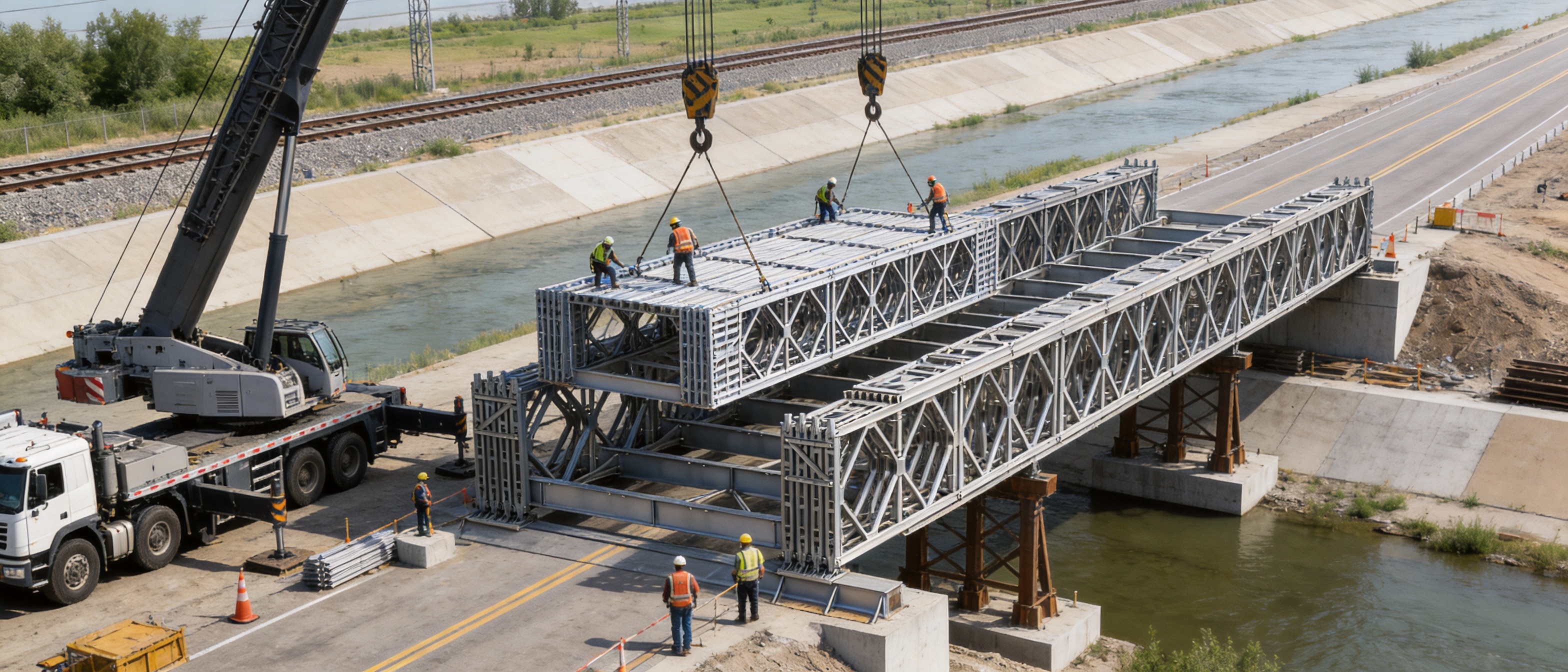
Modern infrastructure projects increasingly require bridge systems that can be delivered quickly, assembled efficiently, and adapted to demanding site conditions. Conventional permanent bridges may require long design and construction periods, extensive foundations, and large quantities of specialized equipment. In contrast, modular steel bridges provide a practical alternative for transportation links, emergency access, construction logistics, industrial facilities, and temporary or semi-permanent infrastructure.
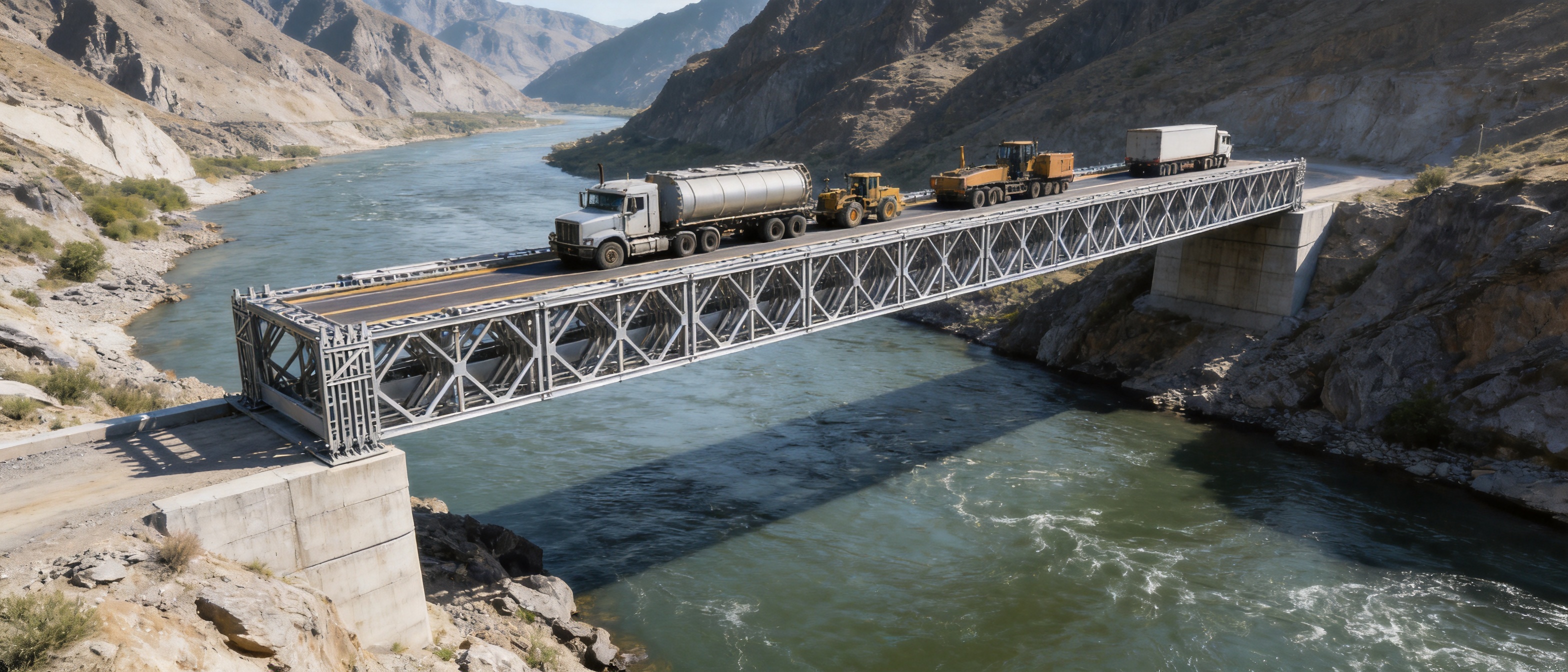
The CB450 Large Span Heavy Load Galvanized Bailey Bridge is designed for projects that demand more than basic temporary access. It combines modular construction with a four-lane, single-layer reinforced configuration, a maximum single span of 81 meters, and a rated load capacity of up to 80 tons. This combination allows the bridge to address applications involving heavy vehicles, construction machinery, logistical traffic, and emergency transportation where ordinary modular bridge systems may not provide sufficient span or capacity.
Manufactured by Jiangsu Zhonghai Bridge Equipment Co., Ltd., the CB450 system reflects a product approach centered on structural engineering, factory pre-assembly, standardized fabrication, corrosion protection, and international project support. Its hot-dip galvanized finish is intended to improve resistance to environmental exposure, while its modular components support efficient transportation, assembly, inspection, and future reconfiguration.
This article examines the bridge’s structure, load performance, manufacturing process, competitive advantages, installation considerations, quality controls, and potential applications. It also explains why a heavy-load modular bridge can be a valuable solution for project owners seeking a balance between deployment speed, structural capacity, durability, and lifecycle value.
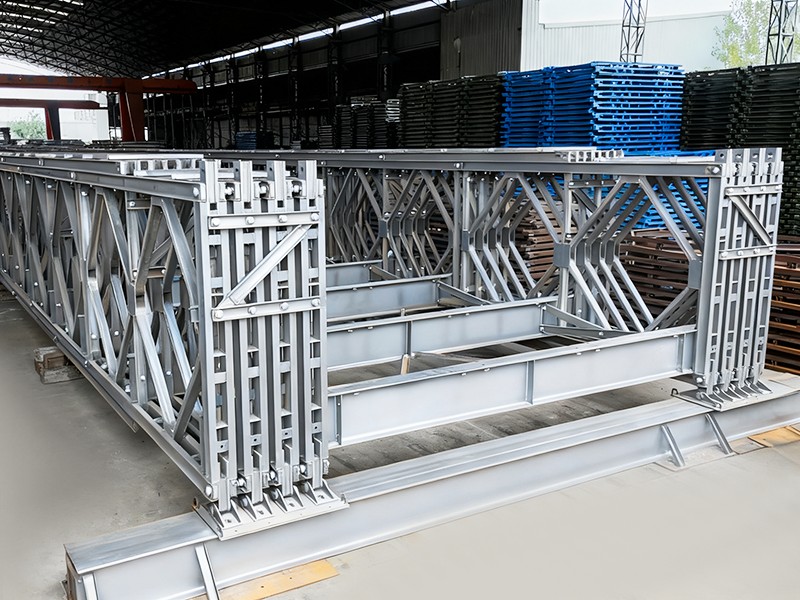
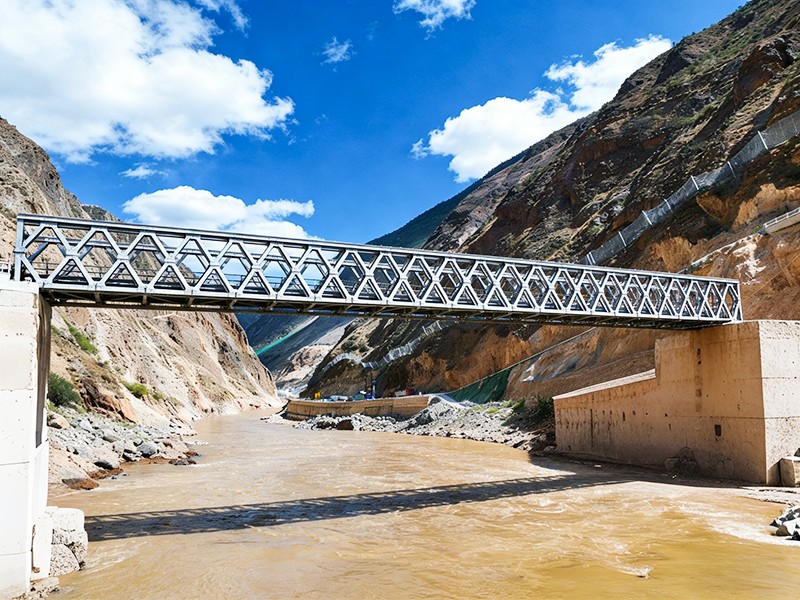
CB450 Type Large Span Heavy Load Galvanized Bailey Bridge
1. The Need for Large-Span Heavy-Load Modular Bridges
Bridge requirements vary considerably from one project to another. A light pedestrian crossing, a rural access bridge, a military logistics route, and a construction access bridge may all be described as “modular bridges,” but their engineering demands are very different. Span length, traffic width, load class, environmental exposure, erection conditions, foundation limitations, and expected service duration all influence the appropriate bridge design.
Many standard Bailey bridges are optimized for short or medium spans and moderate traffic. They are useful because their panels and components can be transported and assembled relatively easily. However, when the required span becomes longer or the expected vehicle load becomes heavier, a conventional configuration may require additional reinforcement, more supports, multiple bridge lanes, or a more complicated erection method.
The CB450 system addresses this challenge through a reinforced, four-lane, single-layer arrangement. The design is intended to provide substantial traffic width while maintaining a modular structural concept. A maximum single span of 81 meters reduces the need for intermediate piers in locations where river channels, flood zones, transportation corridors, or unstable ground conditions make additional supports difficult or undesirable.
The bridge’s load capacity of up to 80 tons further expands its application range. This capacity can support heavy transport requirements when the design, site conditions, traffic arrangement, and foundation system are properly verified by qualified engineers. The system is also designed with reference to recognized loading standards, including HS-15, HS-20, HS-25, HL-93, and tracked-50. These references provide a basis for evaluating different vehicle and tracked-load scenarios during project planning.
A large-span modular bridge is not simply a longer version of a small bridge. As the span increases, structural deflection, connection forces, stability, erection-stage behavior, wind effects, fatigue, and foundation reactions become increasingly important. The CB450 product is therefore positioned as an engineered heavy-load system rather than a basic collection of interchangeable panels.
2. Product Overview
The CB450 Large Span Heavy Load Galvanized Bailey Bridge is a modular steel bridge system developed for heavy traffic and demanding site conditions. Its principal characteristics include a four-lane single-layer reinforced structure, a maximum single span of 81 meters, a maximum load capacity of 80 tons, and hot-dip galvanized corrosion protection.
| Item | Product Information |
|---|---|
| Bridge type | Large-span heavy-load modular steel bridge |
| Model | CB450 |
| Structural arrangement | Four-lane, single-layer reinforced configuration |
| Maximum single span | 81 meters |
| Maximum stated load capacity | 80 tons |
| Corrosion protection | Hot-dip galvanizing |
| Referenced load design standards | HS-15, HS-20, HS-25, HL-93, and tracked-50 |
| Factory status | Pre-assembled before shipment to the project site |
| Typical application areas | Heavy transport, emergency response, construction access, industrial logistics, and infrastructure projects |
The four-lane configuration is particularly valuable for projects where traffic capacity and operational flexibility are important. A wider bridge can support separated traffic flows, improve access for large vehicles, and reduce the need for repeated one-way movements. In construction and emergency applications, additional lanes may also allow equipment, material delivery vehicles, and service traffic to use the same crossing more efficiently.
The single-layer arrangement helps preserve the basic advantages of modular bridge construction. Compared with more complex multi-level systems, a single-layer structure can simplify transportation, component identification, erection planning, and inspection. At the same time, reinforcement enables the bridge to meet more demanding span and load requirements than a light-duty modular bridge.
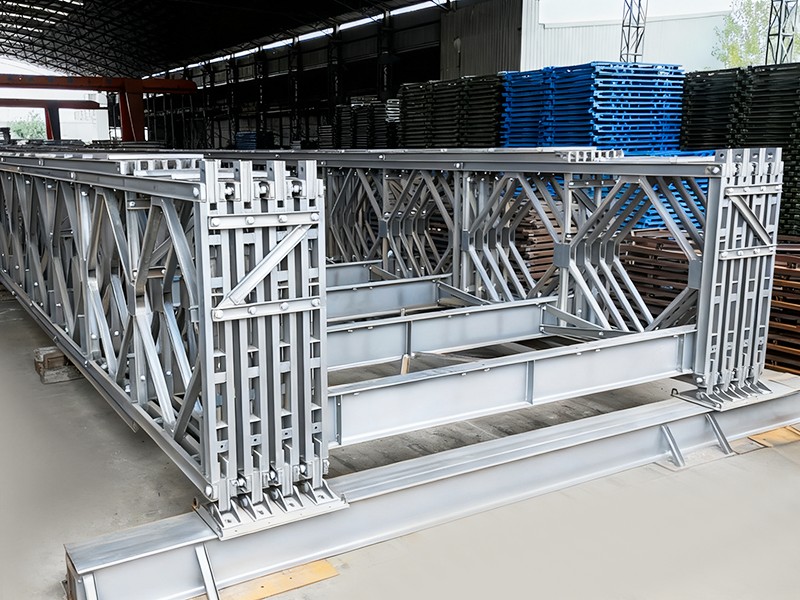
Factory pre-assembly is another important feature. The bridge was pre-assembled at the manufacturing facility before being shipped to the Sichuan project site. This approach allows the manufacturer and project team to verify component fit, connection alignment, assembly sequence, and overall dimensional accuracy before the bridge reaches the construction location.
3. Structural Design Advantages
3.1 Large Single-Span Capability
The ability to reach a maximum single span of 81 meters is one of the product’s most important advantages. In many bridge locations, intermediate supports create additional engineering and construction problems. Piers placed in rivers can affect water flow, obstruct navigation, increase scour risk, and require extensive foundation work. Supports placed in transportation corridors can interfere with road or railway operations. In flood-prone areas, additional foundations may be vulnerable to erosion or impact from floating debris.
A longer single span can help reduce these difficulties. By crossing a wider opening with fewer or no intermediate supports, the bridge can preserve the natural or operational conditions below. This can shorten foundation construction, reduce in-water work, and improve the practicality of installation in locations with limited access.
Large-span performance also provides greater flexibility during project planning. The same modular concept can potentially be adapted to different crossing lengths through engineering review, component selection, and reinforcement planning. The final configuration must always be checked against the actual span, load combination, wind condition, support arrangement, and erection method, but the product’s span range gives project designers a broader starting point than conventional short-span bridge systems.
3.2 Heavy Load Performance
The stated load capacity of up to 80 tons makes the CB450 suitable for heavy-duty applications that may exceed the requirements of ordinary access bridges. Potential traffic may include loaded trucks, construction equipment, industrial vehicles, emergency vehicles, and tracked machinery, subject to project-specific design approval.
Heavy-load performance depends on more than the nominal strength of the main trusses. Deck systems, transverse beams, longitudinal members, connections, bearings, ramps, foundations, and approach roads must all work together. The load must also be distributed appropriately across the four-lane width. For this reason, a complete bridge design should consider vehicle positioning, lane usage, dynamic effects, braking forces, lateral loads, wind, temperature, fatigue, and accidental impact.
The CB450’s reinforced configuration is intended to provide an integrated structural response. The bridge is designed around a coordinated system of modular steel components rather than isolated members. This helps improve the predictability of assembly and supports consistent quality control during fabrication.
3.3 Four-Lane Traffic Width
A four-lane bridge can offer advantages over narrower modular bridges in both permanent and temporary applications. It may support two-way movement, provide separate lanes for different traffic classes, or allow a project owner to maintain access while one portion of the bridge is inspected or repaired.
For infrastructure projects, wide traffic capacity can reduce congestion and improve logistics efficiency. For emergency response, it can support simultaneous movement of rescue vehicles, supply trucks, and engineering equipment. For construction projects, it can allow material delivery vehicles to pass without requiring frequent reversing or complicated traffic control.
The traffic arrangement must be selected according to the final design loads and operating plan. A four-lane configuration does not mean that every lane can automatically carry the maximum rated load at the same time. Traffic management, vehicle spacing, and load distribution should be established by the project engineer and included in the operating instructions.
3.4 Modular Assembly
Modular construction is central to the Bailey bridge concept. Rather than manufacturing the entire bridge as one indivisible structure, the system is produced from standardized or semi-standardized steel components that can be transported, stored, assembled, inspected, and replaced in sections.
This modularity provides several practical benefits. Damaged or worn components can potentially be replaced without dismantling the entire bridge. Spare parts can be stocked for emergency response. The bridge can be shipped to locations where large fabrication facilities are unavailable. Components can also be handled using commonly available lifting and transport equipment, subject to weight and safety planning.
Modular construction may also reduce project risk. Factory-made components can be inspected before delivery, while the site team can follow a defined assembly sequence instead of performing extensive structural fabrication in difficult weather or remote conditions. The bridge can therefore be installed with greater predictability than a fully site-fabricated alternative.
4. Hot-Dip Galvanizing and Corrosion Protection
Steel bridges are exposed to moisture, oxygen, airborne contaminants, road salt, industrial pollutants, and changing temperatures. Corrosion can reduce section thickness, affect connections, increase maintenance requirements, and shorten service life if it is not controlled effectively.
The CB450 uses hot-dip galvanizing as its primary stated corrosion-protection treatment. In this process, prepared steel components are immersed in molten zinc. The zinc forms a metallurgically bonded coating that provides both barrier protection and sacrificial protection. If the coating is locally damaged, the surrounding zinc can help protect exposed steel through galvanic action.
Hot-dip galvanizing is particularly attractive for modular bridge components because it can provide a durable factory-applied finish before the parts are transported to the project site. Compared with relying only on field-applied paint, factory galvanizing can reduce the influence of weather, dust, humidity, and site workmanship on the initial protective coating.
Galvanized components may also be advantageous in locations where regular repainting is difficult. Remote areas, flood zones, temporary logistics routes, and emergency deployments often have limited maintenance resources. A robust factory-applied coating can reduce the frequency of protective treatment, although regular inspection remains necessary.
Corrosion protection should be considered as part of a complete durability plan. Drainage, connection detailing, contact surfaces, debris accumulation, water traps, transport damage, and local site conditions all influence performance. Cut edges, field modifications, welding repairs, and areas damaged during erection may require approved touch-up procedures. The bridge owner should maintain inspection and maintenance records throughout the service period.
5. Advanced Manufacturing Process
5.1 Engineering and Production Planning
The manufacture of a large-span heavy-load modular bridge begins with engineering coordination. Product dimensions, material specifications, load requirements, connection details, fabrication tolerances, surface treatment, transport limitations, and assembly sequences must be considered together.
Jiangsu Zhonghai Bridge Equipment Co., Ltd. integrates engineering design with production planning. This integrated approach can reduce the risk of discrepancies between drawings, shop fabrication, and field assembly. It also allows manufacturing teams to identify difficult connection details, lifting points, welding sequences, and inspection locations before production begins.
For customized projects, the engineering process may include span verification, lane arrangement, support reactions, deck configuration, approach geometry, wind conditions, seismic considerations, and erection-stage analysis. The final design should be based on site-specific information and approved by the responsible structural engineer.
5.2 Material Preparation
High-quality modular bridge production depends on consistent material preparation. Steel plates, sections, fasteners, and other components must be received, identified, stored, and processed according to approved procedures. Traceability helps ensure that the correct material grade is used in the correct component and that quality documentation can be retained for the project.
Material preparation may include plate cutting, profile processing, hole making, edge preparation, straightening, and dimensional checking. Accurate preparation is essential because modular bridge components must fit together repeatedly through bolted or mechanical connections. Small dimensional errors can accumulate across a long bridge if they are not controlled at the component stage.
5.3 Automated Welding
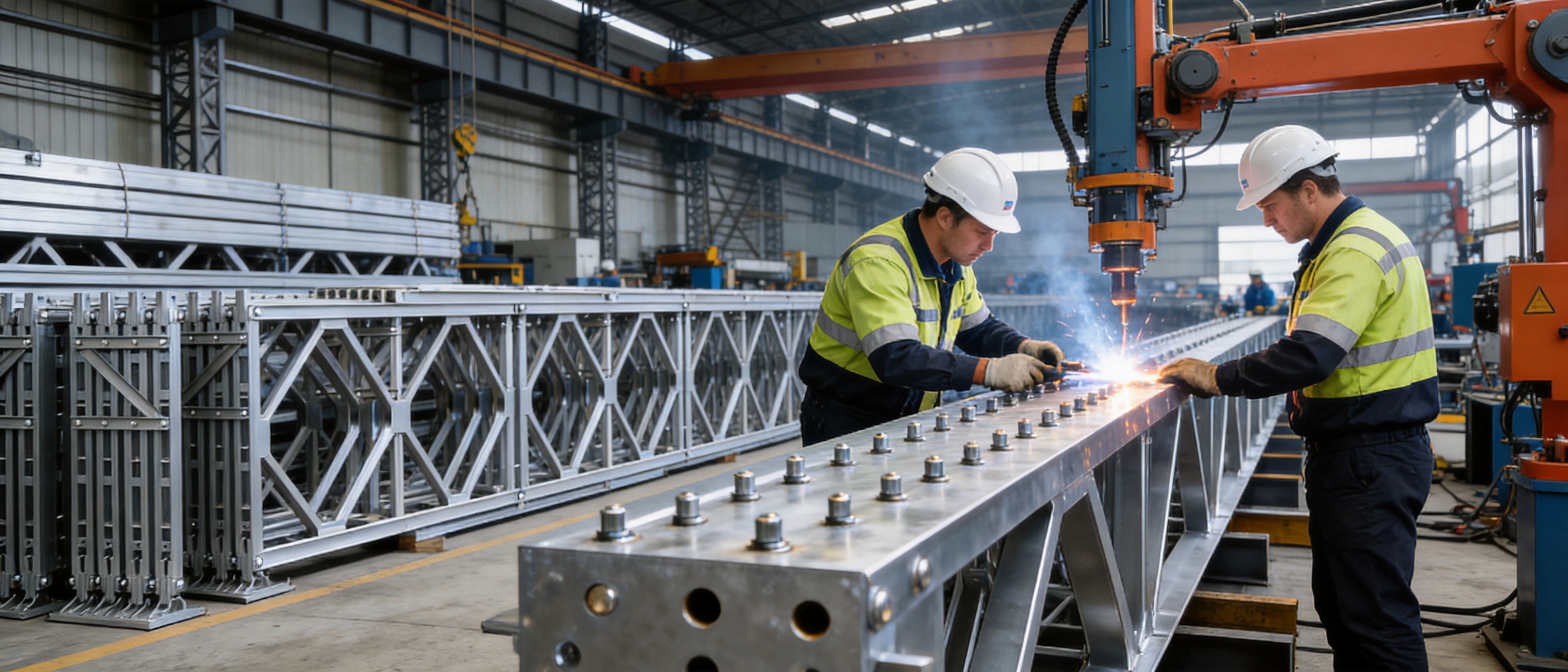
The company’s manufacturing capabilities include automated welding and precision steel fabrication. Automated welding can improve repeatability by controlling travel speed, heat input, weld placement, and production sequence. It can also improve productivity for repeated components and reduce variation between individual assemblies.
Welding quality affects structural reliability, fatigue resistance, dimensional stability, and surface treatment. A controlled welding process can help reduce common problems such as incomplete fusion, excessive spatter, undercutting, distortion, and inconsistent weld profiles. Welding procedures should be supported by appropriate qualification, operator training, and inspection.
Automated equipment does not eliminate the need for skilled personnel. Engineers, welding technicians, inspectors, and production supervisors remain responsible for selecting appropriate procedures, monitoring production, reviewing results, and addressing deviations. The strongest manufacturing systems combine automation with qualified human oversight.
5.4 Precision Fabrication
Precision fabrication is especially important for a bridge made from interchangeable modules. Panel dimensions, pin or bolt hole positions, connection plates, beam lengths, bearing surfaces, and deck interfaces must remain within controlled tolerances. Reliable interchangeability makes field assembly faster and reduces the need for unplanned modification.
Modern fabrication workflows may combine digital drawings, production planning, CNC cutting, controlled drilling, assembly jigs, calibrated measurement tools, and documented inspections. These methods support consistent production across large numbers of structural components.
Precision also contributes to the final appearance and performance of the bridge. Properly aligned components reduce forced fit-up, minimize connection stress, support smooth deck installation, and help ensure that the assembled structure follows the intended geometry.
5.5 Factory Pre-Assembly
Factory pre-assembly is one of the clearest indicators that the CB450 is developed as a project-ready bridge system. Before shipment, the bridge can be assembled at the manufacturing facility to verify the relationship between its components.
Pre-assembly may be used to check panel alignment, connection compatibility, deck fit, reinforcement placement, dimensional control, and erection sequence. It can also help identify missing parts or packaging problems before the bridge leaves the factory.
For the Sichuan project, the bridge was pre-assembled at the factory and then shipped to the project site. This process can reduce uncertainty during site installation because the construction team receives a system that has already undergone a practical assembly check. It also provides an opportunity to document the component arrangement and prepare more accurate erection instructions.
5.6 Surface Treatment and Galvanizing
After fabrication and inspection, suitable components are prepared for hot-dip galvanizing. Surface preparation is essential because oil, scale, rust, welding residues, and other contaminants can affect coating quality. The galvanizing process must be managed to achieve complete coverage while considering drainage, venting, component geometry, and handling requirements.
After galvanizing, components should be inspected for coating continuity, appearance, excessive buildup, distortion, blocked holes, and transport-related damage. Components are then organized for packing and shipment in a way that protects connection surfaces and allows efficient identification at the project site.
6. Quality Management and Standards
Quality management for a modular bridge must address both individual components and the assembled system. A component can meet its dimensional requirements while the complete bridge still suffers from an assembly or alignment problem. Effective quality control therefore extends from raw material receipt through fabrication, galvanizing, factory assembly, packing, delivery, and site erection.
Jiangsu Zhonghai Bridge Equipment Co., Ltd. states that its products are manufactured through standardized workflows and are designed to comply with ASTM, EN, and applicable national specifications. These standards provide frameworks for materials, fabrication, design, testing, and quality assurance. The specific standard applied to a project should be identified in the contract and engineering documentation.
Typical quality-control activities may include:
Material certificate review and traceability.
Dimensional inspection of plates, sections, panels, holes, and connection components.
Welding procedure control and welder qualification.
Visual inspection and, where required, nondestructive testing of welds.
Verification of fastener grades, sizes, coatings, and installation requirements.
Inspection of factory trial assembly and component interchangeability.
Verification of galvanizing coverage and coating condition.
Packaging inspection and component identification before dispatch.
Review of inspection records and project documentation.
The load design references HS-15, HS-20, HS-25, HL-93, and tracked-50 provide useful points of comparison for project engineers. These load designations should not be interpreted as a universal operating license. Actual bridge capacity depends on the approved design, span, configuration, lane loading, foundation, support conditions, vehicle arrangement, and service environment.
7. Competitive Advantages
7.1 Higher Capacity Than Basic Modular Access Bridges
One of the CB450’s main advantages over ordinary modular access bridges is its combination of long span and heavy-load capacity. Many basic systems are intended for light vehicles, pedestrians, or short crossings. They may not be suitable for large construction machinery or high-volume logistics.
The CB450 is specifically positioned for applications requiring up to 80 tons of load capacity and a maximum single span of 81 meters. This allows project owners to consider one system for demanding crossings that might otherwise require a more expensive conventional bridge or a heavily reinforced alternative.
7.2 Wide Four-Lane Configuration
A four-lane arrangement can provide greater operational value than a narrow single-lane bridge. It supports more efficient vehicle movement and can reduce bottlenecks at busy construction or logistics sites. Where traffic continuity is important, the additional width may offer practical redundancy and improved access management.
Compared with a narrow bridge that requires strict alternating traffic control, the CB450 can be configured to support a more productive traffic plan. This can be particularly useful for industrial facilities, major construction projects, emergency corridors, and infrastructure links serving large vehicle fleets.
7.3 Reduced Site Fabrication
Factory production and pre-assembly move much of the complex work away from the project site. This can reduce the amount of welding, drilling, cutting, and corrective fitting required in the field. Less site fabrication may lead to shorter installation periods, lower dependence on weather conditions, and improved control over workmanship.
For remote or difficult sites, this advantage can be significant. Transporting finished modular components is often easier than establishing a complete structural fabrication operation at the crossing location.
7.4 Corrosion-Resistant Finish
Hot-dip galvanizing gives the CB450 a durability advantage over unprotected or inadequately protected steel systems. A galvanized bridge is better prepared for exposure to rain, humidity, and other environmental factors than a bridge that relies solely on untreated steel.
The finish may also reduce the long-term maintenance burden. Although inspection and repair remain necessary, a durable zinc coating can extend the interval before major surface treatment is required, especially when the bridge is installed and maintained correctly.
7.5 International Manufacturing and Delivery Capability
The manufacturer is based in Zhenjiang, Jiangsu Province, an important industrial and transportation region in China. Its location supports access to industrial supply chains, manufacturing labor, transportation networks, and export logistics.
The company has experience serving transportation, water conservancy, military logistics, disaster relief, and international development projects. Its project experience includes coastal engineering in the Maldives, temporary access bridges for the Shenzhen–Zhongshan Corridor, structural components for the Hangzhou Expo Center, multi-span Bailey bridges for the Lalin Railway, and emergency bridge deployments in different regions.
This range of applications indicates an ability to support varied project environments rather than focusing only on one narrow market. International buyers may benefit from a supplier that can coordinate design, fabrication, packaging, delivery, and technical support under one manufacturing organization.
8. Site Installation and Erection Considerations
Although the CB450 is designed for modular erection, large-span heavy-load bridge installation still requires careful planning. The project team should review access roads, lifting equipment, temporary supports, assembly areas, water levels, weather, wind, traffic control, and emergency procedures before work begins.
Factory pre-assembly can help establish the correct sequence, but the site arrangement may differ from the factory environment. Components may need to be transported over narrow roads, lifted in restricted spaces, or assembled near active traffic and watercourses. A site-specific erection method statement should therefore be prepared and approved by qualified personnel.
Important erection activities may include:
Surveying and confirming the positions and elevations of abutments, bearings, and support points.
Inspecting delivered components for transport damage and checking the packing list.
Organizing components in the sequence required for assembly.
Installing temporary supports or launching equipment where required.
Assembling panels, beams, bracing, deck elements, and connections according to approved drawings.
Checking bolt installation, pin installation, alignment, camber, deck level, and bearing contact.
Completing ramps, approaches, drainage, traffic barriers, and safety equipment.
Performing final inspection and, where required, a controlled proof or commissioning procedure.
Large-span erection introduces temporary conditions that may be more critical than the completed bridge condition. The partially assembled structure may have reduced stiffness and different load paths. Wind can be particularly important during launching or lifting. No construction traffic should be permitted on the bridge until the responsible engineer confirms that the structure is complete and ready for service.
9. Foundation and Approach Requirements
A modular steel bridge can be assembled quickly, but its performance depends on reliable supports. Abutments, foundations, bearings, approach roads, and embankments must be designed to transfer vertical and horizontal reactions safely to the ground.
Site investigation should consider soil strength, settlement, groundwater, scour, erosion, seismic conditions, flood levels, and potential vehicle impact. For a large-span heavy-load bridge, foundation behavior can influence alignment, deck smoothness, bearing performance, and long-term serviceability.
Approach roads are equally important. A bridge rated for heavy vehicles cannot perform properly if the approaches are weak, uneven, poorly drained, or too steep. The transition between the road and bridge deck should be designed to reduce impact effects and prevent vehicles from striking the structure at an unsafe angle.
Drainage should be planned so that water does not accumulate on the deck or around the supports. In cold or wet climates, surface water and debris can accelerate deterioration if not removed effectively. Proper drainage also improves traffic safety and reduces the risk of hydroplaning.
10. Applications
10.1 Emergency and Disaster Response
Floods, earthquakes, landslides, storms, and infrastructure failures can isolate communities and interrupt the movement of essential supplies. A large-span modular bridge can restore access more quickly than a conventional permanent bridge when immediate connectivity is required.
The CB450’s heavy-load capability makes it appropriate for emergency logistics involving rescue trucks, mobile cranes, engineering equipment, fuel vehicles, and supply transport. Its modular nature supports storage and deployment planning, allowing bridge components to be prepared for rapid mobilization.
10.2 Construction Access
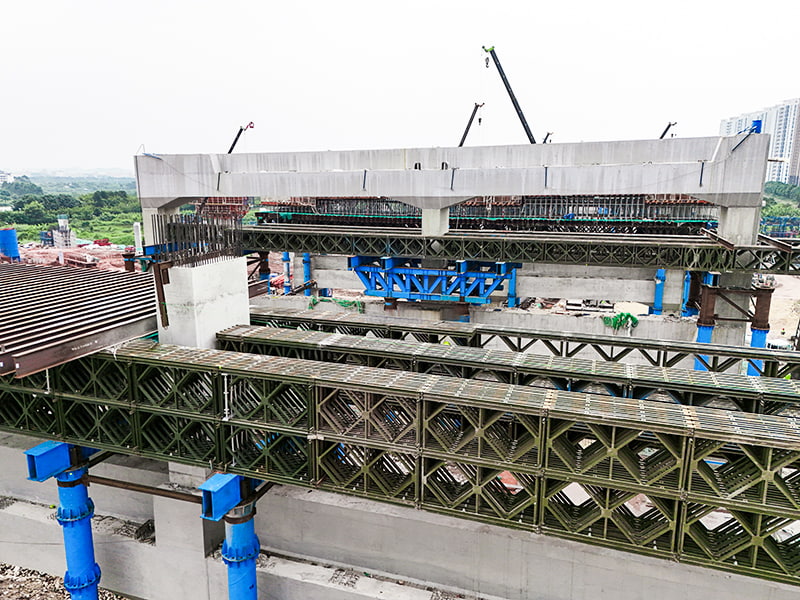
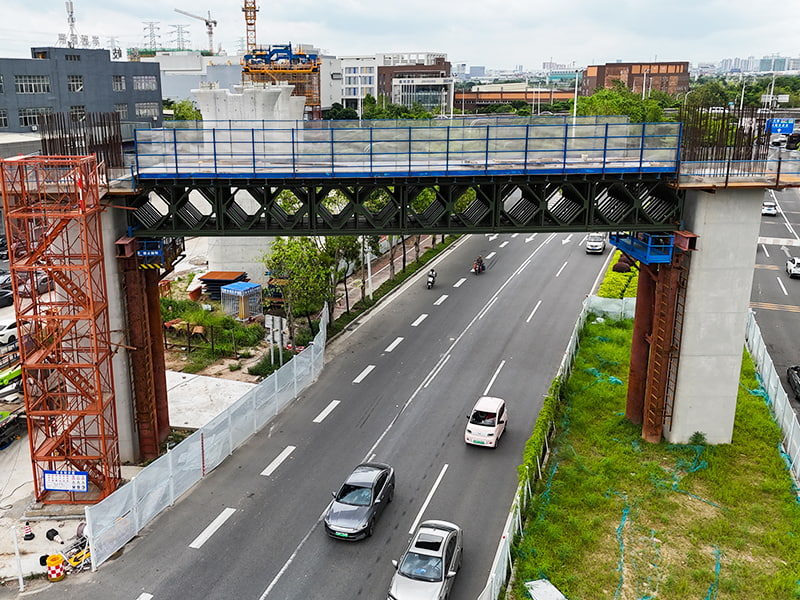
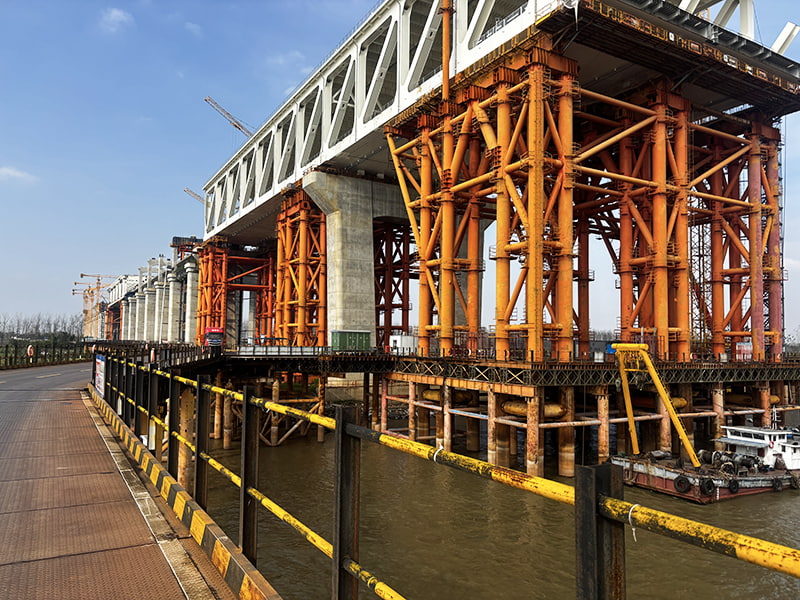
Large infrastructure projects often need temporary crossings for workers, concrete trucks, excavators, cranes, and material delivery vehicles. A heavy-load modular bridge can provide access across rivers, drainage channels, rail corridors, existing roads, or unfinished sections of a project.
The four-lane arrangement can improve the movement of construction traffic and reduce conflicts between delivery vehicles and service vehicles. When the project phase is complete, a modular bridge may be dismantled, relocated, or reconfigured for another work area, depending on the approved design and component condition.
10.3 Industrial and Mining Logistics
Industrial plants, mines, energy facilities, and large warehouses may require temporary or semi-permanent crossings for heavy vehicles. The CB450 can provide a practical connection where conventional bridge construction would take too long or where the crossing is expected to change as the facility develops.
Industrial environments may contain dust, moisture, chemicals, vibration, and heavy traffic. Galvanized steel can provide an important layer of protection, but the exact environmental compatibility should be reviewed before use in highly aggressive conditions.
10.4 Water Conservancy and Flood-Control Projects
Water conservancy construction frequently involves canals, rivers, reservoirs, levees, and flood-control corridors. Access bridges may be needed to transport machinery and materials while preserving water flow and construction operations.
A large single span can reduce the need for intermediate supports in the watercourse. This may simplify construction and reduce interference with hydraulic conditions. Site-specific flood levels, flow velocity, debris impact, scour, and temporary works must still be evaluated.
10.5 Military and Strategic Logistics
Military logistics often require fast deployment, adaptable transport infrastructure, and the ability to support heavy vehicles. Modular bridge components can be stored, transported, assembled, and removed according to operational requirements.
The CB450’s large span and heavy-load characteristics may be relevant to strategic routes where rapid access and high vehicle capacity are necessary. Any defense-related application would require additional operational, security, and design controls determined by the responsible authority.
10.6 International Development Projects
Infrastructure development programs may be implemented in regions where transportation networks are incomplete, construction resources are limited, or seasonal access is a major concern. A modular bridge supplied as a coordinated system can help reduce the need for extensive local fabrication infrastructure.
Factory manufacturing, standardized components, and technical documentation can also support training and local erection teams. The supplier’s experience with international development and coastal engineering projects provides a foundation for coordinating projects across different environmental and logistical conditions.
11. Lifecycle Value and Maintenance
The economic value of a bridge should be assessed across its full lifecycle rather than only by its initial purchase price. A system that is quick to install, easy to inspect, corrosion-resistant, and adaptable may provide greater value than a lower-cost system that requires extensive site work or frequent repair.
The CB450 offers several lifecycle benefits. Modular components can support replacement and reconfiguration. Factory production can improve consistency. Hot-dip galvanizing can reduce corrosion-related maintenance. Pre-assembly can reduce installation uncertainty. A wide, heavy-load configuration can support more demanding traffic and potentially serve multiple project phases.
Routine inspections should cover truss panels, bracing, deck members, fasteners, pins, bearings, expansion areas, welds, galvanized surfaces, barriers, ramps, drainage, and foundations. Inspectors should look for loose connections, deformation, cracking, coating damage, corrosion buildup, unusual vibration, impact marks, settlement, and water-related deterioration.
Inspection frequency should reflect the bridge’s environment and use. A bridge exposed to saltwater, heavy traffic, flood debris, industrial pollutants, or frequent tracked vehicles may require more frequent inspection than a bridge in a mild and lightly trafficked environment.
Maintenance records should document inspection dates, observed conditions, repairs, replaced parts, traffic restrictions, and responsible personnel. Good records help identify recurring problems and support decisions regarding continued use, refurbishment, relocation, or decommissioning.
12. Why Manufacturer Integration Matters
Bridge projects often involve multiple parties, including owners, designers, contractors, logistics providers, inspectors, and local authorities. Coordination problems can arise when the supplier only produces isolated steel parts and does not understand the complete bridge system.
Jiangsu Zhonghai Bridge Equipment Co., Ltd. combines engineering design, manufacturing, quality management, and on-site support. This integrated structure can improve communication between design and production teams. It also allows technical questions about component fit, erection sequence, replacement parts, and project customization to be addressed by an organization familiar with the product.
The company’s focus includes modular steel bridges, Bailey bridge systems, customized steel components, bridge erection support equipment, automated welding, and precision steel fabrication. This product and service range supports both standard bridge orders and projects requiring specialized structural components.
For international customers, supplier capability is particularly important. Buyers may need assistance with technical submittals, packing lists, shipping arrangements, assembly instructions, inspection documentation, and communication between local contractors and the factory. A manufacturer with international delivery experience is better positioned to manage these requirements.
13. Project Customization
Although the CB450 is based on a defined product type, bridge projects rarely have identical requirements. Customization may be required for span length, roadway width, deck system, barrier arrangement, support geometry, access ramps, corrosion environment, transport packaging, or erection method.
Customization should begin with a clear project data sheet. Useful information includes the required clear span, total crossing length, roadway width, design vehicle, maximum axle load, traffic frequency, foundation conditions, river or road clearance, wind speed, seismic category, temperature range, expected service period, and site access limitations.
The supplier can then coordinate the appropriate configuration with the project engineer. Any changes to standard components should be reviewed for structural effects, manufacturing feasibility, galvanizing requirements, transport limitations, and field assembly consequences.
Customization is most effective when completed before production begins. Late changes can affect material procurement, fabrication schedules, pre-assembly, galvanizing batches, packing, and shipping. Early technical communication helps control both cost and schedule.
14. Procurement and Delivery Considerations
Purchasing a large modular bridge involves more than ordering steel components. The procurement package should clearly define the bridge configuration, applicable standards, design loads, corrosion-protection requirements, documentation, inspection procedures, delivery terms, spare parts, erection support, and warranty provisions.
Because modular bridge components may be numerous, packing and identification are important. Each component should be marked or documented so that the site team can identify it quickly. The packing plan should protect galvanized surfaces and prevent damage to holes, connection plates, pins, and other critical interfaces.
Shipping dimensions and weights should be considered during the design stage. The bridge may travel by road, sea, rail, or a combination of methods. Export packaging, lifting points, container utilization, port handling, and inland transportation can all influence the final delivery schedule.
Factory pre-assembly can support delivery planning by confirming the quantity and relationship of components. It can also help generate assembly records, photographs, inspection reports, and component schedules for use by the project team.
15. Safety Considerations
Safety must govern design, fabrication, transport, erection, commissioning, and operation. Heavy modular bridge components can create significant lifting and handling risks. The erection team should use approved lifting plans, certified equipment, trained personnel, exclusion zones, communication procedures, and weather monitoring.
During assembly, temporary structures and partially completed trusses may not have the same capacity as the final bridge. Construction loads should be controlled, and workers should not enter areas that have not been secured or approved. Wind restrictions may be necessary during lifting, launching, or work at height.
After completion, the bridge should have suitable barriers, signs, lane markings, lighting where required, speed controls, and traffic-management procedures. Load restrictions should be displayed clearly if the operating plan does not permit the maximum rated load in every traffic arrangement.
Operators should be trained to recognize unusual movement, impact damage, flooding, settlement, or connection problems. If abnormal conditions are observed, traffic should be restricted until the bridge has been inspected by qualified personnel.
16. Comparing the CB450 with Alternative Bridge Solutions
Permanent reinforced-concrete and conventional steel bridges may provide excellent long-term performance, but they often require longer construction schedules, extensive formwork, more complex site operations, and larger initial foundations. They remain appropriate when a permanent structure is required and sufficient time and budget are available.
Light-duty modular bridges can be economical for short spans and limited traffic. However, they may not offer sufficient capacity, width, or stiffness for heavy vehicles and large construction equipment. Reinforcing a light system can reduce its cost advantage and complicate erection.
Prefabricated one-piece bridges can provide rapid installation but may require oversized transport, heavy lifting equipment, and suitable access for a complete bridge unit. Their transport and handling limitations can be significant in remote or congested locations.
The CB450 occupies a useful position between these alternatives. It retains the transportability and assembly advantages of modular construction while offering a larger span, wider traffic arrangement, higher load capacity, and factory-applied galvanizing. Its suitability is strongest where project requirements exceed ordinary modular bridge performance but do not justify the time and cost of a fully conventional bridge.
| Evaluation Factor | CB450 Modular Bridge | Basic Light-Duty Modular Bridge | Conventional Site-Built Bridge |
|---|---|---|---|
| Deployment speed | High, supported by factory fabrication and pre-assembly | High for short spans | Usually lower because of extensive site work |
| Maximum stated span | Up to 81 meters in the specified configuration | Generally more limited and project-dependent | Highly variable |
| Maximum stated load | Up to 80 tons | Usually lower, depending on design | Highly variable and custom-designed |
| Traffic arrangement | Four-lane single-layer reinforced structure | Often narrower | Customizable |
| Corrosion protection | Hot-dip galvanized steel | Depends on supplier and specification | Often paint or project-specific systems |
| Relocation potential | High because of modular components | High | Low |
| Site fabrication requirement | Reduced through factory production | Usually reduced | Often substantial |
This comparison is general rather than a substitute for engineering evaluation. The most suitable bridge depends on the project’s span, load, service life, environmental exposure, budget, construction program, and local regulations.
17. Recommended Evaluation Process for Buyers
Potential buyers should begin by defining the operational purpose of the bridge. Is it intended for emergency use, temporary construction access, semi-permanent logistics, industrial transportation, or long-term public traffic? The answer affects design life, corrosion protection, inspection, traffic control, and foundation requirements.
The next step is to define the loading conditions. Buyers should identify the heaviest vehicle, axle arrangement, wheel spacing, tracked equipment, traffic frequency, lane distribution, braking conditions, and any abnormal or oversized loads. A general statement such as “heavy traffic” is not sufficient for final structural design.
Site information should include the clear crossing distance, available working area, ground conditions, approach elevations, flood information, wind exposure, temperature, seismic requirements, and transportation access. Accurate data allows the manufacturer to recommend a suitable configuration and identify potential site constraints early.
Buyers should also request technical documentation, including general arrangement drawings, component lists, material information, galvanizing details, inspection records, assembly instructions, and maintenance recommendations. The documentation package should match the bridge supplied and should be suitable for review by the project owner and local authorities.
Finally, the buyer should evaluate the supplier’s ability to support the entire project. Manufacturing capacity, factory inspection, packaging, export experience, spare parts, technical communication, erection assistance, and after-sales support can be as important as the initial product specification.
18. Frequently Asked Questions
What is the CB450 Large Span Heavy Load Bailey Bridge?
The CB450 is a modular steel bridge designed for large-span and heavy-load applications. It uses a four-lane, single-layer reinforced configuration and is protected with hot-dip galvanizing. The stated maximum single span is 81 meters, and the stated maximum load capacity is 80 tons.
How many lanes does the bridge provide?
The specified product configuration is a four-lane bridge. The actual traffic arrangement, lane loading, vehicle spacing, and operating restrictions should be established in the approved project design and traffic-management plan.
Can the bridge span 81 meters without an intermediate pier?
The product is stated to support a maximum single span of 81 meters. Whether a particular project can use the full span without intermediate support depends on the approved structural design, ground conditions, support arrangement, wind environment, construction method, and applicable regulations.
What is the maximum load capacity?
The stated maximum load capacity is 80 tons. The final allowable load must be confirmed for the actual bridge span, configuration, vehicle type, lane arrangement, foundation, and operating conditions. The maximum value should not be applied automatically to every traffic scenario.
What corrosion protection does the CB450 use?
The bridge uses hot-dip galvanizing. This process applies a bonded zinc coating to steel components and provides barrier and sacrificial protection against corrosion. Inspection and maintenance are still required, particularly in aggressive environments or after field damage.
Why is factory pre-assembly important?
Factory pre-assembly helps verify component fit, alignment, connection compatibility, dimensions, and erection sequence before shipment. It can reduce field uncertainty, identify missing or incorrect components, and help the installation team understand the assembly process.
Which design load standards are referenced?
The product information references HS-15, HS-20, HS-25, HL-93, and tracked-50. These references provide a basis for load design and comparison. The applicable loading standard for a project should be selected and confirmed by the responsible engineer and authority.
Where can the CB450 be used?
Potential applications include emergency and disaster-response routes, construction access, water conservancy projects, industrial logistics, mining operations, military logistics, international development projects, and other crossings requiring a wide, heavy-load modular bridge.
Can the bridge be relocated after installation?
Modular bridge components generally offer strong relocation potential. However, relocation requires a new engineering review, including inspection of component condition, revised span and load requirements, support conditions, erection method, and corrosion-protection repairs.
Does the manufacturer provide customized solutions?
The company focuses on modular bridge systems, customized steel components, bridge erection support equipment, automated welding, and precision steel fabrication. Project-specific customization should be discussed during the engineering and procurement stage.
What should be inspected after delivery?
The project team should check component quantities, identification marks, dimensions, connection holes, pins, bolts, galvanized surfaces, packaging condition, and transport damage. Any discrepancy should be recorded and reported before assembly begins.
Is a foundation design included with the bridge?
Foundation requirements depend on the site and project configuration. Abutments, bearings, foundations, approaches, scour protection, and drainage should be designed or verified according to local ground and environmental conditions. The bridge supplier can coordinate technical information, but the final foundation design must be approved by the responsible engineer.
19. Overall Assessment
The CB450 Large Span Heavy Load Galvanized Bailey Bridge offers a strong combination of capacity, width, span, durability, and modular deployment. Its four-lane single-layer reinforced structure is designed for projects that require more traffic capability than a basic modular bridge can provide. Its maximum stated single span of 81 meters helps address crossings where intermediate supports are undesirable, while its 80-ton load capacity supports demanding transport and construction applications.
Hot-dip galvanizing strengthens the bridge’s durability proposition by providing factory-applied corrosion protection. Factory pre-assembly adds another practical advantage by allowing component fit and assembly procedures to be checked before delivery. These features reduce site uncertainty and support faster, more controlled installation.
The manufacturer’s integrated capabilities in engineering, automated welding, precision steel fabrication, standardized production, quality management, and project support further enhance the product’s competitiveness. Experience in transportation, water conservancy, emergency response, international development, and major infrastructure projects demonstrates the broad application range of the company’s bridge systems.
As with any structural product, the CB450 must be selected, configured, installed, and operated according to a project-specific engineering design. Span, loading, foundations, environment, erection conditions, traffic management, and maintenance planning all require professional review. When these factors are properly addressed, the bridge can provide a fast, durable, and adaptable connection for demanding infrastructure and logistics projects.
20. References
1. Product technical information for the CB450 Large Span Heavy Load Galvanized Bailey Bridge.
2. General principles of modular steel bridge design and temporary bridge engineering.
3. American bridge loading classification references, including HS and HL vehicle loading models.
4. Engineering guidance for tracked-vehicle loading and heavy equipment crossings.
5. ASTM standards related to structural steel materials, fabrication, fasteners, welding, and protective coatings.
6. EN standards related to structural steel execution, design verification, fabrication, and corrosion protection.
7. General technical guidance for hot-dip galvanizing of fabricated steel structures.
8. Good practice recommendations for bridge inspection, maintenance, traffic management, and modular bridge erection.
9. Jiangsu Zhonghai Bridge Equipment Co., Ltd. company and manufacturing information.
10. Project application information concerning modular bridge systems used in transportation, water conservancy, emergency response, and international infrastructure development.
Product: CB450 Type Large Span Heavy Load Galvanized Bailey Bridge

We respond quickly to all international requests and provide technical support when needed.
Product Category
Bailey Bridge/Modular Bridge Modular Steel Bridge Pedestrian Bridge Modular Pipe Bridge Truss Bridge Steel StructureContact Us

+86-511-84522866
+86-13921582699

zhwm@zjql.com

Building 1,83#, dantu New Town, Yanjiang Road, Dantu District, Zhenjiang, Jiangsu, China
Copyright © Jiangsu Zhonghai Bridge Equipment Co., Ltd. All
Rights
Reserved
China bailey bridge for sale
bailey bridge supplier from china
