
 English
 русский
 Español
 Português


Tang Yuwei — International Bailey Bridge Sales Manager
CB100 Galvanized Modular Bailey Bridge: High-Strength, Reusable Access for Demanding Infrastructure Projects
Content
- 1 1. The Role of Modular Bridges in Modern Construction
- 2 2. CB100 Bailey Bridge Product Overview
- 3 3. High-Strength Truss Structure
- 4 4. Galvanized Steel and Long-Term Corrosion Protection
- 5 5. Component Interchangeability and Modular Flexibility
- 6 6. Installation and Erection Benefits
- 7 7. Load Compatibility and Engineering Application
- 8 8. Applications Across Infrastructure Sectors
- 9 9. Manufacturing Strengths Behind the Product
- 10 10. Engineering Design and Customized Support
- 11 11. Advantages Over Conventional Temporary Bridge Solutions
- 12 12. Lifecycle Cost and Reuse Value
- 13 13. Manufacturing and Quality-Control Workflow
- 14 14. International Project Experience and Delivery Capability
- 15 15. Recommended Project Selection Process
- 16 16. Operation, Inspection, and Maintenance
- 17 17. Why Choose an Integrated Modular Bridge Manufacturer?
- 18 18. Q&A About the CB100 Galvanized Modular Bailey Bridge
- 18.1 Q1: What type of bridge is the CB100?
- 18.2 Q2: What is the primary benefit of galvanizing the bridge?
- 18.3 Q3: Can the bridge be reused after removal?
- 18.4 Q4: Which load standards can the CB100 meet?
- 18.5 Q5: Is the bridge suitable for emergency response?
- 18.6 Q6: Can the CB100 be used in coastal areas?
- 18.7 Q7: Does modular construction limit bridge customization?
- 18.8 Q8: What manufacturing capabilities support the product?
- 18.9 Q9: Is professional engineering required before installation?
- 18.10 Q10: What information should a customer provide when requesting a quotation?
- 19 19. Conclusion
- 20 References
- 21 Product: CB100 Bailey Bridge High Strength Galvanized Truss-Type Modular Bailey Bridge
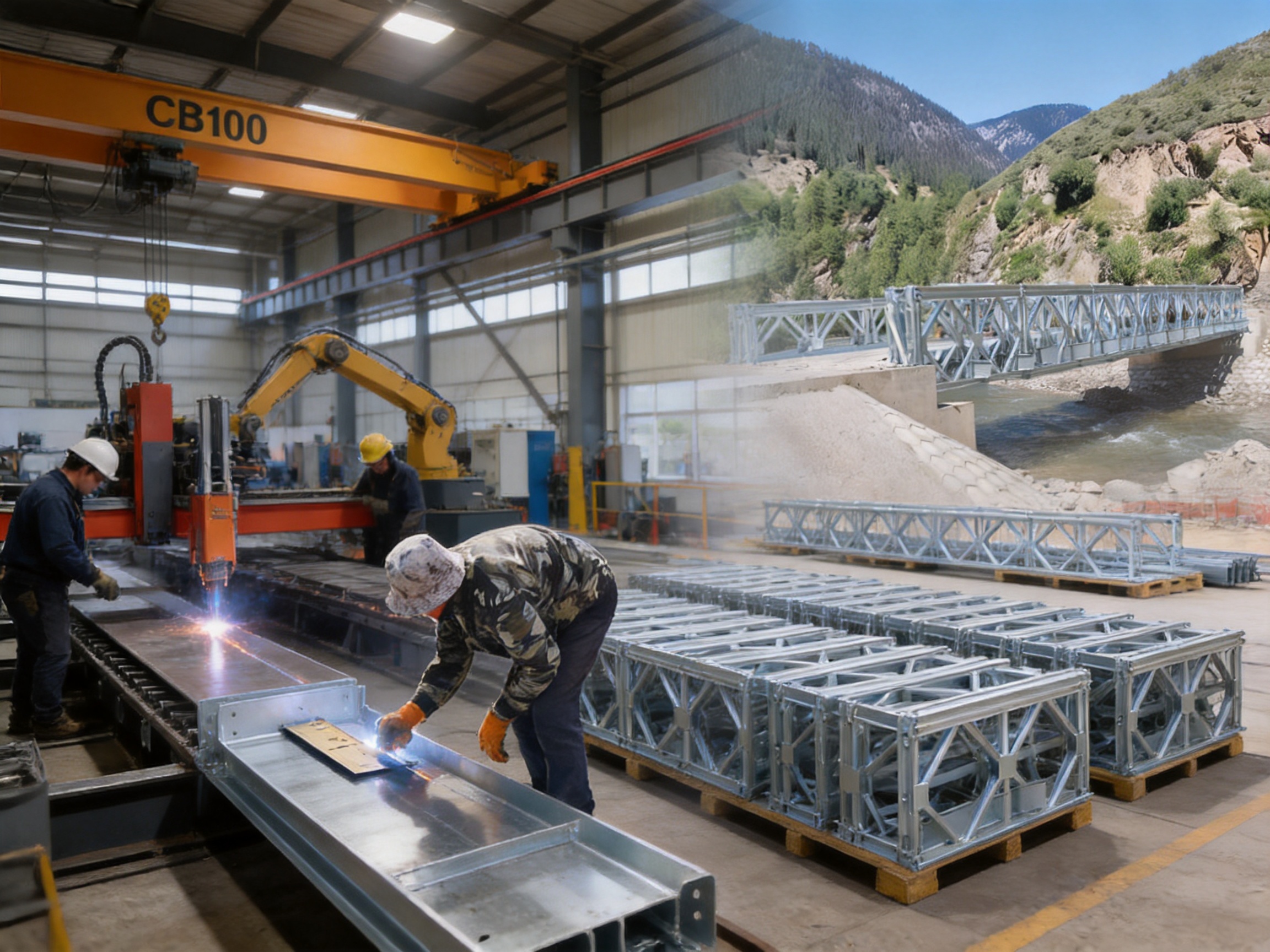
Modern infrastructure projects often require reliable bridge access before permanent structures are completed. Roads may need to cross rivers, construction sites may need temporary traffic routes, and emergency teams may need to restore transportation after floods, earthquakes, or other disasters. In these situations, a bridge must be strong enough for the required traffic loads, quick to install, adaptable to changing site conditions, and economical to remove or reuse.
The CB100 galvanized modular Bailey bridge is designed to meet these requirements through a high-strength truss structure, standardized modular components, and a corrosion-resistant galvanized steel finish. Based on the widely recognized 321-type modular bridge configuration, it combines the practical benefits of prefabricated construction with the structural efficiency of a truss bridge. Its components can be transported in manageable units, assembled with limited site preparation, disassembled after use, and redeployed for another project.
This combination of strength, interchangeability, corrosion protection, and engineering flexibility makes the CB100 suitable for temporary passage, construction access, emergency response, coastal development, water conservancy works, military logistics, and other infrastructure applications. It is also supported by the manufacturing capabilities of Jiangsu Zhonghai Bridge Equipment Co., Ltd., a Chinese manufacturer specializing in modular steel bridges, Bailey bridge systems, structural components, and bridge construction support equipment.
1. The Role of Modular Bridges in Modern Construction
Infrastructure projects rarely progress under ideal conditions. A permanent bridge may require months or years of design, foundation work, material procurement, and construction. However, workers, equipment, and vehicles often need to cross an obstacle long before the permanent structure is ready. A modular bridge provides an intermediate solution that allows the project to continue while reducing dependence on complex site-built structures.
Unlike a conventional bridge fabricated entirely at the jobsite, a modular bridge uses standardized structural units manufactured in advance. These units can include truss panels, deck systems, transoms, stringers, bracing components, connection assemblies, and other accessories. The standardized design simplifies production and makes it possible to configure the bridge for different spans, widths, and load requirements, subject to engineering verification.
Modular construction also reduces the amount of specialized equipment required at the installation site. Many bridge sections can be assembled on the ground and moved into position through controlled erection procedures. This is particularly valuable where access is restricted, environmental conditions are difficult, or heavy permanent construction equipment cannot be used efficiently.
For emergency projects, speed is often the most important consideration. A damaged road or washed-out crossing can isolate communities, delay medical assistance, and interrupt the transportation of food and materials. A modular Bailey bridge can be delivered as a series of prepared components and assembled according to an approved erection plan. Once the immediate need has passed, the bridge can be dismantled and stored for future deployment.
For construction projects, the same system may serve as a temporary access road, a material transport crossing, a worker passage, or a support route for heavy equipment. In coastal and water conservancy projects, modular bridges can also provide access across channels, embankments, wetlands, and temporary work zones where permanent roads are not yet available.
2. CB100 Bailey Bridge Product Overview
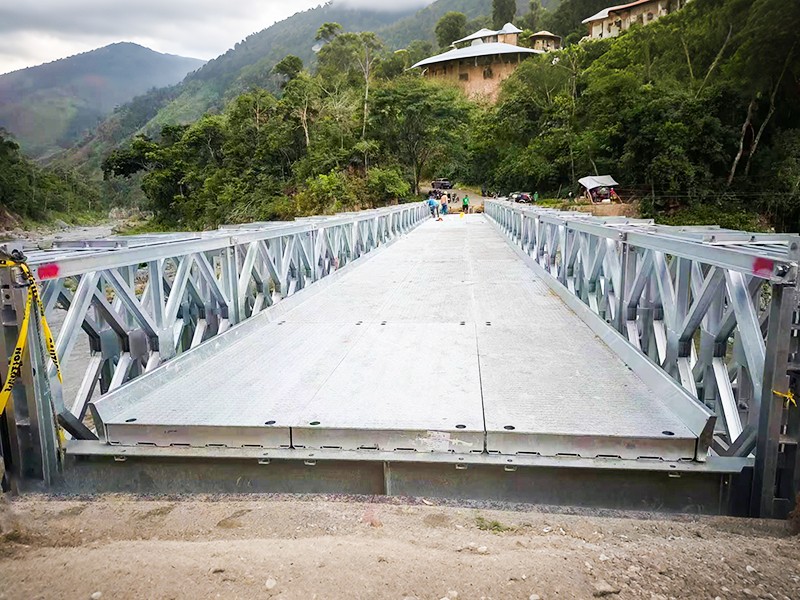
The CB100 is a galvanized modular steel bridge with a truss-type structure. It belongs to the 321-type Bailey bridge family, a design recognized for its practical modular arrangement and wide range of field applications. The bridge is formed from high-strength structural components that work together as a continuous load-bearing system.
Its truss configuration provides an efficient method of carrying loads over a span. Instead of relying solely on a deep solid beam, the truss distributes forces through interconnected top chords, bottom chords, vertical members, diagonal members, transoms, and bracing systems. This arrangement provides a favorable balance between structural strength, material efficiency, transportability, and assembly convenience.
The bridge’s primary steel components are galvanized. Galvanization creates a protective zinc layer over the steel surface, helping reduce exposure to moisture, oxygen, salts, and other corrosive agents. This is especially important for bridges used outdoors, in coastal regions, in humid climates, near waterways, or in temporary projects where repeated repainting would be inconvenient.
The CB100 is designed around component interchangeability. Standardized parts can be combined and replaced without requiring a completely different bridge system for every application. This gives project planners greater flexibility when selecting bridge length, configuration, deck arrangement, and strengthening requirements.
As with all structural bridge systems, the final bridge arrangement must be selected through engineering design. Span length, traffic class, foundation condition, wind exposure, deck width, support arrangement, construction sequence, and site-specific hazards must be considered before installation. The product is intended to provide a robust modular platform, while the completed bridge must be verified for the actual project conditions.
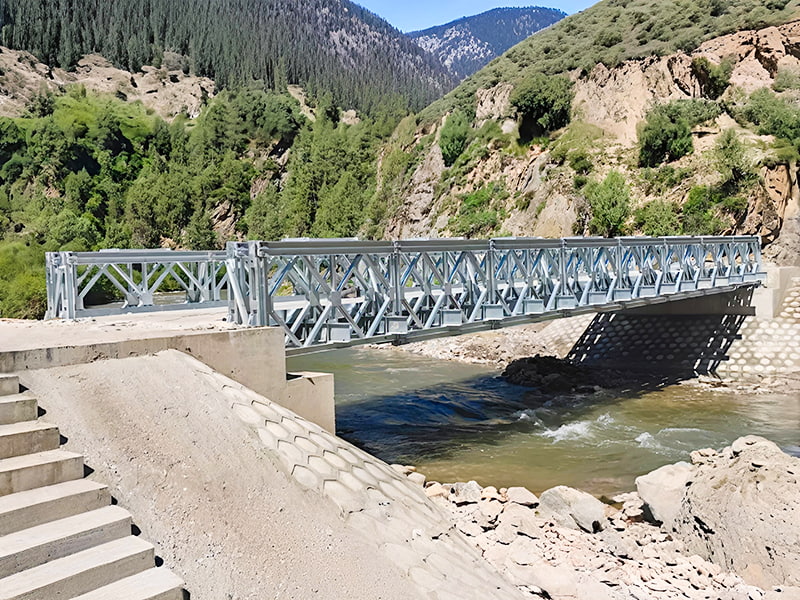
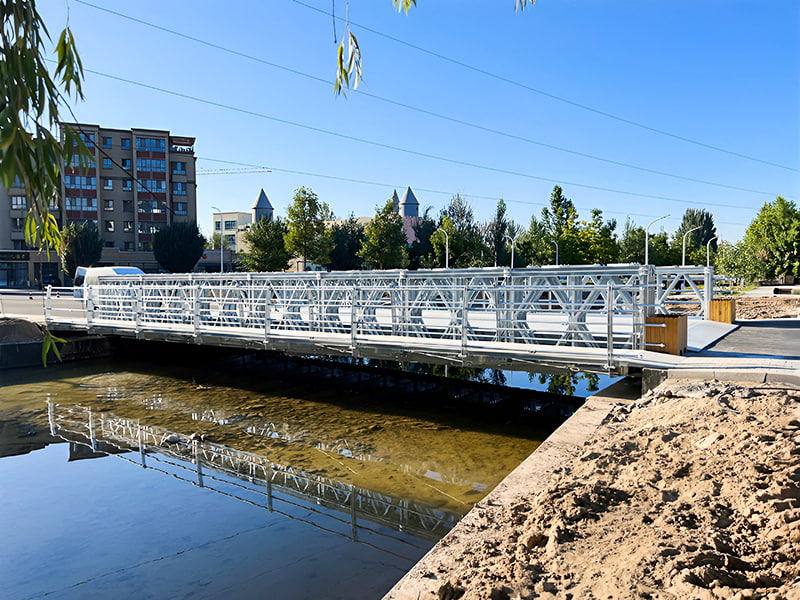
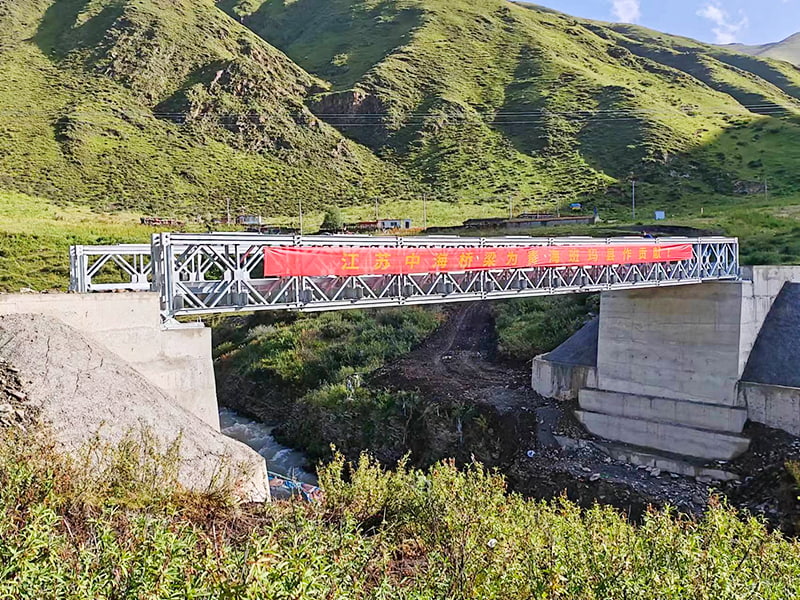
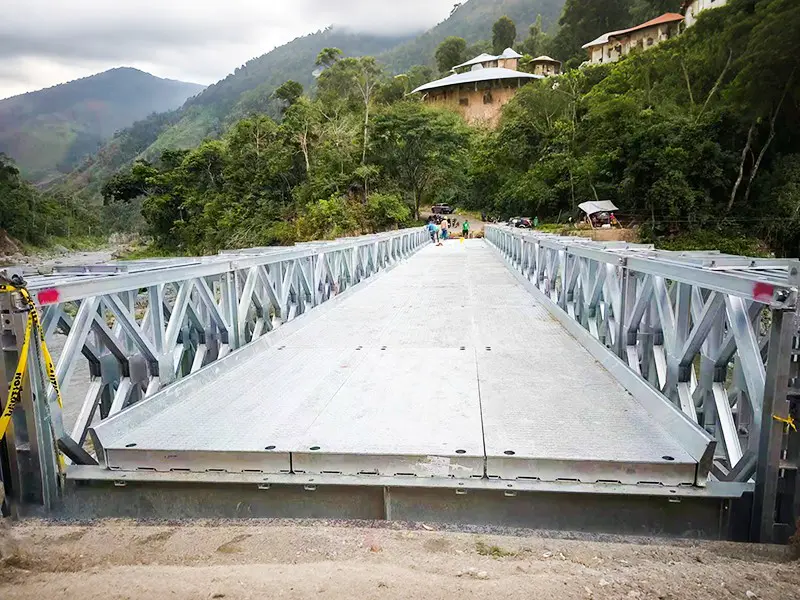
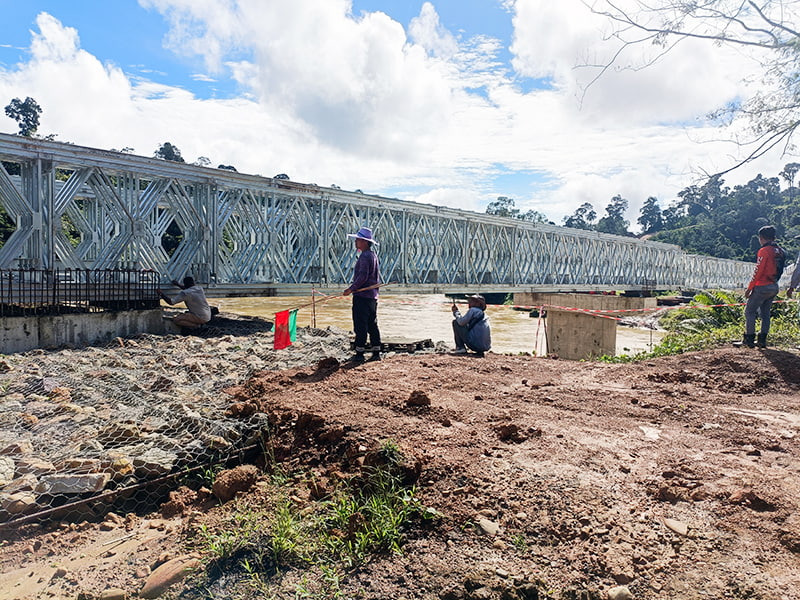
CB100 Bailey Bridge High Strength Galvanized Truss-Type Modular Bailey Bridge
3. High-Strength Truss Structure
The main competitive advantage of a Bailey bridge is the efficient use of a truss structure. A truss transfers loads through a network of interconnected members rather than concentrating all structural demand in a single massive beam. This allows the bridge to achieve substantial load-bearing capability while maintaining a modular form that can be transported and assembled more easily than many conventional bridge types.
When a vehicle enters the bridge, the deck system transfers wheel loads to the transoms and longitudinal members. These elements distribute the loads to the side trusses. The truss panels then transfer forces through their chords and web members toward the supports. Proper bracing helps control lateral movement, torsional behavior, and structural deformation during use.
The modular truss approach also allows the bridge configuration to be adjusted according to project requirements. In suitable applications, multiple truss lines or reinforced arrangements may be used to increase capacity. Additional panels can be incorporated to accommodate longer spans, while different deck and support arrangements can be selected for specific traffic or site conditions. These modifications must be confirmed through structural calculations and an approved design rather than applied informally in the field.
High-strength steel provides another important advantage. Stronger material can support demanding structural requirements while keeping individual components within practical transport and handling limits. This is useful for remote construction sites, disaster-response operations, and projects where crane capacity or road access is limited.
The structural efficiency of the CB100 makes it suitable for both temporary and semi-permanent applications. In a short-term construction project, the bridge can be installed for a defined work period and later removed. In a longer-term application, galvanized components can help reduce maintenance requirements, provided that the bridge is inspected and maintained according to the site environment and operating conditions.
4. Galvanized Steel and Long-Term Corrosion Protection
Steel bridges operating outdoors are exposed to rain, condensation, ultraviolet radiation, soil contamination, industrial pollutants, and, in coastal environments, salt-laden air. Corrosion can reduce the effective thickness of structural members, weaken connection areas, damage deck systems, and increase maintenance costs. For this reason, corrosion protection is a central consideration in bridge selection.
The CB100 uses galvanized steel components to improve resistance to atmospheric corrosion. The zinc layer acts as a physical barrier and can also provide sacrificial protection to exposed steel areas. If minor surface damage occurs, zinc can continue to protect the underlying steel in many ordinary environmental conditions.
Galvanization is especially beneficial for bridge systems that must be deployed quickly. A painted bridge may require careful surface preparation, primer application, intermediate coating, finish coating, and drying time before it can be placed into service. A galvanized system is supplied with a factory-applied protective layer, reducing the amount of corrosion-preparation work required at the construction site.
The galvanized finish also supports repeated use. Temporary bridges are often dismantled, transported, stored, and reassembled. A durable protective coating helps the components withstand this cycle more effectively than an unprotected steel surface. Because the corrosion protection does not prevent standard modular connections from being made, the bridge can retain its assembly and reuse advantages.
Galvanization does not eliminate the need for inspection. Connection areas, cut edges, damaged surfaces, deck elements, bearing zones, and locations that retain water should be checked regularly. If components are drilled, welded, or significantly modified after galvanization, the affected areas may require appropriate repair treatment. Good drainage, proper storage, controlled handling, and scheduled inspection remain important for achieving a long service life.
Compared with conventional temporary bridges that require frequent rust removal and repainting, the galvanized CB100 can reduce routine maintenance effort. This may lower total ownership costs, particularly in humid, coastal, and high-use environments. The exact service life depends on atmospheric exposure, traffic intensity, maintenance quality, and the bridge’s structural configuration.
5. Component Interchangeability and Modular Flexibility
Component interchangeability is one of the defining characteristics of the CB100 system. Standardized parts are designed to work together within a recognized modular arrangement. This makes procurement, replacement, storage, and project planning more straightforward.
For contractors and infrastructure agencies, interchangeable components can simplify inventory management. Instead of maintaining a completely separate bridge design for every project, the owner may store compatible modules and use them in different configurations. Damaged or worn parts can be replaced individually when appropriate, reducing the need to remove an entire bridge from service.
Interchangeability also supports faster field assembly. Workers can follow a repeatable installation procedure based on a known sequence of components. Standardized connection patterns reduce uncertainty and help erection teams organize materials before construction begins. This is particularly valuable during emergency response, when time, labor, and equipment may be limited.
The modular format supports different project uses, including temporary vehicle crossings, construction access routes, flood-response bridges, logistics crossings, and pedestrian or service access structures when designed with appropriate deck and safety provisions. The same basic system can be adapted to different locations through engineering adjustments to span, width, support, and reinforcement.
Transport efficiency is another benefit. Modular components can be bundled, loaded, and delivered using ordinary logistics methods suitable for the component dimensions and weights. This reduces the difficulty of moving a complete bridge structure through narrow roads or into areas without large fabrication yards.
At the end of a project, the bridge can be disassembled into reusable units. Components may be inspected, repaired where necessary, stored, and deployed elsewhere. This supports a circular approach to temporary infrastructure by extending the useful life of structural materials and reducing waste associated with one-time site-built solutions.
6. Installation and Erection Benefits
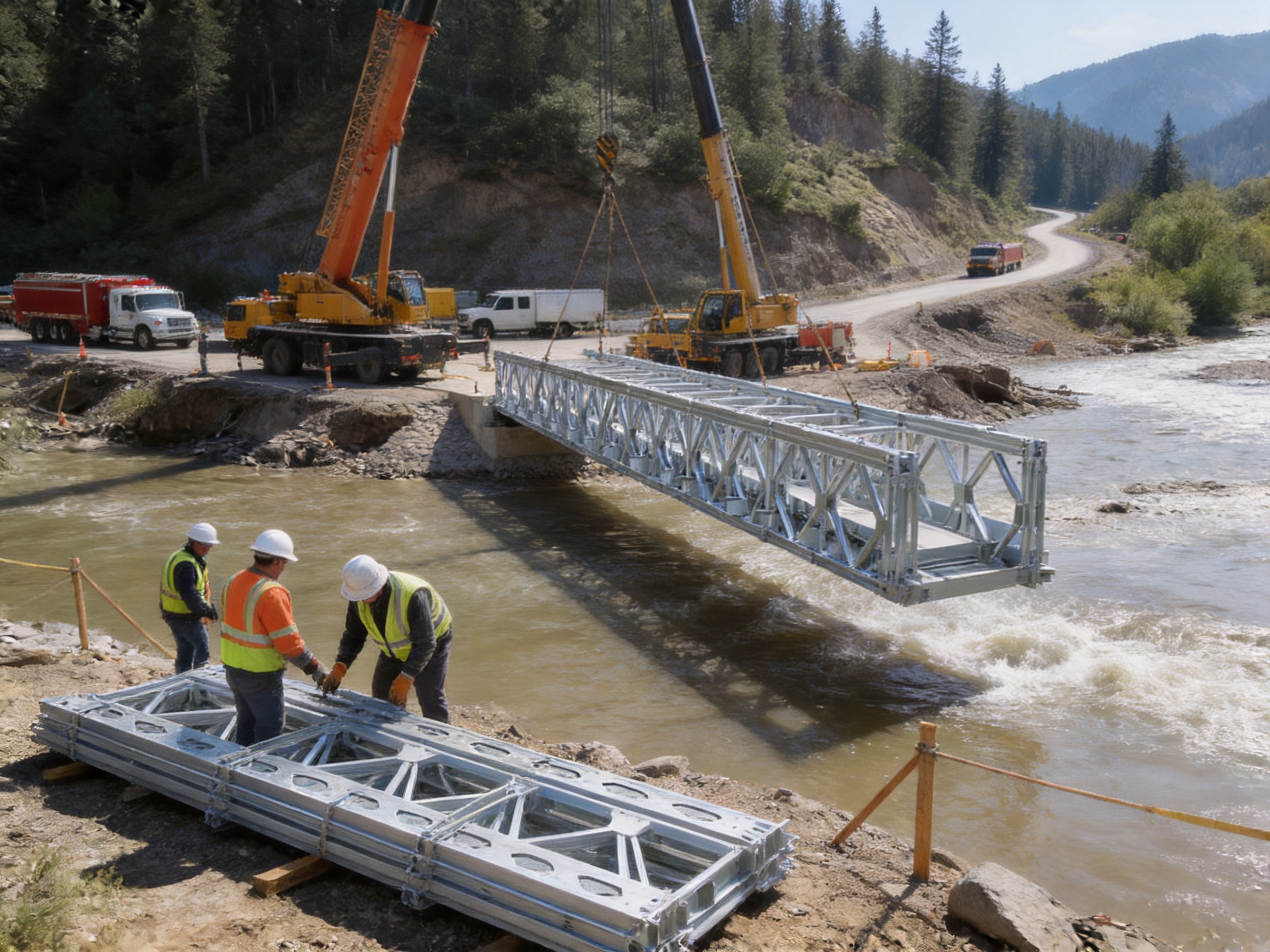
A modular Bailey bridge is intended to reduce the amount of complicated work required at the final installation site. The precise erection method depends on bridge length, terrain, water depth, foundation arrangement, available equipment, and the approved construction plan. However, the general process commonly involves preparing supports, organizing components, assembling the truss and deck sections, launching or lifting the bridge into position, and completing connections and safety checks.
Many bridge components can be assembled in a controlled area beside the crossing. This allows workers to complete a significant portion of the work away from unstable ground, active water flow, traffic lanes, or restricted work zones. Once prepared, the bridge can be moved or launched into place using suitable equipment and procedures.
The modular design is advantageous where environmental constraints make conventional construction difficult. A project may not have enough space for a large casting yard, extensive temporary works, or the storage of long continuous beams. Small and standardized bridge modules provide greater flexibility in arranging materials within the available site area.
Because the bridge can be erected with a limited construction footprint, it may reduce disturbance to riverbanks, wetlands, roads, railway corridors, and sensitive project areas. The actual environmental impact depends on the site and construction method, but modular construction can help reduce the need for extensive permanent access roads and large-scale excavation.
Installation planning remains essential. The contractor should verify foundation capacity, bearing alignment, lateral stability, lifting points, temporary bracing, launching forces, wind conditions, and exclusion zones. Workers should use approved erection equipment and follow the manufacturer’s technical instructions and local safety requirements.
After installation, the bridge should be inspected before opening to traffic. The inspection should include panel connections, bolts, deck alignment, bracing, bearings, approach transitions, guardrails, drainage, and any visible damage to galvanized surfaces. Load restrictions and traffic controls should be clearly communicated to users.
7. Load Compatibility and Engineering Application
The CB100 product information identifies compatibility with HS-15, HS-20, HS-25, HL-93, and Caterpillar-50 load standards. These references represent common vehicle or design-load classifications used in bridge engineering and transportation projects. The correct configuration must be selected according to the required load model, span, lane width, number of lanes, impact effects, and local design regulations.
A bridge’s load capacity is not determined by the steel grade alone. It depends on the complete structural system, including the number and arrangement of trusses, span length, deck construction, connection condition, support settlement, bracing, wind action, fatigue effects, and vehicle distribution. A shorter bridge with a particular configuration may have a different capacity from a longer bridge using the same basic components.
For that reason, project engineers should provide the intended design load, span, road width, site conditions, and traffic type when requesting a bridge solution. The manufacturer or qualified engineering team can then develop or confirm the appropriate modular arrangement and supporting calculations.
HS-15, HS-20, and HS-25 classifications may be relevant to projects using standardized highway load models. HL-93 is widely associated with highway bridge design practice and combines truck, tandem, and lane-load considerations. Caterpillar-50 may be specified for projects involving heavy tracked construction equipment or a particular owner’s loading requirement. These labels should be interpreted according to the governing project standard rather than treated as universal capacity ratings.
Where construction vehicles, cranes, military vehicles, or tracked equipment will use the bridge, the design should account for axle spacing, wheel loads, track contact, dynamic effects, braking, turning, and repeated loading. Approaches should also be designed to prevent impact from abrupt level changes or poor transitions.
The CB100’s modular arrangement gives engineers a practical platform for configuring the bridge to the project’s load requirements. It is not a substitute for design review, geotechnical assessment, or professional approval. Proper engineering ensures that the bridge is not only strong enough in theory but also stable and safe in its actual operating environment.
8. Applications Across Infrastructure Sectors
8.1 Temporary Construction Access
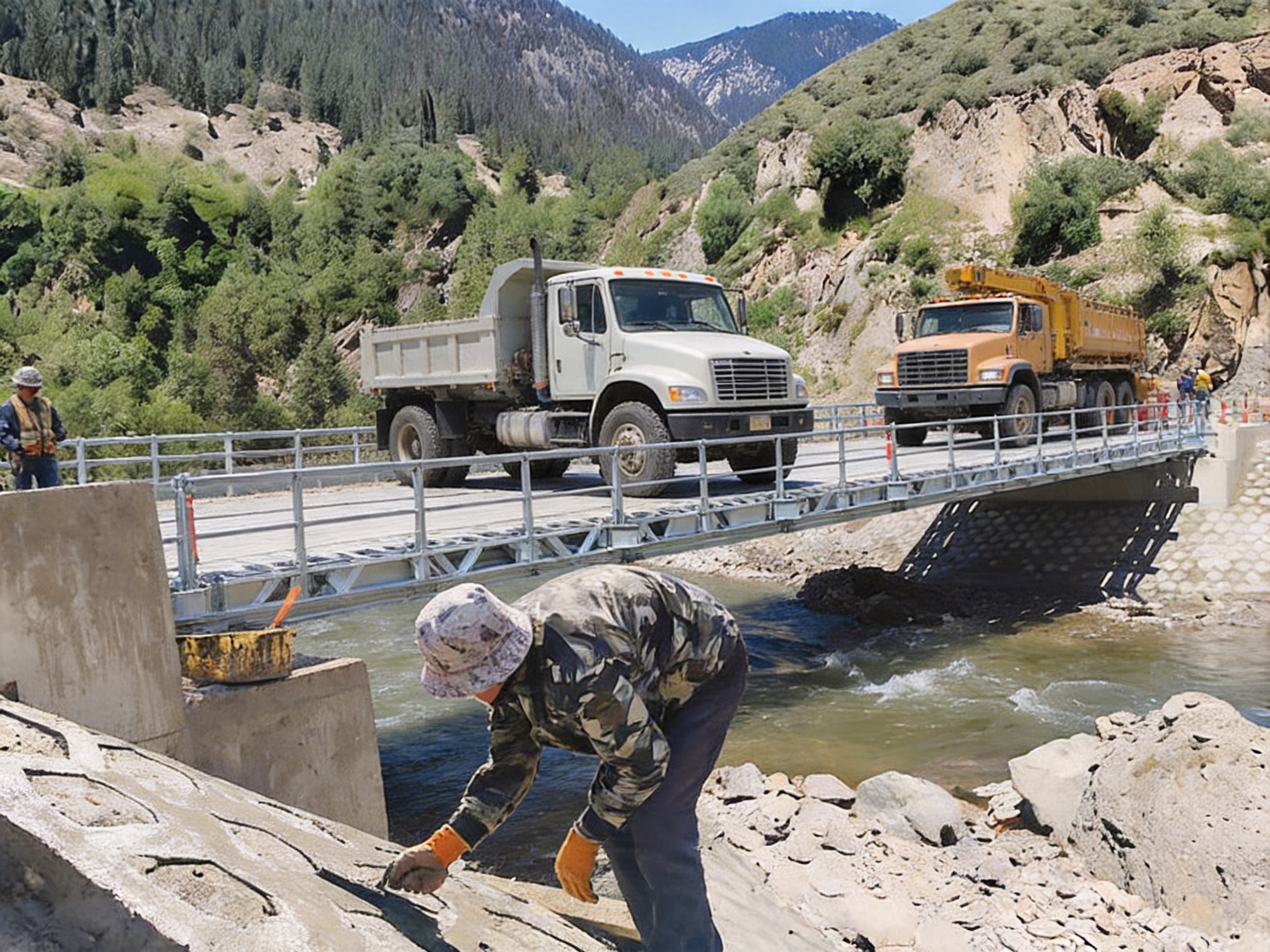
Large civil engineering projects often need temporary crossings for construction traffic. A CB100 bridge can connect work areas across rivers, drainage channels, excavated zones, railway corridors, and unfinished road sections. It can support the movement of dump trucks, concrete vehicles, loaders, service vehicles, and other equipment when designed for the required loading.
By providing a dedicated access route, the bridge can separate construction traffic from public roads and reduce delays. It can also help contractors maintain access while a permanent bridge is being built or while existing infrastructure is being rehabilitated.
8.2 Emergency and Disaster Response
Floods, landslides, earthquakes, storms, and other disasters can destroy bridges and interrupt essential transportation. A modular bridge system is well suited to response operations because components can be stored in advance and delivered when needed. The bridge can restore access for ambulances, relief supplies, utility crews, evacuation vehicles, and reconstruction equipment.
Its reusable design is particularly valuable to government agencies, emergency contractors, and infrastructure owners that must respond to more than one event. After recovery work is completed, the bridge can be dismantled, inspected, and returned to an emergency stockpile.
8.3 Coastal and Marine-Influenced Projects
Coastal projects expose steel structures to moisture and salt spray. Galvanized components can provide an important level of corrosion protection in such environments. The bridge may be used for temporary access to coastal construction zones, water treatment facilities, ports, embankments, marine works, and island development projects.
The product information notes applications in coastal projects, including engineering work in the Maldives. In these environments, corrosion-control planning should include drainage, inspection intervals, fastener protection, handling procedures, and any additional coating requirements specified by the project engineer.
8.4 Water Conservancy and Flood-Control Works
Water conservancy projects frequently involve channels, reservoirs, levees, drainage systems, and temporary diversions. A modular bridge can provide access across these features without waiting for a permanent crossing to be completed. It may support construction teams working on dams, flood-control structures, irrigation systems, or river-management facilities.
Because water levels and ground conditions can change, temporary support and foundation design are especially important. The bridge should be designed to accommodate hydraulic conditions, scour risk, seasonal flow, and access for inspection.
8.5 Military Logistics and Strategic Access
Military logistics require rapid mobility and dependable access across difficult terrain. A modular steel bridge can be transported to a staging area and erected according to operational requirements. Its standardized components and repeatable assembly process may simplify deployment planning and maintenance.
Applications involving military vehicles or heavy tracked equipment require careful load assessment. The bridge arrangement, deck system, approaches, and support conditions must be matched to the vehicles and the mission profile.
8.6 Pedestrian and Service Crossings
With suitable design, deck, handrails, barriers, and access provisions, modular bridge technology can also support pedestrian crossings and service routes. Such applications may be required at construction sites, temporary events, mining areas, industrial facilities, or disaster zones.
Pedestrian use requires specific attention to walking surfaces, guardrails, access ramps, lighting, crowd loading, and separation from vehicles. The bridge should never be opened to a different user group without confirming that the structure and safety equipment are appropriate.
9. Manufacturing Strengths Behind the Product
The performance of a modular bridge depends not only on its design but also on the quality and consistency of manufacturing. Jiangsu Zhonghai Bridge Equipment Co., Ltd. integrates engineering design, precision manufacturing, quality management, and project support within its production model.
The company operates from Zhenjiang, Jiangsu Province, an industrial and transportation hub with strong access to manufacturing resources, logistics networks, steel processing capabilities, and engineering talent. This location supports the production and international delivery of modular bridge systems and structural components.
According to the provided company information, the factory uses advanced automation and standardized workflows. Automation can improve repeatability in processes such as material handling, cutting, forming, welding, and inspection. Standardized workflows help ensure that production steps are clearly defined and consistently followed across different batches and bridge configurations.
Automated welding is an important capability for modular bridge production. Consistent welding parameters and controlled welding paths can help produce uniform joints, reduce variation between components, and improve production efficiency. Depending on the component and design, automated welding may be combined with manual procedures, inspection, dimensional verification, and corrective work by trained personnel.
Precision steel fabrication also contributes to component interchangeability. Modular parts must meet defined dimensional and connection requirements so that they can be assembled reliably in the field. Accurate hole locations, panel geometry, connection surfaces, weld dimensions, and overall alignment are essential to the performance of a standardized bridge system.
Quality management extends from material purchasing to final shipment. It may include verification of steel grades, review of production drawings, dimensional inspection, weld-quality checks, surface-treatment control, component identification, packing inspection, and documentation. These activities help reduce the risk of mismatched parts, installation delays, and premature field problems.
The company states that its products are manufactured to comply with ASTM, EN, and national specifications where applicable. Compliance should always be confirmed against the project’s required standard, contract documents, and inspection plan. For international projects, clear technical documentation and communication are essential because load standards, welding requirements, coating specifications, and acceptance procedures may differ between countries.
10. Engineering Design and Customized Support
A modular bridge is standardized, but infrastructure projects are not. Every site has different span requirements, foundation conditions, traffic demands, climate exposure, construction access, and operational constraints. For this reason, the value of a bridge manufacturer includes the ability to translate a general product system into a project-specific solution.
Zhonghai focuses on the design, engineering, and fabrication of modular bridge systems and supporting steel structures. This integrated approach can help coordinate structural requirements with manufacturing realities. When the design and fabrication teams work within the same organization, potential issues involving component dimensions, connection details, production sequencing, packing, and erection can be identified earlier.
Customers may require assistance with bridge selection, modular arrangement, deck systems, reinforcement, support details, transport planning, or erection procedures. Engineering support may also include drawings, bills of materials, installation guidance, inspection documentation, and technical communication with the project owner or supervising engineer.
Customized steel components can be produced for projects that require special connections, support frames, access structures, or supplementary bridge elements. Bridge erection and construction support equipment may also be incorporated into the overall delivery plan, depending on the scope of supply.
For international customers, project coordination is particularly important. Technical information must be exchanged accurately across languages, time zones, and regulatory environments. A clear specification should identify the required bridge type, span, width, load model, environmental exposure, deck arrangement, delivery location, erection method, and documentation requirements.
Customization should preserve the basic advantages of modular construction. A modified component must remain compatible with the approved structural system, and any change in steel grade, connection, coating, or geometry should be reviewed by qualified engineers before production.
11. Advantages Over Conventional Temporary Bridge Solutions
The CB100 offers several advantages when compared with temporary crossings made from untreated steel, site-built timber, improvised beams, or nonstandard structural frames.
First, its modular design provides greater predictability. Standardized components can be designed, produced, inspected, packed, and assembled according to a defined system. This is generally more reliable than fabricating a one-off temporary bridge under pressure at the construction site.
Second, galvanized steel offers a stronger corrosion-protection strategy than uncoated steel. Unprotected temporary structures may require frequent surface treatment, particularly in wet or coastal conditions. The factory-applied galvanized layer helps reduce maintenance demands and supports repeated deployment.
Third, the truss arrangement provides a practical strength-to-weight balance. A conventional solid beam solution may require oversized members that are difficult to transport and lift. The modular truss divides the bridge into manageable parts while retaining an efficient load path.
Fourth, component interchangeability improves lifecycle value. A bridge owner can reuse compatible panels, transoms, bracing, and accessories across multiple projects. The system can be repaired or expanded through individual components rather than replaced as a single permanent structure.
Fifth, the bridge can be installed in locations where extensive permanent construction is not yet practical. Its relatively limited site footprint and prefabricated nature can shorten the time between delivery and operation, subject to site preparation and engineering approval.
Finally, the manufacturing support available from an experienced modular bridge producer can reduce procurement risk. Engineering, fabrication, quality management, logistics coordination, and technical support can be organized as parts of one project process rather than handled by unrelated suppliers.
12. Lifecycle Cost and Reuse Value
The purchase price of a bridge is only one part of its total cost. Owners should also consider transportation, installation, inspection, corrosion protection, repairs, storage, dismantling, and reuse. A modular galvanized bridge can provide value across this entire lifecycle.
During procurement, standardized parts may simplify quantity planning and reduce the need for highly specialized fabrication. During transport, components can be packed and shipped in an organized manner. During installation, repeatable assembly procedures can reduce uncertainty and support more efficient labor planning.
During operation, galvanized steel can reduce the frequency of painting and rust-removal work compared with untreated or inadequately protected steel. Maintenance is still necessary, but routine attention can focus more on connections, deck wear, bearings, drainage, and traffic-related damage rather than repeated full-surface repainting.
After the first project, the bridge may retain substantial residual value. If components are correctly dismantled, inspected, stored, and maintained, they can be transported to another location and reassembled. This makes the system particularly attractive to contractors, public agencies, disaster-response organizations, and companies managing multiple infrastructure projects.
Reuse also has environmental benefits. Extending the service life of steel components reduces the need for new materials and limits the amount of waste generated by temporary infrastructure. The environmental performance of each project still depends on transport distances, foundation works, access roads, and end-of-life practices, but modular reuse is an important part of responsible resource management.
13. Manufacturing and Quality-Control Workflow
13.1 Engineering Review
Production begins with a review of the customer’s technical requirements. The manufacturer must understand the intended span, bridge width, design load, deck type, support conditions, environmental exposure, delivery location, and erection method. Drawings and specifications are checked before material preparation begins.
13.2 Material Selection and Preparation
Structural steel is selected according to the approved design and applicable standards. Material identification and documentation help maintain traceability. Cutting, drilling, forming, and edge preparation are carried out according to production drawings and process requirements.
13.3 Precision Fabrication
Precision fabrication ensures that individual parts maintain the geometry necessary for modular assembly. This includes dimensional control of panels, connection areas, holes, stiffeners, plates, and other structural elements. Accurate fabrication supports interchangeability and helps prevent excessive field adjustment.
13.4 Controlled Welding
Welding procedures are selected for the applicable steel grades, joint types, thicknesses, and component functions. Automated welding can improve consistency in suitable production operations. Welds may be subject to visual inspection, dimensional checks, and additional examination where required by the design or customer specification.
13.5 Galvanizing and Surface Protection
After fabrication and appropriate preparation, steel components receive galvanizing or the specified corrosion-protection treatment. The coating must be checked for coverage, continuity, and visible defects. Components should be handled carefully after treatment to avoid unnecessary damage before packing.
13.6 Final Inspection and Packing
Final inspection verifies component quantity, dimensions, markings, connection compatibility, surface condition, and packing arrangement. Proper identification is important because modular bridge projects may involve many similar-looking parts. Organized packing helps the erection team locate components efficiently at the site.
This manufacturing sequence supports a product that is not merely strong in individual members but reliable as a complete modular system. The combination of automation, standardized workflows, precision fabrication, controlled welding, and quality management helps create the repeatability required for large-scale bridge production.
14. International Project Experience and Delivery Capability
Modular bridges are frequently purchased for projects involving multiple stakeholders, international transportation, and strict delivery schedules. A manufacturer must therefore provide more than a product catalog. It must coordinate engineering information, production planning, packing, shipping, documentation, and customer communication.
The company’s stated project experience includes coastal engineering in the Maldives, temporary access bridges for the Shenzhen–Zhongshan Corridor, structural components for the Hangzhou Expo Center, multi-span Bailey bridges for the Lalin Railway, and flood-response and emergency bridge deployments in multiple regions.
These projects represent different operating conditions and demonstrate the broad range of situations in which modular steel bridge systems may be used. Coastal work highlights corrosion considerations. Major transport infrastructure requires coordination and schedule control. Railway-related work requires careful structural and construction planning. Flood-response projects emphasize rapid deployment and practical field installation.
International delivery also requires attention to export packing, component labeling, shipping dimensions, customs documentation, technical drawings, and local installation requirements. Customers should define these needs early so that the bridge package can be prepared for the destination country and project site.
A dependable supplier should be able to communicate clearly about manufacturing lead time, inspection arrangements, transport preparation, technical documentation, installation support, and after-sales service. These factors can influence the actual project outcome as much as the nominal bridge capacity.
15. Recommended Project Selection Process
Before ordering a CB100 bridge, project owners and contractors should collect the basic information needed for engineering evaluation. The first item is the required clear span or total bridge length. The second is the usable deck width, including whether the bridge will carry one lane, two lanes, pedestrians, service vehicles, or mixed traffic.
The required load model should then be identified. This may include HS-15, HS-20, HS-25, HL-93, Caterpillar-50, local highway loads, construction equipment loads, or a project-specific vehicle arrangement. Vehicle speed, traffic frequency, and potential impact effects should also be considered.
Site information is equally important. Engineers should review river or channel conditions, soil bearing capacity, foundation elevations, approach grades, flood levels, scour potential, wind exposure, seismic conditions, and available space for assembly. The transport route should be evaluated to confirm that bridge components can reach the site.
The customer should also specify the expected service period. A bridge needed for several months may have different inspection and storage arrangements from one intended for many years. In coastal or chemically aggressive environments, additional protective measures may be required.
Finally, the erection method must be planned. The site may permit crane lifting, ground assembly, incremental launching, or another controlled method. The chosen process must account for temporary stability and the safety of personnel, equipment, nearby traffic, and the public.
16. Operation, Inspection, and Maintenance
A galvanized modular bridge is designed to reduce maintenance demands, not to eliminate them. Routine inspection is necessary to verify that the bridge continues to perform safely under its actual conditions of use.
Inspections should examine truss panels, bolts, pins, bracing, transoms, stringers, deck plates, bearings, foundations, guardrails, approach roads, and drainage paths. Particular attention should be given to areas exposed to standing water, debris accumulation, vehicle impact, excessive vibration, or repeated heavy loading.
Bolted and pinned connections should remain secure and correctly installed. Any missing, loose, damaged, or unauthorized replacement fasteners should be addressed according to the manufacturer’s instructions. Structural components showing deformation, cracking, severe corrosion, or impact damage should be removed from service until evaluated by a qualified engineer.
Deck condition is important because deterioration of the driving surface can create impact loads and unsafe operating conditions. Approach transitions should remain smooth enough to limit shock loading. Traffic controls should prevent vehicles exceeding the approved load, speed, or width restrictions.
Galvanized surfaces should be checked for mechanical damage, especially after assembly, dismantling, or contact with lifting equipment. Areas requiring repair should be treated with an appropriate compatible system. Storage should keep components elevated from standing water and arranged to allow inspection and ventilation.
A documented maintenance program can help owners preserve the bridge’s reuse value. Records should identify the bridge configuration, installation date, inspection results, repairs, traffic restrictions, dismantling date, and storage condition. These records are valuable when the components are redeployed to a different project.
17. Why Choose an Integrated Modular Bridge Manufacturer?
Purchasing a bridge system from an integrated manufacturer can reduce coordination problems between design, fabrication, and installation. A company that understands the complete modular system can better anticipate how components will be produced, packed, transported, assembled, inspected, and maintained.
Jiangsu Zhonghai Bridge Equipment Co., Ltd. combines engineering design, steel fabrication, automated welding, quality management, modular bridge production, and construction support. This combination provides customers with access to both standardized products and project-oriented technical assistance.
The company’s focus on modular steel bridges and structural components allows it to serve different sectors, including transportation, water conservancy, military logistics, disaster relief, coastal development, and international infrastructure. Its stated use of automation and standardized workflows supports production consistency, while its engineering capabilities support customized bridge configurations.
For customers comparing suppliers, important evaluation criteria include structural design capability, manufacturing capacity, corrosion-protection methods, component interchangeability, inspection procedures, documentation quality, delivery experience, and technical support. The CB100 addresses these criteria through its galvanized 321-type design and the manufacturer’s integrated production model.
The best supplier is not necessarily the one offering the lowest initial quotation. A more complete evaluation should consider installation time, maintenance, component reuse, logistics, inspection support, and the supplier’s ability to respond when site conditions change. These factors determine the bridge’s practical value over its full lifecycle.
18. Q&A About the CB100 Galvanized Modular Bailey Bridge
Q1: What type of bridge is the CB100?
The CB100 is a galvanized modular steel Bailey bridge with a truss-type structure. It is based on the 321-type modular bridge configuration and uses standardized components that can be assembled, disassembled, transported, and reused.
Q2: What is the primary benefit of galvanizing the bridge?
Galvanizing provides a protective zinc layer that improves resistance to atmospheric corrosion. It can reduce the need for frequent rust removal and repainting, particularly in outdoor, humid, and coastal environments. Regular inspection and maintenance are still required.
Q3: Can the bridge be reused after removal?
Yes. Reuse is one of the main advantages of the modular design. After dismantling, components should be inspected, repaired if necessary, properly identified, and stored in suitable conditions before being redeployed.
Q4: Which load standards can the CB100 meet?
The product information identifies HS-15, HS-20, HS-25, HL-93, and Caterpillar-50 load standards. The correct bridge configuration must be verified through engineering calculations based on span, width, traffic, vehicle characteristics, and site conditions.
Q5: Is the bridge suitable for emergency response?
Yes. Its modular construction, transportable components, rapid assembly potential, and reusability make it suitable for flood response, disaster relief, temporary road restoration, and emergency logistics. The installation must follow a site-specific erection and safety plan.
Q6: Can the CB100 be used in coastal areas?
It can be used in coastal projects, and galvanization provides useful corrosion protection in marine-influenced environments. However, salt exposure, drainage, fasteners, inspection intervals, and any additional protective coating requirements should be reviewed by the project engineer.
Q7: Does modular construction limit bridge customization?
No. The bridge is based on standardized modules, but the arrangement can be selected or adapted for different spans, widths, loads, and site conditions. Customized components may also be produced when required, provided that the complete configuration is engineered and approved.
Q8: What manufacturing capabilities support the product?
The manufacturer integrates engineering design, precision steel fabrication, automated welding, quality management, galvanized surface treatment, standardized workflows, and international delivery support. These capabilities help maintain dimensional consistency and component interchangeability.
Q9: Is professional engineering required before installation?
Yes. A bridge must be designed or verified for its actual span, loads, foundations, environmental conditions, erection method, and operating restrictions. The product system provides the structural platform, but project approval should be completed by qualified engineers under the applicable local regulations.
Q10: What information should a customer provide when requesting a quotation?
The customer should provide the required span, deck width, load standard or vehicle type, project location, environmental conditions, support elevations, expected service period, traffic use, delivery requirements, and preferred erection method. Site drawings and geotechnical information are also helpful.
19. Conclusion
The CB100 galvanized modular Bailey bridge provides a practical response to the need for fast, strong, and reusable infrastructure access. Its 321-type truss structure offers efficient load transfer, while standardized modules simplify transportation, erection, dismantling, and future reuse. Galvanized high-strength steel improves corrosion resistance and can reduce the maintenance burden associated with temporary outdoor bridges.
Compared with improvised crossings, untreated temporary structures, and many conventional site-built solutions, the CB100 offers greater standardization, more predictable assembly, improved lifecycle value, and better suitability for repeated deployment. It can support construction access, emergency response, coastal engineering, water conservancy, military logistics, transportation works, and other demanding projects when properly configured and engineered.
The product is supported by Jiangsu Zhonghai Bridge Equipment Co., Ltd.’s integrated capabilities in engineering design, precision fabrication, automated welding, quality management, modular bridge production, and project support. The company’s manufacturing experience and international project background provide a foundation for supplying bridge systems to contractors, infrastructure owners, government agencies, and engineering organizations worldwide.
For customers seeking a modular bridge solution, the most important step is to match the bridge configuration to the real project requirements. Span, load, foundation, environment, erection sequence, traffic control, and maintenance must all be considered. With suitable engineering and responsible operation, the CB100 can provide a durable, adaptable, and cost-effective connection where permanent infrastructure is unavailable, delayed, or still under construction.
References
1. Product information for the CB100 High-Strength Galvanized Truss-Type Modular Bailey Bridge.
2. Manufacturer information for Jiangsu Zhonghai Bridge Equipment Co., Ltd., including modular steel bridge production, engineering design, precision fabrication, and construction support capabilities.
3. General principles of modular Bailey bridge design, component interchangeability, field erection, dismantling, and reuse.
4. ASTM-based highway bridge loading and structural steel application practices.
5. EN-based structural steel fabrication, welding, inspection, and bridge engineering practices.
6. General technical guidance for hot-dip galvanized steel corrosion protection and maintenance.
7. Bridge inspection and temporary structure safety practices for construction, emergency response, and infrastructure projects.
8. Project application information concerning coastal engineering, railway construction, flood response, and temporary transportation access.
Product: CB100 Bailey Bridge High Strength Galvanized Truss-Type Modular Bailey Bridge

We respond quickly to all international requests and provide technical support when needed.
Product Category
Bailey Bridge/Modular Bridge Modular Steel Bridge Pedestrian Bridge Modular Pipe Bridge Truss Bridge Steel StructureContact Us

+86-511-84522866
+86-13921582699

zhwm@zjql.com

Building 1,83#, dantu New Town, Yanjiang Road, Dantu District, Zhenjiang, Jiangsu, China
Copyright © Jiangsu Zhonghai Bridge Equipment Co., Ltd. All
Rights
Reserved
China bailey bridge for sale
bailey bridge supplier from china
