
 English
 русский
 Español
 Português


Tang Yuwei — International Bailey Bridge Sales Manager
CB200 Four-Row Single-Layer Reinforced Bailey Bridge: Engineering Advantages, Manufacturing Strength, and Global Applications
Content
- 1 1. Overview of the CB200 Four-Row Single-Layer Reinforced Bridge
- 2 2. Structural Design and Load-Bearing Concept
- 3 3. Main Product Components
- 4 4. Advantages Compared with Conventional Bridge Construction
- 5 5. Advantages Over Competing Modular Bridge Solutions
- 6 6. Advanced Manufacturing Processes
- 7 7. Quality Management and International Capability
- 8 8. Typical Applications
- 9 9. Manufacturing and Supply Strengths
- 10 10. Installation and Erection Considerations
- 11 11. Durability, Maintenance, and Service Life
- 12 12. Project Selection and Specification Guidance
- 13 13. Why Choose an Integrated Bailey Bridge Manufacturer
- 14 14. Cost and Project Value
- 15 15. Safety and Compliance
- 16 16. Q&A About the CB200 Bailey Bridge
- 16.1 Q1: What is a CB200 four-row single-layer reinforced Bailey bridge?
- 16.2 Q2: What is the main advantage of using four rows of panels?
- 16.3 Q3: Why is the bridge described as single-layer?
- 16.4 Q4: Does the bridge include an asphalt surface?
- 16.5 Q5: Can the bridge be used as a permanent bridge?
- 16.6 Q6: Can the bridge carry heavy construction equipment?
- 16.7 Q7: How quickly can the bridge be installed?
- 16.8 Q8: What components are supplied with the bridge?
- 16.9 Q9: How does factory manufacturing improve bridge quality?
- 16.10 Q10: Can the bridge be customized?
- 16.11 Q11: Is technical support available during installation?
- 16.12 Q12: What information is needed for a quotation?
- 16.13 Q13: Is the bridge suitable for international projects?
- 16.14 Q14: How should the bridge be maintained?
- 17 17. Conclusion
- 18 References
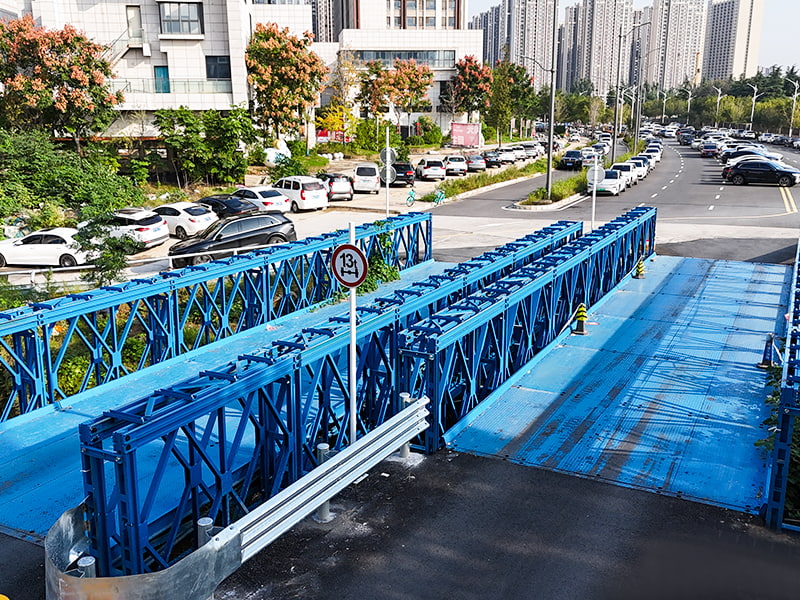
- 19 Product: CB 200 Bailey Bridge Four-Row Single-Layer Reinforced Bailey Bridge
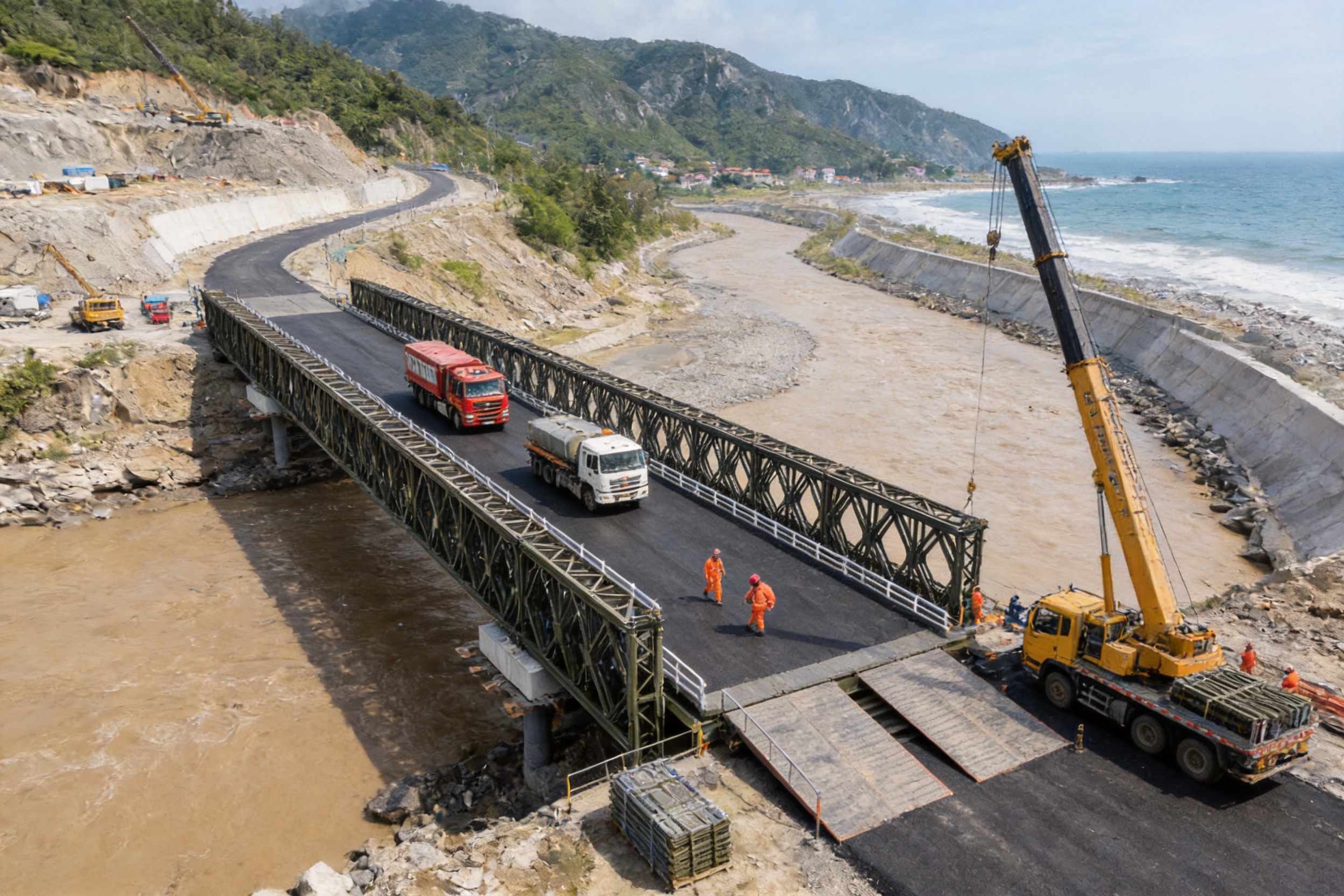
Modular bridge systems have become an essential solution for transportation infrastructure, emergency access, construction logistics, and temporary or semi-permanent crossings. Their value is especially clear when a bridge must be delivered quickly, installed with limited equipment, or adapted to changing site conditions. Among the available modular systems, the CB200 four-row single-layer reinforced Bailey bridge provides a strong combination of structural capacity, rapid assembly, standardized components, and dependable field performance.
Designed around the proven principles of the Bailey bridge system, the CB200 configuration uses prefabricated steel panels and supporting components to create a stable truss structure. Its four-row single-layer reinforced arrangement increases the effective load-bearing capacity of the bridge while maintaining the practical advantages associated with modular construction. The bridge is suitable for road traffic, temporary transportation routes, construction access, disaster-relief operations, and other infrastructure projects where speed and reliability are critical.
The product is manufactured and supplied by Jiangsu Zhonghai Bridge Equipment Co., Ltd., a specialist in modular steel bridges, Bailey bridge systems, engineered structural components, and bridge construction support equipment. The company integrates engineering design, automated and precision manufacturing, quality management, logistics coordination, and technical support into a unified production system. This approach allows the CB200 bridge to be supplied as a coordinated package rather than as a collection of unrelated steel components.
1. Overview of the CB200 Four-Row Single-Layer Reinforced Bridge
The CB200 four-row single-layer reinforced Bailey bridge is a modular steel truss bridge developed for applications requiring enhanced structural strength and efficient installation. The designation refers to a reinforced bridge arrangement based on the CB200 type, with four parallel rows of Bailey panels forming the main load-bearing truss system. The single-layer layout keeps the bridge profile relatively compact while the four-row configuration improves lateral stability, stiffness, and load distribution.
Unlike conventional permanent bridges that require extensive foundations, long construction periods, and large quantities of on-site materials, the CB200 system is composed primarily of factory-manufactured modules. Panels, transoms, stringers, bracing members, deck components, connection materials, and supporting accessories can be transported to the project site and assembled using a controlled sequence.
The bridge has also been presented at the Shanghai International Import Expo, where it demonstrated the application of modular steel bridge technology in a professional exhibition environment. The project represents the company’s ability to design, fabricate, coordinate, and supply a complete Bailey bridge system with consistent components and standardized quality control.
A notable feature of the product is its asphalt deck surface. Asphalt provides a more familiar driving surface than exposed steel decking and can increase the anti-slip coefficient when properly specified and applied. It also contributes to a smoother vehicle ride, improves the user experience, and supports safer operation in conditions where tire grip is important.
The CB200 bridge is not limited to one narrowly defined application. Depending on project requirements, it may be used as a temporary public road bridge, a construction access bridge, a replacement bridge during reconstruction, a flood-response crossing, a military logistics route, or a modular connection for industrial and civil engineering works.
2. Structural Design and Load-Bearing Concept
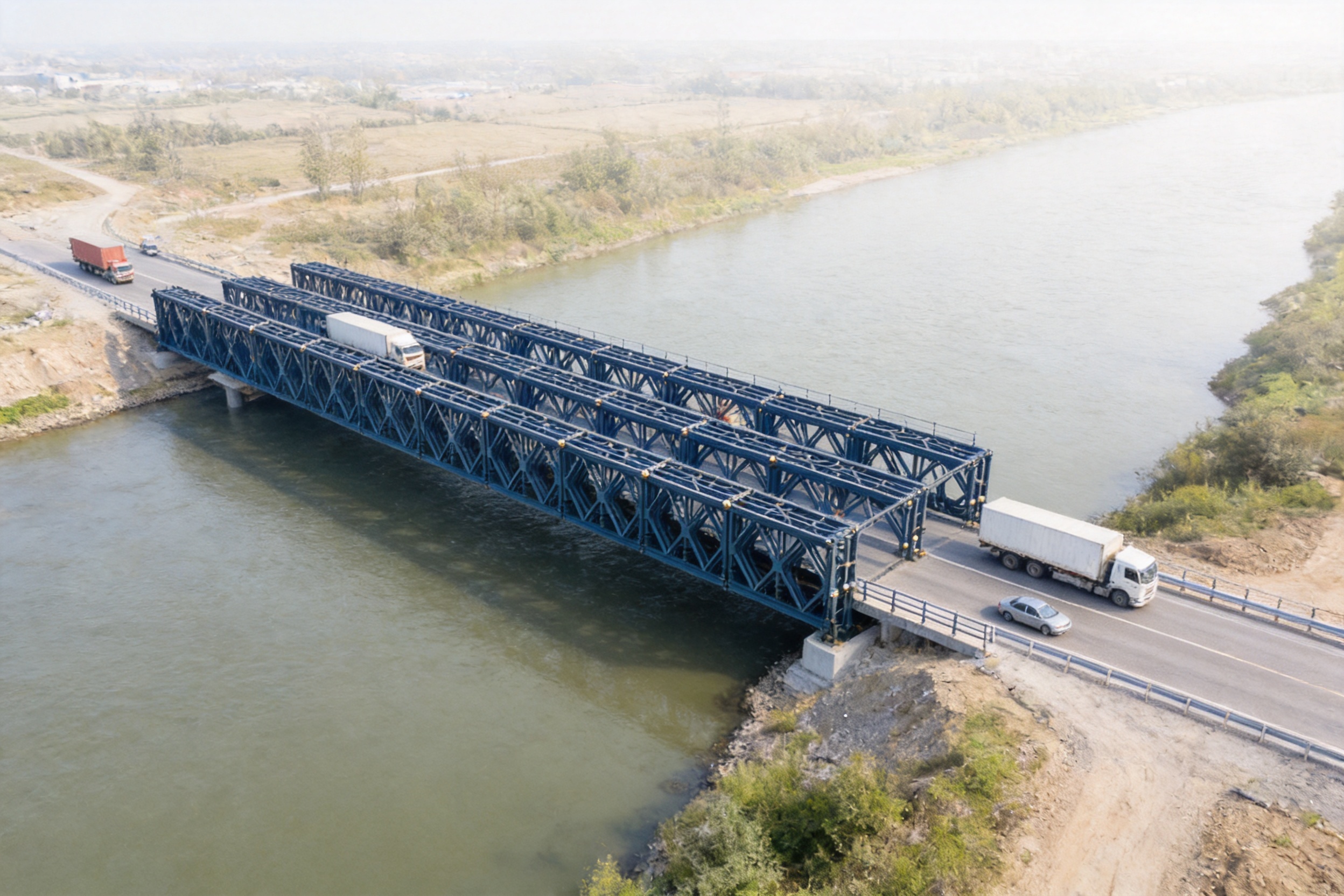
The primary structural concept of the CB200 bridge is based on the triangular stability of a steel truss. Bailey panels are connected longitudinally to create continuous side trusses. Cross members and bracing components connect the parallel trusses, producing a three-dimensional bridge structure capable of distributing traffic loads across multiple panel lines.
In a four-row single-layer arrangement, the bridge has four principal rows of Bailey panels working together as the main truss system. Compared with a lighter two-row configuration, the four-row arrangement offers increased resistance to bending and improved distribution of applied loads. It is particularly useful where a project requires greater structural confidence without adopting a more complex double-layer configuration.
The single-layer arrangement also provides practical advantages. It reduces the overall vertical height of the truss, simplifies assembly, and can make transportation and lifting operations more manageable. A lower-profile structure may be beneficial where clearance restrictions, visual impact, or construction equipment limitations must be considered.
Load transfer begins at the deck level, where vehicle or equipment loads are applied to the deck panels or asphalt surface. These loads are transferred to transverse members, then distributed to the longitudinal trusses. The Bailey panels carry the resulting axial forces, bending effects, and shear forces through their connected steel members. Bearings and substructure elements then transfer the reaction forces to the foundations or supporting abutments.
The efficiency of this structural system depends on the quality of the panels, the accuracy of the connection points, the proper installation of bracing, and the correct arrangement of all supporting components. For this reason, the bridge should not be viewed simply as a collection of standard panels. It is a coordinated structural system whose performance depends on both design integrity and installation discipline.
The CB200 type uses the core technology of the CB200 modular bridge family. This provides a recognized structural basis for engineering analysis, component production, and site assembly. Project-specific factors such as span length, traffic type, design load, foundation conditions, wind exposure, seismic requirements, and expected service duration should be evaluated before final configuration and installation.
3. Main Product Components
A complete CB200 four-row single-layer reinforced bridge normally includes the primary Bailey panels and a range of supporting components. The exact quantity and configuration depend on span length, width, loading requirements, approach conditions, and project-specific design calculations.
3.1 Bailey Panels
Bailey panels form the principal longitudinal truss members. They are manufactured from structural steel and include standardized connection points that allow adjacent panels to be joined with pins and related connection hardware. The panel geometry is designed to provide a balance between strength, weight, transportability, and assembly efficiency.
Panel consistency is critical. If dimensions, hole positions, connection interfaces, or welding quality vary beyond acceptable limits, assembly can become difficult and the completed structure may not perform as intended. Factory-controlled production helps ensure that panels manufactured for the same bridge system remain interchangeable and compatible.
3.2 Transoms and Stringers
Transoms span between the main trusses and support the deck structure. They help transfer vertical loads from the roadway to the side trusses while maintaining the correct spacing between the panel rows. Stringers or longitudinal deck supports are installed over or alongside the transoms to support deck panels and distribute traffic loads more evenly.
The relationship between the transoms, stringers, deck units, and trusses is essential to overall stiffness. Correct spacing and secure connections reduce unwanted movement and help maintain a stable driving surface during service.
3.3 Bracing Components
Wind bracing, sway bracing, lateral bracing, and other stabilizing members contribute to the bridge’s resistance to lateral movement and deformation. These components are particularly important for bridges exposed to strong winds, uneven traffic loading, construction equipment, or changing environmental conditions.
Because modular bridges are assembled from repeated units, the correct installation of every bracing member is essential. Missing or incorrectly positioned bracing may reduce the structural system’s ability to share loads as designed.
3.4 Deck and Asphalt Surface
The bridge deck provides the direct interface between the structure and traffic. Depending on the design, the deck may include steel deck panels, supporting plates, wearing layers, and an asphalt surface. The asphalt layer improves driving comfort and can increase slip resistance compared with an untreated steel surface.
Surface treatment should be selected according to expected traffic, climate, drainage, maintenance requirements, and the intended service period. Proper drainage is also important because standing water can accelerate corrosion, affect skid resistance, and increase maintenance demands.
3.5 Bearings, Ramps, and Accessories
Bearings transfer bridge reactions to the supporting structure while allowing controlled movement caused by temperature changes, loading, and other effects. Approach ramps, end posts, guardrails, walkways, connection pins, bolts, retaining components, and other accessories help complete the installation.
A major advantage of receiving these items from one coordinated supplier is that interface problems can be reduced. Components are designed and checked as part of a common system, rather than being selected from unrelated sources with potentially different dimensions or tolerances.
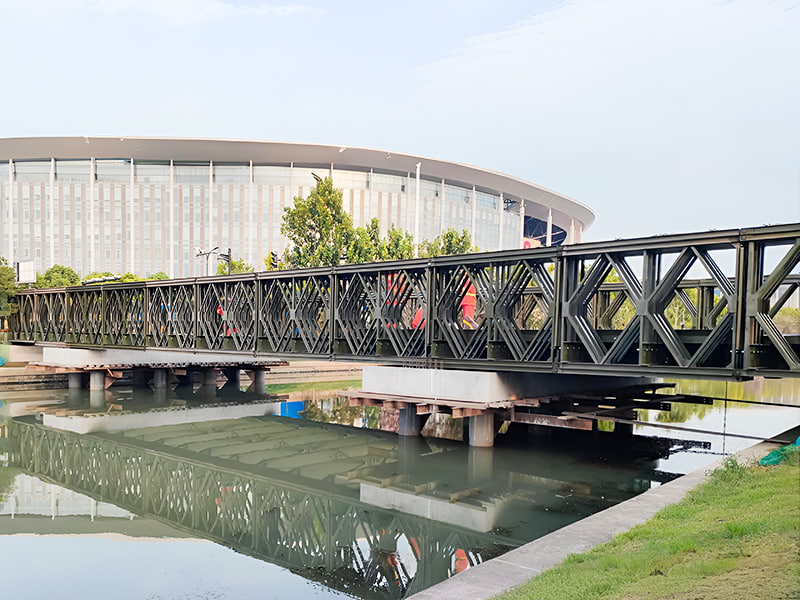
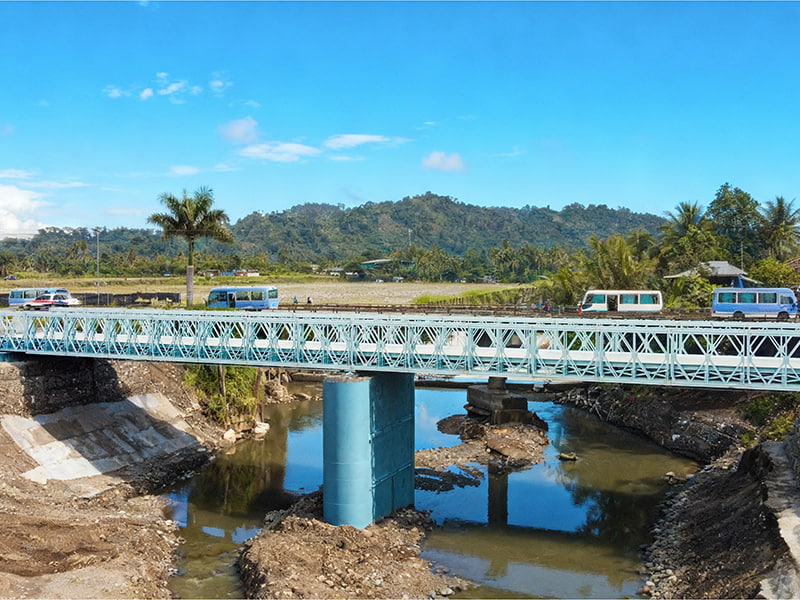
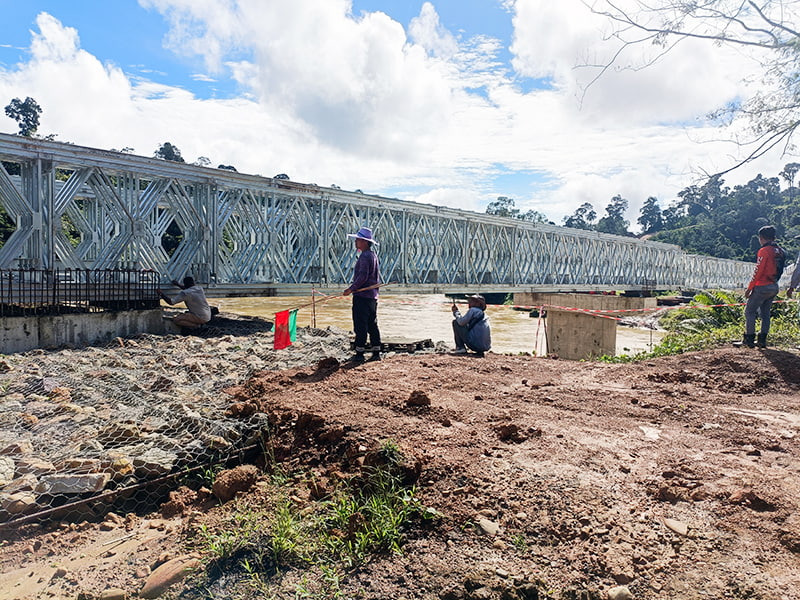
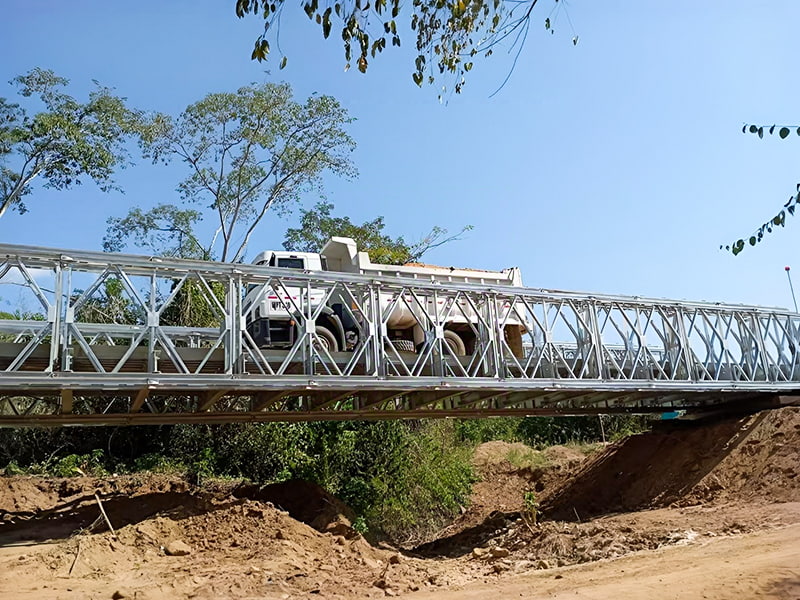
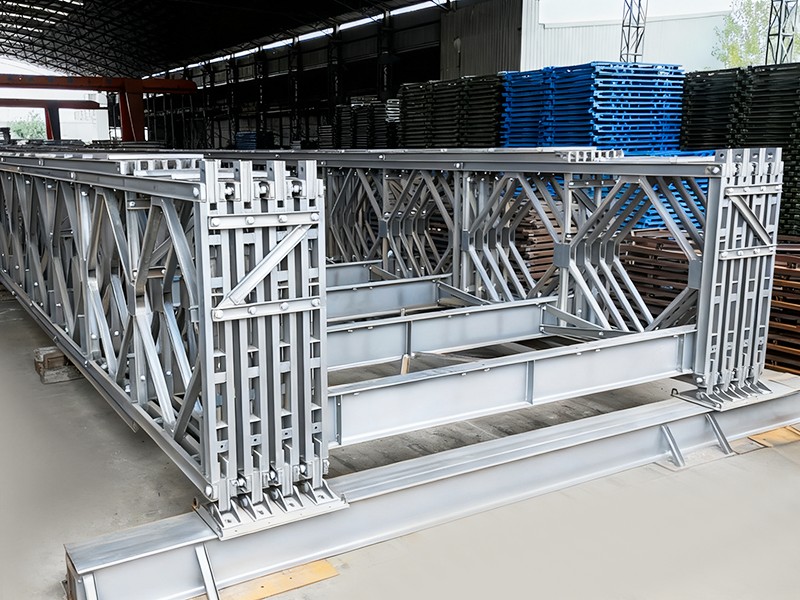
CB 200 Bailey Bridge Four-Row Single-Layer Reinforced Bailey Bridge
4. Advantages Compared with Conventional Bridge Construction
4.1 Faster Installation
The most widely recognized benefit of a Bailey bridge is the speed of erection. Since the principal components are produced in advance, much of the work normally associated with bridge construction is transferred from the project site to the factory. This can significantly reduce site preparation, fabrication, and waiting time.
For emergency projects, a rapid installation cycle can restore access to communities, construction areas, industrial facilities, and transportation routes much sooner than a conventional cast-in-place bridge. For planned projects, quicker construction can reduce traffic disruption, equipment rental periods, labor costs, and indirect project expenses.
The CB200 four-row single-layer configuration retains this modular efficiency while providing a reinforced structural arrangement. It is therefore appropriate for projects that require both speed and a higher level of load-bearing performance.
4.2 Reduced On-Site Fabrication
Conventional steel bridge projects may require substantial cutting, drilling, welding, and fitting at the construction site. These activities are affected by weather, site access, power availability, worker skill, and inspection conditions. By contrast, the CB200 system is manufactured using controlled factory processes before delivery.
Reduced on-site fabrication can improve quality consistency and make project scheduling more predictable. It also lowers the amount of heavy fabrication equipment required at the bridge location. This is especially valuable in remote areas, disaster zones, mountainous regions, and sites where the movement of large machinery is difficult.
4.3 Adaptability to Different Project Conditions
Modular panels can be combined in different quantities to create bridges of varying lengths. The same general component family may support multiple project arrangements, including different spans, roadway widths, approach conditions, and traffic functions.
This adaptability helps contractors and infrastructure owners respond to changing requirements. A bridge may initially be used as a temporary crossing and later be relocated, extended, or reconfigured for another purpose, subject to engineering review and component condition assessment.
4.4 Efficient Transportation and Handling
Individual Bailey components are more manageable to transport than a fully assembled bridge. They can be loaded in organized batches, delivered by conventional freight vehicles, and handled using cranes or other lifting equipment available at the site.
Standardized module dimensions also simplify packaging and inventory planning. Components can be counted, labeled, inspected, and matched against shipping documents before dispatch. This reduces the risk of missing parts and supports more efficient site logistics.
4.5 Reusability and Lifecycle Value
One of the important differences between a modular Bailey bridge and many conventional bridge systems is the potential for reuse. When panels and accessories are properly maintained, inspected, and stored, they may be redeployed for subsequent projects. Reusability can improve lifecycle value and reduce material waste.
Reuse must always be subject to engineering assessment. Components exposed to heavy loading, impact, corrosion, fatigue, or deformation should be inspected before being installed again. Nevertheless, the modular structure offers a practical foundation for asset management and long-term infrastructure flexibility.
5. Advantages Over Competing Modular Bridge Solutions
Many modular bridge systems are available in the international market, but not all offer the same combination of structural configuration, manufacturing control, surface treatment, and supply coordination. The CB200 four-row single-layer reinforced bridge distinguishes itself through several integrated advantages.
5.1 Reinforced Four-Row Configuration
Some lightweight modular bridges are intended mainly for pedestrian traffic, low-volume access, or limited temporary use. The four-row CB200 configuration provides a more substantial structural arrangement for projects that require greater reserve capacity, improved stiffness, or heavier operational demands.
Compared with a basic two-row arrangement, the four-row structure can distribute loads across more panel lines. This may reduce the demand on individual truss components and improve overall structural behavior. The final capacity remains dependent on span, design load, support conditions, materials, and installation quality, but the configuration provides a strong basis for demanding applications.
5.2 Compact Single-Layer Arrangement
A double-layer bridge may offer increased capacity in certain applications, but it can also require more steel, greater lifting height, additional assembly time, and more complex bracing. The CB200 single-layer arrangement seeks to provide reinforcement through the number of parallel panel rows while preserving a relatively compact profile.
This can be advantageous when site access is restricted or when contractors prefer a simpler erection sequence. It may also reduce the need for exceptionally tall cranes or specialized temporary works, depending on the span and local conditions.
5.3 Complete Component Coordination
Competitive products are sometimes supplied as basic panels only, leaving the customer to identify compatible transoms, deck systems, bearings, bracing, ramps, and connection hardware. This can create procurement delays and interface risks.
The CB200 system is supplied with a coordinated set of Bailey panels and supporting components. A complete package simplifies engineering review, purchasing, shipping, quality documentation, and installation planning. It also gives the customer a clearer responsibility chain when technical questions arise.
5.4 Asphalt Driving Surface
Not every modular bridge includes an asphalt surface. Exposed steel decking may be functional, but it can provide a harsher ride, produce higher tire noise, and offer less familiar driving characteristics. The asphalt surface of the CB200 bridge can improve traction and driving comfort when properly designed and maintained.
The surface is particularly useful for public access bridges, construction routes carrying wheeled equipment, and applications where vehicle control is important. The asphalt layer should be integrated with adequate drainage and edge protection to achieve reliable long-term performance.
5.5 Factory-Based Quality Control
The performance of a modular bridge depends heavily on repeatable manufacturing quality. The CB200 product benefits from standardized production workflows, controlled welding, dimensional inspection, material management, and coordinated component fabrication.
This factory-based approach creates an advantage over low-cost products manufactured with inconsistent processes. A lower purchase price does not necessarily represent lower total cost if poor dimensional accuracy causes installation delays, rework, premature corrosion, or field safety concerns.
5.6 Engineering and Application Support
A modular bridge supplier should provide more than steel parts. Customers often need assistance with preliminary configuration, component quantities, loading assumptions, transportation planning, erection sequence, and site support. Zhonghai combines product manufacturing with engineering and construction support capabilities, allowing the bridge solution to be matched more closely to the project’s actual needs.
6. Advanced Manufacturing Processes
The reliability of the CB200 bridge begins with its manufacturing process. Modular bridge components must meet strict requirements for geometry, material strength, weld integrity, connection accuracy, surface protection, and interchangeability. These requirements call for an organized production system rather than occasional workshop fabrication.
6.1 Engineering Design and Production Planning
Manufacturing begins with engineering review. Project requirements are examined to determine the bridge arrangement, span, width, traffic category, loading conditions, deck type, supporting components, and expected service environment. Production documentation is then prepared for the panels and accessories required for the selected configuration.
Standardized drawings and process documents help ensure that operators, inspectors, and assembly teams use the same technical information. Production planning also coordinates material procurement, cutting schedules, welding operations, coating procedures, inspection stages, packaging, and dispatch.
6.2 Material Selection and Traceability
Structural steel must be selected according to the required mechanical properties, weldability, environmental conditions, and applicable specifications. Material certificates and batch information provide traceability from incoming steel to finished components.
Traceability is valuable for quality assurance and future maintenance. If a question arises about a particular component, production records can help identify the material batch, manufacturing date, inspection status, and coating process. This is especially important for bridges used in safety-critical infrastructure.
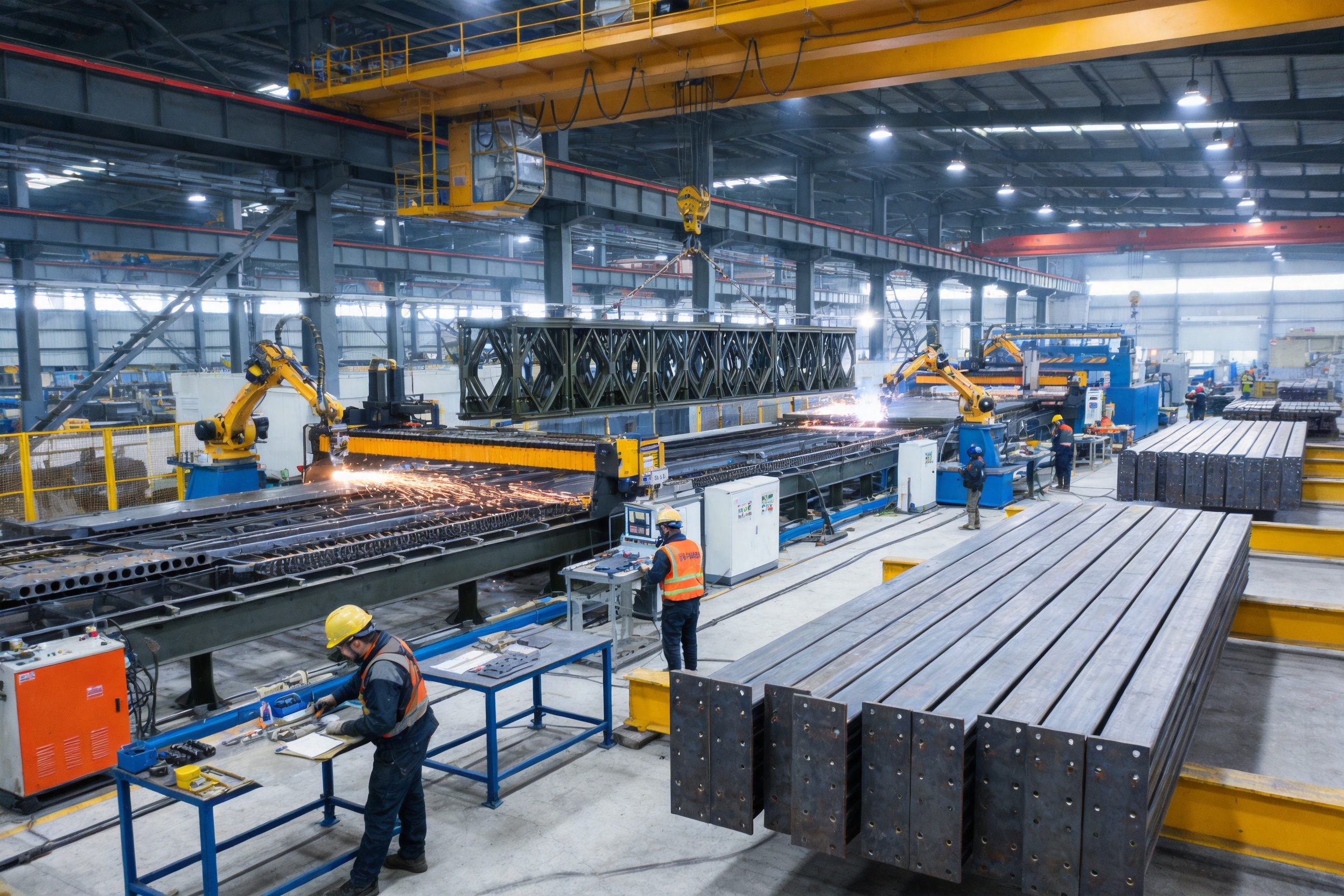
6.3 Automated Cutting and Precision Preparation
Automated cutting equipment can improve the consistency of panel plates, stiffeners, gussets, connection parts, and other components. Accurate cutting reduces the amount of manual adjustment required during fabrication and supports better control of dimensional tolerances.
Preparation of edges and connection surfaces is also important. Clean, accurately prepared surfaces contribute to stronger and more consistent welds. Automated processes can reduce variation between production batches and improve the repeatability of the completed components.
6.4 Controlled Welding
Welding is one of the most important manufacturing operations in a steel bridge panel. Welding procedures must be established according to the material, joint type, thickness, welding position, and required mechanical performance. Proper control of heat input, sequence, preheating where necessary, and cooling conditions helps reduce distortion and residual stress.
Automated welding and dedicated fixtures can improve weld consistency and productivity. Fixtures hold components in the correct position during welding, helping maintain the geometry of the panel. After welding, visual examination and other inspection methods can be used to identify surface defects, incomplete fusion, cracks, undercut, excessive porosity, or dimensional problems.
6.5 Dimensional Inspection
Dimensional accuracy directly influences field assembly. Inspectors may check panel length, width, height, diagonal dimensions, hole positions, connection interfaces, flatness, and deformation. Components that do not meet specified tolerances can be repaired, reworked, or rejected before shipment.
Inspection at the factory is more efficient than discovering problems during bridge erection. When components fit correctly, installation crews can proceed according to the planned sequence with fewer interruptions. This contributes to both schedule performance and site safety.
6.6 Surface Preparation and Corrosion Protection
Steel bridge components require suitable corrosion protection, particularly when they will be used in humid, coastal, industrial, or flood-prone environments. Surface preparation removes contaminants and improves the adhesion of protective coatings.
The coating system should be selected according to the intended service environment and maintenance plan. Proper coating thickness, curing conditions, edge coverage, and handling procedures all affect durability. Components should be protected from unnecessary damage during loading, transport, and site assembly.
6.7 Assembly Verification and Packaging
Before dispatch, components can be organized into shipment groups and checked against packing lists. Where appropriate, sample assembly or interface verification can be performed to confirm that panels, transoms, braces, deck units, and connection components work together as intended.
Packaging is not simply a logistics task. It protects the components from impact, moisture, contamination, and loss. Clear identification makes it easier for the site team to locate the correct parts and follow the planned erection sequence.
7. Quality Management and International Capability
Jiangsu Zhonghai Bridge Equipment Co., Ltd. combines engineering design, manufacturing, quality management, and international delivery. Its factory uses advanced automation and standardized workflows to produce modular steel bridge systems and structural components for domestic and overseas projects.
The company states that its products are manufactured in accordance with applicable ASTM, EN, and national specifications, depending on the project requirements. Standards provide a framework for material selection, structural design, fabrication, inspection, and documentation. However, the correct standard must always be confirmed for each project because requirements vary by country, authority, bridge function, and contract specification.
Quality management covers the complete product lifecycle, beginning with engineering review and material procurement and continuing through fabrication, inspection, packaging, delivery, erection support, and maintenance guidance. This integrated method is more reliable than treating quality as a final inspection performed only after production is complete.
International delivery experience also requires careful attention to documentation, packaging, customs coordination, shipping dimensions, spare parts, installation instructions, and communication across time zones. A bridge may be technically sound but still create project difficulties if shipment information and supporting documents are incomplete. Zhonghai’s experience serving international infrastructure and emergency-response projects supports a more coordinated supply process.
8. Typical Applications
8.1 Temporary Road Bridges
The CB200 bridge can be used to maintain road access while a permanent bridge is being repaired, replaced, or constructed. It may be installed beside an existing crossing or on a temporary alignment. The modular structure enables the temporary route to be planned and erected within a shorter period than many conventional alternatives.
8.2 Construction Access
Large infrastructure projects often require temporary crossings for construction vehicles, materials, cranes, and workers. A modular bridge can connect work zones across rivers, drainage channels, excavations, rail corridors, or unfinished roadways.
The four-row reinforced configuration may be useful where construction traffic is heavier than ordinary pedestrian or light-vehicle traffic. Loading requirements should be evaluated carefully, particularly when tracked machinery, loaded trucks, or repeated heavy cycles are expected.
8.3 Emergency and Disaster Relief
Floods, earthquakes, landslides, storms, and other disasters can destroy or disable road connections. A modular bridge can restore access for emergency vehicles, food distribution, medical teams, rescue equipment, and reconstruction materials.
Emergency bridge projects place special demands on logistics. Components may need to be delivered to remote areas, installed under difficult weather conditions, and operated before permanent infrastructure is available. The CB200 system’s prefabricated design and standardized components make it suitable for rapid-response planning when supported by appropriate engineering and site preparation.
8.4 Industrial and Mining Access
Industrial facilities, mining operations, energy projects, and large construction sites may need temporary or semi-permanent crossings for equipment and materials. The ability to assemble, relocate, or expand a modular bridge can support changing site layouts and phased development.
8.5 Water Conservancy and Flood-Control Projects
Water conservancy construction frequently involves canals, rivers, embankments, diversion channels, and temporary works. A modular bridge can provide access for machinery and personnel without requiring a lengthy permanent bridge construction process.
8.6 Military and Strategic Logistics
Modular bridges have long been associated with military logistics because they can be transported, assembled, and adapted to changing operational conditions. For strategic access routes, the ability to rapidly establish a crossing can be as important as ultimate structural capacity.
8.7 Public Infrastructure and International Development
Developing regions and remote communities may require reliable crossings but lack the time, equipment, or resources for conventional construction. A modular steel bridge can provide a practical intermediate or long-term infrastructure solution when designed, installed, and maintained according to local requirements.
9. Manufacturing and Supply Strengths
| Capability | Value to the Customer | Importance for the CB200 Bridge |
|---|---|---|
| Engineering design integration | Improves configuration accuracy and project coordination | Supports correct selection of panel rows, deck components, bracing, and accessories |
| Automated production | Increases repeatability and manufacturing efficiency | Helps maintain consistent panel geometry and weld quality |
| Precision steel fabrication | Reduces field fitting and rework | Improves connection accuracy during erection |
| Standardized quality management | Creates traceable and predictable production results | Supports safe and reliable modular assembly |
| Complete component supply | Reduces procurement complexity | Provides panels and supporting components as a coordinated package |
| International delivery experience | Improves logistics and documentation control | Supports overseas infrastructure and emergency-response projects |
| Construction support | Assists contractors during planning and installation | Helps reduce erection errors and schedule delays |
The company’s manufacturing strength is based on the combination of scale, technical expertise, and process discipline. Large production capacity is valuable because it supports repeat orders, standardized parts, and more efficient material utilization. Technical expertise is necessary for adapting a standard product to a particular site. Process discipline ensures that the product remains consistent from one project to another.
Zhonghai also provides customized steel components, automated welding, precision steel fabrication, bridge erection support equipment, and related structural products. These capabilities allow the company to support customers whose projects require more than a standard bridge package.
Its experience includes coastal engineering in the Maldives, temporary access bridges for major transportation infrastructure, structural components for exhibition-center construction, multi-span Bailey bridges for railway projects, and emergency bridge deployments in flood-affected areas. Such applications demonstrate the broad operating range of modular bridge technology.
10. Installation and Erection Considerations
Although modular bridges are designed for efficient installation, erection must be performed according to an approved method statement and engineering plan. The site should be assessed for access, ground stability, lifting capacity, water conditions, traffic control, temporary supports, and weather exposure.
Foundations or abutments must be capable of supporting the expected vertical and horizontal reactions. The bearing locations should be accurately positioned, level, and aligned. Poor support conditions can cause uneven settlement, excessive structural stress, deck irregularities, or difficulty connecting the modules.
During assembly, panels are connected in the planned sequence. Transoms, bracing, stringers, deck units, end posts, and other components are then installed and secured. Temporary launching arrangements may be used for certain spans, subject to engineering approval. Cranes, winches, rollers, or other equipment must be selected according to the weight and geometry of the components.
Connection pins and bolts should be inspected to ensure that they are fully inserted, correctly secured, and free from damage. Bracing must be installed in the specified locations. Deck components should be checked for alignment and firm support before the asphalt surface is applied or opened to traffic.
After erection, the bridge should undergo a formal inspection. This may include checking truss alignment, bearing conditions, connection security, deck level, guardrails, approach transitions, drainage, asphalt integrity, and clearance. Load testing or other acceptance procedures may be required by the project authority.
Installation speed should never replace installation quality. The primary purpose of modular construction is to make a safe and controlled installation more efficient, not to eliminate engineering review or inspection.
11. Durability, Maintenance, and Service Life
The service life of a modular steel bridge depends on design, material quality, corrosion protection, traffic intensity, environmental exposure, foundation performance, and maintenance. A well-manufactured bridge can provide dependable service, but regular inspection remains necessary.
Visual inspections should examine coating condition, corrosion, cracks, deformation, loose connections, damaged deck components, drainage problems, guardrails, and approach settlement. Particular attention should be given to areas where water, dirt, salt, or industrial contaminants may accumulate.
Asphalt surfaces should be monitored for potholes, cracking, rutting, edge deterioration, and loss of skid resistance. Prompt repairs can prevent water from reaching the underlying steel and can maintain safe driving conditions.
Connection components should be checked after initial loading and periodically thereafter. Vibration, temperature changes, traffic impact, and settlement may affect the tightness or alignment of some components. Any abnormal movement or noise should be investigated by qualified personnel.
Protective coatings may require localized repair or complete renewal depending on exposure and condition. Surface preparation for maintenance coating is important because applying new paint over rust, oil, or poorly bonded material will not provide durable protection.
When the bridge is intended for relocation or reuse, it should be dismantled carefully. Panels must be inspected for distortion, fatigue damage, corrosion, cracked welds, damaged holes, and other defects. Components should be cleaned, labeled, stored off the ground, and protected from moisture before redeployment.
12. Project Selection and Specification Guidance
Customers considering a CB200 bridge should prepare basic project information before requesting a quotation or technical proposal. Important data includes the required clear span, roadway width, design traffic, bridge elevation, approach geometry, foundation conditions, environmental exposure, construction schedule, and expected service period.
Traffic requirements should be defined clearly. A bridge designed for passenger vehicles may not be suitable for loaded trucks or construction machinery. The type, frequency, speed, and axle configuration of expected vehicles can affect the structural design and deck requirements.
Site geography is equally important. Rivers and channels may have flowing water, seasonal flooding, debris impact, scour, navigation clearance, or unstable banks. These factors influence the bridge elevation, foundation design, temporary works, and installation method.
Environmental exposure should also be considered. Coastal locations, saltwater environments, industrial facilities, high humidity, extreme temperatures, and areas with heavy rainfall may require enhanced corrosion protection and a more frequent inspection schedule.
Customers should also confirm the required standards, approval procedures, design responsibility, inspection requirements, and documentation package. The supplier can provide product data and technical support, but final acceptance normally depends on the project owner, local engineer, and relevant authority.
13. Why Choose an Integrated Bailey Bridge Manufacturer
Choosing an integrated manufacturer can reduce risk throughout the project lifecycle. When design, fabrication, accessories, inspection, packaging, and technical support are managed by one experienced supplier, the customer benefits from clearer communication and better control of interfaces.
An integrated manufacturer can identify potential conflicts earlier. For example, the selected deck system must match the transoms, the bracing must fit the panel arrangement, and the bearings must suit the support conditions. If these items are purchased separately, responsibility for compatibility may be unclear.
Manufacturing integration also supports consistent quality. The same organization can control material procurement, welding procedures, dimensional inspection, coating, packaging, and documentation. This is especially important for projects with demanding schedules or international procurement arrangements.
Jiangsu Zhonghai Bridge Equipment Co., Ltd. positions itself as a solutions provider rather than only a component seller. Its product range includes modular steel bridges, Bailey bridge systems, customized steel structures, precision-fabricated components, automated welding services, and bridge erection support equipment. This broader capability enables the company to address both standard and customized requirements.
The company’s location in Zhenjiang, Jiangsu Province, provides access to an established industrial and transportation network. Its manufacturing operations are supported by standardized workflows and production resources intended for domestic and international delivery.
14. Cost and Project Value
The purchase price of a bridge is only one part of total project cost. Site labor, transportation, lifting equipment, foundation work, traffic management, installation time, maintenance, and potential reuse all contribute to the final economic result.
The CB200 system can create value by reducing the amount of on-site fabrication and shortening the installation period. A faster bridge project may reduce road closure costs, construction equipment rental, labor hours, and delays to adjacent work. In emergency applications, the economic benefit of restoring access quickly may be greater than the direct cost of the bridge itself.
Reusability can further improve lifecycle economics. A modular bridge may be relocated after the original project is completed, provided that its components remain suitable and the new installation is properly engineered. This flexibility can be valuable for contractors, government agencies, disaster-response organizations, and infrastructure owners with recurring temporary access needs.
Cost comparisons should therefore evaluate the complete solution. A low-cost bridge with incomplete accessories, inconsistent dimensions, poor coating, or limited technical support may create hidden expenses during assembly and operation. A coordinated product with documented quality and engineering assistance may provide better value over the full project lifecycle.
15. Safety and Compliance
Safety must guide every stage of the CB200 bridge project, from design and manufacturing to transport, erection, operation, inspection, and dismantling. The bridge should be designed for its actual loading conditions and installed by competent personnel under an approved plan.
Factory safety includes proper material handling, welding control, lifting procedures, machine guarding, and inspection. Site safety includes traffic control, work-at-height protection, lifting plans, exclusion zones, water hazards, temporary supports, and weather monitoring.
Operational safety depends on suitable guardrails, approach transitions, deck condition, signage, speed control, load limits, and regular inspection. If the bridge is used by the public, the owner should ensure that the bridge configuration and operating restrictions are clearly communicated.
Compliance with ASTM, EN, national, or project-specific requirements should be confirmed during the engineering stage. Standards may address steel materials, welding, structural design, corrosion protection, load testing, and quality documentation. Compliance is not only a manufacturing issue; it also depends on correct installation and operation.
16. Q&A About the CB200 Bailey Bridge
Q1: What is a CB200 four-row single-layer reinforced Bailey bridge?
It is a modular steel truss bridge based on the CB200 system and arranged with four parallel rows of Bailey panels in a single-layer configuration. The arrangement is intended to provide increased structural strength, stiffness, and load distribution while retaining the efficiency of modular assembly.
Q2: What is the main advantage of using four rows of panels?
Four panel rows allow the bridge to distribute applied loads across more principal truss lines than a basic lighter arrangement. This can improve stiffness and structural reserve, although final capacity must always be determined through project-specific engineering calculations.
Q3: Why is the bridge described as single-layer?
Single-layer refers to the vertical arrangement of the Bailey panels in the main truss. The panels are not stacked in two vertical levels. This keeps the bridge relatively compact and can simplify handling, bracing, and erection.
Q4: Does the bridge include an asphalt surface?
The described CB200 product includes an asphalt surface on the deck. The asphalt is intended to improve the driving surface and increase the anti-slip coefficient when properly applied and maintained.
Q5: Can the bridge be used as a permanent bridge?
It may be suitable for temporary, semi-permanent, or long-term applications depending on the design, environment, maintenance plan, approvals, and project requirements. The intended service period should be identified at the beginning of the engineering process.
Q6: Can the bridge carry heavy construction equipment?
It may be designed for construction traffic, but the actual vehicle types, axle loads, frequency, and operating conditions must be reviewed. Loaded trucks, cranes, tracked machinery, and abnormal loads may require special design verification.
Q7: How quickly can the bridge be installed?
Installation time depends on span length, site conditions, foundation readiness, equipment, workforce, weather, bridge configuration, and inspection requirements. Modular prefabrication can significantly reduce the installation period compared with conventional bridge construction, but a precise schedule requires project information.
Q8: What components are supplied with the bridge?
A complete package may include Bailey panels, transoms, stringers, bracing, deck components, connection pins, bolts, bearings, end posts, ramps, guardrails, and other accessories. The exact supply scope should be confirmed in the technical quotation and contract.
Q9: How does factory manufacturing improve bridge quality?
Factory manufacturing provides controlled material handling, repeatable cutting, standardized welding, dimensional inspection, coating control, packaging, and traceability. These processes reduce variation and help ensure that modular components fit together during field assembly.
Q10: Can the bridge be customized?
Modular systems can often be adapted through changes in span, width, deck arrangement, support components, surface treatment, and accessory selection. Customization must remain consistent with structural calculations, manufacturing capabilities, transport limits, and applicable standards.
Q11: Is technical support available during installation?
The supplier provides engineering and bridge erection support capabilities. The level of support should be agreed according to the project, including preliminary design, component schedules, installation guidance, inspection documents, and on-site assistance where required.
Q12: What information is needed for a quotation?
Useful information includes the bridge span, clear width, design load, traffic type, site location, support arrangement, deck requirements, environmental conditions, delivery schedule, required standards, and whether installation support is needed.
Q13: Is the bridge suitable for international projects?
Yes. The product is intended for domestic and international infrastructure, emergency-response, construction, water conservancy, and transportation applications. International projects should confirm local standards, customs requirements, transport limitations, foundation design, and installation responsibilities.
Q14: How should the bridge be maintained?
Maintenance should include regular inspection of steel panels, welds, pins, bolts, bracing, deck components, asphalt, bearings, guardrails, drainage, coatings, and approaches. Corrosion, deformation, loose connections, and surface damage should be repaired promptly.
17. Conclusion
The CB200 four-row single-layer reinforced Bailey bridge provides a practical response to modern infrastructure requirements. It combines the modularity and rapid installation of a Bailey bridge with a reinforced four-row structural arrangement, coordinated accessories, and an asphalt driving surface designed to improve traction and user comfort.
Its advantages are strongest when the project requires speed, adaptability, reduced on-site fabrication, efficient transportation, and the possibility of future relocation or reuse. Compared with less comprehensive modular bridge products, the CB200 system offers a more coordinated solution supported by complete component supply and factory-based manufacturing control.
The quality of a modular bridge depends on more than its structural concept. Accurate engineering, certified materials, controlled welding, dimensional inspection, corrosion protection, organized packaging, correct installation, and disciplined maintenance all contribute to reliable performance. Zhonghai’s integrated capabilities in design, manufacturing, precision fabrication, automated welding, quality management, and international delivery support these requirements.
For contractors, infrastructure owners, government agencies, emergency-response organizations, and international development projects, the CB200 bridge can serve as a dependable connection solution for temporary, semi-permanent, and selected long-term applications. With appropriate project-specific design and professional installation, it can help create safer, faster, and more efficient access across challenging sites.
References
1. Bailey Bridge System Engineering Principles, modular truss bridge design and erection guidance.
2. Structural Steel Fabrication and Welding Quality Management Practices.
3. ASTM Structural Steel, Welding, and Bridge Construction Standards.
4. EN Standards for Steel Structures, Execution Quality, and Protective Coatings.
5. Modular Bridge Inspection, Maintenance, and Corrosion Protection Guidelines.
6. Temporary Works Planning for Construction and Emergency Access Bridges.
7. International Practices in Disaster-Response and Rapid-Deployment Bridge Systems.
8. Jiangsu Zhonghai Bridge Equipment Co., Ltd. Product and Manufacturing Information.
Product: CB 200 Bailey Bridge Four-Row Single-Layer Reinforced Bailey Bridge


We respond quickly to all international requests and provide technical support when needed.
Product Category
Bailey Bridge/Modular Bridge Modular Steel Bridge Pedestrian Bridge Modular Pipe Bridge Truss Bridge Steel StructureContact Us

+86-511-84522866
+86-13921582699

zhwm@zjql.com

Building 1,83#, dantu New Town, Yanjiang Road, Dantu District, Zhenjiang, Jiangsu, China
Copyright © Jiangsu Zhonghai Bridge Equipment Co., Ltd. All
Rights
Reserved
China bailey bridge for sale
bailey bridge supplier from china
