
 English
 русский
 Español
 Português


Tang Yuwei — International Bailey Bridge Sales Manager
CB100 Double-Row Single-Layer Reinforced Galvanized Bailey Bridge for Rapid Modular Construction
Content
- 1 Understanding the CB100 Bailey Bridge System
- 2 Structural and Functional Advantages
- 3 Manufacturing Strengths of an Integrated Bridge Producer
- 4 Quality Management and International Supply Capability
- 5 Applications of the CB100 Modular Bridge
- 6 Installation Process and Site Planning
- 7 Maintenance, Inspection, and Long-Term Performance
- 8 Why Choose a Specialized Supplier for Global Projects?
- 9 Procurement Considerations for Buyers
- 10 Competitive Advantages in Practical Terms
- 11 Frequently Asked Questions
- 11.1 What is a CB100 Bailey Bridge?
- 11.2 What does double-row single-layer reinforced mean?
- 11.3 Can the bridge be used as a permanent bridge?
- 11.4 How quickly can a CB100 bridge be installed?
- 11.5 Does the bridge require field welding?
- 11.6 Why is hot-dip galvanizing important?
- 11.7 Can the bridge be reused at another location?
- 11.8 Can the system be used for pedestrian crossings?
- 11.9 Can it carry pipes or utilities?
- 11.10 What information should be provided for a quotation?
- 11.11 What makes a specialized manufacturer different from a general steel fabricator?
- 11.12 What standards can apply to the bridge?
- 12 Conclusion
- 13 References
- 14 Product: CB 100 Bailey Bridge Double-Row Single-Layer Reinforced Galvanized Bailey Bridge
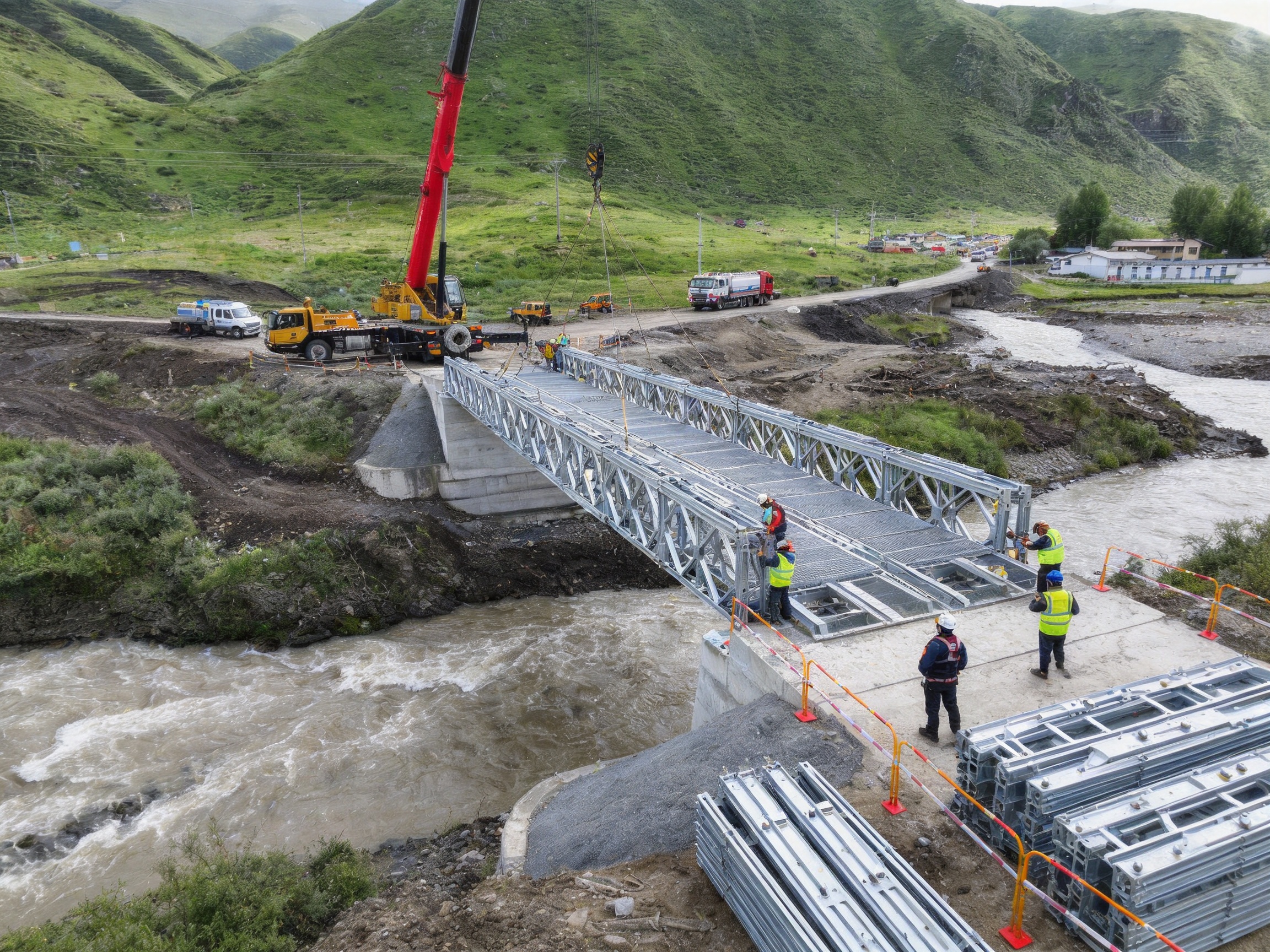
Modern infrastructure projects increasingly require bridge systems that can be delivered quickly, assembled with limited equipment, and adapted to changing site conditions. Emergency response agencies, transportation contractors, water conservancy authorities, military logistics teams, industrial developers, and international infrastructure programs all face similar challenges: a crossing must be established safely, project delays must be minimized, and the completed structure must provide dependable service under demanding environmental conditions. The CB100 Bailey Bridge Double-Row Single-Layer Reinforced Galvanized Bailey Bridge is designed to address these requirements through standardized modular construction, high-strength steel components, bolted and pinned connections, and corrosion-resistant surface protection.
Unlike a conventional permanent bridge that may require extensive foundations, specialized erection machinery, long manufacturing lead times, and complicated field welding, a Bailey bridge is based on a reusable structural kit. Individual panels, transoms, stringers, bracing members, deck components, pins, and connection accessories can be transported separately and assembled in a logical sequence. This approach allows a project team to establish a temporary, semi-permanent, or emergency crossing while retaining the flexibility to dismantle, relocate, expand, or reconfigure the bridge later.
The CB100 or 321-type modular bridge is especially suitable for projects that need a practical balance between load capacity, installation speed, structural adaptability, and lifecycle economy. Its double-row, single-layer reinforced configuration provides greater structural capacity and stiffness than a basic single-row arrangement while maintaining the characteristic modularity of the Bailey bridge system. The use of hot-dip galvanizing further improves resistance to atmospheric corrosion, moisture, industrial exposure, and repeated outdoor service.
This article examines the structural concept, manufacturing advantages, practical applications, installation process, maintenance requirements, and project value of the CB100 double-row single-layer reinforced galvanized Bailey Bridge. It also explains why a specialized manufacturer with integrated engineering, production, quality management, and delivery capabilities can provide advantages over suppliers that only trade standard components or fabricate individual steel parts without a complete bridge-system approach.
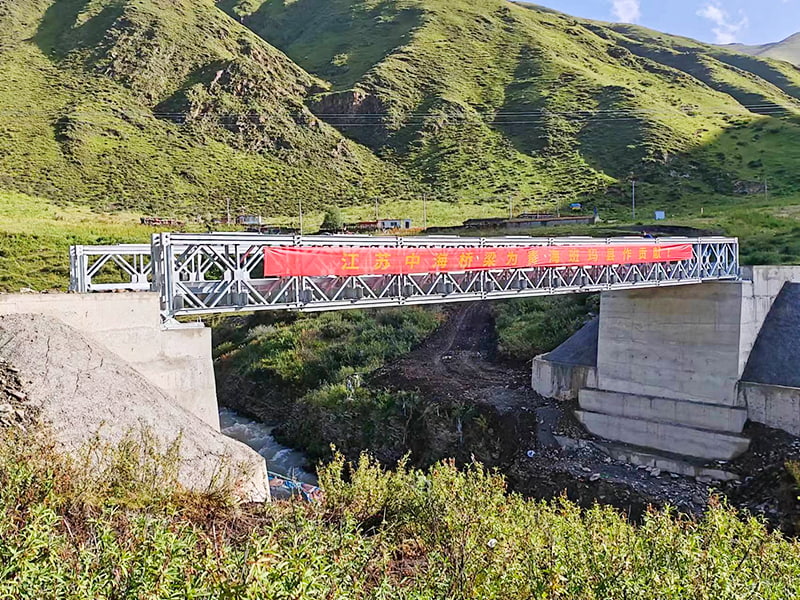
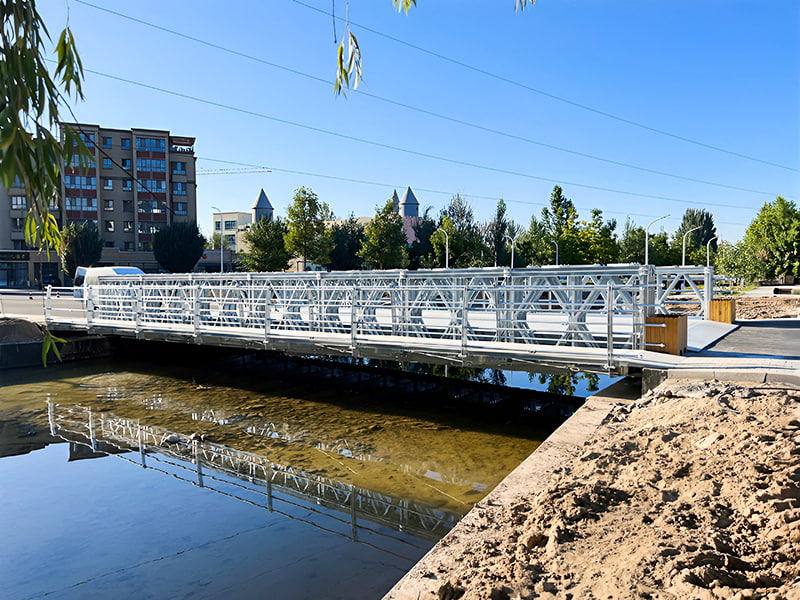
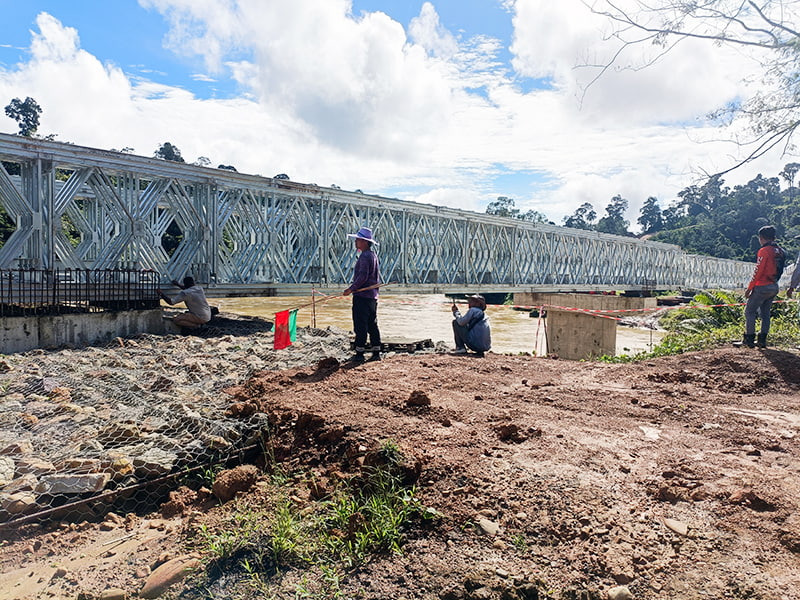
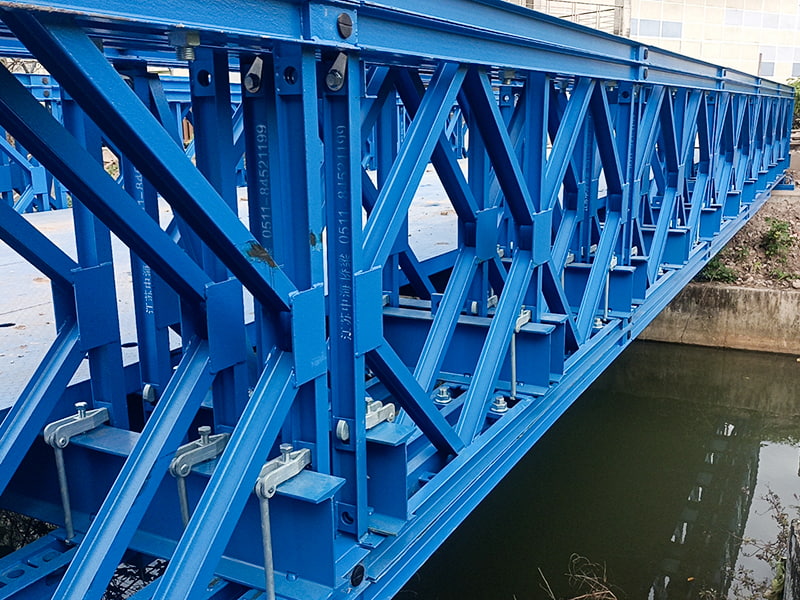
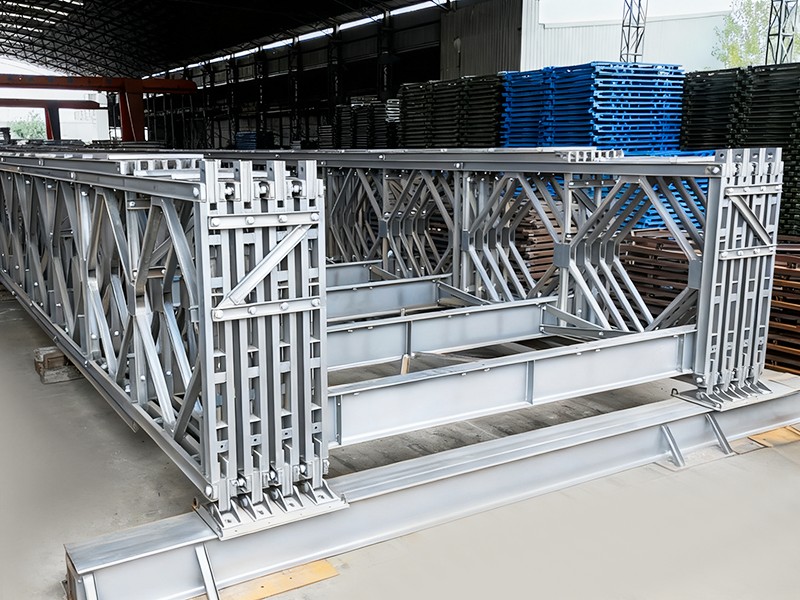
CB 100 Bailey Bridge Double-Row Single-Layer Reinforced Galvanized Bailey Bridge
Understanding the CB100 Bailey Bridge System
The CB100 Bailey Bridge belongs to the family of modular panel bridges developed around the principle of standardized, interchangeable structural elements. Each main panel functions as part of a truss line, and multiple panels are connected longitudinally to create the required bridge length. Additional rows of panels can be installed transversely to increase the effective structural width and load-carrying capability.
The designation “double-row single-layer reinforced” describes the principal arrangement of the side trusses. “Double-row” generally indicates that two parallel panel rows are used on each side or within the main load-carrying truss arrangement, depending on the engineering configuration. “Single-layer” refers to the vertical stacking arrangement of the panel assembly rather than a two-level truss. “Reinforced” indicates that the bridge is configured with additional structural strength compared with a basic single-row single-layer arrangement.
Exact allowable span, load rating, deck width, foundation arrangement, and erection method must be confirmed through project-specific engineering calculations. These parameters depend on traffic type, vehicle axle configuration, environmental loads, support spacing, bridge length, approach conditions, wind exposure, seismic requirements, and local design standards. The modular system provides the hardware and configuration flexibility, while the final bridge design must be prepared and approved by qualified engineers.
A typical CB100 system may include main truss panels, end posts, transoms, stringers, sway bracing, horizontal bracing, bracing frames, deck units, bridge bearings, ramps, walkways, bolts, pins, and other connection accessories. Because the components are manufactured according to standardized dimensions, they can be combined into different span lengths and widths without requiring the entire bridge to be redesigned from the beginning.
Modularity as a Project Advantage
Modularity is one of the most important advantages of the CB100 system. A conventional bridge is often treated as a single, site-specific structure. Its components are fabricated for one location, one span, and one final arrangement. If site conditions change, modifications may become expensive and time-consuming. A modular Bailey bridge is different because its principal members are designed as repeatable units.
Standardized panels can be connected end to end to form a longer bridge, or they can be arranged in parallel to achieve a wider deck and a stronger truss configuration. This allows the same inventory to support multiple projects. A contractor may use the components for an emergency access bridge during a flood response, dismantle the bridge after the permanent crossing is restored, and later reuse the same components on an industrial access project or temporary construction road.
The interchangeable nature of the system also simplifies inventory management. Replacement panels and accessories can be stocked in advance, inspected periodically, and dispatched rapidly when a project arises. This is particularly valuable for government agencies, disaster-relief organizations, defense logistics units, and contractors operating in regions where road access is limited.
Double-Row Reinforcement
The double-row arrangement increases the quantity of structural material participating in the main truss system. Compared with a basic configuration, it can provide improved resistance to bending, greater lateral stability, and enhanced load distribution when properly engineered and assembled. Reinforcement is important for projects involving heavier vehicles, longer spans, frequent traffic, or more demanding service conditions.
The reinforced arrangement also provides a practical method for upgrading a modular bridge without abandoning its basic component system. Instead of moving immediately to a completely different bridge design, the project team may use additional panel rows, bracing members, or related reinforcement components to meet a higher structural requirement. This creates a useful balance between standardization and performance customization.
Nevertheless, reinforcement does not eliminate the need for a site-specific structural assessment. A bridge’s performance depends on the entire load path, including foundations, bearings, end posts, transoms, deck units, lateral bracing, connections, and approach embankments. A stronger truss cannot compensate for inadequate supports or poorly prepared foundations.
Structural and Functional Advantages
The CB100 double-row single-layer reinforced galvanized Bailey Bridge offers several advantages compared with many conventional temporary crossing methods and less integrated modular bridge products.
Rapid Installation with Mechanical Connections
The bridge uses a pin connection system and standardized mechanical components. This reduces the need for complex field welding and allows erection crews to work with commonly available lifting and assembly equipment. Mechanical connections are especially beneficial in remote locations, wet environments, emergency zones, and sites where electrical power or welding facilities are unavailable.
A launching-nose method may be used for certain bridge arrangements. In this approach, the bridge is assembled progressively on one side of the obstacle and pushed or rolled toward the opposite support. The method can reduce the need for temporary supports within a river, canal, roadway, or ravine. The specific erection method depends on span length, available working space, ground conditions, water flow, equipment, and the approved construction plan.
Fast installation does not mean that safety procedures can be omitted. Every bridge erection project requires an approved method statement, lifting plan, temporary stability measures, connection inspection, and final structural verification. The advantage is that the system is designed to make these procedures more organized and repeatable than fully site-fabricated construction.
Adaptability to Difficult Terrain
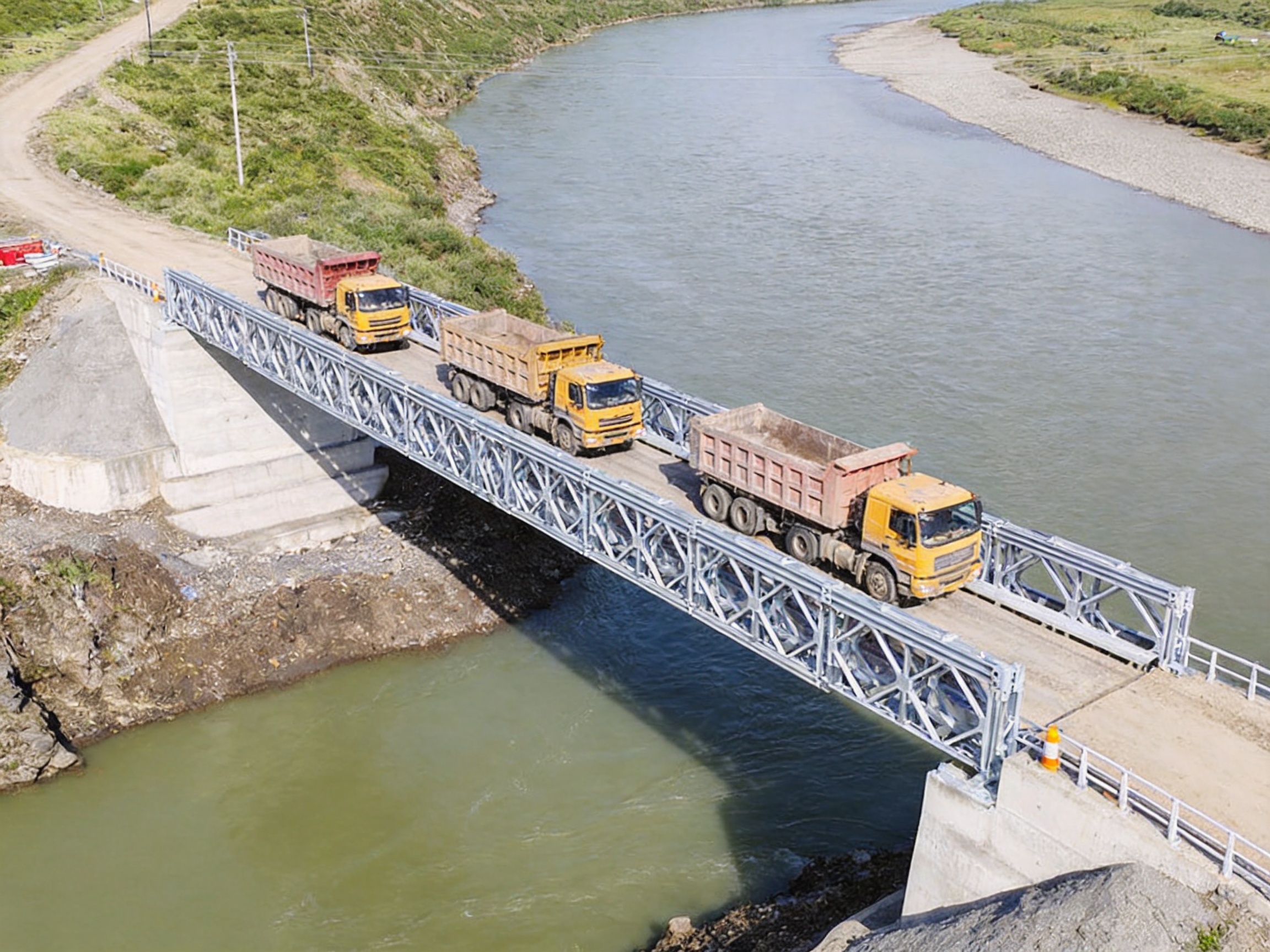
Bailey bridges are commonly selected when normal construction access is restricted. They can be used across rivers, drainage channels, flood zones, railway interruptions, construction corridors, mining sites, and temporary road diversions. Because the bridge is assembled from manageable sections, components can often be transported to locations where large prefabricated bridge units would be difficult to deliver.
The modular structure can accommodate a wide range of span and width requirements. It may function as a single-lane vehicle bridge, a wider access bridge, a temporary logistics route, a pedestrian crossing, or a support structure for industrial pipe and utility lines when configured with the correct deck and engineering accessories. The final use must always be checked against the design load and applicable regulations.
Hot-Dip Galvanized Corrosion Protection
The CB100 bridge body is hot-dip galvanized. During this process, prepared steel components are immersed in molten zinc so that a metallurgically bonded zinc coating forms over the steel surface. The resulting coating provides both barrier protection and sacrificial protection. If a small area is scratched, the zinc can continue to protect the exposed steel through electrochemical action.
Galvanizing is particularly useful for bridges exposed to rain, humidity, condensation, river environments, coastal air, road splash, and outdoor storage. It also reduces the frequency of repainting compared with unprotected or inadequately protected carbon steel. By extending the service life of bridge components and reducing routine maintenance, galvanizing can lower the total cost of ownership.
Surface protection is not a substitute for design drainage or inspection. Dirt, vegetation, standing water, deicing salts, and aggressive industrial deposits can still affect bridge components and connections. Galvanized members should therefore be inspected, cleaned when necessary, and repaired according to an appropriate maintenance plan.
Reusability and Lifecycle Economy
One of the strongest economic benefits of a Bailey bridge is that it can be disassembled after the original project. Components may be inspected, repaired, stored, and reused at another location. This contrasts with many temporary structures that are designed for one-time use or that lose most of their value after removal.
Reuse can reduce the quantity of new steel required for future projects, lower transportation and fabrication costs, and shorten the procurement cycle. It also supports more sustainable construction by extending the useful life of structural components. When a project is planned around reusable bridge modules, the initial investment can create value across several deployments rather than only one crossing.
Efficient Transportation and Storage
Modular bridge components can be packaged and transported in batches. Their standardized shapes make it easier to calculate loading plans, organize container or truck shipments, and maintain clear component inventories. When disassembled, a bridge occupies considerably less space than a completed structure of the same length.
For international projects, packaging and documentation are particularly important. Components must be protected against transport damage, identified clearly, and accompanied by packing lists, assembly drawings, inspection records, and relevant quality documents. A manufacturer with experience in international delivery can help reduce confusion during customs clearance, site receipt, and construction preparation.
| Feature | CB100 Double-Row Single-Layer Reinforced System | Potential Project Benefit |
|---|---|---|
| Structural arrangement | Double-row, single-layer reinforced modular truss | Improved stiffness and load distribution compared with a basic single-row arrangement |
| Connection method | Standardized pins, bolts, and mechanical connections | Reduced dependence on field welding and faster assembly |
| Surface protection | Hot-dip galvanized steel components | Enhanced resistance to outdoor corrosion and reduced coating maintenance |
| Configuration | Interchangeable panels and supporting members | Adaptable bridge length, width, and reinforcement arrangement |
| Deployment | Suitable for temporary, semi-permanent, emergency, and construction access uses | Useful across changing project conditions |
| Lifecycle | Disassemblable and reusable components | Lower long-term investment for organizations with repeated bridge requirements |
Manufacturing Strengths of an Integrated Bridge Producer
The performance of a modular bridge depends not only on the design concept but also on the consistency of manufacturing. Panels that are not dimensionally accurate, welds that contain defects, holes that are misaligned, or coatings that are inadequately prepared can create problems during installation and service. For this reason, selecting a manufacturer with integrated engineering and production capabilities is a major procurement consideration.
Jiangsu Zhonghai Bridge Equipment Co., Ltd. specializes in modular steel bridges, Bailey bridge systems, customized steel components, bridge erection equipment, automated welding, and precision steel fabrication. Its position as both an engineering-oriented manufacturer and a bridge-system supplier allows it to coordinate design interpretation, material preparation, fabrication, surface treatment, inspection, packaging, and delivery as connected stages of one production process.
Engineering and Design Coordination
A complete modular bridge order involves more than supplying steel panels. The supplier must understand the required span, deck width, traffic category, foundation conditions, erection sequence, environmental exposure, loading assumptions, and applicable specifications. Engineering coordination helps ensure that the selected configuration is appropriate for the actual project rather than being treated as a generic product.
Design coordination may include arrangement drawings, component schedules, connection details, erection instructions, loading information, foundation interface requirements, and shipping breakdowns. When a customer requires a nonstandard width, a special ramp, a pedestrian walkway, a pipe support arrangement, or a particular corrosion protection system, early engineering communication can identify the necessary modifications before fabrication begins.
The company’s manufacturing and engineering services are intended to support projects in transportation, water conservancy, military logistics, disaster relief, industrial access, and international development. These sectors often require a combination of standard modules and project-specific adjustments.
Material Preparation and Traceability
Reliable bridge production begins with suitable structural steel and controlled material preparation. Steel plates, sections, and connection components should be purchased according to the approved specification. Material certificates, heat numbers, inspection records, and identification marks support traceability throughout the manufacturing process.
Traceability is valuable when components are produced in large quantities or shipped to multiple locations. Each panel or major member can be associated with production records, inspection results, and coating information. If a question arises during installation or maintenance, the project team can more easily identify the relevant batch and documentation.
Precision Cutting and Forming
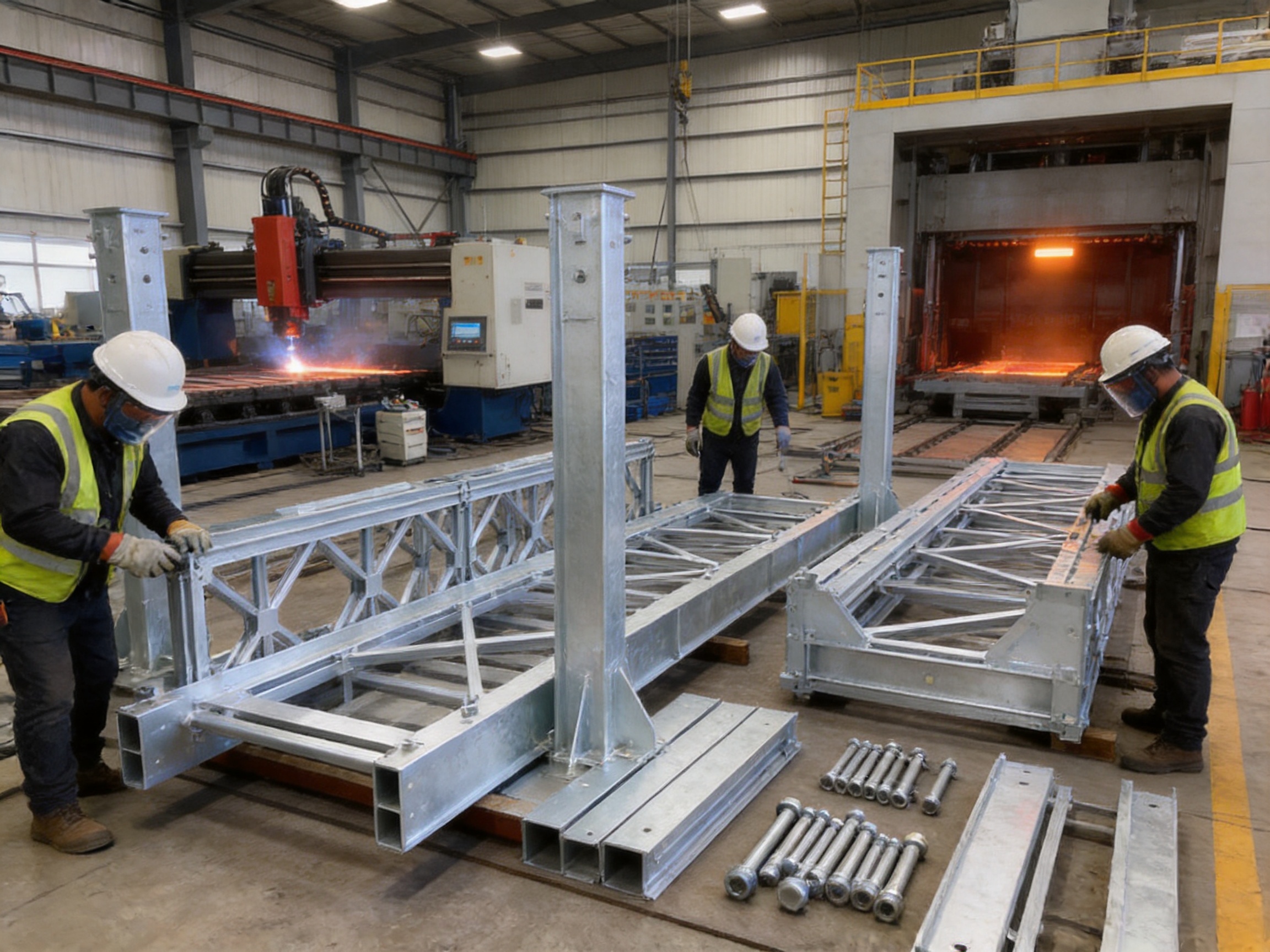
Automated or digitally controlled cutting equipment helps produce consistent dimensions and repeatable component geometry. Accurate cutting reduces fit-up difficulties and limits material waste. Where plates require forming, controlled bending and shaping processes help maintain the intended profile and reduce residual distortion.
Precision is particularly important for Bailey bridge panels because the components must align with pins, bolts, transoms, bracing members, and adjacent panels. Small dimensional errors can accumulate across a long bridge if they are not controlled during production. Consistent fabrication makes field assembly faster and reduces the need for corrective work.
Automated Welding and Fabrication Control
Welding is used to fabricate many modular bridge components, even though the bridge is generally assembled in the field using pins and bolts. The quality of factory welds directly influences the strength and durability of panels, end posts, bracing members, and other structural parts.
Automated welding can improve repeatability by controlling travel speed, heat input, wire feed, and weld placement. Standardized welding procedures also support more consistent results across repeated panel production. Skilled technicians remain essential for joint preparation, fit-up, inspection, equipment setup, and the treatment of complex or nonstandard details.
Quality control may include visual inspection, dimensional checks, weld procedure qualification, welder qualification, non-destructive testing where required, and correction of unacceptable defects. The inspection scope should be based on the project specification, governing standards, and engineering requirements.
Assembly Trial and Dimensional Verification
For modular systems, trial assembly can be an effective way to verify that components fit correctly before shipment. Selected panels, connection members, transoms, deck elements, and bracing parts may be assembled in the factory or checked using controlled dimensional inspection. This helps identify hole alignment problems, interference, missing accessories, or inconsistencies in component labeling.
A well-organized factory verification process can prevent avoidable delays at the construction site. It is much more efficient to correct a missing or misaligned part before the bridge is shipped than after the components have reached a remote flood zone or an international project location.
Galvanizing and Surface Treatment
Before hot-dip galvanizing, steel surfaces must be prepared properly. Oil, grease, rust, mill scale, welding residue, and other contaminants can interfere with coating adhesion and coverage. Appropriate cleaning, pickling, and fluxing stages help prepare the steel for immersion in molten zinc.
After galvanizing, components should be visually inspected for coating continuity, excessive zinc buildup, bare spots, drainage issues, and damage caused by handling. Threaded areas, connection holes, lifting points, and contact surfaces require particular attention because they must remain functional during assembly.
Where damage occurs during transport or erection, repair procedures should comply with the relevant galvanizing and bridge maintenance requirements. Small areas may be repaired using approved zinc-rich systems after the surface is properly cleaned. Larger damage may require additional technical evaluation.
Quality Management and International Supply Capability
Bridge equipment is frequently supplied across national borders, so manufacturing quality must be matched by documentation and delivery control. A project can experience delays even when the steelwork itself is satisfactory if packing lists are incomplete, parts are not clearly marked, drawings are missing, or shipping groups do not correspond to the erection sequence.
Jiangsu Zhonghai Bridge Equipment Co., Ltd. integrates manufacturing, quality management, and international delivery support. The company states that its production systems use standardized workflows and are intended to meet ASTM, EN, and applicable national specifications. The specific standard or combination of standards should be confirmed for each project during the technical clarification stage.
International supply performance involves several coordinated activities:
First, the technical scope must be clearly defined. This includes the bridge arrangement, design loads, span, deck width, access requirements, corrosion environment, accessories, and documentation package.
Second, the production plan must link the approved drawings to material procurement, fabrication, inspection, galvanizing, packing, and shipment. Clear hold points allow the customer or an appointed inspection agency to review progress before the goods leave the factory.
Third, the finished components must be organized for transport and site use. Heavy members require suitable lifting points and packaging. Small accessories should be grouped, labeled, and protected against loss. Component markings should remain legible after galvanizing, handling, and shipment.
Fourth, the supplier should provide technical information that supports erection. This may include installation drawings, component lists, connection instructions, handling guidance, and maintenance recommendations. Where required, the manufacturer can also coordinate technical support for erection and construction activities.
Advantages over Trading-Only Suppliers
A trading-only supplier may offer a low initial quotation by purchasing standard components from several factories. However, this approach can create uncertainty regarding design responsibility, dimensional consistency, coating quality, accessory compatibility, and after-sales support. If a problem occurs, the customer may need to coordinate among multiple parties.
An integrated manufacturer can provide a more coherent chain of responsibility. Engineering, fabrication, welding, galvanizing, inspection, packaging, and technical support are managed within a connected organization. This does not automatically guarantee that every project is suitable or that every risk disappears, but it can improve communication and make quality verification more straightforward.
Compared with suppliers focused only on conventional steel fabrication, a modular bridge specialist also understands the importance of interchangeability. A structural member may be strong enough in isolation but still unsuitable if it does not align with the system’s standard pin geometry, panel spacing, bracing arrangement, or deck interface. System knowledge is therefore as important as raw fabrication capacity.
Applications of the CB100 Modular Bridge
Emergency and Disaster-Relief Crossings
Floods, earthquakes, landslides, storms, and infrastructure failures can isolate communities and disrupt the movement of food, medical supplies, rescue teams, and construction equipment. In these situations, restoring connectivity quickly is often more important than constructing a final permanent bridge immediately.
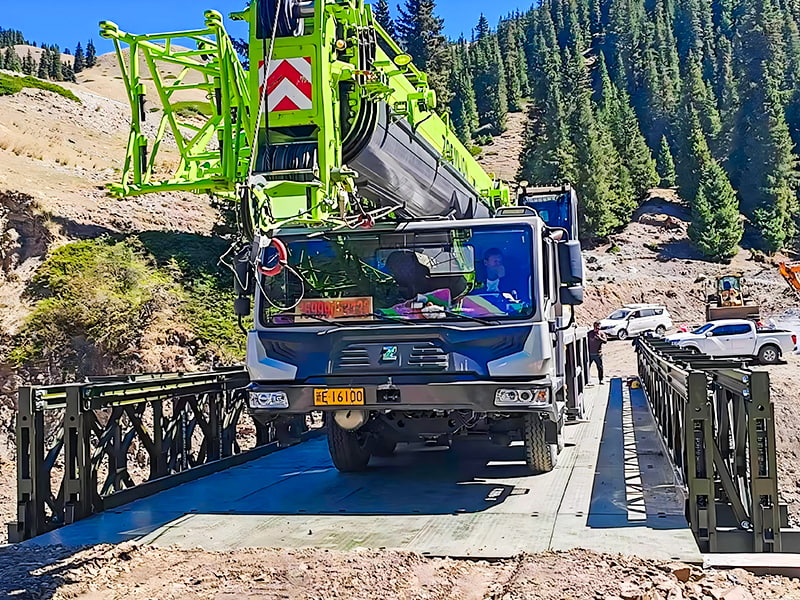
The CB100 system can be deployed as an emergency access bridge when the original structure has been damaged or when a temporary crossing is needed while a permanent replacement is designed. Its modular parts can be transported to the affected area, assembled with limited site welding, and removed or reused after the emergency phase.
Emergency projects require especially careful assessment of river flow, scour, debris impact, unstable ground, changing water levels, and access for cranes or trucks. The speed of assembly is valuable, but it must be combined with professional site investigation and temporary works planning.
Construction Access and Temporary Diversions
Large civil engineering projects often need temporary bridges before the final road, railway, dam, tunnel, or interchange is complete. A modular bridge can maintain traffic while an existing crossing is repaired or can provide access to construction zones separated by a river, excavation, or new transport corridor.
Because the components are reusable, contractors may relocate the bridge as construction stages progress. A crossing installed during earthworks may later be dismantled and reassembled at another work front. This flexibility can reduce the need to construct several separate temporary access roads.
Water Conservancy and Flood-Control Projects
Water conservancy projects commonly involve canals, drainage channels, reservoirs, embankments, and flood-control works. Access conditions may change as water levels and construction zones shift. Modular bridges can provide temporary or semi-permanent crossings for maintenance vehicles, material transport, inspection teams, and construction equipment.
In wet environments, hot-dip galvanizing is a valuable protective measure. Drainage, bearing design, foundation stability, and resistance to hydraulic action remain important considerations. The bridge should be positioned and supported so that water flow is not unnecessarily obstructed and scour risks are addressed.
Military and Strategic Logistics
Military logistics and civil-defense operations may require rapidly deployable crossings that can support personnel, vehicles, equipment, and supplies. The modular nature of a Bailey bridge allows bridge components to be stored, transported, and assembled according to operational needs.
Projects in this category may demand rapid deployment, standardized training, repairable components, and compatibility with existing transport equipment. The final design must be based on the required military load class, vehicle characteristics, security considerations, terrain, and applicable authority requirements.
Industrial and Utility Crossings
Industrial facilities, mines, energy projects, and large construction sites may need temporary crossings for service roads, conveyors, pipelines, or utility routes. A modular steel bridge can be adapted with suitable supports and secondary structures to carry non-road loads, provided that the design is engineered for the actual pipe, cable, equipment, and environmental loads.
A dedicated pipe bridge configuration may use modular truss components as the supporting frame while incorporating pipe saddles, clamps, walkways, maintenance platforms, and expansion provisions. These accessories must not be added casually; they must be checked for dead load, wind load, vibration, thermal movement, and maintenance access.
Pedestrian and Community Access
With an appropriate deck system, guardrails, handrails, lighting provisions, and accessibility arrangements, modular bridge technology can support pedestrian crossings. This may be useful where a river, railway, highway, or construction area separates communities or work zones.
Pedestrian use requires different considerations from vehicle traffic. The bridge must control vibration, provide safe walking surfaces, prevent falls, maintain sufficient clear width, and comply with local accessibility and guardrail requirements. A vehicle bridge should not automatically be opened to pedestrians without verifying these provisions.
Installation Process and Site Planning
The success of a Bailey bridge project depends heavily on preparation before the first panel arrives. A modular bridge can be assembled quickly only when the foundation, access route, component inventory, lifting equipment, and erection team are ready.
Site Investigation
The site investigation should identify the crossing geometry, span requirements, bank elevations, soil conditions, water levels, flow velocity, flood history, scour potential, overhead obstructions, underground utilities, access roads, and available assembly areas. The investigation should also determine whether cranes, forklifts, rollers, or launching equipment can reach the site.
For river crossings, the project team should consider seasonal water variation, debris, ice where applicable, navigation requirements, and the possibility of sudden upstream releases. For road and railway crossings, traffic management and clearance requirements must be incorporated into the erection plan.
Foundation and Bearing Preparation
Although a modular bridge can reduce superstructure construction time, it still requires stable supports. Abutments, concrete pads, steel stools, or other foundation systems must be designed for vertical reactions, horizontal forces, overturning effects, settlement, and environmental action.
The bearing seats must be level and correctly aligned. Differences in elevation or orientation can create unintended stresses and make panel installation difficult. Drainage should be arranged so that water does not accumulate around the supports or beneath the bridge approaches.
Component Inspection and Sorting
When the shipment arrives, the site team should compare the delivered components with the packing list and approved drawings. Panels and accessories should be inspected for transport damage, coating damage, deformation, missing pins, missing bolts, and unclear identification marks.
Sorting components by erection sequence can significantly improve productivity. Main panels, transoms, bracing members, deck units, ramps, and connection hardware should be placed in accessible but safe locations. Small parts should be stored in secured containers to prevent loss.
Assembly and Launching
The bridge may be assembled in sections on one bank, in a temporary assembly area, or directly over prepared supports, depending on the approved method. Temporary bracing must be installed as required to prevent instability during partial assembly. The structure should never be treated as fully stable until all required panels, transoms, deck elements, and bracing systems are connected.
If a launching nose is used, the nose and the bridge must be designed and balanced for the launching condition. Rollers, jacks, winches, or other equipment must have adequate capacity and must be positioned on stable ground. Personnel should remain outside danger zones during movement.
After the bridge reaches its final position, it is lowered onto the bearings or support seats, the launching equipment is removed or released, and the final connections are checked. Deck installation, guardrails, ramps, approach transitions, and traffic-control devices are then completed.
Final Inspection and Opening
Before opening the bridge, qualified personnel should verify panel alignment, pin installation, bolt tightening, bracing continuity, deck seating, bearing position, guardrail security, approach condition, and clearance. Any temporary erection member that is not part of the final design should be removed only after the permanent system is complete.
Load testing, proof loading, or other acceptance procedures may be required by the project authority. Operating restrictions such as speed limits, vehicle spacing, lane control, or maximum gross weight should be clearly displayed and enforced.
Maintenance, Inspection, and Long-Term Performance
Galvanized steel reduces coating maintenance, but every bridge still requires regular inspection. A maintenance program should be established according to traffic intensity, climate, exposure category, bridge importance, and the consequences of failure.
Routine Inspection
Routine inspections should examine the deck surface, drainage, guardrails, panel connections, pins, bolts, bracing, bearings, ramps, approach embankments, and visible galvanized surfaces. Inspectors should look for loose hardware, deformation, impact damage, abnormal vibration, standing water, blocked drainage, corrosion products, and settlement.
Connection zones deserve special attention because movement, wear, dirt accumulation, and water retention can occur around pins and bolts. Components that experience repeated vehicle impact or heavy braking may require more frequent checks.
Cleaning and Coating Repair
Road dirt, mud, salt, chemical residues, and bird nesting materials should be removed when they retain moisture or create an aggressive environment. Galvanized steel can often be cleaned with water and mild methods, avoiding harsh chemicals that may damage the zinc coating.
If the coating is damaged by impact, cutting, drilling, or abrasion, the affected area should be cleaned and repaired using an approved zinc-rich repair system. Repairs should be documented, especially for bridges intended for repeated reuse.
Inspection after Relocation
When the bridge is dismantled for reuse, each component should be inspected before storage. Bent panels, damaged pins, distorted holes, cracked welds, and severely damaged galvanized areas should be identified and repaired or replaced. Components should be stored above standing water and protected from unnecessary mechanical damage.
A reusable bridge inventory should include records of the number and condition of panels, transoms, stringers, braces, deck units, pins, bolts, and accessories. Good inventory management makes future deployment faster and reduces the risk of assembling a bridge with incomplete or incompatible parts.
Why Choose a Specialized Supplier for Global Projects?
International bridge buyers often need more than a product catalog. They require technical communication, clear commercial documentation, reliable production schedules, export packaging, inspection support, and responsive coordination across time zones. A specialized supplier can help connect these requirements into one procurement process.
Jiangsu Zhonghai Bridge Equipment Co., Ltd. is based in Zhenjiang, Jiangsu Province, an industrial and transportation center with access to manufacturing resources and logistics networks. The company serves domestic and international projects and provides modular bridge systems, engineered steel structures, customized components, and erection-related equipment.
Its stated project experience includes coastal engineering in the Maldives, temporary access bridges associated with the Shenzhen–Zhongshan Corridor, structural components for the Hangzhou Expo Center, multi-span Bailey bridges for the Lalin Railway, and emergency bridge deployments in multiple regions. Such project categories demonstrate the broad application range of modular steel systems, although the technical suitability of any specific configuration must still be verified for each new project.
The company’s strengths can be summarized in four areas. The first is manufacturing capacity supported by standardized workflows and automation. The second is engineering coordination for modular bridge arrangements and customized steel components. The third is quality management covering material, fabrication, welding, galvanizing, and final inspection. The fourth is international delivery support for projects that require organized documentation and reliable shipping.
These capabilities can provide advantages over suppliers that offer only isolated bridge parts. A complete bridge system must work as an integrated assembly. Panels, bracing members, deck units, accessories, drawings, and erection procedures must correspond with one another. Integrated production reduces the possibility that components from different sources will have incompatible dimensions or inconsistent quality.
Procurement Considerations for Buyers
Before ordering a CB100 bridge, buyers should prepare a clear technical brief. Important information includes the required clear span, overall length, usable deck width, design vehicle or pedestrian load, expected traffic frequency, bridge elevation, approach geometry, support conditions, climate, corrosion environment, desired service period, and installation method.
Buyers should also identify whether the bridge is temporary, semi-permanent, or intended for extended service. A temporary bridge may have different requirements for deck type, surface treatment, inspection frequency, traffic control, and foundation design than a long-term community or industrial crossing.
The quotation should clearly state which items are included. These may include main panels, end posts, transoms, stringers, bracing, deck units, bearings, ramps, guardrails, walkways, fasteners, launching equipment, spare parts, drawings, packing, inspection, and technical support. Ambiguity in the accessory list can cause significant cost and schedule problems later.
Documentation requirements should be agreed before production. Depending on the project, the buyer may request material certificates, welding records, dimensional inspection reports, galvanizing records, non-destructive testing reports, packing lists, certificates of origin, operation and maintenance documents, and factory inspection arrangements.
It is also important to confirm the design responsibility. The manufacturer can provide product data, arrangement drawings, and engineering support, but the project owner or appointed structural engineer may need to approve the final bridge design according to local regulations. Responsibility for foundations, traffic management, erection safety, and final commissioning should be defined in the contract.
| Procurement Item | Questions to Confirm | Reason for Confirmation |
|---|---|---|
| Bridge configuration | What span, width, panel rows, and reinforcement arrangement are required? | Ensures the selected system matches the structural demand. |
| Design loading | What vehicle, pedestrian, equipment, wind, seismic, and environmental loads apply? | Supports appropriate engineering verification. |
| Deck system | Is the bridge intended for vehicles, pedestrians, pipes, or mixed use? | Determines deck, guardrail, walkway, and accessory requirements. |
| Corrosion environment | Will the bridge be exposed to coastal air, chemicals, high humidity, or deicing salts? | Helps define surface protection and maintenance provisions. |
| Installation method | Will the bridge be crane-assembled, launched, or installed by another method? | Influences temporary works, equipment, and erection planning. |
| Documentation | Which certificates, drawings, inspection records, and manuals are required? | Prevents delays during approval, customs clearance, and construction. |
| Future reuse | Will the bridge be dismantled and relocated after the first project? | Supports inventory planning and lifecycle cost evaluation. |
Competitive Advantages in Practical Terms
The CB100 double-row single-layer reinforced galvanized Bailey Bridge competes not only on purchase price but also on speed, adaptability, quality consistency, durability, and reuse potential. A low-cost bridge that requires extensive site modification, frequent coating repair, or replacement of incompatible parts may become more expensive over its service life.
Its first competitive advantage is the combination of reinforcement and modularity. Some heavy-duty temporary bridge systems achieve higher capacity through large, specialized members that are expensive to transport and difficult to assemble. The CB100 arrangement uses a standardized panel concept while allowing additional structural capacity through a double-row configuration.
Its second advantage is field efficiency. Pin-connected assembly reduces the need for site welding, which can shorten installation time and simplify work in locations with limited power, poor weather, or restricted access. Standard connections also make training and inspection more systematic.
Its third advantage is corrosion protection. Hot-dip galvanizing provides a durable coating for outdoor service and can be more practical than relying entirely on repeated paint applications. This is particularly important for bridges that must remain in service through wet seasons or be stored and redeployed over many years.
Its fourth advantage is lifecycle flexibility. The bridge can be used as a temporary crossing, then dismantled and transferred to another project. This makes it attractive to organizations with recurring access requirements rather than a single isolated bridge need.
Its fifth advantage is manufacturer integration. A supplier that combines automated fabrication, precision steel processing, engineering coordination, quality management, and international delivery can reduce the communication gaps that sometimes occur when design, fabrication, galvanizing, and accessories are purchased separately.
Frequently Asked Questions
What is a CB100 Bailey Bridge?
A CB100 Bailey Bridge is a modular steel truss bridge based on standardized panel components and mechanical connections. The CB100 or 321-type system can be configured for different spans, widths, and load requirements. The double-row single-layer reinforced version uses additional panel capacity to improve structural performance compared with a basic arrangement.
What does double-row single-layer reinforced mean?
It describes the main truss configuration. Double-row refers to the use of two parallel rows of modular panels in the structural arrangement, while single-layer indicates that the panels are not stacked vertically in two levels. Reinforced means the configuration is selected to provide greater capacity or stiffness than a basic single-row single-layer bridge.
Can the bridge be used as a permanent bridge?
It may be suitable for temporary, semi-permanent, or extended-service applications when it is properly designed, founded, assembled, inspected, and maintained. Whether it qualifies as a permanent bridge depends on local codes, design life, traffic requirements, environmental conditions, and approval by the responsible engineer and authority.
How quickly can a CB100 bridge be installed?
Installation time depends on bridge length, site access, foundation readiness, labor, equipment, water conditions, weather, and the selected erection method. The standardized pin-connected system can accelerate assembly, but a responsible project schedule must include site preparation, component inspection, temporary works, deck installation, safety checks, and final acceptance.
Does the bridge require field welding?
The main modular assembly is designed around pins, bolts, and mechanical connections, so extensive field welding is generally not required. Factory welding is used to fabricate many components. Any field modification or welding should be approved by the responsible engineer and performed under controlled procedures.
Why is hot-dip galvanizing important?
Hot-dip galvanizing applies a bonded zinc coating that protects steel from corrosion through barrier and sacrificial action. It is valuable for bridges exposed to rain, humidity, coastal air, water, and outdoor storage. Galvanizing reduces maintenance demands, although regular inspection and cleaning remain necessary.
Can the bridge be reused at another location?
Yes. One of the principal benefits of a modular Bailey bridge is that it can be dismantled, inspected, stored, transported, and reassembled. Before reuse, all panels, pins, bolts, deck units, bracing members, and connection areas should be checked for damage and confirmed to meet the requirements of the new project.
Can the system be used for pedestrian crossings?
It can be configured for pedestrian use when the deck, guardrails, handrails, walking surface, width, vibration control, lighting, and accessibility provisions are designed for pedestrians. A vehicle bridge should not be used by pedestrians without verifying the relevant safety requirements.
Can it carry pipes or utilities?
Modular truss components may support pipes or utilities when a dedicated design includes suitable saddles, clamps, maintenance walkways, expansion provisions, and load checks. Pipe weight, fluid weight, thermal movement, wind, vibration, and maintenance loads must all be considered.
What information should be provided for a quotation?
Buyers should provide the required span, bridge length, usable width, design load, intended application, site conditions, support arrangement, corrosion environment, installation method, delivery destination, and documentation requirements. Photographs, site drawings, geotechnical information, and access limitations are also useful.
What makes a specialized manufacturer different from a general steel fabricator?
A specialized manufacturer understands the complete modular bridge system, including panel interchangeability, pin geometry, truss arrangements, deck interfaces, erection sequences, and reuse requirements. A general steel fabricator may produce strong individual parts but may not provide the same level of system coordination or modular compatibility.
What standards can apply to the bridge?
Applicable standards depend on the project location and use. Structural steel, welding, galvanizing, bridge loading, traffic safety, and inspection may be governed by ASTM, EN, national, transportation authority, or project-specific standards. The applicable requirements should be confirmed during engineering review and contract preparation.
Conclusion
The CB100 Bailey Bridge Double-Row Single-Layer Reinforced Galvanized Bailey Bridge provides a practical solution for projects that require fast deployment, structural adaptability, corrosion resistance, and future reuse. Its standardized modular panels can be combined into different bridge arrangements, while the reinforced double-row configuration offers improved capacity and stiffness for more demanding applications.
The system’s pin-connected construction reduces dependence on complex field welding and supports organized assembly in difficult terrain. Hot-dip galvanizing improves durability in outdoor and humid environments, helping reduce maintenance requirements. Because the bridge can be dismantled and reused, it can deliver value beyond its first installation and serve as part of a long-term bridge inventory.
Jiangsu Zhonghai Bridge Equipment Co., Ltd. adds value through integrated engineering, precision fabrication, automated welding, standardized production, quality management, galvanizing, customized steelwork, and international delivery support. These capabilities can provide an advantage over fragmented procurement models in which design, fabrication, coating, accessories, and documentation come from unrelated sources.
Successful deployment still depends on correct engineering, reliable foundations, qualified erection personnel, thorough inspection, suitable traffic control, and regular maintenance. When these requirements are properly addressed, the CB100 modular bridge can help transportation authorities, contractors, emergency agencies, industrial operators, and international development organizations establish safer and more efficient connections in a wide range of environments.
References
1. Bailey Bridge engineering principles and modular panel bridge construction practices.
2. Structural steel design guidance for temporary and permanent bridge applications.
3. Hot-dip galvanizing practices for corrosion protection of fabricated steel structures.
4. Welding quality management and inspection procedures for structural steel fabrication.
5. Bridge erection safety guidance for launching, lifting, temporary bracing, and site assembly.
6. Transportation authority practices for modular bridges, temporary crossings, and traffic loading.
7. International standards and project specifications relating to structural steel, welding, galvanizing, and bridge inspection.
8. Manufacturer technical information for CB100 and 321-type modular Bailey bridge systems.
Product: CB 100 Bailey Bridge Double-Row Single-Layer Reinforced Galvanized Bailey Bridge

We respond quickly to all international requests and provide technical support when needed.
Product Category
Bailey Bridge/Modular Bridge Modular Steel Bridge Pedestrian Bridge Modular Pipe Bridge Truss Bridge Steel StructureContact Us

+86-511-84522866
+86-13921582699

zhwm@zjql.com

Building 1,83#, dantu New Town, Yanjiang Road, Dantu District, Zhenjiang, Jiangsu, China
Copyright © Jiangsu Zhonghai Bridge Equipment Co., Ltd. All
Rights
Reserved
China bailey bridge for sale
bailey bridge supplier from china
