
 English
 русский
 Español
 Português


Tang Yuwei — International Bailey Bridge Sales Manager
Galvanized Customized Bailey Bridge for Reliable and Rapid Infrastructure Construction
Content
- 1 Project Background and Product Purpose
- 2 Customized Bailey Bridge Design
- 3 Standardized Bailey Panels and Supporting Components
- 4 Advanced Manufacturing Process
- 5 Factory Pre-Assembly and Quality Verification
- 6 Advantages Compared with Conventional Bridge Construction
- 7 Advantages Compared with Basic Standard Bridge Packages
- 8 Corrosion Resistance and Environmental Suitability
- 9 Manufacturing Strengths of Jiangsu Zhonghai Bridge Equipment Co., Ltd.
- 10 Installation and Construction Efficiency
- 11 Quality Management and Documentation
- 12 Applications for Customized Galvanized Bailey Bridges
- 13 Buying Considerations for International Projects
- 14 Maintenance and Service Life
- 15 Why This Product Is a Practical Global Bridge Solution
- 16 Questions and Answers
- 16.1 What is a customized Bailey bridge?
- 16.2 Why was the Nicaragua bridge pre-assembled at the factory?
- 16.3 What is the purpose of hot-dip galvanizing?
- 16.4 Is galvanizing a substitute for maintenance?
- 16.5 Can a Bailey bridge be used as a permanent bridge?
- 16.6 Can the bridge support vehicles?
- 16.7 Can the bridge be used for pedestrians?
- 16.8 What components are included besides Bailey panels?
- 16.9 What standards can be applied to the bridge?
- 16.10 How does factory pre-assembly improve installation efficiency?
- 16.11 What information should a customer provide when requesting a quotation?
- 16.12 Can the bridge be relocated or reused?
- 17 Conclusion
- 18 References
- 19 Product: Galvanized Customized Bailey Bridge
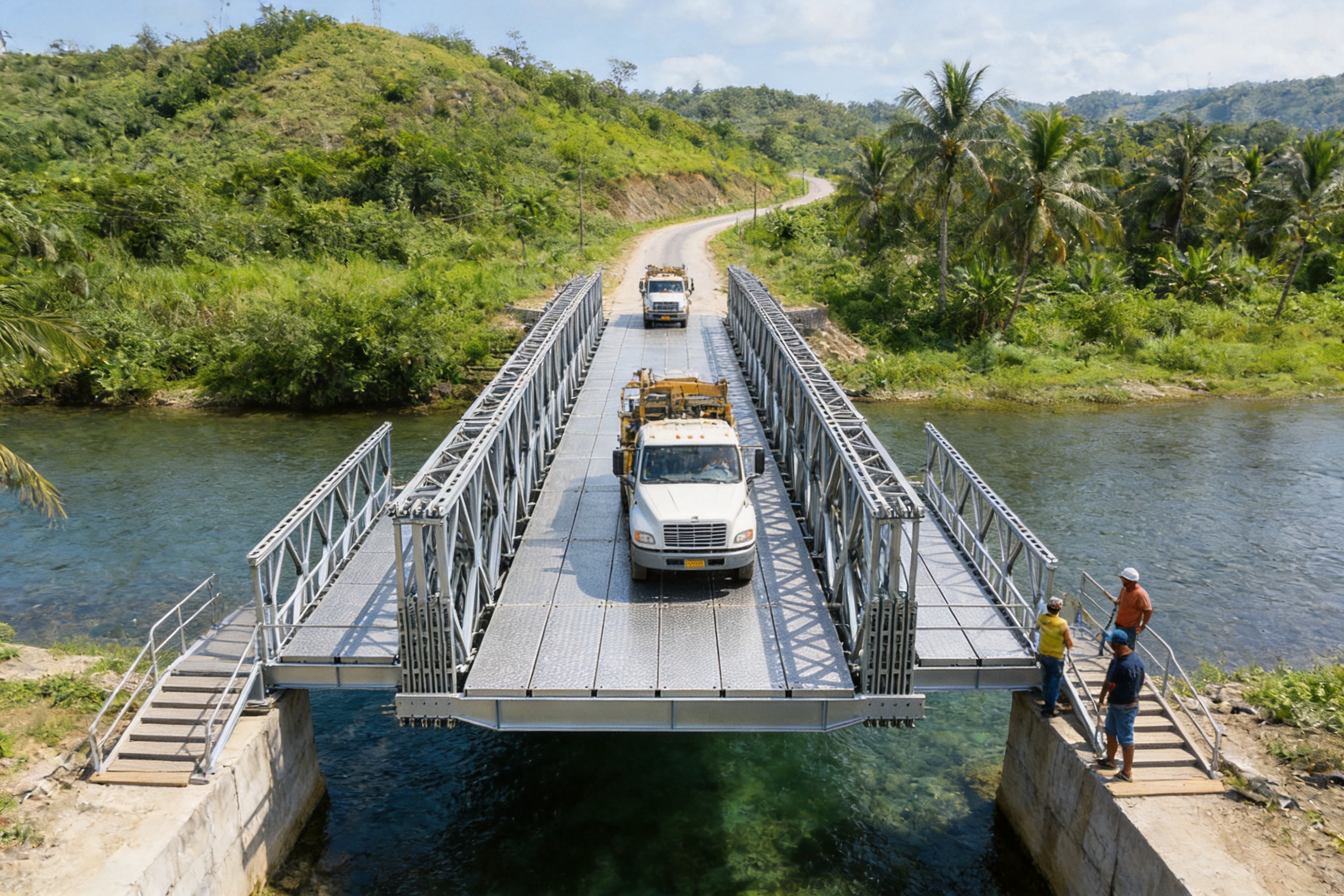
Modern infrastructure projects often require bridge systems that combine structural reliability, rapid installation, flexible configuration, and resistance to demanding environmental conditions. A customized galvanized Bailey bridge can meet these requirements by using standardized modular components that are engineered for efficient transportation, factory inspection, and fast assembly at the project site. This type of bridge is particularly valuable in regions where construction schedules are compressed, access conditions are difficult, or permanent civil works cannot be completed immediately.
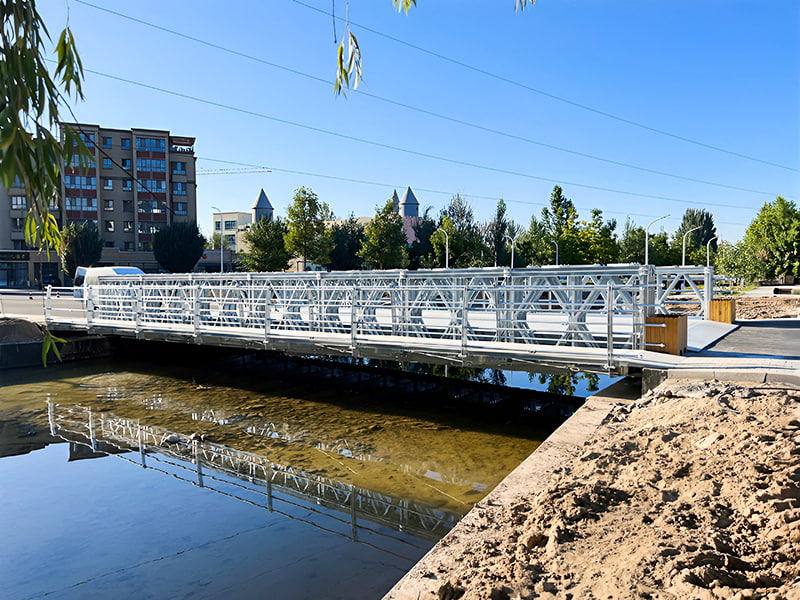
The galvanized customized Bailey bridge developed for a project in Nicaragua demonstrates how a modular steel bridge can be adapted to local geographical conditions, traffic requirements, and environmental factors. The bridge completed full production and factory pre-assembly before shipment. This approach allowed the manufacturer to verify component compatibility, inspect structural connections, identify potential assembly issues, and prepare the bridge for efficient installation after arrival.
Unlike a basic temporary bridge assembled solely from standard stock parts, this project involved customization of the bridge configuration and supporting components. The core Bailey panels, connection elements, fixation parts, and related structural accessories were manufactured through a controlled production process. The result is an engineered bridge package designed to support project-specific requirements while retaining the practical advantages of modular bridge construction.
Hot-dip galvanizing provides an additional layer of protection for steel surfaces. By improving resistance to moisture and corrosion, galvanizing can help extend service life and reduce maintenance requirements in outdoor environments. This is especially important for bridges exposed to rainfall, humidity, changing temperatures, and other factors that can accelerate steel deterioration.
Jiangsu Zhonghai Bridge Equipment Co., Ltd. combines engineering design, steel fabrication, automated welding, quality management, factory pre-assembly, and construction support. Its manufacturing capabilities are focused on modular steel bridges, Bailey bridge systems, customized steel components, and structural products for transportation, water conservancy, military logistics, disaster relief, and international infrastructure projects.
Project Background and Product Purpose
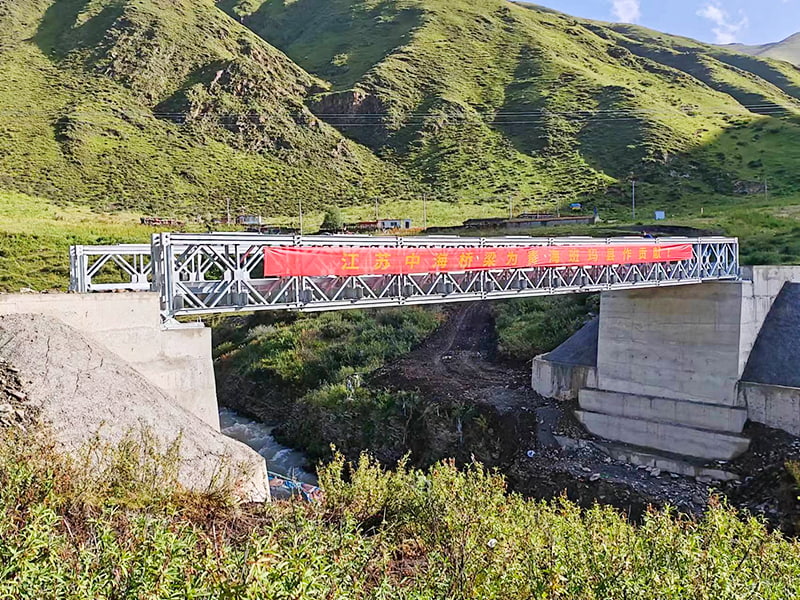
The Nicaragua bridge project was developed to respond to local construction and transportation needs. Nicaragua contains varied terrain, river crossings, rural access routes, and areas where conventional bridge construction may require considerable time and investment. In such circumstances, a modular bridge can provide a practical connection while permanent infrastructure is being developed, or it can serve as a long-term engineered crossing when designed for the required application.
The customized bridge was not treated as a one-size-fits-all product. Its design was based on project conditions, including the anticipated traffic requirements, site characteristics, transportation limitations, and the need for efficient installation. Customization may involve bridge length, width, panel arrangement, deck configuration, support details, connection components, access arrangements, and other structural elements. Each of these factors can influence the overall performance and construction process.
A Bailey bridge is built from prefabricated steel panels and modular accessories. The panels are connected to form the main truss structure, while transoms, stringers, bracing, deck components, bolts, pins, and other parts complete the bridge system. Because the components are manufactured in advance, the project can reduce the amount of cutting, welding, and modification required at the construction site.
For the Nicaragua project, the complete production and pre-assembly process was completed at the factory before shipment. This was an important step because it transformed the bridge from a collection of separate parts into a verified structural package. Factory pre-assembly provides an opportunity to assess whether panels, pins, bolts, bracing, decking, and other components fit as intended before the equipment is transported to the customer.
The primary purpose of this bridge is to provide a dependable and efficient crossing solution. Its modular construction supports rapid deployment, while the customized design helps align the bridge with actual project conditions. Its galvanized surface treatment is intended to improve durability in the local environment, and its pre-assembled manufacturing process is intended to reduce installation uncertainty.
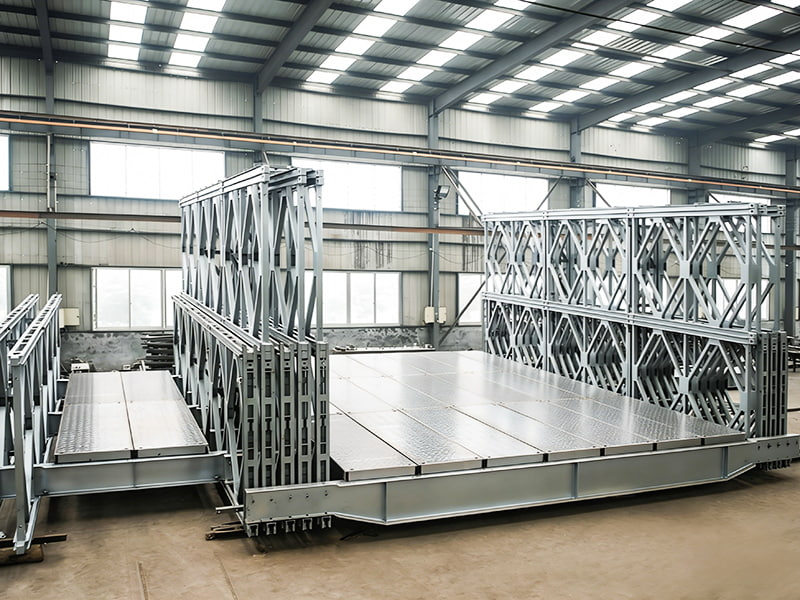
Galvanized Customized Bailey Bridge
Customized Bailey Bridge Design
Customization is one of the most important differences between a general-purpose modular bridge and an engineered bridge package. Standard Bailey bridge components provide a strong foundation for modular construction, but every project has its own requirements. A bridge designed for light pedestrian use will not have the same configuration as a bridge intended for vehicles, construction equipment, emergency traffic, or mixed use.
The customized Nicaragua bridge was designed with attention to geographical conditions and traffic requirements. These factors help determine the bridge’s overall arrangement, structural capacity, deck layout, approach conditions, and installation method. A bridge manufacturer must consider how loads will be transferred through the deck, transoms, panels, bracing, bearings, and foundations. The design must also account for the way the bridge will be transported and assembled.
Important customization considerations may include the following:
- Required crossing length and possible span arrangement.
- Usable bridge width and traffic clearance.
- Expected vehicle, pedestrian, or construction loads.
- Local terrain, riverbanks, access roads, and foundation conditions.
- Transportation dimensions and lifting limitations.
- Assembly sequence and available site equipment.
- Environmental exposure, humidity, rainfall, and corrosion risk.
- Required barriers, handrails, decking, ramps, and safety accessories.
- Future disassembly, relocation, expansion, or reuse requirements.
By reviewing these factors during the engineering stage, the manufacturer can select an appropriate panel arrangement and supporting component package. This helps avoid the problems that can occur when a standard bridge is purchased without sufficient consideration of actual site conditions.
Customization does not eliminate the benefits of standardization. Instead, it combines standardized production with project-specific engineering. The primary Bailey panels and many connection components can be produced using established manufacturing procedures, while the overall arrangement and supporting details are adapted to meet the project requirements. This balance allows the bridge to be both flexible and efficient to manufacture.
A customized modular bridge can also simplify future modifications. If the bridge is designed using compatible modular parts, it may be possible to alter its length, reinforce selected sections, replace damaged components, or relocate the structure, subject to engineering review. This adaptability can provide value for infrastructure programs that must respond to changing traffic demands or emergency conditions.
Standardized Bailey Panels and Supporting Components
The main Bailey panels form the primary truss structure. Each panel is manufactured to a controlled geometry so that multiple units can be connected accurately. The panels transfer loads through the truss system and work together with transoms, bracing, deck elements, and connections to create a stable bridge assembly.
In a modular bridge system, the quality of individual parts is closely related to the quality of the complete structure. A small dimensional deviation in a connection location, pin opening, or bracing interface can make site assembly more difficult. For this reason, production accuracy and inspection are essential. The manufacturer must control material preparation, cutting, welding, drilling, surface treatment, and final verification.
The bridge supplied for Nicaragua included more than the core panels. Various connections, fixation elements, and supporting accessories were also standardized and produced by the manufacturer. This helps improve compatibility because the parts are developed and manufactured as a coordinated system rather than being assembled from unrelated sources.
Typical modular bridge components may include:
- Main Bailey panels for the truss walls.
- Transoms supporting the deck system.
- Stringers distributing deck loads.
- Lateral and vertical bracing members.
- High-strength bolts, pins, and fastening hardware.
- Deck plates, steel decking, or other specified deck materials.
- Bearings and support components.
- Ramps, guardrails, curbs, and pedestrian safety elements where required.
- Temporary erection accessories and construction aids.
The precise component list depends on the bridge design and intended service. A pedestrian bridge may require handrails, anti-slip deck surfaces, and controlled access features. A vehicle bridge may require wheel guards, stronger decking, traffic barriers, and a configuration designed for the expected axle loads. A pipe bridge may require dedicated supports for pipelines, cable trays, or utility services.
Producing the principal components under one manufacturing system also helps improve documentation and traceability. Material records, production drawings, inspection results, and surface treatment information can be organized as part of the project package. This can make it easier for the customer and construction team to verify what has been delivered.
Advanced Manufacturing Process
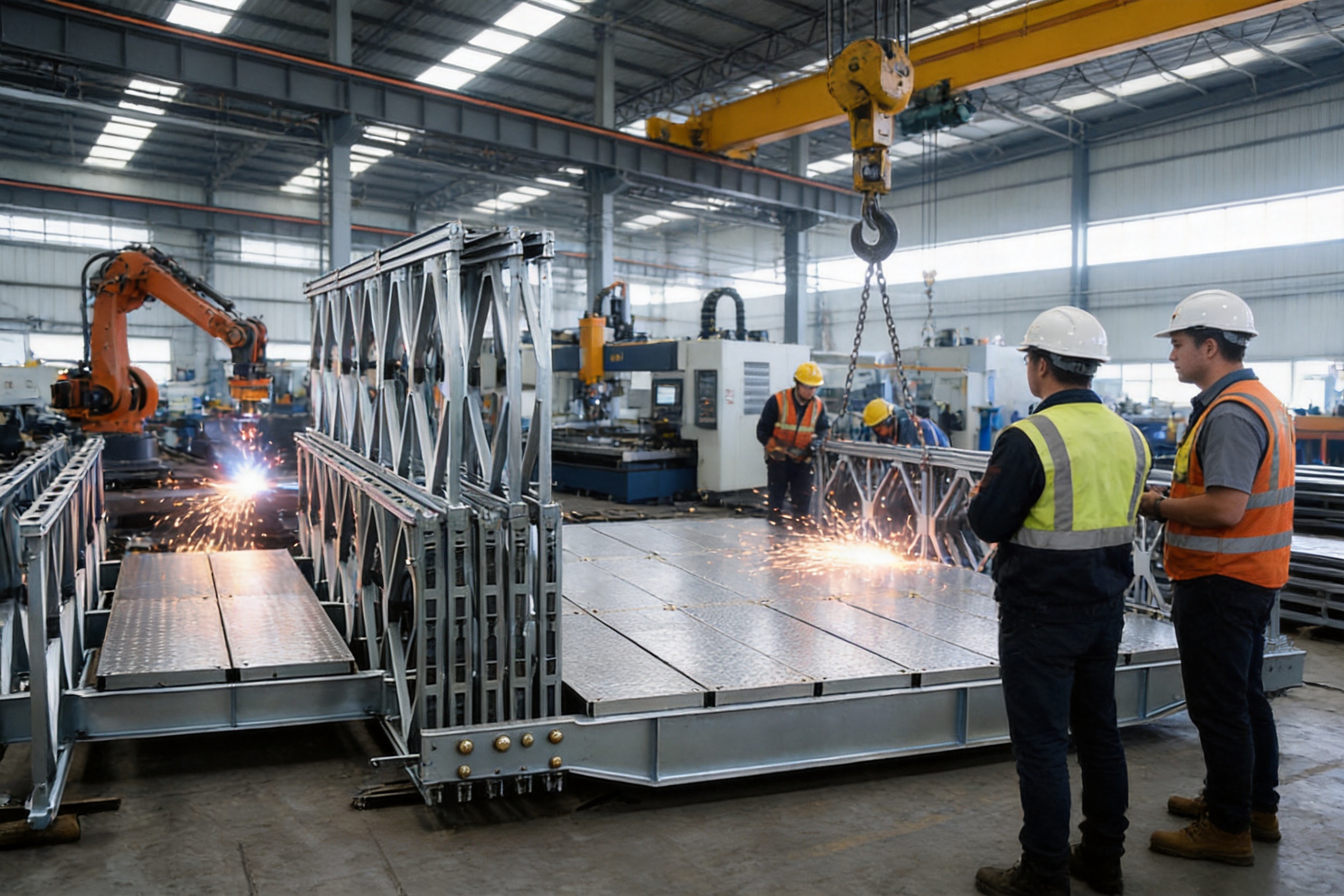
The manufacturing process for a customized galvanized Bailey bridge begins with engineering review and raw material selection. Before fabrication starts, the project requirements are translated into production drawings, component lists, connection details, and inspection criteria. This planning stage helps ensure that the bridge can be manufactured accurately and assembled efficiently.
Raw Material Selection
Steel quality has a direct influence on structural performance, fabrication behavior, and service life. The manufacturer selects appropriate steel materials according to the design requirements and applicable specifications. Material identification and inspection help confirm that the steel supplied for panels, beams, bracing, and accessories is suitable for its intended purpose.
Raw material control may include dimensional checks, identification marking, documentation review, and inspection of visible defects. Proper storage is also important. Steel parts should be protected from unnecessary contamination, deformation, or damage before they enter the production line.
Precision Cutting and Preparation
After material approval, steel plates, sections, and other elements are cut and prepared according to approved drawings. Accurate cutting supports the dimensional consistency of the finished components. Edge preparation, hole positioning, and part identification must be controlled because these details influence welding quality and assembly compatibility.
For modular bridge components, repeated production accuracy is especially important. Bailey panels are designed to connect with other panels, so the location of connection points must remain consistent from one unit to the next. Controlled preparation helps reduce adjustment work during assembly.
Automated and Controlled Welding
Welding is a key manufacturing operation for steel bridge components. Zhonghai’s factory uses automated welding and standardized workflows to improve consistency in appropriate fabrication operations. Controlled welding can help reduce variation in weld size, alignment, and appearance while supporting repeatable production.
Welding procedures must be selected according to the steel material, joint design, component thickness, and applicable quality requirements. Operators and technicians need to manage parameters such as heat input, sequence, pre-cleaning, and distortion control. Welding quality also depends on accurate fit-up before the weld is made.
After welding, components may be checked for dimensional accuracy, deformation, surface defects, and other indications that could affect performance. Depending on project requirements, inspection can include visual examination, dimensional measurement, and additional non-destructive testing for specified welds.
Drilling, Assembly Fitting, and Component Verification
Connection holes and interfaces must be manufactured accurately so that pins and bolts can be installed without excessive force or unplanned modification. Factory fitting checks help confirm that the parts align correctly. This is one of the advantages of producing and pre-assembling the bridge in a controlled factory environment.
Components may be marked according to drawings and assembly sequences. Clear identification is useful when the bridge arrives at the construction site in multiple containers or packages. It can reduce the risk of mixing similar parts and support a more efficient erection process.
Surface Preparation and Hot-Dip Galvanizing
After fabrication and inspection, the steel components undergo surface preparation before galvanizing. The preparation process removes contaminants and prepares the steel surface to receive a zinc coating. Proper preparation is essential because coating adhesion and uniformity depend on the condition of the steel before immersion.
Hot-dip galvanizing immerses prepared steel components in molten zinc. The process creates a metallurgically bonded zinc coating that protects the underlying steel from atmospheric corrosion. The coating can provide both barrier protection and sacrificial protection. If the steel surface is exposed at a small damaged area, the surrounding zinc can help protect the steel through electrochemical action.
Galvanizing is particularly useful for bridge components because bridges are exposed to weather throughout their service life. Rainwater, humidity, condensation, airborne contaminants, and fluctuating temperatures can contribute to corrosion. A properly applied galvanized coating can slow this process and reduce the frequency of repainting or other surface maintenance.
For the Nicaragua project, professional hot-dip galvanizing was applied to improve the bridge’s corrosion resistance and suitability for the local environment. Galvanizing does not replace sound design, drainage, inspection, or maintenance, but it provides an important protective layer within the overall durability strategy.
Final Inspection and Packaging
After galvanizing, the components are inspected for coating condition, dimensions, identification, and general conformity. Any areas requiring repair or additional attention are reviewed before shipment. Packaging must protect the parts during handling and transportation while keeping the components organized for site assembly.
Heavy bridge components require careful loading plans. The package should consider lifting points, weight distribution, container or truck capacity, component identification, and unloading sequence. Good packaging and logistics planning can reduce the risk of damage and simplify the transition from transportation to installation.
Factory Pre-Assembly and Quality Verification
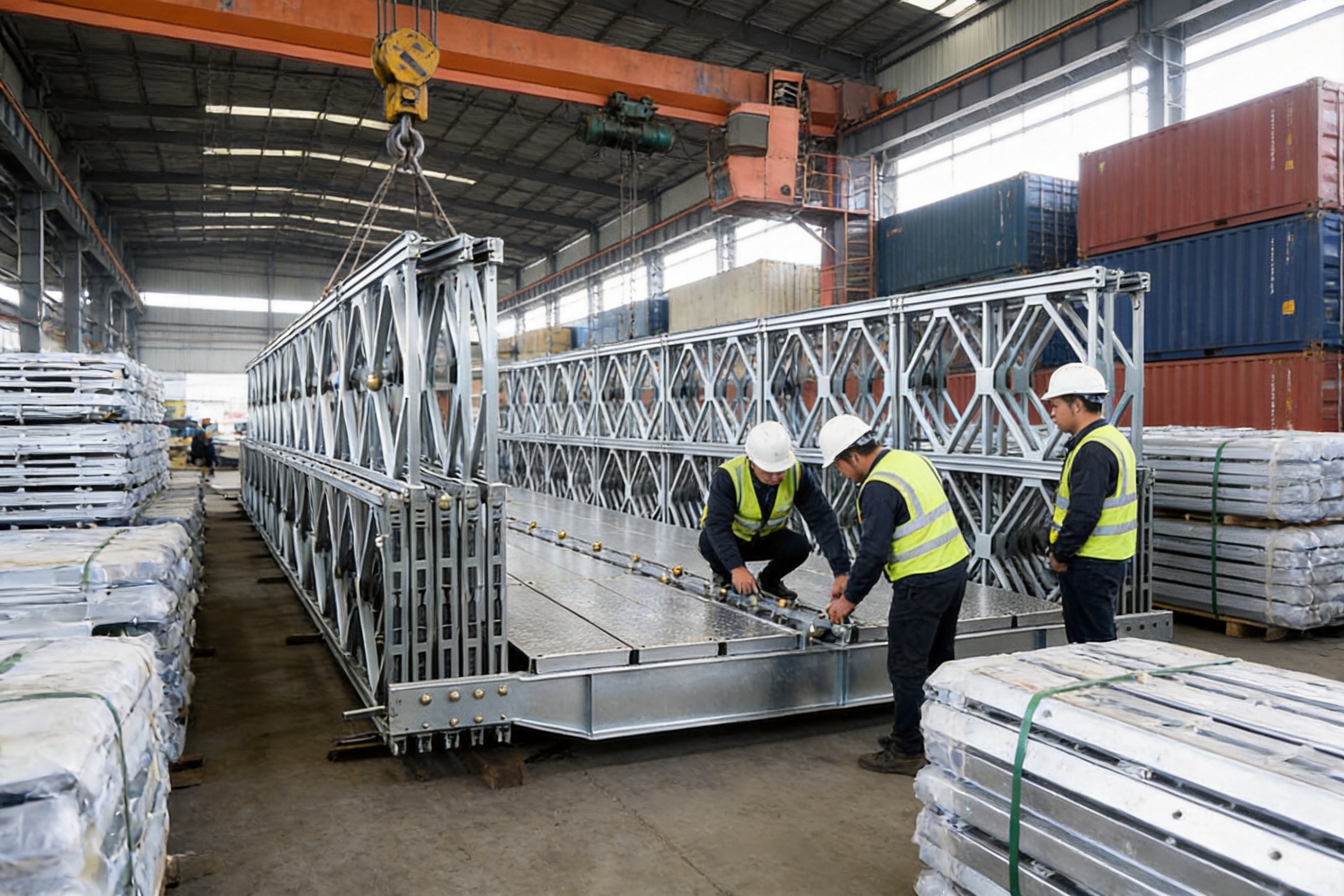
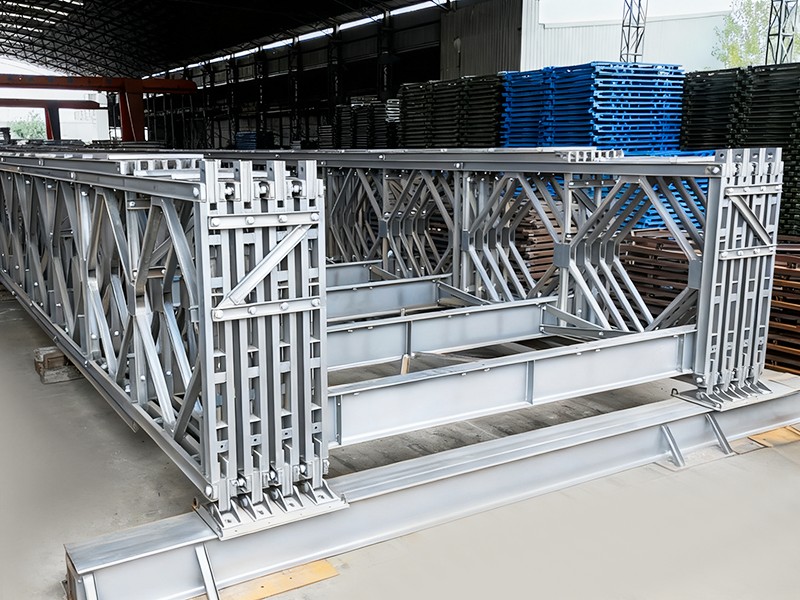
Factory pre-assembly was a major feature of the Nicaragua bridge project. Instead of shipping the components without a full fit-up check, the manufacturer assembled the bridge at the factory before disassembly and shipment. This process allowed the team to review the relationship between the main panels, connections, fixation elements, deck components, and supporting structures.
Pre-assembly can reveal issues that may not be obvious when parts are inspected individually. For example, a component may meet its individual drawing dimensions but still require adjustment if several interfaces accumulate small tolerances. A factory assembly makes these relationships visible before the bridge reaches the site.
The pre-assembly process may include the following activities:
- Arranging panels and structural parts according to the approved assembly sequence.
- Installing pins, bolts, bracing, transoms, and other connections.
- Checking alignment and fit between adjacent components.
- Reviewing deck support positions and accessory interfaces.
- Confirming the identification and quantity of delivered parts.
- Assessing structural stability during the temporary factory assembly.
- Recording corrections or adjustments before final packing.
Pre-assembly does not replace site-specific foundation checks or final installation inspections. However, it reduces the number of unknowns that the construction team must manage at the project location. The factory can provide better access to tools, lifting equipment, technicians, and controlled working conditions than may be available in a remote or difficult site environment.
When a bridge is assembled for the first time at the project site, any mismatch can interrupt the construction schedule. Workers may need to wait for replacement parts, modify components, or seek engineering clarification. These interruptions can be costly when access is limited or when the bridge is required for emergency transportation. Factory pre-assembly helps reduce this risk by identifying potential problems earlier.
The process also supports communication between the manufacturer and customer. Assembly observations can be used to clarify installation instructions, confirm component numbering, and prepare the erection team for the actual sequence. This is especially useful for international projects where the bridge is manufactured in one country and installed by a team in another.
Advantages Compared with Conventional Bridge Construction
A customized galvanized Bailey bridge offers several advantages compared with conventional cast-in-place or heavily site-fabricated bridge solutions. The correct choice depends on span, load, foundation conditions, design life, local regulations, and project objectives. Nevertheless, modular steel bridges are often attractive when speed, adaptability, and transportation efficiency are important.
Rapid Construction
Most of the structural components are manufactured before they reach the project site. This can shorten the amount of site fabrication required. Once foundations and supports are ready, the bridge can be assembled using a planned sequence rather than being constructed entirely from raw materials at the crossing.
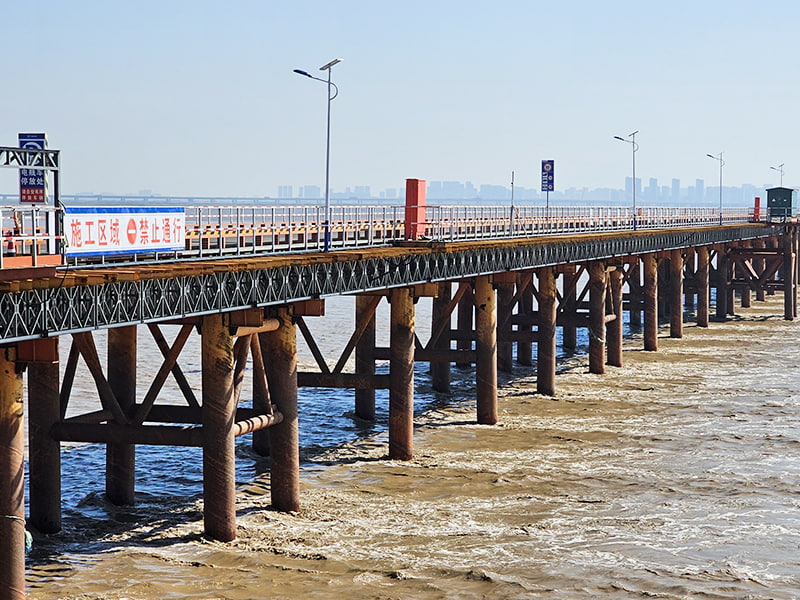
Rapid installation can be particularly valuable for restoring access after floods, landslides, earthquakes, or other events. It can also support temporary construction routes, agricultural transportation, industrial access, and project logistics.
Reduced Site Labor and Equipment Requirements
Because the components are prefabricated, the site may require fewer fabrication operations than a conventional steel structure. This can reduce the need for extensive welding equipment, cutting facilities, and large fabrication yards at the crossing. The exact equipment requirement depends on bridge size and erection method, but modular construction generally moves more work into a controlled factory environment.
Adaptability and Reusability
Modular bridge components can be configured for different lengths and arrangements within engineering limits. Some systems can be dismantled and reused at another location. This is useful for temporary roads, emergency response programs, construction access, and infrastructure owners that need flexible bridge assets.
Predictable Component Quality
Factory production allows materials, welding procedures, dimensions, and surface treatment to be managed under repeatable conditions. The manufacturer can inspect components before shipment and pre-assemble the structure. This is generally more predictable than performing all fabrication in an uncontrolled outdoor environment.
Lower Environmental Disruption During Installation
A shorter site construction period can reduce the duration of disturbance around rivers, roads, communities, and sensitive areas. Modular assembly may also limit the amount of heavy construction activity required at the crossing. Environmental requirements still need to be addressed through proper planning, but the prefabricated approach can support a more efficient installation footprint.
Improved Corrosion Protection
Hot-dip galvanizing provides a durable zinc coating over exposed steel surfaces. Compared with unprotected painted steel, galvanized steel can offer a more robust first line of defense against atmospheric exposure. The coating is applied before shipment, so the protection is integrated into the manufactured components rather than relying only on field-applied treatment.
Advantages Compared with Basic Standard Bridge Packages
Not all modular bridges provide the same level of engineering and manufacturing support. A basic standard package may supply common panels and hardware, but a project may still require design adaptation, component coordination, pre-assembly, surface protection, and technical documentation.
The Nicaragua bridge project illustrates several areas where a customized, factory-verified package can offer an advantage over an off-the-shelf product:
| Project consideration | Basic standard package | Customized galvanized bridge approach |
|---|---|---|
| Design basis | Primarily based on general standard configurations | Adapted to project geography, traffic requirements, and installation conditions |
| Component supply | May rely on separately sourced accessories | Core panels, connections, fixations, and supporting components coordinated by one manufacturer |
| Surface protection | May use basic paint or require site treatment | Professional hot-dip galvanizing completed as part of the factory process |
| Assembly verification | May be performed for the first time at the site | Full factory pre-assembly completed before shipment |
| Site installation | More uncertainty about fit and component sequence | Improved preparation through factory fit-up and component identification |
| Long-term flexibility | May be limited by configuration and documentation | Modular arrangement can support future adjustment or relocation subject to engineering review |
| Technical coordination | Customer may coordinate multiple suppliers | Design, fabrication, inspection, and support are integrated through one bridge specialist |
The table does not mean that every standard bridge package is unsuitable. Standard systems can be effective when the site and loading conditions closely match the available configuration. The advantage of customization is that it gives the project team greater control over fit, performance, installation, and durability.
Corrosion Resistance and Environmental Suitability
Steel bridge durability depends on design, material quality, drainage, coating protection, inspection, maintenance, and local exposure. Galvanizing addresses one of the most important factors: corrosion of exposed steel surfaces.
Hot-dip galvanized components receive a zinc coating that is bonded to the steel through a controlled metallurgical process. The coating acts as a physical barrier between the steel and the atmosphere. Zinc also provides sacrificial protection, meaning it can corrode preferentially to exposed steel in certain conditions.
For a bridge operating in a humid or rainy environment, this protection can be valuable. Water may collect around joints, deck components, or areas with limited ventilation if drainage is not properly designed. Galvanized surfaces help improve resistance, but the bridge still needs appropriate detailing to prevent long-term water retention and accumulation of debris.
Regular inspection should examine areas such as connection zones, deck interfaces, bearing regions, drainage paths, impact points, and locations where the coating may have been damaged during transportation or installation. If damage occurs, the affected area should be repaired in accordance with an approved repair procedure.
Galvanizing is also beneficial because it can reduce the frequency of repainting compared with conventional protective systems. Reduced maintenance can be especially important for bridges in remote locations where access, labor, and materials are more expensive. Lower maintenance demand may also reduce traffic closures and interruptions to local users.
Environmental suitability should always be evaluated as part of the complete engineering design. Factors such as marine atmosphere, industrial pollutants, water chemistry, soil conditions, abrasion, and contact with dissimilar metals may influence coating performance. A qualified engineer should confirm whether additional protection or special detailing is needed for a particular site.
Manufacturing Strengths of Jiangsu Zhonghai Bridge Equipment Co., Ltd.
Jiangsu Zhonghai Bridge Equipment Co., Ltd. is based in Zhenjiang, Jiangsu Province, an important industrial and transportation area in China. The company integrates engineering design, precision manufacturing, quality management, and project support for modular bridges and structural steel products.
Its production capabilities include modular steel bridges, Bailey bridge systems, customized steel components, bridge erection and construction support equipment, automated welding, and precision steel fabrication. This combination allows the company to serve customers that need more than individual steel parts. It can support the development of a coordinated bridge solution from technical review through production and shipment.
The company’s factory uses standardized workflows and advanced production methods for high-strength modular bridge systems. Standardization supports repeatable quality, while engineering customization allows bridge packages to be adapted to individual project needs. This combination is important for international customers because it can provide both product consistency and design flexibility.
Quality control begins with raw material selection and continues through cutting, welding, drilling, assembly fitting, galvanizing, inspection, packaging, and shipment. Maintaining control throughout the process helps reduce the possibility that quality problems will be discovered only after the components arrive at the job site.
The company also has experience serving transportation, water conservancy, military logistics, disaster relief, and international development projects. These applications often require dependable delivery, clear component organization, and practical construction support. They may also involve remote locations, urgent schedules, and difficult access conditions, all of which reinforce the value of modular bridge technology.
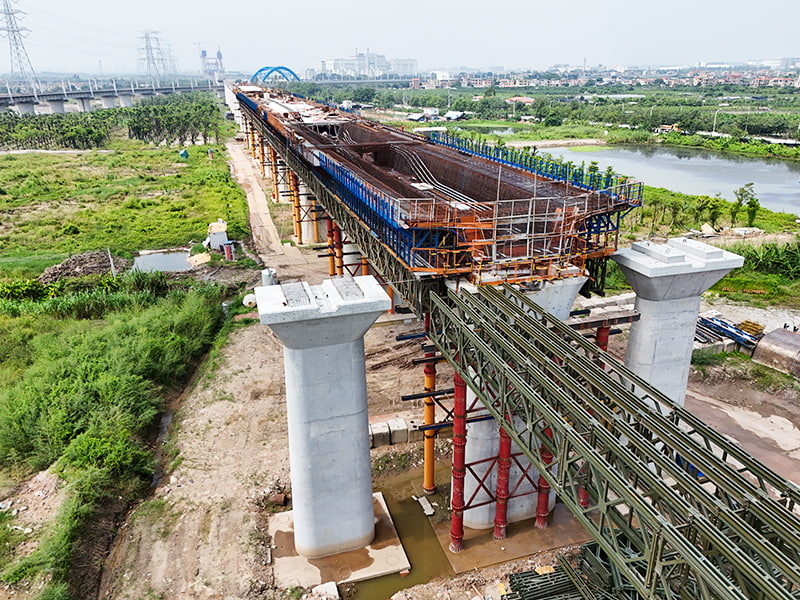
Reported project experience includes coastal engineering in the Maldives, temporary access bridges for the Shenzhen–Zhongshan Corridor, structural components for the Hangzhou Expo Center, multi-span Bailey bridges for the Lalin Railway, and flood-response and emergency bridge deployments in multiple regions. These examples reflect the company’s involvement in different bridge and structural steel applications.
For international customers, manufacturing strength also includes communication and delivery coordination. Bridge projects require accurate drawings, component schedules, packing lists, inspection documents, and installation guidance. A manufacturer that can coordinate these documents with production and shipment can help reduce confusion during overseas construction.
Installation and Construction Efficiency
The installation process for a Bailey bridge should be planned before the components leave the factory. The site team needs to understand the bridge arrangement, foundation readiness, lifting or launching method, component sequence, temporary supports, and safety controls.
Factory pre-assembly supports this preparation by confirming how the bridge components fit together. After pre-assembly, the bridge is disassembled, marked, packaged, and shipped. At the site, the erection team can follow the verified sequence and use the component identification system to reconstruct the bridge.
Typical construction planning may include the following stages:
- Confirming site survey information and foundation or abutment readiness.
- Checking delivered components against the packing list.
- Organizing parts near the installation area without obstructing access.
- Reviewing the assembly drawings and safety procedures.
- Installing supports, bearings, temporary works, and initial structural components.
- Connecting Bailey panels, transoms, bracing, and other structural members.
- Installing the deck, curbs, handrails, barriers, ramps, and accessories.
- Conducting dimensional, connection, and safety inspections.
- Completing any required load testing or approval procedures.
- Opening the bridge for service only after authorization by the responsible engineer.
The exact erection method may vary. Bridges can be assembled and launched from one side, lifted into position in sections, or erected using cranes and temporary supports. The method must be selected according to span length, terrain, water conditions, equipment availability, and local safety requirements.
A modular bridge can reduce construction time, but rapid assembly must not be confused with informal assembly. Every pin, bolt, brace, deck connection, and support must be installed according to the approved design. Temporary erection conditions may produce different structural forces from those experienced during normal service, so the construction sequence requires professional review.
Quality Management and Documentation
Quality management is most effective when it is integrated into every production stage rather than limited to final inspection. For a customized galvanized Bailey bridge, quality records may cover material certificates, welding procedures, inspection reports, dimensional checks, galvanizing records, pre-assembly observations, packaging lists, and shipment documentation.
Traceability helps connect each component to its production information. Marking parts according to drawings can also support assembly accuracy and future maintenance. If a component needs replacement or inspection later, identification records make it easier to determine the correct part.
Engineering documents should clearly define the bridge configuration, design assumptions, component arrangement, connection details, deck requirements, support conditions, and installation limitations. The customer’s local engineer may need to review the design for compliance with local codes, traffic regulations, foundation requirements, and approval procedures.
Applicable standards may differ between projects. Zhonghai’s company information indicates that its factory produces systems intended to comply with ASTM, EN, and national specifications, depending on project requirements. The specific standard basis should be confirmed during contract and engineering review rather than assumed automatically.
Documentation is also important for future maintenance. The owner should retain as-built drawings, galvanizing information, inspection records, replacement part information, and maintenance recommendations. A modular bridge can provide long-term value when its documentation remains available throughout its service life.
Applications for Customized Galvanized Bailey Bridges
Although the Nicaragua bridge was developed for a specific local project, the same product approach can be applied to many infrastructure situations.
Temporary Access Bridges
Construction projects often need temporary crossings for workers, equipment, materials, and service vehicles. A modular bridge can provide access while a permanent bridge is under construction or while other civil works are being completed.
Emergency and Disaster Response
Floods, earthquakes, landslides, and storms can damage roads and bridges. A rapidly deployable Bailey bridge can restore movement for emergency services, relief supplies, agricultural communities, and local residents. Galvanizing is useful when the bridge may remain in service for an extended recovery period.
Rural and Community Connections
In rural regions, a bridge may connect communities to schools, markets, medical facilities, farms, or transportation routes. Modular construction can be practical where conventional construction resources are limited or where the project must be completed in stages.
Industrial and Mining Access
Industrial facilities, quarries, mines, and energy projects may require temporary or permanent crossings for vehicles, pipelines, conveyors, and utilities. Customized support structures can be designed to meet the specific access and loading requirements of the site.
Pedestrian Bridges
Bailey-type modular technology can also be adapted for pedestrian crossings. In such applications, the design may include handrails, anti-slip decking, lighting interfaces, controlled entry, and accessibility features. The bridge must be designed for pedestrian loads and local safety regulations.
Modular Pipe Bridges
A modular truss arrangement can support pipelines, cable trays, or utility services across rivers, roads, and uneven terrain. The support system must be customized for pipe weight, thermal movement, maintenance access, wind effects, and service requirements.
Buying Considerations for International Projects
Customers evaluating a Bailey bridge supplier should consider more than the initial price of steel components. The total value of the bridge depends on engineering suitability, manufacturing accuracy, coating quality, shipping efficiency, installation support, and long-term maintenance.
Important questions include:
- Can the supplier customize the bridge for the required span, width, and traffic load?
- Are the main panels and supporting accessories manufactured as a coordinated system?
- What steel grades and manufacturing standards will be used?
- Is hot-dip galvanizing available, and how will coating quality be verified?
- Will the bridge be pre-assembled before shipment?
- How will components be marked and packed for site installation?
- What drawings, inspection documents, and installation instructions will be provided?
- Can the supplier support international delivery and technical coordination?
- What replacement parts and maintenance assistance are available?
- Has the supplier completed comparable modular bridge or structural steel projects?
A reliable supplier should be willing to review the site conditions and intended use before recommending a configuration. The customer should provide as much information as possible about span, width, loading, traffic type, foundation conditions, environmental exposure, construction equipment, delivery route, and desired service life.
Price comparisons should also account for the difference between a complete engineered bridge package and a shipment of unverified components. Factory pre-assembly, galvanizing, inspection, documentation, and technical coordination may increase the initial purchase scope, but they can reduce site uncertainty and future maintenance risks.
Maintenance and Service Life
Even a galvanized steel bridge requires inspection and maintenance. The owner should establish a schedule based on traffic, environmental exposure, bridge importance, and local regulations. Inspections should be more frequent after unusual events such as floods, collisions, excessive loads, or severe storms.
Inspection personnel should review the main panels, connection pins, bolts, bracing, deck, barriers, bearings, supports, foundations, and drainage paths. They should look for deformation, loosened connections, cracking, impact damage, coating damage, unusual movement, corrosion deposits, and accumulation of soil or debris.
Galvanized surfaces should not be covered by persistent mud, standing water, or aggressive deposits. Cleaning methods should avoid damaging the zinc coating. Where mechanical damage exposes the steel, the area should be cleaned and repaired using a compatible zinc-rich repair system or another method approved by the responsible engineer.
Deck components may experience wear more quickly than the main truss panels because they are directly exposed to traffic, abrasion, water, and de-icing or maintenance materials. Deck inspection and timely replacement of worn parts can help protect the rest of the bridge system.
Connections should be checked according to the design and maintenance instructions. Bolts, pins, and retaining devices must remain correctly installed. Any replacement must use components with appropriate dimensions, strength, and compatibility. Unauthorized drilling, cutting, welding, or modification can affect the structural performance and should not be carried out without engineering approval.
Why This Product Is a Practical Global Bridge Solution
The galvanized customized Bailey bridge combines several features that are valuable for international infrastructure projects. Its modular design supports efficient transportation and assembly. Its customized configuration addresses local project conditions. Its factory production improves component consistency. Its hot-dip galvanized finish enhances corrosion resistance. Its full factory pre-assembly helps identify fit-up issues before shipment.
These advantages are reinforced when the bridge is supplied by a manufacturer capable of managing engineering, fabrication, quality control, galvanizing, packaging, and project coordination as one integrated process. This reduces dependence on multiple suppliers and can simplify communication from design approval through installation.
The product is also adaptable. It can serve vehicle crossings, pedestrian routes, construction access, emergency response, water conservancy projects, industrial facilities, and utility crossings. The specific bridge configuration must be designed for the intended use, but the modular platform provides a practical starting point for many project types.
For the Nicaragua project, the bridge was produced and pre-assembled before shipment, demonstrating a manufacturing philosophy centered on preparation and verification. Rather than leaving assembly uncertainty entirely to the site team, the manufacturer completed critical fit-up work in the factory. This approach can improve construction efficiency and support a more predictable delivery process.
As infrastructure demands continue to grow, bridge owners need solutions that can be delivered efficiently without compromising structural quality. A customized galvanized Bailey bridge can provide a balanced response by combining engineered performance, modular construction, corrosion protection, and practical installation support.
Questions and Answers
What is a customized Bailey bridge?
A customized Bailey bridge is a modular steel bridge designed or configured for specific project requirements rather than supplied only as a general standard arrangement. Customization may address span length, width, loading, panel configuration, deck system, supports, barriers, accessories, transportation limits, and installation conditions.
Why was the Nicaragua bridge pre-assembled at the factory?
Factory pre-assembly was completed to verify structural stability, component compatibility, connection accuracy, and assembly sequence before shipment. It also helped identify potential issues in a controlled environment, reducing the risk of unexpected fitting problems at the project site.
What is the purpose of hot-dip galvanizing?
Hot-dip galvanizing applies a zinc coating to steel components through immersion in molten zinc. The coating provides barrier protection and sacrificial protection, helping reduce atmospheric corrosion and improve the durability of the bridge in outdoor environments.
Is galvanizing a substitute for maintenance?
No. Galvanizing improves corrosion resistance but does not eliminate the need for inspection, cleaning, connection checks, deck maintenance, drainage management, and repair of mechanical or coating damage.
Can a Bailey bridge be used as a permanent bridge?
Some Bailey bridge systems can be used for long-term or permanent applications when they are properly designed, manufactured, installed, inspected, and maintained for the intended loads and environmental conditions. The suitability of a particular bridge must be confirmed by qualified engineers and the relevant authorities.
Can the bridge support vehicles?
A Bailey bridge can be designed for vehicle traffic, but its allowable load, vehicle type, lane width, and operating conditions depend on the engineering design. Customers should provide complete traffic and loading information before production begins.
Can the bridge be used for pedestrians?
Yes, modular bridge systems can be configured for pedestrian applications. The design may require handrails, anti-slip decking, accessibility provisions, lighting interfaces, and other safety features in accordance with local requirements.
What components are included besides Bailey panels?
A complete bridge package may include transoms, stringers, bracing, pins, bolts, fixation elements, decking, bearings, barriers, handrails, ramps, curbs, and erection accessories. The exact list depends on the design and intended use.
What standards can be applied to the bridge?
The applicable standards depend on the customer’s country, project owner, traffic requirements, and approval process. The manufacturer’s company information indicates production capability for systems based on ASTM, EN, and national specifications. The specific standard basis should be agreed during engineering review.
How does factory pre-assembly improve installation efficiency?
Pre-assembly verifies how the components fit together before shipment. It also supports clearer component identification, better packing, more accurate installation instructions, and reduced uncertainty for the site team. It does not eliminate the need for professional site inspection and correct foundation preparation.
What information should a customer provide when requesting a quotation?
The customer should provide the required span, bridge width, traffic type, design load, site location, geographical conditions, environmental exposure, foundation information, desired service life, installation method, delivery requirements, and any applicable local standards or authority requirements.
Can the bridge be relocated or reused?
Many modular bridge systems can be dismantled, transported, and reassembled at another location, subject to engineering review. Reuse depends on the condition of the components, the new span and loading requirements, the connection system, and the suitability of the foundations and site conditions.
Conclusion
The galvanized customized Bailey bridge produced for Nicaragua represents a complete modular bridge solution rather than a simple collection of steel panels. It combines project-specific design, standardized component manufacturing, controlled welding, professional hot-dip galvanizing, factory pre-assembly, quality inspection, and organized shipment.
Its main advantages include rapid construction, flexible configuration, improved corrosion resistance, reduced site fabrication, coordinated component supply, and better installation preparation. These features can provide meaningful value when a project requires a reliable crossing under difficult geographical, environmental, or scheduling conditions.
Jiangsu Zhonghai Bridge Equipment Co., Ltd. supports this product through integrated engineering and manufacturing capabilities. Its experience in modular steel bridges, Bailey bridge systems, precision steel fabrication, automated welding, structural components, and international infrastructure projects provides a foundation for serving customers that require customized and dependable bridge solutions.
For project owners, contractors, government agencies, and infrastructure developers, the key benefit is the integration of flexibility and control. The bridge can be adapted to local requirements while still using standardized modular technology. Factory pre-assembly reduces uncertainty, galvanizing supports durability, and professional manufacturing helps ensure that the delivered structure is prepared for efficient site construction.
When properly designed, installed, inspected, and maintained, a galvanized customized Bailey bridge can help communities and project teams build safer, faster, and more efficient connections.
References
1. Project information supplied for the customized galvanized Bailey bridge produced for Nicaragua.
2. Company profile and manufacturing information supplied by Jiangsu Zhonghai Bridge Equipment Co., Ltd.
3. General engineering principles for modular steel bridge design, fabrication, erection, inspection, and maintenance.
4. General technical guidance for hot-dip galvanized steel structures and corrosion protection.
5. General practices for prefabricated steel fabrication, welding quality control, dimensional inspection, and factory pre-assembly.
6. General principles for temporary, emergency, pedestrian, vehicle, and utility bridge planning.
Product: Galvanized Customized Bailey Bridge

We respond quickly to all international requests and provide technical support when needed.
Product Category
Bailey Bridge/Modular Bridge Modular Steel Bridge Pedestrian Bridge Modular Pipe Bridge Truss Bridge Steel StructureContact Us

+86-511-84522866
+86-13921582699

zhwm@zjql.com

Building 1,83#, dantu New Town, Yanjiang Road, Dantu District, Zhenjiang, Jiangsu, China
Copyright © Jiangsu Zhonghai Bridge Equipment Co., Ltd. All
Rights
Reserved
China bailey bridge for sale
bailey bridge supplier from china
