
 English
 русский
 Español
 Português


Luo Shiqing — Product After-Sales Service Supervisor
Customized Large-Span 900-Ton Super Bailey Construction Support for High-Speed Rail Projects
Content
- 1 1. The Role of Heavy-Duty Construction Support in Bridge Engineering
- 2 2. Product Overview
- 3 3. Large-Span Capability and 900-Ton Load Performance
- 4 4. Compliance with Recognized Load Design Standards
- 5 5. Customized Engineering for Complex Projects
- 6 6. Modular Assembly and High Erection Efficiency
- 7 7. Advanced Manufacturing Processes
- 8 8. Advantages Compared with Conventional Temporary Supports
- 8.1 8.1 Higher Capacity for Heavy Construction Loads
- 8.2 8.2 Greater Span and Working Clearance
- 8.3 8.3 Faster Assembly than Site-Built Steelwork
- 8.4 8.4 Better Adaptability than Fixed Temporary Frames
- 8.5 8.5 Easier Transportation and Storage
- 8.6 8.6 More Consistent Quality
- 8.7 8.7 Reusability and Lifecycle Value
- 9 9. Application in the Guangdong Zhuliao High-Speed Rail Project
- 10 10. Construction Safety and Structural Reliability
- 11 11. Installation and Erection Sequence
- 12 12. Logistics, Transportation, and Site Management
- 13 13. Manufacturing Strengths of the Supplier
- 14 14. International Standards and Export-Oriented Production
- 15 15. Economic and Lifecycle Benefits
- 16 16. Selecting the Correct Configuration
- 17 17. Quality Assurance from Factory to Site
- 18 18. Frequently Asked Questions
- 18.1 What is a Super Bailey Construction Support system?
- 18.2 What is the maximum load capacity of this product?
- 18.3 Is the system suitable for high-speed rail bridge construction?
- 18.4 Can the support system be customized?
- 18.5 Which load design standards can be considered?
- 18.6 How does the system compare with ordinary scaffolding?
- 18.7 Does modular assembly reduce construction time?
- 18.8 Can the system be reused?
- 18.9 What manufacturing processes support product quality?
- 18.10 What information should a customer provide for a quotation?
- 18.11 Does a 900-ton rating mean the system can carry 900 tons in every configuration?
- 18.12 Can the manufacturer provide technical support?
- 19 19. Why This Product Is a Strong Choice for Large Infrastructure
- 20 20. Conclusion
- 21 References
- 22 Product: Customized Large Span 900 Ton Load Super Bailey Construction Support
Modern bridge construction increasingly depends on temporary and semi-permanent support systems that can carry exceptional loads while maintaining precise geometry, fast installation, and dependable performance under demanding site conditions. As bridge spans become longer and construction methods become more sophisticated, ordinary temporary supports may no longer provide the required combination of load capacity, flexibility, erection speed, and safety. The customized large-span 900-ton Super Bailey Construction Support has been developed to address these challenges in major infrastructure projects, particularly high-speed rail bridge construction.
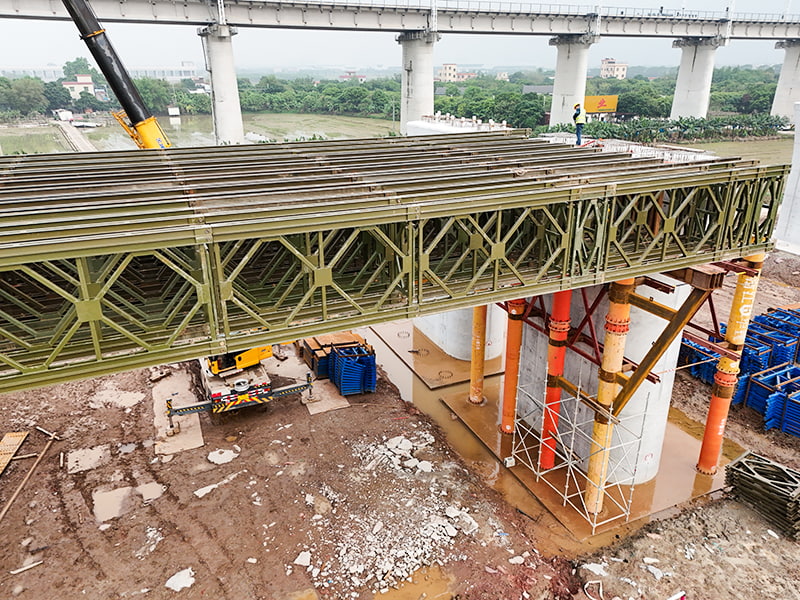
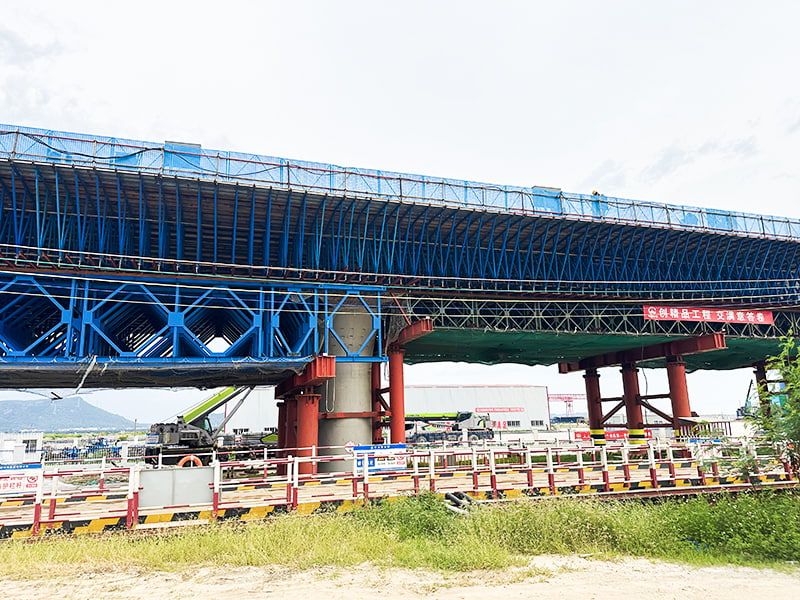
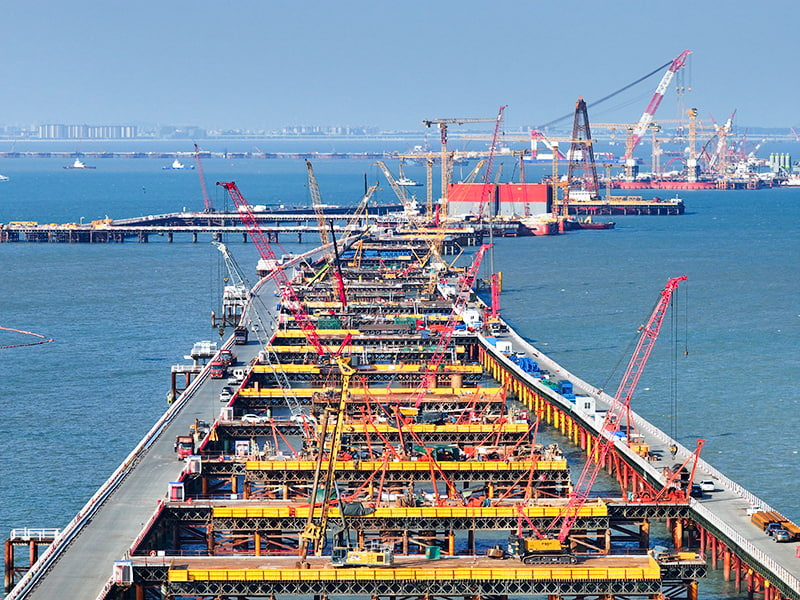
This advanced support system was officially adopted for the Guangdong Zhuliao High-speed Rail Project. With a maximum load capacity of up to 900 tons, it is designed for heavy-duty construction operations involving large spans, substantial temporary loads, and strict structural control. The system combines the modular advantages of Bailey bridge technology with enhanced structural strength and project-specific engineering customization.
Unlike a basic modular bridge assembled from standard panels, a Super Bailey Construction Support system is engineered as an integrated construction solution. It can be configured to suit the span, load path, pier arrangement, construction sequence, and site restrictions of a particular project. This ability to adapt to complex conditions makes it suitable for high-speed rail viaducts, major highway bridges, water conservancy works, industrial structures, and other projects requiring reliable temporary construction support.
Manufactured by Jiangsu Zhonghai Bridge Equipment Co., Ltd., the system reflects the company’s experience in modular steel bridges, Bailey bridge systems, engineered structural components, automated welding, and precision steel fabrication. Its design and manufacturing approach emphasizes structural reliability, repeatable quality, efficient transportation, rapid assembly, and professional technical support throughout the project lifecycle.
1. The Role of Heavy-Duty Construction Support in Bridge Engineering
Bridge construction support systems are used to transfer temporary construction loads safely to foundations, piers, ground structures, or other approved load-bearing points. Depending on the construction method, these loads may include formwork, reinforcement, wet concrete, precast segments, launching equipment, construction machinery, temporary platforms, and dynamic effects produced during lifting or positioning.
In high-speed rail construction, support requirements are particularly demanding. The finished railway structure must meet strict requirements for alignment, settlement, stiffness, and long-term durability. Even during construction, the temporary support system must limit deflection and movement so that the permanent bridge components can be installed accurately. A support system that is adequate for a conventional road bridge may not be suitable for a high-speed railway project because railway structures are highly sensitive to geometric deviations and uneven deformation.
Large-span construction creates additional challenges. As the distance between support points increases, bending moments and deflection can rise significantly. The support system must therefore provide sufficient section capacity, lateral stability, connection strength, and resistance to local buckling. It must also remain stable during partial assembly, load transfer, lifting, and dismantling.
A 900-ton support capacity places the product in a heavy-duty category. Such capacity is valuable where a project requires temporary support for large bridge segments, substantial casting operations, heavy launching equipment, or complex staged construction. The practical value of the system is not limited to its nominal load rating. Its effectiveness also depends on how efficiently that capacity can be deployed across a large span and how accurately the system can be integrated into the project’s construction method.
2. Product Overview
The customized Super Bailey Construction Support is a modular steel support system engineered for large-span and high-load construction applications. It is based on the proven concept of prefabricated modular steel members connected through standardized joints, but it is enhanced through project-specific structural design and heavy-duty component configuration.
The system can be arranged as a single support line, a multi-line support frame, a parallel truss arrangement, a multi-span system, or another configuration selected according to the structural calculations and construction plan. Its modular nature allows components to be transported separately and assembled at the project site. This reduces the need to fabricate an entire temporary structure in one piece and makes the system more practical for projects with restricted access.
The product is designed to provide a maximum load capacity of up to 900 tons. Actual allowable capacity depends on the final design, span length, support arrangement, connection configuration, foundation conditions, wind effects, construction loads, and applicable safety factors. For this reason, the product should always be supplied with project-specific calculations, drawings, erection instructions, and an approved load-transfer plan.
The Super Bailey Construction Support is particularly suitable for:
• High-speed rail bridge construction and viaduct erection.
• Large-span temporary support during cast-in-place bridge work.
• Heavy precast segment placement and bridge launching operations.
• Temporary support for steel and composite bridge structures.
• Construction access and support systems for water conservancy projects.
• Heavy-duty industrial and infrastructure construction.
• Emergency reconstruction and rapid-response bridge works.
• Specialized support structures where conventional scaffolding lacks sufficient capacity.
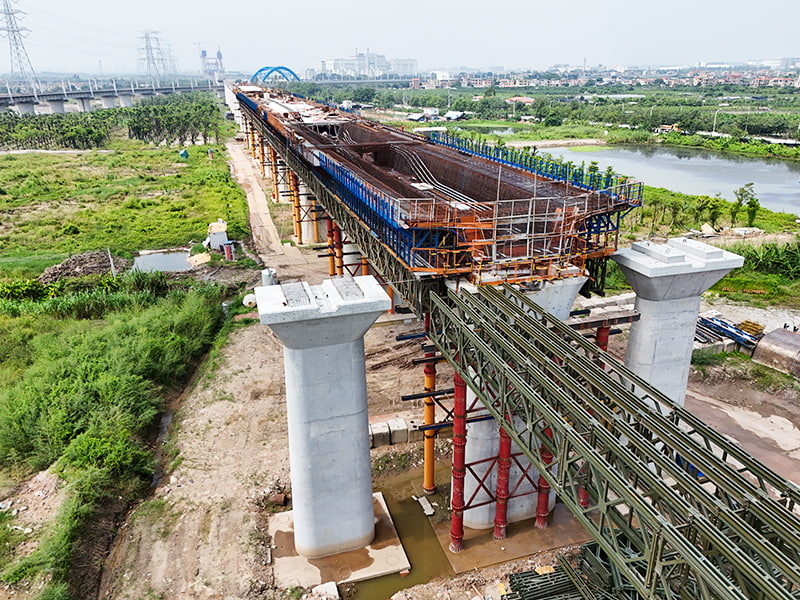
Customized Large Span 900 Ton Load Super Bailey Construction Support
3. Large-Span Capability and 900-Ton Load Performance
The most important characteristic of this system is its combination of large-span performance and high load capacity. Many temporary support solutions can carry considerable loads only when the support points are closely spaced. However, closely spaced supports may obstruct roads, waterways, railway corridors, work areas, or existing structures. They may also increase foundation work, interfere with construction machinery, and slow the overall construction sequence.
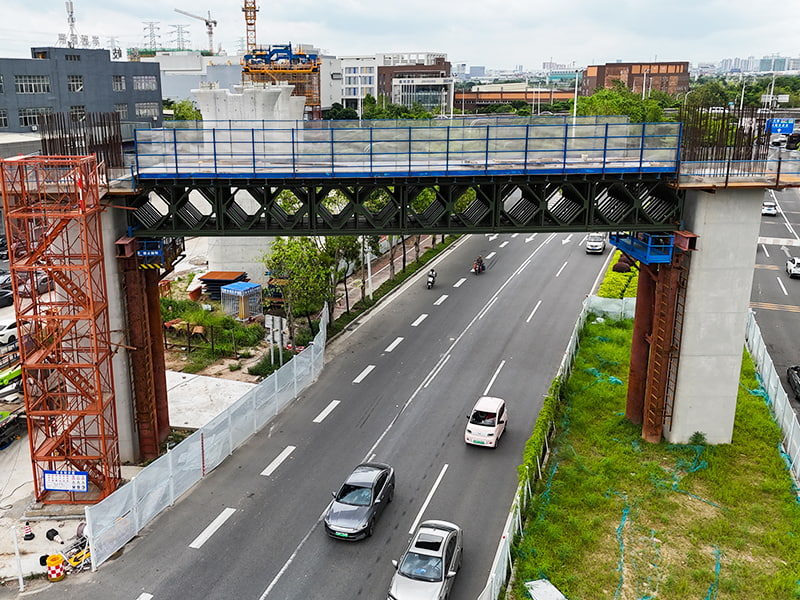
A large-span support system reduces the number of intermediate support points required beneath the working area. This can provide greater clearance for equipment and traffic, simplify site organization, and make construction possible where ground conditions or access restrictions prevent dense support placement. The Super Bailey Construction Support is designed to address these conditions through a stronger modular truss arrangement and carefully engineered load distribution.
The 900-ton capacity provides a substantial reserve for heavy construction operations. In practice, a high-capacity system can reduce the need to combine several unrelated temporary support structures. A single coordinated support solution is easier to analyze, inspect, monitor, and manage than a collection of independent systems with different connection details and load-transfer behaviors.
High load capacity also supports safer construction planning. Engineers can evaluate the expected construction load against the designed capacity and establish controlled loading stages. When the support system has been engineered specifically for the project, the design team can consider the actual load path instead of relying on generalized assumptions intended for lighter standard structures.
Large-span behavior depends on more than the strength of individual members. The overall system must control vertical deflection, lateral movement, torsional response, connection slip, and local instability. The design may therefore incorporate multiple truss lines, transverse bracing, reinforced connection zones, bearing assemblies, stiffening members, and temporary anchoring arrangements. These elements work together to maintain structural integrity during loading and construction movement.
For high-speed rail projects, deformation control is especially significant. A support system that experiences excessive deflection may affect the geometry of formwork or precast components. Excessive differential movement between support lines can create construction inaccuracies or unwanted stress in partially completed structures. The Super Bailey system is therefore intended to provide a stable platform for controlled construction rather than merely acting as a high-capacity load-carrying frame.
4. Compliance with Recognized Load Design Standards
The product information identifies HS-15, HS-20, HS-25, HL-93, and Track-50 among the load design standards considered for engineering applications. These designations represent important load models used in bridge and transportation infrastructure analysis. Their inclusion demonstrates that the support system can be evaluated against recognized heavy vehicle, highway, and railway loading requirements where applicable.
HS-15, HS-20, and HS-25 are associated with highway loading classifications, while HL-93 is widely used as a modern highway bridge design load model. Track-50 represents a railway-related loading requirement. The applicable standard depends on the project location, the permanent or temporary nature of the structure, the client’s specifications, and the governing engineering code.
Compliance should not be interpreted as a universal claim that every configuration automatically meets every listed standard. Instead, the relevant load model must be selected during project design, and the final support arrangement must be checked against the applicable requirements. This approach enables the system to be adapted to different transportation environments while preserving a clear and traceable engineering basis.
A professional design package may include load combinations, member capacity checks, connection calculations, bearing reactions, deflection analysis, stability verification, foundation reactions, wind considerations, construction-stage conditions, and erection-stage temporary conditions. These calculations are essential because a support system may experience different critical load cases during assembly, initial loading, full loading, load transfer, and removal.
Applying recognized standards also improves communication among owners, consultants, contractors, inspectors, and manufacturers. When the design basis is clearly stated, all parties can understand the assumptions used for capacity, safety factors, permissible deformation, and operational restrictions. This reduces ambiguity and supports more consistent quality control during fabrication and erection.
5. Customized Engineering for Complex Projects
Standard modular bridge products offer important advantages, but complex infrastructure projects often require more than a standard bill of materials. Span length, elevation, pier spacing, working clearance, access routes, foundation conditions, construction sequence, and interface requirements may differ substantially from one project to another. The Super Bailey Construction Support is therefore positioned as a customized engineering product rather than a one-size-fits-all structure.
Customization may involve the length and height of the support truss, the number of parallel lines, the arrangement of transverse bracing, bearing details, support seats, lifting points, access platforms, connection reinforcement, and temporary stabilization systems. It may also involve special adaptation to curved bridge geometry, variable elevations, restricted waterways, existing roads, railway corridors, or uneven terrain.
The customization process normally begins with the collection of project data. Important information includes the required span, maximum load, load distribution, support elevations, construction equipment, site restrictions, environmental conditions, installation method, dismantling method, and expected construction duration. The manufacturer and project engineering team can then develop a preliminary structural concept and identify the most appropriate modular arrangement.
After the concept is approved, detailed engineering can address member sizing, connection design, lateral stability, bearing reactions, temporary bracing, lifting arrangements, and erection sequences. The final result is intended to fit the construction process instead of forcing the contractor to redesign the work method around an unsuitable support product.
This project-oriented approach is a major advantage over low-cost generic support systems. A generic system may appear economical at the purchasing stage but create additional costs through field modifications, reinforcement, uncertain capacity, slow installation, or complicated inspection. Customized engineering can reduce these risks by resolving critical issues before the components reach the project site.
6. Modular Assembly and High Erection Efficiency
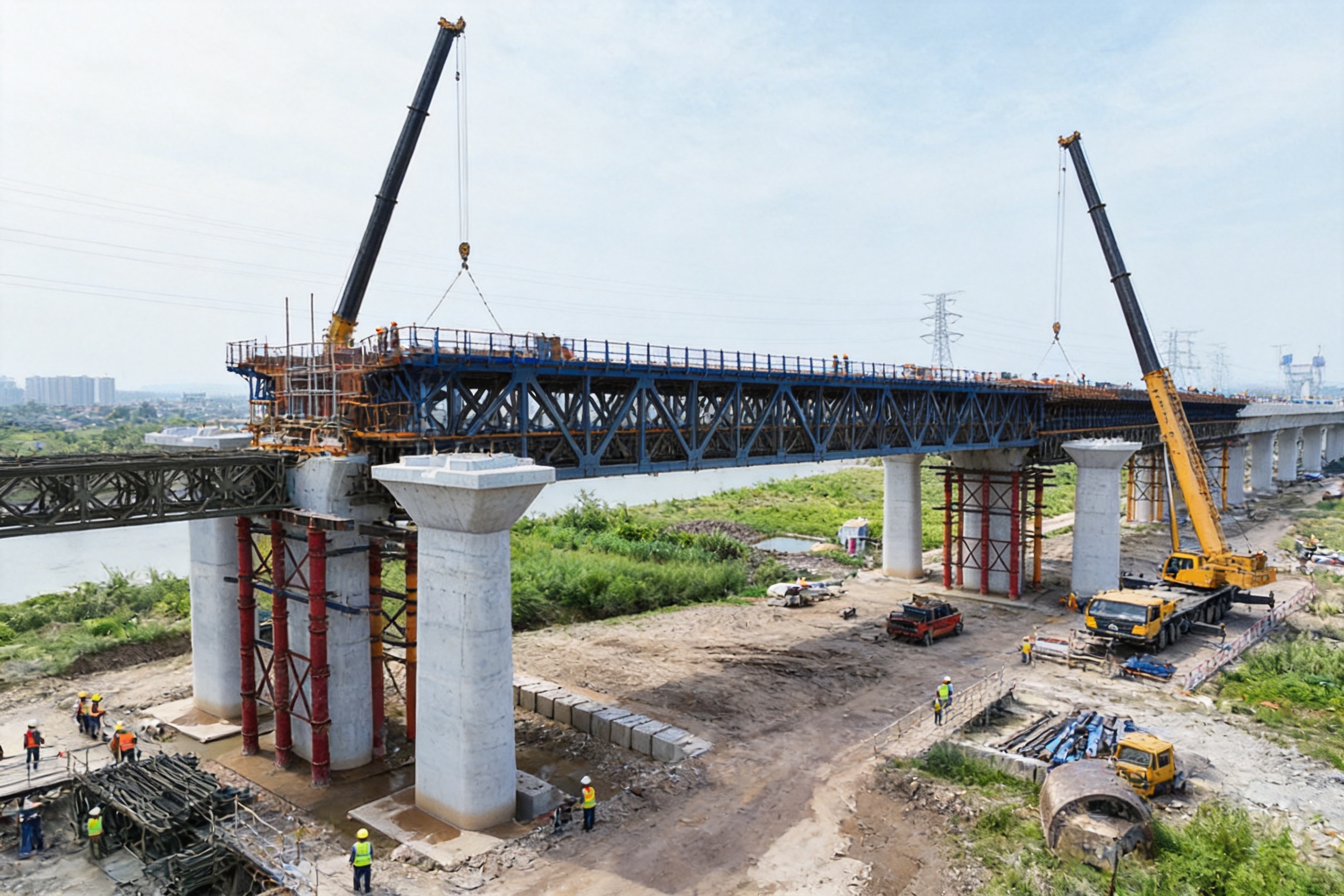
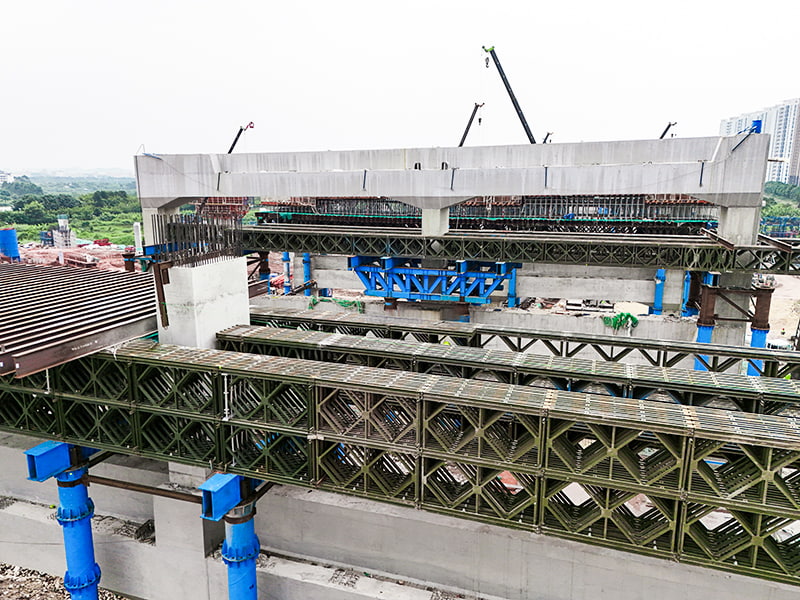
One of the principal advantages of Bailey-type systems is modular assembly. Components are fabricated in a controlled factory environment, transported to the site, and connected using standardized methods. This process can be faster and more predictable than site-fabricating a large temporary steel structure from raw materials.
The modular configuration allows construction teams to organize work into repeatable steps. Components can be inspected, staged, preassembled, lifted, connected, aligned, and secured according to a defined erection plan. The use of repeated panels and connection details reduces the amount of on-site measurement and cutting required.
For large infrastructure projects, erection efficiency directly affects the construction schedule. Temporary support is often on the critical path because permanent bridge work cannot proceed until the support is installed and verified. A system that can be assembled rapidly helps contractors begin formwork, segment placement, or concrete operations sooner.
Modularity also supports parallel working. While one group prepares foundations or bearings, another can preassemble truss sections nearby. Additional components can be inspected and staged without interrupting the main construction activity. Where site access permits, complete sections may be assembled on the ground and lifted into position, reducing work at height.
The system’s flexible assembly is especially useful when the construction sequence must change. Project conditions can evolve because of weather, traffic restrictions, equipment availability, or changes in the permanent structure. A modular support system can often be lengthened, shortened, repositioned, or reconfigured more readily than a permanently welded temporary frame, subject to engineering review and approval.
Fast erection does not mean that safety procedures can be omitted. Every assembly must follow approved drawings and method statements. Connection pins, bolts, bracing members, bearings, temporary supports, and lifting equipment must be checked before loading. The advantage of modular construction is realized when the process is standardized and properly supervised.
7. Advanced Manufacturing Processes
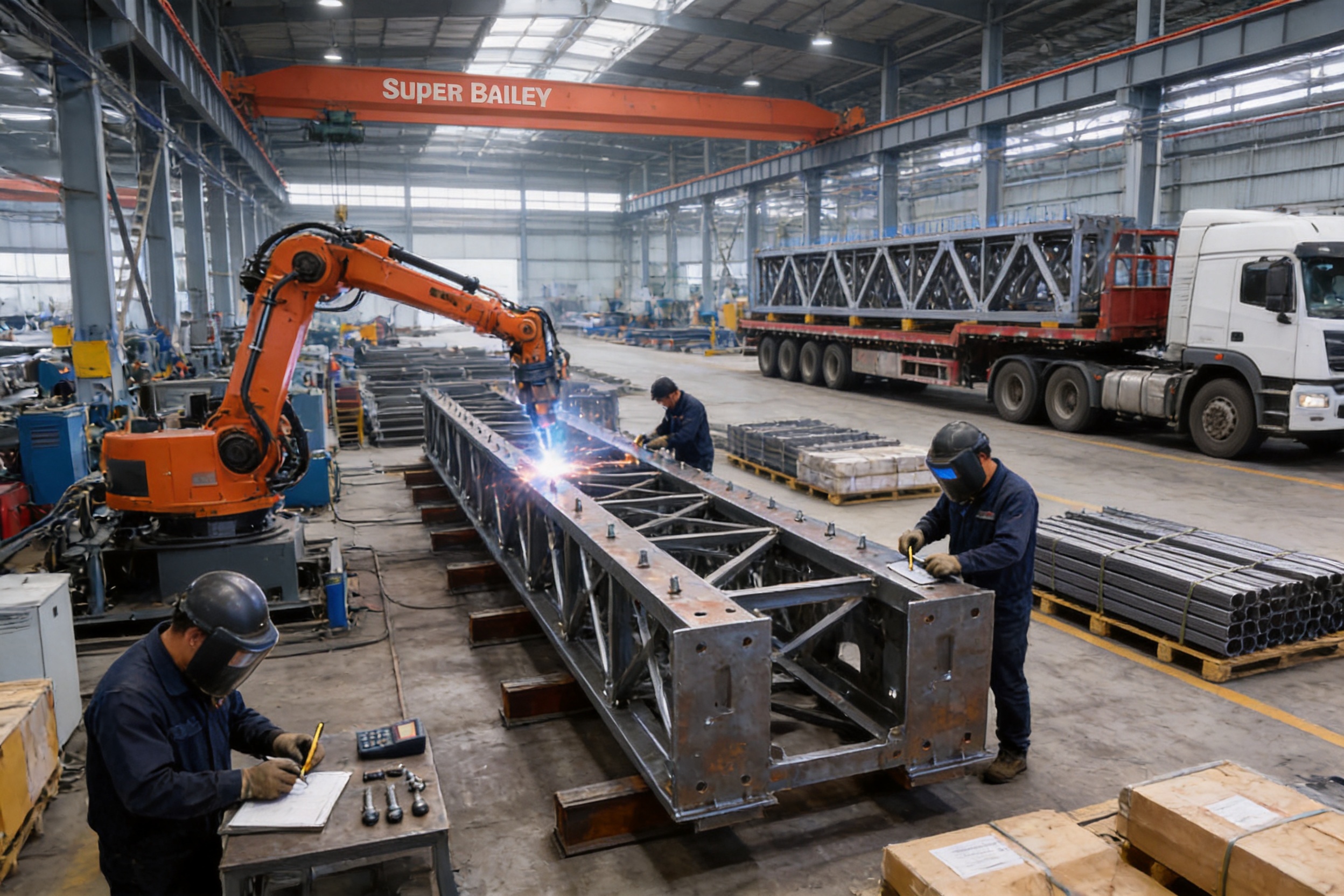
The performance of a heavy-duty modular support system begins with manufacturing quality. Structural calculations determine the required capacity, but the manufactured product must consistently achieve the specified dimensions, material properties, weld quality, surface condition, and connection accuracy. Jiangsu Zhonghai Bridge Equipment Co., Ltd. integrates engineering design, precision manufacturing, quality management, automated welding, and standardized production workflows to support this objective.
7.1 Engineering-Based Production Planning
Before fabrication begins, production planning translates engineering drawings into controlled manufacturing procedures. This includes material identification, cutting plans, component numbering, welding sequences, dimensional tolerances, inspection points, surface treatment requirements, and packaging instructions. A structured production plan reduces variation between batches and helps ensure that components remain interchangeable when assembled at the project site.
For customized systems, production planning is particularly important because the product may combine standard modular members with project-specific components. Each customized part must be clearly identified so that it is installed in the correct location. A controlled numbering and marking system minimizes confusion during site erection and supports later inspection or replacement.
7.2 Precision Steel Fabrication
Precision steel fabrication involves accurate cutting, forming, drilling, fitting, welding, and finishing. The geometry of a modular truss depends on the relationship between its panel members, connection holes, bearing surfaces, and bracing points. Small errors can accumulate over a long assembly, affecting alignment and connection fit. Controlled fabrication helps maintain the dimensional consistency required for efficient erection.
Automated and semi-automated production equipment can improve repeatability for high-volume components. Standardized workflows also reduce reliance on unpredictable manual operations. Skilled technicians remain essential for fit-up, inspection, complex assemblies, and corrective work, but automation can provide a more consistent baseline for repetitive processes.
7.3 Automated Welding
Welding is a critical manufacturing process for steel bridge components. Welded joints must transfer forces reliably and maintain their performance under repeated construction loading, vibration, and environmental exposure. Automated welding can improve deposition consistency, weld appearance, process control, and productivity when applied to suitable component geometries.
Automated welding is supported by controlled parameters such as current, voltage, travel speed, wire feed, shielding conditions, and preheating requirements. These parameters can be established through qualified procedures. Production personnel can then monitor the process and verify that the welds comply with the required standards and inspection plans.
Quality control may include visual inspection, dimensional inspection, weld profile checks, non-destructive testing, and documentation of repair work where necessary. The precise inspection scope depends on the project specification, the component’s structural importance, and the applicable code.
7.4 Material Traceability and Quality Management
Material traceability is important for load-bearing temporary structures because the performance of the system depends on the strength and consistency of its steel members, pins, bolts, plates, and other components. Proper records can connect incoming material certificates to specific fabricated parts and finished assemblies.
A robust quality management system may include incoming material inspection, in-process checks, final dimensional verification, weld inspection, coating inspection, assembly checks, and shipment release procedures. These controls help identify problems before delivery, when corrective work is generally easier and less expensive than after installation.
Factory quality management also supports international supply. The company states that its products are manufactured through standardized workflows and are intended to comply with ASTM, EN, and national specifications. The exact standard applied to a project should be confirmed during procurement and engineering review, but the ability to work within multiple specification frameworks is valuable for global infrastructure clients.
7.5 Surface Protection and Long-Term Reusability
Temporary support equipment may be assembled, dismantled, transported, stored, and reused several times. Surface protection therefore contributes to both immediate durability and long-term asset value. Appropriate surface preparation and coating help reduce corrosion during service, storage, and transportation.
After dismantling, components should be cleaned, inspected, repaired where required, and stored in a manner that prevents water accumulation and mechanical damage. Modular equipment that is maintained correctly can support multiple projects, improving the economic and environmental efficiency of the investment.
8. Advantages Compared with Conventional Temporary Supports
The Super Bailey Construction Support offers several potential advantages when compared with conventional scaffolding, fixed temporary trestles, or generic light-duty modular systems. These advantages should be assessed in relation to the project’s specific design, but they provide a useful basis for selecting an appropriate support method.
8.1 Higher Capacity for Heavy Construction Loads
Conventional scaffolding is often designed for access, light platforms, or distributed construction loads. It may not be suitable for supporting large bridge segments, heavy formwork systems, or major lifting operations. A heavy-duty modular truss designed for loads up to 900 tons provides a stronger structural basis for demanding construction conditions.
8.2 Greater Span and Working Clearance
Closely spaced temporary supports can obstruct construction traffic, waterways, existing roads, and work zones. Large-span support reduces the number of intermediate columns required, potentially improving clearance and simplifying site logistics. This is particularly valuable where the bridge crosses an active transportation route or environmentally sensitive area.
8.3 Faster Assembly than Site-Built Steelwork
Traditional site-built temporary structures may require extensive welding, cutting, drilling, and fitting in the field. Such work is affected by weather, access, lighting, and site congestion. Factory-made modular components reduce the amount of field fabrication and can shorten the erection period.
8.4 Better Adaptability than Fixed Temporary Frames
A permanent-looking temporary frame may be strong but difficult to modify. A modular Bailey-type system can be configured for different spans and support layouts, subject to engineering approval. This flexibility is useful for projects with changing construction stages or multiple bridge sections.
8.5 Easier Transportation and Storage
Modular panels and members can generally be transported more efficiently than a complete welded support frame. Components can be stacked, bundled, labeled, and delivered in batches. This is an advantage for remote sites, international projects, and emergency deployment where transport volume and handling efficiency are important.
8.6 More Consistent Quality
Factory production allows inspection and process control in a dedicated environment. Compared with extensive field fabrication, controlled manufacturing can reduce dimensional inconsistency, welding variability, and installation uncertainty. This contributes to a more predictable erection process.
8.7 Reusability and Lifecycle Value
A modular support system can be dismantled and redeployed, provided it is inspected and maintained. Reusability may lower the lifecycle cost compared with one-time temporary works that must be fabricated and discarded for each project.
| Evaluation Factor | Super Bailey Construction Support | Generic Light-Duty Support | Site-Fabricated Temporary Frame |
|---|---|---|---|
| Typical application | Large-span, heavy-load bridge construction | Access platforms and lighter temporary works | Project-specific heavy or medium temporary works |
| Maximum stated capacity | Up to 900 tons, subject to final engineering | Usually more limited and configuration-dependent | Dependent on site design and fabrication quality |
| Assembly method | Modular connection and planned erection | Modular connection or scaffolding assembly | Extensive field fitting, welding, or bolting |
| Large-span suitability | Designed specifically for large-span applications | Often limited by deflection and stability | Possible, but may require substantial temporary works |
| Site fabrication requirement | Reduced through factory production | Low for standard applications | Potentially high |
| Adaptability | High when supported by customized engineering | Moderate for standard layouts | Low after fabrication unless modified |
| Reusability | High when inspected and maintained | Moderate to high depending on system | Variable and often limited by project-specific fabrication |
| Quality control | Factory-based production and documented inspection | Standard product inspection | Combination of factory and site controls |
9. Application in the Guangdong Zhuliao High-Speed Rail Project
The Guangdong Zhuliao High-speed Rail Project represents the type of demanding infrastructure application for which the product was developed. High-speed rail construction requires strict control of geometry, construction sequence, structural stability, and site safety. The adoption of the Super Bailey Construction Support for this project demonstrates its suitability for heavy, large-span bridge construction conditions.
The system supports the project by providing a robust temporary load path during construction. Its high capacity enables it to accommodate substantial construction loads, while its modular arrangement allows the support layout to be adapted to the bridge’s actual geometry and site conditions. The ability to assemble the system efficiently helps reduce delays and supports the overall construction schedule.
High-speed rail projects often involve repeated bridge sections, constrained access, and close coordination among civil, structural, mechanical, and railway teams. A standardized modular support system can simplify coordination because its component dimensions, connection methods, and erection procedures can be documented and repeated across different work areas.
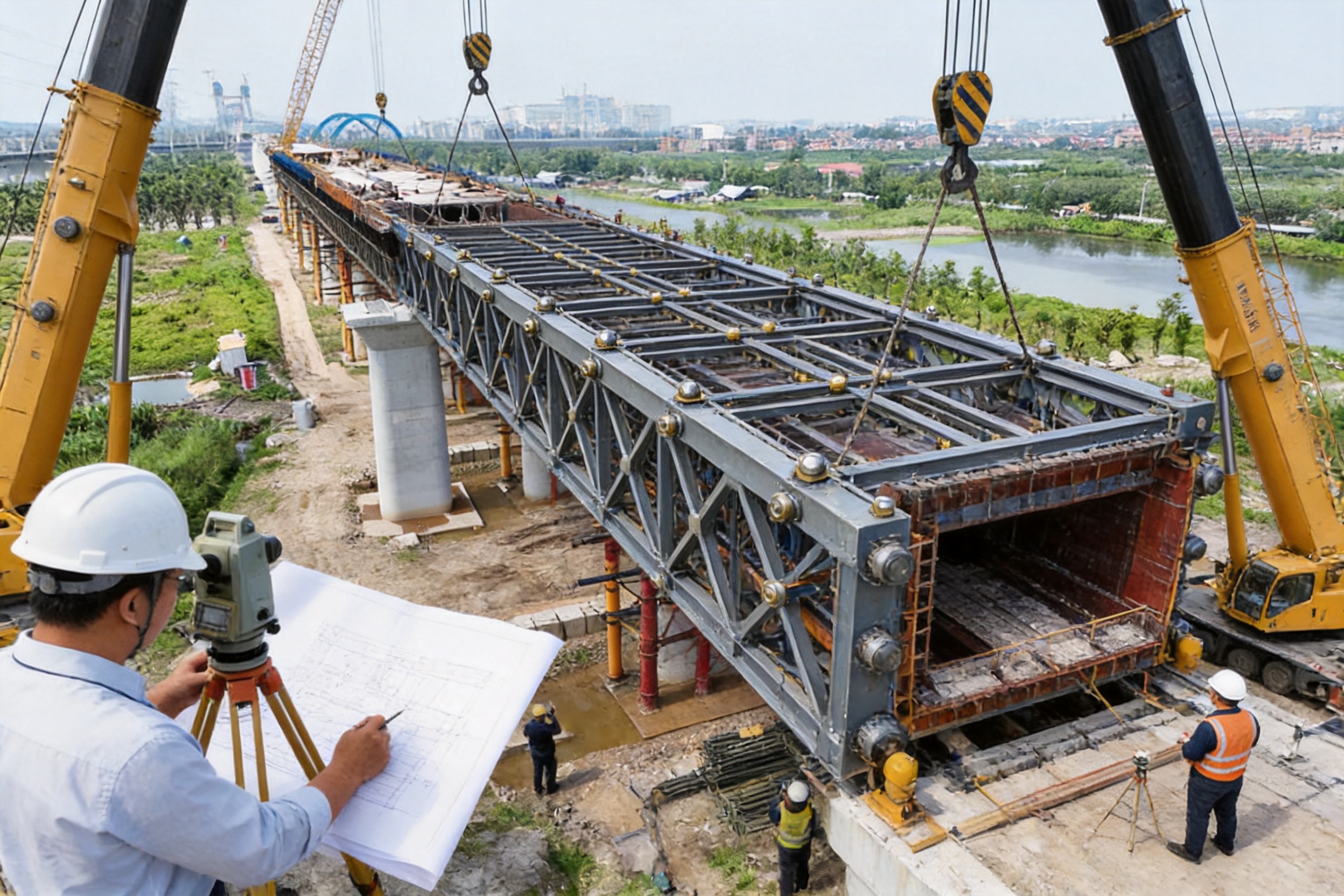
The support system also contributes to construction organization. Components can be delivered according to the sequence of work, preassembled where appropriate, and installed with planned lifting equipment. Once a section has completed its required construction stage, the support can be dismantled and moved to another location, subject to inspection and approval.
Project adoption is meaningful because it indicates that the system has been evaluated in an actual major infrastructure environment rather than being limited to theoretical design claims. Nevertheless, every project configuration must be treated individually. The performance of a support system depends on correct engineering, foundation preparation, assembly accuracy, inspection, loading control, and compliance with the approved construction method.
10. Construction Safety and Structural Reliability
Safety is the primary consideration in any temporary support system. Temporary works may be used for a shorter period than permanent structures, but they frequently carry critical loads during stages when the permanent structure is incomplete. A failure or excessive deformation can affect workers, equipment, permanent bridge elements, traffic, and the wider project schedule.
The Super Bailey Construction Support should be used with a complete temporary works safety plan. This plan should identify design loads, construction stages, permitted loading conditions, inspection responsibilities, weather limitations, emergency procedures, and communication arrangements. It should also identify the sequence for installing and removing temporary bracing and the procedure for transferring loads from temporary supports to permanent structures.
Foundation and bearing conditions require careful attention. A high-capacity truss can perform as designed only when reactions are transferred to adequately prepared supports. Bearing seats must be level, stable, and correctly positioned. Ground improvement, spread foundations, pile-supported foundations, or other support arrangements may be required depending on the reaction forces and site conditions.
Lateral stability is another essential consideration. Wind, eccentric loading, construction machinery, vibration, and partial loading can generate forces that are not apparent from the vertical load alone. Transverse bracing, longitudinal bracing, anchorage, and temporary restraints should be designed and installed according to the approved drawings.
Connections must be inspected before loading. This includes pins, bolts, splice plates, bracing connections, bearing components, and any special reinforced joints. Missing or incorrectly installed connection components can significantly reduce the capacity of an otherwise strong system.
Monitoring can provide additional assurance during critical operations. Depending on the project, monitoring may include level surveys, displacement measurements, bearing checks, visual inspections, and load-stage verification. If unexpected deflection, settlement, vibration, or connection movement is observed, loading should be controlled and the engineering team should be consulted before work continues.
11. Installation and Erection Sequence
A typical installation process begins with a review of the approved design and site conditions. The construction team confirms the support locations, access routes, lifting capacity, foundation readiness, material delivery sequence, and exclusion zones. Components are then delivered, inventoried, and inspected for damage or missing parts.
Where possible, modules can be assembled on the ground. Ground assembly reduces work at height and provides a better environment for checking connection fit, bracing installation, and dimensional alignment. Depending on the length and weight of the assembled sections, they may be lifted into position or launched using suitable temporary equipment.
Once the primary truss lines are positioned, transverse bracing and other stabilizing members are installed. Bearings, support seats, lateral restraints, and connection hardware are then checked. The system is aligned to the required elevation and geometry before the construction load is introduced.
Loading should occur in controlled stages. The initial loading stage allows the team to verify that reactions, deflection, alignment, and connection behavior are consistent with the design assumptions. Additional loads can then be applied according to the approved sequence.
Dismantling follows a reverse and carefully controlled process. The supported permanent or temporary load must first be transferred according to the project method statement. Components are then removed in a sequence that prevents instability or sudden load release. After dismantling, each member should be inspected, cleaned, marked, and stored properly for future use.
12. Logistics, Transportation, and Site Management
Large bridge projects often involve difficult logistics. Construction sites may be remote, access roads may be narrow, and delivery windows may be restricted by traffic or environmental requirements. Modular components help manage these challenges because they can be transported in batches and handled using commonly available lifting equipment, subject to weight and dimension limits.
Effective logistics begins with a component schedule that matches the erection sequence. Delivering all components at once may create unnecessary congestion, while delivering them too late can interrupt construction. A planned sequence helps maintain an organized laydown area and reduces the risk of components being misplaced or damaged.
Component marking is important for both logistics and assembly. Each member should be identified according to the approved drawings, with durable markings that remain legible during handling. Packing lists and inspection records should be maintained so the site team can confirm that the correct quantity and type of material has arrived.
For international projects, export packaging, corrosion protection, shipping documents, and local handling requirements must be considered. The manufacturer’s experience in global delivery can help clients coordinate production, inspection, packing, and shipment. However, the purchaser should confirm applicable import, certification, and site regulations before placing an order.
13. Manufacturing Strengths of the Supplier
Jiangsu Zhonghai Bridge Equipment Co., Ltd. is based in Zhenjiang, Jiangsu Province, an important industrial and transportation center in China. The company specializes in modular steel bridges, Bailey bridge systems, customized steel components, construction support equipment, automated welding, and precision steel fabrication.
Its manufacturing strength comes from the integration of several capabilities rather than from a single product line. Engineering design enables the company to develop customized arrangements. Precision fabrication converts those designs into accurate structural components. Automated welding and standardized workflows support repeatable production. Quality management provides inspection and documentation. On-site support helps connect factory production with actual field installation.
This integrated model is valuable for large projects because temporary support equipment must fit the construction method, not merely meet a nominal material specification. A supplier that understands design, fabrication, assembly, and site requirements can identify potential problems earlier and provide more useful technical coordination.
The company’s production experience extends beyond a single bridge type. Its stated project background includes coastal engineering in the Maldives, temporary access bridges for the Shenzhen–Zhongshan Corridor, structural components for the Hangzhou Expo Center, multi-span Bailey bridges for the Lalin Railway, and emergency bridge deployments in multiple regions. This range of applications suggests experience with different climates, transportation conditions, span arrangements, and delivery requirements.
Manufacturing scale is also important for customized heavy-duty equipment. Large orders may require coordinated procurement of steel, controlled production scheduling, dedicated quality inspection, and organized shipment. A supplier with industrial-scale capacity is better positioned to maintain delivery consistency than a small workshop handling each component as an isolated fabrication job.
14. International Standards and Export-Oriented Production
Infrastructure clients often operate under specifications that differ from the manufacturer’s domestic standards. A bridge support system may need to be designed or manufactured according to ASTM, EN, national standards, railway authority requirements, or project-specific technical conditions. The ability to interpret and coordinate these requirements is essential for international procurement.
The company states that its factory uses advanced automation and standardized workflows to produce high-strength modular bridge systems complying with ASTM, EN, and national specifications. In practical terms, compliance should be verified through project documentation, material certificates, welding procedure qualifications, inspection records, dimensional reports, and any required third-party testing.
International delivery also requires clear communication. Drawings should use consistent units, terminology, component references, and revision control. Installation manuals should explain connection details, erection tolerances, inspection points, and loading restrictions. When the manufacturer provides remote or on-site technical support, the client can receive assistance during assembly and troubleshooting.
These capabilities distinguish a professional export supplier from a manufacturer that simply sells steel components. Global customers require dependable documentation, packaging, production scheduling, technical responsiveness, and after-sales support in addition to the physical product.
15. Economic and Lifecycle Benefits
The initial purchase price is only one part of the cost of a temporary bridge support system. A more complete evaluation should include engineering, transport, assembly, inspection, modification, dismantling, storage, maintenance, and potential reuse. A modular heavy-duty system can provide lifecycle advantages in several of these areas.
Customized engineering may reduce site modification costs. When the support is designed for the actual project, the contractor is less likely to need unplanned reinforcement, additional bracing, or improvised connection work. This can reduce labor, material waste, and schedule risk.
Fast assembly can lower installation labor and shorten the time that cranes, lifting equipment, and traffic management arrangements are required. In high-value infrastructure projects, even a modest reduction in temporary works duration can produce meaningful savings.
Reusability can further improve the economic case. After one project, the modular members can be inspected and redeployed for another suitable application. Standardized components also simplify the management of a company’s bridge equipment inventory because the same panel and connection families can be used in multiple configurations.
There may also be environmental benefits. Reusing steel components reduces the need to manufacture new temporary structures for every project. Modular transportation can reduce unnecessary oversized loads, while controlled factory production can reduce material waste compared with extensive on-site fabrication.
16. Selecting the Correct Configuration
Although the product offers a maximum stated capacity of up to 900 tons, selection should be based on the complete structural and construction requirement. A qualified engineering team should review the following factors before final configuration:
• Total vertical load and the distribution of that load.
• Span length and the number of required support points.
• Construction-stage load combinations.
• Deflection limits and required geometric accuracy.
• Lateral loads caused by wind, machinery, braking, or construction activity.
• Bearing capacity and settlement characteristics of the foundation.
• Clearance requirements above roads, waterways, railways, and work areas.
• Available cranes, transport equipment, and site access.
• Erection and dismantling sequence.
• Applicable design codes and client specifications.
• Environmental exposure, corrosion conditions, and project duration.
• Inspection, monitoring, and maintenance requirements.
The most efficient configuration is not always the one with the largest number of members. Overdesign can increase cost, weight, transport requirements, and erection time. The objective is to achieve the required capacity and stability through an optimized arrangement that is appropriate for the actual project conditions.
17. Quality Assurance from Factory to Site
Quality assurance should continue throughout the entire supply chain. At the factory, raw materials and fabricated components should be inspected according to the quality plan. Before shipment, the finished modules should be checked against drawings and packing lists. At the site, the receiving team should inspect the material for transport damage, corrosion, deformation, and missing components.
During assembly, quality checks should verify member orientation, connection installation, bracing arrangement, bearing position, alignment, and temporary restraints. Inspection records should identify the responsible personnel and document any corrective action. Before loading, the completed support should be reviewed by the designated project engineer or competent temporary works authority.
A strong quality system does not eliminate the need for site expertise. Field conditions can differ from design assumptions, and construction teams must report unexpected problems. Good communication between the contractor, consultant, and manufacturer is therefore an important part of structural reliability.
For repeat projects, lessons learned can be recorded and used to improve future erection plans. Information about transport handling, connection accessibility, assembly time, inspection issues, and dismantling performance can help optimize later applications.
18. Frequently Asked Questions
What is a Super Bailey Construction Support system?
A Super Bailey Construction Support system is a heavy-duty modular steel truss or support arrangement used to carry temporary construction loads over large spans. It combines prefabricated modular components with customized structural engineering for demanding bridge and infrastructure applications.
What is the maximum load capacity of this product?
The product is described as having a maximum load capacity of up to 900 tons. The actual allowable capacity must be confirmed for the specific span, support arrangement, load distribution, foundation condition, connection configuration, and applicable safety factors.
Is the system suitable for high-speed rail bridge construction?
Yes. The system was adopted for the Guangdong Zhuliao High-speed Rail Project and is intended for construction conditions requiring high load capacity, large-span performance, structural stiffness, and controlled erection efficiency.
Can the support system be customized?
Yes. Customization may include span length, truss height, number of support lines, transverse bracing, bearing details, connection reinforcement, lifting points, and other project-specific components. Final customization should be based on approved engineering calculations and construction drawings.
Which load design standards can be considered?
The product information identifies HS-15, HS-20, HS-25, HL-93, and Track-50 among the applicable load design standards. The correct standard or combination of standards depends on the project location, client requirements, bridge type, construction stage, and governing code.
How does the system compare with ordinary scaffolding?
Ordinary scaffolding is commonly used for access, work platforms, and lighter distributed loads. The Super Bailey system is intended for substantially heavier loads and larger spans. It offers a truss-based load path and can be customized for bridge construction, although the final selection must always be supported by structural calculations.
Does modular assembly reduce construction time?
Modular assembly can reduce construction time because components are prefabricated, standardized, and connected according to an erection plan. Ground preassembly and staged delivery may further improve efficiency. Actual installation time depends on site access, crane capacity, foundation readiness, weather, and project management.
Can the system be reused?
Modular components are generally suitable for reuse when they remain within their design condition and pass inspection. After dismantling, members should be cleaned, checked for deformation or damage, repaired where necessary, and stored correctly.
What manufacturing processes support product quality?
The supplier integrates engineering design, precision steel fabrication, automated welding, standardized workflows, and quality management. These processes support dimensional consistency, weld quality, material traceability, and reliable component interchangeability.
What information should a customer provide for a quotation?
Useful information includes the required span, maximum construction load, bridge geometry, support elevations, foundation conditions, site clearance, construction method, erection equipment, project location, applicable standards, delivery schedule, and any special environmental or corrosion requirements.
Does a 900-ton rating mean the system can carry 900 tons in every configuration?
No. The 900-ton figure is a maximum stated capacity for an engineered configuration. Capacity varies with span, member arrangement, load eccentricity, bracing, support conditions, connection details, and safety factors. A project-specific design must confirm the permitted load.
Can the manufacturer provide technical support?
The company integrates engineering design and on-site support services. Depending on the contract and project location, technical assistance may include design coordination, fabrication documentation, erection guidance, inspection support, and troubleshooting during installation.
19. Why This Product Is a Strong Choice for Large Infrastructure
The customized large-span 900-ton Super Bailey Construction Support brings together several qualities that are difficult to achieve in a single temporary works solution. It provides heavy load capacity without abandoning modularity, large-span performance without relying entirely on complex site fabrication, and customization without losing the repeatability of standardized production.
Its suitability for high-speed rail construction is supported by the combination of stiffness, controlled geometry, flexible assembly, and professional engineering. Its value for contractors lies in the ability to create a planned and repeatable construction process. Its value for owners lies in improved schedule confidence, structural reliability, and the possibility of reuse across multiple projects.
The supplier’s manufacturing capabilities further strengthen the product offering. Engineering, fabrication, automated welding, quality control, and international delivery are coordinated within one organization. This integrated approach can reduce communication gaps between design and production and help ensure that customized components arrive ready for site assembly.
Compared with generic low-capacity systems, the product is better suited to heavy bridge construction. Compared with extensive site-fabricated temporary steelwork, it can reduce field labor and improve production consistency. Compared with rigid fixed support structures, it offers greater flexibility for changing spans and construction stages.
20. Conclusion
Large-span bridge construction requires temporary support systems that are strong, stable, adaptable, and efficient. The customized Super Bailey Construction Support, with a maximum load capacity of up to 900 tons, is designed to meet these requirements in high-speed rail and other major infrastructure projects.
Its principal advantages include large-span capability, high structural strength, modular assembly, rapid erection, customized engineering, compatibility with recognized load design standards, efficient transportation, and potential reusability. The product’s adoption in the Guangdong Zhuliao High-speed Rail Project demonstrates its relevance to demanding railway bridge construction.
The system’s performance is reinforced by the manufacturing strengths of Jiangsu Zhonghai Bridge Equipment Co., Ltd. The company combines design engineering, precision steel fabrication, automated welding, standardized production, quality management, and project support. This combination enables the production of reliable modular bridge systems and specialized construction support equipment for domestic and international infrastructure projects.
For customers evaluating a heavy-duty temporary support solution, the most important step is to begin with a complete project assessment. Span, loads, foundation conditions, construction stages, applicable standards, erection equipment, and site constraints should all be reviewed before the final system is selected. When properly designed, manufactured, assembled, inspected, and maintained, the Super Bailey Construction Support can provide a safe and efficient foundation for complex bridge construction operations.
References
1. American Association of State Highway and Transportation Officials. Load and Resistance Factor Design Bridge Specifications.
2. American Association of State Highway and Transportation Officials. Standard Specifications for Highway Bridges and Bridge Design Loading.
3. European Committee for Standardization. Eurocode 3: Design of Steel Structures.
4. European Committee for Standardization. Execution of Steel Structures and Aluminium Structures.
5. International Organization for Standardization. Quality Management Systems: Requirements.
6. American Welding Society. Structural Welding Code—Steel.
7. International Federation for Structural Concrete. Guidance on Temporary Works and Construction-Stage Structural Safety.
8. Railway bridge construction and temporary works engineering guidance, industry reference edition.
9. Modular steel bridge design, erection, inspection, and maintenance engineering manuals.
10. Project-specific technical information for the Guangdong Zhuliao High-speed Rail construction support application.
Product: Customized Large Span 900 Ton Load Super Bailey Construction Support


We respond quickly to all international requests and provide technical support when needed.
Product Category
Bailey Bridge/Modular Bridge Modular Steel Bridge Pedestrian Bridge Modular Pipe Bridge Truss Bridge Steel StructureContact Us

+86-511-84522866
+86-13921582699

zhwm@zjql.com

Building 1,83#, dantu New Town, Yanjiang Road, Dantu District, Zhenjiang, Jiangsu, China
Copyright © Jiangsu Zhonghai Bridge Equipment Co., Ltd. All
Rights
Reserved
China bailey bridge for sale
bailey bridge supplier from china
