
 English
 русский
 Español
 Português


Luo Shiqing — Product After-Sales Service Supervisor
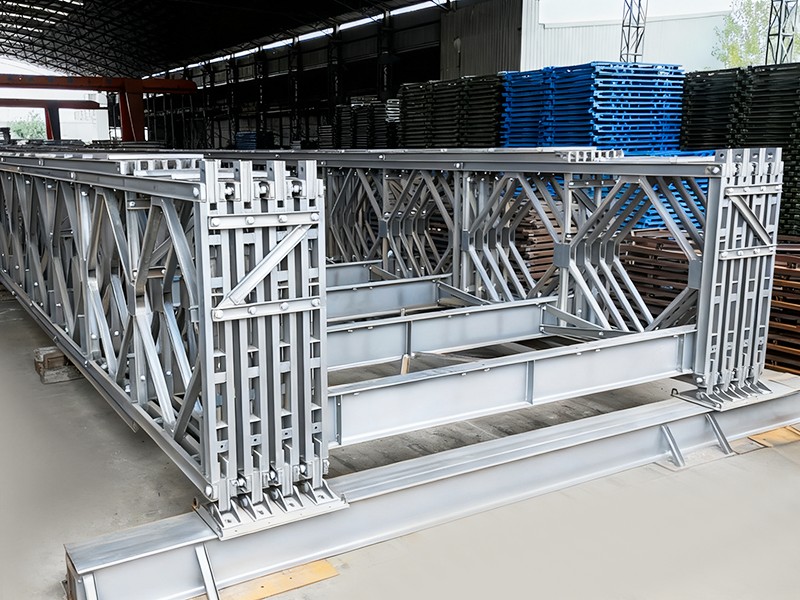
CB100 Triple-Row Single-Layer Reinforced Painted Bailey Bridge for High-Capacity Modular Transport
Content
- 1 1. Understanding the CB100 Bailey Bridge Concept
- 2 2. Main Product Advantages
- 3 3. Manufacturing Strengths Behind the Bridge System
- 4 4. Surface Protection for Warm and Humid Regions
- 5 5. Site Assembly and Installation Considerations
- 6 6. Applications for the Reinforced Modular Bridge
- 7 7. Comparison with Alternative Bridge Solutions
- 8 8. International Engineering and Delivery Experience
- 9 9. Selecting the Correct Configuration
- 10 10. Safety, Inspection, and Long-Term Operation
- 11 11. Why the Manufacturing Partner Matters
- 12 12. Project Value from Design to Delivery
- 13 13. Frequently Asked Questions
- 13.1 Q1: What is a triple-row single-layer reinforced Bailey bridge?
- 13.2 Q2: What types of traffic can the CB100 bridge support?
- 13.3 Q3: Is the bridge suitable for three lanes?
- 13.4 Q4: Why is a single-layer reinforced bridge useful?
- 13.5 Q5: How does the paint-based corrosion-resistant treatment help in Guangdong?
- 13.6 Q6: Can the bridge be reused after a temporary project?
- 13.7 Q7: How quickly can a modular Bailey bridge be installed?
- 13.8 Q8: Does the manufacturer provide customized bridge solutions?
- 13.9 Q9: Which standards can be used for the bridge design?
- 13.10 Q10: What information should a buyer provide when requesting a quotation?
- 13.11 Q11: Can the bridge be used as a permanent structure?
- 13.12 Q12: What makes this bridge different from a light temporary crossing?
- 14 14. Conclusion
- 15 References
- 16 Product: CB 100 Bailey Bridge Triple-Row Single-Layer Reinforced Painted Bailey Bridge
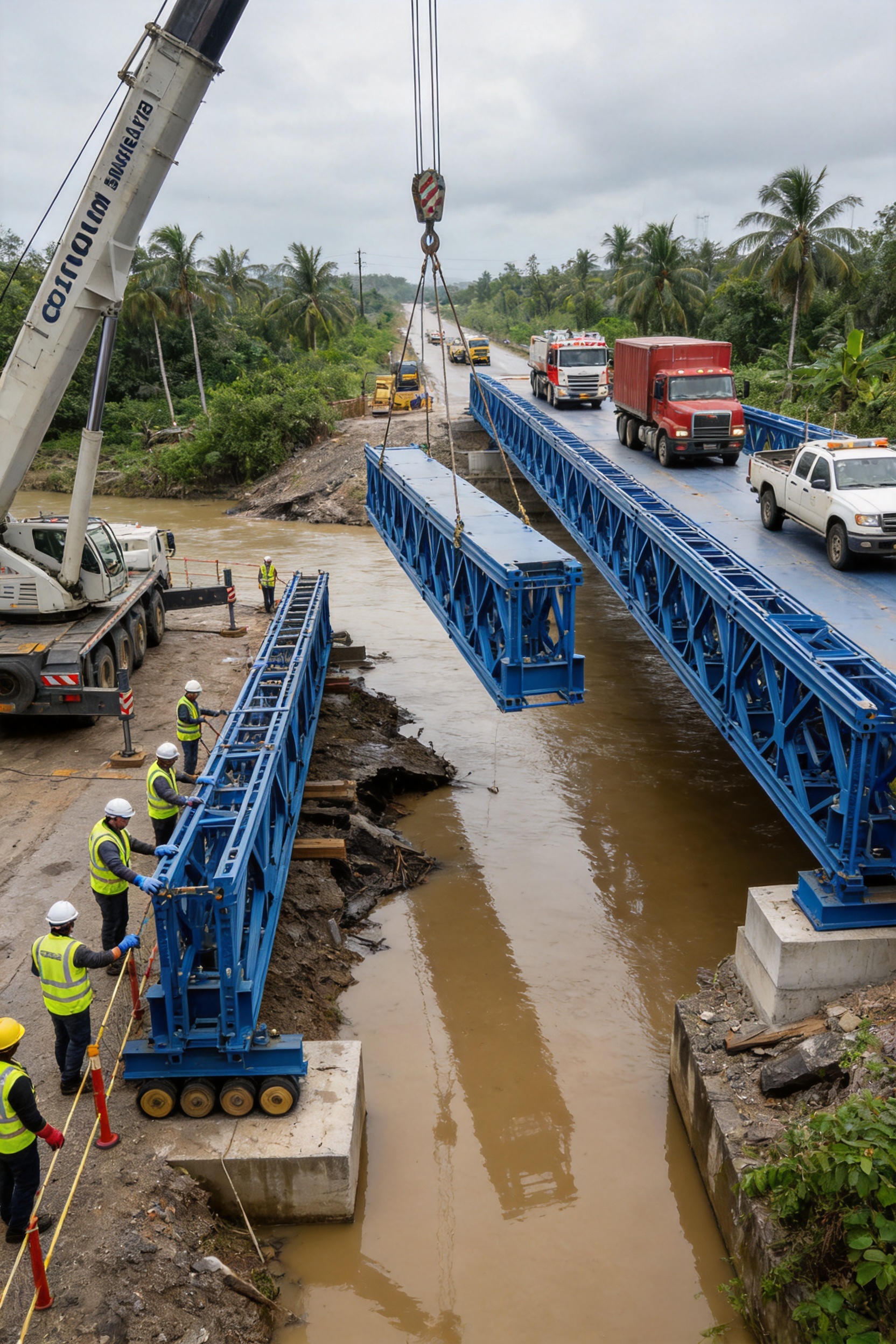
Modern infrastructure projects increasingly require bridge systems that can be delivered quickly, assembled efficiently, and adapted to changing site conditions. Conventional permanent bridges may require long design cycles, extensive foundations, specialized construction equipment, and significant investment before they can carry traffic. In contrast, a modular Bailey bridge provides a practical solution for temporary access, emergency transportation, construction logistics, rural connectivity, industrial transport, and permanent or semi-permanent infrastructure.
The CB100 triple-row single-layer reinforced painted Bailey bridge is designed for applications that require a strong, flexible, and rapidly deployable steel bridge system. Its reinforced three-lane arrangement combines the proven modular concept of Bailey bridge construction with increased structural capacity and a wider traffic platform. The result is a bridge solution that can support demanding vehicle movements while retaining the advantages of standardized components, repeatable fabrication, and efficient field assembly.
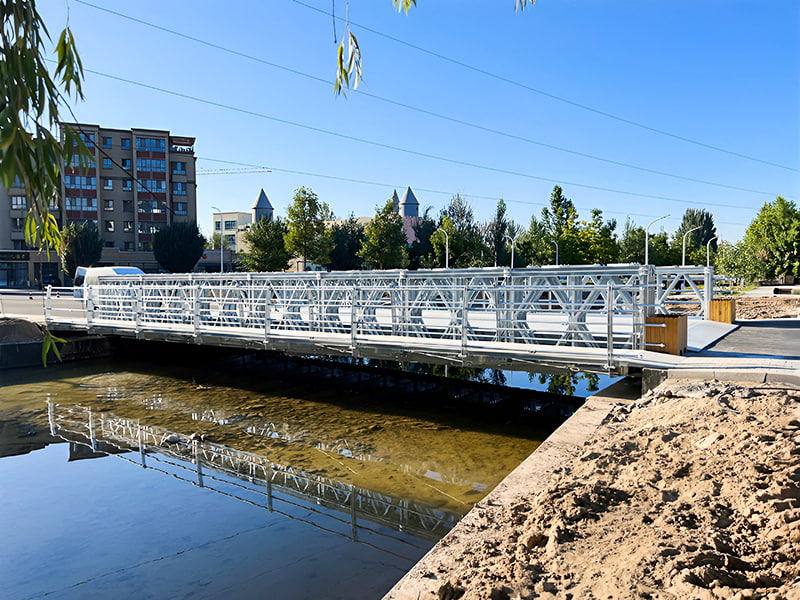
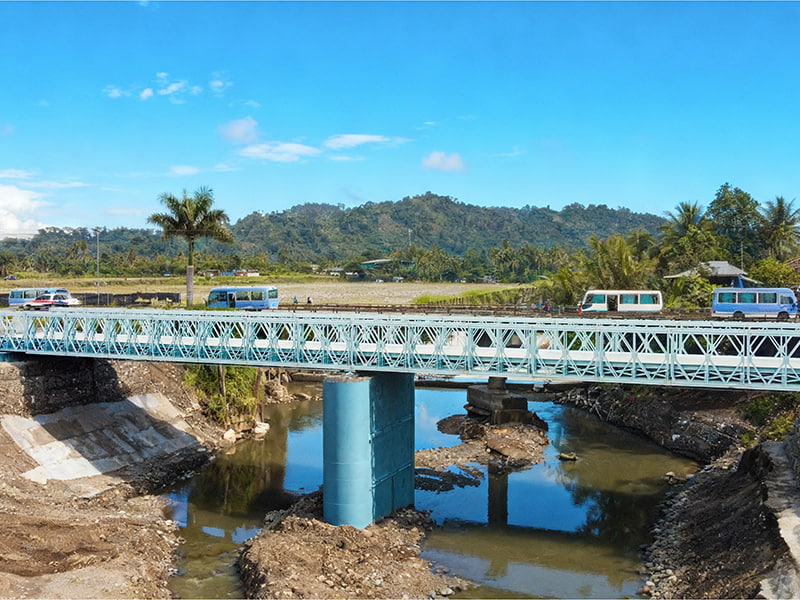
Produced by Jiangsu Zhonghai Bridge Equipment Co., Ltd., this type of bridge is engineered for projects that need reliable modular steel construction and adaptable installation options. The featured bridge is located in Guangdong, where a warm and humid climate can accelerate corrosion on exposed steel structures. Its paint-based corrosion-resistant treatment is intended to reduce the effects of moisture and environmental exposure while helping maintain structural serviceability and appearance over time.
The bridge is particularly suitable for projects involving construction traffic, emergency routes, flood-response access, industrial transportation, temporary detours, and areas where a conventional bridge would take too long to construct. Its modular design also allows the bridge length, support arrangement, deck configuration, and traffic organization to be adapted according to project requirements and engineering calculations.
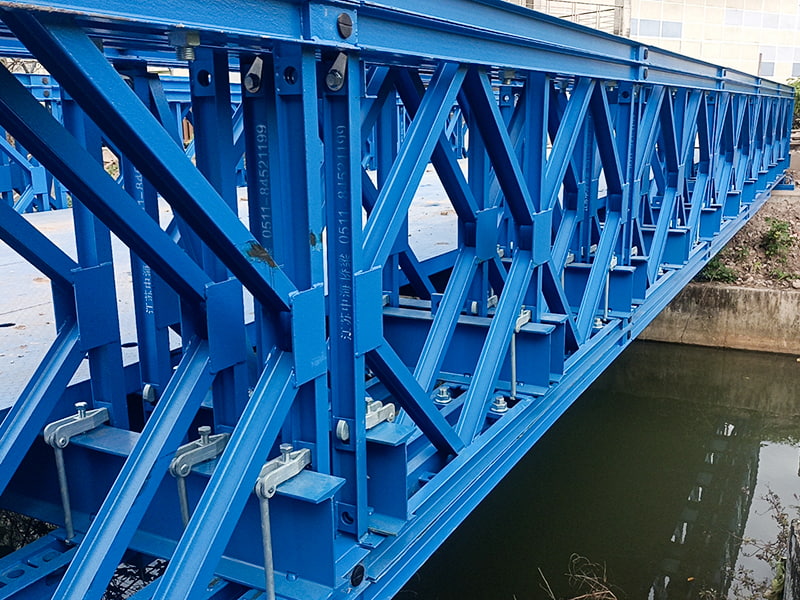
CB 100 Bailey Bridge Triple-Row Single-Layer Reinforced Painted Bailey Bridge
1. Understanding the CB100 Bailey Bridge Concept
A Bailey bridge is a modular steel bridge assembled from prefabricated components. Instead of manufacturing the entire bridge as one large structure, the system is divided into standardized panels, transoms, stringers, decks, bracing members, connection components, and supporting accessories. These elements can be transported to a project site and assembled in a planned sequence.
The CB100 designation identifies a specific type of modular Bailey bridge system. The structural arrangement described for this project is a triple-row, single-layer, reinforced configuration. “Triple-row” refers to the use of three parallel panel lines across the bridge width, increasing the amount of structural steel supporting the deck and traffic loads. “Single-layer” describes the vertical arrangement of the main panel system, while “reinforced” indicates that the basic configuration has been strengthened to meet a higher load or traffic requirement than a standard single-row arrangement.
This combination is valuable because it increases load-bearing potential without requiring the full height and complexity of a double-layer bridge. A single-layer reinforced solution can be more convenient where vertical clearance, transportation, erection time, or overall project cost must be controlled. At the same time, the triple-row layout distributes forces across multiple structural lines and provides a wider support base for the bridge deck.
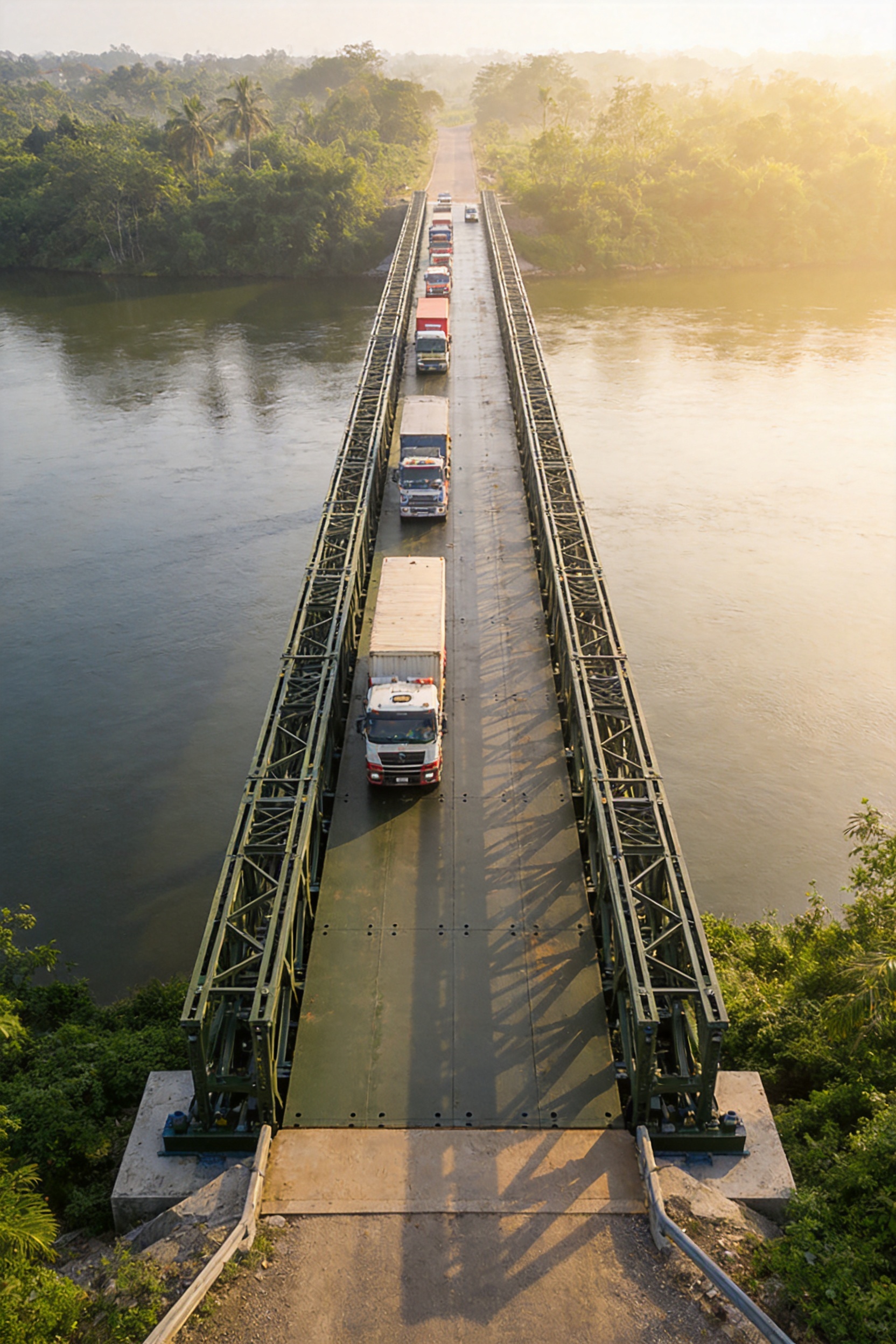
The CB100 bridge is not limited to one type of project. Depending on the span, foundation condition, traffic requirements, wind exposure, approach geometry, and local regulations, it may be used as a temporary bridge, a construction access bridge, an emergency crossing, a logistics route, or a semi-permanent modular structure. Each application still requires professional engineering review, but the underlying system provides a practical starting point for rapid bridge deployment.
1.1 Triple-row structural arrangement
The triple-row arrangement is one of the main features that distinguishes this bridge from lighter modular bridge configurations. Three longitudinal panel rows work together to support the bridge span. This arrangement can improve load distribution and provide greater resistance to bending and deformation when compared with a basic single-row structure of similar general dimensions.
A wider and stronger modular frame can be especially useful when the bridge must carry frequent vehicle movements rather than occasional light traffic. It can also provide additional structural reserve for construction equipment, loaded trucks, emergency vehicles, or other project-specific traffic, subject to the approved design calculations and operating restrictions.
The triple-row configuration may also support a broader deck arrangement. For a three-lane application, the usable width and traffic organization must be carefully designed to account for vehicle dimensions, lane separation, pedestrian safety, barriers, drainage, and access geometry. The bridge description identifies the system as a three-lane single-layer reinforced bridge, but final lane arrangements should always be confirmed through project drawings and site-specific engineering.
1.2 Single-layer reinforced design
A single-layer bridge can reduce the total structural height compared with a double-layer arrangement. This may simplify transportation, reduce interference with overhead utilities or temporary works, and make launching or lifting operations more manageable. The reinforced configuration adds structural capacity while preserving the relatively compact form of a single-layer modular bridge.
The design can be advantageous where a project must balance strength, construction speed, clearance, and cost. A taller bridge system may provide greater capacity in some cases, but it can also increase material use, handling requirements, erection complexity, and visual impact. The reinforced single-layer approach offers an efficient alternative when the calculated span and traffic loads are compatible with its capabilities.
2. Main Product Advantages
The CB100 triple-row single-layer reinforced painted Bailey bridge offers several advantages over less reinforced modular bridges, non-standard temporary structures, and conventional cast-in-place alternatives. These advantages are related to structural arrangement, manufacturing consistency, installation efficiency, surface protection, adaptability, and lifecycle practicality.
2.1 High load-bearing potential for demanding traffic
The three parallel panel rows provide a stronger load path than a basic single-row Bailey bridge. Loads from vehicles and deck components are transferred through the deck system into transoms, stringers, panels, bracing members, bearings, and foundations. A properly designed triple-row configuration can distribute these forces more effectively and reduce the concentration of stress in individual components.
This makes the bridge suitable for projects in which traffic capacity is more important than minimum material consumption. Construction trucks, supply vehicles, emergency-response vehicles, and other heavy transport may require a bridge with greater structural capacity and improved operational confidence. The bridge’s load design is described as suitable for standards and vehicle classes such as HS-15, HS-20, HS-25, HL-93, and Track-50, subject to project-specific verification, span conditions, applicable codes, and operating controls.
It is important to understand that a load designation does not automatically establish one universal capacity for every bridge length or site. The final allowable load depends on span, support spacing, foundation settlement, wind conditions, deck details, connection quality, fatigue considerations, vehicle positioning, and other engineering factors. The value of the CB100 system is that its modular and reinforced structure can be configured and calculated for demanding applications rather than being restricted to light-duty access alone.
2.2 Efficient modular assembly
Modular construction is a major advantage when a bridge must be completed under a limited schedule. Standardized components can be manufactured before the site is ready, delivered in batches, and organized for assembly. This reduces the amount of cutting, drilling, welding, and fitting that must take place in the field.
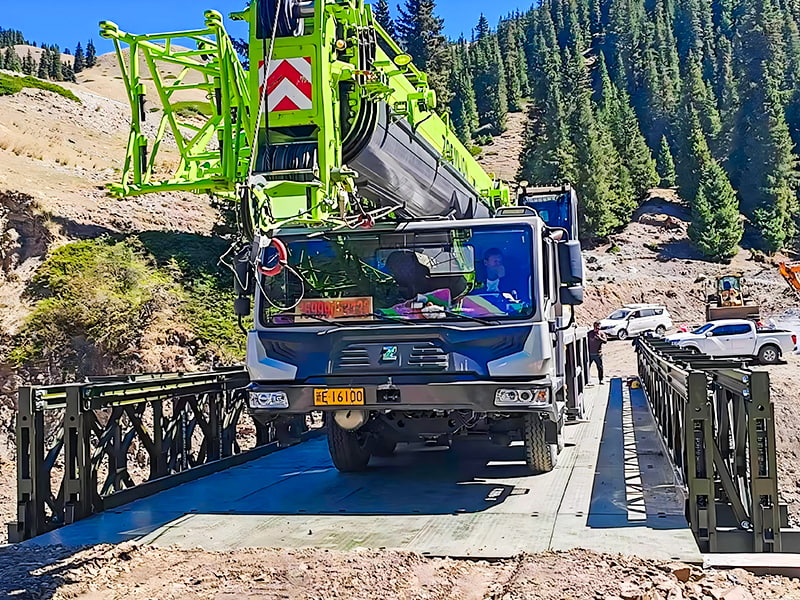
Compared with a bridge fabricated entirely on site, a modular Bailey bridge can reduce dependence on site-based production facilities. Assembly teams can work with repeatable components and predefined connection points. Where access and ground conditions permit, the bridge may be assembled using staged erection or incremental launching methods. The selected method depends on span, available equipment, river or road conditions, safety requirements, and the approved erection plan.
Efficient assembly also has economic benefits. Shorter construction periods can reduce labor costs, equipment rental, traffic disruption, and temporary site overhead. For emergency projects, the time saved may be even more significant because restoring a transportation connection can be essential to relief operations, medical access, supply delivery, and community recovery.
2.3 Adaptability to different project conditions
A modular bridge is not restricted to a single fixed length or location. The bridge can be configured using combinations of standard components, with the final arrangement determined by span requirements and engineering calculations. This adaptability allows a similar product platform to serve different road crossings, water channels, construction sites, industrial facilities, and temporary detours.
The system can also be customized in areas such as deck width, guardrails, approach connections, surface treatment, support details, access stairs, pedestrian provisions, and traffic control equipment. Customization is particularly important when the bridge must fit existing road geometry, uneven terrain, restricted transport routes, or specialized operational requirements.
Compared with a one-off steel bridge, a modular system can offer better repeatability. The basic components are already established, while project-specific elements can be adjusted around a proven structural concept. This balance between standardization and customization is one of the strongest competitive benefits of modular bridge engineering.
2.4 Paint-based corrosion-resistant treatment
Climate is a critical consideration in steel bridge performance. Guangdong’s warm and humid environment can expose steel to high moisture levels, rainfall, condensation, airborne contaminants, and seasonal weather changes. Without suitable surface protection, exposed steel may experience accelerated corrosion, especially at connection areas, edges, welds, drainage locations, and places where water can accumulate.
The featured bridge uses a paint-based corrosion-resistant process. A properly specified coating system creates a protective barrier between the steel substrate and the surrounding environment. Depending on the approved coating specification, the process may include surface preparation, primer application, intermediate coating, and finishing coats. Each stage contributes to adhesion, corrosion resistance, weatherability, and overall service performance.
Paint protection is also useful because it can be inspected, repaired, and renewed during the bridge’s service life. Damaged areas can be cleaned and recoated, allowing maintenance teams to address localized deterioration before it develops into a larger structural concern. The exact maintenance interval depends on coating quality, exposure conditions, traffic impact, inspection findings, and the project’s maintenance plan.
In comparison with untreated steel, painted steel is better prepared for humid and exposed environments. In comparison with some more complex protective systems, a paint-based treatment can provide practical application flexibility and easier field repair. The best result depends on correct surface preparation, coating compatibility, dry-film thickness, environmental control during application, and quality inspection.
2.5 Cost control through standardized components
Bridge cost is influenced not only by steel quantity but also by design time, fabrication, transport, site labor, equipment, foundations, traffic management, and maintenance. A standardized modular system can help control several of these cost categories simultaneously.
Factory production improves material planning and reduces the waste that can occur in uncoordinated site fabrication. Standard components can be produced in batches, inspected through established procedures, and packed according to the erection sequence. This can make procurement and project scheduling more predictable.
Modular reusability may provide an additional economic benefit. After a temporary project is completed, suitable components can potentially be inspected, repaired, recoated, and redeployed in another location. Reuse must be supported by condition assessment and engineering approval, but it can improve the long-term value of the bridge system.
3. Manufacturing Strengths Behind the Bridge System
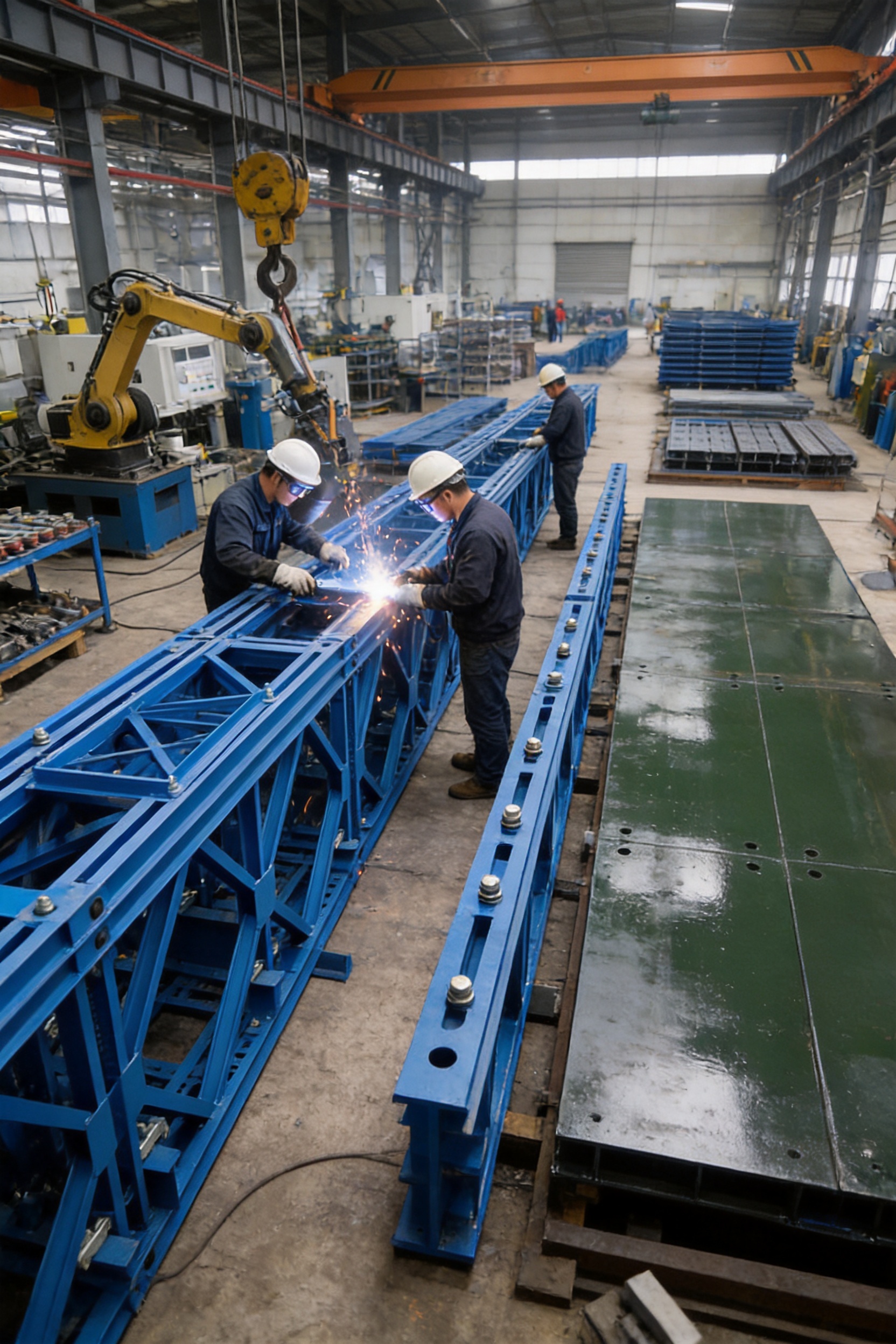
The performance of a modular bridge depends heavily on how consistently its components are designed, fabricated, inspected, protected, and delivered. Jiangsu Zhonghai Bridge Equipment Co., Ltd. integrates engineering design, precision manufacturing, quality management, and project support to produce modular steel bridge systems and associated structural components.
3.1 Industrial-scale production capability
Industrial-scale production provides advantages over small, highly improvised fabrication. A structured factory environment supports organized material flow, dedicated production areas, calibrated equipment, repeatable work instructions, and controlled inspection points. This is especially important for Bailey bridge components because the panels and connection elements must fit together accurately during field assembly.
Factory production also supports better scheduling for large or international orders. Components can be grouped, identified, inspected, painted, and packed according to project requirements. This reduces the risk of missing parts or incompatible batches when the bridge is assembled at a remote site.
Manufacturing capacity is particularly valuable for emergency response and infrastructure programs. Projects may require multiple bridge sets, replacement components, reinforcement parts, or supporting steel structures within a compressed timeframe. A manufacturer with organized production resources is better positioned to manage these requirements than a supplier dependent solely on ad hoc fabrication.
3.2 Engineering design and customization
Engineering design is the foundation of a successful modular bridge project. The manufacturer’s role may include selecting the appropriate configuration, preparing structural drawings, reviewing span and load requirements, developing component schedules, and coordinating fabrication details with site conditions.
Customization can include adjustments to bridge width, panel arrangement, deck design, approach interfaces, support conditions, access systems, and protective coating specifications. The purpose of customization is not to replace engineering discipline with unlimited variation. Instead, it allows standardized modular principles to be adapted responsibly to the needs of a particular project.
Professional design review should consider dead loads, live loads, impact effects, braking forces, wind, temperature, seismic conditions where applicable, fatigue, vibration, differential settlement, bearing behavior, lateral stability, connection forces, and erection-stage stability. Temporary bridges can be exposed to demanding conditions during construction, and the bridge must be assessed for both completed and partially assembled states.
3.3 Precision steel fabrication
Precision fabrication helps ensure that panels, bracing members, transoms, stringers, and connection components meet the intended dimensions and tolerances. Accurate fabrication is important because modular bridges depend on the compatibility of repeated parts. Small inconsistencies can become significant when many components are connected across a long span.
Fabrication activities may include plate cutting, section preparation, drilling, fit-up, welding, straightening, dimensional inspection, surface preparation, coating, marking, and packing. The use of standardized workflows helps reduce variation between production batches and provides a clear sequence for quality control.
Connection holes and bearing surfaces deserve particular attention. Correct alignment supports efficient field assembly and helps maintain the intended force transfer through pins, bolts, and other connection devices. Welded assemblies must also be controlled to reduce distortion and confirm that the completed component meets the approved drawing requirements.
3.4 Automated welding and controlled production
Automated welding can improve consistency in repetitive fabrication operations. When suitable for the component geometry, automated systems can maintain stable travel speed, welding parameters, and bead placement. This can help improve productivity while reducing some of the variability associated with purely manual processes.
Automation does not eliminate the need for skilled personnel. Welding procedure qualification, fit-up control, consumable management, preheating where required, interpass control, visual inspection, and non-destructive testing remain important. Automated equipment must be correctly programmed, maintained, and monitored to produce reliable results.
The combination of automation and experienced technical staff provides a balanced manufacturing approach. Repetitive tasks benefit from machine consistency, while engineers, welders, inspectors, and production managers address complex details and verify that the finished components meet project requirements.
3.5 Quality management
Quality management should begin with incoming materials and continue through final packing. Steel grades, certificates, dimensions, welding consumables, bolts, pins, coatings, and other products should be checked against approved specifications. Traceability helps connect the finished bridge components to their material and production records.
In-process inspection can include dimensional checks, fit-up verification, weld inspection, hole alignment checks, surface preparation assessment, coating thickness measurement, and visual examination. Final inspection confirms that components are complete, correctly marked, protected from transport damage, and ready for installation.
The company reports experience with manufacturing according to ASTM, EN, and national specifications. The applicable standard for a particular project should be agreed during design and procurement. Compliance is not only a matter of selecting a standard name; it also involves using the correct material requirements, fabrication procedures, inspection criteria, design assumptions, and documentation.
4. Surface Protection for Warm and Humid Regions
The corrosion protection of a painted Bailey bridge depends on more than the visible color of the final coat. The complete process includes steel preparation, environmental control, primer compatibility, coating thickness, edge treatment, curing, handling, transport protection, and maintenance planning.
4.1 Surface preparation
Before paint is applied, the steel surface must be prepared to remove mill scale, rust, oil, dust, moisture, weld spatter, and other contaminants. The required preparation grade should be established in the coating specification. Adequate preparation creates a clean and suitably profiled surface for coating adhesion.
Edges, corners, bolt holes, welds, and narrow gaps may require special attention because coatings can become thinner or discontinuous in these locations. Stripe coating of edges and welds may be used as part of a suitable coating system. The exact process should be determined by the approved technical specification and environmental exposure category.
4.2 Multi-stage coating approach
A paint system commonly uses multiple layers, with each layer serving a particular purpose. The primer bonds to the prepared steel and provides initial corrosion protection. An intermediate coat may build thickness and strengthen the barrier. The finishing coat can improve weather resistance, appearance, color consistency, and resistance to ultraviolet exposure.
Coating products must be compatible with one another and applied within the manufacturer’s specified recoat intervals. Temperature, humidity, dew point, ventilation, and cleanliness can affect application quality. Factory application allows these conditions to be controlled more effectively than open-site painting, although touch-up work may still be required after transport and assembly.
4.3 Inspection and maintenance
Coated bridge components should be inspected before shipment, after delivery, during erection, and at planned service intervals. Areas exposed to vehicle impact, standing water, abrasion, drainage leakage, and connection movement should receive particular attention.
Maintenance normally involves cleaning, identifying coating damage, removing corrosion products, preparing the affected area, and applying compatible repair coats. A written inspection schedule can help owners track coating condition and prioritize repairs. In a humid climate, preventive maintenance is generally more economical than waiting until corrosion has affected large areas or structural connections.
5. Site Assembly and Installation Considerations
The modular nature of the CB100 bridge can simplify installation, but successful erection still requires careful planning. The bridge should be assembled by qualified personnel under an approved method statement that addresses equipment, lifting, temporary stability, connection procedures, traffic control, and weather conditions.
5.1 Site investigation
Before assembly begins, the project team should confirm the span, alignment, ground conditions, water levels, access routes, working platforms, foundation locations, and approach roads. Existing utilities, overhead lines, adjacent structures, navigation requirements, and environmental restrictions should also be considered.
Foundation and bearing conditions are essential. A strong superstructure cannot perform safely if its supports are undersized, unstable, uneven, or vulnerable to scour. The support design should account for vertical reactions, horizontal forces, braking loads, wind, construction-stage effects, and possible settlement.
5.2 Component organization
Because a Bailey bridge contains many repeated parts, organized logistics are important. Components should be checked against the packing list, identified by type, and placed in an order that supports the erection sequence. Damage, deformation, missing pins, coating defects, or incorrect parts should be reported before installation.
Good component organization reduces lifting time and minimizes the risk of connecting incompatible or incorrectly oriented members. It also improves worker safety by reducing unnecessary movement around the assembly area.
5.3 Erection methods
Depending on the site, the bridge may be assembled through staged lifting, incremental launching, or another approved method. Incremental launching can be useful where access beneath the span is limited, such as over a river, roadway, railway, or deep excavation. The bridge is assembled on one side and moved progressively into position, often with temporary launching equipment and a suitable nose arrangement.
Lifting may be appropriate where cranes can safely access both the assembly area and the supports. The lifting plan must verify crane capacity, ground bearing, rigging arrangements, component weights, lifting points, wind limitations, and exclusion zones.
During erection, the partially assembled bridge may have a different structural behavior from the completed bridge. Temporary bracing, erection rollers, supports, launching noses, and connection controls may be necessary. Workers should never assume that a structure is stable simply because the main panels appear connected.
5.4 Connection control
Connections are central to modular bridge performance. Pins, bolts, bracing connections, deck fasteners, and bearing interfaces must be installed according to the approved drawings and procedures. Components should be seated correctly, and locking or retaining devices should be checked before the bridge is loaded.
Connection inspection should include alignment, seating, tightening where applicable, pin retention, visible damage, and correct installation of bracing members. A documented inspection record can provide evidence that the bridge was assembled in accordance with the approved method.
5.5 Commissioning and load control
Before opening the bridge to traffic, the project team should complete a final inspection of the deck, barriers, drainage, approaches, bearings, connections, and safety signage. The bridge may require a controlled load test or proof-load procedure if specified by the design engineer or applicable regulations.
Operating controls can include speed limits, lane restrictions, vehicle spacing, traffic direction, axle-load limits, and restrictions on simultaneous heavy vehicles. These controls are not signs of a weak bridge; they are normal tools for managing the interaction between the bridge structure and the traffic environment.
6. Applications for the Reinforced Modular Bridge
The CB100 bridge can support a wide range of infrastructure and industrial applications. Its value is greatest where speed, flexibility, and load capacity must be combined.
6.1 Emergency and disaster-response access
Floods, landslides, earthquakes, storms, and other disasters can damage or isolate roads and bridges. A modular bridge can provide a rapid replacement route for emergency vehicles, rescue teams, food, fuel, medical equipment, and reconstruction materials.
The reinforced three-lane arrangement may be particularly useful when emergency logistics require more than a narrow one-way crossing. It can help separate traffic movements or provide additional working width, subject to the project design and site conditions.
6.2 Construction access
Large infrastructure projects often need temporary crossings before the permanent road or bridge is complete. Construction vehicles may need to cross rivers, drainage channels, rail corridors, excavations, or existing roads. A modular Bailey bridge can provide an access route that is faster to deploy than a permanent reinforced-concrete structure.
Its reusable components may also be relocated as construction phases change. This can reduce the need to build multiple temporary roads and crossings, supporting more efficient project logistics.
6.3 Rural and remote connectivity
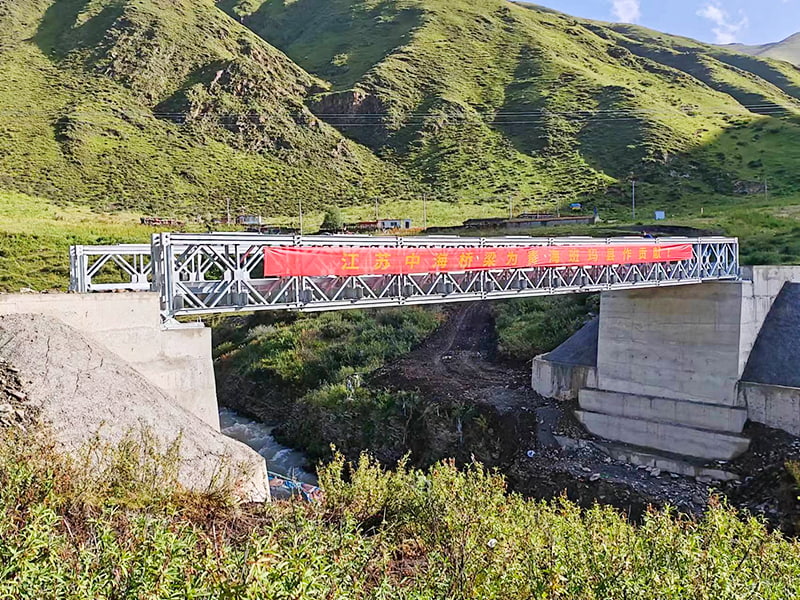
Remote communities and rural areas may face long delays when conventional bridge construction is difficult because of limited equipment, difficult terrain, seasonal water levels, or restricted budgets. A modular bridge can provide a practical connection for agricultural vehicles, public transport, supply trucks, and local traffic.
Transport planning remains important because bridge components must reach the site. However, standardized steel members can often be shipped in manageable loads and assembled using locally available equipment supplemented by specialist support.
6.4 Industrial and mining transportation
Industrial sites, quarries, mines, energy projects, and logistics facilities may require temporary or semi-permanent crossings for heavy vehicles and equipment. The reinforced CB100 arrangement can be evaluated for project-specific loads, traffic cycles, and environmental exposure.
Industrial applications may also require special deck surfaces, barriers, drainage, lighting supports, inspection walkways, or corrosion protection. Modular design allows these requirements to be incorporated into the project solution rather than forcing the owner to use an inflexible standard bridge.
6.5 Military and strategic logistics
Modular bridge systems have long been associated with rapid deployment and logistical flexibility. A bridge that can be transported, assembled, reinforced, and relocated can support temporary routes and operational access where speed and adaptability are critical.
Any defense or strategic application must be designed according to the responsible authority’s security, load, transport, and deployment requirements. The general advantage remains the same: standardized components can create a usable crossing without waiting for a conventional permanent structure.
7. Comparison with Alternative Bridge Solutions
Every bridge type has an appropriate application. The advantages of a CB100 modular bridge become clearer when it is compared with common alternatives.
| Evaluation Factor | CB100 Triple-Row Single-Layer Bailey Bridge | Basic Single-Row Modular Bridge | Conventional Cast-in-Place Bridge | Light Temporary Access Structure |
|---|---|---|---|---|
| Deployment speed | High, because components are prefabricated and assembled on site | High for light-duty applications | Usually lower because of foundations, formwork, curing, and extensive site work | High, but often limited by load and span |
| Load potential | High for a modular system when properly configured and engineered | Moderate, depending on span and reinforcement | High, with extensive design flexibility | Low to moderate |
| Adaptability | High, with configurable spans, widths, and accessories | Moderate to high | Lower after construction because the structure is generally fixed | Moderate |
| Field fabrication requirement | Relatively low | Relatively low | High | Low |
| Reuse potential | High when components are inspected and maintained | High | Low after demolition or major modification | Moderate |
| Climate protection | Paint-based corrosion-resistant treatment suitable for planned maintenance | Depends on supplier and coating specification | Concrete provides different protection but includes its own durability considerations | Often limited unless specially protected |
| Best suited applications | Heavy temporary access, emergency routes, construction logistics, and adaptable transport crossings | Light or moderate traffic crossings | Long-term permanent infrastructure with sufficient construction time and budget | Light, short-term access and pedestrian or service use |
A conventional bridge may remain the best option where a permanent structure is required, traffic volumes are very high, aesthetics are central, or the project allows a long construction schedule. However, the conventional approach may not be economical or practical for emergency routes, temporary detours, construction access, or locations with uncertain future requirements.
Compared with a basic single-row Bailey bridge, the triple-row reinforced CB100 configuration is better positioned for higher traffic demand and more challenging load requirements. Compared with a light temporary bridge, it offers a stronger structural platform and broader potential applications. Compared with a one-off site-fabricated steel structure, it benefits from standardized components and a repeatable manufacturing process.
8. International Engineering and Delivery Experience
A bridge supplier’s value is measured not only by its factory output but also by its ability to support projects across different regions. Jiangsu Zhonghai Bridge Equipment Co., Ltd. has supplied products for domestic and international engineering applications involving transportation, water conservancy, military logistics, disaster relief, and international development.
Reported project experience includes coastal engineering in the Maldives, temporary access bridges associated with the Shenzhen–Zhongshan Corridor, structural components for the Hangzhou Expo Center, multi-span Bailey bridges for the Lalin Railway, and flood-response bridge deployments in different regions. These examples indicate experience with varied project environments, transport conditions, and structural requirements.
International delivery requires more than manufacturing. It involves export packing, component identification, documentation, shipping coordination, technical communication, installation guidance, and after-sales support. Modular bridge components must arrive in a condition that allows the assembly team to identify and use them efficiently, even when the project site is far from the manufacturing facility.
Experience across different markets can also improve the manufacturer’s understanding of varied standards, climate conditions, logistics practices, and client expectations. The company states that its products are manufactured in accordance with ASTM, EN, and national specifications, with the final standard selected according to project requirements.
9. Selecting the Correct Configuration
Although the CB100 triple-row single-layer reinforced bridge offers strong capabilities, selecting the correct configuration requires a structured engineering process. Buyers should provide accurate project information so that the bridge can be designed and priced appropriately.
9.1 Essential project information
Important information includes the required clear span, total bridge length, deck width, number of lanes, design vehicle, traffic frequency, target service period, site elevation, foundation conditions, water levels, flood velocity, wind exposure, approach alignment, and construction method.
For temporary projects, the owner should also identify the expected removal date, potential relocation requirements, storage conditions, and whether the bridge will be reused. For permanent or semi-permanent applications, the owner should provide a lifecycle maintenance plan and confirm local approval requirements.
9.2 Load and traffic requirements
Vehicle classification should be considered carefully. A bridge designed for occasional trucks may not be suitable for continuous heavy haulage without additional fatigue and operational review. Traffic lanes, vehicle spacing, braking behavior, pedestrian movement, and emergency access can all affect the design.
The listed standards, including HS-15, HS-20, HS-25, HL-93, and Track-50, provide useful reference points for discussing design requirements. The final design should identify the governing load model and confirm how it applies to the selected span, lane arrangement, impact factor, and national approval system.
9.3 Environmental exposure
In humid, coastal, industrial, or chemically aggressive environments, the coating system should be selected according to the exposure category. Drainage and detailing are also important because water retention can create localized corrosion even when the overall coating is suitable.
Owners should ask for information about surface preparation, paint products, coating thickness, inspection records, touch-up procedures, and recommended maintenance intervals. These details help establish realistic expectations for service life and future operating cost.
10. Safety, Inspection, and Long-Term Operation
A modular steel bridge should be treated as an engineered structural asset rather than a simple temporary product. Safe operation depends on design, fabrication, erection, inspection, traffic management, and maintenance working together.
10.1 Routine inspection
Routine inspections should check panels, transoms, stringers, bracing members, deck plates, barriers, bearings, pins, bolts, welds, drainage points, and coating condition. Inspectors should look for deformation, cracking, loose connections, corrosion, impact damage, unusual vibration, water accumulation, and foundation movement.
Inspection frequency should reflect the bridge’s exposure and use. A heavily trafficked bridge in a humid climate may require more frequent review than a lightly used bridge in a dry environment. Inspections should also be performed after flooding, vehicle impact, extreme weather, or any event that could affect structural performance.
10.2 Traffic management
Clear signs and operating rules help preserve the bridge’s safety and service life. Speed limits reduce dynamic impact. Lane controls prevent vehicles from occupying unsafe positions. Weight restrictions prevent loads beyond the design basis. Barriers and edge protection help prevent vehicles from leaving the deck.
For a three-lane bridge, traffic organization should be especially clear. Depending on the site, the owner may use two-way traffic, one-way traffic with passing controls, dedicated heavy-vehicle lanes, or separate pedestrian facilities. The selected arrangement should be compatible with the structural design and road safety plan.
10.3 Maintenance planning
Maintenance should include cleaning, tightening or replacing approved connection components where required, repairing damaged coatings, clearing drainage paths, checking approach settlements, and monitoring bearings and supports. Early attention to small defects can prevent more expensive repairs.
Replacement components should match the approved design and material requirements. Improvised modifications, unauthorized welding, drilling, or cutting can change the structural behavior and should not be performed without engineering approval.
11. Why the Manufacturing Partner Matters
Choosing a modular bridge manufacturer is a strategic decision because the supplier influences the project from initial design through installation and future maintenance. A low purchase price does not necessarily represent the lowest total project cost if the components are inconsistent, documentation is incomplete, delivery is unreliable, or technical support is unavailable.
A capable manufacturing partner should be able to discuss the project’s structural requirements, explain configuration options, provide component schedules, coordinate coating specifications, prepare shipping documentation, and support the erection team. The manufacturer should also communicate clearly about what is included in the supply scope and what must be provided by the contractor or owner.
Jiangsu Zhonghai Bridge Equipment Co., Ltd. positions itself as an engineering and manufacturing partner rather than only a product trader. Its stated capabilities include modular steel bridges, Bailey bridge systems, customized steel components, bridge erection and construction support equipment, automated welding, and precision steel fabrication.
This integrated capability can simplify procurement. Instead of coordinating separate suppliers for design, structural panels, special components, coating, and technical support, a client may be able to manage more of the project through one experienced source. The benefits can include improved interface coordination, consistent documentation, and clearer accountability.
The company’s location in Zhenjiang, Jiangsu Province, provides access to China’s industrial and transportation networks. This can support material procurement, factory logistics, domestic transportation, and international shipment planning. For overseas clients, effective communication and export coordination are as important as the physical bridge components.
12. Project Value from Design to Delivery
The complete value of the CB100 bridge is found in the combination of structural capacity, manufacturing quality, protective treatment, installation efficiency, and long-term adaptability. Each feature addresses a practical challenge faced by infrastructure owners.
The reinforced triple-row structure responds to heavier traffic requirements. The single-layer arrangement helps control structural height and erection complexity. Modular components support rapid assembly and potential reuse. Paint-based corrosion protection addresses the humid Guangdong climate and provides a maintainable barrier system. Factory fabrication improves consistency, while customization allows the bridge to fit different sites and operating conditions.
These benefits can help owners reduce the time between procurement and traffic opening. They can also reduce the amount of specialized field fabrication and improve predictability in project scheduling. For emergency and construction applications, this practical efficiency can be more valuable than a solution optimized only for permanent architectural appearance.
The bridge is also compatible with a wide range of project delivery models. It may be purchased as a complete bridge system, supplied as a component package, or integrated into a broader engineering and construction contract. The required level of technical support should be established at the beginning of the project.
13. Frequently Asked Questions
Q1: What is a triple-row single-layer reinforced Bailey bridge?
It is a modular steel bridge using three parallel rows of main structural panels arranged in a single vertical layer. The reinforced arrangement provides greater load-bearing potential than a basic single-row configuration while retaining the relatively compact height and efficient assembly benefits of a single-layer bridge.
Q2: What types of traffic can the CB100 bridge support?
The bridge can be engineered for vehicle traffic requirements associated with load references such as HS-15, HS-20, HS-25, HL-93, and Track-50. The actual allowable traffic depends on span, deck arrangement, support conditions, design calculations, applicable standards, and operating restrictions. The design vehicle and expected traffic frequency should be confirmed before production.
Q3: Is the bridge suitable for three lanes?
The featured product is described as a three-lane bridge. The final traffic layout must be verified by the project engineer because usable width, barriers, pedestrian provisions, vehicle dimensions, lane separation, and structural loading all affect the design. Three-lane operation may be arranged as two-way traffic, controlled one-way traffic, or another approved configuration.
Q4: Why is a single-layer reinforced bridge useful?
A single-layer reinforced bridge can provide increased capacity without the additional height of a double-layer arrangement. This may help where vertical clearance, transport limits, installation equipment, or project cost must be controlled. The suitability of the configuration depends on the required span and load.
Q5: How does the paint-based corrosion-resistant treatment help in Guangdong?
The coating system forms a protective barrier over the steel and helps reduce exposure to moisture and environmental contaminants. This is important in warm and humid regions. Long-term performance also depends on surface preparation, coating quality, drainage, inspection, and timely repair of damaged areas.
Q6: Can the bridge be reused after a temporary project?
Modular components are generally well suited to relocation and reuse. Before redeployment, the components should be inspected for deformation, cracking, corrosion, coating damage, worn connection areas, and other defects. Reuse must be approved through an engineering assessment and may require repair or recoating.
Q7: How quickly can a modular Bailey bridge be installed?
Installation time varies according to span, site access, foundation readiness, erection method, equipment, weather, workforce, and traffic-control requirements. Modular prefabrication can significantly reduce field construction time compared with cast-in-place alternatives, but a safe installation plan and properly prepared supports remain essential.
Q8: Does the manufacturer provide customized bridge solutions?
Yes. The company specializes in modular bridge systems, customized steel components, structural fabrication, and construction support equipment. Customization may involve span, width, deck components, support details, barriers, coating, and other project-specific requirements. All modifications should be developed through engineering review.
Q9: Which standards can be used for the bridge design?
The company reports manufacturing experience related to ASTM, EN, and national specifications. The governing standard should be agreed by the owner, designer, contractor, and approving authority. The bridge should be designed, fabricated, inspected, and documented consistently with that selected standard.
Q10: What information should a buyer provide when requesting a quotation?
A buyer should provide the required span, bridge length, width, lane arrangement, design loads, traffic type, site location, environmental conditions, foundation information, erection method, project schedule, corrosion-protection requirements, and desired technical support. Accurate information helps the manufacturer recommend a suitable configuration and prepare a more reliable quotation.
Q11: Can the bridge be used as a permanent structure?
A modular Bailey bridge can serve temporary, semi-permanent, or selected permanent applications when it is designed, approved, maintained, and operated for the intended service period. The owner should confirm local codes, durability requirements, inspection obligations, fatigue considerations, foundation design, and lifecycle expectations before selecting it for permanent use.
Q12: What makes this bridge different from a light temporary crossing?
The triple-row reinforced structural arrangement is intended for higher load-bearing potential than a light access bridge. It also offers a broader range of possible applications, including construction logistics, emergency routes, industrial transportation, and demanding vehicle traffic. Final performance still depends on the approved project configuration.
14. Conclusion
The CB100 triple-row single-layer reinforced painted Bailey bridge is a practical modular solution for projects that require capacity, speed, adaptability, and controlled cost. Its three-row structure provides a stronger load path than basic lightweight configurations, while the single-layer arrangement helps maintain a relatively compact and efficient form. The system can be considered for heavy temporary access, emergency response, construction transport, rural connectivity, industrial logistics, and other infrastructure applications.
Its paint-based corrosion-resistant treatment is especially relevant to the warm and humid conditions of Guangdong. When combined with proper drainage, inspection, and maintenance, the coating helps protect the steel and support reliable service. The modular construction approach also allows components to be transported, assembled, modified, and potentially reused more efficiently than many conventional bridge alternatives.
The manufacturing strength behind the product is equally important. Engineering design, industrial-scale production, precision steel fabrication, automated welding, standardized workflows, quality management, and international delivery experience help create a bridge system that is more consistent and easier to integrate into real projects.
For owners and contractors, the most important step is to match the bridge configuration with actual site conditions and traffic requirements. Span, load, foundation, erection method, climate, maintenance, and local approval requirements must all be evaluated. With proper engineering and professional installation, the CB100 modular bridge can provide a fast, durable, and flexible connection for infrastructure projects in China and around the world.
References
1. Manufacturer-provided product information for the CB100 triple-row single-layer reinforced painted Bailey bridge.
2. Manufacturer-provided company profile and technical capability statement for modular steel bridge systems and structural components.
3. American Association of State Highway and Transportation Officials, bridge design and vehicle loading guidance.
4. American Society for Testing and Materials, standards relating to structural steel materials, fabrication, coatings, and inspection.
5. European Committee for Standardization, Eurocode guidance for steel structures, bridge actions, and structural design.
6. International Organization for Standardization, quality management and corrosion-protection principles for manufactured steel structures.
7. General engineering practice for modular bridge erection, temporary works, connection inspection, traffic management, and structural maintenance.
Product: CB 100 Bailey Bridge Triple-Row Single-Layer Reinforced Painted Bailey Bridge


We respond quickly to all international requests and provide technical support when needed.
Product Category
Bailey Bridge/Modular Bridge Modular Steel Bridge Pedestrian Bridge Modular Pipe Bridge Truss Bridge Steel StructureContact Us

+86-511-84522866
+86-13921582699

zhwm@zjql.com

Building 1,83#, dantu New Town, Yanjiang Road, Dantu District, Zhenjiang, Jiangsu, China
Copyright © Jiangsu Zhonghai Bridge Equipment Co., Ltd. All
Rights
Reserved
China bailey bridge for sale
bailey bridge supplier from china
