
 English
 русский
 Español
 Português


Luo Shiqing — Product After-Sales Service Supervisor
Concert Stage Support Frames: Engineering Reliable, Reusable Structures for Large Events
Content
- 1 1. The Role of a Stage Support Frame in Concert Production
- 2 2. Product Overview
- 3 3. Engineering Advantages Over Improvised or Non-Standard Alternatives
- 4 4. Structural Design Considerations
- 5 5. Manufacturing Process and Quality Control
- 6 6. Manufacturing Strengths of the Supplier
- 7 7. Performance Benefits for Event Contractors
- 8 8. Assembly, Disassembly, and Reuse
- 9 9. Safety and Compliance Considerations
- 10 10. Customization for Different Concert Applications
- 11 11. Maintenance and Long-Term Asset Management
- 12 12. Why Manufacturing Experience in Modular Steel Systems Matters
- 13 13. Project Delivery Process
- 14 14. Selecting a Suitable Stage Support Frame
- 15 15. Environmental and Economic Value
- 16 16. Application Experience and Industrial Capability
- 17 17. Recommended Documentation for a Professional Project
- 18 18. Practical Limitations and Responsible Use
- 19 19. Frequently Asked Questions
- 19.1 What is a concert stage support frame?
- 19.2 Is the frame suitable for outdoor concerts?
- 19.3 Can the frame be reused?
- 19.4 Can the dimensions be customized?
- 19.5 Does the system require field welding?
- 19.6 What equipment can the frame support?
- 19.7 How does the frame resist deformation?
- 19.8 What are the advantages over improvised steel supports?
- 19.9 What manufacturing capabilities support this product?
- 19.10 How should the frame be maintained?
- 19.11 Can the supplier support international projects?
- 19.12 What information should a customer provide for a quotation?
- 20 20. Conclusion
- 21 References
- 22 Product: Concert Stage Support Frame
Concerts, festivals, touring productions, and large public performances depend on temporary structures that must perform with the reliability of permanent infrastructure. A stage support frame is not merely a collection of steel members assembled behind a performance platform. It is an engineered load-bearing system that helps carry lighting equipment, audio systems, video screens, roof structures, scenic elements, access platforms, and other production components. When thousands of people gather around a stage, the support frame becomes an essential part of the event’s safety, efficiency, and visual presentation.
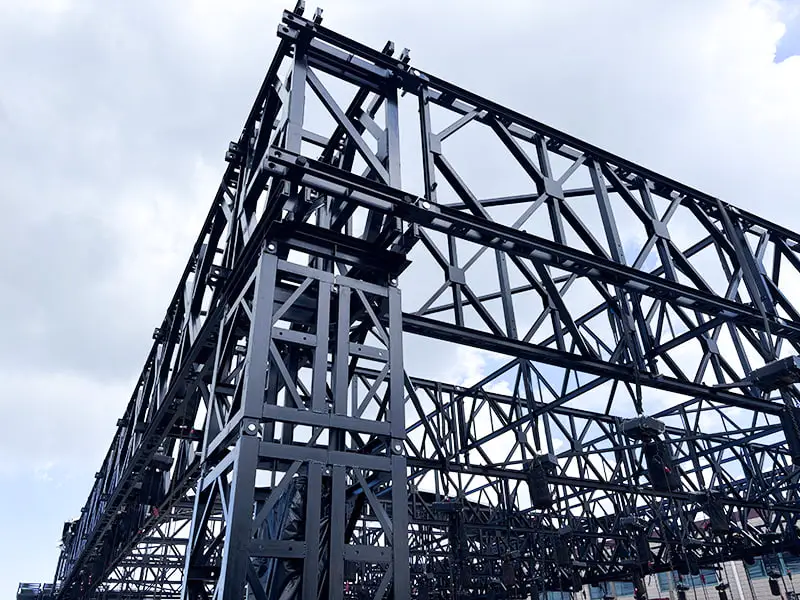
The Concert Stage Support Frame developed for the Sichuan Guiyang concert project is a custom-manufactured steel structure designed to provide dependable support for large concert stages. It combines high-strength steel fabrication, a stable structural arrangement, practical assembly features, and the adaptability required for temporary event construction. Its purpose is to deliver a solid foundation for stage equipment while allowing production teams to install, dismantle, transport, and reuse the system at different locations.
Manufactured by Jiangsu Zhonghai Bridge Equipment Co., Ltd., the frame reflects an engineering approach shaped by experience in modular steel bridges, Bailey bridge systems, structural components, and construction support equipment. Although concert staging has different functional requirements from bridge construction, both fields demand careful attention to load distribution, fabrication accuracy, connection quality, deformation control, transport planning, and rapid site assembly.
This article examines the design value, manufacturing process, performance advantages, application flexibility, and practical considerations associated with a custom concert stage support frame. It also explains why a professionally fabricated modular steel support system can offer important advantages over improvised, non-standard, or single-use alternatives.
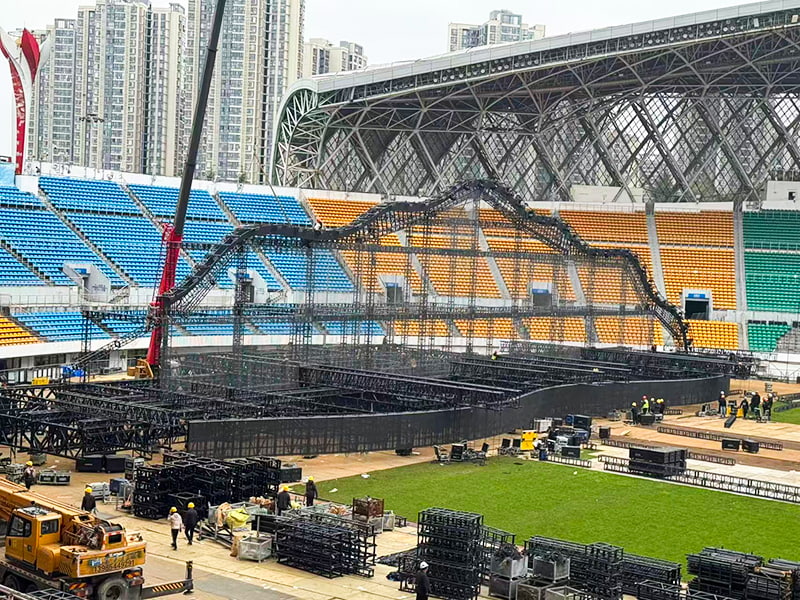
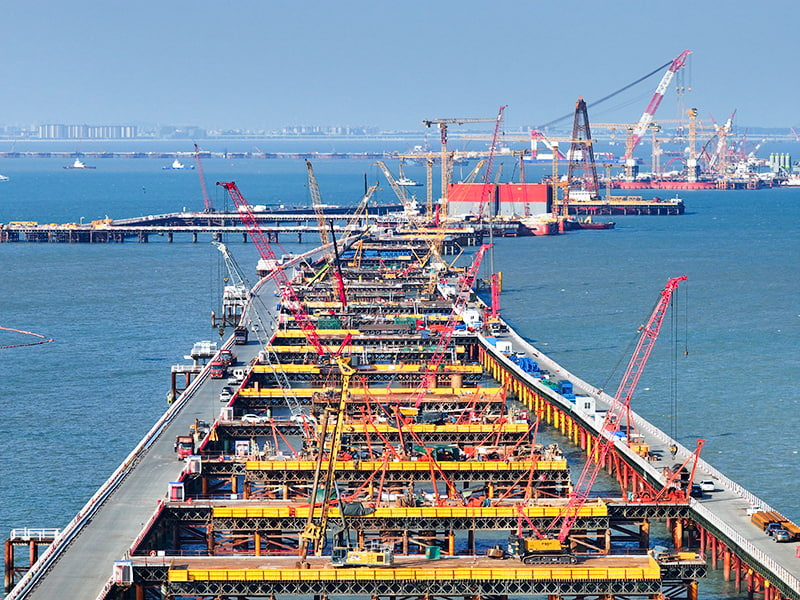
Concert Stage Support Frame
1. The Role of a Stage Support Frame in Concert Production
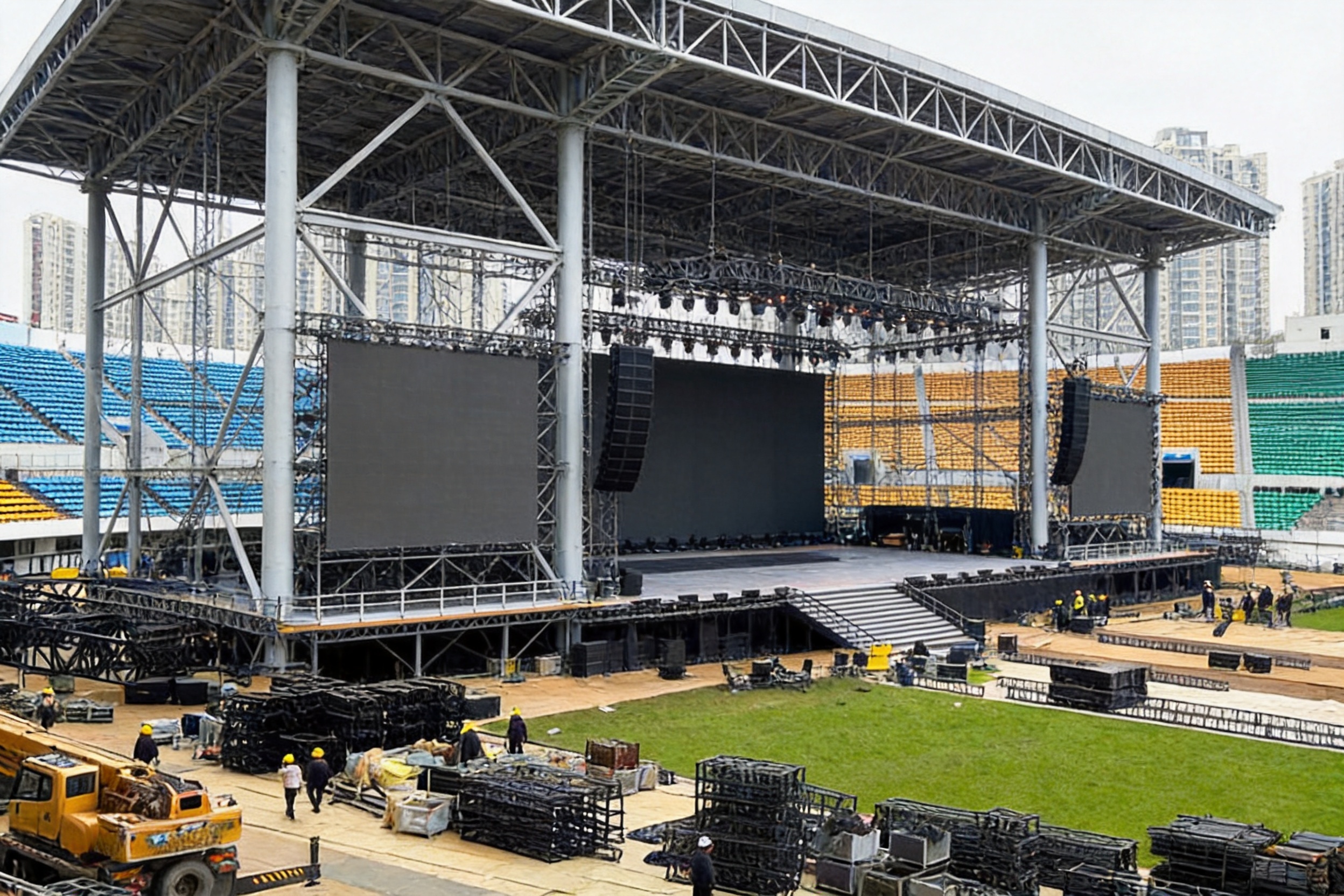
A concert stage is a coordinated system made up of many elements. The performance deck supports artists, instruments, production personnel, and movable equipment. Above or around the deck, a roof or truss may carry lighting fixtures, loudspeakers, display screens, banners, and mechanical equipment. Side towers may support line-array audio systems or video walls. Back-of-house structures may carry scenery, rigging points, and technical access platforms.
These components create vertical loads, horizontal loads, eccentric loads, and temporary dynamic effects. The support frame must transfer these forces safely to the foundations or bearing surfaces. It must also maintain the intended geometry of the stage, prevent excessive movement, and preserve adequate stability during setup, operation, weather exposure, and dismantling.
Unlike a permanent building, a concert stage is often constructed within a short schedule. The structure may be assembled in a stadium, open field, exhibition area, waterfront district, city square, or temporary event site. Site conditions can vary significantly from one venue to another. The support system therefore needs to be practical, adjustable, and suitable for repeated installation.
A well-designed stage support frame helps event contractors achieve several objectives:
• Create a stable structural base for the performance and production systems.
• Carry specified equipment and stage loads without unsafe deformation.
• Facilitate organized assembly with repeatable connection procedures.
• Reduce dependence on site-specific fabrication and welding.
• Support faster dismantling after the event.
• Allow the system to be transported and reused for future projects.
• Help reduce long-term construction costs through a durable modular design.
The frame must be considered as part of a complete stage system rather than as an isolated product. Final engineering verification should account for the actual roof arrangement, equipment positions, wind conditions, foundation design, connection details, and event-specific loading requirements.
2. Product Overview
The Concert Stage Support Frame is a custom steel structure manufactured to meet the requirements of a large-scale performance venue. It is produced using structural steel fabrication methods intended to deliver reliable load-bearing performance and controlled dimensional accuracy.
The overall frame is designed to provide strong support for stage structures and performance equipment. Its steel members work together through a coordinated arrangement of columns, beams, bracing, connection assemblies, and support points. Depending on the project configuration, the frame may be integrated with stage decks, roof trusses, equipment towers, access platforms, or other temporary event structures.
Its principal characteristics include structural solidity, high load-bearing capacity, resistance to deformation, practical assembly, convenient disassembly, and suitability for repeated use. These characteristics are particularly valuable to concert organizers, event contractors, rental companies, municipal event departments, exhibition operators, and construction teams that need a dependable support system for changing venues.
The frame is not limited to one fixed visual arrangement. A custom-manufactured structure can be configured according to the required stage width, height, equipment distribution, access requirements, and venue limitations. This allows the engineering team to address the differences between an outdoor festival stage, an indoor concert platform, a touring stage, and a temporary civic performance structure.
Core Product Characteristics
High-strength steel construction: Steel provides a favorable combination of strength, stiffness, durability, and fabrication flexibility. Properly selected and processed structural steel can support heavy equipment while maintaining a manageable member size and transport weight.
Stable load transfer: The frame is arranged to transmit loads through an organized structural path. This reduces the risk of isolated overstress and supports more predictable behavior during stage operation.
Deformation resistance: A rigidly coordinated frame with appropriate bracing helps control deflection and unwanted movement. This is important for lighting alignment, video screen positioning, roof integrity, and audience confidence.
Modular installation: Components can be manufactured in manageable sections and connected at the project site. This reduces the need for extensive field fabrication and can shorten the installation period.
Repeated use: The system is intended to be assembled, dismantled, transported, inspected, and reused. This supports more efficient asset management for event contractors and rental businesses.
Project-specific customization: Dimensions, connection arrangements, support points, and member configurations can be developed according to project requirements rather than forcing every venue to use a single standard layout.
3. Engineering Advantages Over Improvised or Non-Standard Alternatives
Temporary event structures are sometimes assembled using miscellaneous steel components, locally modified members, or systems that were not originally designed for the required loads. Such approaches may appear inexpensive at the beginning, but they can create difficulties in structural verification, installation quality, inspection, maintenance, and future reuse.
A professionally manufactured concert stage support frame offers a more controlled alternative. Its members are produced according to defined drawings, fabrication procedures, and quality requirements. The structural system can be reviewed before production, and the assembly sequence can be planned in advance. This increases predictability and helps reduce uncertainty during a time-sensitive event build.
More Predictable Structural Performance
Standardized engineering and fabrication allow the support frame to be assessed according to its intended loading conditions. The frame’s geometry, member sizes, connection locations, and bracing arrangements can be coordinated before delivery. This is different from adapting unverified components at the site, where unexpected gaps, misalignment, or inadequate reinforcement may affect performance.
Improved Dimensional Accuracy
Controlled factory production generally provides better dimensional consistency than extensive field cutting and welding. Accurate members fit together more efficiently, reduce installation adjustments, and help maintain the design geometry. This is especially important when the frame must connect to roof systems, stage decks, lighting trusses, stairs, handrails, or equipment towers.
Reduced Site Labor and Welding
When a structure is manufactured with prepared connection points and modular sections, site crews can focus on positioning, bolting, alignment, inspection, and final stabilization. Reducing field welding can lower the need for temporary power, welding shelters, fire control, and additional finishing work. It can also make the construction schedule easier to manage in crowded venues or adverse weather.
Better Reuse Economics
A single-use temporary structure generates a high cost every time a new frame must be designed and fabricated. A reusable modular frame distributes the original investment across multiple events. If components are properly labeled, inspected, protected, and stored, the same system can serve different venues and production programs over an extended service period.
More Professional Appearance
Concerts are highly visible public events. Structural components are often seen by audiences, broadcast cameras, sponsors, and venue operators. A professionally fabricated frame provides a cleaner appearance, consistent member geometry, and better coordination with stage architecture than a collection of mismatched temporary supports.
Adaptation to Different Venues
Concert production rarely takes place in identical locations. A modular structural approach makes it easier to adapt the support arrangement to different footprints and access conditions. Subject to engineering review, the system may be configured for different stage dimensions, equipment layouts, and site constraints.
4. Structural Design Considerations
The design of a concert stage support frame must begin with a clear understanding of the loads it will carry. The exact design values vary by project, and the final structure should be checked by qualified engineers. Nevertheless, several categories of load are commonly relevant.
Dead Loads
Dead loads include the self-weight of the steel frame, roof members, stage decking, permanent fixtures, walkways, handrails, equipment platforms, and attached components. These loads remain in place throughout the event and form the basic load case for the structural system.
Live Loads
Live loads may include performers, technicians, temporary equipment, movable scenery, cases, maintenance personnel, and other items that are present during setup or operation. Access routes and platforms must be considered carefully because people and equipment may be concentrated in specific areas.
Equipment Loads
Lighting systems, loudspeakers, LED screens, video equipment, follow spots, moving mechanisms, and rigging hardware can create significant concentrated loads. Their positions may also be eccentric in relation to the main support members. The frame must therefore be coordinated with the production equipment plan rather than designed independently of it.
Wind Loads
Outdoor stages are exposed to wind pressure and suction. Large screens, banners, roof coverings, and side panels can increase the effective wind area. Wind may also generate overturning forces and lateral movement. The support system, bracing, foundations, ballast, and anchorage must be reviewed as a complete stability system.
Dynamic Effects
Sound equipment, moving lighting, mechanical stage components, and crowd activity can introduce vibration or repeated movement. The frame should provide adequate stiffness and connection reliability to prevent excessive vibration or fatigue-related concerns during the intended service period.
Transport and Lifting Loads
Reusable components experience additional forces during loading, unloading, lifting, stacking, and transportation. Lifting points, member proportions, and packaging arrangements should be considered so that components are not damaged before they reach the event site.
Foundation and Ground Conditions
Even a strong steel frame requires adequate support beneath it. Soil bearing capacity, pavement condition, drainage, settlement risk, level differences, and anchorage capacity can affect the overall performance. A frame should not be judged only by the strength of its steel members; the supporting surface and connection to the ground are equally important.
5. Manufacturing Process and Quality Control
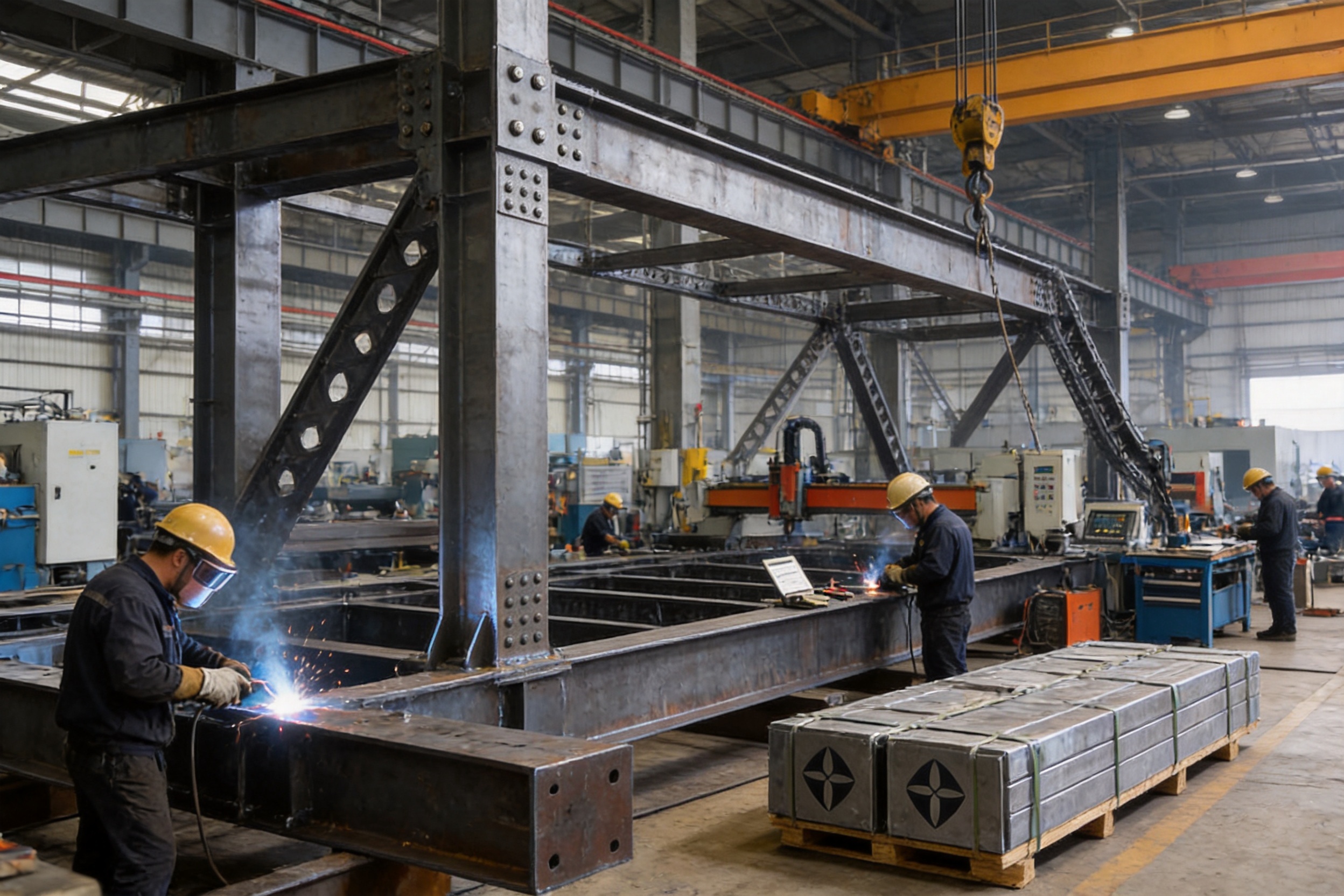
The quality of a steel stage support frame depends on more than the material selected. It is also affected by design coordination, cutting accuracy, welding quality, dimensional control, surface treatment, traceability, inspection, and packing. Jiangsu Zhonghai Bridge Equipment Co., Ltd. combines engineering design, precision manufacturing, quality management, and structural fabrication capabilities to produce modular steel systems and related components.
Engineering Review and Production Planning
Manufacturing begins with a review of the project requirements. The engineering team considers the intended use, frame dimensions, equipment arrangement, connection method, transportation limits, site assembly sequence, and expected environmental conditions. Drawings and fabrication information are then organized so that individual parts can be produced and checked systematically.
Good production planning also considers how the frame will be assembled in practice. A component that is structurally adequate but difficult to lift, orient, align, or connect may create unnecessary site delays. By evaluating fabrication and installation together, the manufacturer can improve the practical value of the finished system.
Material Preparation
Structural steel plates, sections, tubes, connection plates, stiffeners, and other materials are prepared according to the approved production information. Material identification and controlled handling help reduce the risk of mixing different grades or using components outside their intended application.
For reusable temporary structures, material selection should balance strength, stiffness, durability, weldability, and transport practicality. Members must be robust enough for repeated handling while remaining manageable for cranes, forklifts, and site crews.
Precision Cutting and Forming
Steel members are cut and prepared using controlled equipment. Accurate cutting helps ensure that connection holes, end plates, stiffeners, and intersecting members align correctly. Where forming, drilling, or bending is required, the process must maintain the intended geometry and avoid unnecessary distortion.
Precision preparation is especially important in modular systems because one inaccurate component may affect several connected members. Consistent dimensions allow multiple sections to be interchanged or reused according to the approved configuration.
Fixture-Based Assembly
Fabrication fixtures and controlled assembly procedures help maintain the correct relationship between members during welding. Fixtures can reduce accumulated dimensional error and support repeatable production. They are useful for beams, frames, bracing assemblies, connection plates, and other components that must meet consistent geometry.
Automated and Controlled Welding
Welding is a critical part of steel structure fabrication. The company’s manufacturing capabilities include automated welding and precision steel fabrication. Controlled welding procedures can improve consistency, reduce irregular weld profiles, and support better production efficiency for repeated components.
Welding quality depends on appropriate procedures, qualified personnel, suitable consumables, joint preparation, heat control, and inspection. Careful welding also helps limit distortion, which can otherwise make site assembly more difficult or affect the alignment of connected members.
Connection Fabrication
Bolted and mechanical connections are commonly valuable in reusable temporary structures because they support assembly and disassembly without cutting the primary members. Connection plates, bolt holes, sleeves, pins, and other interface components must be fabricated accurately so that site crews can complete the structure efficiently.
Connection design should consider not only the strength of the fasteners but also bearing, tear-out, local plate effects, member stability, installation access, and repeated use. Components that are frequently assembled should be designed and maintained to minimize wear and accidental damage.
Dimensional Inspection
After fabrication, components can be checked for length, straightness, hole location, connection geometry, weld appearance, and overall fit. Dimensional inspection is an important safeguard against cumulative errors. It also helps ensure that the delivered components correspond to the drawings and assembly documentation.
Surface Protection
Temporary outdoor structures may be exposed to rain, humidity, dust, ultraviolet radiation, and changing temperatures. Surface preparation and protective coating can help reduce corrosion and preserve the appearance of the steel. The appropriate treatment depends on the project environment, expected service period, storage conditions, and maintenance plan.
Marking, Packing, and Dispatch
Reusable modular systems benefit from clear component identification. Labels, part numbers, assembly references, and packing lists help site teams locate the correct members and reconstruct the frame efficiently. Proper packing also protects connection surfaces, coatings, and vulnerable edges during transportation.
6. Manufacturing Strengths of the Supplier
Jiangsu Zhonghai Bridge Equipment Co., Ltd. is based in Zhenjiang, Jiangsu Province, an important industrial and transportation region in China. The company specializes in modular steel bridges, Bailey bridge systems, customized steel components, bridge erection and construction support equipment, automated welding, and precision steel fabrication.
These capabilities are relevant to the production of concert stage support frames because both bridge systems and stage structures depend on disciplined steel engineering. Bridge manufacturing requires careful control of member strength, connection accuracy, load paths, modularity, and site erection. Those same principles support the production of dependable event structures.
The company integrates several stages of project delivery:
• Engineering design and technical coordination.
• Material preparation and controlled fabrication.
• Automated and precision welding.
• Quality management and inspection.
• Modular packaging and delivery planning.
• Erection and construction support where required.
This integrated approach can reduce communication gaps between designers, fabricators, and installation teams. It also gives customers a single engineering partner for customized structural components rather than requiring them to coordinate multiple unrelated suppliers.
The company reports that its factory uses automation and standardized workflows to manufacture high-strength modular bridge systems in accordance with ASTM, EN, and national specifications. The exact standard and design basis for a concert stage frame should be agreed with the customer and project engineer, but experience with recognized structural specifications demonstrates the importance of documented procedures and repeatable quality control.
7. Performance Benefits for Event Contractors
| Requirement | Value of the Modular Steel Frame | Practical Benefit |
|---|---|---|
| High equipment loads | Strong steel members and coordinated load paths | Reliable support for lighting, audio, screens, and stage components |
| Rapid construction | Prepared modular members and planned connections | Shorter site assembly and reduced field modification |
| Different venues | Customizable geometry and component arrangement | Greater adaptability to venue dimensions and access conditions |
| Repeated events | Disassemblable and reusable structural components | Lower long-term cost and better asset utilization |
| Quality consistency | Factory-controlled cutting, welding, and inspection | More predictable fit and structural performance |
| Transportation | Modular sections and organized packing | Efficient loading, handling, storage, and inventory control |
| Maintenance | Identifiable steel members and accessible connections | Easier inspection, repair, replacement, and refurbishment |
Faster Installation
Concert schedules are often compressed. Venue access may be available for only a few days before rehearsals begin. A frame manufactured with preplanned components can reduce site work and help crews follow a logical construction sequence. Faster installation may also reduce labor costs, equipment rental periods, and conflicts with other production activities.
Reduced Construction Waste
Factory fabrication allows material to be planned and cut before delivery. Compared with extensive on-site modification, this can reduce scrap, packaging waste, and the need to dispose of temporary offcuts. Reusable members further reduce the environmental and financial impact associated with repeated single-use construction.
Improved Schedule Control
When the support frame is manufactured as a coordinated system, the contractor can review the bill of materials, assembly drawings, and transport plan before mobilization. This helps identify missing components or installation challenges earlier, when they are easier to correct.
Reliable Interface with Production Equipment
Lighting, audio, and video suppliers need dependable attachment points and predictable structural geometry. A properly coordinated frame can provide designated locations for equipment support, access, and maintenance. This reduces last-minute improvisation and helps production teams work more safely.
Lower Lifecycle Cost
The initial purchase price is only one part of the economic evaluation. A reusable frame may offer savings through repeated deployment, lower site labor, reduced fabrication waste, simpler maintenance, and improved transport planning. For a rental company or frequent event contractor, these lifecycle benefits can be more important than the lowest initial quotation.
8. Assembly, Disassembly, and Reuse
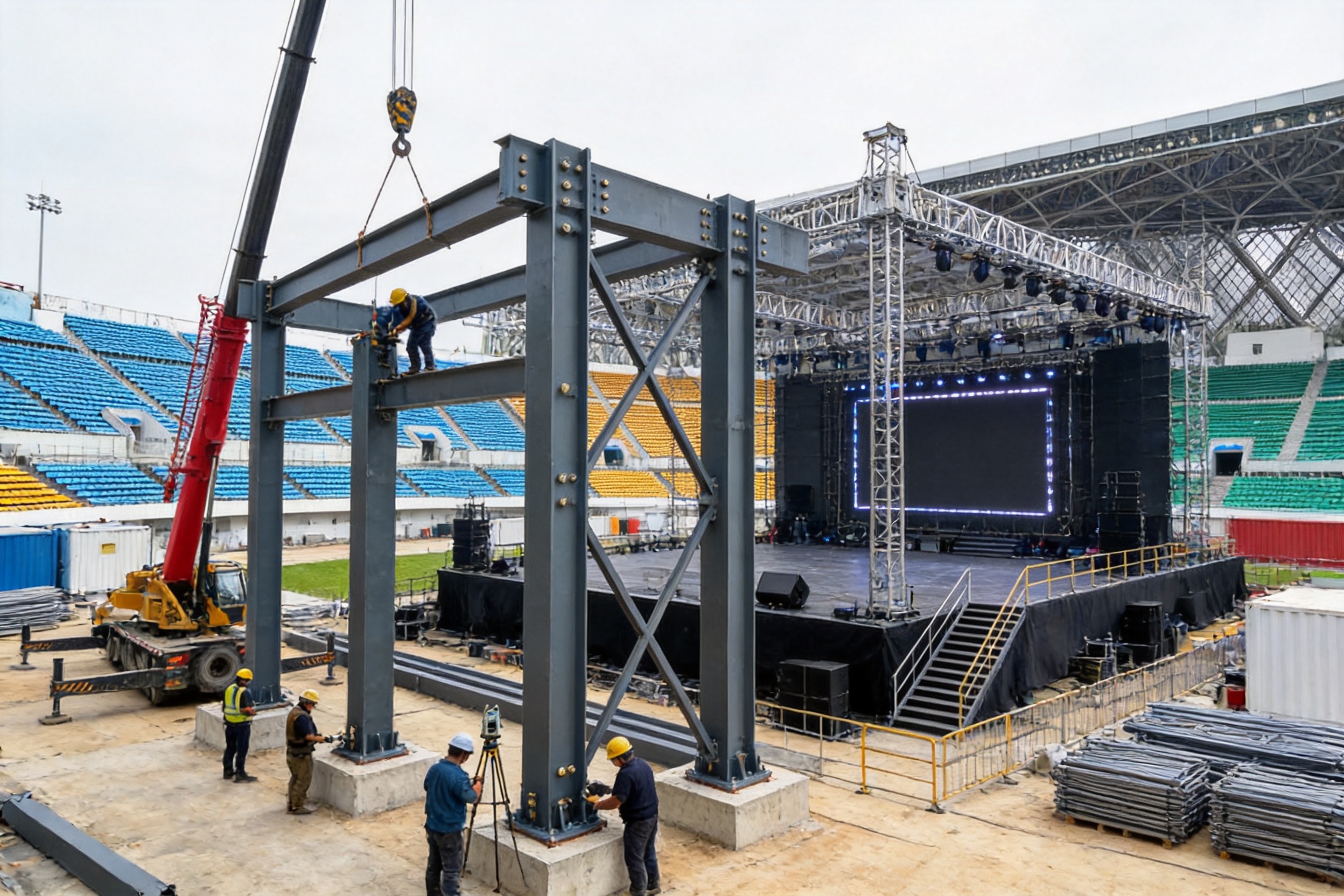
The practical success of a modular stage support frame depends on how easily it can be installed and removed. Assembly should be planned around a clear sequence that includes site preparation, component inspection, base positioning, primary frame erection, bracing installation, connection tightening, alignment checks, equipment integration, and final inspection.
Before assembly, the site should be checked for level, access, bearing capacity, drainage, underground services, and potential interference with audience areas or emergency routes. Components should be laid out in an organized manner, with connection hardware and tools available near the relevant work area.
Primary members are generally positioned first, followed by beams, bracing, platforms, and secondary supports. Temporary stability measures may be needed until the complete structural system is connected. Crews should follow approved erection instructions and avoid removing temporary supports before the frame has achieved its intended stability.
Connection tightening should be performed using the specified method. Bolts, pins, plates, and other connection hardware should be checked for damage, correct size, proper seating, and secure installation. Any field adjustment should be reviewed by the responsible technical team rather than carried out through uncontrolled cutting or drilling.
Disassembly should follow a controlled reverse sequence. Equipment and non-structural attachments should be removed first. The frame should be stabilized during the removal of secondary members and bracing. Components should not be dropped, dragged unnecessarily, or stacked in a manner that causes bending or coating damage.
After dismantling, every reusable component should be inspected. The inspection should look for bent members, elongated holes, cracked welds, corrosion, damaged threads, missing hardware, coating failure, and deformation caused by lifting or transport. Components that do not meet the required condition should be repaired, tested, or removed from service.
9. Safety and Compliance Considerations
A stage support frame is only one part of a safe event environment. The complete system must be designed and managed according to applicable local regulations, engineering requirements, event policies, and occupational safety procedures.
Important areas for review include structural calculations, wind limitations, anchorage, ballast, fire safety, electrical routing, emergency access, fall protection, crowd separation, lifting operations, working-at-height procedures, and weather monitoring.
Outdoor event organizers should establish clear operating limits for severe weather. Wind conditions can change quickly, particularly when large screens, roof membranes, banners, or side coverings are installed. The event plan should identify who has authority to stop work, suspend performance, evacuate the area, or remove temporary elements when conditions exceed the approved limits.
Installation crews should use appropriate personal protective equipment and follow safe lifting procedures. Cranes, forklifts, hoists, and temporary access equipment must be selected for the actual component weights and site conditions. Work at height should be controlled with suitable platforms, guardrails, fall-arrest systems, and rescue planning.
Engineering documents should identify the intended load limits and approved configuration. Production teams should not add equipment, advertising structures, decorative elements, or rigging points without reviewing their effect on the frame. Unplanned additions can change load distribution, wind exposure, and stability.
Compliance should be considered during the design stage rather than after fabrication. Early coordination allows the manufacturer and customer to address required documentation, material certificates, inspection records, welding procedures, coating requirements, and project-specific approvals.
10. Customization for Different Concert Applications
One of the principal benefits of a custom steel frame is the ability to align the structure with the event rather than treating the event as a fixed standard application.
Outdoor Music Festivals
Outdoor festivals often require broad stages, large video screens, extensive lighting, side audio towers, and weather-resistant structural arrangements. The frame must be coordinated with wind exposure, temporary foundations, audience circulation, production vehicles, and rapid construction schedules.
Indoor Arenas
Indoor arenas may have more controlled weather conditions but can impose strict limits on floor loading, ceiling height, access routes, and rigging operations. A stage support frame can be adapted to the available footprint and coordinated with existing venue structures.
Municipal and Public Events
City celebrations, cultural festivals, national ceremonies, and public performances may use temporary stages in squares, parks, or transportation areas. These projects often require an efficient installation method, a clean appearance, reliable crowd separation, and careful integration with public access routes.
Touring Productions
Touring productions benefit from systems that can be packed, transported, and reassembled repeatedly. Consistent component identification, standardized connections, and a documented assembly method become especially valuable when different crews work at different venues.
Exhibitions and Corporate Events
Large corporate events and exhibitions may require stage structures that support branding, LED walls, lighting grids, presentation equipment, and architectural finishes. The frame can be coordinated with temporary partitions, display systems, access platforms, and backstage facilities.
11. Maintenance and Long-Term Asset Management
Because the support frame is reusable, maintenance should be treated as part of the product’s lifecycle rather than an optional activity. A maintenance program protects the original investment and helps ensure that the structure remains suitable for future deployments.
After every event, the contractor should record the operating location, weather exposure, loading arrangement, assembly duration, unusual incidents, repairs, and component condition. A simple asset register can track each member by identification number and document inspections over time.
Steel members should be stored on suitable supports that prevent standing water and excessive contact with soil. Components should be protected from impact, uncontrolled stacking, and contamination by corrosive materials. Small connection parts should be stored in labeled containers to prevent loss and mixing.
Coatings should be checked for scratches, peeling, rust staining, and areas of exposed steel. Minor damage should be repaired using an approved preparation and coating process. More serious corrosion or deformation may require technical assessment before the member is returned to service.
Welds and connection regions deserve particular attention because they may experience repeated handling and localized stress. Bolts, pins, plates, and holes should be examined for wear, distortion, cracks, or missing components. Any suspected structural damage should be isolated until evaluated by qualified personnel.
12. Why Manufacturing Experience in Modular Steel Systems Matters
Modular bridge systems and concert stage support frames serve different markets, but they share important engineering principles. Both use steel members that must be transported, assembled, connected, inspected, and sometimes reused under demanding conditions.
Experience in bridge equipment encourages a disciplined approach to load paths and connection design. Bridge components must work together across spans and supports, and their performance depends on accurate fabrication. The same attention to geometry is valuable in a stage frame, where misalignment can affect equipment installation and overall stability.
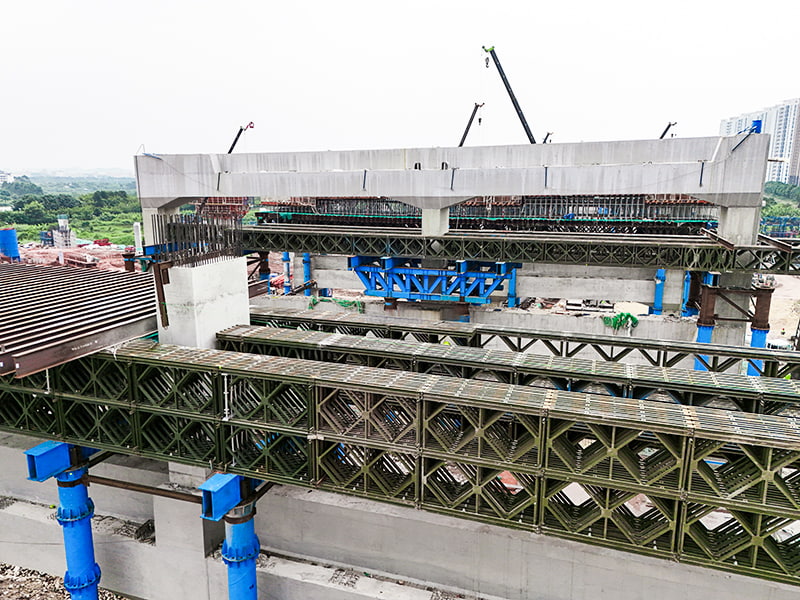
Bridge manufacturing also places strong emphasis on modularity. A Bailey bridge system is designed around repeatable parts, standardized interfaces, and practical erection. These concepts can be transferred to event structures, where assembly speed, transport efficiency, and the ability to reconfigure components are important commercial advantages.
In addition, bridge equipment projects commonly require coordination between factory production and site construction. This experience supports better planning of delivery, lifting, temporary support, erection sequence, and field troubleshooting for customized steel stage systems.
13. Project Delivery Process
A successful custom stage support frame project usually follows a series of coordinated steps.
Step 1: Requirement Definition
The customer provides the stage dimensions, intended equipment, venue information, schedule, expected environmental conditions, and desired reuse plan. The more complete the initial information, the more accurately the frame can be developed.
Step 2: Preliminary Engineering
The manufacturer reviews the project requirements and proposes a structural arrangement. Preliminary discussions may address member layout, support locations, connection methods, transportation limits, and installation sequence.
Step 3: Technical Confirmation
Drawings, specifications, load assumptions, materials, coatings, tolerances, inspection requirements, and delivery conditions are confirmed. Any interfaces with third-party stage, lighting, audio, or video systems should be coordinated at this stage.
Step 4: Fabrication
Approved materials are processed through cutting, drilling, forming, assembly, welding, finishing, inspection, marking, and packing. Production records should be maintained according to the project’s quality requirements.
Step 5: Pre-Delivery Review
Before shipment, the customer or designated representative may review documentation, component quantities, packing lists, inspection records, and selected dimensional details. This provides an opportunity to resolve discrepancies before the equipment reaches the venue.
Step 6: Site Assembly
Site crews unload, inspect, position, connect, align, and stabilize the frame according to the approved erection plan. Technical support can help address questions related to component identification, connection sequence, or site coordination.
Step 7: Final Inspection and Handover
The completed frame is checked for geometry, connections, bracing, support conditions, equipment interfaces, and visible damage. Handover records may include inspection results, approved configuration information, and operational limitations.
Step 8: Dismantling and Reuse Planning
After the event, the frame is dismantled, inspected, documented, repaired where necessary, and prepared for storage or transportation to the next venue.
14. Selecting a Suitable Stage Support Frame
Customers comparing suppliers should evaluate more than steel tonnage or quoted price. A suitable frame should be supported by clear technical information and a manufacturing process capable of delivering consistent results.
Important questions include:
• What loads and equipment arrangements were used for the design?
• Which steel grades and connection types are proposed?
• How are cutting, drilling, forming, and welding controlled?
• What dimensional tolerances apply to the modular components?
• How are corrosion protection and coating repairs managed?
• Are assembly drawings and component identification documents provided?
• Can the frame be adapted to different stage dimensions?
• What inspection records and material documentation are available?
• How are lifting, transport, storage, and repeated reuse addressed?
• What technical support is available during erection and commissioning?
A supplier with engineering, fabrication, quality control, and construction support capabilities can often provide a more complete solution than a vendor that only supplies uncoordinated steel members.
15. Environmental and Economic Value
Reusable modular construction can support more responsible resource use. Instead of fabricating a new temporary support for each event, contractors can deploy the same steel components across multiple projects. This reduces repeated material consumption and may lower the volume of construction waste generated by temporary events.
Steel also has a long service potential when it is properly designed, protected, inspected, repaired, and stored. At the end of its useful service life, steel can be recovered and recycled through established industrial processes. The sustainability benefit depends on actual lifecycle management, but modular reuse provides a strong foundation for improving resource efficiency.
From an economic perspective, the initial cost of a professionally engineered frame may be higher than that of improvised supports. However, the total cost should include fabrication, labor, installation time, equipment rental, transport, maintenance, dismantling, storage, and future deployment. A reusable system can produce greater value when used repeatedly by a contractor, rental company, or event organization.
Operational reliability also has economic value. Delays caused by poor fit, missing parts, unexpected field welding, or structural modifications can affect rehearsals, ticketed performances, broadcast schedules, and venue availability. A more predictable support frame can help reduce these indirect costs.
16. Application Experience and Industrial Capability
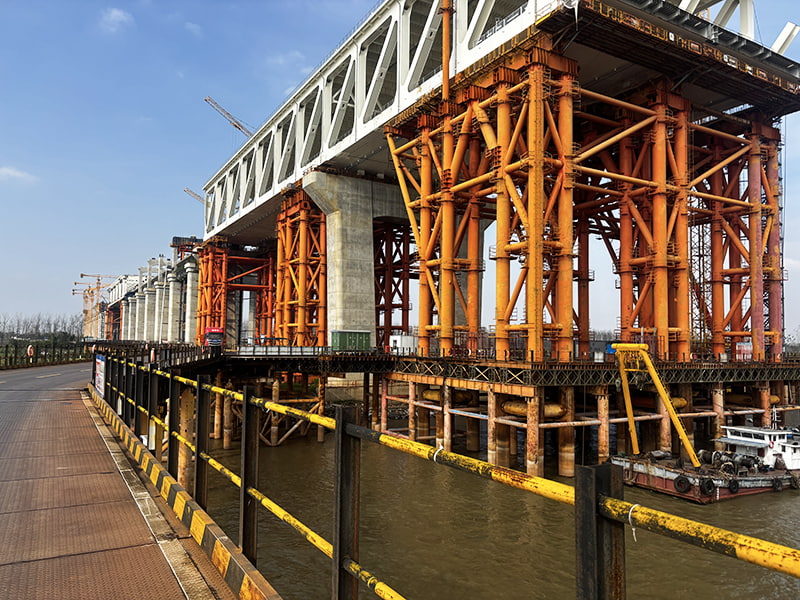
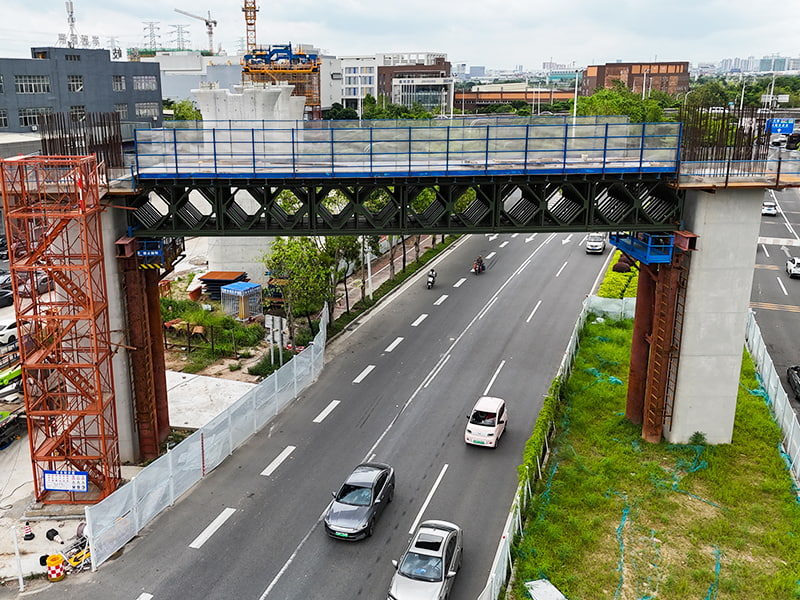
Jiangsu Zhonghai Bridge Equipment Co., Ltd. has supplied structural products and engineering support for projects in China and international markets. Its reported project experience includes coastal engineering in the Maldives, temporary access bridges associated with the Shenzhen–Zhongshan Corridor, structural components for the Hangzhou Expo Center, multi-span Bailey bridges for the Lalin Railway, and flood-response and emergency bridge deployments.
These applications demonstrate experience with different project environments, transportation requirements, structural configurations, and delivery conditions. Such experience is useful when developing a custom stage support frame because event structures often face similar logistical challenges: limited installation windows, changing site conditions, temporary access restrictions, and the need for dependable prefabricated components.
The company’s focus on modular steel bridges, engineered components, and construction support equipment also provides a broad manufacturing foundation for customers seeking customized steel structures beyond standard bridge products. A concert stage support frame is therefore part of a wider capability in steel engineering and fabrication.
17. Recommended Documentation for a Professional Project
Documentation helps ensure that a temporary structure is assembled and operated as intended. Depending on project requirements, a delivery package may include general arrangement drawings, component drawings, assembly instructions, material information, welding or fabrication records, inspection reports, coating information, packing lists, and maintenance recommendations.
Customers may also require load tables, approved configuration drawings, connection details, foundation reactions, lifting guidance, and limitations related to wind or equipment placement. The exact documentation should be agreed before production begins.
Clear documentation is especially important when the frame will be reused by different crews. It reduces dependence on individual memory and provides a consistent reference for future installation. Component markings should correspond directly with drawings and packing lists so that the system can be managed as an organized asset.
18. Practical Limitations and Responsible Use
No temporary structural product should be treated as universally suitable without project review. A stage support frame designed for one configuration may not automatically support a different roof, screen, speaker arrangement, or venue condition. Modifications should be assessed before implementation.
The frame’s capacity can be affected by unsupported spans, missing bracing, uneven foundations, altered connection details, corrosion, impact damage, excessive wind exposure, and unapproved attachments. Reuse is valuable, but repeated deployment must be accompanied by inspection and maintenance.
Customers should provide accurate information about intended loads and operating conditions. Event contractors should follow the approved assembly sequence and ensure that all relevant production suppliers understand the permitted attachment points and load limits.
Responsible use protects not only the structure but also performers, technicians, venue staff, audiences, and the reputation of the event organizer. Professional engineering and disciplined site management are essential complements to high-quality manufacturing.
19. Frequently Asked Questions
What is a concert stage support frame?
A concert stage support frame is a steel structural system that supports stage decks, roof structures, lighting, audio equipment, LED screens, scenery, access platforms, and related production components. It transfers these loads to the foundation or supporting surface while maintaining stability and geometry.
Is the frame suitable for outdoor concerts?
It can be customized for outdoor applications, but the final design must consider wind, rain, ground conditions, anchorage, ballast, roof coverings, screens, and local regulations. Outdoor use should always be reviewed for the specific venue and equipment arrangement.
Can the frame be reused?
Yes. The frame is designed for assembly, disassembly, transport, inspection, and repeated use. Reuse depends on proper handling, storage, maintenance, and verification of each component before a new deployment.
Can the dimensions be customized?
Custom manufacturing allows the frame configuration to be developed according to stage size, equipment layout, venue restrictions, access requirements, and transportation conditions. Engineering confirmation is required whenever dimensions or loads change.
Does the system require field welding?
A modular frame is generally intended to reduce field fabrication through prepared members and mechanical connections. The exact connection method depends on the approved design. Any field welding or drilling should be authorized by the responsible technical team.
What equipment can the frame support?
The frame may support lighting, loudspeakers, LED screens, roof components, scenic elements, platforms, and other stage equipment when these loads are included in the design. Customers should provide accurate equipment weights and attachment locations before fabrication.
How does the frame resist deformation?
Resistance to deformation comes from the selection and arrangement of steel members, bracing, connection design, support conditions, and overall structural stiffness. The precise performance depends on the project configuration and engineering calculations.
What are the advantages over improvised steel supports?
A professionally fabricated frame offers more predictable geometry, controlled material and welding quality, prepared connections, better documentation, improved installation efficiency, and greater potential for repeated use. Improvised supports may lack consistent engineering verification and may require more field modification.
What manufacturing capabilities support this product?
The supplier integrates engineering design, precision steel fabrication, automated welding, quality management, standardized production workflows, and construction support experience. These capabilities help create consistent modular components for customized structural applications.
How should the frame be maintained?
After each use, components should be inspected for deformation, corrosion, damaged welds, worn holes, missing hardware, and coating defects. Members should be cleaned, repaired where necessary, labeled, and stored on suitable supports away from standing water and impact hazards.
Can the supplier support international projects?
The company serves global infrastructure and emergency response projects and has experience with international delivery. Project-specific shipping, documentation, standards, installation support, and local approval requirements should be confirmed during the quotation and engineering stages.
What information should a customer provide for a quotation?
Useful information includes stage dimensions, height, roof arrangement, equipment weights, screen sizes, lighting and audio locations, venue conditions, wind exposure, foundation information, required delivery date, expected reuse frequency, and applicable technical standards.
20. Conclusion
The Concert Stage Support Frame is a practical steel solution for large-scale performances that require dependable structural support, efficient installation, and repeated use. Its solid construction, load-bearing capability, deformation resistance, modular assembly, and custom configuration provide advantages for concert organizers and event contractors working across different venues.
Its value is strengthened by the manufacturing capabilities of Jiangsu Zhonghai Bridge Equipment Co., Ltd. The company combines structural engineering, precision fabrication, automated welding, quality management, modular steel system experience, and construction support. These capabilities help transform project requirements into organized, transportable, and reusable steel structures.
Compared with improvised or single-use alternatives, a professionally engineered frame can provide better consistency, clearer documentation, improved site efficiency, and lower lifecycle costs. Its performance, however, depends on proper design coordination, suitable foundations, correct assembly, controlled equipment loading, weather management, and regular inspection.
For event structures where safety, schedule, appearance, and reuse all matter, a custom modular steel support frame offers a balanced and durable solution. It provides the structural foundation needed to help concert production teams deliver complex performances with greater confidence and operational control.
References
1. American Institute of Steel Construction, Specification for Structural Steel Buildings.
2. American Institute of Steel Construction, Steel Construction Manual.
3. European Committee for Standardization, Eurocode 3: Design of Steel Structures.
4. International Organization for Standardization, Quality Management Systems—Requirements.
5. International Organization for Standardization, Welding Quality Requirements for Fusion-Welded Metallic Materials.
6. International Organization for Standardization, Corrosion Protection of Steel Structures by Protective Paint Systems.
7. Occupational safety guidance for temporary structures, lifting operations, and work at height.
8. Manufacturer-provided product information for custom concert stage support frames and modular steel structures.
9. Project engineering documentation, fabrication drawings, inspection records, and assembly instructions applicable to the specified stage support configuration.
Product: Concert Stage Support Frame


We respond quickly to all international requests and provide technical support when needed.
Product Category
Bailey Bridge/Modular Bridge Modular Steel Bridge Pedestrian Bridge Modular Pipe Bridge Truss Bridge Steel StructureContact Us

+86-511-84522866
+86-13921582699

zhwm@zjql.com

Building 1,83#, dantu New Town, Yanjiang Road, Dantu District, Zhenjiang, Jiangsu, China
Copyright © Jiangsu Zhonghai Bridge Equipment Co., Ltd. All
Rights
Reserved
China bailey bridge for sale
bailey bridge supplier from china
