
 English
 русский
 Español
 Português


Luo Shiqing — Product After-Sales Service Supervisor
CB450 Large Span Heavy Load Galvanized Bailey Bridge: Engineering, Manufacturing, and Project Applications
Content
- 1 Product Overview
- 2 Key Technical Characteristics
- 3 Advantages of the Reinforced Modular Concept
- 4 Manufacturing Process and Quality Control
- 5 Why the Product Offers Competitive Advantages
- 6 Project Delivery and Site Installation
- 7 Applications
- 8 Maintenance, Inspection, and Service Life
- 9 Company Manufacturing Strengths
- 10 Selection Considerations for Buyers
- 11 Q&A
- 11.1 What is the CB450 bridge designed for?
- 11.2 What is the maximum single span?
- 11.3 How much load can the bridge carry?
- 11.4 What does the four-lane single-layer structure mean?
- 11.5 Why is hot-dip galvanizing important?
- 11.6 Can the bridge be reused?
- 11.7 Why is factory pre-assembly useful?
- 11.8 Can the bridge be customized?
- 11.9 What standards are referenced for the product?
- 11.10 Does galvanizing eliminate maintenance?
- 11.11 What should be prepared before installation?
- 11.12 Is the bridge suitable for emergency use?
- 12 Conclusion
- 13 References
- 14 Product: CB450 Type Large Span Heavy Load Galvanized Bailey Bridge
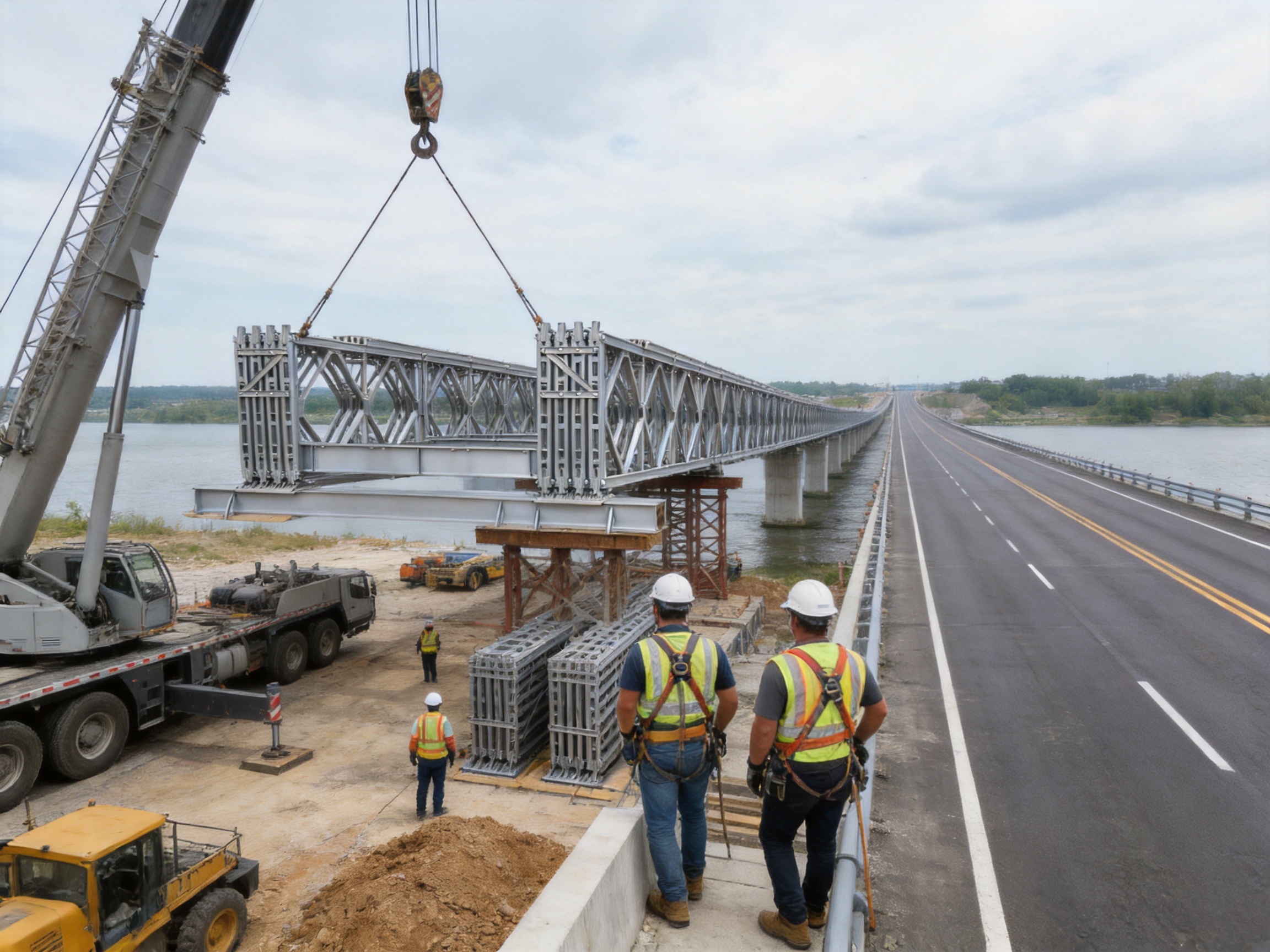
Modern infrastructure projects increasingly require bridge systems that can be delivered quickly, assembled efficiently, and adapted to demanding site conditions. Permanent highway construction, emergency access, military logistics, water conservancy works, industrial transportation, and remote-area development all require dependable bridge solutions. In many of these applications, a traditional cast-in-place or fully custom steel bridge may involve long design periods, extensive foundation work, complex transportation arrangements, and high installation costs. A modular Bailey bridge provides a practical alternative by combining standardized components, rapid erection, flexible configuration, and strong load-bearing performance.
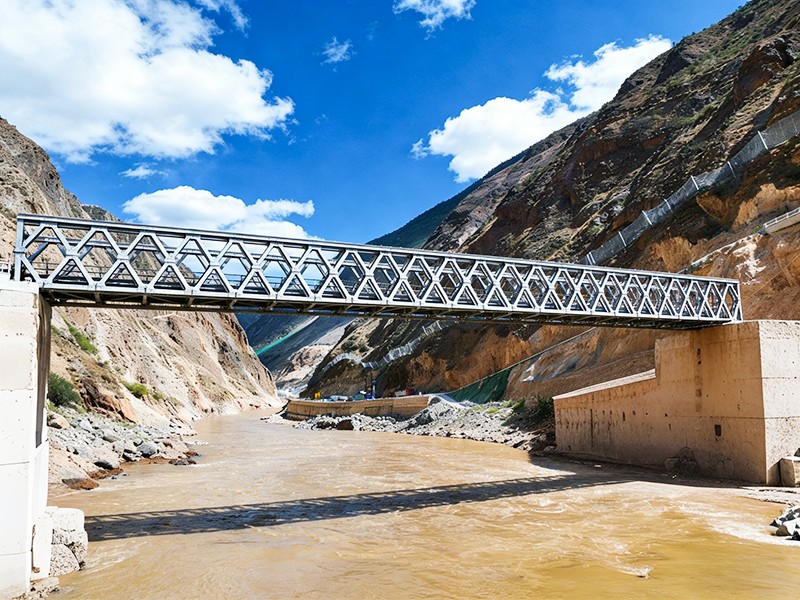
The CB450 Type Large Span Heavy Load Galvanized Bailey Bridge is designed for projects where ordinary modular bridge systems may not provide sufficient span length or carrying capacity. It adopts a four-lane, single-layer reinforced configuration and is engineered for a maximum single span of 81 meters. Its rated load capacity can reach 80 tons, making it suitable for heavy vehicle traffic, construction logistics, industrial transportation, emergency response, and other applications involving substantial moving loads. The bridge is also protected by hot-dip galvanizing, which improves resistance to corrosion and supports long-term use in challenging outdoor environments.
Unlike basic temporary bridges intended only for light traffic or short-term access, the CB450 combines modular construction with the structural characteristics required for large-span and heavy-load service. Its components can be manufactured under controlled factory conditions, pre-assembled before shipment, inspected systematically, and then transported to the project site for erection. This approach reduces uncertainty during installation and helps project owners achieve a more predictable construction schedule.
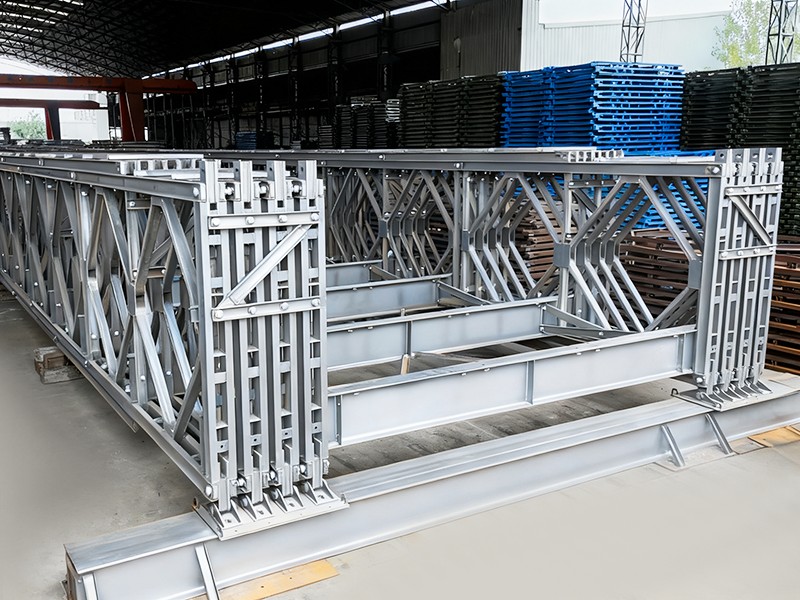
CB450 Type Large Span Heavy Load Galvanized Bailey Bridge
Product Overview
The CB450 is a large-span heavy-load modular steel bridge developed for demanding transportation and access requirements. Its structural concept is based on the proven advantages of Bailey bridge technology: repeated standard components, bolted or mechanically connected assemblies, convenient transportation, and the ability to form different bridge lengths and configurations from a modular inventory. The reinforced CB450 configuration expands these advantages for projects that require greater width, higher load capacity, and longer individual spans.
The bridge uses a four-lane single-layer reinforced arrangement. A four-lane layout can provide substantially greater traffic capacity than a standard single-lane modular bridge and may support construction vehicles, heavy trucks, emergency fleets, or controlled two-way traffic depending on the project traffic plan. The single-layer configuration can also simplify erection compared with more vertically complex multi-layer arrangements, while reinforcement allows the bridge to achieve the required performance for large-span service.
One of the product’s most important features is its maximum single-span capability of 81 meters. Long single spans can be valuable when the bridge must cross rivers, channels, ravines, roads, rail corridors, construction zones, or environmentally sensitive areas. Reducing the number of intermediate piers may lower foundation requirements, minimize obstruction to waterways, and preserve access beneath the bridge. In emergency or temporary applications, a long span can also shorten the time required to establish a safe route across a damaged or inaccessible area.
The CB450 has a stated load capacity of up to 80 tons. This capacity makes it suitable for projects involving heavy engineering vehicles, loaded transport trucks, construction machinery, logistics equipment, and other substantial moving loads. The actual allowable loading arrangement, vehicle classification, speed, lane use, dynamic effects, foundation conditions, and safety factors must be determined through project-specific engineering. Nevertheless, the product’s high nominal capacity distinguishes it from ordinary lightweight modular footbridges and low-load access bridges.
Corrosion protection is provided through hot-dip galvanizing. During this process, prepared steel components are immersed in molten zinc so that a metallurgically bonded protective coating forms on the steel surface. Compared with basic paint-only protection, hot-dip galvanizing can provide a more robust barrier and sacrificial protection, particularly for components exposed to rain, humidity, spray, mud, and changing outdoor conditions. The galvanized finish is especially valuable where maintenance access is limited or where the bridge is expected to remain in service for extended periods.
Key Technical Characteristics
| Item | Stated Characteristic | Project Value |
|---|---|---|
| Bridge type | Large-span heavy-load modular Bailey bridge | Supports rapid assembly and adaptable project deployment |
| Structural arrangement | Four-lane, single-layer reinforced structure | Provides broad traffic capacity and enhanced structural performance |
| Maximum single span | 81 meters | Helps cross wide obstacles with fewer intermediate supports |
| Load capacity | Up to 80 tons | Suitable for heavy vehicles, construction traffic, and logistics operations |
| Surface protection | Hot-dip galvanizing | Improves resistance to corrosion and outdoor exposure |
| Applicable design references | HS-15, HS-20, HS-25, HL-93, and tracked-50 | Provides reference points for different traffic and tracked-load requirements |
| Delivery approach | Factory pre-assembly followed by project-site shipment | Supports quality verification and more efficient field installation |
The load design references listed for the CB450 include HS-15, HS-20, HS-25, HL-93, and tracked-50. These references represent different vehicle, highway, and tracked-load design conditions used in bridge engineering. Applying these standards requires professional structural calculation and confirmation of the project’s governing code, but their inclusion demonstrates that the bridge is intended for serious engineered applications rather than informal or lightly loaded access use.
Every bridge project remains dependent on site conditions. Span, deck arrangement, support reactions, wind exposure, seismic conditions, flood levels, approach geometry, vehicle frequency, and foundation design all influence the final configuration. The stated product characteristics should therefore be understood as a strong technical starting point for engineering design, not as a substitute for project-specific calculations and approvals.
Advantages of the Reinforced Modular Concept
Large Span Performance
A long single span provides a major advantage where intermediate supports are undesirable or difficult to construct. In a river crossing, piers may interfere with navigation or reduce waterway capacity during floods. In a road or railway crossing, additional supports can obstruct traffic and require extensive protection work. In a ravine or unstable area, foundation construction may be technically challenging and expensive. An 81-meter single-span capability can help the project team address these constraints with a more direct crossing solution.
Large-span performance can also reduce the amount of work performed in the field. Instead of constructing multiple foundations and installing several bridge segments, the project may be able to use fewer support points and a more concentrated erection process. This can be particularly important in emergency reconstruction, where every additional activity affects the restoration schedule.
High Load Capacity
An 80-ton load capacity gives the CB450 a significant advantage over modular bridges designed only for pedestrians, light utility vehicles, or limited construction traffic. Heavy-load bridges must manage not only static vehicle weight but also the effects of movement, braking, acceleration, uneven loading, and repeated traffic. A reinforced structure provides a stronger platform for demanding operations when correctly designed, installed, and maintained.
High capacity is valuable during industrial and infrastructure construction because the bridge itself may need to carry cranes, dump trucks, concrete delivery vehicles, excavators, drilling equipment, and prefabricated components. A bridge that cannot accommodate the required equipment can create bottlenecks, require vehicle unloading and reloading, or force long detours. A heavy-load modular bridge can support a more efficient flow of materials and machinery.
Four-Lane Traffic Potential
The four-lane arrangement provides a wider bridge platform than conventional single-lane Bailey systems. Depending on the approved design and traffic management plan, the width may support multiple traffic lanes, controlled two-way movement, dedicated construction traffic, or a combination of vehicle and operational space. A wider platform can improve traffic throughput and reduce the need for frequent vehicle scheduling across a narrow crossing.
For temporary works, the four-lane configuration can be useful when the bridge serves a large construction site or acts as a temporary bypass during permanent bridge rehabilitation. For emergency response, it may allow relief vehicles, supply trucks, recovery equipment, and maintenance vehicles to use the crossing with less conflict. For industrial sites, a wide bridge can support organized movement of heavy loads and improve operational safety.
Modular Flexibility
Modular Bailey bridge systems are valued because their components can be combined into different lengths and configurations. This flexibility allows the bridge supplier and project engineer to adjust the structure to the site rather than designing every member from the beginning as a unique component. Standardized panels, connections, deck elements, bracing members, and support accessories can simplify production, packing, replacement, and future reuse.
Modularity is also beneficial for projects with uncertain or changing requirements. A temporary bridge may later be extended, relocated, reinforced, or adapted for a different crossing. A standardized component system makes such changes more practical than with a one-off welded structure that is difficult to disassemble or repurpose.
Hot-Dip Galvanized Protection
Steel bridges are exposed to water, condensation, soil splash, airborne contaminants, and temperature variation. Without effective protection, corrosion can reduce the cross-section of steel members, damage connections, increase maintenance costs, and shorten service life. Hot-dip galvanizing creates a zinc coating that acts as a physical barrier and also provides cathodic protection when the surface is locally damaged.
Galvanized modular components are especially useful when the bridge is transported, erected, dismantled, or reused. The protective finish helps reduce the risk that routine outdoor exposure will quickly degrade the components. It can also reduce the frequency of repainting compared with a conventional paint system, although inspection, cleaning, and localized repair remain necessary throughout the bridge’s service life.
Manufacturing Process and Quality Control
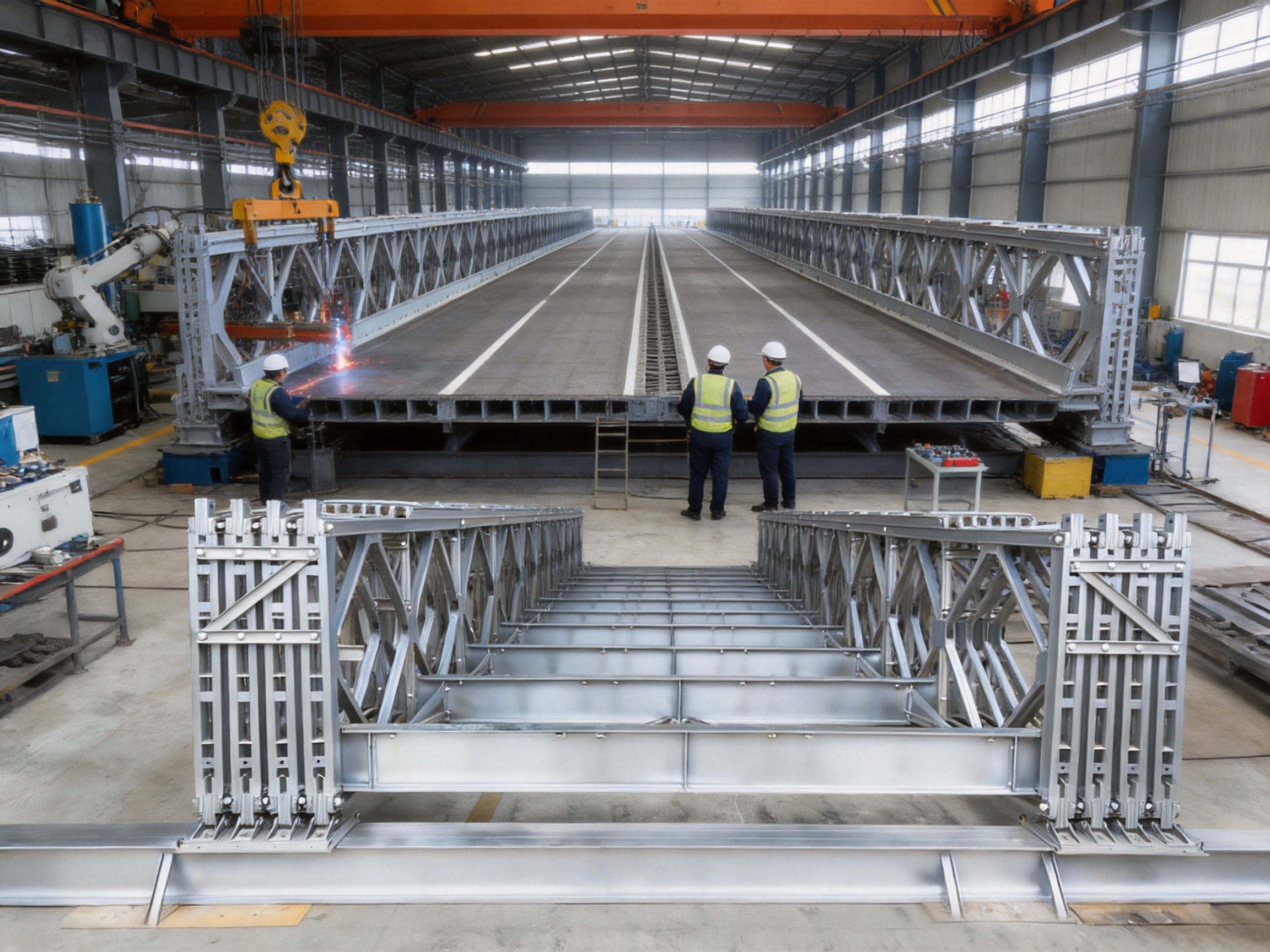
The performance of a heavy-load modular bridge depends not only on its engineering concept but also on the accuracy and consistency of its manufacturing. A bridge assembled from interchangeable components requires reliable dimensions, repeatable connection geometry, controlled welding, suitable steel quality, and careful inspection. Jiangsu Zhonghai Bridge Equipment Co., Ltd. integrates engineering design, precision fabrication, quality management, and project support within its manufacturing operations.
Engineering Design and Configuration Development
The manufacturing process begins with the interpretation of project requirements. Designers consider the required span, traffic lanes, load model, deck arrangement, support conditions, erection method, transportation limits, environmental exposure, and applicable standards. The resulting design identifies the necessary panels, chords, bracing members, deck units, connection hardware, reinforcement elements, bearings, ramps, and ancillary components.
For a bridge such as the CB450, configuration development must address the interaction between span length and structural capacity. Longer spans create greater bending moments, deflection considerations, support reactions, and erection demands. Four-lane service introduces additional width-related requirements, while heavy loads require careful attention to deck behavior, transverse distribution, connection forces, and local stresses. Engineering review is therefore central to the product rather than an afterthought.
Material Preparation
Steel plates, sections, and other raw materials must be selected according to the approved design and applicable material specifications. Material identification and traceability help ensure that the correct grade and thickness are used in each component. Preparation may include plate cutting, profiling, drilling, edge treatment, straightening, and dimensional verification.
Accurate material preparation improves assembly efficiency and helps reduce the need for corrective work. In modular bridge production, even relatively small dimensional deviations can accumulate across repeated panels or affect the alignment of bolted connections. Controlled cutting and drilling are therefore essential to ensure that components can be assembled correctly at the factory and later at the project site.
Automated and Controlled Welding
Welding quality directly influences the strength and durability of fabricated bridge members. Zhonghai’s manufacturing capabilities include automated welding and standardized production workflows. Automation can improve bead consistency, penetration control, repeatability, and production efficiency, particularly for repetitive structural components.
Controlled welding also helps reduce defects associated with inconsistent heat input, poor alignment, or variable operator technique. Depending on the component and approved quality plan, inspections may include visual examination, dimensional checks, weld profile review, and non-destructive testing where required. Welded assemblies can then proceed to cleaning, correction, drilling, trial assembly, and surface treatment.
Precision Fabrication and Dimensional Verification
Precision fabrication is critical for modular bridges because the components must fit together during factory pre-assembly and field erection. Panels and connection elements must be manufactured within suitable tolerances so that bolts can be installed without excessive force, members remain aligned, and the finished bridge geometry matches the design intent.
Dimensional verification may include checks of member length, hole spacing, panel width, diagonal alignment, connection locations, deck-unit fit, and overall assembly geometry. Factory pre-assembly provides an additional layer of verification. Rather than sending untested components directly to the project site, the manufacturer can assemble representative or complete sections, identify interface problems, and correct them before shipment.
Surface Preparation and Galvanizing
Before hot-dip galvanizing, steel surfaces must be prepared so that the zinc coating can bond effectively. Preparation generally involves cleaning, degreasing, pickling, rinsing, and fluxing, followed by immersion in molten zinc. The process creates a series of zinc-iron alloy layers with an outer zinc layer, producing a durable protective system.
Galvanizing quality depends on surface condition, steel chemistry, drainage and venting provisions, immersion practice, coating thickness, and post-treatment handling. Properly designed components allow air, gases, and zinc to move effectively through hollow or enclosed areas. After galvanizing, components should be inspected for coating continuity, appearance, adhesion, excess zinc, dimensional effects, and areas requiring touch-up or correction.
Factory Pre-Assembly
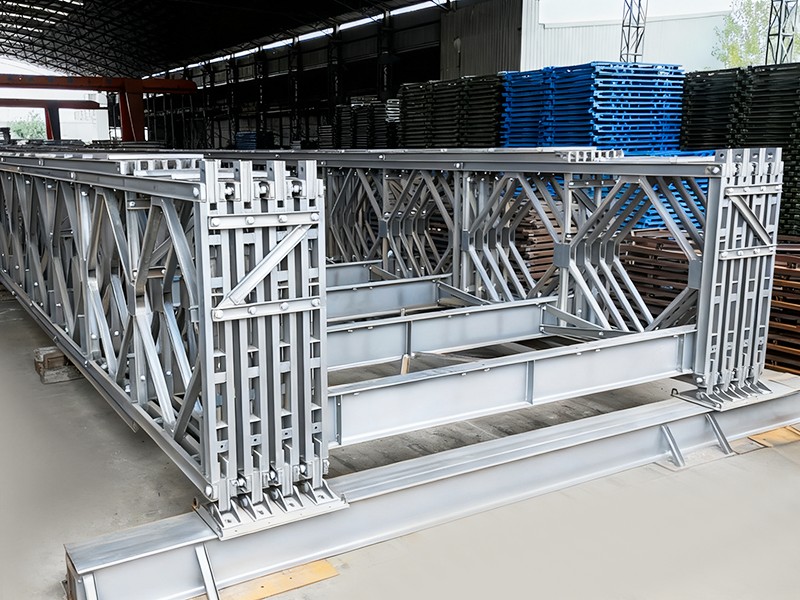
The CB450 bridge has been pre-assembled at the factory before shipment to the Sichuan project site. This step is particularly valuable for a large-span, four-lane reinforced structure because it provides an opportunity to verify component compatibility at full or representative scale. It can reveal missing parts, connection interference, alignment issues, assembly sequencing concerns, or packaging requirements before the bridge reaches the installation location.
Factory pre-assembly also improves communication between the manufacturer, contractor, and site team. Installation personnel can receive a clearer understanding of the component sequence, connection locations, temporary supports, lifting points, and bracing requirements. The result is a more organized field operation with fewer avoidable delays.
Why the Product Offers Competitive Advantages
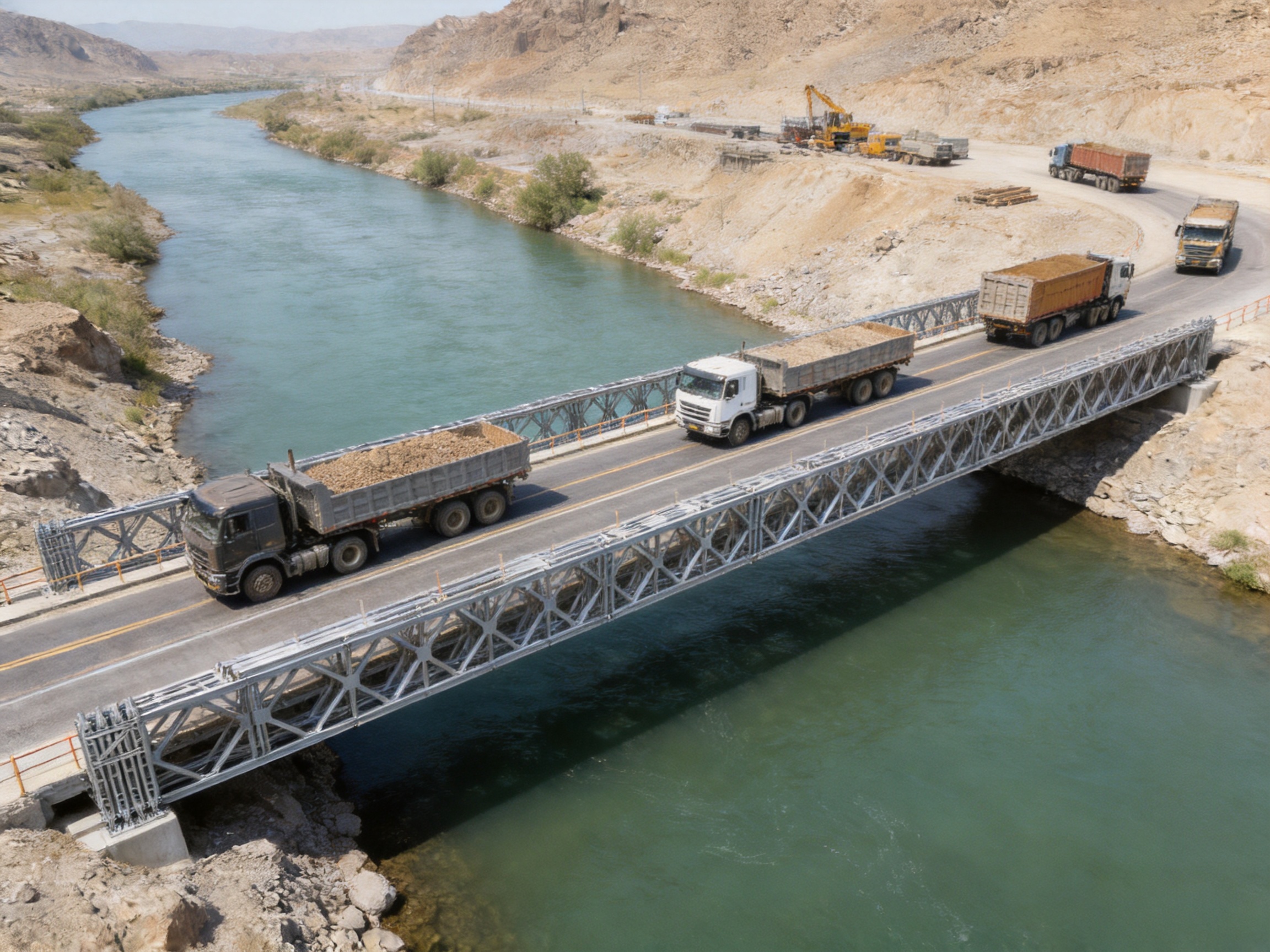
The modular bridge market includes many products designed for different load levels, span ranges, widths, and environmental conditions. The CB450 distinguishes itself by combining several characteristics that are not always available in one standardized system: long-span performance, heavy-load capacity, four-lane width, single-layer reinforced construction, hot-dip galvanizing, and factory pre-assembly.
A lightweight bridge may be easy to transport but unable to carry heavy equipment. A conventional heavy steel bridge may provide capacity but require longer fabrication and more complex site work. A narrow modular bridge may be economical but create traffic restrictions. A paint-protected structure may have an attractive initial cost but require more frequent coating maintenance in aggressive environments. The CB450 is designed to balance these considerations through an integrated system.
Its long-span capability can reduce the need for intermediate piers. Its high capacity can accommodate demanding vehicle classes. Its four-lane arrangement can increase operational flexibility. Its galvanized finish can improve durability. Its modular design can facilitate shipment, assembly, disassembly, and reuse. These advantages can produce lower total project risk even when the initial product specification is more substantial than that of a basic temporary bridge.
Another competitive advantage is the manufacturer’s ability to provide more than individual steel components. Zhonghai combines design, manufacturing, quality management, bridge erection support equipment, customized steel fabrication, and construction assistance. This integrated approach can simplify coordination for clients who prefer to work with one experienced bridge equipment partner rather than separate design, fabrication, and support suppliers.
The company’s manufacturing background also supports customization. Although the CB450 is based on a standardized modular concept, project conditions may require adjustments to deck arrangements, access ramps, support details, corrosion protection, connection accessories, or erection equipment. A manufacturer with engineering and fabrication capabilities can respond more effectively to these requirements than a distributor limited to off-the-shelf products.
Project Delivery and Site Installation
Successful delivery of a large-span modular bridge begins well before shipment. The project team must confirm the bridge alignment, foundation or support locations, approach roads, lifting access, temporary works, assembly area, transportation route, storage conditions, and erection sequence. Site preparation should be coordinated with the bridge supplier so that the delivered components can be handled efficiently.
Transportation Planning
Modular bridge components are generally more manageable to transport than a fully assembled conventional bridge. Panels, deck units, bracing members, and accessories can be packed according to installation sequence and shipped in batches. Packaging should protect galvanized surfaces from unnecessary damage and allow identification of each component during unloading.
Transportation planning should account for road restrictions, vehicle dimensions, lifting equipment, loading limits, customs or regional requirements, and the sequence in which components will be needed. Clearly labeled bundles reduce the time spent searching for individual parts at the site. A detailed packing list and component register are useful tools for inventory control and installation management.
Foundation and Support Preparation
Even a modular bridge requires reliable support conditions. Abutments, piers, bearings, stools, temporary supports, or other foundation elements must be designed for the bridge reactions and site conditions. The ground must be evaluated for bearing capacity, settlement, scour, erosion, seismic effects, and flood exposure where applicable.
Support alignment and elevation are particularly important for long spans. Incorrect support levels can create unwanted stresses, connection difficulties, or excessive deck irregularity. Before assembly begins, the contractor should verify support locations, top elevations, bearing orientation, anchor details, and access for lifting and temporary works.
Assembly and Erection
Modular Bailey bridge erection may involve launching, crane-assisted assembly, incremental placement, or a combination of methods. The selected method depends on span, terrain, waterway conditions, available equipment, traffic restrictions, and the approved construction plan. Large-span heavy-load structures require careful control of temporary conditions because the partially assembled bridge may experience forces that differ from those in the completed structure.
Installation teams should follow the approved erection sequence and use the specified bracing, lifting points, temporary supports, and connection procedures. Bolts and other fasteners must be installed and tightened according to the relevant requirements. Deck units, guardrails, approach connections, drainage details, and traffic protection elements should be completed before the bridge is opened to service.
Site personnel should also inspect galvanized surfaces after erection. Minor handling marks may require approved repair treatment, while significant damage, exposed steel, or coating defects should be assessed and corrected according to the galvanizing and maintenance specification. Careful handling reduces the need for such repairs.
Commissioning and Load Verification
Before opening the bridge, the project team should complete a commissioning inspection. This may include checking member alignment, bolt installation, bracing, deck seating, bearing position, approach transitions, guardrails, signage, drainage, and clearance. Where required by the project authority, a controlled proof load or acceptance test may be performed.
Traffic should be introduced according to the approved operating plan. Load restrictions, speed limits, lane controls, vehicle spacing, and inspection intervals may be required depending on the bridge configuration and local authority requirements. The bridge’s nominal capacity does not eliminate the need for responsible traffic management.
Applications
Emergency and Disaster-Response Bridges
Floods, earthquakes, landslides, storms, and other disasters can destroy permanent crossings or isolate communities. A large-span modular bridge can restore access while permanent reconstruction is planned. The CB450’s high load capacity can support relief trucks, rescue vehicles, medical transport, engineering equipment, and supply logistics.
Hot-dip galvanizing is especially useful in disaster environments because emergency bridges may be exposed to standing water, mud, debris, high humidity, and limited maintenance resources. The modular format also allows components to be transported to difficult areas and assembled with locally available equipment when suitable planning and technical support are provided.
Construction Access
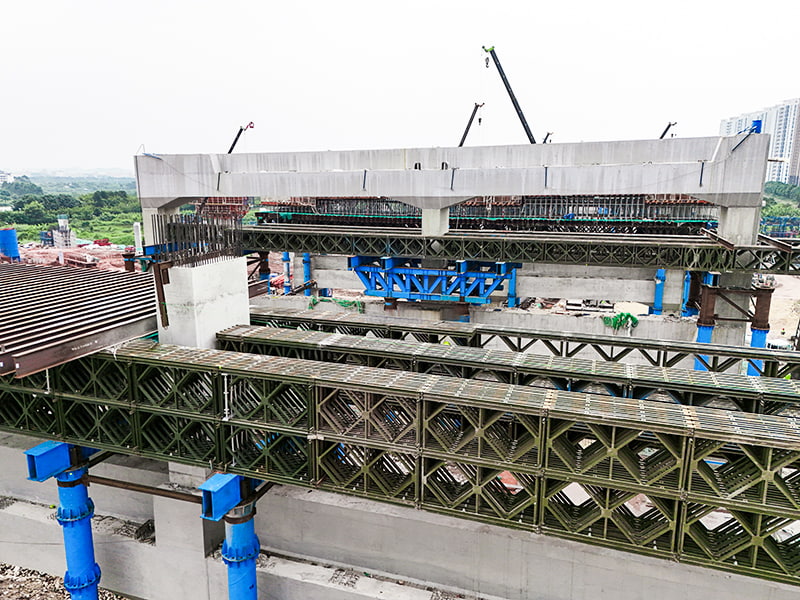
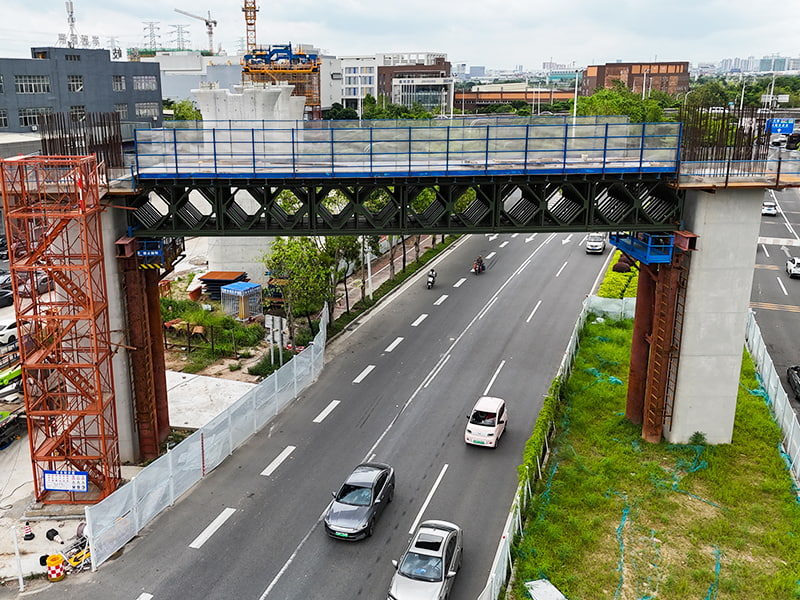
Large infrastructure projects often require temporary crossings before the final bridge, tunnel, road, railway, or dam is complete. The CB450 can provide access for concrete trucks, cranes, earthmoving equipment, steel deliveries, and construction personnel. Its four-lane arrangement may support separate traffic flows or reduce congestion at large worksites.
Because the bridge can be dismantled or reconfigured, it may be reused during different construction phases. This can improve the value of the initial investment and reduce the need to build multiple temporary access routes.
Industrial and Mining Logistics
Industrial facilities, mines, quarries, energy projects, and large manufacturing sites often require bridges capable of carrying heavy equipment and raw materials. A reinforced modular bridge can provide a controlled crossing over drainage channels, haul roads, rail lines, excavated zones, or temporary work corridors.
In such applications, project planners should consider axle loads, vehicle frequency, turning geometry, braking areas, dust, vibration, drainage, and maintenance access. The bridge can be designed as part of a broader logistics plan rather than treated as an isolated structure.
Water Conservancy and River Crossings
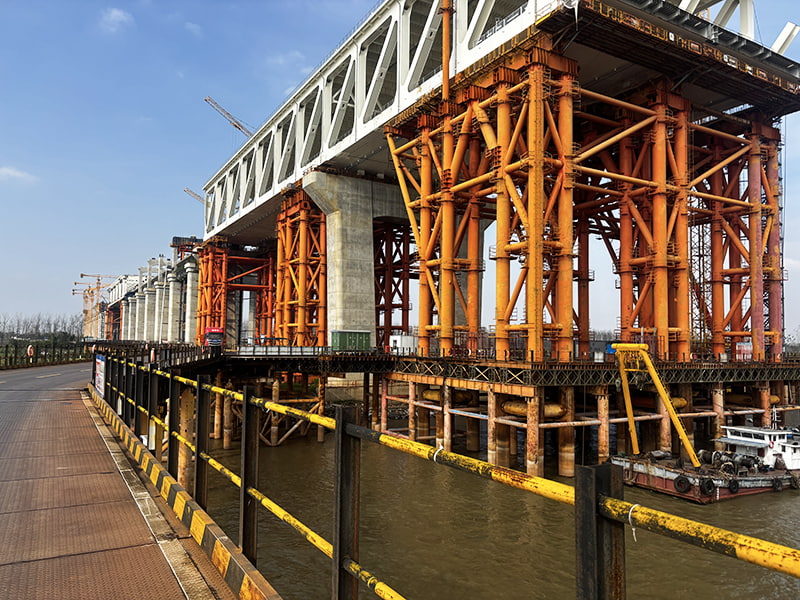
Water conservancy projects frequently require temporary or semi-permanent access over rivers, irrigation channels, diversion routes, and flood-control works. Minimizing the number of in-water supports can reduce obstruction and simplify hydraulic management. A long-span configuration can therefore be advantageous where water flow, navigation, or flood conditions make intermediate piers undesirable.
Military and Strategic Logistics
Modular bridges have long been associated with rapid deployment and logistical flexibility. A heavy-load system can support equipment movement, field operations, temporary route restoration, and strategic access. Standardized components simplify inventory planning and may support repeated deployment at different locations.
Maintenance, Inspection, and Service Life
Galvanizing improves corrosion protection but does not remove the need for inspection. Bridge owners should establish an inspection program appropriate to the bridge’s environment, traffic volume, service duration, and importance. Inspections should cover steel members, bolts, deck units, bearings, expansion areas, support conditions, approaches, drainage, guardrails, and signs of deformation or impact.
Special attention should be given to locations where water, mud, debris, or chemicals can accumulate. Crevices, contact surfaces, damaged coating areas, drainage outlets, and connections exposed to road spray may experience more aggressive conditions than open surfaces. Cleaning may be necessary to prevent persistent contamination and retain the protective value of the galvanized coating.
Traffic management is part of maintenance. Overloading, excessive speed, sudden braking, impact from oversized vehicles, and unauthorized lane use can increase structural stress. Clearly posted weight limits and operating rules help protect the bridge and reduce the risk of premature deterioration.
Bolted connections should be checked for loosening, damage, corrosion, or missing components. Deck units should be examined for wear, deformation, cracking, or unsafe surface conditions. Bearings and supports should be monitored for displacement, settlement, scour, or obstruction. Any unusual vibration, deflection, noise, or visible distortion should trigger a professional assessment before normal service continues.
One of the advantages of a modular system is replaceability. If an individual panel, deck unit, brace, or connection component is damaged, it may be possible to replace that component without removing the entire bridge. This can shorten repair time and reduce operational disruption, provided the replacement is approved and installed according to the engineering requirements.
Company Manufacturing Strengths
Jiangsu Zhonghai Bridge Equipment Co., Ltd. is based in Zhenjiang, Jiangsu Province, an important industrial and transportation region in China. The company specializes in modular steel bridges, Bailey bridge systems, customized steel components, bridge erection and construction support equipment, automated welding, and precision steel fabrication.
Its production model combines engineering design, manufacturing, quality management, and project support. This combination is important for international infrastructure clients because bridge performance depends on the connection between design intent and production execution. A supplier that understands both structural engineering and factory processes can identify practical manufacturing issues earlier and help ensure that the final product is suitable for transportation and erection.
The company uses standardized workflows and advanced automation to produce high-strength modular bridge systems. These processes can improve repeatability, support production efficiency, and help maintain consistent component quality across large orders. Factory-based production also provides better control over weather, tools, inspection access, material handling, and assembly conditions than uncontrolled field fabrication.
Zhonghai serves transportation, water conservancy, military logistics, disaster relief, and international development projects. Its experience includes coastal engineering in the Maldives, temporary access bridges for the Shenzhen–Zhongshan Corridor, structural components for the Hangzhou Expo Center, multi-span Bailey bridges for the Lalin Railway, and flood-response bridge deployments in different regions.
For overseas buyers, manufacturing capacity is only one part of supplier reliability. Documentation, packaging, communication, delivery coordination, spare parts, erection guidance, and after-sales support also matter. The company’s integrated approach is intended to help clients manage these project interfaces and receive a complete bridge solution rather than a shipment of disconnected steel products.
Selection Considerations for Buyers
Before ordering a CB450 bridge, buyers should define the project’s technical and operational requirements. Important questions include the required clear span, overall bridge length, traffic lanes, deck width, design vehicle, maximum axle load, daily traffic volume, service duration, environmental exposure, erection method, and future reuse plan.
The site survey should identify river or channel behavior, flood levels, soil conditions, access restrictions, overhead and underground utilities, adjacent roads or railways, construction staging areas, and available lifting equipment. The bridge supplier can use this information to develop an appropriate arrangement and identify components that require customization.
Buyers should also clarify the applicable design standards and approval process. The references HS-15, HS-20, HS-25, HL-93, and tracked-50 may be relevant to different projects, but the governing standard must be selected by the responsible engineer or authority. A complete technical package may include general arrangement drawings, structural calculations, material information, galvanizing requirements, erection instructions, inspection records, packing lists, and maintenance recommendations.
Commercial evaluation should consider total installed cost rather than purchase price alone. Transportation, foundations, cranes, temporary supports, traffic management, surface protection, maintenance, dismantling, storage, and future reuse can all influence project economics. A bridge with higher initial structural capability may provide better value if it avoids additional piers, reduces installation time, supports heavier vehicles, or can be redeployed after the first project.
Q&A
What is the CB450 bridge designed for?
The CB450 is designed for large-span and heavy-load applications, including construction access, emergency response, industrial logistics, water conservancy works, military logistics, and temporary or semi-permanent transportation routes. It is suitable for projects that need more capacity and width than a basic modular bridge can provide.
What is the maximum single span?
The stated maximum single span is 81 meters. The final usable span must be confirmed through project-specific structural design, including support conditions, load requirements, erection method, deflection limits, wind effects, and applicable standards.
How much load can the bridge carry?
The bridge has a stated load capacity of up to 80 tons. The allowable traffic arrangement depends on the approved design, vehicle type, axle configuration, speed, dynamic effects, and project authority requirements. Professional engineering verification is required before operation.
What does the four-lane single-layer structure mean?
It means the bridge is arranged to provide four lanes of bridge width within a single vertical structural layer, with reinforcement for demanding load conditions. The exact traffic operation may involve multiple lanes, controlled two-way traffic, construction traffic, or other arrangements determined by the project design.
Why is hot-dip galvanizing important?
Hot-dip galvanizing applies a bonded zinc coating to steel surfaces. The coating provides a barrier against moisture and also offers sacrificial protection if localized damage occurs. This improves corrosion resistance and can reduce maintenance demands compared with less durable protection systems.
Can the bridge be reused?
Yes. One of the main benefits of a modular Bailey bridge is that it can be dismantled, transported, stored, and reassembled for another application, provided the components remain within acceptable condition and the new configuration is professionally checked.
Why is factory pre-assembly useful?
Factory pre-assembly helps verify component fit, connection alignment, assembly sequence, and completeness before shipment. It can reduce field errors, identify potential interface problems early, and give the installation team a clearer understanding of the erection process.
Can the bridge be customized?
Modular systems can often be adapted through changes to span arrangement, deck configuration, support details, access ramps, reinforcement, corrosion protection, and erection accessories. Customization must be developed and approved according to the project’s engineering requirements.
What standards are referenced for the product?
The product description references HS-15, HS-20, HS-25, HL-93, and tracked-50 load design conditions. The appropriate reference depends on the project location, authority, traffic type, and governing bridge code. The final design should identify the applicable standard and load combinations clearly.
Does galvanizing eliminate maintenance?
No. Galvanizing substantially improves corrosion protection but does not eliminate the need for inspection, cleaning, connection checks, deck maintenance, support monitoring, and repair of impact or coating damage. A planned maintenance program remains necessary.
What should be prepared before installation?
The project team should prepare foundations or supports, access roads, assembly areas, lifting equipment, temporary works, traffic controls, storage space, drainage arrangements, and qualified installation personnel. The approved erection sequence and technical documentation should be available before work begins.
Is the bridge suitable for emergency use?
Its modular construction, long-span capability, heavy-load rating, and factory-controlled production make it suitable for many emergency access applications. The emergency deployment must still consider transportation, site safety, support conditions, flood risks, lifting capacity, and inspection requirements.
Conclusion
The CB450 Type Large Span Heavy Load Galvanized Bailey Bridge is a high-capacity modular steel bridge developed for projects that demand wide traffic space, long spans, reliable heavy-load performance, and durable outdoor protection. Its four-lane single-layer reinforced structure, maximum single-span capability of 81 meters, load capacity of up to 80 tons, and hot-dip galvanized finish provide a combination of features that can address challenging transportation and construction requirements.
Its competitive value comes from the integration of structural performance and practical deployment. The bridge can help reduce intermediate supports, accommodate heavy vehicles, improve traffic flow, simplify transportation through modular components, and support faster field installation through factory pre-assembly. These benefits are strengthened by a manufacturing process that includes engineering design, precision fabrication, automated welding, dimensional verification, galvanizing, quality management, and project support.
Jiangsu Zhonghai Bridge Equipment Co., Ltd. brings together bridge engineering experience, industrial-scale production, standardized workflows, and international project service. This integrated capability allows the CB450 to function not merely as a collection of steel members but as a coordinated bridge system prepared for real project conditions.
For owners, contractors, government agencies, and infrastructure developers, the final selection should be based on a complete review of span, load, width, environment, foundations, erection logistics, applicable standards, and life-cycle cost. When properly engineered, installed, inspected, and maintained, the CB450 can provide a strong, adaptable, and durable connection for transportation, emergency response, construction, industrial, and water conservancy projects.
References
1. Product Technical Description for the CB450 Type Large Span Heavy Load Galvanized Bailey Bridge.
2. Manufacturer Information for Jiangsu Zhonghai Bridge Equipment Co., Ltd., including modular bridge production and project support capabilities.
3. General Principles of Modular Steel Bridge Design, Fabrication, Erection, and Maintenance.
4. Hot-Dip Galvanizing Practice for Structural Steel Components and Corrosion Protection.
5. Highway Bridge Load Design References for HS-15, HS-20, HS-25, HL-93, and Tracked-50 Conditions.
6. Guidance on Temporary Bridges, Emergency Access Structures, and Heavy-Load Construction Crossings.
Product: CB450 Type Large Span Heavy Load Galvanized Bailey Bridge


We respond quickly to all international requests and provide technical support when needed.
Product Category
Bailey Bridge/Modular Bridge Modular Steel Bridge Pedestrian Bridge Modular Pipe Bridge Truss Bridge Steel StructureContact Us

+86-511-84522866
+86-13921582699

zhwm@zjql.com

Building 1,83#, dantu New Town, Yanjiang Road, Dantu District, Zhenjiang, Jiangsu, China
Copyright © Jiangsu Zhonghai Bridge Equipment Co., Ltd. All
Rights
Reserved
China bailey bridge for sale
bailey bridge supplier from china
