
 English
 русский
 Español
 Português


Luo Shiqing — Product After-Sales Service Supervisor
27-Meter CB 200 Bailey Bridge: Double-Row Single-Layer Reinforced Modular Steel Bridge for Demanding Road Applications
Content
- 1 Project Background and Application Requirements
- 2 Structural Configuration of the 27-Meter Bridge
- 3 Key Advantages of the CB 200 Bailey Bridge
- 4 Advantages Compared with Conventional and Competing Bridge Solutions
- 5 Manufacturing and Engineering Strengths
- 6 Project Planning from Design to Installation
- 7 Environmental and Operational Considerations
- 8 Maintenance and Service-Life Management
- 9 Manufacturing and Supply Capabilities for International Projects
- 10 Technical Summary
- 11 Why This Bridge Is a Practical Choice
- 12 Frequently Asked Questions
- 12.1 What is the main purpose of the 27-meter CB 200 Bailey Bridge?
- 12.2 What does double-row, single-layer reinforced mean?
- 12.3 Why is galvanization important for this bridge?
- 12.4 Which load designs can the bridge support?
- 12.5 Can the bridge be used as a permanent structure?
- 12.6 How is the bridge transported to the project site?
- 12.7 How is the bridge installed?
- 12.8 Does the manufacturer provide customized bridge solutions?
- 12.9 What standards can be considered for the bridge?
- 12.10 What maintenance does a galvanized Bailey bridge require?
- 12.11 Can the bridge be reused at another location?
- 12.12 What information is needed before requesting a quotation?
- 13 Conclusion
- 14 References
- 15 Product: CB 200 Bailey Bridge 27-Meter Double-Row Single-Layer Reinforced Bailey Bridge
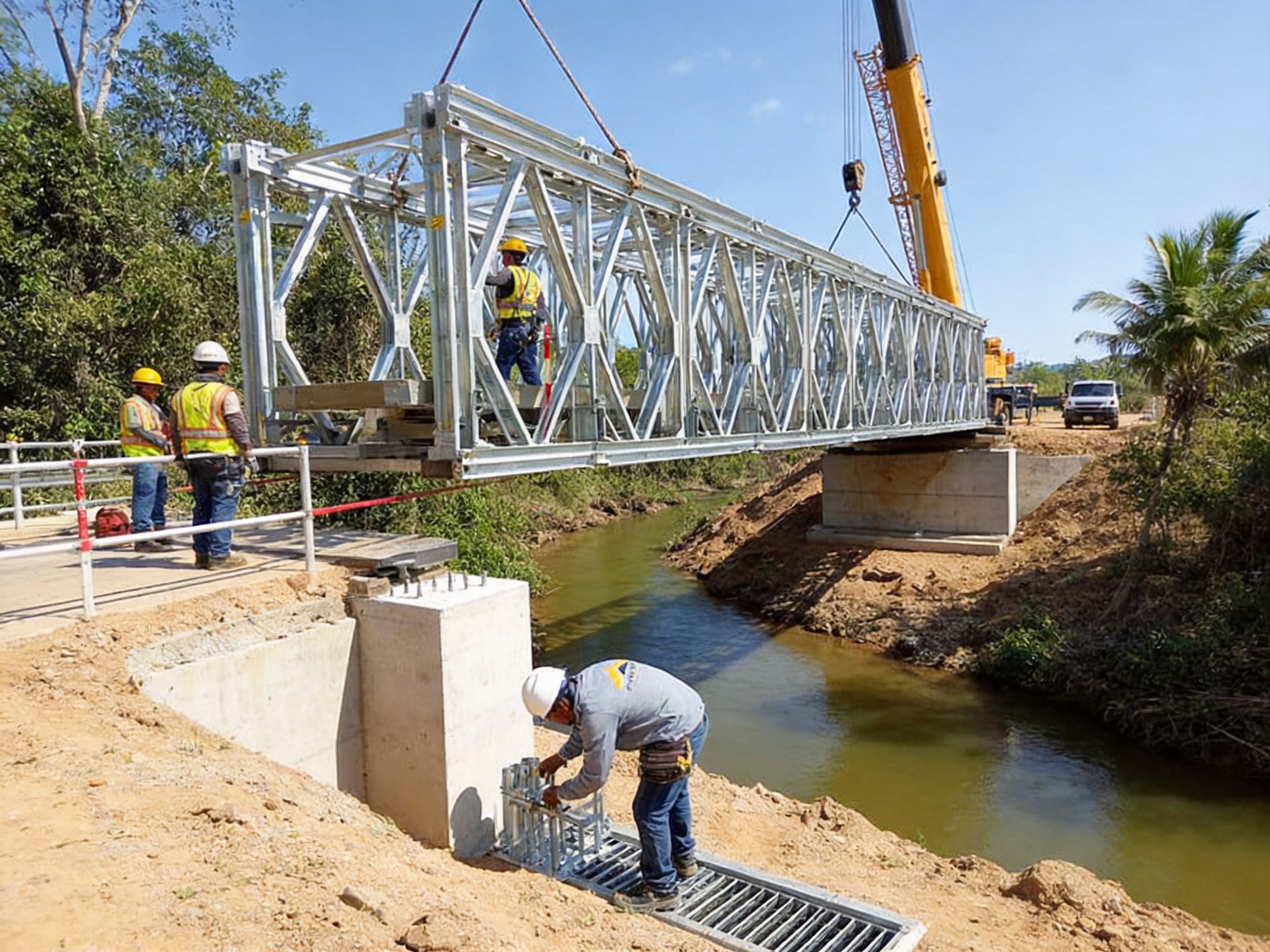
Modern infrastructure projects often require bridges that can be designed, manufactured, transported, and installed within a limited period. This need is especially important in regions affected by difficult terrain, seasonal flooding, emergency access requirements, growing traffic volumes, or marine environmental conditions. A modular Bailey bridge provides a practical answer because its standardized steel components can be assembled rapidly while still delivering the structural performance required for road traffic.
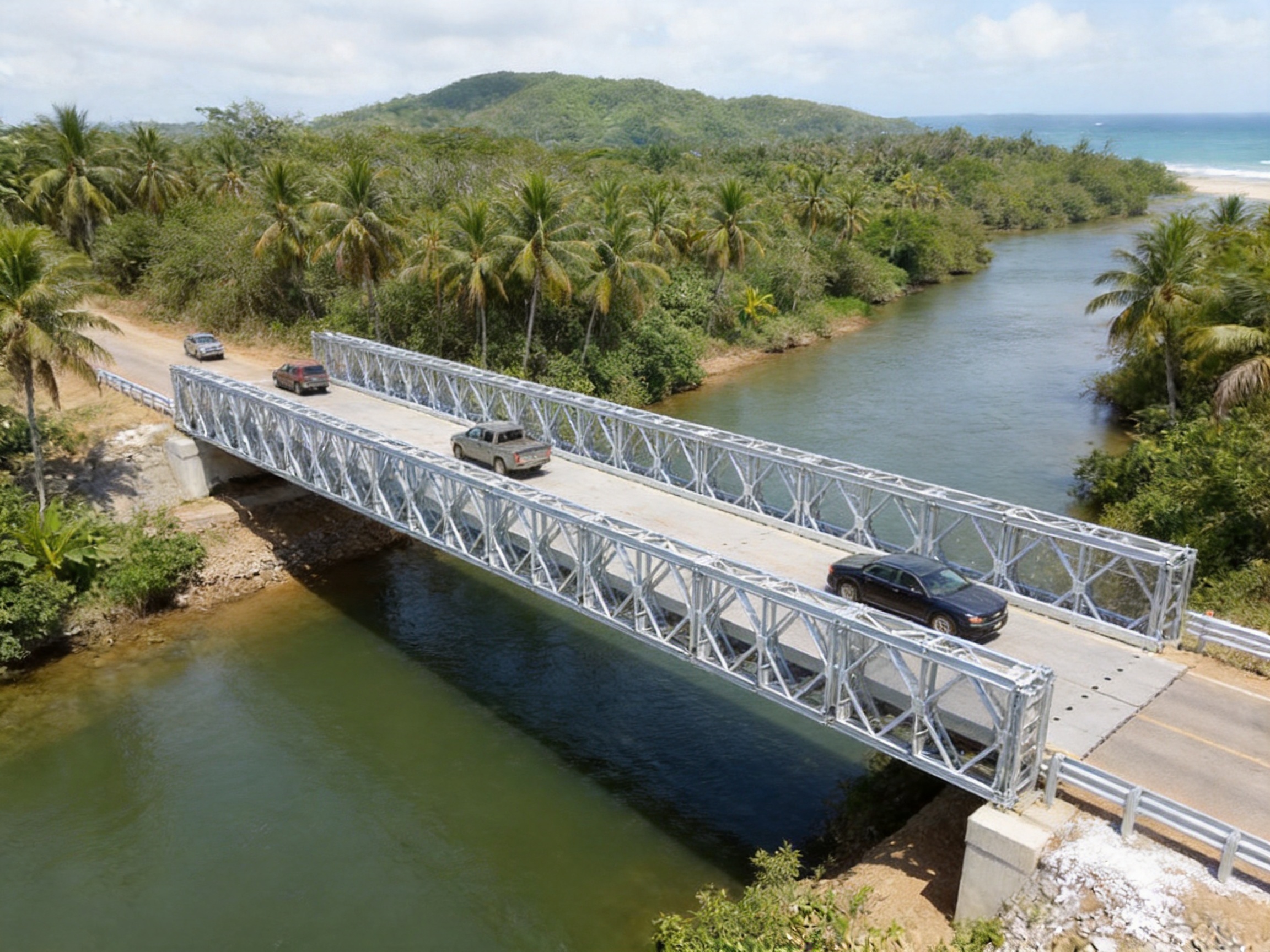
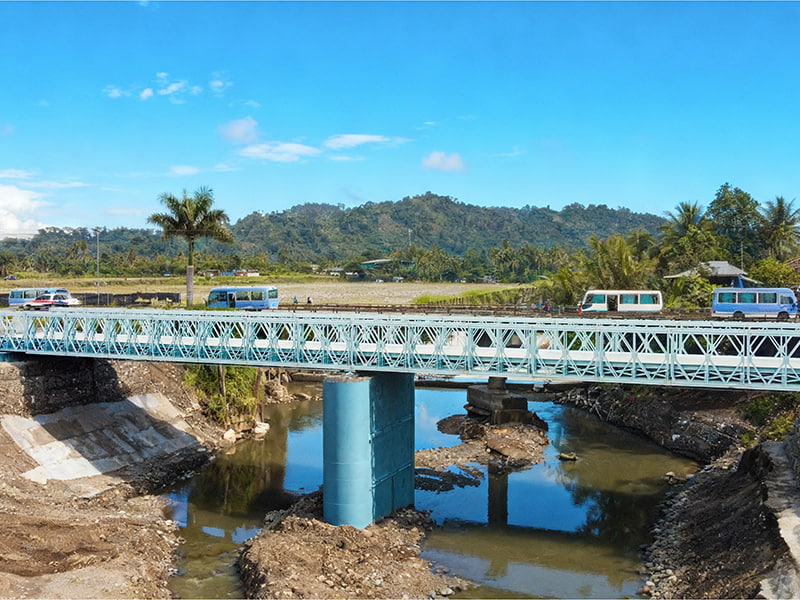
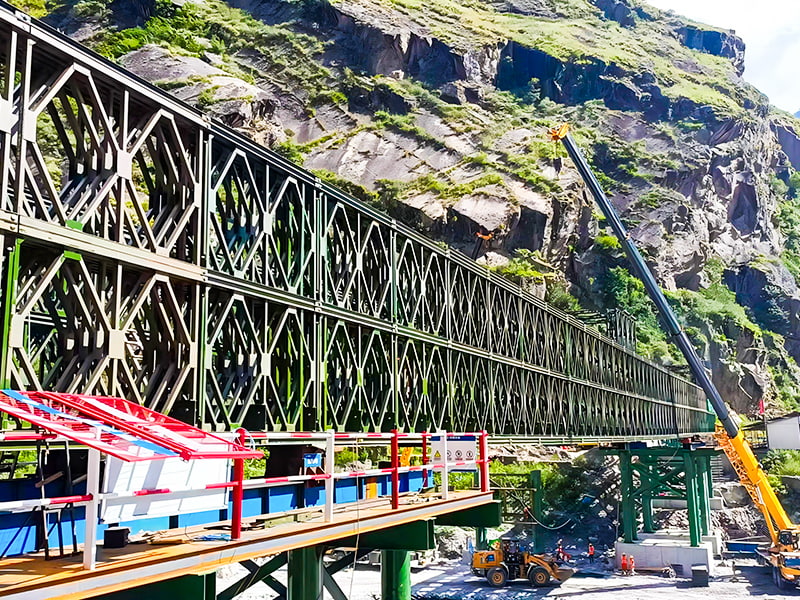
The 27-meter CB 200 Bailey Bridge is a double-row, single-layer reinforced modular steel bridge developed for demanding local road and infrastructure applications. Deployed in Colombia, this bridge represents a solution designed around practical transportation needs, environmental exposure, load requirements, and construction efficiency. Its galvanized steel components provide additional resistance to corrosion, while the reinforced truss arrangement delivers stability and dependable load-bearing capacity.
Unlike conventional bridges that depend on lengthy concrete construction, extensive on-site formwork, and long curing periods, a modular Bailey bridge uses factory-produced steel panels, transoms, bracing components, deck elements, and connection hardware. These elements are transported to the project site and assembled according to an engineered configuration. The result is a bridge system capable of supporting important road connections with reduced construction complexity.
The 27-meter span is suitable for many medium-span crossings, including waterways, drainage channels, temporary diversions, rural road gaps, construction access routes, and emergency transportation corridors. Its CB 200 configuration can be adapted to the required traffic arrangement and structural design criteria. It is also suitable for load designs such as HS-15, HS-20, HS-25, HL-93, and Track-50, subject to project-specific engineering verification.
Project Background and Application Requirements
Bridge projects in tropical, coastal, and rapidly developing regions must address more than span length alone. Local traffic patterns, vehicle weights, rainfall, soil conditions, construction access, environmental exposure, and future maintenance all affect the selection of a bridge system. A bridge that performs well in a dry inland climate may require additional protection when installed near the sea or in an area exposed to salt-laden air.
The bridge deployed in Colombia was designed for local road conditions and daily traffic requirements. Colombia includes regions with high rainfall, complex terrain, river crossings, and coastal environments. In such settings, a bridge must provide a reliable connection while remaining practical to transport and erect. The use of a modular steel system helps reduce dependence on large-scale permanent construction facilities at the project location.
The project also demonstrates the importance of selecting a structure with a balance between strength and installation efficiency. A bridge that is excessively heavy or complicated may increase transportation and lifting costs. Conversely, a bridge that is too light for the expected traffic may require restrictions or future reinforcement. The double-row, single-layer reinforced CB 200 arrangement is intended to provide a suitable balance for the specified span and road use.
As a modular bridge, the system can be planned in advance through component schedules, erection drawings, connection details, and load calculations. This approach supports more predictable procurement and construction. It also allows project teams to prepare foundations, abutments, temporary works, cranes, launching equipment, and site access before the bridge components arrive.
Structural Configuration of the 27-Meter Bridge
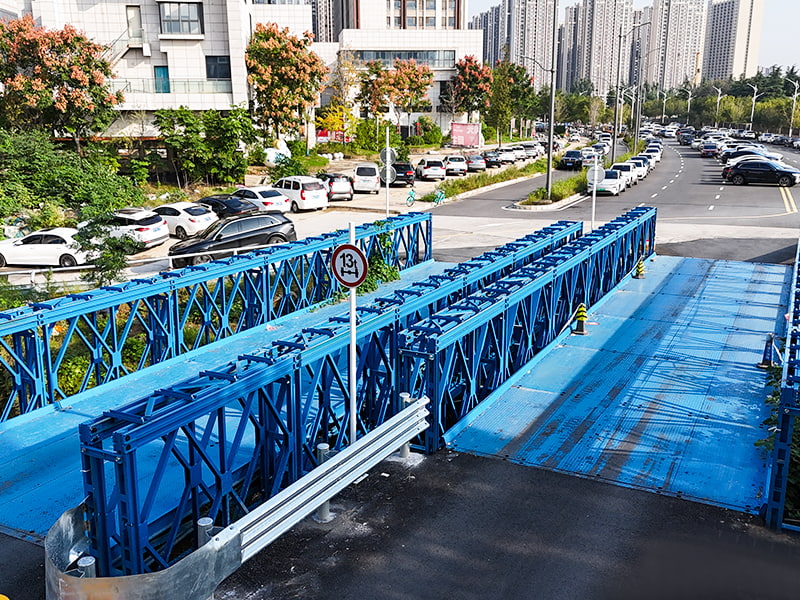
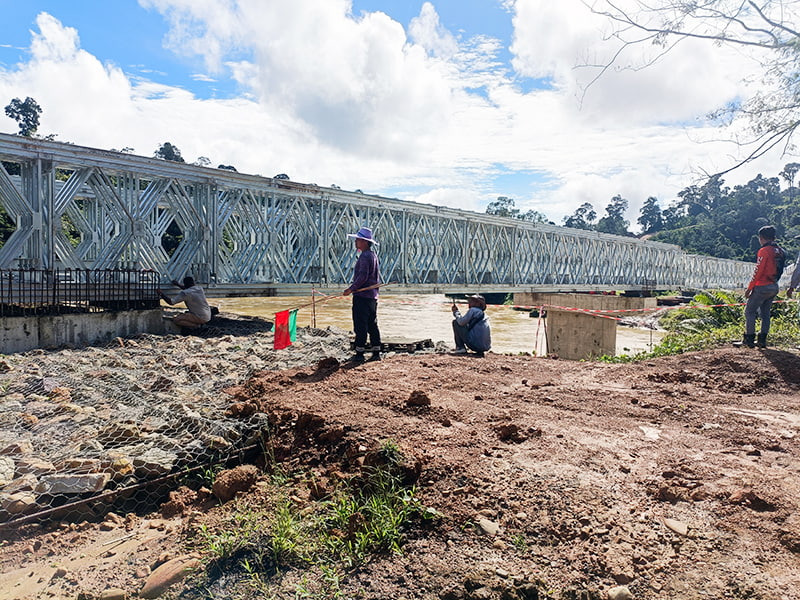
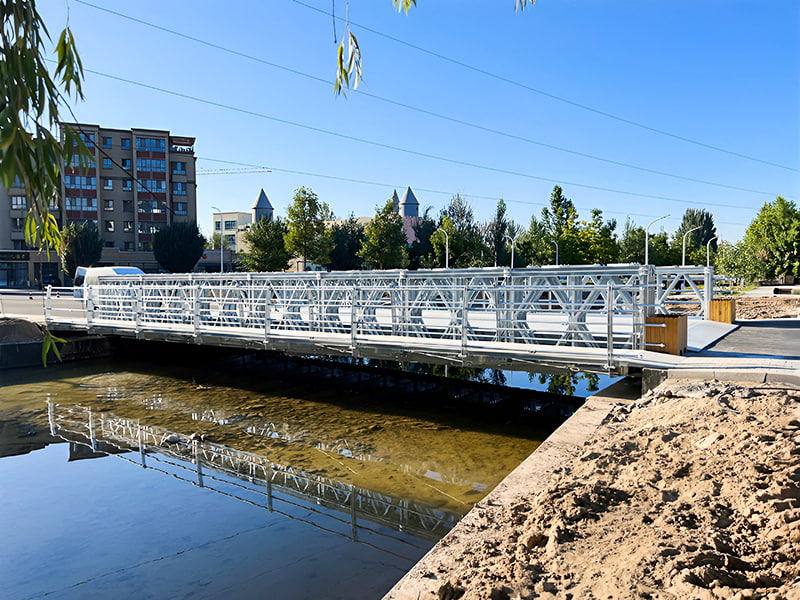
The CB 200 Bailey Bridge uses a truss-based structural arrangement. In a truss bridge, individual steel members work together through triangulated geometry to transfer vehicle loads toward the supports. The modular panels form the main side trusses, while transoms and bracing members connect the system across the bridge width and stabilize the structure against deformation.
The double-row configuration increases the effective structural capacity of the main trusses compared with a single-row arrangement. Each side of the bridge is formed using two rows of modular panels connected according to the design requirements. This configuration improves the ability of the bridge to resist bending, shear, and other effects generated by moving traffic and environmental loads.
The single-layer arrangement refers to the vertical layout of the truss panels. This configuration maintains a relatively compact bridge profile while allowing the double-row reinforcement to provide additional strength. The result is a practical structural form for a medium-span crossing where transportation clearance, erection simplicity, and load performance must be considered together.
Reinforcement is especially valuable when a bridge must accommodate regular road vehicles rather than occasional light access. It can support the design process by providing additional structural reserve, improving stiffness, and helping control deflection under traffic. Final capacity remains dependent on the complete engineering design, including foundation conditions, deck arrangement, connection quality, vehicle loading, wind exposure, and erection method.
The bridge deck transfers wheel loads to the transoms and then to the main trusses. Properly arranged deck components create a continuous driving surface while distributing traffic effects through the modular frame. Depending on the project design, the bridge may include deck plates, roadway panels, anti-skid surfacing, curbs, guardrails, pedestrian walkways, drainage provisions, and approach transition elements.
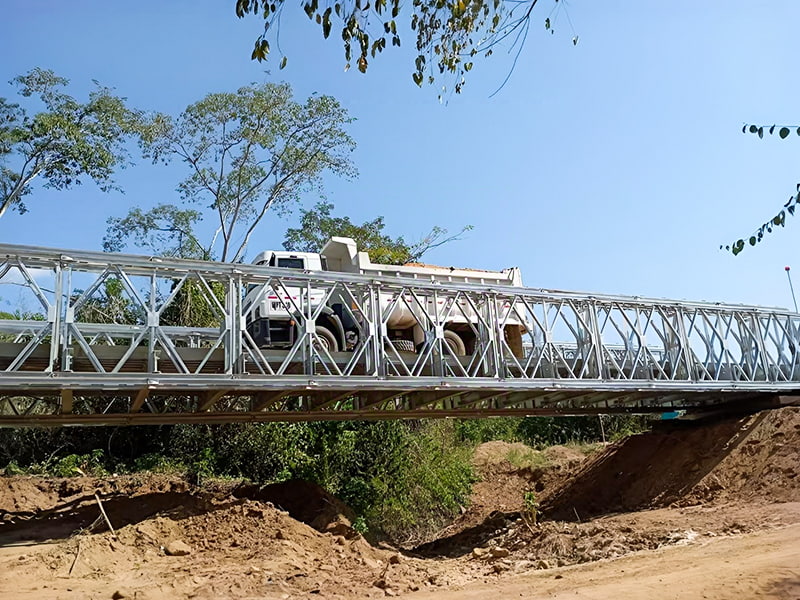
CB 200 Bailey Bridge 27-Meter Double-Row Single-Layer Reinforced Bailey Bridge
Key Advantages of the CB 200 Bailey Bridge
Rapid Assembly and Reduced Site Work
One of the main advantages of a Bailey bridge is the high proportion of work completed before delivery. Steel panels and related components are fabricated, inspected, and prepared at the manufacturing facility. At the project site, the construction team mainly focuses on foundation readiness, component handling, bolted assembly, launching or lifting, deck installation, alignment, and final inspection.
This process can reduce the amount of welding, cutting, temporary formwork, and concrete curing required in the field. It is particularly useful where construction windows are short or where traffic must be restored quickly. In emergency and disaster-response projects, this time-saving characteristic can be decisive because communities may depend on temporary or permanent access for food, medical services, evacuation, and economic activity.
Adaptability to Different Project Conditions
Modular bridge systems are based on standardized components, but they are not limited to one type of application. The same basic family of components can be configured for different spans, widths, traffic arrangements, and support conditions. Engineers can select an appropriate combination of panels, rows, bracing systems, deck units, and reinforcement based on the project requirements.
The 27-meter CB 200 bridge is therefore suitable for a range of road connection projects. It can be considered for a river or canal crossing, an access bridge inside an industrial project, a temporary bypass during permanent bridge reconstruction, or an emergency connection after flood damage. Its suitability must be confirmed through project-specific calculations and local regulations, but the modular concept allows it to respond efficiently to different site needs.
Corrosion Protection for Challenging Environments
Galvanization is a major feature of this bridge. Steel exposed to moisture, oxygen, road spray, and salt can experience corrosion if it is not adequately protected. In coastal or marine climates, chloride contamination can accelerate deterioration, especially on exposed edges, connection areas, deck components, and drainage zones.
Galvanized steel provides a protective zinc layer over the steel surface. This coating acts as a barrier and also provides sacrificial protection when small areas of the surface are damaged. The result is improved resistance to atmospheric corrosion and reduced maintenance exposure compared with unprotected carbon steel.
The Colombian project demonstrates the value of galvanized bridge components in a high-temperature and high-salt environment. Galvanization does not eliminate the need for inspection or maintenance, but it can extend the service life of the bridge system and reduce the frequency of repainting. The coating is especially useful for modular components that may be transported, assembled, disassembled, or reused in different locations.
Strong Load-Bearing Performance
The reinforced double-row truss arrangement is designed to provide dependable load-bearing performance for road traffic. It is suitable for load design references including HS-15, HS-20, HS-25, HL-93, and Track-50. These designations represent different vehicle loading approaches used in bridge engineering. The applicable design must be selected according to the project’s governing standards, traffic category, vehicle types, and safety requirements.
For clients, the availability of multiple load design options provides greater flexibility during project planning. A bridge intended for light local traffic may be designed differently from a bridge serving construction vehicles, emergency vehicles, or heavier commercial transport. Engineering review is necessary to confirm the correct structural arrangement, deck design, foundation capacity, and operational restrictions.
Efficient Transportation and Handling
Because the bridge is composed of modular steel elements, its components can be packed and transported in a systematic manner. Standardized panels and accessories can be bundled according to erection stages, reducing confusion during delivery and site assembly. The ability to move components separately can also be beneficial where roads, bridges, or site entrances cannot accommodate a fully assembled bridge.
Modular handling gives the project team more options. Components can be delivered by truck, container, or other suitable transport methods depending on the location. At the site, they can be moved with cranes, forklifts, winches, or other lifting equipment selected for the available access and project plan.
Potential for Reuse and Relocation
A conventional cast-in-place bridge is generally a permanent structure at one location. A modular Bailey bridge can provide greater flexibility because many of its components are mechanically connected. Subject to inspection and engineering approval, the bridge may be dismantled, transported, and reassembled for another application.
This reusability is valuable for temporary construction routes, emergency access programs, military logistics, mining operations, disaster recovery, and staged infrastructure development. It can also help owners manage changing transportation needs without investing immediately in a permanent bridge at every location.
Advantages Compared with Conventional and Competing Bridge Solutions
Compared with Cast-In-Place Concrete Bridges
Concrete bridges can provide excellent long-term performance, but they often require extensive formwork, reinforcement installation, concrete placement, curing, and quality control at the project site. These activities may be difficult in remote areas, during rainy seasons, or where access to concrete plants and heavy equipment is limited.
The modular steel approach moves much of the fabrication process into a controlled factory environment. Site activities become more focused on assembly and installation. This can shorten the construction schedule, reduce weather-related delays, and limit the need for large quantities of wet construction materials at the crossing location.
Concrete remains an important option for permanent bridge construction, particularly where a long design life and large traffic capacity are required. However, the CB 200 system can be more practical when speed, transportability, temporary use, or limited site infrastructure are major priorities.
Compared with Unreinforced Modular Bridges
A single-row modular bridge may be sufficient for light traffic or shorter spans, but the required structural capacity can increase as span length, vehicle weight, traffic frequency, or environmental loading increases. The double-row reinforcement of the CB 200 arrangement provides a stronger configuration for projects that need more structural capability within a compact single-layer form.
The reinforced structure can also improve stiffness and help manage movement under traffic. For users, this may contribute to a more stable driving experience when the bridge is properly designed, installed, and maintained. The advantage is not simply a higher nominal capacity; it is the ability to configure the bridge more appropriately for real operating conditions.
Compared with Improvised Temporary Crossings
Improvised crossings may be assembled from locally available steel, timber, or miscellaneous components. Although such methods can provide immediate access in an emergency, they may lack standardized design calculations, controlled manufacturing tolerances, reliable connection details, and documented load performance.
A manufactured Bailey bridge offers a more systematic solution. Components are produced according to defined specifications, inspected through established quality procedures, and supplied with engineering information. This supports safer planning and more consistent installation than an improvised structure assembled without a coordinated design basis.
Compared with Heavier Permanent Steel Bridges
Large welded steel bridges can provide high capacity and long service life, but they may require specialized fabrication, oversized transport, large cranes, complex site welding, and substantial temporary works. These demands can increase the cost and schedule of medium-span projects.
The modular CB 200 bridge uses a standardized component concept that can simplify logistics and erection. It may be a more efficient choice when the project does not require the mass or complexity of a fully welded permanent bridge. The final decision should consider the total project cost, including foundations, transport, erection, inspection, maintenance, removal, and future reuse.
Manufacturing and Engineering Strengths
The performance of a modular bridge depends heavily on manufacturing quality. A well-designed structural system can still experience problems if components do not meet dimensional requirements, connection holes are misaligned, welds are inconsistent, or protective coatings are poorly applied. For this reason, the manufacturing process is as important as the conceptual bridge design.
Jiangsu Zhonghai Bridge Equipment Co., Ltd. integrates engineering design, precision manufacturing, quality management, and international delivery support. Its production capabilities cover modular steel bridges, Bailey bridge systems, customized steel components, bridge erection and construction support equipment, automated welding, and precision steel fabrication.
Engineering Design and Product Configuration
Engineering begins with an understanding of the project requirements. These may include span length, roadway width, traffic class, design vehicle, environmental exposure, foundation arrangement, erection method, site access, and expected service period. The engineering team can then determine the appropriate panel arrangement, reinforcement level, deck system, bracing, connections, and accessories.
For the 27-meter CB 200 bridge, the double-row single-layer reinforced configuration reflects a deliberate balance between strength and erection practicality. Rather than treating every bridge as a completely independent structure, the modular approach uses a proven family of components that can be configured according to project-specific calculations.
Standardized Component Production
Standardization supports interchangeability and predictable assembly. Panels, transoms, bracing members, deck units, pins, bolts, and other components are manufactured to defined dimensions and tolerances. Consistent production reduces the risk of field modification and helps the erection team follow an organized sequence.
Standardized components also support spare-parts management. If a project requires replacement parts after accidental damage or prolonged operation, compatible components can be identified more easily than with a one-off structure. This can simplify long-term ownership and maintenance planning.
Automated and Controlled Welding
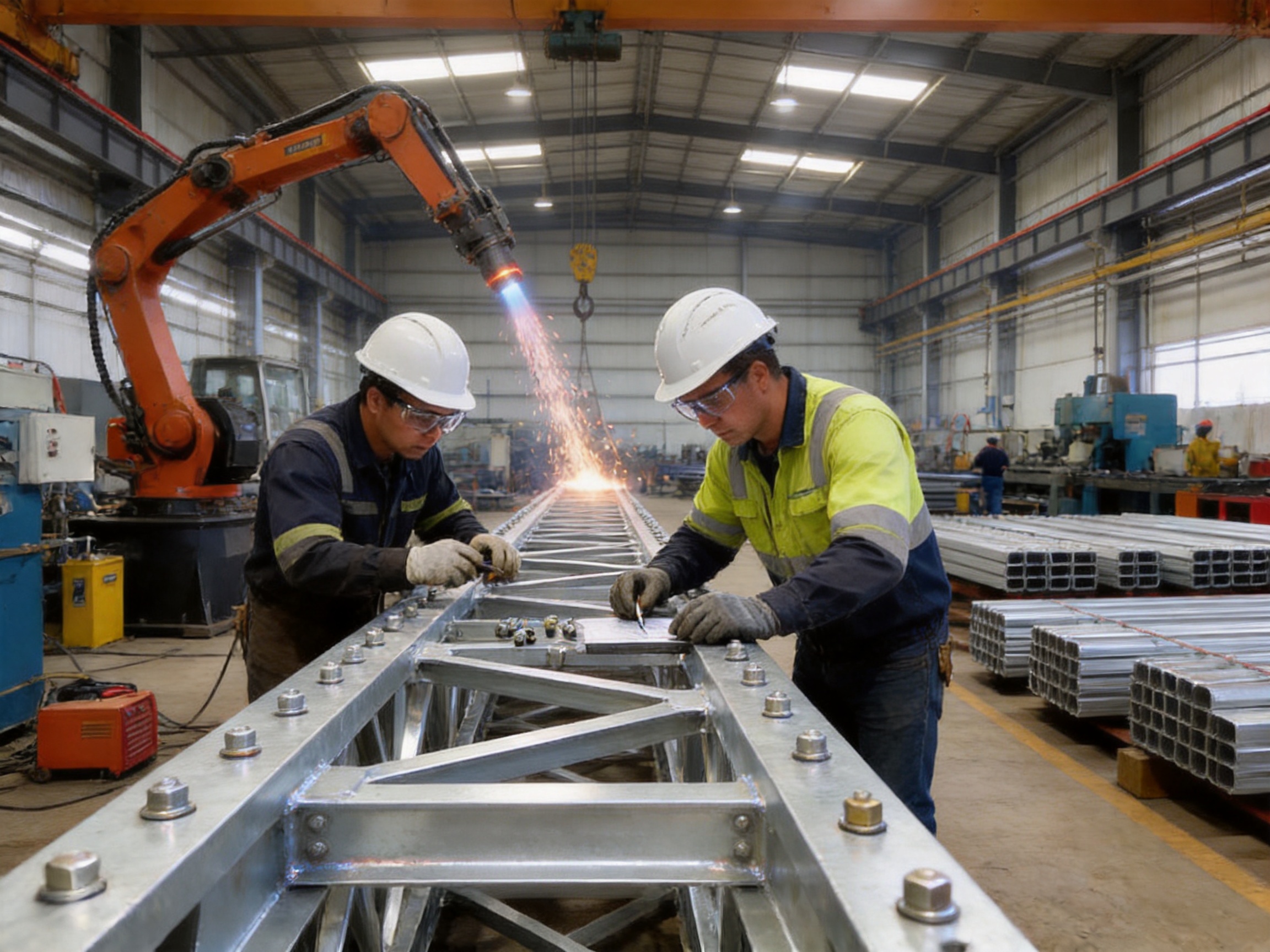
Welding is a critical process in steel bridge fabrication. Weld quality affects strength, fatigue performance, dimensional stability, and corrosion behavior. Automated welding can improve consistency by controlling travel speed, heat input, weld geometry, and process repeatability.
Automation does not replace engineering judgment or inspection. Instead, it provides a more stable production process when combined with qualified procedures, trained personnel, calibrated equipment, and appropriate inspection methods. Welded assemblies can be checked for visual quality, dimensional accuracy, surface defects, and other specified requirements.
Precision Steel Fabrication
Precision fabrication is essential for modular bridge components because the parts must fit together accurately during field assembly. Connection holes, panel edges, stiffeners, brackets, and bearing surfaces must be produced within the required tolerances. Accurate cutting, forming, drilling, and assembly reduce the need for adjustment at the project site.
Factory-controlled fabrication also improves production planning. Materials can be traced through purchasing, cutting, welding, inspection, surface preparation, coating, packing, and dispatch. Such a process helps the manufacturer maintain consistency across multiple bridge orders and international projects.
Surface Preparation and Galvanization
Corrosion protection begins before the coating is applied. Steel surfaces must be prepared to remove contaminants, scale, oil, and other materials that could reduce coating adhesion. The galvanization process then creates a protective zinc layer across suitable steel surfaces.
Attention to surface preparation, component geometry, drainage, venting, handling, and inspection is important for coating quality. After galvanization, components should be handled carefully to minimize unnecessary damage during packing, transport, and erection. Any field damage should be repaired using an approved method consistent with the project specification.
Quality Management and Inspection
Quality management covers more than final visual inspection. It includes material verification, dimensional checks, welding control, coating checks, assembly verification, documentation, packing inspection, and shipment control. A complete quality process helps ensure that components delivered to a remote project site match the approved design and bill of materials.
The company’s manufacturing approach is intended to support compliance with ASTM, EN, and applicable national specifications. The specific standard used for a project should be confirmed during engineering and contract review. International projects may require additional documentation, third-party inspection, material certificates, welding records, coating reports, or load-test procedures.
Project Planning from Design to Installation
Initial Site Investigation
Before ordering a modular bridge, the project team should investigate the crossing location. Important information includes the clear span, bank conditions, water level, flood history, approach alignment, roadway width, soil characteristics, construction access, overhead restrictions, utility locations, and environmental constraints.
The 27-meter bridge span describes the bridge system, but the complete crossing may require additional length for bearings, abutments, approach slabs, embankments, or flood protection. A survey should confirm the actual distance between supports and the required deck elevation.
Load and Traffic Assessment
Traffic assessment should identify the types of vehicles expected to use the bridge. Local passenger vehicles, buses, delivery trucks, agricultural vehicles, emergency vehicles, construction equipment, and heavy commercial trucks may impose different demands. The selected design load should reflect both current traffic and reasonable future use.
HS-15, HS-20, HS-25, HL-93, and Track-50 are examples of load design references that may be considered. The selected loading model must be applied within the relevant design code and combined with other effects such as dead load, wind, braking, centrifugal forces, temperature, seismic action, and flood-related debris where applicable.
Foundation and Abutment Design
A strong superstructure requires suitable supports. The bridge may use concrete abutments, reinforced concrete footings, steel support frames, temporary foundations, or other engineered arrangements. The selected support system must safely transfer vertical and horizontal reactions into the ground.
Soil investigation is therefore essential. Weak or saturated soil may require ground improvement, deeper foundations, larger footings, or erosion protection. In a river or flood-prone area, scour and high-water events must be considered. The bridge supplier can provide reaction information and interface requirements, while local civil and geotechnical engineers typically finalize the foundation design.
Delivery and Component Organization
Efficient delivery begins with a clear packing plan. Components should be grouped according to bridge sections or erection stages. Labels, packing lists, drawings, and identification marks help the site team locate the required parts quickly.
Storage at the site should protect components from unnecessary damage, contamination, and standing water. Galvanized steel should be stored in a manner that supports drainage and ventilation. Bolts, pins, fittings, and smaller accessories should be secured and inventoried because missing connection hardware can interrupt the erection sequence.
Erection and Launching
Bailey bridges can be assembled using different erection methods, depending on site conditions. A bridge may be assembled on one bank and launched across the gap, lifted into position in sections, or erected directly between supports. The selected method depends on available equipment, water conditions, access, clearance, bridge weight, and safety requirements.
A temporary launching nose or other erection aid may be used when the bridge is pushed or pulled across a crossing. The erection plan should define lifting points, temporary supports, bracing requirements, assembly sequence, connection tightening, and exclusion zones. The bridge must not be opened to traffic until alignment, connections, deck installation, guardrails, and inspections are complete.
Environmental and Operational Considerations
The galvanized CB 200 bridge is particularly relevant to locations where atmospheric corrosion is a concern. High humidity, salt spray, industrial pollutants, and repeated wetting and drying cycles can increase steel deterioration. Protective coating, good drainage, regular cleaning, and inspection together provide the best approach to long-term performance.
Bridge drainage should prevent water from accumulating on the deck or around connections. Road surfaces should be maintained to reduce potholes, impact loads, and water retention. Expansion and movement details should remain clear and functional. Where the bridge crosses a waterway, debris accumulation should be monitored because floating branches, sediment, and flood-borne materials can increase lateral forces.
Operational controls may be required depending on the design. These can include speed limits, lane controls, vehicle spacing, axle-load restrictions, traffic signs, height restrictions, and inspection intervals. Such controls are not weaknesses of modular bridges; they are normal tools for managing bridge use according to the approved design and site conditions.
In a marine or coastal environment, inspections should pay particular attention to connection zones, deck supports, drainage outlets, cut edges, damaged coating areas, and locations where salt deposits may collect. Galvanization provides important protection, but maintenance personnel should still remove dirt and deposits and repair damage when necessary.
Maintenance and Service-Life Management
One benefit of a modular steel bridge is that its components can be inspected individually. Maintenance teams can examine panels, bracing members, transoms, deck units, bolts, pins, bearings, guardrails, and support areas. A documented inspection program should identify loose or missing fasteners, deformation, cracks, corrosion, coating damage, deck wear, settlement, scour, and changes in alignment.
Routine maintenance may include tightening or replacing approved connection hardware, repairing deck surfacing, cleaning drainage paths, removing debris, checking guardrails, and maintaining approach roads. More detailed inspections may be required after exceptional events such as floods, collisions, earthquakes, unusually heavy vehicle movements, or accidental overloads.
Component replacement can be more practical than repairing a fully integrated welded structure. If a deck panel or bracing member is damaged, the affected component may be removed and replaced after engineering review. This modular repair strategy can reduce downtime and help keep the bridge in service.
Owners should maintain records of the original design load, installation date, component identification, inspection results, repairs, traffic restrictions, and unusual events. These records support better decisions throughout the bridge’s service life and help future engineers understand the structure’s operating history.
Manufacturing and Supply Capabilities for International Projects
International bridge projects require more than manufacturing capacity. They require coordination across engineering, documentation, packaging, logistics, customs preparation, communication, and site support. Jiangsu Zhonghai Bridge Equipment Co., Ltd. serves clients involved in transportation, water conservancy, military logistics, disaster relief, and international development.
The company’s location in Zhenjiang, Jiangsu Province, provides access to an important industrial and transportation region. Its production system is designed to support large-scale manufacturing and standardized export delivery. This can be valuable for clients who need consistent component quality across multiple bridge orders or projects in different countries.
International delivery performance depends on accurate bills of materials, clear technical drawings, suitable packing, reliable labeling, and coordination with the destination country’s import requirements. For a modular bridge, missing one small but essential item can delay field work, so documentation and packing control are important parts of the overall supply service.
Technical support may include product selection, bridge configuration, load-design coordination, component schedules, erection guidance, and construction support equipment. The level of support should be defined in the contract, especially when local contractors will perform the foundation work or bridge erection.
Technical Summary
| Item | Product Information |
|---|---|
| Bridge type | CB 200 Bailey bridge and modular steel truss bridge |
| Application | Road traffic, temporary access, emergency response, construction access, and local infrastructure connections |
| Bridge span | 27 meters |
| Structural arrangement | Double-row, single-layer reinforced configuration |
| Primary material | Fabricated structural steel components |
| Corrosion protection | Galvanized steel components |
| Load design references | HS-15, HS-20, HS-25, HL-93, and Track-50, subject to project verification |
| Manufacturing capabilities | Precision steel fabrication, automated welding, modular bridge production, customized components, and bridge erection support equipment |
| Typical advantages | Rapid assembly, transportability, structural adaptability, corrosion resistance, and potential reuse |
| Engineering requirement | Final design must consider local codes, foundations, traffic, environmental loads, erection method, and operating conditions |
Why This Bridge Is a Practical Choice
The 27-meter CB 200 Bailey Bridge combines several characteristics that are difficult to achieve in one conventional solution. It provides a reinforced truss structure for meaningful road traffic, a modular format for efficient transportation and erection, and galvanized protection for challenging atmospheric conditions.
Its double-row, single-layer configuration offers a practical structural arrangement for a medium-span crossing. The bridge is not limited to one application category. It can support permanent infrastructure planning where a modular system is appropriate, while also serving temporary, emergency, construction, and disaster-response purposes.
The manufacturing process strengthens the product’s value. Automated welding, precision fabrication, standardized components, quality management, and controlled galvanization help reduce variability between production batches. These capabilities give project owners a stronger basis for planning installation, maintenance, and future component replacement.
Compared with improvised crossings, the system provides a more systematic engineering and manufacturing basis. Compared with heavy conventional steel bridges, it may reduce transportation and erection complexity. Compared with cast-in-place construction, it can shorten the amount of site work and avoid long curing periods. These advantages make it especially relevant to projects where access, speed, corrosion exposure, and construction logistics are major concerns.
At the same time, responsible bridge selection requires proper engineering. Span length, traffic loading, foundation conditions, flood effects, wind, seismic requirements, construction sequence, and local regulations must all be reviewed. A modular bridge is most effective when the manufacturer, designer, contractor, and owner coordinate from the beginning of the project.
Frequently Asked Questions
What is the main purpose of the 27-meter CB 200 Bailey Bridge?
The bridge is designed to provide a modular road crossing for local infrastructure, temporary access, emergency transportation, construction routes, and other medium-span applications. Its specific use depends on the approved design, traffic requirements, and site conditions.
What does double-row, single-layer reinforced mean?
Double-row refers to the use of two rows of modular truss panels in the main structural arrangement. Single-layer describes the vertical panel layout. Together, the configuration provides reinforcement and load-bearing capability while maintaining a relatively compact bridge profile.
Why is galvanization important for this bridge?
Galvanization adds a zinc protective layer to the steel. It helps shield the structural components from moisture and atmospheric corrosion and is particularly useful in humid, coastal, high-salt, or marine environments. Regular inspection and maintenance remain necessary.
Which load designs can the bridge support?
The bridge is suitable for load design references such as HS-15, HS-20, HS-25, HL-93, and Track-50. The correct design reference and final capacity must be confirmed through project-specific structural calculations and the applicable local or international standard.
Can the bridge be used as a permanent structure?
A modular Bailey bridge can be used for temporary or longer-term infrastructure applications when it is appropriately designed, protected, installed, inspected, and maintained. The owner and project engineer should determine whether the selected configuration satisfies the required service life and operating conditions.
How is the bridge transported to the project site?
The bridge is transported as separate modular components. Panels, deck elements, bracing, transoms, connections, and accessories can be packed and delivered according to the project logistics plan. This allows the system to reach locations where transporting a fully assembled bridge would be impractical.
How is the bridge installed?
Depending on the site, the bridge may be assembled on one bank and launched across the gap, lifted into position in sections, or assembled directly between supports. The erection method must be developed by qualified personnel based on bridge weight, access, equipment, water conditions, temporary works, and safety requirements.
Does the manufacturer provide customized bridge solutions?
Modular bridge systems can be configured for different spans, widths, load requirements, deck arrangements, and site conditions. Customized steel components, erection support equipment, and engineering coordination may also be included depending on the project scope.
What standards can be considered for the bridge?
The manufacturing system is intended to support ASTM, EN, and applicable national specifications. The governing standard should be identified before design and procurement. Local authorities may also require specific documents, calculations, inspections, or certifications.
What maintenance does a galvanized Bailey bridge require?
Maintenance includes inspection of panels, connections, deck elements, bearings, guardrails, approaches, drainage, and support areas. Owners should look for deformation, loose fasteners, coating damage, corrosion deposits, settlement, scour, and impact damage. Any significant defect should be evaluated by qualified bridge personnel.
Can the bridge be reused at another location?
One advantage of modular construction is the potential for dismantling and relocation. Reuse requires inspection of every component, confirmation of structural condition, review of the new site and load requirements, and approval of the new erection and foundation design.
What information is needed before requesting a quotation?
Useful information includes the required span, roadway width, design vehicle or loading standard, traffic frequency, site location, environmental conditions, foundation concept, expected service period, erection method, delivery destination, and whether accessories or installation support are required.
Conclusion
The 27-meter CB 200 Bailey Bridge is a practical modular steel solution for road and infrastructure projects that require strength, installation efficiency, and environmental protection. Its double-row single-layer reinforced structure supports dependable load-bearing performance, while the galvanized finish improves resistance to high-humidity and high-salt conditions such as those encountered in coastal or marine climates.
The bridge’s modular construction simplifies transport, assembly, inspection, repair, and potential relocation. Its suitability for load designs including HS-15, HS-20, HS-25, HL-93, and Track-50 gives project planners a flexible starting point for different traffic requirements. Final performance depends on correct engineering, foundations, erection, traffic management, and maintenance.
Behind the bridge system is an integrated manufacturing approach that combines engineering design, standardized component production, automated welding, precision steel fabrication, surface protection, quality management, and international delivery support. These capabilities help transform a modular bridge concept into a dependable field solution for transportation, emergency response, water conservancy, construction, and infrastructure development.
For projects where time, access, corrosion exposure, and structural reliability must be balanced, the 27-meter CB 200 Bailey Bridge offers a competitive alternative to more complex conventional construction methods. With proper design and professional installation, it can provide a safer, faster, and more adaptable connection for communities and infrastructure projects worldwide.
References
American Association of State Highway and Transportation Officials. AASHTO LRFD Bridge Design Specifications.
American Institute of Steel Construction. Specification for Structural Steel Buildings.
ASTM International. Standard Specifications and Test Methods for Structural Steel and Zinc Coatings.
European Committee for Standardization. Eurocode 3: Design of Steel Structures.
International Organization for Standardization. Quality Management Systems: Requirements.
International Organization for Standardization. Corrosion Protection of Metals by Protective Coatings.
Modular Bridge Engineering Practice. Principles of Bailey Bridge Configuration, Erection, Inspection, and Maintenance.
Bridge Construction and Maintenance Guidelines. Technical principles for steel truss bridges, temporary bridges, and modular access structures.
Product: CB 200 Bailey Bridge 27-Meter Double-Row Single-Layer Reinforced Bailey Bridge


We respond quickly to all international requests and provide technical support when needed.
Product Category
Bailey Bridge/Modular Bridge Modular Steel Bridge Pedestrian Bridge Modular Pipe Bridge Truss Bridge Steel StructureContact Us

+86-511-84522866
+86-13921582699

zhwm@zjql.com

Building 1,83#, dantu New Town, Yanjiang Road, Dantu District, Zhenjiang, Jiangsu, China
Copyright © Jiangsu Zhonghai Bridge Equipment Co., Ltd. All
Rights
Reserved
China bailey bridge for sale
bailey bridge supplier from china
