
 English
 русский
 Español
 Português


Luo Shiqing — Product After-Sales Service Supervisor
CB 200 Double-Row Single-Layer Galvanized Bailey Bridge: Engineering Advantages, Manufacturing Quality, and Global Applications
Content
- 1 1. Overview of the CB 200 Modular Bridge System
- 2 2. Double-Row Single-Layer Structural Configuration
- 3 3. Standardized Bailey Panels and Supporting Components
- 4 4. Hot-Dip Galvanizing for Harsh Environmental Conditions
- 5 5. Advanced Manufacturing Processes
- 6 6. Competitive Advantages Compared with Conventional Bridge Solutions
- 7 7. Efficiency of On-Site Assembly
- 8 8. Suitability for Tropical, Coastal, and Island Projects
- 9 9. Engineering Design and Project Adaptation
- 10 10. Manufacturing Strengths of the Supplier
- 11 11. Quality, Compliance, and Documentation
- 12 12. Transportation, Packaging, and Delivery
- 13 13. Maintenance and Long-Term Service Considerations
- 14 14. Applications in Transportation and Emergency Response
- 15 15. Why Factory-Direct Supply Matters
- 16 16. Project Planning Checklist
- 17 17. Frequently Asked Questions
- 17.1 17.1 What is a double-row single-layer Bailey Bridge?
- 17.2 17.2 Where can the CB 200 bridge be used?
- 17.3 17.3 Why is hot-dip galvanizing important?
- 17.4 17.4 Can the bridge be installed in a remote location?
- 17.5 17.5 Is the bridge reusable?
- 17.6 17.6 Does the supplier provide an assembly plan?
- 17.7 17.7 What information is needed for a quotation?
- 17.8 17.8 How does this bridge compare with a conventional concrete bridge?
- 17.9 17.9 What maintenance does a galvanized bridge require?
- 17.10 17.10 Can the bridge be customized?
- 18 18. Conclusion
- 19 References
- 20 Product: CB 200 Bailey Bridge Double-Row Single-Layer Galvanized Bailey Bridge
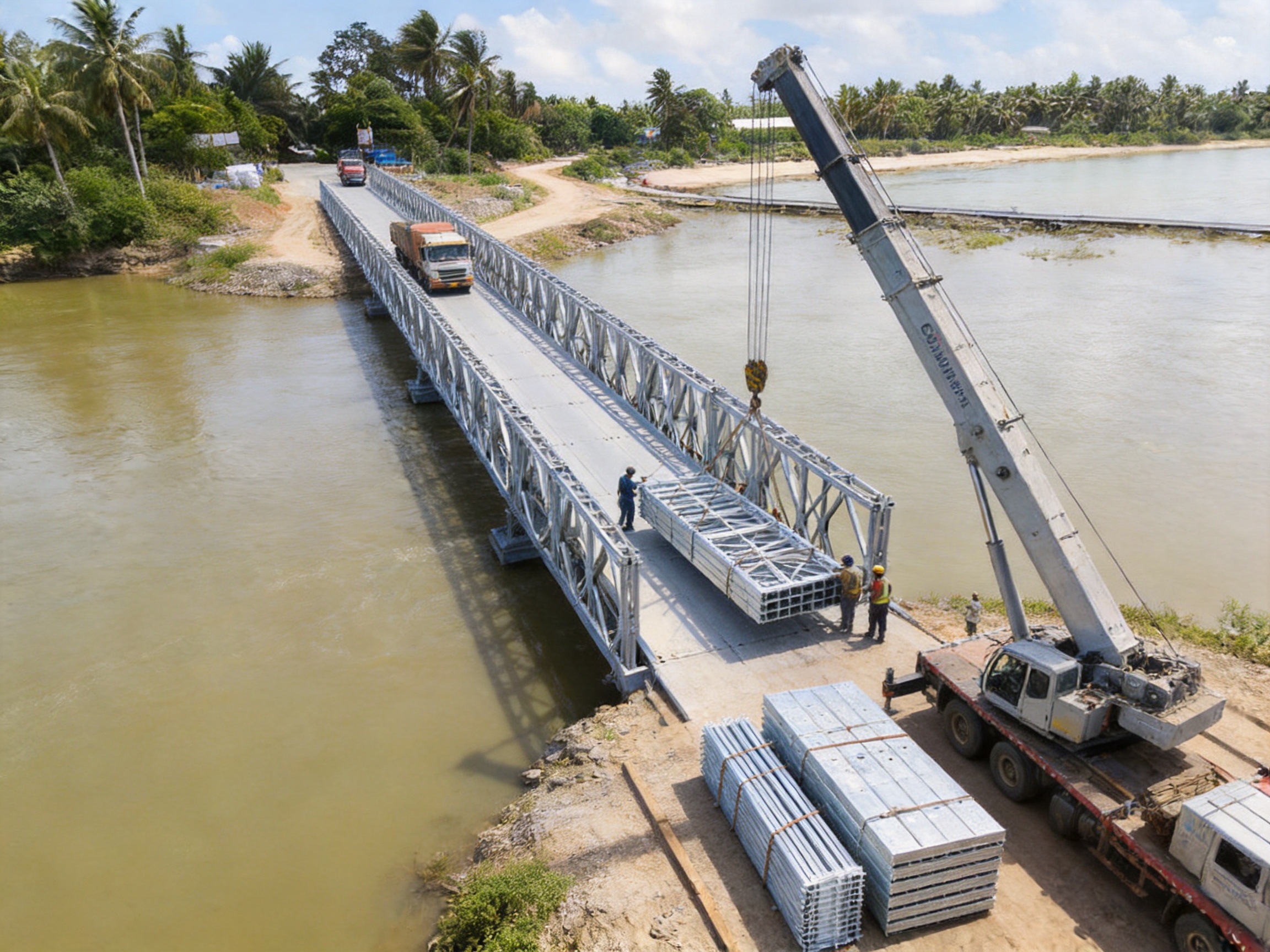
Reliable bridge infrastructure is essential for connecting communities, supporting logistics, and maintaining access during construction, flooding, natural disasters, and other challenging conditions. In locations where conventional concrete or permanently welded steel bridges are difficult to transport and install, modular bridge systems provide an efficient and practical alternative. The CB 200 double-row single-layer galvanized Bailey Bridge is designed for this purpose. It combines standardized modular components, high-strength steel construction, corrosion-resistant protection, and rapid assembly into a bridge solution suitable for demanding transportation and infrastructure projects.
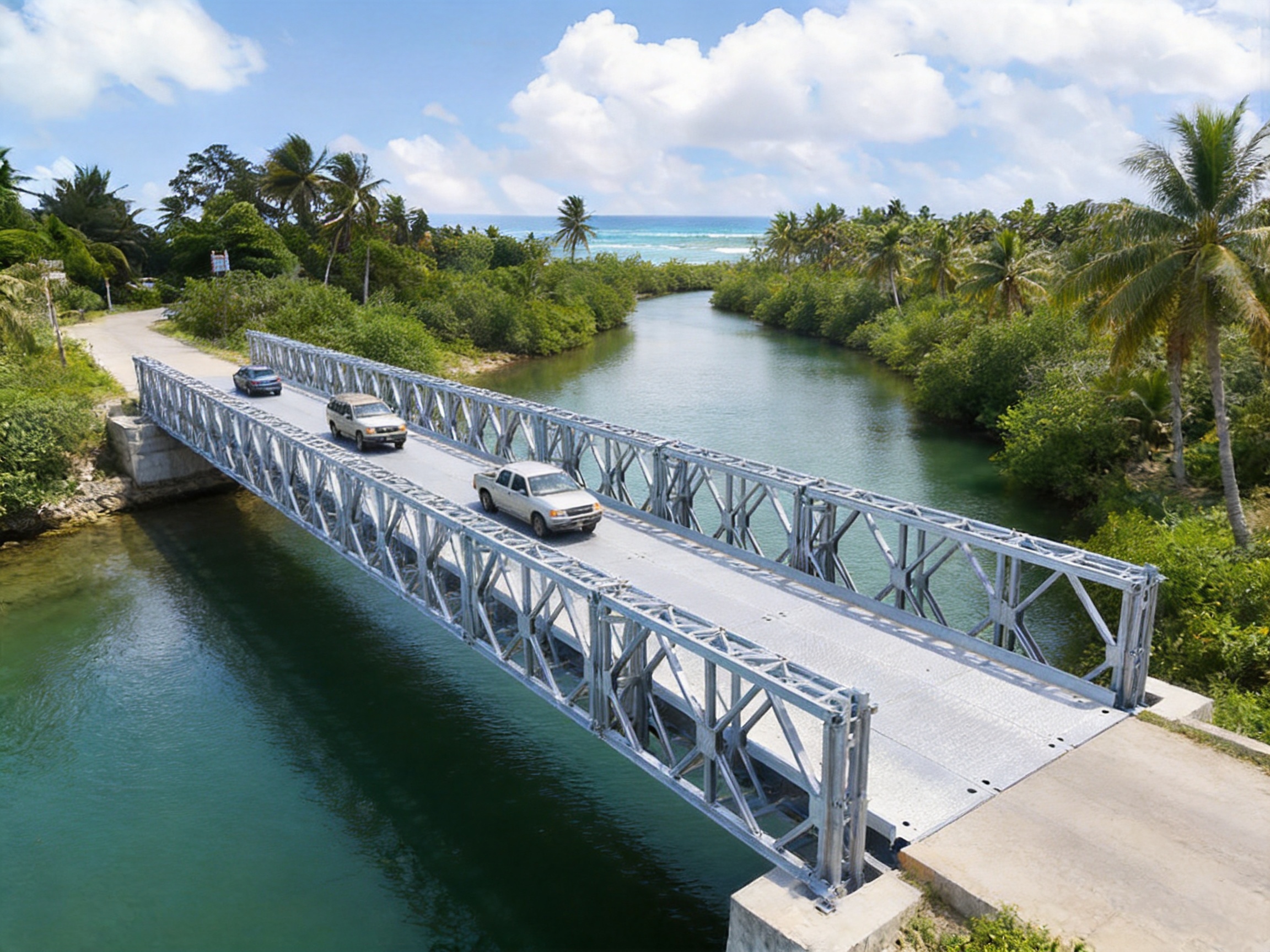
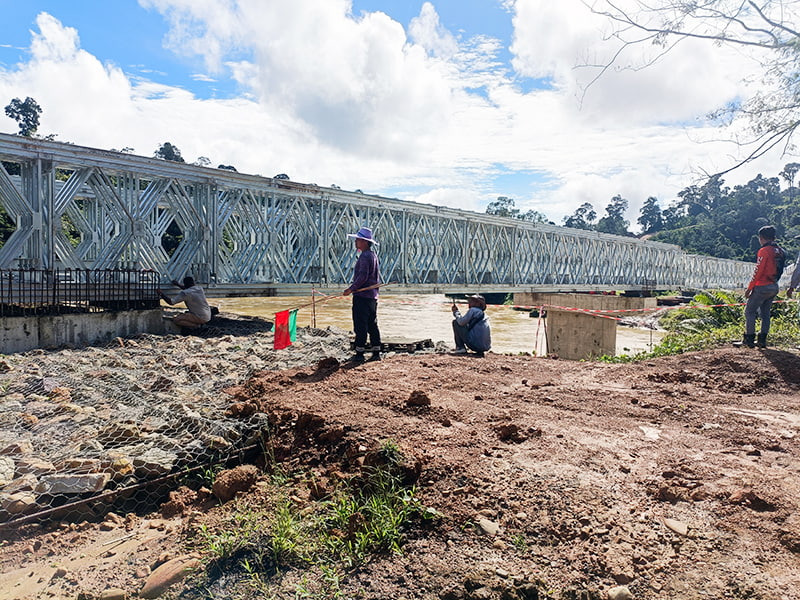
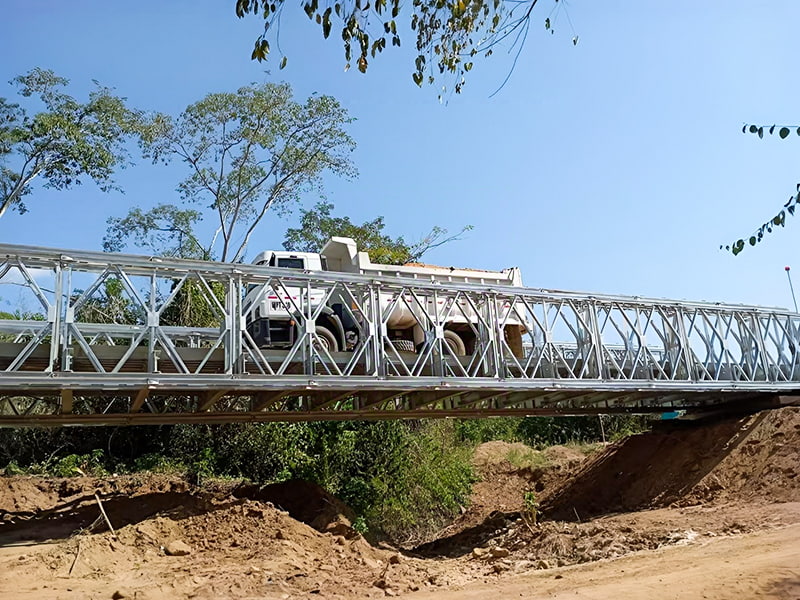
Installed in Kiribati, this bridge uses standard CB 200 Bailey panels and supporting components manufactured through a controlled factory process. Its double-row single-layer configuration has been adapted to local traffic requirements, while hot-dip galvanizing provides additional protection against the high-temperature and high-humidity conditions common in island environments. The result is a bridge system that supports fast construction without sacrificing structural reliability, service durability, or maintainability.
This article examines the product’s design, structural configuration, manufacturing process, transportation benefits, installation efficiency, corrosion protection, quality management, and competitive advantages. It also explains how a specialized modular bridge manufacturer can support clients from engineering design and component production through delivery, erection guidance, and project coordination.
1. Overview of the CB 200 Modular Bridge System
The CB 200 Bailey Bridge is a modular steel bridge system based on standardized panels and interchangeable support components. Unlike a conventional bridge that is fabricated as a single large structure, a Bailey Bridge is assembled from factory-produced elements. These components can be transported separately, connected at the project site, and reused or reconfigured for other applications when necessary.
The product described here uses a double-row single-layer arrangement. In a double-row configuration, two parallel rows of Bailey panels form the main longitudinal truss on each side of the bridge. The single-layer arrangement refers to the vertical stacking of the panel rows. This configuration provides a practical balance between load-bearing capability, material efficiency, transport requirements, and construction speed.
Standardized CB 200 panels are connected with supporting components, transverse members, deck elements, bracing parts, fastening systems, and other accessories required for bridge assembly. Because the components are designed as part of one modular system, the construction team can follow a prepared assembly plan rather than developing a completely new fabrication method at the site.
The bridge is particularly suitable for temporary or semi-permanent applications, including rural access routes, emergency transportation links, construction access, waterway crossings, logistics roads, and infrastructure rehabilitation projects. Depending on the engineering design, site conditions, and approved loading requirements, the system may also be considered for longer-term service applications.
A key advantage of the CB 200 concept is repeatability. Standardized component dimensions and connection arrangements make it easier to organize production, inspection, packaging, transport, and installation. Repeatability also reduces uncertainty during construction because contractors can work with a defined system instead of relying on extensive on-site adaptation.
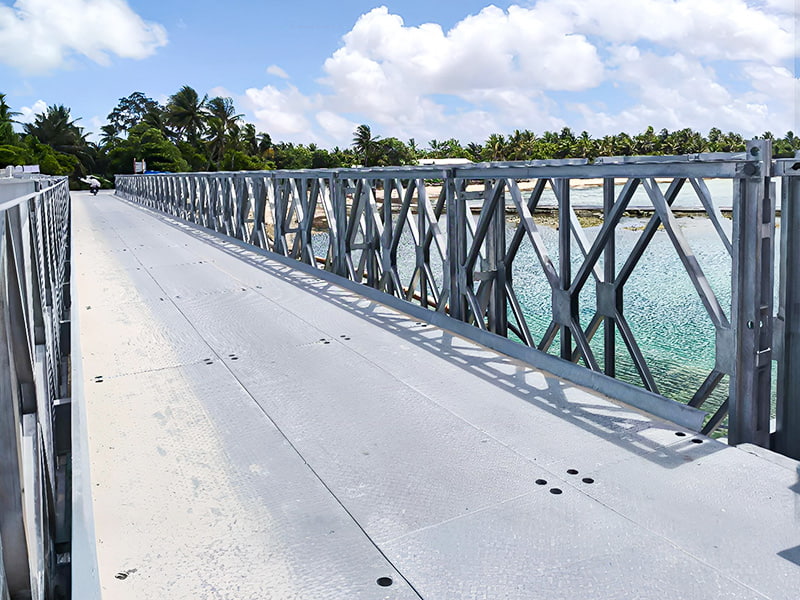
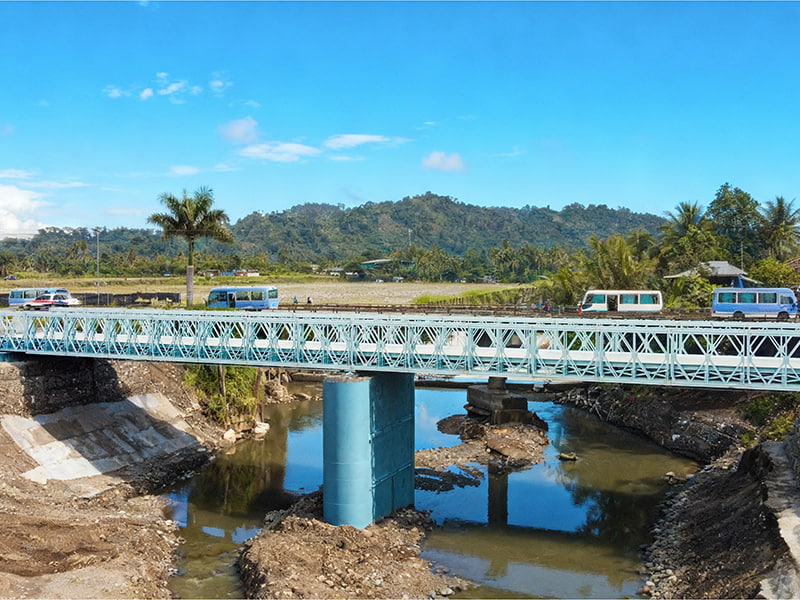
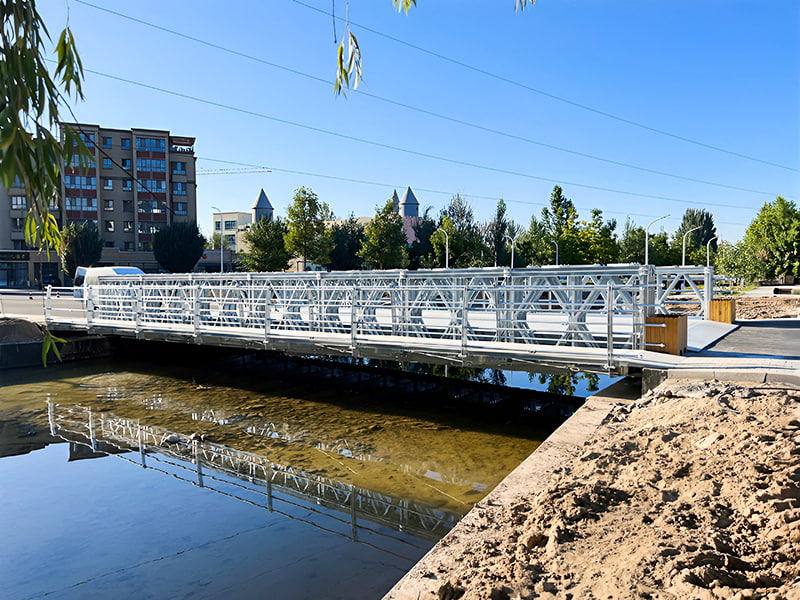
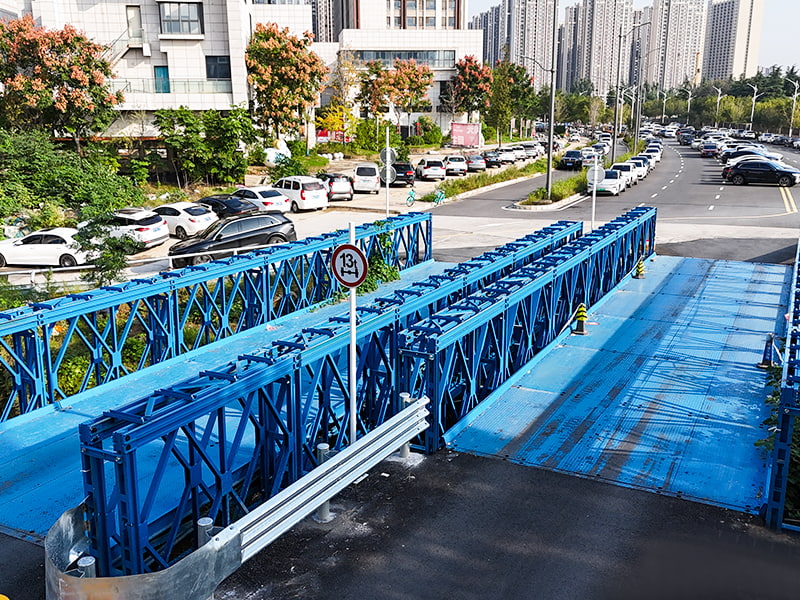
CB 200 Bailey Bridge Double-Row Single-Layer Galvanized Bailey Bridge
2. Double-Row Single-Layer Structural Configuration
The double-row single-layer structure is an important feature of this bridge. Bridge configuration must be selected according to span length, traffic demand, design load, deck width, site conditions, and erection method. A double-row single-layer arrangement is commonly selected when the project requires a practical modular structure with a higher level of load distribution than a single-row arrangement while maintaining relatively simple assembly procedures.
The two parallel truss lines work together through transverse beams, bracing members, deck components, and connection hardware. Loads applied to the bridge deck are transferred through the deck system into the transverse members and then distributed to the longitudinal Bailey panels. The panels transmit the forces toward the supports at each end of the bridge.
This arrangement provides several operational benefits. First, it creates a stable structural framework that can be assembled from manageable components. Second, it supports efficient load distribution across the bridge width. Third, it enables the bridge to be transported in sections rather than as a complete welded structure. Finally, it allows the bridge to be erected with a relatively limited amount of heavy lifting equipment, depending on the span and selected construction method.
The configuration can be adapted to the requirements of a specific project through engineering review. Relevant factors include the actual span, approach alignment, foundation conditions, expected vehicle type, traffic frequency, flood level, wind exposure, deck width, and restrictions on construction equipment. The bridge should always be installed according to approved structural calculations, erection drawings, and site-specific instructions.
The modular nature of the bridge also supports future modification. If a project later requires a different access arrangement, additional components may be added or the bridge may be dismantled and relocated, subject to engineering verification. This flexibility is valuable for emergency response, temporary construction routes, and areas where infrastructure needs may change rapidly.
3. Standardized Bailey Panels and Supporting Components
Standardization is central to the performance of a modular bridge. The CB 200 system uses panels and accessories produced according to controlled dimensions and established connection requirements. Each panel must be compatible with the corresponding pins, bolts, bracing members, transoms, deck components, and support elements.
Factory standardization provides several advantages over project-specific fabrication. It makes the components easier to inspect, package, label, and replace. It also reduces the possibility of dimensional inconsistencies between parts produced at different times. When a bridge project involves multiple spans or future expansion, standardized components make planning and inventory control more straightforward.
The supporting components are just as important as the primary panels. A bridge system requires coordinated interaction between the main trusses, transverse members, deck units, lateral bracing, end posts, bearings, ramp interfaces, and connection hardware. A complete supply package helps ensure that the contractor receives the parts required for the planned assembly sequence.
Providing a complete assembly plan is another important advantage. Modular construction is efficient only when the components and erection procedures are properly coordinated. The assembly plan can identify the sequence of panel connection, placement of transoms, installation of bracing, deck arrangement, launching or lifting requirements, and final inspection points.
Clear identification of components also improves field productivity. When each part is marked, grouped, and packed according to the erection sequence, site personnel spend less time searching for materials or determining where individual components belong. This is particularly valuable in remote areas, where replacement parts, specialist labor, and heavy handling equipment may not be immediately available.
4. Hot-Dip Galvanizing for Harsh Environmental Conditions
Corrosion protection is a major consideration for bridges installed in coastal, tropical, and high-humidity environments. Kiribati and other island regions can expose steel structures to high temperatures, moisture, salt-laden air, rainfall, and repeated wetting and drying cycles. Without appropriate protection, uncoated or inadequately protected steel may experience accelerated corrosion, leading to increased maintenance requirements and reduced service life.
The CB 200 bridge components are professionally hot-dip galvanized. In this process, prepared steel components are immersed in molten zinc so that a metallurgically bonded zinc coating forms on the steel surface. The coating provides both barrier protection and sacrificial protection. As a barrier, it separates the steel from moisture and atmospheric contaminants. As a sacrificial layer, zinc can protect exposed areas of steel if minor surface damage occurs.
Hot-dip galvanizing is particularly suitable for modular bridge components because it can protect complex steel parts, connection areas, edges, and exposed surfaces more comprehensively than many conventional painting methods. The durability of the coating depends on coating thickness, steel chemistry, environmental exposure, handling practices, and the quality of the galvanizing process.
Galvanized components also offer practical maintenance benefits. A well-applied zinc coating can reduce the frequency of repainting and help simplify routine inspections. This is important for bridges located far from major maintenance centers, where transporting materials and specialized personnel can be expensive or difficult.
Although galvanizing provides strong corrosion resistance, it does not eliminate the need for inspection. Connection points, areas subject to abrasion, drainage locations, bearing interfaces, and places where dissimilar materials contact each other should be reviewed periodically. Proper drainage, cleaning, traffic control, and timely repair of damaged surfaces remain important parts of bridge maintenance.
Compared with a bridge supplied with only basic surface treatment, a hot-dip galvanized modular system offers a stronger starting point for service in humid and coastal climates. The protective treatment is integrated into the manufacturing process rather than left entirely to the construction site, where weather, equipment, and labor conditions may affect coating consistency.
5. Advanced Manufacturing Processes
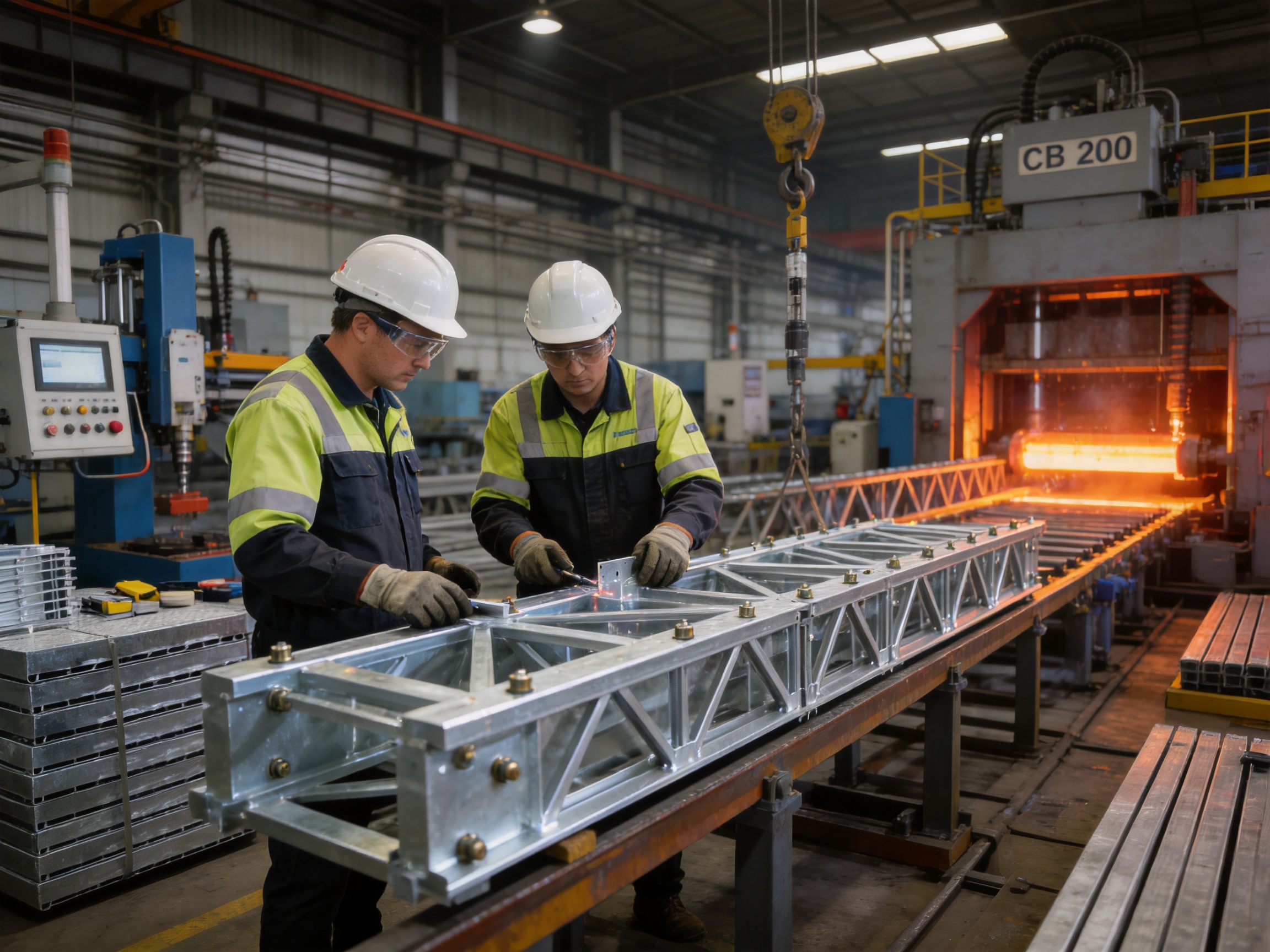
The quality of a modular bridge depends on more than the raw material used in its panels. It also depends on engineering control, cutting accuracy, forming, welding, dimensional inspection, surface preparation, galvanizing, packaging, and traceability. A manufacturer with integrated production capabilities can coordinate these steps more effectively than a supplier that relies entirely on fragmented subcontracting.
The manufacturing process begins with engineering review and production planning. Drawings, component schedules, material specifications, connection details, and inspection requirements are evaluated before fabrication begins. The production team can then organize the manufacturing sequence according to the bridge design and delivery schedule.
Steel preparation is followed by precision cutting and forming. Accurate dimensions are necessary because modular bridge components must connect correctly during field assembly. Small variations in hole locations, panel geometry, or member length can create difficulties during erection and may affect the alignment of the completed bridge.
Automated and semi-automated welding equipment can improve repeatability in the fabrication of structural members. Controlled welding procedures help maintain consistent weld quality, reduce production variation, and improve workshop productivity. Welding operators and inspectors must still follow approved procedures, and completed welds should be checked according to the applicable quality requirements.
Manufacturing quality management also includes dimensional inspection. Components may be checked for overall length, width, thickness, hole position, straightness, squareness, weld appearance, and connection compatibility. Inspection records provide evidence that the parts conform to the approved drawings and production tolerances.
After fabrication and inspection, components undergo surface preparation before hot-dip galvanizing. Proper preparation is essential because oil, grease, mill scale, rust, paint residue, or other contaminants can affect coating quality. The galvanizing stage must be managed to achieve suitable coverage and minimize defects such as bare areas, excessive buildup, runs, or damage caused by handling.
Following galvanizing, the parts are inspected again. Components may be checked for coating continuity, visible surface condition, dimensional compatibility, identification marks, and completeness of the shipment. Packaging is then organized to reduce handling damage and support efficient unloading at the project site.
This integrated approach is a competitive advantage because the manufacturer controls a larger portion of the value chain. Engineering, production, quality control, galvanizing, packaging, and delivery coordination can be managed as one connected process. It also allows the supplier to respond more effectively when a project requires customized component quantities, special packaging, or a particular erection sequence.
5.1 Precision Fabrication
Precision fabrication is especially important for modular bridges because the structural parts are designed to fit together through standardized connections. The accuracy of each component contributes to the ease of assembly and the final alignment of the bridge.
Modern fabrication methods may include automated cutting, controlled drilling, programmed welding, fixture-based assembly, and inspection using calibrated measurement tools. These methods reduce dependence on inconsistent manual measurements and help maintain the repeatability required for bridge systems produced in multiple batches.
5.2 Automated Welding and Structural Reliability
Automated welding can provide consistent weld paths and controlled production parameters for suitable components. It can improve deposition consistency, reduce production time, and support more uniform weld appearance. For critical structural parts, automated welding should be combined with qualified procedures, trained personnel, inspection, and appropriate non-destructive or visual testing methods.
Weld quality affects the reliability of bridge components throughout their service life. Proper joint preparation, heat control, material compatibility, and post-weld inspection help reduce the risk of defects. A professional manufacturing system treats welding as an engineered process rather than simply a joining operation.
5.3 Factory-Based Quality Management
Factory-based quality control reduces the uncertainty associated with producing structural components in uncontrolled field conditions. The workshop can provide stable working areas, calibrated tools, lifting systems, inspection stations, and dedicated personnel. Production records can be maintained for materials, fabrication stages, galvanizing, packaging, and shipment.
This approach is especially useful for international projects. When components are manufactured and inspected before export, the construction team can focus primarily on foundation preparation, logistics, assembly, and final commissioning. It also helps reduce the need for extensive field welding or cutting, which can be difficult to control in remote locations.
6. Competitive Advantages Compared with Conventional Bridge Solutions
The CB 200 double-row single-layer galvanized Bailey Bridge offers several advantages when compared with conventional cast-in-place concrete bridges, permanently welded steel bridges, and less standardized temporary structures.
| Evaluation Factor | CB 200 Modular Bridge | Conventional Permanent Bridge | Basic Temporary Steel Structure |
|---|---|---|---|
| Transport | Components can be separated, bundled, and shipped efficiently | Often requires large prefabricated sections or extensive site work | May depend on project-specific parts and irregular packing |
| Installation | Factory-prepared components support rapid bolted or pinned assembly | Usually requires longer civil construction and curing periods | Speed varies according to fabrication quality and site preparation |
| Adaptability | Modular parts can support different layouts after engineering review | Limited once the structure is completed | May be adaptable but not necessarily standardized |
| Corrosion Protection | Professional hot-dip galvanizing for improved environmental resistance | Depends on the selected coating and maintenance program | May use basic paint or inconsistent site-applied protection |
| Reuse Potential | Components can potentially be dismantled and reused | Generally not designed for relocation | Depends on connection design and component condition |
| Remote-Site Suitability | Suitable for projects with limited heavy equipment and challenging logistics | May require extensive materials, labor, and equipment on site | Varies considerably by supplier and design |
| Quality Control | Standardized factory production and documented inspection | Quality is distributed across multiple civil construction stages | May have limited manufacturing consistency |
One of the most important advantages is construction speed. Since the panels and accessories are fabricated in advance, site work can proceed after the foundations, abutments, bearings, and approach areas are ready. This can significantly shorten the period during which roads or communities remain disconnected.
Another advantage is reduced dependence on large-scale site fabrication. Conventional bridge projects may require extensive formwork, reinforcement installation, concrete placement, curing, and specialized equipment. The modular steel approach transfers much of the work to the factory, where production conditions are more stable and repeatable.
The bridge also offers logistical flexibility. Components can be transported by container, truck, ship, or other suitable means according to project conditions. For island destinations and remote communities, the ability to ship a bridge in organized component packages can be more practical than transporting large completed sections.
Compared with an improvised temporary bridge, the standardized CB 200 system provides a more coordinated structural solution. Panels, connections, bracing, deck components, and accessories are developed to operate together. This improves assembly planning and reduces the risk of compatibility problems between parts from different sources.
Hot-dip galvanizing adds another competitive advantage. In tropical or marine environments, the initial surface treatment can have a major influence on maintenance demand. A galvanized structure is better positioned to resist atmospheric exposure than a structure with minimal protection, particularly when it is correctly designed, installed, inspected, and maintained.
7. Efficiency of On-Site Assembly
Rapid assembly is one of the defining benefits of a Bailey Bridge. Once the site has been surveyed and the supports prepared, the bridge can be assembled using a planned sequence. Components are positioned, connected, braced, aligned, and checked before the deck and approach transitions are completed.
The assembly plan is important because modular construction requires disciplined sequencing. The erection team must understand how the panels are connected, where temporary supports are placed, how stability is maintained during construction, and when the deck and bracing elements are installed. A properly organized sequence reduces unnecessary handling and improves worker productivity.
Depending on the approved method and site conditions, the bridge may be assembled incrementally and launched across the gap or lifted into position in sections. The selected method should consider span length, terrain, water depth, access for cranes, wind conditions, river flow, nearby traffic, and the capacity of temporary works.
Factory-prefabricated components reduce the amount of cutting, drilling, and welding required at the project site. This not only saves time but also improves safety and quality control. Field personnel can focus on connection, alignment, tightening, inspection, and other controlled installation activities.
On-site efficiency is also influenced by packaging. Components should be packed in a manner that protects galvanized surfaces, separates different part types, and follows the anticipated erection sequence. Clearly marked packages reduce the time required for material identification and help prevent accidental damage during unloading.
For a remote project, the construction schedule can be improved further when the supplier provides technical documents, component lists, foundation interface information, erection guidance, and inspection recommendations before shipment. Early coordination allows the contractor to prepare tools, lifting equipment, labor, storage areas, and site access before the bridge arrives.
8. Suitability for Tropical, Coastal, and Island Projects
Island infrastructure projects often face a combination of logistical, environmental, and economic challenges. Construction materials may need to be transported over long distances, heavy equipment may be limited, and maintenance resources may be concentrated far from the project location. A modular galvanized bridge addresses several of these challenges through transportable components, factory-based production, and reduced site fabrication.
High humidity and elevated temperatures can create persistent corrosion risks. The use of hot-dip galvanized steel provides a durable protective foundation for the bridge. The coating is applied before shipment, allowing the project team to receive components that are already protected rather than depending entirely on field painting after installation.
Coastal exposure also makes drainage and detailing important. Water should not be allowed to accumulate in connection zones or enclosed areas. The bridge should be installed with suitable deck drainage, approach grading, and maintenance access. Galvanizing performs best when combined with sound structural detailing and a planned inspection program.
The modular format is also useful when a bridge must be installed across a waterway with limited access. Components can be brought to the site in smaller loads, assembled near the crossing, and moved into position using an appropriate erection method. This can reduce the need to construct large temporary roads or platforms for transporting a complete bridge span.
For communities that depend on a single crossing, rapid installation can have social and economic importance. A modular bridge can restore access for people, emergency services, agricultural transport, construction supplies, and local commerce more quickly than many conventional alternatives. The exact schedule depends on foundation work, shipping, weather, local labor, and regulatory approvals, but the modular design supports a shorter structural assembly phase.
9. Engineering Design and Project Adaptation
Although the CB 200 system uses standardized parts, each bridge project still requires engineering evaluation. Standard components do not mean that every site has identical requirements. The final bridge arrangement must be checked against the actual geometry, load conditions, environmental exposure, and construction method.
Important design inputs include the clear span, roadway or pedestrian width, design vehicle, traffic frequency, approach elevation, flood level, waterway clearance, wind exposure, seismic conditions, foundation type, and expected service period. The design team should also review restrictions on construction equipment and the availability of temporary supports.
The double-row single-layer configuration can be selected when it matches the project’s required structural performance. If the span, loading, or site conditions exceed the capacity of the selected arrangement, another modular configuration or a different bridge type may be required. A responsible supplier should therefore evaluate the project rather than recommend a standard arrangement without checking the application.
Bridge interfaces also require attention. Abutments, bearings, anchorages, approach slabs, drainage, guardrails, ramps, and road alignment must be coordinated with the modular superstructure. A high-quality bridge package should identify the interface requirements so that civil works can be completed before delivery and erection.
Engineering adaptation can include bridge length, deck width, panel arrangement, approach details, corrosion protection requirements, accessory quantities, and packaging. This allows the system to serve different projects while retaining the benefits of standardized production.
10. Manufacturing Strengths of the Supplier
Jiangsu Zhonghai Bridge Equipment Co., Ltd. specializes in modular steel bridges, Bailey bridge systems, customized steel components, bridge erection equipment, automated welding, and precision steel fabrication. Its location in Zhenjiang, Jiangsu Province, provides access to established industrial, transportation, and manufacturing resources.
The company integrates engineering design, fabrication, quality management, and project support. This integrated model is important for international bridge projects because clients often require more than a shipment of steel parts. They may need assistance with configuration selection, component schedules, erection planning, technical documentation, inspection coordination, and delivery organization.
The company’s factory uses automation and standardized workflows to produce high-strength modular bridge systems and supporting steel structures. Standardized workflows help establish repeatable production stages, while automation can improve cutting, welding, handling, and inspection efficiency. These capabilities are particularly valuable when a project requires multiple bridge units or a large volume of interchangeable parts.
The supplier also serves diverse application sectors, including transportation, water conservancy, military logistics, disaster relief, and international development. Experience across these sectors can help the manufacturer understand the different priorities associated with permanent infrastructure, emergency access, temporary construction routes, and remote-area transportation.
Reported project experience includes coastal engineering in the Maldives, temporary access bridges associated with major transportation construction, structural components for a large exhibition center, multi-span Bailey bridges for railway infrastructure, and emergency bridge deployments in flood-affected areas. Such applications demonstrate the value of modular bridge systems in environments where construction speed, transport efficiency, and structural adaptability are important.
For buyers, the manufacturer’s strength lies in combining product standardization with project-level support. A bridge system must be manufactured consistently, but it must also be configured correctly for the site. The ability to provide both production capacity and engineering coordination helps reduce communication gaps between design, manufacturing, shipping, and installation.
11. Quality, Compliance, and Documentation
International bridge projects require clear technical documentation. Depending on the contract and jurisdiction, documentation may include general arrangement drawings, component drawings, material certificates, welding records, inspection reports, galvanizing records, packing lists, installation instructions, and maintenance recommendations.
The supplier states that its products are manufactured in accordance with ASTM, EN, and applicable national specifications. The exact standard requirements should be confirmed for each project because the governing code may depend on the client, funding agency, location, traffic authority, and structural design basis.
Quality documentation supports transparency throughout the supply chain. Material certificates help verify the steel used in structural components. Welding records and inspection documents provide evidence of fabrication control. Galvanizing records help confirm that corrosion protection was included in the production process. Packing lists allow the contractor to verify the shipment upon arrival.
Inspection should not stop when the bridge leaves the factory. The construction team should inspect components during unloading, storage, assembly, and final installation. Galvanized surfaces should be protected from unnecessary abrasion, and any damage should be repaired using an approved method. Connections should be checked for correct installation, and the completed bridge should be reviewed before opening to traffic.
A comprehensive quality approach therefore includes design verification, factory inspection, shipping control, field assembly inspection, and commissioning. This sequence helps ensure that the bridge performs as intended throughout its service period.
12. Transportation, Packaging, and Delivery
Modular bridge components are easier to transport than a fully assembled bridge. Panels and accessories can be organized into bundles or packages suitable for road, sea, or container transportation. This is particularly important for international projects, including island destinations where shipping capacity and port handling conditions must be considered carefully.
Packaging should protect the components from impact, deformation, contamination, and excessive abrasion. Galvanized surfaces require careful handling because deep scratches or mechanical damage can expose the underlying steel. Components should also be secured to prevent movement during transport.
Efficient packaging can reduce freight costs and simplify site logistics. Parts should be grouped by type, bridge section, or erection stage. Labels and packing records allow the receiving team to compare the delivered materials with the approved component list.
Delivery planning should consider the route from the factory to the project site, port requirements, customs documentation, local unloading equipment, storage conditions, and the construction schedule. Early communication between the manufacturer, freight provider, contractor, and client helps reduce delays.
For remote areas, spare connection hardware and selected maintenance items may be included in the supply plan. The appropriate spare parts depend on the bridge design and client requirements, but advance planning can prevent minor component shortages from interrupting assembly.
13. Maintenance and Long-Term Service Considerations
A galvanized modular bridge is designed to reduce maintenance demands, but regular inspection remains necessary. Bridge owners should establish an inspection schedule based on traffic volume, environmental exposure, flood conditions, and the required service period.
Routine inspections should review the deck, panels, bracing, connection points, bearings, approach areas, drainage paths, guardrails, and visible galvanized surfaces. Inspectors should look for loose or damaged connections, abnormal deformation, impact marks, standing water, debris accumulation, corrosion at damaged areas, and deterioration of the approaches.
Heavy vehicles, overloading, collision, flooding, and unusual vibration can affect a bridge even when the original design was adequate. Traffic controls should therefore be clearly posted and enforced. If the bridge is intended for a specific loading category, the owner should prevent unauthorized vehicles from exceeding the approved limits.
When galvanized surfaces are damaged, repairs should be performed promptly using suitable zinc-rich repair materials or other approved systems. The repair area should be cleaned and prepared according to the product instructions. Severe structural damage should be assessed by qualified engineers before the bridge returns to service.
Good maintenance also includes keeping drainage systems clear and preventing contact with materials that may retain moisture or accelerate corrosion. Approaches should be maintained so that vehicles enter the bridge smoothly and do not create excessive impact at the ends.
Because modular bridges can potentially be dismantled and relocated, owners should maintain records of the bridge configuration, component identification, inspection history, repairs, and any modifications. These records are valuable if the bridge is later extended, moved, or reconfigured.
14. Applications in Transportation and Emergency Response
The CB 200 bridge is suitable for a wide range of applications. In rural transportation, it can provide access across rivers, drainage channels, and damaged crossings. In construction, it can serve as a temporary route for equipment, materials, and workers. In disaster response, it can help restore connectivity after floods, storms, earthquakes, or other events that damage existing bridges.
Water conservancy projects may require temporary access across canals, reservoirs, or construction channels. Modular bridges can support phased construction because they can be erected, adjusted, and removed as the project progresses. Their reusable nature can improve the value of the investment when a bridge is not required at one location permanently.
Railway and highway construction projects may use Bailey-type systems to maintain temporary access while permanent structures are being built. The bridge can help keep local traffic moving, provide access to work areas, or support temporary detours during major construction programs.
Military logistics and emergency management agencies may value the system’s transportability and rapid erection potential. In these applications, bridge components may need to be stored in advance and deployed according to an emergency plan. Standardized parts and prepared assembly documentation can support faster mobilization.
International development projects often require solutions that balance cost, durability, local construction capability, and transport limitations. A modular galvanized bridge can be a practical option when the project needs a reliable crossing but cannot support the time and expense of a conventional bridge construction program.
15. Why Factory-Direct Supply Matters
Purchasing directly from a specialized manufacturer can improve communication and reduce the risk of technical information being lost between intermediaries. The client can discuss span requirements, loading, deck width, galvanizing, accessories, packaging, and delivery directly with the engineering and production team.
Factory-direct supply may also provide better control over component compatibility. Since the main panels and supporting parts are produced within one coordinated system, the supplier can verify that the components match the intended arrangement. This is preferable to combining bridge parts from unrelated sources with different dimensions or connection details.
Direct manufacturer cooperation can be especially useful for original equipment manufacturing and customized orders. A project may require a particular bridge length, non-standard deck width, special approach components, additional corrosion protection, or a unique packaging plan. The manufacturer can assess whether these requirements can be incorporated while preserving structural and production quality.
Cost should not be evaluated only by the purchase price of steel components. The total project cost includes transportation, site labor, equipment, installation duration, maintenance, replacement parts, and possible delays. A standardized, galvanized, factory-produced bridge may provide a stronger overall value when these factors are considered together.
16. Project Planning Checklist
Before ordering a CB 200 double-row single-layer bridge, the project team should prepare accurate information about the site and intended use. This information allows the supplier and design professionals to confirm whether the selected configuration is suitable.
Required clear span and total bridge length.
Required carriageway, pedestrian, or service width.
Design vehicle, axle loads, traffic frequency, and operating restrictions.
River, canal, drainage, or terrain conditions below the bridge.
Flood levels, water flow, wind exposure, and other environmental factors.
Abutment, foundation, bearing, and approach requirements.
Available cranes, lifting tools, temporary supports, and construction labor.
Access for trucks, ships, containers, and unloading equipment.
Required galvanizing, inspection, documentation, and testing procedures.
Expected service period and future relocation or reuse plans.
Providing complete information at the beginning reduces the possibility of changes after production has started. It also helps the supplier prepare a more accurate bill of materials, assembly plan, quotation, delivery schedule, and technical proposal.
17. Frequently Asked Questions
17.1 What is a double-row single-layer Bailey Bridge?
A double-row single-layer Bailey Bridge uses two parallel rows of modular Bailey panels in its main truss arrangement, with the panels positioned in one vertical layer. The panels are connected with transverse members, bracing, deck components, and other accessories to form a complete bridge structure.
17.2 Where can the CB 200 bridge be used?
It can be used for rural roads, temporary transportation routes, construction access, waterway crossings, emergency response, disaster relief, logistics, water conservancy works, and selected semi-permanent infrastructure applications. The final suitability depends on engineering design, span, loading, foundation conditions, and local regulations.
17.3 Why is hot-dip galvanizing important?
Hot-dip galvanizing forms a protective zinc coating on steel components. It helps resist moisture, humidity, and atmospheric corrosion and is particularly valuable in tropical and coastal environments. It can also reduce repainting requirements when combined with appropriate inspection and maintenance.
17.4 Can the bridge be installed in a remote location?
Yes, modular bridges are well suited to remote locations because the components can be transported separately and assembled at the site. However, the project still requires proper access, foundations, lifting or launching equipment, trained personnel, and an approved erection plan.
17.5 Is the bridge reusable?
One benefit of modular construction is the potential to dismantle and reuse components. Reuse must be evaluated by qualified personnel who inspect the parts, confirm their condition, and verify the new configuration against the required structural design.
17.6 Does the supplier provide an assembly plan?
The product package includes provision for an assembly plan. The plan should be reviewed together with the bridge drawings, component schedule, site conditions, erection method, and local safety requirements before construction begins.
17.7 What information is needed for a quotation?
The supplier normally needs the required span, bridge length, deck width, design loading, application, site location, environmental conditions, support arrangement, delivery method, and desired accessories. Photos, site surveys, drawings, and approach details can also help improve quotation accuracy.
17.8 How does this bridge compare with a conventional concrete bridge?
A modular steel bridge can usually be transported and assembled more quickly, requires less site fabrication, and may be relocated or reused. A conventional concrete bridge may provide different long-term characteristics and may be preferable for certain permanent applications. The correct choice depends on design life, budget, site conditions, construction schedule, and local engineering requirements.
17.9 What maintenance does a galvanized bridge require?
Maintenance includes routine inspection of panels, connections, deck elements, bracing, bearings, drainage, approaches, and galvanized surfaces. Damage, loose hardware, standing water, debris, and abnormal deformation should be addressed promptly. Traffic loads should remain within the approved limits.
17.10 Can the bridge be customized?
Standardized modular components support several project adaptations, including length, width, component quantities, accessories, packaging, and erection planning. Any customization that affects structural performance should be reviewed and approved through engineering calculations and technical drawings.
18. Conclusion
The CB 200 double-row single-layer galvanized Bailey Bridge provides a practical combination of modular construction, structural adaptability, corrosion resistance, transport efficiency, and rapid assembly. Its use of standardized panels and supporting components allows the bridge to be manufactured, inspected, packaged, and installed through a coordinated process. The configuration is well suited to projects that require a reliable crossing but face limitations in time, transportation, equipment, or site access.
The hot-dip galvanized finish is especially valuable for high-temperature, high-humidity, and coastal environments such as Kiribati. It provides a durable protective layer before the components leave the factory and helps reduce the maintenance burden associated with atmospheric corrosion. The product’s modular nature also supports future adjustment, dismantling, relocation, or reuse when permitted by engineering review.
The manufacturer’s strengths extend beyond the bridge components themselves. Integrated engineering, precision fabrication, automated welding, standardized workflows, quality control, galvanizing, packaging, and technical support create a complete supply capability. This approach helps clients manage international infrastructure projects with greater consistency and confidence.
For transportation authorities, contractors, emergency organizations, development agencies, and infrastructure investors, the key value of this bridge lies in its balance of speed, durability, adaptability, and manufacturing quality. With proper design, installation, inspection, and maintenance, the CB 200 modular bridge can provide an efficient connection for communities and projects around the world.
References
1. Bailey Bridge engineering principles and modular truss bridge design practices.
2. General structural steel fabrication and inspection procedures for modular bridge components.
3. Hot-Dip Galvanizing Association, technical guidance on zinc coatings for fabricated steel structures.
4. ASTM International, standards and guidance related to structural steel materials, fabrication, and protective coatings.
5. European structural steel and bridge design practices applicable to modular steel structures.
6. International guidance on temporary works, bridge erection planning, lifting operations, and construction safety.
7. Manufacturer technical information for CB 200 Bailey Bridge panels, accessories, galvanizing, assembly planning, and modular steel bridge systems.
Product: CB 200 Bailey Bridge Double-Row Single-Layer Galvanized Bailey Bridge

We respond quickly to all international requests and provide technical support when needed.
Product Category
Bailey Bridge/Modular Bridge Modular Steel Bridge Pedestrian Bridge Modular Pipe Bridge Truss Bridge Steel StructureContact Us

+86-511-84522866
+86-13921582699

zhwm@zjql.com

Building 1,83#, dantu New Town, Yanjiang Road, Dantu District, Zhenjiang, Jiangsu, China
Copyright © Jiangsu Zhonghai Bridge Equipment Co., Ltd. All
Rights
Reserved
China bailey bridge for sale
bailey bridge supplier from china
