
 English
 русский
 Español
 Português


Luo Shiqing — Product After-Sales Service Supervisor
CB 200 Bailey Bridge: A High-Performance Two-Lane Modular Solution for Urban Traffic
Content
- 1 1. Product Overview
- 2 2. Why Modular Bridges Are Important in Modern Infrastructure
- 3 3. Structural Design of the CB 200 Bridge
- 4 4. Key Product Advantages
- 5 5. Manufacturing Capabilities and Production Strengths
- 6 6. Competitive Comparison with Other Bridge Solutions
- 7 7. Applications of the CB 200 Bridge
- 8 8. Installation and Project Execution
- 9 9. Durability, Inspection, and Maintenance
- 10 10. Engineering and Safety Considerations
- 11 11. Advantages of Working with an Integrated Manufacturer
- 12 12. Manufacturing and International Project Experience
- 13 13. Total Project Value
- 14 14. Recommended Procurement Process
- 15 15. Frequently Asked Questions
- 15.1 Q1: What is the CB 200 Bailey Bridge designed for?
- 15.2 Q2: What does the double-row configuration mean?
- 15.3 Q3: Why is a two-lane bridge useful for urban roads?
- 15.4 Q4: Is the bridge permanent or temporary?
- 15.5 Q5: How is the bridge protected against corrosion?
- 15.6 Q6: Can the bridge be customized?
- 15.7 Q7: Does the product include all bridge components?
- 15.8 Q8: How quickly can the bridge be installed?
- 15.9 Q9: What standards are followed during production?
- 15.10 Q10: What information should be provided for a quotation?
- 16 16. Conclusion
- 17 References
- 18 Product: CB 200 Bailey Bridge Two-Lane Single-Layer Double-Row Reinforced Bailey Bridge
Urban transportation networks depend on reliable bridges to maintain mobility, support economic activity, and provide safe access for communities. When a permanent bridge is damaged, undergoing reconstruction, or unable to meet rapidly changing traffic requirements, a modular steel bridge can provide a practical and efficient solution. The CB 200 Bailey Bridge Two-Lane Single-Layer Double-Row Reinforced Bailey Bridge is designed for this purpose. With a 24-meter span, dual-lane configuration, reinforced single-layer truss structure, and standardized prefabricated components, it combines rapid deployment with dependable structural performance.
This bridge is intended for urban road traffic and emergency transportation restoration. It is also suitable for temporary infrastructure, construction access, disaster-response routes, industrial logistics, and other applications in which a strong and adaptable bridge must be installed within a controlled project schedule. Its modular architecture allows the bridge to be transported in manageable components, assembled efficiently, and adapted to different site conditions through appropriate engineering design.
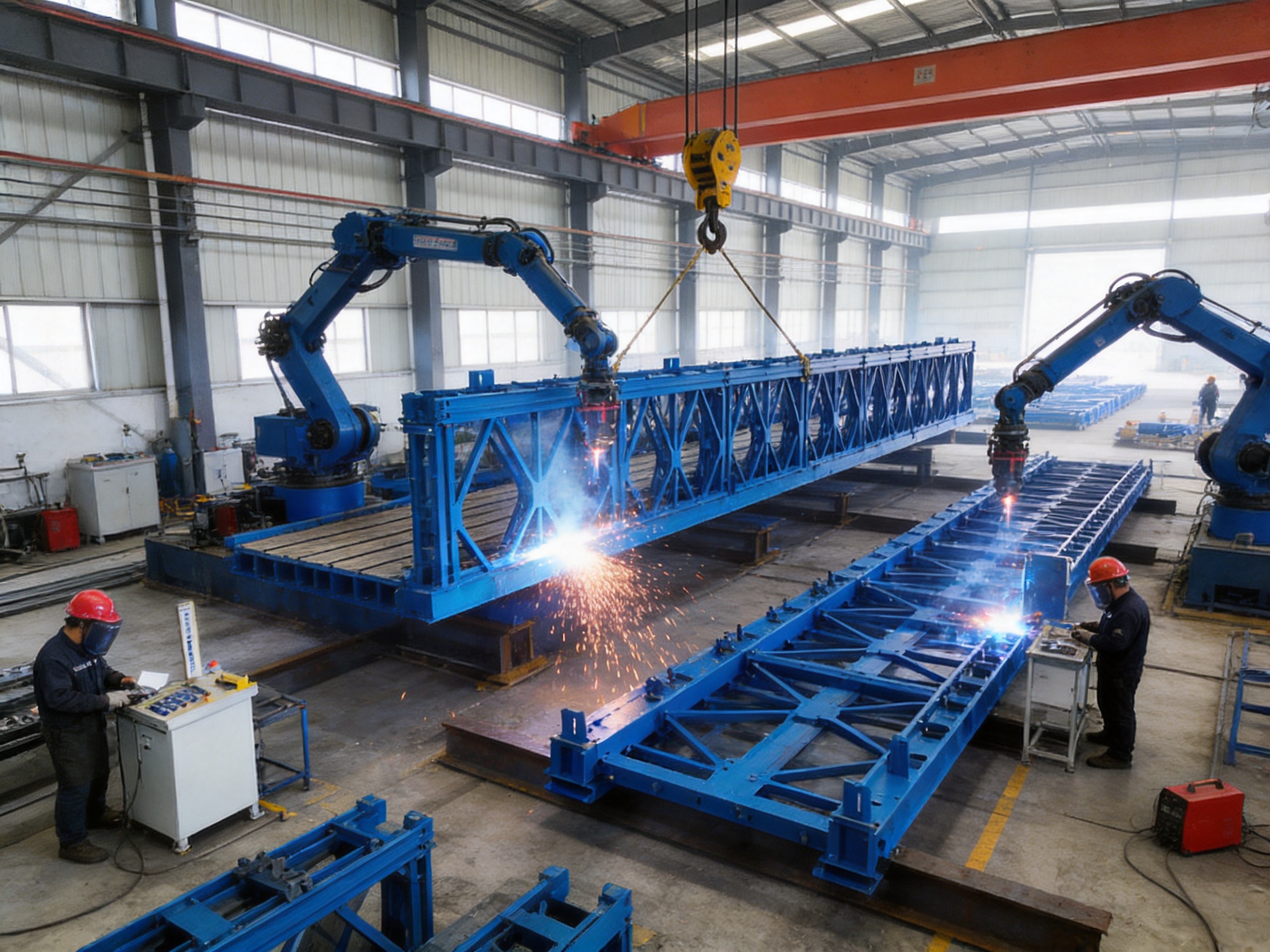
Unlike a conventional bridge that requires extensive site-built fabrication, the CB 200 system is manufactured through standardized industrial processes. Bridge panels and supporting components are produced in a controlled factory environment, where cutting, forming, welding, inspection, surface preparation, and painting can be managed systematically. This approach helps improve dimensional consistency, reduce site labor, and support predictable installation quality.
The bridge also offers a competitive alternative to many temporary bridge systems because it combines two-lane traffic capacity with a reinforced single-layer arrangement. A double-row panel configuration increases the structural robustness of the truss while retaining the logistical advantages of a modular Bailey bridge. The result is a bridge system intended to balance strength, installation speed, transportability, maintainability, and overall project value.
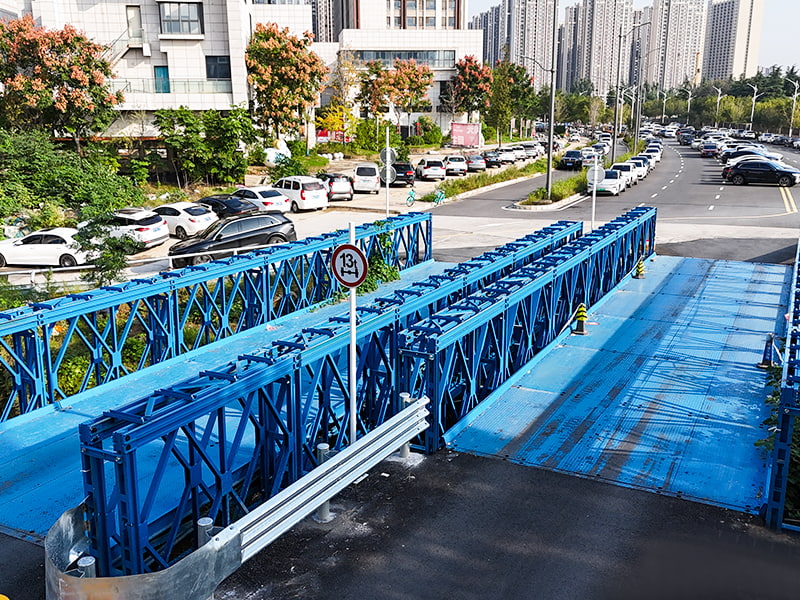
CB 200 Bailey Bridge Two-Lane Single-Layer Double-Row Reinforced Bailey Bridge
1. Product Overview
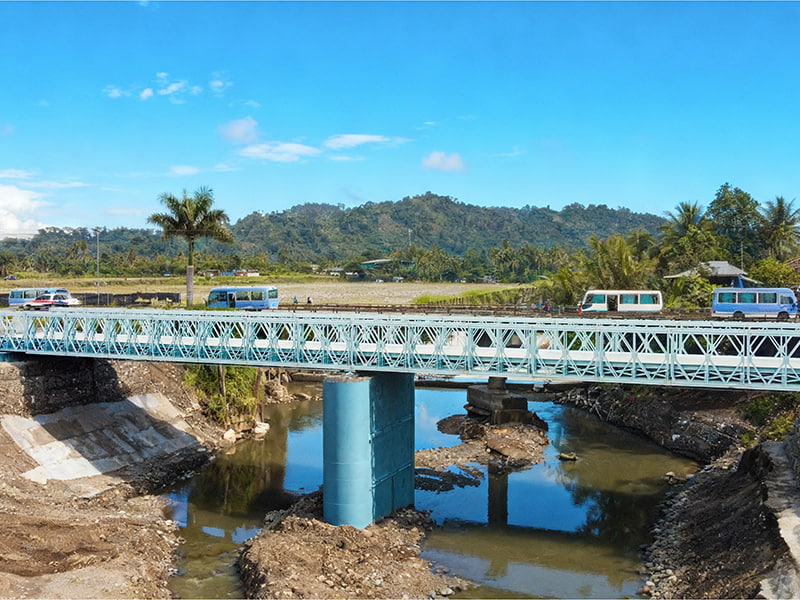
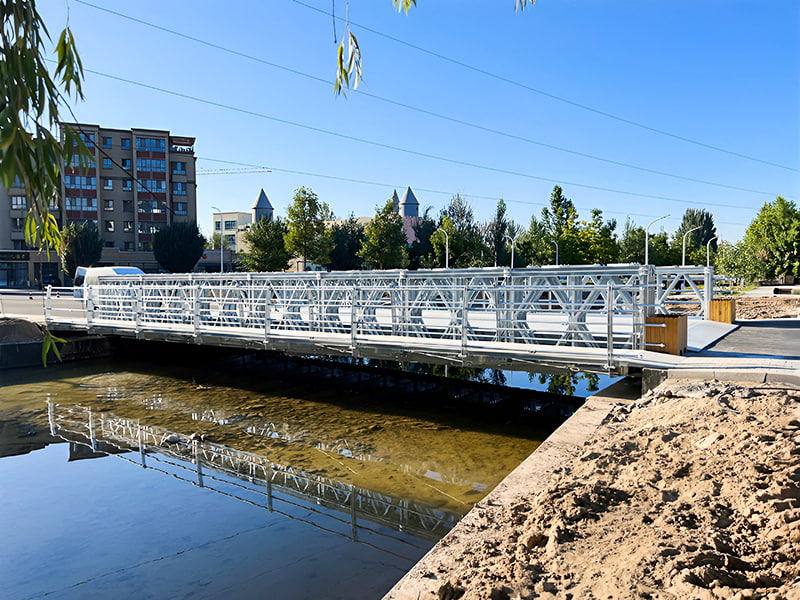
The CB 200 Bailey Bridge is a 24-meter dual-lane, single-layer, double-row reinforced modular steel bridge. It uses a panelized truss structure assembled from standardized steel components. The system is designed for urban road traffic, where the bridge must accommodate regular vehicle movement rather than only light pedestrian or low-speed access.
The term “single-layer” describes the vertical arrangement of the main truss system. Instead of stacking multiple truss levels, the bridge uses a single principal truss layer. This arrangement can simplify transportation, erection, and inspection while reducing the complexity of the overall assembly. The “double-row” configuration refers to the arrangement of the Bailey panels within the main truss, providing a stronger and more stable structural framework than a basic single-row arrangement.
The dual-lane layout is one of the product’s most important practical features. A single-lane emergency bridge may restore access, but it can create traffic bottlenecks, require alternating vehicle control, and restrict emergency response operations. By providing two traffic lanes, the CB 200 bridge is better suited to urban roads where vehicles must pass in both directions or where traffic flow must continue with fewer operational restrictions.
The bridge is supplied with Bailey panels and a complete set of supporting components produced and supplied by the same manufacturer. This integrated supply arrangement can simplify procurement, improve component compatibility, and reduce the risk of combining parts from different systems. For project owners and contractors, a coordinated component package also makes it easier to plan transportation, inventory, assembly, and technical support.
The system is painted blue with a corrosion-resistant treatment. The coating is intended to protect the steel surface from common environmental exposure and to improve the service life of the structure. Proper surface preparation, paint application, inspection, transportation, erection, and maintenance remain essential to achieving the expected durability of any painted steel bridge.
2. Why Modular Bridges Are Important in Modern Infrastructure
Infrastructure projects increasingly require construction methods that reduce disruption and accelerate completion. Urban road closures can affect public transportation, emergency access, commercial deliveries, schools, hospitals, and local businesses. In these circumstances, a modular bridge can serve as a temporary or semi-permanent connection while a permanent structure is repaired, expanded, or constructed.
Modular bridges are manufactured from repeatable components rather than being built entirely from unique site-fabricated pieces. This allows many production activities to take place before the bridge arrives at the project location. Factory production can continue while foundations, abutments, access roads, and site preparation are being completed. As a result, the bridge assembly stage can be shorter than the construction period required for a conventional bridge.
Another important advantage is adaptability. Modular components can be configured for different spans, widths, load requirements, and site conditions, subject to engineering verification. The CB 200 product is specifically presented as a 24-meter two-lane bridge, but the underlying modular philosophy supports a broader family of bridge solutions for different infrastructure requirements.
Modular bridges are also useful in emergency response. Floods, earthquakes, landslides, military logistics, and other disruptions can damage transportation links with little warning. A standardized steel bridge system can be stored, transported, and deployed more rapidly than a fully custom bridge. Its components can be handled using common lifting and construction equipment, provided that the erection method is planned by qualified professionals.
For urban authorities, the value of a modular bridge is not limited to initial installation speed. The bridge may also reduce the amount of specialized equipment required at the site, simplify replacement of damaged components, and support future relocation or reconfiguration. These features can make modular infrastructure a practical part of a broader resilience strategy.
3. Structural Design of the CB 200 Bridge
3.1 Two-Lane Traffic Arrangement
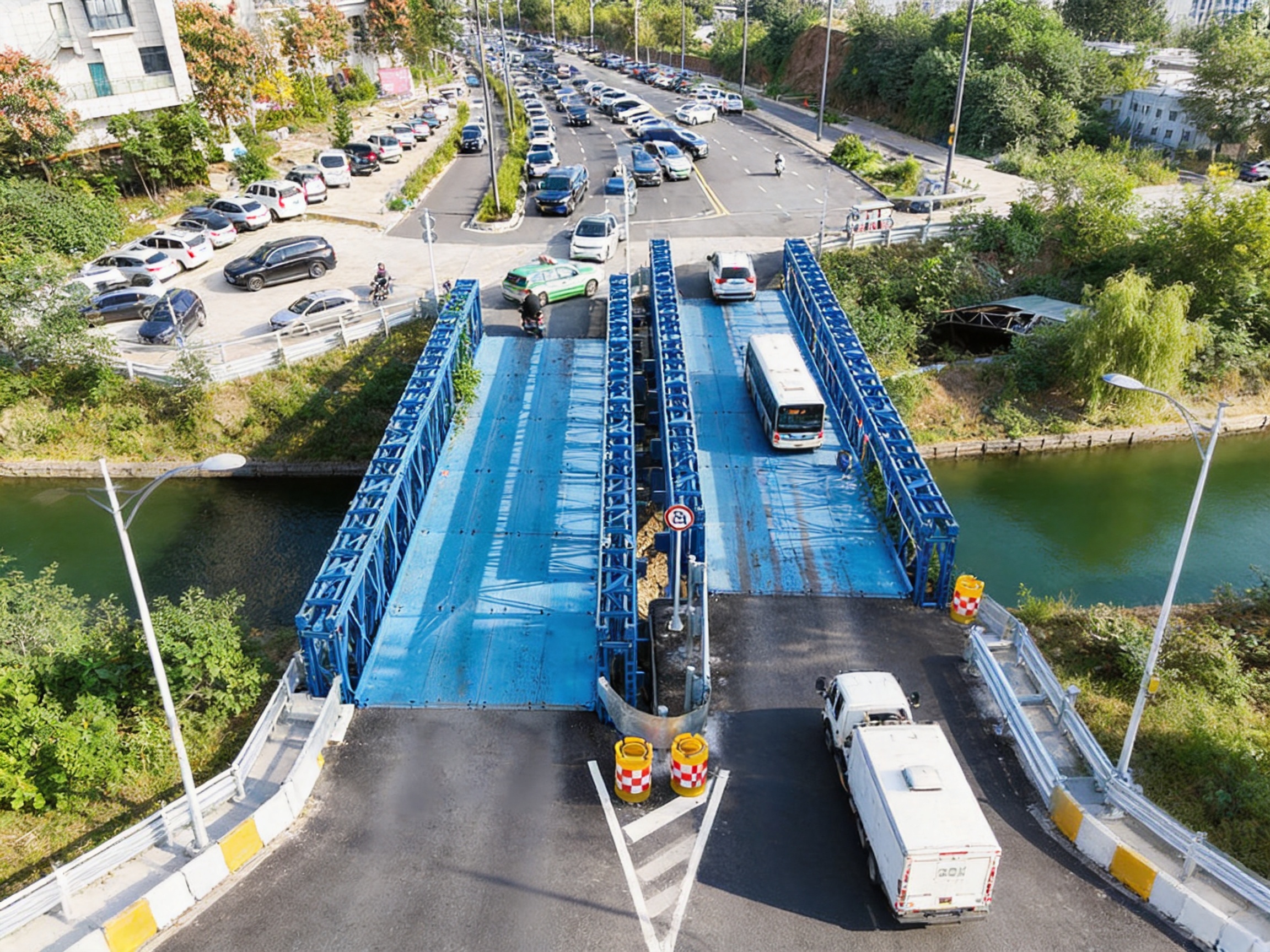
The two-lane configuration is designed to support more efficient urban traffic movement than a single-lane temporary crossing. Two-way traffic can be organized more naturally, and the bridge can better support emergency vehicles, service vehicles, passenger cars, and commercial traffic. The exact traffic management plan, lane width, speed restriction, vehicle separation, and allowable loading must be confirmed through project-specific engineering calculations.
A two-lane bridge can also reduce the need for temporary traffic signals or manual traffic control at the bridge entrance. This may be particularly valuable on roads serving industrial districts, residential communities, logistics facilities, and emergency-response areas. However, the bridge approach roads, foundations, barriers, drainage, and signage must be designed to match the bridge’s traffic function.
3.2 Single-Layer Truss Structure
The single-layer truss arrangement provides a relatively straightforward structural form. The principal load-bearing system consists of connected steel panels and supporting members that work together to transfer vehicle loads toward the bearings and foundations. Because the system is standardized, the assembly sequence can be documented in advance, helping crews understand the location and function of each major component.
A single-layer configuration may also support efficient transportation. Components do not need to be handled as large prefabricated bridge sections. Instead, panels and other members can be loaded, delivered, and assembled in stages. This is useful when project sites have narrow access roads, limited lifting capacity, or restricted working areas.
3.3 Double-Row Reinforcement
The double-row panel arrangement increases the structural depth and load-sharing capability of the main truss compared with a basic single-row configuration. It can improve the bridge’s resistance to the effects of vehicle loading, vibration, and lateral forces when properly engineered and assembled. The reinforced arrangement is particularly relevant for a dual-lane bridge because the structure must accommodate a wider roadway and potentially greater simultaneous traffic effects.
Double-row construction does not eliminate the need for engineering verification. Bridge performance depends on span length, panel condition, connection quality, deck arrangement, support conditions, vehicle loads, wind effects, seismic requirements, fatigue considerations, and foundation performance. The CB 200 bridge should therefore be selected and installed according to approved calculations, drawings, and project specifications.
3.4 Standardized Supporting Components
A modular bridge is only as reliable as the compatibility and quality of its supporting components. The CB 200 system includes the panels and the complete set of related support components supplied as an integrated product package. These components may include connection elements, deck-support members, bracing members, bearings, end arrangements, and other parts required by the specific bridge configuration.
Integrated component supply helps reduce uncertainty during assembly. When panels, fasteners, supports, and accessories are designed to work together, the project team can use a coordinated bill of materials and standardized erection instructions. This can reduce the risk of missing parts, incorrect substitutions, or dimensional incompatibility between suppliers.
4. Key Product Advantages
4.1 Efficient Installation
One of the primary advantages of the CB 200 Bailey Bridge is its installation efficiency. The bridge is prefabricated and standardized at the factory, allowing the site team to focus on transportation, positioning, connection, deck installation, inspection, and commissioning. Compared with a bridge fabricated entirely on site, this can reduce the amount of field cutting, drilling, welding, and adjustment.
Faster installation can reduce road closure duration and help restore transportation services sooner. It can also reduce the exposure of workers to difficult site conditions. On emergency projects, the ability to move from delivery to assembly with a clear installation sequence is especially valuable.
4.2 Urban Traffic Suitability
The dual-lane layout makes the product more suitable for urban road applications than many narrow temporary crossings. Urban traffic often includes different vehicle types and variable demand throughout the day. A two-lane bridge can provide a more practical connection between existing roads, construction zones, damaged crossings, and temporary detours.
The bridge can also support phased infrastructure projects. For example, it may be used to maintain traffic while a permanent bridge is demolished and rebuilt, or to provide access while a new urban road interchange is under construction. Its modular format allows the project owner to consider temporary and semi-permanent applications without committing immediately to a fully permanent structure.
4.3 Stronger Reinforced Configuration
The double-row reinforced truss arrangement provides a more robust structural solution than a basic single-row bridge of comparable modular type. This is an important advantage when the bridge must support two traffic lanes across a 24-meter span. The reinforced arrangement can improve load distribution and structural stability when used within the limits established by the design calculations.
4.4 Factory-Controlled Quality
Factory manufacturing provides better control over production conditions than uncontrolled site fabrication. Steel material identification, component dimensions, weld quality, surface preparation, and coating application can be managed through documented procedures. The manufacturer’s industrial workflow is intended to support consistent production of bridge panels and supporting structures.
Controlled production also supports repeatability. If multiple bridges or replacement components are required, standardized manufacturing can make it easier to maintain consistent dimensions and appearance. This is beneficial for infrastructure owners managing several bridge installations or maintaining a spare-parts inventory.
4.5 Transport and Handling Benefits
Because the bridge is assembled from modular components, it can be transported in sections rather than as a fully assembled structure. This can make delivery easier on roads with height, width, or turning restrictions. Components can be loaded according to the erection sequence, reducing unnecessary handling at the destination.
Transport planning remains important. The project team must review component weights, dimensions, loading limits, lifting points, packaging, and delivery access. Even when the modular components are manageable, safe handling procedures and suitable lifting equipment are required.
4.6 Maintenance and Replaceability
Modular bridge systems can simplify maintenance because individual components may be inspected, repaired, or replaced without dismantling the entire bridge. A damaged panel, deck element, connection component, or bracing member can be assessed and replaced according to the approved maintenance plan.
The replaceability of modular parts is particularly useful in emergency and temporary applications. Bridge owners can maintain a stock of commonly used components, reducing the time required to restore the bridge after accidental damage or excessive wear. Routine inspection remains essential, especially for connections, weld zones, bearings, deck surfaces, and areas where water or debris may accumulate.
5. Manufacturing Capabilities and Production Strengths
The manufacturer behind the CB 200 bridge integrates engineering design, precision manufacturing, quality management, and technical support. This combination is important because a modular bridge is not simply a collection of steel panels. It is an engineered system that requires coordination between structural design, fabrication, component identification, quality control, logistics, and site erection.
5.1 Engineering Design Integration
Engineering integration begins with the evaluation of span, roadway width, traffic requirements, support conditions, environmental exposure, and applicable design standards. The manufacturer can use modular design principles to develop a bridge configuration that matches the project requirements while maintaining the advantages of standardized components.
Design integration also helps coordinate the bridge with foundations and approaches. Bearing locations, end supports, deck elevation, connection geometry, and access requirements must be considered before fabrication begins. Early engineering coordination can reduce modifications during installation and help the contractor prepare the site correctly.
5.2 Automated and Standardized Welding
Welding quality is a critical factor in fabricated steel structures. Automated welding and standardized welding workflows can improve consistency in repetitive production. They can help control welding parameters, reduce variability between components, and support a more uniform finished product.
Automated processes do not replace inspection or skilled supervision. Welds must still be produced according to approved procedures, and inspection requirements should be defined by the project specification. Depending on the component and application, inspection may include visual examination, dimensional checks, and appropriate nondestructive testing.
5.3 Precision Steel Fabrication
Precision fabrication includes accurate cutting, forming, drilling, assembly, and dimensional verification of steel members. Modular bridges require components to fit together correctly during field erection. Small dimensional errors can create alignment problems when repeated across multiple panels or connection points.
Standardized production methods help maintain consistency in hole locations, connection interfaces, member lengths, and panel geometry. This supports faster assembly and reduces the need for field adjustment. It also improves the interchangeability of replacement components when the system is maintained over time.
5.4 Quality Management
Quality management involves more than final inspection. It includes material purchasing, incoming inspection, process control, welding management, dimensional verification, surface treatment, coating inspection, documentation, packaging, and shipment control. A complete quality system provides traceability and helps identify problems before components leave the factory.
The manufacturer states that its products are produced through workflows intended to comply with ASTM, EN, and relevant national specifications. The precise standard and acceptance criteria for a particular project should be stated in the contract documents and verified through the applicable inspection and certification procedures.
5.5 Industrial-Scale Manufacturing Capacity
Industrial-scale production gives the manufacturer the ability to support individual bridge projects as well as larger infrastructure programs. A consistent factory workflow can help coordinate multiple production batches, replacement parts, customized steel components, and supporting equipment.
This capacity is valuable for international projects, where delivery schedules, export packaging, documentation, and remote technical coordination must be managed carefully. A supplier with experience in international delivery is better positioned to anticipate logistical requirements and provide a complete product package.
5.6 Surface Preparation and Corrosion Protection
Steel bridge durability depends heavily on surface preparation and protective coating quality. Before painting, steel surfaces must be appropriately cleaned and prepared to promote coating adhesion. Paint application must be controlled for coverage, thickness, curing, and handling damage.
The CB 200 bridge uses a blue corrosion-resistant paint treatment. The color provides a clear visual identity and can make coating damage easier to identify during inspection. The coating system should be selected and maintained according to the environmental conditions of the project, including humidity, rainfall, salt exposure, industrial pollution, and freeze-thaw cycles.
6. Competitive Comparison with Other Bridge Solutions
Bridge selection should be based on engineering suitability, lifecycle value, installation requirements, and project risk. The CB 200 bridge offers several advantages compared with alternative solutions, although the final choice must always reflect the specific site and loading conditions.
| Evaluation Factor | CB 200 Modular Bailey Bridge | Site-Fabricated Steel Bridge | Concrete Bridge | Single-Lane Temporary Bridge |
|---|---|---|---|---|
| Traffic arrangement | Two-lane configuration | Can be customized | Can be customized | Typically limited to one lane |
| Factory prefabrication | High degree of standardization | May vary by project | Often requires major site work | Usually modular |
| Installation speed | Generally fast after site preparation | Often slower because of field fabrication | Usually longer construction period | Generally fast |
| Transportability | Components shipped separately | May require large assembled sections | Limited after construction | Good |
| Reusability | High potential for relocation or reconfiguration | Usually limited | Generally not reusable | High potential |
| Maintenance flexibility | Individual modular parts can be assessed and replaced | Depends on design | Repair can be more disruptive | Generally modular |
| Urban emergency suitability | Strong, especially for two-way traffic restoration | Possible but slower to deploy | Less suitable for urgent restoration | Useful where traffic demand is low |
Compared with a site-fabricated steel bridge, the CB 200 system can reduce the amount of field welding and custom fabrication. This may lower the risk associated with variable site conditions and limited field facilities. It can also improve schedule predictability because many components are completed before shipment.
Compared with a concrete bridge, the modular steel system offers faster deployment and greater potential for relocation. Concrete bridges may provide excellent long-term performance when designed and constructed correctly, but they generally require formwork, reinforcement placement, concrete curing, and more extensive site operations. For emergency or temporary traffic restoration, these requirements can create schedule challenges.
Compared with a single-lane modular bridge, the CB 200 offers a more useful traffic arrangement for urban roads. Two lanes can improve traffic continuity and reduce the operational limitations associated with alternating one-way movement. The reinforced double-row truss also provides a more substantial structural configuration for a wider roadway.
7. Applications of the CB 200 Bridge
7.1 Emergency Traffic Restoration
When floods, storms, landslides, collisions, or construction failures interrupt an urban road connection, the CB 200 bridge can be considered for emergency traffic restoration. Its modular components can be transported to the affected area and assembled after the foundations and approaches are made suitable for installation.
Emergency deployment requires careful inspection of the ground, watercourse, damaged structure, utilities, traffic conditions, and environmental hazards. The bridge should not be installed solely on the basis of its nominal span. Temporary works, foundations, approach stability, scour protection, and vehicle control must all be evaluated.
7.2 Urban Road Reconstruction
The bridge can maintain traffic while a permanent urban bridge is being reconstructed. It may be positioned beside the construction zone or installed on temporary supports, depending on the site arrangement. By preserving a traffic route, the system can reduce the indirect costs of road closure and help construction crews work on the permanent structure with fewer interruptions.
7.3 Construction Access
Large infrastructure projects often require temporary crossings for construction vehicles, workers, materials, and equipment. A modular bridge can provide access across canals, drainage channels, excavation zones, rail corridors, or temporary diversions. The project engineer must determine whether the bridge’s design is suitable for construction vehicle loads and the expected frequency of use.
7.4 Industrial and Logistics Facilities
Industrial sites may need temporary or semi-permanent connections between storage yards, production areas, loading zones, and access roads. The two-lane configuration can support the movement of service vehicles and delivery traffic. The bridge’s modular form also allows a facility owner to adapt access routes as the site develops.
7.5 Disaster Relief and Remote Access
Disaster-relief operations often require practical transportation systems that can be deployed under difficult conditions. A modular bridge can help reconnect isolated communities, provide access to medical facilities, support relief deliveries, and improve the movement of rescue equipment.
Remote projects may place additional demands on packaging, transportation, assembly training, spare parts, and technical support. A complete supply package and clear installation documentation are therefore important parts of project success.
8. Installation and Project Execution
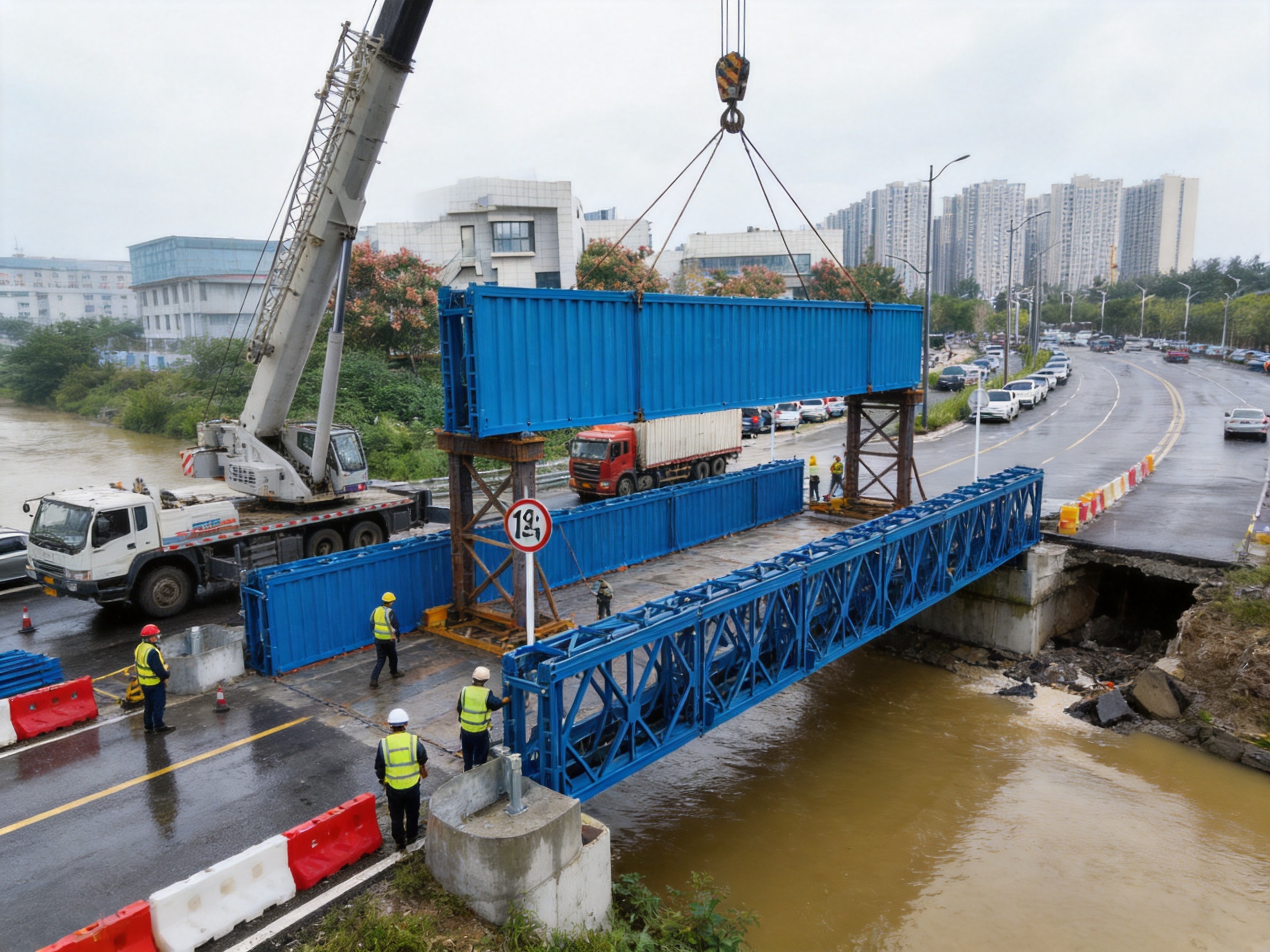
The installation of a Bailey bridge should be directed by qualified bridge engineers and experienced erection crews. Although modular construction is intended to simplify assembly, the bridge remains a structural system subject to significant forces during lifting, launching, connection, and loading.
8.1 Site Investigation
Before installation, the project team should assess the span, terrain, ground conditions, water levels, existing structures, utility lines, access routes, and available working space. The location of the abutments and bearings must be confirmed, and the foundations must be designed to resist vertical, horizontal, and environmental loads.
8.2 Foundation and Support Preparation
The bridge’s performance depends on stable and correctly aligned supports. Abutments, temporary foundations, bearing seats, or other support systems must be constructed according to the approved design. Elevation, alignment, bearing orientation, and approach geometry should be checked before the first bridge panel is assembled.
8.3 Component Inspection
All delivered components should be inspected for shipping damage, coating damage, distortion, missing parts, and identification markings. Fasteners and connection elements should be checked against the packing list. Any damaged structural component should be isolated and assessed before use.
8.4 Assembly Sequence
The bridge is assembled according to the approved erection method. Depending on the project arrangement, panels may be assembled near the bank and launched into position, lifted into place, or erected using temporary supports and cranes. The sequence must account for temporary stability, connection completion, wind conditions, lifting capacity, and worker access.
8.5 Deck and Safety Equipment
After the main truss is assembled, the deck system, roadway surface, curbs, guardrails, barriers, drainage features, and approach transitions are installed. Safety equipment is essential for a two-lane urban bridge. Signage should communicate load limits, speed restrictions, lane organization, clearance limitations, and any temporary traffic-control requirements.
8.6 Inspection Before Opening
Before opening the bridge to traffic, the project team should confirm that all connections are complete, supports are correctly seated, the deck is properly secured, safety barriers are installed, and the approach roads are stable. A final inspection should be documented, and any required load testing or commissioning procedure should be completed in accordance with the project specification.
9. Durability, Inspection, and Maintenance
The blue corrosion-resistant paint system provides an important first line of defense against environmental exposure. However, coating systems require regular inspection and maintenance. Scratches, impact damage, coating blistering, corrosion at connection points, and water accumulation should be identified early.
Inspection should cover the entire bridge, including panels, chords, bracing members, deck supports, fasteners, bearings, expansion areas, barriers, and drainage points. Particular attention should be paid to locations where dirt, salt, moisture, or chemicals may collect. The inspection frequency should reflect the bridge’s environment, traffic volume, intended service duration, and regulatory requirements.
Routine maintenance may include cleaning, tightening or replacing approved connection components, repairing damaged coating, clearing drainage paths, checking bearings, and replacing worn deck elements. Structural repairs should be performed only according to approved procedures. Unauthorized drilling, cutting, welding, or modification can change the behavior of the bridge and may invalidate the original design assumptions.
For temporary bridges, maintenance is sometimes neglected because the planned service period is short. This can create unnecessary risk. Even a bridge intended for temporary use may experience heavy traffic, adverse weather, and repeated dynamic loading. A documented maintenance schedule should therefore be established from the beginning of the project.
10. Engineering and Safety Considerations
The CB 200 bridge is a standardized product, but its application must be project-specific. A 24-meter span and two-lane arrangement do not by themselves define the complete design capacity. The allowable traffic loads, bridge width, deck type, support conditions, wind requirements, seismic provisions, fatigue considerations, and service duration must be confirmed by engineering analysis.
Project owners should provide accurate information about the intended traffic. Important factors include vehicle types, axle loads, traffic frequency, emergency vehicle requirements, construction vehicle use, pedestrian movement, and possible abnormal loads. The design team can then determine whether the selected configuration is suitable and whether additional strengthening, traffic control, or protection is required.
Hydraulic conditions are also important when the bridge crosses a river, drainage channel, or flood-prone area. Water flow, debris impact, scour, seasonal water levels, and flood clearance must be evaluated. Temporary supports may require additional protection to prevent erosion or displacement.
Wind and lateral stability must be considered during both erection and service. A partially assembled truss may be more vulnerable to wind than the completed bridge. Erection plans should define temporary bracing, anchorage, lifting limits, and weather restrictions.
Safety also includes worker protection. Assembly areas should be organized to control lifting operations, prevent unauthorized access, protect workers from falling objects, and provide safe access to elevated components. Clear communication between the supplier, contractor, engineer, and site supervisor is essential.
11. Advantages of Working with an Integrated Manufacturer
Choosing an integrated bridge manufacturer can provide benefits beyond the physical product. A supplier that combines design, fabrication, quality management, and technical support can help coordinate the complete project lifecycle.
First, integrated manufacturing can improve communication. Engineering questions can be addressed directly by teams familiar with the product’s structural system and production methods. This can reduce delays caused by communication gaps between separate designers, fabricators, and component suppliers.
Second, integrated production supports better component coordination. The panels, supporting members, deck elements, and accessories can be manufactured according to a common system. This reduces the likelihood of dimensional conflicts and helps simplify the site inventory.
Third, a capable manufacturer can support customization without abandoning standardization. Project requirements may call for modified deck arrangements, special end conditions, different corrosion-protection systems, additional steel components, or particular packaging arrangements. Engineering-led customization can address these needs while preserving as many standard components as possible.
Fourth, technical support can be important for international projects. Documentation, packing lists, installation guidance, inspection records, and remote coordination all contribute to successful delivery. A manufacturer with experience serving transportation, water conservancy, military logistics, disaster relief, and international development projects is familiar with the practical challenges of different project environments.
12. Manufacturing and International Project Experience
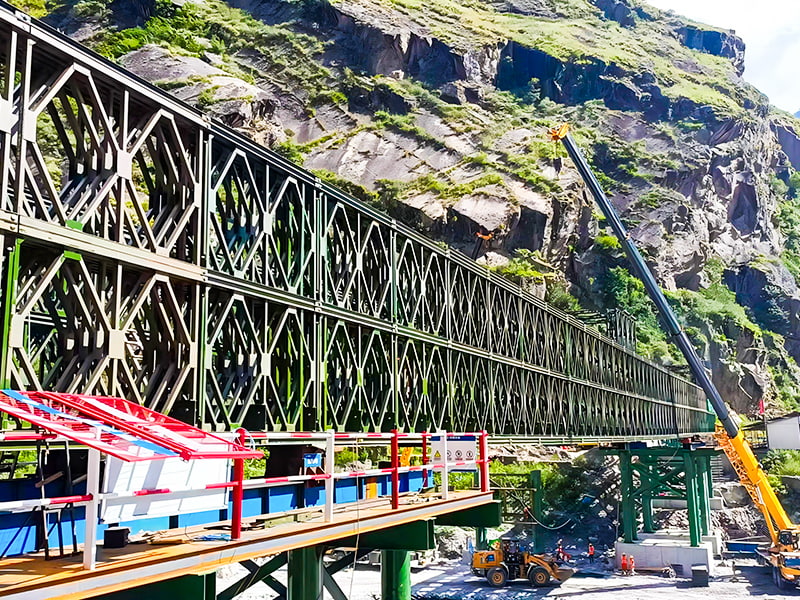
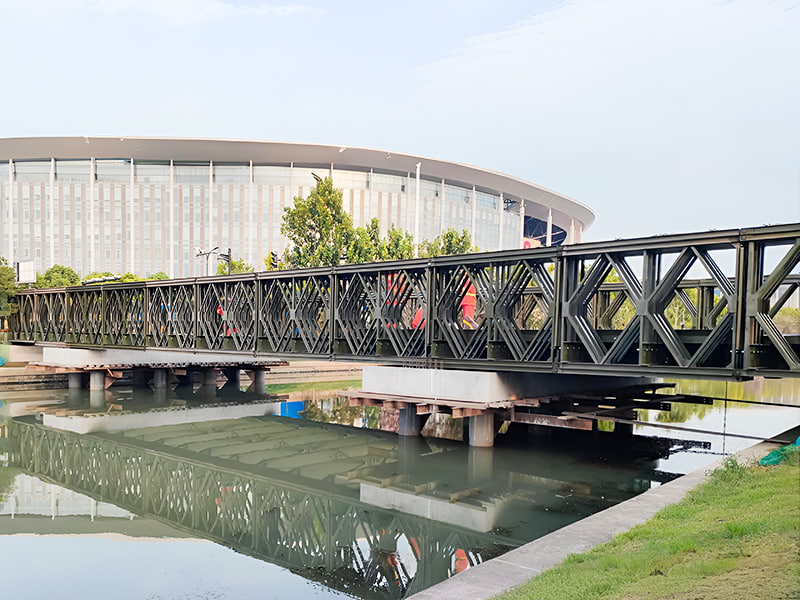
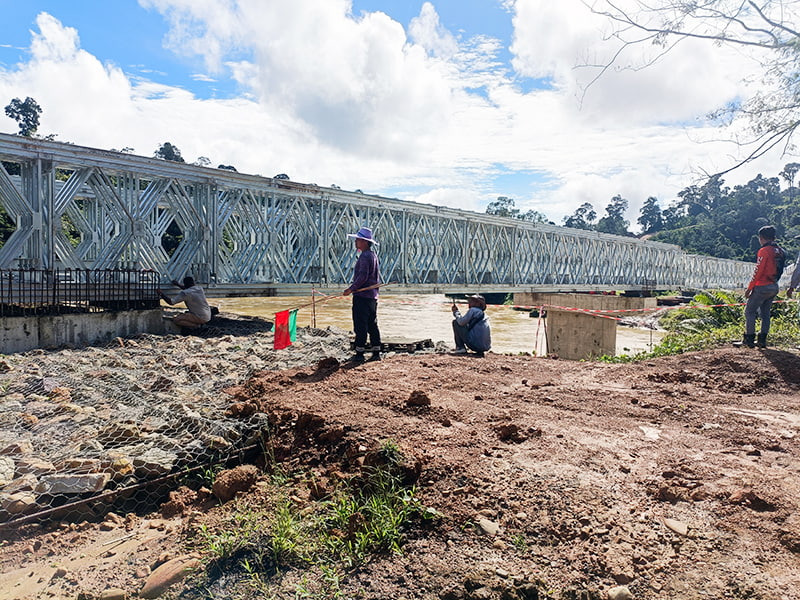
The company’s project experience includes coastal engineering in the Maldives, temporary access bridges for major transport infrastructure, structural components for exhibition and public facilities, multi-span Bailey bridges for railway development, and emergency bridge deployments in flood-affected areas. These applications demonstrate the broad range of environments in which modular steel bridge systems may be used.
Coastal and island projects can require special attention to salt exposure, transportation, limited site access, and corrosion protection. Railway and major corridor projects may require strict coordination with construction schedules, heavy equipment movement, and temporary traffic planning. Flood-response projects often require rapid mobilization, unstable ground conditions, and changing water levels.
Experience across these applications can strengthen the manufacturer’s ability to anticipate project risks. It also provides practical knowledge about packaging, delivery, site assembly, component identification, and remote technical assistance. Such experience does not replace project-specific engineering, but it can improve the efficiency and reliability of project execution.
13. Total Project Value
The value of a modular bridge should be assessed over the complete project lifecycle rather than only by purchase price. Factors include design coordination, manufacturing quality, transport, installation labor, traffic disruption, maintenance, potential relocation, component replacement, and final removal or reuse.
The CB 200 system can provide economic advantages when rapid traffic restoration is important. Reduced closure time may lower indirect costs for road users, businesses, emergency services, and public agencies. Factory prefabrication may also reduce field labor and shorten the duration of temporary works.
Reusability can further improve lifecycle value. If the bridge is designed for relocation or future reconfiguration, the initial investment may support more than one project. Components that remain in good condition can be inspected, stored, and redeployed, subject to engineering approval.
Quality and durability also influence total value. A bridge with consistent dimensions, reliable connections, and effective corrosion protection can reduce maintenance interruptions and improve operational confidence. The most economical solution is often the one that minimizes total project risk while satisfying the required performance criteria.
14. Recommended Procurement Process
Project owners should begin by defining the bridge’s intended use, span, traffic arrangement, site conditions, design life, environmental exposure, and delivery schedule. The supplier should receive sufficient information to prepare an appropriate technical proposal.
The procurement documents should identify the required standards, material grades, inspection procedures, coating system, documentation, packaging, delivery terms, installation responsibilities, and warranty expectations. If the bridge will carry public traffic, the applicable authority requirements should be incorporated into the project specifications.
Before production, the final drawings, component lists, erection method, foundation interface, and traffic-control plan should be reviewed and approved. Any changes made after fabrication begins may affect cost and schedule, so early coordination is strongly recommended.
During delivery, the project team should verify the shipment against the packing list and store components on suitable supports. Steel members should be protected from unnecessary ground contact, standing water, impact, and contamination. A well-organized storage area can prevent damage and make the erection process more efficient.
15. Frequently Asked Questions
Q1: What is the CB 200 Bailey Bridge designed for?
The bridge is designed as a 24-meter, two-lane, single-layer, double-row reinforced modular steel bridge for urban road traffic. It is particularly suitable for emergency traffic restoration, temporary urban connections, construction access, and other applications requiring a standardized bridge system.
Q2: What does the double-row configuration mean?
The double-row configuration refers to the arrangement of Bailey panels in the main truss. It provides a reinforced structural system intended to improve load-sharing and stability compared with a basic single-row arrangement. The final capacity must always be verified through project-specific engineering calculations.
Q3: Why is a two-lane bridge useful for urban roads?
A two-lane bridge can support traffic in both directions and reduce the operational limitations of a single-lane crossing. It can improve access for passenger vehicles, commercial traffic, service vehicles, and emergency responders. Traffic controls, lane widths, speed limits, and vehicle restrictions must be established for each project.
Q4: Is the bridge permanent or temporary?
The bridge can be used for temporary, semi-permanent, or emergency applications, depending on the design, environment, maintenance program, and project requirements. Its modular construction also makes it suitable for relocation or reuse when the bridge is no longer needed at its original site.
Q5: How is the bridge protected against corrosion?
The bridge receives a blue corrosion-resistant paint treatment. Long-term performance depends on proper surface preparation, coating quality, environmental conditions, inspection, and maintenance. Damaged coating should be repaired promptly using an approved procedure.
Q6: Can the bridge be customized?
Modular bridge systems can often be adapted through engineering design, including support arrangements, deck features, end conditions, safety barriers, coatings, and associated steel components. Any customization should be reviewed and approved by qualified engineers before production or installation.
Q7: Does the product include all bridge components?
The bridge panels and the complete set of supporting components are produced and supplied by the manufacturer. The exact supply scope should be confirmed in the quotation and technical agreement, including decks, bearings, fasteners, barriers, approaches, foundations, tools, and installation equipment.
Q8: How quickly can the bridge be installed?
Installation time depends on site preparation, foundation readiness, access, weather, equipment, crew experience, bridge configuration, inspection requirements, and traffic-control arrangements. Factory prefabrication and standardized components are intended to make installation more efficient than extensive site fabrication.
Q9: What standards are followed during production?
The manufacturer states that its products are produced through workflows intended to comply with ASTM, EN, and relevant national specifications. The exact standards, material requirements, testing procedures, and acceptance criteria should be defined for each project.
Q10: What information should be provided for a quotation?
Useful information includes the required span, roadway width, traffic loads, site location, support conditions, environmental exposure, intended service period, delivery schedule, installation responsibilities, applicable standards, and any special requirements for coating, deck systems, barriers, or transportation.
16. Conclusion
The CB 200 Bailey Bridge is a practical modular steel solution for urban road traffic, emergency transportation restoration, construction access, and infrastructure projects that require a combination of speed, strength, and flexibility. Its 24-meter span, two-lane layout, single-layer truss arrangement, and double-row reinforcement provide a balanced configuration for demanding temporary and semi-permanent applications.
The product’s competitive advantages come from more than its structural arrangement. Factory prefabrication, standardized components, integrated supply, controlled welding, precision fabrication, corrosion-resistant coating, and technical support all contribute to a more predictable project outcome. The ability to transport the bridge in manageable components and assemble it efficiently can reduce disruption and accelerate the restoration of critical connections.
The manufacturer’s capabilities in engineering design, automated welding, quality management, modular bridge production, customized steel fabrication, and international project delivery further strengthen the product’s value. Its experience in transportation, water conservancy, military logistics, disaster relief, coastal engineering, railway development, and major infrastructure projects demonstrates the broad applicability of modular bridge technology.
As with any bridge system, successful performance depends on correct engineering, suitable foundations, proper erection, qualified inspection, traffic management, and regular maintenance. When these requirements are properly addressed, the CB 200 Bailey Bridge can provide a reliable and efficient connection for communities, construction projects, emergency agencies, and infrastructure owners around the world.
References
1. American Society for Testing and Materials. Structural Steel and Bridge Construction Material Standards.
2. European Committee for Standardization. Structural Steelwork and Execution of Steel Structures Standards.
3. National bridge design, fabrication, inspection, and temporary works specifications applicable to the project location.
4. Modular Bridge Engineering Principles: Panelized Truss Systems, Erection Methods, and Maintenance Practices.
5. Steel Structure Fabrication Quality Management Guidelines.
6. Bridge Corrosion Protection and Protective Coating Inspection Practices.
7. Temporary Bridge Planning and Emergency Transportation Restoration Procedures.
8. Manufacturer technical information for the CB 200 Bailey Bridge Two-Lane Single-Layer Double-Row Reinforced Bailey Bridge.
Product: CB 200 Bailey Bridge Two-Lane Single-Layer Double-Row Reinforced Bailey Bridge

We respond quickly to all international requests and provide technical support when needed.
Product Category
Bailey Bridge/Modular Bridge Modular Steel Bridge Pedestrian Bridge Modular Pipe Bridge Truss Bridge Steel StructureContact Us

+86-511-84522866
+86-13921582699

zhwm@zjql.com

Building 1,83#, dantu New Town, Yanjiang Road, Dantu District, Zhenjiang, Jiangsu, China
Copyright © Jiangsu Zhonghai Bridge Equipment Co., Ltd. All
Rights
Reserved
China bailey bridge for sale
bailey bridge supplier from china
