
 English
 русский
 Español
 Português


Luo Shiqing — Product After-Sales Service Supervisor
CB 200 Four-Row Single-Layer Reinforced Bailey Bridge: Engineering Performance, Manufacturing Strength, and Global Applications
Content
- 1 1. Overview of the CB 200 Four-Row Single-Layer Reinforced Bailey Bridge
- 2 2. Structural Configuration and Load-Transfer Principles
- 3 3. Main Product Advantages
- 4 4. Comparison with Competing Bridge Solutions
- 5 5. Advanced Manufacturing Process
- 6 6. Quality Management and International Standards
- 7 7. Installation Method and Construction Management
- 8 8. Applications in Infrastructure and Emergency Response
- 9 9. Manufacturing Strength of the Supplier
- 10 10. Sustainability and Lifecycle Considerations
- 11 11. Inspection, Maintenance, and Service Life
- 12 12. Selection Guidance for Project Owners
- 13 13. Frequently Asked Questions
- 13.1 What is the CB 200 four-row single-layer reinforced Bailey bridge?
- 13.2 Why are four rows used instead of fewer panel rows?
- 13.3 What is the benefit of the asphalt deck surface?
- 13.4 Can the bridge be used as a permanent bridge?
- 13.5 How is the bridge installed?
- 13.6 Are all components supplied together?
- 13.7 What manufacturing technologies support the product?
- 13.8 Does the supplier provide customized bridge solutions?
- 13.9 What standards can be applied to the bridge?
- 13.10 How should the bridge be maintained?
- 14 14. Conclusion
- 15 References
- 16 Product: CB 200 Bailey Bridge Four-Row Single-Layer Reinforced Bailey Bridge
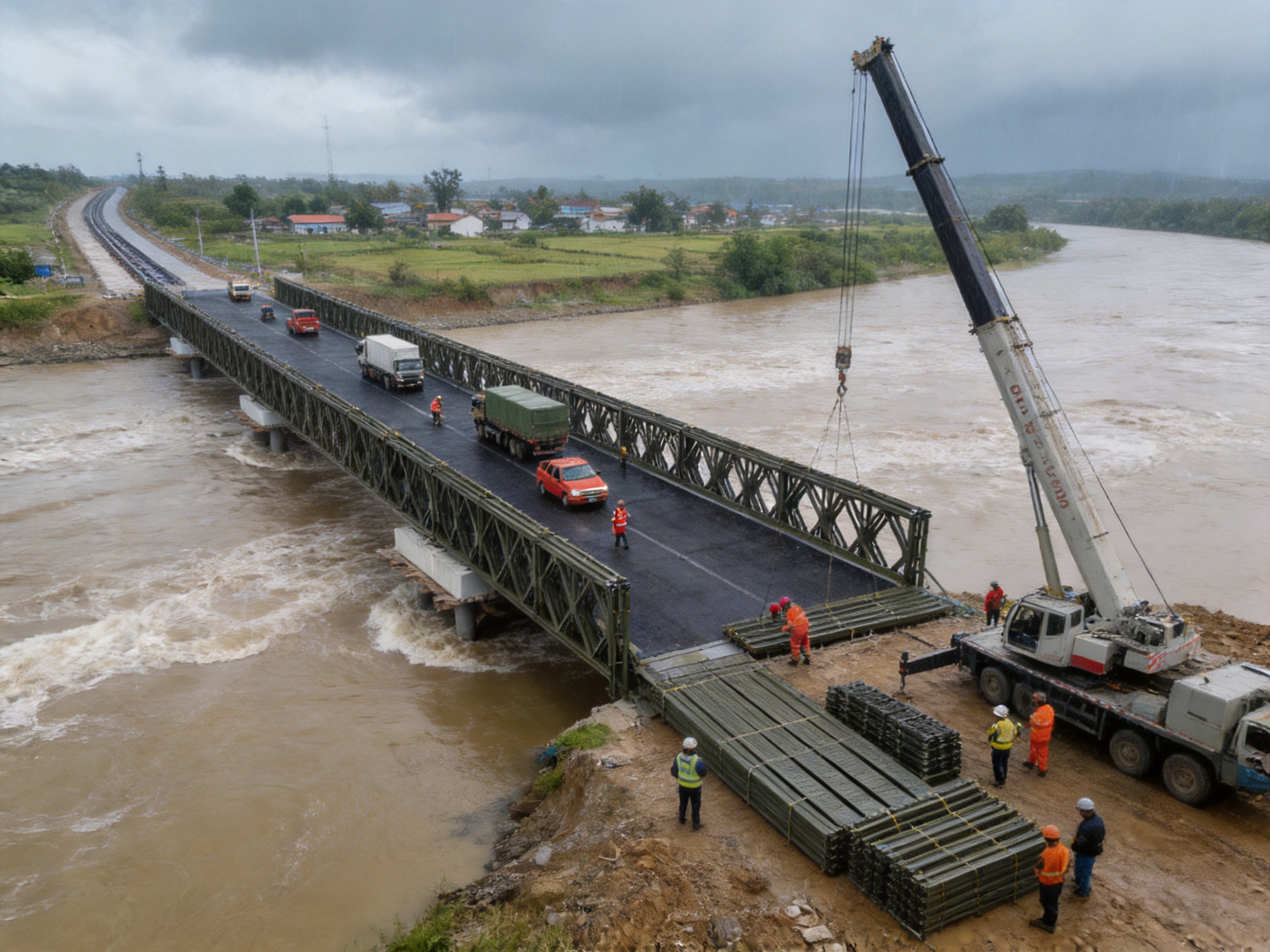
Modular bridge systems are increasingly important in modern infrastructure because they provide a practical response to changing transportation, construction, emergency-relief, and industrial-access requirements. Unlike permanently constructed bridges that may require long design and construction cycles, modular steel bridges can be manufactured in standardized components, transported efficiently, and assembled rapidly at the project location. Their flexibility makes them suitable for temporary crossings, permanent infrastructure, construction access, military logistics, disaster response, and regional transportation projects.
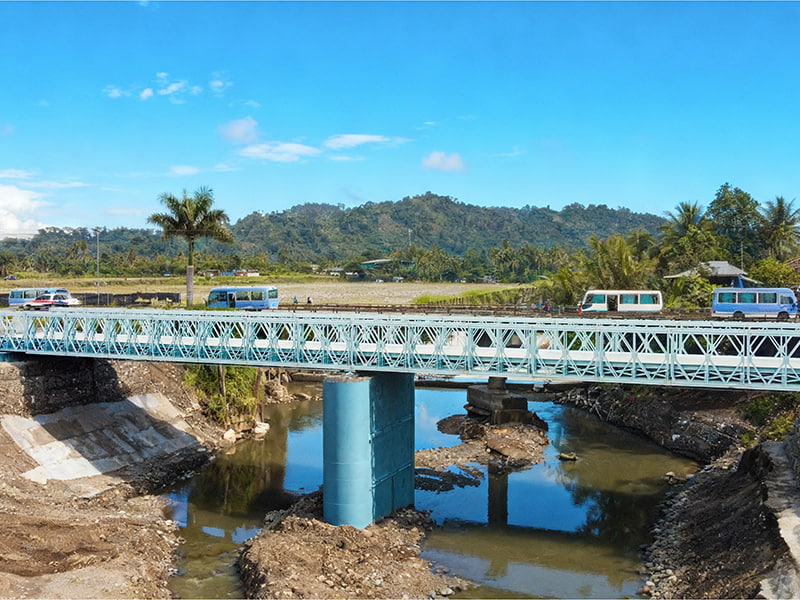
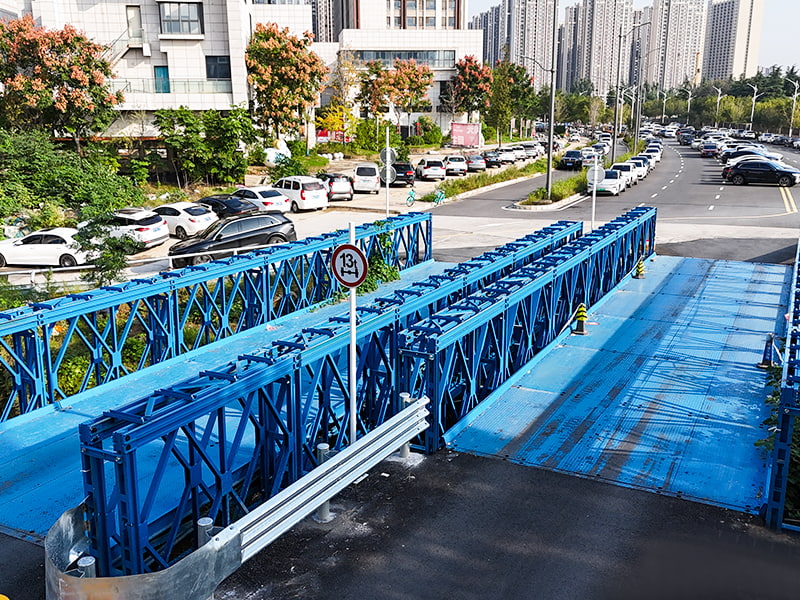
The CB 200 four-row single-layer reinforced Bailey bridge is a representative example of this approach. Developed around the core technology of the CB 200 system, this bridge combines a reinforced truss arrangement with standardized Bailey panels, an asphalt deck surface, and a complete range of supporting components. Its structure is designed to provide dependable load-bearing performance while retaining the installation efficiency that makes modular bridges attractive to contractors, infrastructure authorities, and emergency-response organizations.
The bridge was showcased at the Shanghai International Import Expo, where it demonstrated the practical capabilities of modern modular steel bridge engineering. All Bailey panels and supporting components for this product are manufactured and supplied by Jiangsu Zhonghai Bridge Equipment Co., Ltd. The company integrates engineering design, steel fabrication, automated welding, quality control, logistics coordination, and technical support into one manufacturing system. This integrated capability allows the product to be delivered as a coordinated bridge solution rather than as a collection of unrelated steel parts.
1. Overview of the CB 200 Four-Row Single-Layer Reinforced Bailey Bridge
The CB 200 four-row single-layer reinforced Bailey bridge is a modular truss bridge configured with four longitudinal rows of Bailey panels in a single-layer reinforced arrangement. This configuration increases the effective structural capacity and stiffness of the bridge compared with lighter single-row or two-row arrangements. It is intended for projects requiring a stronger and more stable modular crossing while still benefiting from standardized components and rapid erection.
A Bailey bridge is formed from prefabricated panels, transverse beams, longitudinal members, bracing elements, deck components, connection hardware, and approach or support accessories. These components are assembled into a structural system using bolted or pinned connections. Because the principal parts are standardized, a bridge can often be designed according to span, loading requirement, site condition, and traffic purpose without requiring every structural member to be manufactured from the beginning for one individual project.
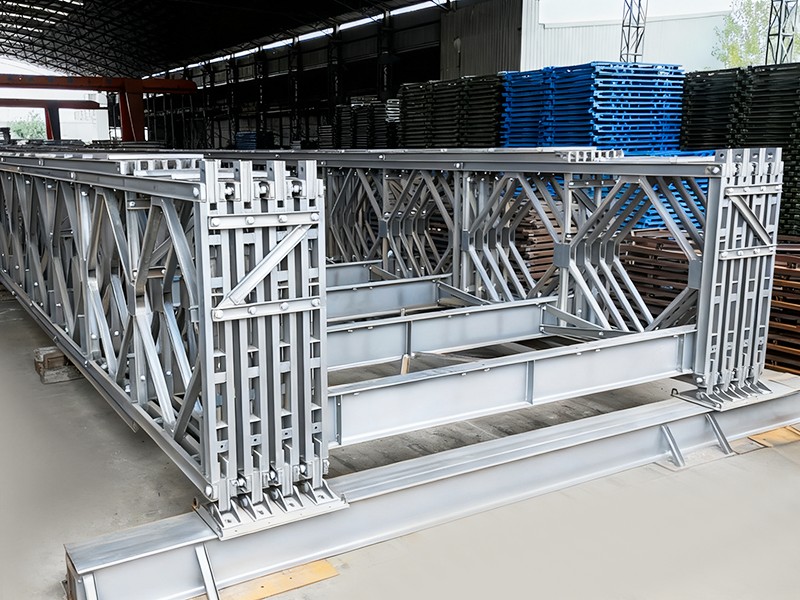
The four-row configuration distributes structural demand across a wider and stronger truss arrangement. When a vehicle or other moving load travels across the deck, the force is transferred through the deck system to the transoms and then into the parallel truss lines. The coordinated action of these trusses helps control deflection, improves lateral stability, and provides a more dependable load path. This is especially valuable for projects where traffic loads, construction equipment, changing weather, or repeated use may create demanding operating conditions.
The term “single-layer reinforced” refers to the arrangement of the modular panels in the vertical direction and to the strengthening applied within the system. Rather than creating a double-height truss, the design maintains a relatively compact structural profile while using additional longitudinal panel rows and reinforced components to increase capacity. This can simplify transportation, erection, and site management while offering a stronger alternative to basic Bailey bridge configurations.
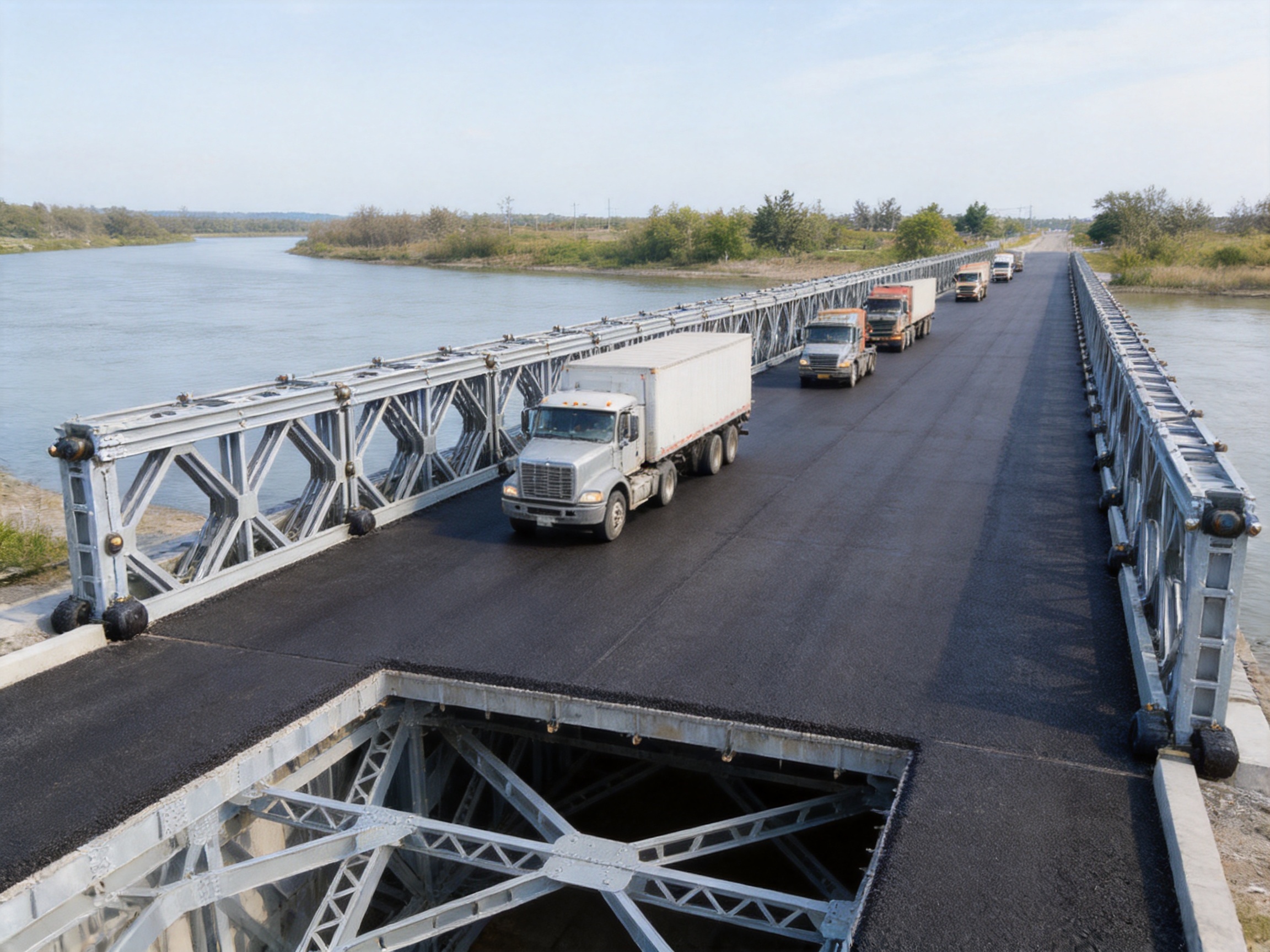
The bridge deck includes an asphalt surface. This surface is important because the quality of the running surface affects more than driving comfort. An asphalt layer can increase the anti-slip coefficient, improve vehicle traction, reduce surface irregularities, and provide a more familiar roadway environment for cars, trucks, and construction vehicles. It can also help distribute localized wheel effects across the deck system when properly designed and maintained.
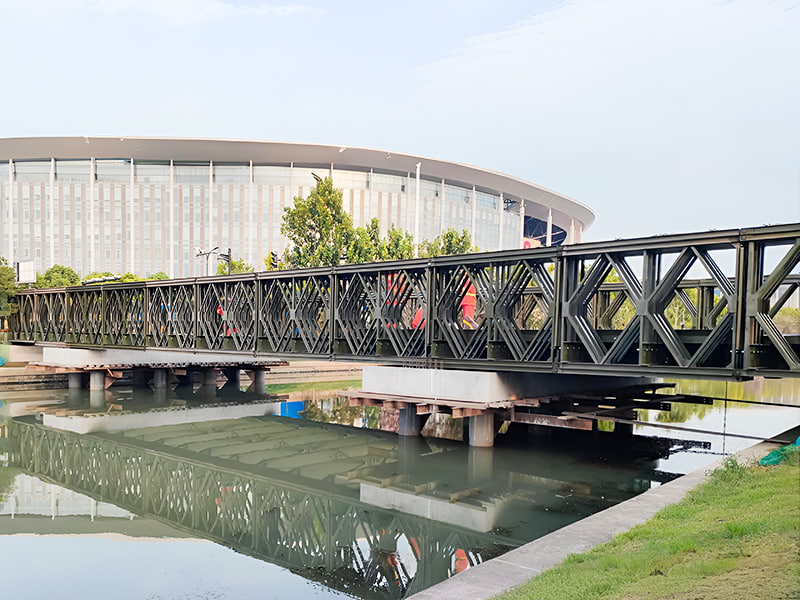
CB 200 Bailey Bridge Four-Row Single-Layer Reinforced Bailey Bridge
2. Structural Configuration and Load-Transfer Principles
The performance of a modular bridge depends on the interaction of its individual components. Panels, chords, bracing members, transoms, deck units, bolts, pins, and supports must operate together as a complete structural system. The CB 200 four-row single-layer reinforced bridge is designed around this principle of coordinated load transfer rather than relying on one isolated component to provide all of the strength.
Under traffic loading, wheel pressure is first applied to the asphalt surface and the underlying deck members. The deck transfers the load to transverse beams, which distribute the force between the longitudinal trusses. The trusses then carry the load through the upper and lower chord members, vertical members, diagonal bracing, and connection points. At the ends of the bridge, support reactions are transferred into bearings, abutments, piers, or other approved foundation systems.
The four-row arrangement provides multiple parallel load paths. This can reduce the amount of load carried by any individual panel line and improve the overall stiffness of the bridge. It also gives engineers greater flexibility in addressing the effects of eccentric traffic, uneven vehicle positioning, wind, braking, acceleration, and construction-stage loads. Proper transverse bracing and deck connection are essential because the trusses must act as one integrated structure rather than as four independent frames.
Connection quality is a central factor in modular bridge safety. Bailey bridges are assembled from repeatable components, but repeatability does not eliminate the need for precision. Pin holes, bolt holes, bearing surfaces, gusset locations, and panel interfaces must be produced within appropriate dimensional tolerances. When components fit correctly, erection crews can assemble the structure efficiently and achieve reliable transfer of forces through the connection system.
The CB 200 system is based on standardized modular technology, allowing the bridge to retain the practical advantages of the Bailey concept while supporting a reinforced configuration. Standardization can reduce design uncertainty, simplify spare-parts management, and make it easier for project teams to train workers in installation procedures. It also helps manufacturers maintain consistent tooling, inspection methods, and production records.
For any project, the bridge must be engineered according to the actual design span, live load, dead load, wind condition, seismic environment, foundation arrangement, deck width, traffic category, and construction method. A product configuration should not be selected solely by appearance or nominal span. Professional engineering review remains necessary to confirm the suitability of the four-row single-layer reinforced arrangement for each application.
3. Main Product Advantages
3.1 Higher Strength Within a Compact Modular Arrangement
One of the main advantages of the CB 200 four-row single-layer reinforced bridge is its balance between structural strength and modular compactness. The four-row truss configuration provides additional capacity and stiffness without requiring a double-layer structural profile. This may be beneficial where clearance, transport dimensions, erection equipment, or construction access are limited.
A compact truss profile can simplify the movement of components to remote locations. Panels and supporting members can be loaded, stacked, inspected, and delivered in an organized manner. At the project site, the components can be positioned using cranes, launching methods, or other approved erection equipment depending on the span and terrain. This flexibility is particularly useful for crossings in areas where conventional heavy construction equipment cannot remain on site for long periods.
3.2 Efficient Installation
Rapid installation is one of the most recognized benefits of modular bridge technology. Since the major components are prefabricated, site work is concentrated on foundation preparation, component staging, assembly, launching or lifting, deck installation, and finishing. This can shorten the period during which roads, waterways, rail corridors, or construction zones are disrupted.
The CB 200 bridge uses standardized panels and a complete set of supporting components supplied as part of an integrated product system. Coordinated supply can reduce the risk of receiving panels from one source, deck components from another source, and connection accessories from an incompatible system. A complete supply package also helps the contractor prepare an erection schedule, verify the bill of materials, and organize site storage before assembly begins.
Installation efficiency does not mean that safety procedures can be reduced. The erection sequence must be planned by qualified personnel, and temporary bracing, lifting points, working platforms, exclusion zones, and connection inspections must be controlled throughout construction. The advantage of modular design is that it makes the work more organized and predictable, not that it removes the need for engineering supervision.
3.3 Improved Road-Surface Performance
The asphalt deck surface provides an important operational advantage over basic bare-steel or untreated deck arrangements. Asphalt can increase the anti-slip coefficient and produce a more continuous driving surface. This helps vehicles maintain traction, especially where rain, dust, mud, or repeated traffic would otherwise make a smooth steel deck more difficult to use.
A finished roadway also improves the user experience. Drivers encounter a surface that is closer to a conventional road, while pedestrians and maintenance workers benefit from a more regular walking and working area. The deck treatment can contribute to lower vibration and reduced noise compared with an exposed, uneven steel surface, although actual performance depends on the complete deck design, installation quality, vehicle speed, and maintenance condition.
The asphalt surface must be designed for the bridge’s expected traffic and environmental conditions. Drainage, expansion movement, waterproofing, surface repair, and temperature effects should be considered. Regular inspection is also required because a modular bridge deck is subject to repeated flexure, braking forces, water exposure, and changing weather.
3.4 Reliable Structural Stability
The product is built around CB 200 core technology and uses a reinforced four-row truss system to improve stability. Structural stability includes resistance to vertical loads, lateral movement, torsion, wind effects, construction-stage forces, and local deformation. The bridge must also remain stable during launching, lifting, connection, deck placement, and traffic operation.
Multiple truss rows can help distribute loads and limit the concentration of stress in individual members. Cross bracing and transverse connections further improve the relationship between the trusses. When properly designed and installed, these features support a stable bridge structure that can be used for repeated traffic and demanding infrastructure applications.
3.5 Standardized Maintenance and Replacement
Standard modular components provide a practical maintenance advantage. If a panel, transom, bracing member, deck unit, or connection accessory is damaged, the affected part can be inspected and replaced according to the system’s approved component specifications. This may be more efficient than repairing a permanently welded bridge with unique, site-specific members.
Replacement planning is particularly important for emergency bridges, military logistics routes, construction access roads, and temporary crossings. Operators can keep selected spare parts in storage, establish inspection procedures, and train maintenance personnel on recognizable component types. Standardization also supports inventory control across multiple bridge locations.
4. Comparison with Competing Bridge Solutions
Every bridge type has an appropriate field of use. The CB 200 four-row single-layer reinforced bridge is not intended to replace every permanent concrete, steel girder, arch, cable-stayed, or truss bridge. Its competitive strength lies in providing a combination of load-bearing capability, modularity, delivery efficiency, and installation speed.
| Evaluation factor | CB 200 four-row single-layer reinforced Bailey bridge | Conventional permanent bridge | Light temporary crossing |
| Component production | Prefabricated standardized modular components | Often highly project-specific | Usually simplified and lower-capacity components |
| Installation approach | Assembly, launching, or lifting using planned modular procedures | May require extensive formwork, heavy equipment, and long site operations | Generally fast but may provide lower structural capacity |
| Adaptability | Suitable for different spans, support conditions, and deployment requirements subject to engineering review | Strong long-term customization but less adaptable after construction | Adaptable for limited loads and short-term access |
| Traffic surface | Asphalt deck surface designed to improve traction and roadway usability | Concrete or asphalt surface depending on the design | May use basic steel plates, timber, or light decking |
| Replacement and repair | Standard parts can support organized replacement and inventory management | Repairs may require project-specific fabrication | Replacement may be simple but component life can be limited |
| Best application | Temporary or semi-permanent crossings, emergency routes, construction access, logistics, and modular infrastructure | Long-term permanent transportation infrastructure | Pedestrian, light-vehicle, or short-duration access routes |
Compared with a conventional permanent bridge, the CB 200 system can reduce the amount of site-based fabrication and shorten the construction schedule. A permanent bridge may provide a longer design life and greater architectural or geometric freedom, but it often requires extensive foundation work, formwork, specialized lifting, complex traffic management, and a longer approval process. A modular bridge can offer a more direct solution where speed and adaptability are critical.
Compared with a light temporary crossing, the four-row reinforced configuration provides a stronger structural platform. It is more appropriate for projects involving heavier vehicles, repeated traffic, construction machinery, or demanding operational conditions. The reinforced arrangement can provide a useful margin of structural performance compared with basic temporary access systems, subject to the approved design load and site conditions.
Compared with products assembled from multiple unrelated suppliers, a complete system supplied by one manufacturer can improve component compatibility and project coordination. Consistent manufacturing standards, unified documentation, and centralized technical communication may reduce procurement complexity and help prevent mismatches between panels, deck units, fasteners, and accessories.
5. Advanced Manufacturing Process
The quality of a modular bridge is determined long before the components reach the construction site. Manufacturing accuracy, material control, welding quality, dimensional inspection, surface treatment, and final assembly verification all influence the finished bridge. Jiangsu Zhonghai Bridge Equipment Co., Ltd. combines engineering design, precision manufacturing, quality management, and technical support in an integrated production system.
5.1 Engineering Design and Production Planning
The manufacturing process begins with engineering definition. The bridge configuration, component schedule, connection details, material requirements, fabrication tolerances, inspection points, and packaging method must be identified before production starts. A standardized design platform helps ensure that the panels and accessories remain compatible with the CB 200 system.
Production planning converts engineering information into controlled manufacturing operations. Each component can be assigned a production route that identifies cutting, forming, drilling, welding, inspection, surface treatment, marking, and packing requirements. This approach helps reduce variation between production batches and supports traceability throughout the manufacturing cycle.
5.2 Material Preparation and Traceability
High-strength modular bridge components require carefully controlled steel materials. Incoming steel should be checked against purchase specifications, including grade, thickness, dimensions, identification, and relevant material documentation. Traceability allows the manufacturer to connect material records with individual components or production batches.
Material preparation includes plate and section cutting, edge treatment, straightening, and layout. Accurate preparation is essential because small deviations introduced at the beginning of fabrication can affect hole alignment, panel geometry, weld fit-up, and final bridge assembly. Controlled preparation reduces the need for corrective work later in the process.
5.3 Automated Welding and Precision Fabrication
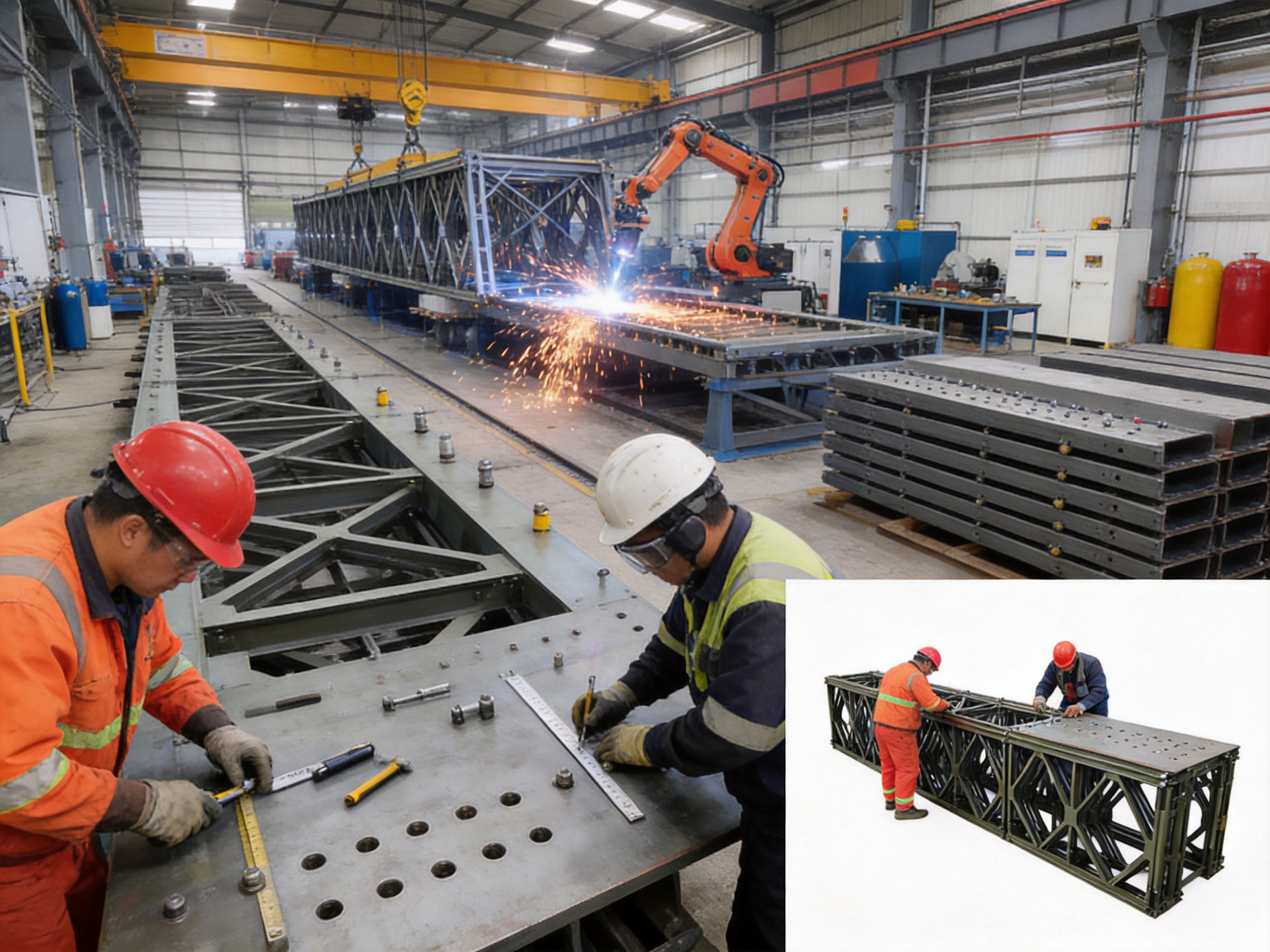
Welding is a major part of modular bridge manufacturing. Welded joints must achieve the required strength, fusion, geometry, and durability. Automated welding can improve consistency by controlling travel speed, heat input, wire feed, and welding position. It also supports repeatable production for components that are manufactured in significant quantities.
Automation does not replace skilled engineering or inspection. Welding procedures must be qualified for the relevant materials and joint types, and operators must be trained to manage fit-up, distortion, preheating, interpass conditions, and defect prevention. After welding, components may undergo visual examination, dimensional checks, and additional non-destructive testing where required by the project or applicable standard.
Precision steel fabrication covers more than welding. It includes drilling or machining of connection holes, forming of stiffeners, preparation of bearing surfaces, fitting of reinforcement members, and verification of panel geometry. The production objective is to ensure that components assembled at the project site fit together without excessive force, unapproved modification, or misalignment.
5.4 Drilling, Connection Accuracy, and Dimensional Control
Bailey bridge panels depend on accurate connection points. Pin holes and bolt holes must be positioned correctly so that adjacent panels, bracing members, transoms, and accessories can be connected efficiently. Dimensional control is therefore applied during fabrication and at final inspection.
Inspection may include measurements of overall length, width, depth, hole spacing, diagonal dimensions, straightness, squareness, weld size, and component weight. Inspection equipment should be calibrated and used according to documented procedures. If a deviation is identified, the component should be evaluated before release to determine whether correction, rework, or rejection is appropriate.
5.5 Surface Protection and Finishing
Steel bridge components operate in environments that may include rainfall, humidity, road salt, industrial pollution, mud, and coastal exposure. Surface preparation and protective coating are therefore important to long-term performance. The appropriate process may include cleaning, abrasive preparation, primer application, intermediate coating, and finishing layers according to the project specification.
Coating quality depends on surface cleanliness, environmental conditions, film thickness, curing time, and application technique. Areas around connection points, edges, welds, and drainage locations require particular attention. Coating records and inspection results can support future maintenance planning and help operators identify areas that require repair.
5.6 Final Assembly and Quality Verification
Before shipment, selected components may be trial-assembled or checked against approved drawings and production records. This step can identify dimensional conflicts before the bridge reaches the construction site. It also allows the manufacturer to verify that panels, accessories, bracing, deck elements, pins, bolts, and other components are included in the intended supply package.
Final quality verification can include visual inspection, dimensional inspection, weld inspection, coating inspection, marking verification, documentation review, and packing-list confirmation. The objective is to ensure that the delivered system is complete, identifiable, and ready for organized installation.
6. Quality Management and International Standards
The company states that its products are manufactured through standardized workflows and that its high-strength modular bridge systems comply with ASTM, EN, and applicable national specifications. The exact governing standard for a project should be confirmed during engineering and procurement because requirements can vary according to country, bridge function, traffic category, climate, and approval authority.
Quality management should cover the entire product lifecycle, beginning with design and continuing through procurement, production, inspection, packaging, delivery, erection, and maintenance. A reliable quality system defines responsibilities, inspection points, nonconformance procedures, document control, supplier management, and corrective actions.
For international infrastructure projects, documentation is particularly important. Customers may require material certificates, welding procedure records, inspection reports, coating records, dimensional reports, packing lists, installation manuals, and maintenance recommendations. Clear technical documentation helps local contractors and supervising engineers understand the product and apply the correct construction procedures.
International delivery performance also depends on packaging and logistics. Modular bridge parts must be protected against impact, moisture, abrasion, and loss during transportation. Components should be marked clearly, grouped logically, and packed in a way that supports unloading and site inventory. Proper packaging is a manufacturing responsibility as well as a logistics responsibility because it protects the quality achieved in the factory.
7. Installation Method and Construction Management
The installation method for a CB 200 bridge depends on span length, site access, foundation condition, waterway or roadway clearance, available lifting equipment, traffic requirements, and local regulations. Common modular bridge methods may include staged assembly and launching, crane lifting, or assembly over prepared temporary supports. The selected method must be developed by qualified engineers and reviewed for every stage of construction.
7.1 Site Preparation
Before bridge components arrive, the project team should confirm the alignment, foundation locations, bearing elevations, approach roads, drainage, access routes, staging areas, and lifting zones. Ground conditions must be adequate for cranes, transport vehicles, temporary supports, and construction personnel. Any risk of flooding, erosion, unstable soil, or underground utility conflict should be addressed before erection begins.
The foundations and abutments must be completed to the approved dimensions and strength requirements. Bearing surfaces should be clean, level, and correctly positioned. Errors in support location or elevation can create installation difficulties and introduce unintended forces into the structure.
7.2 Component Inspection and Staging
When the components arrive, the contractor should compare the shipment against the packing list and inspect the parts for transportation damage, coating damage, deformation, missing hardware, or incorrect identification. Components should be stored on stable supports above standing water and arranged according to the erection sequence.
Staging is particularly important for modular bridge construction. Panels, transoms, bracing members, deck sections, pins, bolts, and accessories should be separated and identified. Organized staging reduces handling time and lowers the risk of installing an incorrect component or delaying the work because a small accessory cannot be located.
7.3 Assembly and Connection
Assembly normally begins with the preparation of the initial bridge section or launching nose, depending on the selected method. Panels are connected in accordance with approved drawings, and bracing, transoms, and connection hardware are installed at the required stages. Workers must use suitable lifting equipment and personal protection systems, and no one should work beneath suspended loads.
Connections should be checked progressively rather than waiting until the entire bridge has been assembled. Pins must be fully seated, bolts must be installed and tightened according to the specification, bracing must be correctly oriented, and components must not be forced into position through unauthorized drilling, cutting, or heating. Any assembly discrepancy should be reported for engineering review.
7.4 Launching or Lifting
When launching is selected, the temporary condition of the bridge must be analyzed carefully. The bridge may experience different bending moments and reactions during launching than it will experience after reaching its final supports. The launching nose, rollers, temporary supports, counterweights, and pulling or pushing equipment must be designed or selected for the actual operation.
When cranes are used, lifting plans must account for component weight, center of gravity, lifting points, crane capacity, working radius, wind, ground bearing pressure, and communication procedures. The bridge should be lifted and positioned in a controlled manner, with personnel kept outside danger zones.
7.5 Deck Installation and Finishing
After the main truss structure is positioned and secured, deck members, edge protection, safety barriers, drainage elements, and the asphalt surface can be installed according to the approved sequence. The deck must be checked for alignment, connection security, surface continuity, and drainage performance.
The asphalt surface should be applied under suitable environmental and technical conditions. Proper preparation of the underlying deck, controlled material placement, compaction, and edge treatment contribute to a durable and skid-resistant roadway. The final surface should be inspected before opening the bridge to traffic.
8. Applications in Infrastructure and Emergency Response
The CB 200 four-row single-layer reinforced Bailey bridge can support a wide variety of applications. Its strongest value is found in situations where a dependable crossing is needed quickly, where the site may change over time, or where conventional construction would create excessive cost or delay.
8.1 Temporary Road Bridges
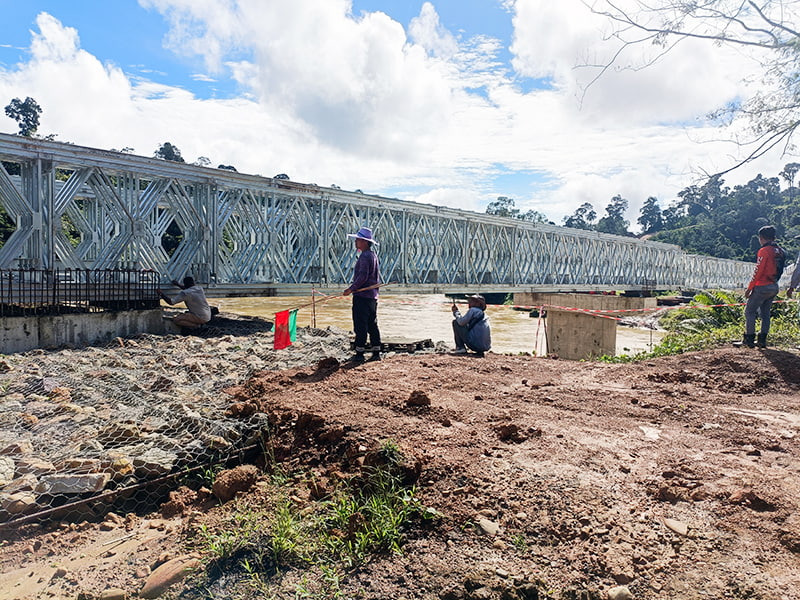
Temporary road bridges are used during the reconstruction of permanent crossings, road widening, flood damage repair, railway development, and utility construction. The modular system can provide a controlled traffic route while the original bridge or roadway is unavailable. Its asphalt deck can improve vehicle handling and support regular traffic operations during the temporary period.
8.2 Construction Access
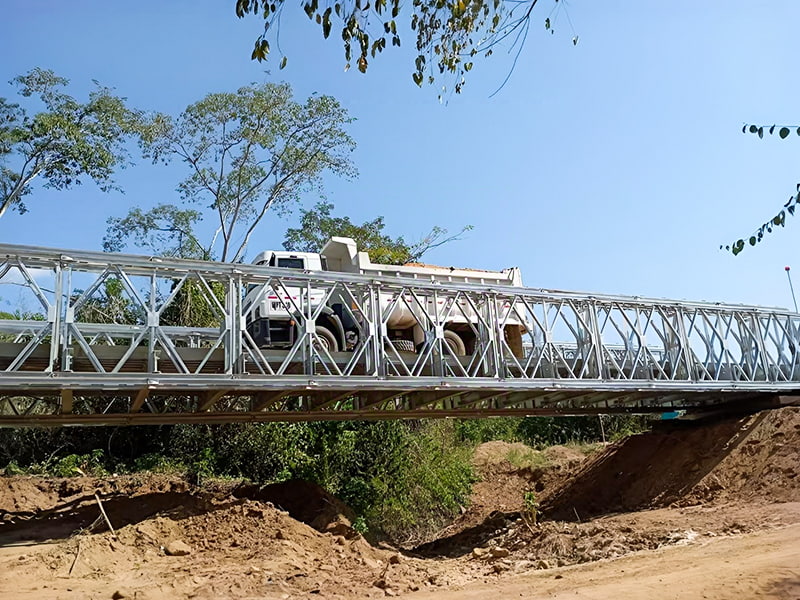
Large civil engineering projects often require access across rivers, drainage channels, excavation zones, rail corridors, or unfinished road alignments. A modular steel bridge can provide access for dump trucks, cranes, concrete vehicles, and service equipment. The four-row reinforced arrangement may be selected when construction traffic is heavier or more frequent than ordinary light access traffic.
8.3 Disaster Relief and Flood Response
Floods, earthquakes, landslides, and other disasters can destroy or isolate transportation links. In these conditions, time is often as important as structural capacity. A modular bridge assembled from prefabricated parts can help restore access for emergency vehicles, food deliveries, medical services, evacuation operations, and repair crews.
Emergency deployment requires more than a strong bridge. It requires clear packing, rapid transport, trained erection teams, adaptable foundation solutions, and a reliable technical support system. The manufacturer’s ability to supply a complete component package can help emergency agencies coordinate procurement and deployment under difficult conditions.
8.4 Military and Strategic Logistics
Military logistics may require bridges that can be transported, assembled, relocated, and maintained under challenging conditions. Modular truss systems are suitable for controlled crossings where mobility, speed, and standardized components are important. The exact use must comply with applicable military engineering, security, traffic, and safety requirements.
8.5 Water Conservancy and Regional Development
Water conservancy projects may involve channels, reservoirs, irrigation systems, flood-control works, and remote access roads. Modular bridges can support construction vehicles and maintenance teams while allowing infrastructure work to continue. In developing regions, a modular bridge can also provide an efficient connection between communities, agricultural areas, industrial sites, and transportation corridors.
8.6 International Infrastructure Projects
The company has supplied or supported products for projects in China and abroad, including coastal engineering in the Maldives, temporary access bridges for the Shenzhen–Zhongshan Corridor, structural components for the Hangzhou Expo Center, multi-span Bailey bridges for the Lalin Railway, and flood-response deployments in multiple regions. These project references illustrate the broad range of environments in which modular bridge products may be applied.
9. Manufacturing Strength of the Supplier
A modular bridge supplier should be evaluated not only by the appearance of its products but also by its ability to manage the complete project process. Jiangsu Zhonghai Bridge Equipment Co., Ltd. is based in Zhenjiang, Jiangsu Province, an important industrial and transportation region in China. The company focuses on modular steel bridges, Bailey bridge systems, customized steel components, bridge erection and construction support equipment, automated welding, and precision steel fabrication.
The company’s manufacturing strength comes from the combination of several capabilities. Engineering design supports the development and adaptation of bridge configurations. Precision fabrication establishes the geometry and connection accuracy of components. Automated welding supports consistent production. Quality management provides inspection and documentation. International delivery experience supports packaging, shipment coordination, and communication with overseas customers.
This integrated model can offer advantages over a trading-only supplier. A manufacturer with direct control of production can respond more effectively to technical questions, verify component compatibility, coordinate design changes, and investigate quality issues. Customers can also benefit from clearer responsibility because engineering, fabrication, inspection, and supply are managed within one organization.
Exclusive supply of the Bailey panels and supporting components for the featured bridge provides another project-management benefit. It creates a single technical source for the main structural system and accessories. This can reduce the risk of inconsistent steel grades, incompatible connection details, different coating systems, or unclear warranty responsibilities.
The company’s experience across transportation, water conservancy, military logistics, disaster relief, and international development also supports its ability to understand different operating environments. A bridge used in a coastal project may face salt exposure, while a flood-response bridge may require rapid deployment and difficult access. A construction access bridge may experience concentrated heavy equipment loads. Each application requires careful engineering and project coordination.
10. Sustainability and Lifecycle Considerations
Modular steel bridges can contribute to more efficient use of construction resources when their components are designed for repeated deployment, maintenance, and replacement. A bridge assembled from standardized parts may be dismantled, relocated, extended, shortened, or reconfigured when project conditions change. This flexibility can reduce the need to discard an entire structure when a temporary project ends.
Steel components can also be inspected, repaired, recoated, and recycled at the end of their useful service. Lifecycle performance depends on design, corrosion protection, traffic loading, inspection frequency, and maintenance quality. The asphalt surface may require periodic repair, and connection areas should be monitored for wear, loosening, deformation, or corrosion.
Efficient manufacturing can reduce waste through controlled cutting plans, repeatable production, and the reuse of suitable offcuts where permitted. Automated welding and standardized workflows can improve resource utilization by reducing rework and production variation. Environmental performance should be evaluated across material sourcing, factory energy use, transportation, installation, operation, maintenance, and eventual recovery.
A lifecycle approach also helps customers select the correct bridge configuration. The lowest initial purchase price may not represent the lowest total cost if the bridge requires frequent repair, difficult installation, or early replacement. A stronger and more adaptable modular system may provide better value when the bridge will be used repeatedly or in demanding environments.
11. Inspection, Maintenance, and Service Life
Regular inspection is essential for maintaining the performance of any modular bridge. Inspection intervals should be established according to traffic volume, environmental exposure, design life, bridge importance, and applicable regulations. Visual inspections can identify coating damage, corrosion, loose hardware, cracked welds, bent members, deck deterioration, drainage blockage, and changes in alignment.
Connection areas deserve special attention because repeated traffic can produce vibration and movement. Inspectors should verify that pins, bolts, locking devices, bracing, transoms, and deck connections remain secure. Any unusual noise, excessive vibration, visible deformation, or change in ride quality should be investigated promptly.
The asphalt surface should be inspected for potholes, cracking, rutting, delamination, water retention, and loss of skid resistance. Surface defects can increase vehicle impact and transmit higher dynamic effects to the bridge. Timely repair helps protect both the deck system and the structural components below.
Coating maintenance is particularly important in wet, coastal, industrial, and high-salt environments. Damaged areas should be cleaned, prepared, and recoated according to the approved coating system. Drainage paths must remain open so that water does not accumulate around connections, deck supports, or lower chord members.
Maintenance records should include inspection dates, observed conditions, repairs, replacement parts, traffic incidents, coating work, and any changes to the permitted loading. Accurate records help operators identify trends and plan future interventions before minor issues become major structural problems.
12. Selection Guidance for Project Owners
Project owners should define the intended bridge function before selecting a modular configuration. Important questions include the required clear span, carriageway width, traffic type, design vehicle, pedestrian requirements, expected service period, site access, environmental exposure, foundation arrangement, and desired installation method.
The four-row single-layer reinforced arrangement may be suitable where a project needs more capacity and stiffness than a basic modular bridge can provide. However, the final selection must be confirmed through structural analysis and site-specific engineering. The bridge configuration, deck details, support system, bracing, and foundation must all be evaluated together.
Procurement teams should request a complete technical package. This may include general arrangement drawings, component schedules, material specifications, connection details, design calculations, installation instructions, inspection requirements, surface protection information, and maintenance guidance. Clear documentation reduces ambiguity during bidding, approval, construction, and operation.
Customers should also evaluate manufacturing capacity. Questions may address factory equipment, automated welding capability, dimensional inspection, quality records, production lead time, packaging, spare-parts support, international shipment experience, and technical assistance during erection. These factors can influence the project outcome as much as the nominal bridge specification.
When comparing quotations, the buyer should consider the complete delivered system rather than only the price of the main panels. Deck units, bracing, fasteners, bearings, approach elements, asphalt treatment, barriers, transport, inspection, and technical support may all affect the final project cost. A complete and compatible supply package can reduce hidden expenses and schedule risk.
13. Frequently Asked Questions
What is the CB 200 four-row single-layer reinforced Bailey bridge?
It is a modular steel truss bridge using four longitudinal rows of Bailey panels in a single-layer reinforced arrangement. It is designed to provide improved structural capacity and stability while retaining the prefabricated, transportable, and rapidly assembled characteristics of Bailey bridge technology.
Why are four rows used instead of fewer panel rows?
Four panel rows provide additional parallel load paths and can increase the overall stiffness and load-distribution capability of the bridge. This arrangement is useful for projects involving heavier traffic, repeated vehicle movement, construction machinery, or more demanding operating conditions. The actual suitability must be verified through project-specific engineering.
What is the benefit of the asphalt deck surface?
The asphalt surface can increase the anti-slip coefficient and provide a more continuous roadway surface than exposed steel decking. It can improve vehicle traction, driving comfort, and operational usability. Surface design, drainage, compaction, and maintenance remain important for long-term performance.
Can the bridge be used as a permanent bridge?
Modular Bailey bridges can be used for temporary, semi-permanent, or certain permanent applications, depending on the design, maintenance plan, environmental conditions, and approval requirements. The intended service period and local regulations should be defined before procurement, and the final bridge must be engineered for its specific use.
How is the bridge installed?
Installation may involve staged assembly and launching, crane lifting, or another approved erection method. The correct method depends on the span, terrain, access conditions, support arrangement, and available equipment. Qualified engineers should prepare the erection plan and verify temporary-stage stability.
Are all components supplied together?
The featured bridge is supplied with Bailey panels and a complete set of supporting components from the same manufacturer. A coordinated supply package can improve compatibility, simplify inventory control, and reduce the risk of missing or mismatched parts. The exact supply scope should be confirmed in the project quotation and technical documents.
What manufacturing technologies support the product?
The production system includes engineering design, standardized workflows, precision steel fabrication, automated welding, dimensional control, quality inspection, surface protection, and logistics preparation. These capabilities are intended to provide consistent component geometry and reliable connection performance.
Does the supplier provide customized bridge solutions?
The company specializes in modular steel bridges, Bailey bridge systems, customized steel components, and supporting structural equipment. Customization may involve bridge configuration, span arrangement, deck requirements, accessories, or project-specific components, subject to engineering review and applicable standards.
What standards can be applied to the bridge?
The company states that its high-strength modular bridge systems comply with ASTM, EN, and national specifications. The governing standard should be confirmed for each project because the applicable requirements depend on the country, design code, traffic loading, environmental conditions, and approval authority.
How should the bridge be maintained?
Maintenance should include routine inspection of panels, welds, pins, bolts, bracing, deck members, asphalt, barriers, bearings, drainage, and protective coatings. Defects should be recorded and repaired promptly. Inspection frequency should reflect traffic intensity, service environment, design importance, and local regulations.
14. Conclusion
The CB 200 four-row single-layer reinforced Bailey bridge represents a practical development of modular bridge technology. Its four-row reinforced truss arrangement is designed to provide stronger structural performance and improved load distribution while maintaining a compact, standardized, and installation-efficient format. The asphalt deck surface adds operational value by improving traction and creating a more familiar roadway environment.
Its advantages become especially clear in projects where time, adaptability, logistics, and dependable capacity are all important. Temporary road crossings, construction access, flood response, emergency transportation, military logistics, water conservancy, and international infrastructure projects can all benefit from a coordinated modular bridge system when the configuration is properly engineered.
The product’s competitive value is also supported by the manufacturing capabilities of Jiangsu Zhonghai Bridge Equipment Co., Ltd. The company combines engineering, precision steel fabrication, automated welding, quality management, standardized production, international delivery, and technical support. Exclusive supply of the main Bailey panels and supporting components helps establish a unified technical and quality-control system from factory production through site installation.
For project owners, contractors, and infrastructure authorities, the most important consideration is not simply whether a bridge can be assembled quickly. The complete solution must provide suitable structural performance, accurate components, reliable connections, effective corrosion protection, safe installation, clear documentation, and maintainable long-term operation. When these factors are managed together, the CB 200 four-row single-layer reinforced Bailey bridge can provide a fast, flexible, and dependable connection for demanding infrastructure needs.
References
1. Product technical information for the CB 200 four-row single-layer reinforced Bailey bridge, supplied for engineering and product communication purposes.
2. Modular bridge system design and installation principles, including prefabricated truss assembly, launching procedures, temporary-stage stability, and connection control.
3. ASTM structural steel, welding, inspection, and bridge engineering practices applicable to modular steel construction.
4. EN standards and related European practices for steel structures, execution quality, corrosion protection, and bridge loading assessment.
5. General bridge inspection and maintenance principles for steel trusses, modular components, deck systems, bearings, coatings, and traffic surfaces.
6. Company information concerning engineering design, precision fabrication, automated welding, quality management, international delivery, and modular bridge project experience.
Product: CB 200 Bailey Bridge Four-Row Single-Layer Reinforced Bailey Bridge

We respond quickly to all international requests and provide technical support when needed.
Product Category
Bailey Bridge/Modular Bridge Modular Steel Bridge Pedestrian Bridge Modular Pipe Bridge Truss Bridge Steel StructureContact Us

+86-511-84522866
+86-13921582699

zhwm@zjql.com

Building 1,83#, dantu New Town, Yanjiang Road, Dantu District, Zhenjiang, Jiangsu, China
Copyright © Jiangsu Zhonghai Bridge Equipment Co., Ltd. All
Rights
Reserved
China bailey bridge for sale
bailey bridge supplier from china
