
 English
 русский
 Español
 Português


Guo Zhenyi — Customer Support and Installation Coordinator
Customized Large-Span Super Bailey Construction Support for Heavy-Duty Projects
Content
- 1 1. The Role of Bailey Construction Support in Modern Engineering
- 2 2. Product Configuration for Large-Span Heavy-Load Support
- 3 3. Advantages Over Conventional and Generic Support Systems
- 3.1 3.1 Better Adaptation to Project Requirements
- 3.2 3.2 Faster Installation and Construction Progress
- 3.3 3.3 Reusability and Lifecycle Economy
- 3.4 3.4 Improved Site Management Through Color Coding
- 3.5 3.5 Stronger Protection in Outdoor Environments
- 3.6 3.6 More Reliable Quality Than Improvised Site Fabrication
- 4 4. Advanced Manufacturing Process
- 4.1 4.1 Engineering Design and Production Preparation
- 4.2 4.2 Material Selection and Traceability
- 4.3 4.3 Automated Cutting and Precision Preparation
- 4.4 4.4 Automated and Controlled Welding
- 4.5 4.5 Assembly Fixtures and Dimensional Control
- 4.6 4.6 Surface Preparation and Anti-Corrosion Coating
- 4.7 4.7 Final Inspection, Packing, and Delivery
- 5 5. Quality Management and Engineering Support
- 6 6. Installation and Project Execution Considerations
- 7 7. Why Integrated Manufacturing Strength Matters
- 8 8. Application Value for Contractors and Project Owners
- 9 9. Comparative Evaluation of Support Options
- 10 10. Recommended Technical Documentation
- 11 11. Maintenance and Long-Term Service Life
- 12 12. Questions and Answers
- 12.1 What is a Bailey construction support system?
- 12.2 What makes the Zhangzhou Dongshan Project system customized?
- 12.3 Why are the panels painted green and blue?
- 12.4 Can the system support HS-15, HS-20, HS-25, HL-93, and Track-50 scenarios?
- 12.5 Is the Bailey support system suitable for large spans?
- 12.6 What is the purpose of the anti-corrosion coating?
- 12.7 Can the components be reused on other projects?
- 12.8 How does factory manufacturing improve the product?
- 12.9 Can the system be modified at the construction site?
- 12.10 What information is needed to design a customized support system?
- 12.11 How should the system be inspected before use?
- 12.12 Why choose an integrated manufacturer instead of a component reseller?
- 13 13. Conclusion
- 14 References
- 15 Product: Customized Large Span Super Bailey Construction Support
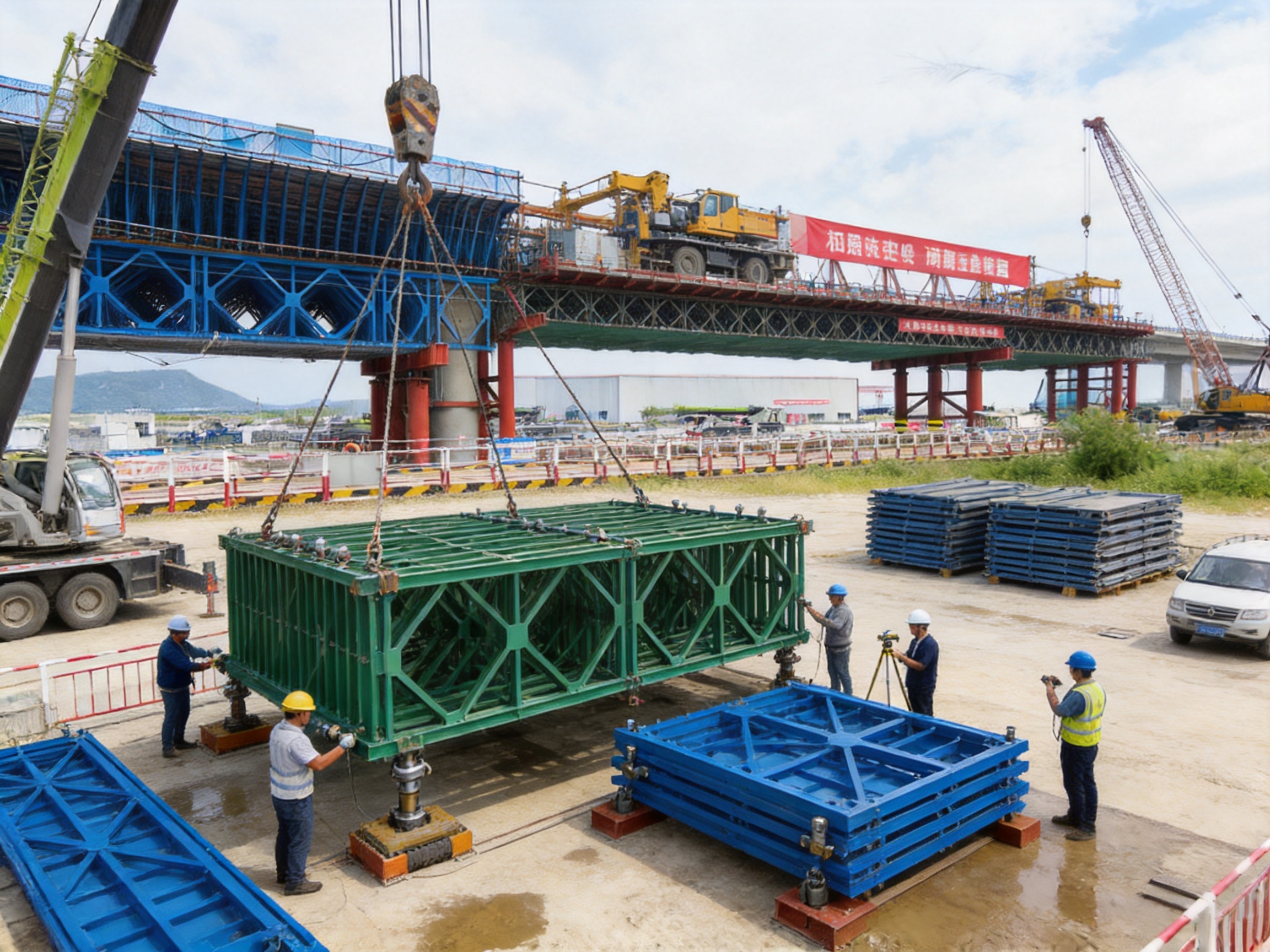
Large-span construction projects demand temporary support systems that can carry substantial loads, remain stable under changing site conditions, and be installed quickly without interrupting the overall construction schedule. Conventional temporary works often struggle when spans become longer, loads become heavier, or the site presents difficult outdoor conditions. A customized Bailey construction support system provides a practical response to these challenges by combining modular steel components, repeatable connections, adaptable geometry, and efficient manufacturing.
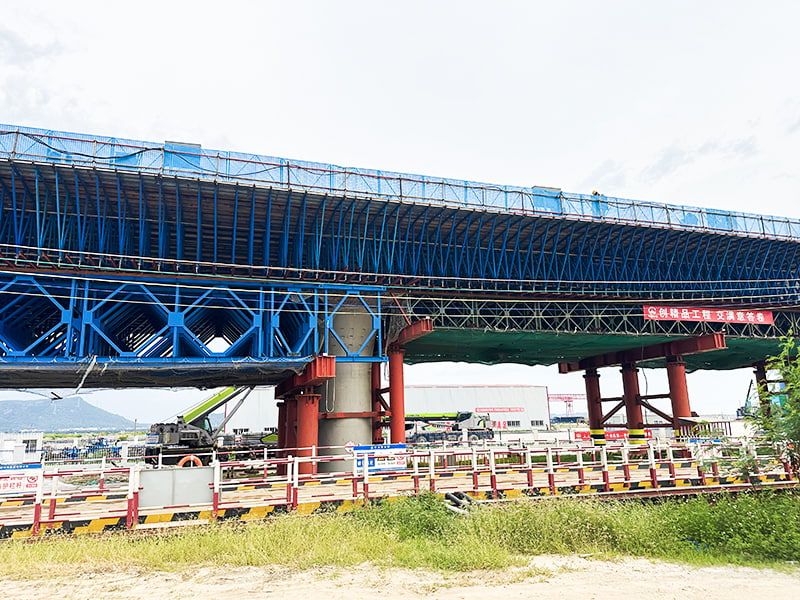
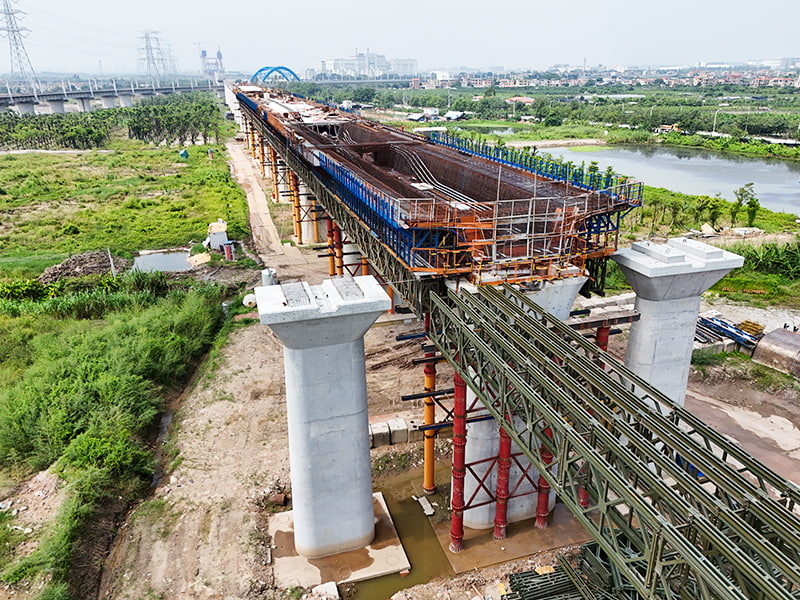
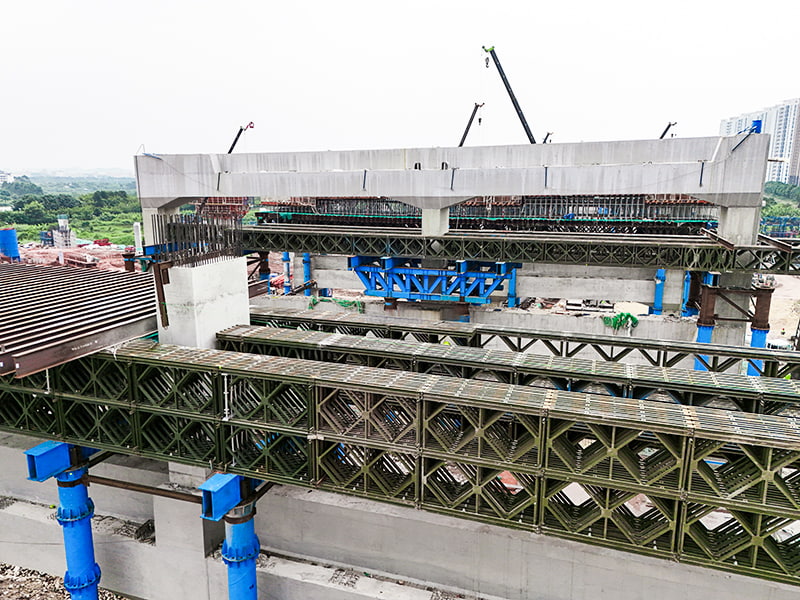
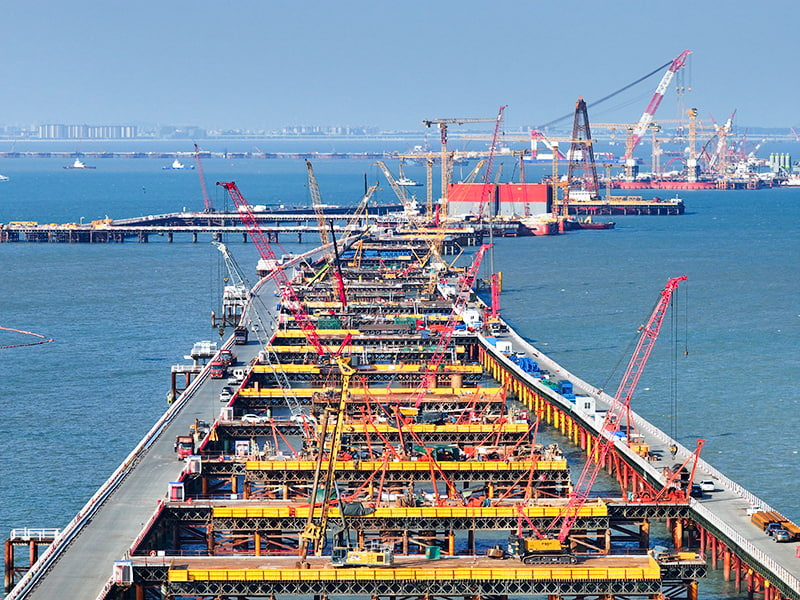
The customized large-span super Bailey construction support supplied for the Zhangzhou Dongshan Project was developed for demanding heavy-load construction applications. It features specially crafted Bailey panels measuring 3 meters by 1 meter with green paint and 3 meters by 6 meters with blue paint. The clearly differentiated colors support fast component identification and improve onsite organization. At the same time, the system’s anti-corrosion coating is designed to protect the steel against rust and environmental deterioration during outdoor construction.
This type of support system is intended for large-span and heavy-load scenarios, including load-bearing conditions associated with HS-15, HS-20, HS-25, HL-93, and Track-50 applications. The final structural arrangement, loading capacity, connection details, and foundation requirements must always be confirmed through project-specific engineering calculations and site assessments. Within that framework, the modular configuration offers an efficient and reliable foundation for temporary construction support.
Unlike generic temporary steel frames, a customized Bailey support solution can be adapted to the actual span, loading condition, construction sequence, clearance requirement, and access limitations of a project. Its value is not limited to the steel panels themselves. The complete solution includes engineering coordination, component selection, fabrication, surface treatment, quality inspection, delivery planning, and technical support. These combined capabilities help contractors reduce uncertainty and maintain better control over schedule, safety, and cost.
Customized Large Span Super Bailey Construction Support
1. The Role of Bailey Construction Support in Modern Engineering
Construction support systems are temporary or semi-temporary structures used to transfer loads safely during the construction, repair, replacement, or expansion of permanent works. They may support formwork, beams, slabs, launching equipment, pipelines, access structures, temporary decks, or other components before the final structure becomes self-supporting. In many large projects, the temporary support system carries considerable loads and is exposed to weather, vibration, construction impact, and repeated assembly or adjustment.
A Bailey-based support system is particularly suitable for these conditions because it is formed from modular steel units that can be combined into different configurations. Standardized panels and connection components make it possible to create towers, frames, trestles, piers, longitudinal supports, or other load-bearing arrangements. The system can also be dismantled and reused after the construction stage, improving the value of the investment compared with one-time fabricated temporary works.
The modular principle is important when site conditions are not fully uniform. A project may require different support heights at different locations, additional bracing in selected bays, or a transition between short and long support segments. With a suitable engineering layout, Bailey components can be arranged to respond to those variations without redesigning an entirely new steel structure for every location.
For large-span work, the temporary system must do more than support vertical loads. It must also control lateral movement, resist wind and construction-induced vibration, accommodate erection tolerances, and maintain safe working clearances. A well-designed Bailey support arrangement therefore includes more than panels. It may include bracing, connection hardware, bearing components, base plates, adjustable elements, working platforms, access provisions, and other project-specific steel accessories.
1.1 Typical Construction Applications
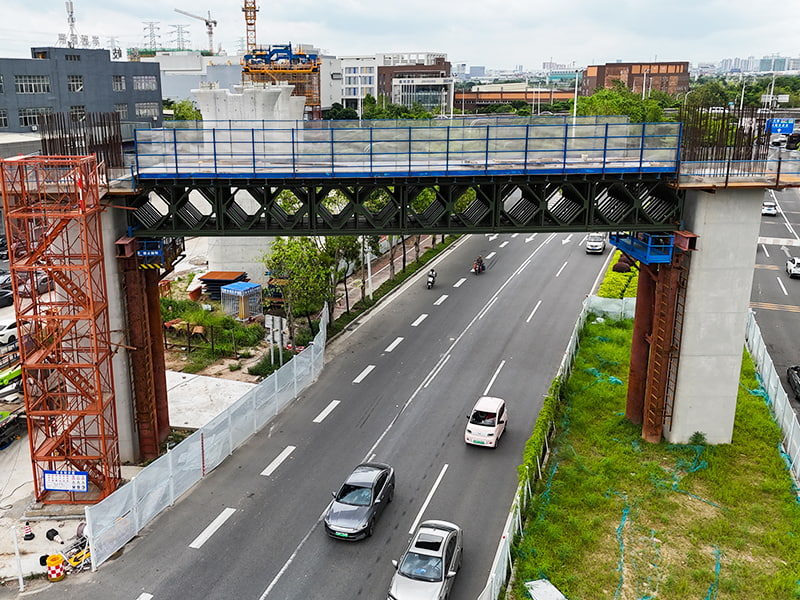
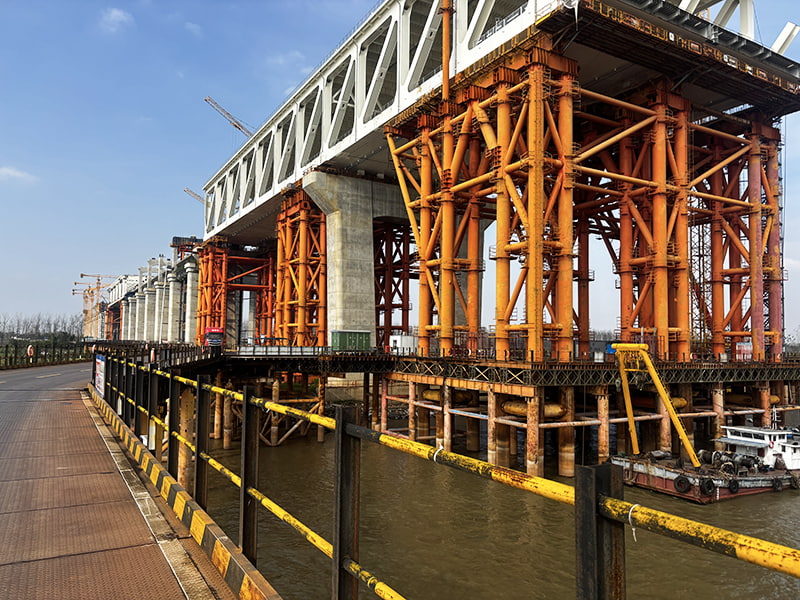
Customized Bailey construction support can be used in a wide range of civil and industrial applications. These include temporary support for bridge construction, elevated road structures, railway works, water conservancy projects, pipeline crossings, marine and coastal engineering, industrial plant construction, and emergency access or restoration work.
In bridge construction, the system may support girders, deck formwork, launching operations, or temporary access routes. In water conservancy projects, it can provide support across channels, excavation areas, or difficult ground conditions. For modular pipe bridge applications, the same engineering principles can be applied to create a temporary or permanent support arrangement for pipelines and utility services.
The system is also relevant to projects where transportation and access are restricted. Components can be manufactured in manageable modules, transported to the worksite, and assembled using common lifting and connection methods. This can be especially valuable in remote locations, congested urban areas, industrial sites, and emergency construction environments where large monolithic frames are difficult to move or install.
1.2 Temporary Does Not Mean Low-Performance
Temporary structures are sometimes incorrectly treated as secondary elements. In reality, their failure can interrupt the entire construction process and create serious safety consequences. A temporary support system must be designed and managed with the same discipline applied to other load-bearing structures. Material quality, welding integrity, connection fit, corrosion protection, geometry, erection sequence, and inspection all influence performance.
The customized Bailey support system addresses this need through a combination of engineered modularity and industrial production. Rather than relying solely on improvised site fabrication, the principal components are manufactured under controlled conditions. This improves dimensional consistency and reduces the likelihood of incompatible parts, irregular welds, or uncertain material quality.
2. Product Configuration for Large-Span Heavy-Load Support
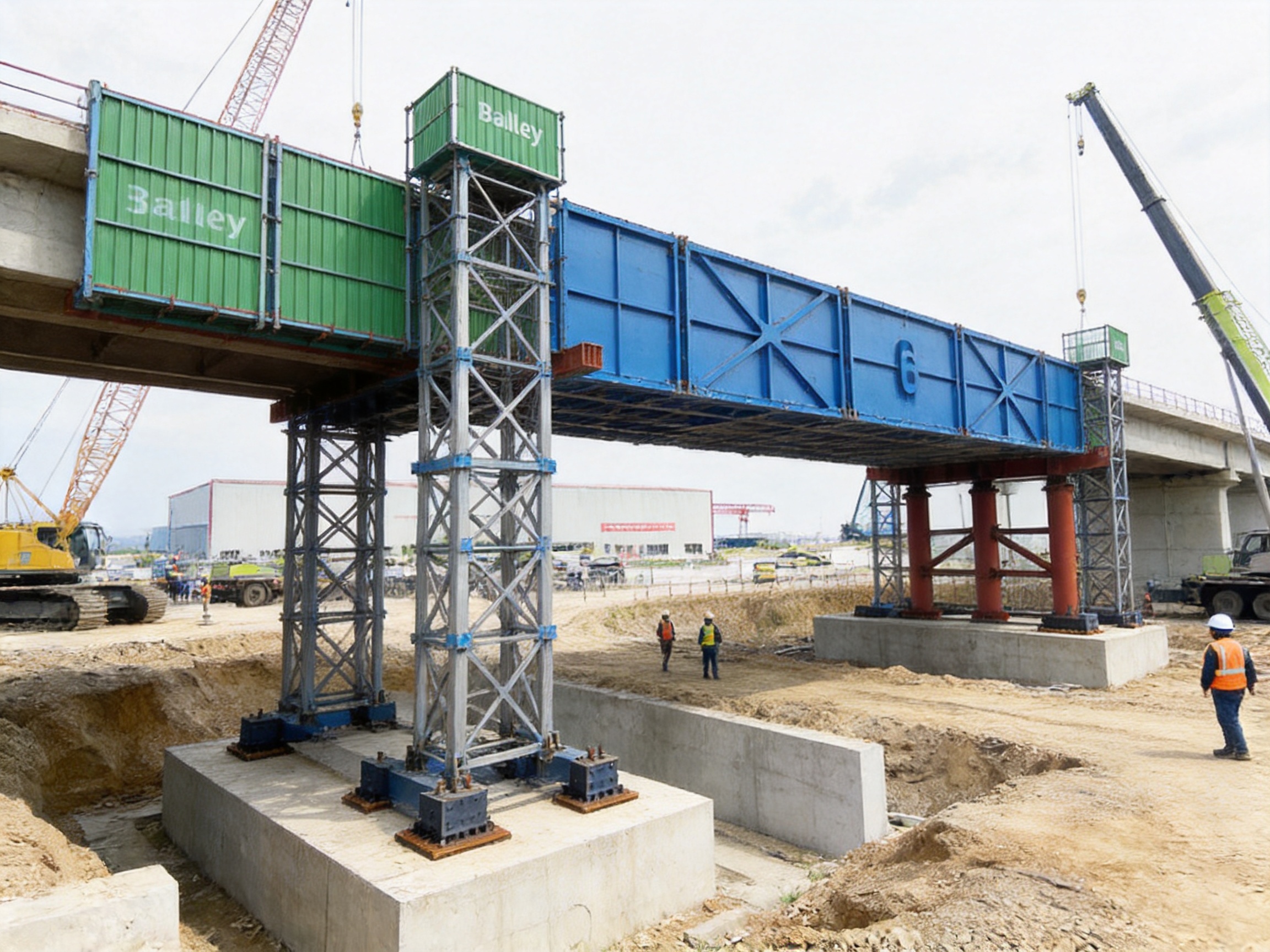
The Zhangzhou Dongshan Project required a support system tailored to large-span and heavy-load conditions. The supplied solution included specially crafted Bailey panels in two principal dimensions: 3 meters by 1 meter panels with green paint and 3 meters by 6 meters panels with blue paint. The differentiated panel format and color scheme provide both structural and operational benefits.
The 3-meter by 1-meter green panels can be used where a more compact modular arrangement, local reinforcement, or specific support geometry is required. The 3-meter by 6-meter blue panels provide a larger structural module for long-span arrangements and broader support zones. The actual application of each panel type depends on the approved design, loading arrangement, erection sequence, and connection configuration.
Color coding is more than a visual feature. On a busy construction site, components may be delivered in large quantities and moved between storage, assembly, and erection areas. A clear color distinction helps workers identify the correct module quickly, reduces handling confusion, and supports inventory control. It can also make inspection records easier to organize by helping teams associate a component type with a particular location or assembly stage.
The color system may be combined with component markings, batch identification, inspection labels, and erection drawings. These measures support traceability from factory production to final installation. They also help site supervisors verify that the correct components have been delivered and that the planned support configuration is being followed.
| Product Feature | Application Value | Project Benefit |
|---|---|---|
| 3 m × 1 m green Bailey panels | Compact modular support and localized configuration | Improved flexibility for varying support geometry |
| 3 m × 6 m blue Bailey panels | Large modular support for long-span arrangements | Faster assembly across broad support zones |
| Color-differentiated components | Quick visual identification during storage and erection | Better onsite organization and reduced handling errors |
| Anti-corrosion coating | Protection against outdoor exposure and moisture | Improved durability and longer service life |
| Modular steel construction | Assembly, dismantling, relocation, and reuse | Lower lifecycle cost and greater project adaptability |
| Customized configuration | Adaptation to span, load, clearance, and site conditions | More effective performance than one-size-fits-all support |
2.1 Load Scenario Compatibility
The support system is suitable for load-bearing scenarios such as HS-15, HS-20, HS-25, HL-93, and Track-50. These designations represent different vehicle or rail-related loading concepts used in structural planning. They should not be interpreted as automatic approval for every possible arrangement. Actual capacity depends on span length, support spacing, panel configuration, bracing, connection condition, foundation stability, load distribution, dynamic effects, and the construction stage.
For that reason, the system should be selected and installed according to project-specific design documentation. A responsible engineering process considers the most unfavorable combination of permanent loads, temporary construction loads, equipment loads, impact effects, wind, uneven settlement, and other relevant actions. The modular system provides the physical building blocks, while engineering analysis determines how those blocks should be assembled and restrained.
This distinction is one of the key advantages of working with an experienced manufacturer. A supplier with engineering and fabrication capabilities can communicate more effectively about panel arrangements, bracing requirements, connection details, fabrication tolerances, and practical erection limitations. This reduces the gap between a theoretical design and the actual product delivered to the site.
3. Advantages Over Conventional and Generic Support Systems
3.1 Better Adaptation to Project Requirements
Generic support frames are usually produced around a fixed arrangement. They may be suitable for repeated standard spans, but they can become inefficient when a project includes varying elevations, irregular obstacles, nonstandard clearances, or unusual loading. A customized Bailey support system can be configured around the specific conditions of the project rather than forcing the project to adapt to a fixed product.
Customization may involve the panel dimensions, support spacing, connection details, bracing layout, working clearance, surface treatment, component labeling, and delivery sequence. The system can be planned to match the construction method and the order in which the contractor intends to build, load, inspect, and dismantle the temporary works.
This flexibility is especially useful for large-span applications. A longer span creates greater demands on stiffness, stability, deflection control, and erection accuracy. By using larger modules where appropriate and reinforcing selected areas with compact panels or additional bracing, the support arrangement can be optimized for the actual structural demand.
3.2 Faster Installation and Construction Progress
Construction schedules are strongly influenced by the time required to prepare temporary works. Site-welded frames and individually fabricated members can require extensive cutting, fitting, welding, inspection, and correction at the worksite. These activities are affected by weather, access, power availability, worker skill, and the presence of other contractors.
Modular Bailey components shift much of the fabrication work into a controlled factory environment. Onsite teams can focus on positioning, bolting, bracing, alignment, and inspection rather than creating every component from raw steel. This can shorten the support installation period and help the main construction activity begin earlier.
Faster assembly does not mean that inspection should be reduced. Instead, modular production makes it possible to use repeatable installation procedures and predefined inspection points. When the erection sequence is carefully planned, color identification and standardized components further improve worksite coordination.
3.3 Reusability and Lifecycle Economy
A major advantage of modular steel support is its potential for repeated use. After a project is completed, the structure can be dismantled, inspected, repaired where necessary, stored, and redeployed on another project. This contrasts with temporary works fabricated for one location and then cut apart or discarded.
Reusability depends on proper handling and maintenance. Components must not be overloaded beyond their design parameters, damaged during lifting, modified without approval, or stored in conditions that cause severe corrosion. With appropriate management, however, modular Bailey equipment can serve multiple projects over an extended period.
The economic benefit includes more than material reuse. Standardized components reduce the number of unique spare parts, simplify training, and make future planning easier. Contractors can develop internal erection procedures around familiar components and maintain a more predictable inventory of temporary works equipment.
3.4 Improved Site Management Through Color Coding
The green and blue coating scheme used for the customized panels offers an operational advantage that is often overlooked. When large quantities of steel parts are stored on a crowded site, visual identification can save time and prevent incorrect selection. Workers can distinguish the two panel categories before checking detailed markings or drawings.
Color coding also supports communication between engineering, warehouse, transport, and erection teams. A delivery schedule may identify the required green or blue modules for each stage. Site supervisors can quickly compare delivered components against the planned bill of materials. During dismantling, color-based separation helps organize components for transport and future reuse.
3.5 Stronger Protection in Outdoor Environments
Temporary support systems are often exposed to rain, humidity, dust, salt-laden air, sunlight, and construction contaminants. Corrosion can reduce section thickness, damage connection areas, make inspection more difficult, and shorten the useful life of steel components. The exclusive anti-corrosion coating applied to the customized system is intended to improve resistance to rust and corrosion in complex outdoor construction environments.
A protective coating also improves the visual condition of the structure. A clean and consistent surface makes cracks, deformation, coating damage, and other abnormalities easier to identify during inspection. This is particularly important when components are used repeatedly and require condition assessment before every new deployment.
Coating performance depends on surface preparation, application conditions, film thickness, curing, transport handling, and subsequent maintenance. A quality-oriented manufacturing process therefore treats coating as an engineered production stage rather than a final decorative operation.
3.6 More Reliable Quality Than Improvised Site Fabrication
Improvised temporary works may vary significantly from one location to another. Differences in steel grade, welding quality, hole alignment, member straightness, and connection hardware can create uncertainty. Factory-produced modular components provide more consistent geometry and repeatable manufacturing controls.
Standardized production also makes it easier to establish inspection records. Material certificates, welding inspections, dimensional checks, coating records, and final assembly checks can be associated with defined production batches. This documentation supports project quality management and helps the contractor demonstrate that the delivered equipment matches the approved specification.
4. Advanced Manufacturing Process
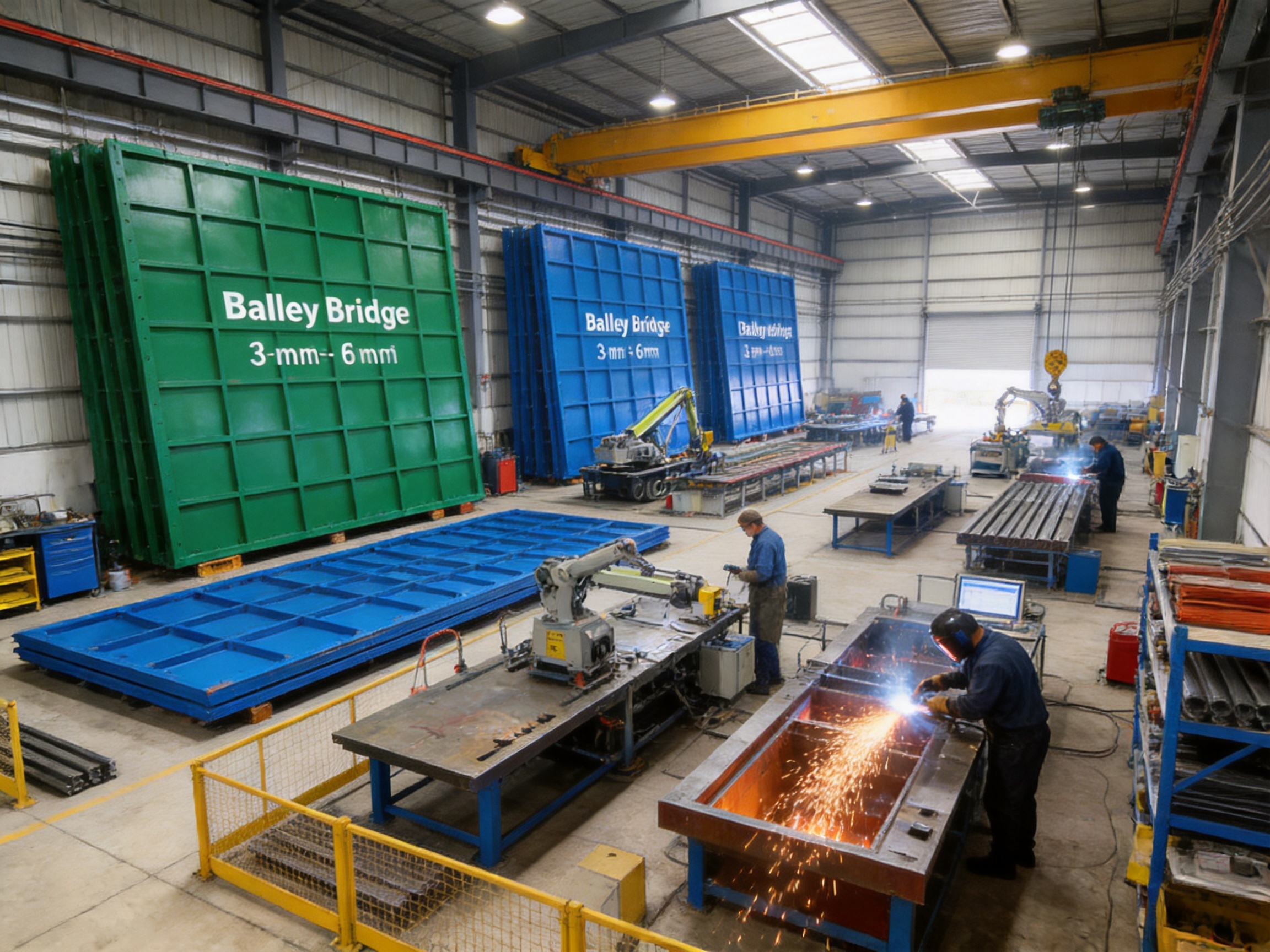
The performance of a Bailey construction support system depends heavily on how the steel components are manufactured. A robust process begins with engineering review and material planning, continues through precision fabrication and welding, and ends with surface treatment, inspection, packaging, and delivery. Jiangsu Zhonghai Bridge Equipment Co., Ltd. integrates engineering design, precision manufacturing, quality management, and onsite support within one service structure.
4.1 Engineering Design and Production Preparation
Before fabrication begins, project information is reviewed to identify span requirements, load scenarios, panel dimensions, bracing arrangements, support reactions, foundation conditions, access constraints, and erection sequence. The engineering team can then prepare drawings, bills of materials, component schedules, and production instructions.
Production preparation is essential for customized projects because the system may include both standard and specially crafted elements. The 3-meter by 1-meter green panels and 3-meter by 6-meter blue panels must be coordinated with connection details, handling requirements, and the overall support arrangement. This coordination reduces the risk of producing components that are difficult to assemble or incompatible with the planned structure.
Digital drawing review and standardized production documentation can improve communication between design, procurement, fabrication, inspection, and site teams. Any project-specific changes should be recorded and approved before the affected components enter production.
4.2 Material Selection and Traceability
Structural steel must be selected according to the design requirements, applicable specifications, environmental exposure, and intended reuse. Material procurement should include verification of grade, thickness, mechanical properties, and relevant quality documentation.
Traceability allows the manufacturer to associate raw material with fabricated components. This can be achieved through batch records, identification marks, production logs, and inspection documentation. Traceability is particularly valuable for modular products because components may be delivered in separate batches and used on multiple projects over time.
Proper storage of steel before fabrication is also important. Materials should be protected from unnecessary moisture accumulation, contamination, deformation, and confusion between grades or dimensions. Organized material handling supports both product quality and production efficiency.
4.3 Automated Cutting and Precision Preparation
Accurate cutting and preparation are necessary for proper panel geometry and reliable connection performance. Automated production equipment can improve repeatability when processing plates, angles, channels, stiffeners, and other steel components. Consistent dimensions help ensure that holes, welds, and adjoining members align as shown in the engineering drawings.
Precision preparation also reduces the amount of corrective work required during assembly. When components fit together accurately, workers spend less time forcing connections into position, enlarging holes, adjusting misaligned members, or making unplanned site modifications. This improves both productivity and structural quality.
4.4 Automated and Controlled Welding
Welding is one of the most important stages in the production of modular steel panels. Weld size, penetration, continuity, alignment, heat input, and sequence can influence the strength and durability of the finished component. Automated welding and controlled welding procedures help create more uniform results than irregular manual fabrication performed under changing site conditions.
Automated welding is especially useful for repeated panel components. Once the appropriate parameters and fixtures are established, multiple units can be produced with consistent weld placement and geometry. Skilled personnel remain necessary for setup, monitoring, inspection, repair, and areas that cannot be processed automatically.
Welded assemblies should be inspected in accordance with the approved quality plan. Depending on the component and project requirements, inspection may include visual examination, dimensional checks, and non-destructive testing. Any weld repair should be controlled and documented so that the finished component remains compliant with the design intent.
4.5 Assembly Fixtures and Dimensional Control
Fixtures help hold components in the correct position during fabrication and welding. They reduce distortion and support repeatable geometry across a production batch. For Bailey panels, accurate control of overall dimensions, connection points, hole positions, and member alignment is essential because small deviations can accumulate during long-span assembly.
Dimensional inspection should verify critical features before coating. This may include panel length and width, diagonal measurements, connection-hole alignment, member straightness, weld appearance, and the position of stiffeners or bracing attachments. Early correction is more efficient than attempting to modify coated or fully assembled components later.
4.6 Surface Preparation and Anti-Corrosion Coating
Coating quality begins with surface preparation. Oil, mill scale, rust, moisture, dust, and other contaminants must be controlled before primer or protective layers are applied. A properly prepared surface allows the coating to bond more effectively and reduces the risk of premature peeling or under-film corrosion.
The coating system should be selected according to the expected environment and project requirements. The green and blue colors serve a practical identification purpose while also forming part of the protective finish. Application should be performed under controlled conditions, with attention to temperature, humidity, surface cleanliness, wet-film thickness, dry-film thickness, curing time, and handling protection.
Inspection of the finished coating may include visual checks, color verification, thickness measurement, and identification of holidays, runs, pinholes, or damaged areas. Coated components should be handled carefully during loading and transport to avoid exposing bare steel or damaging edges and connection surfaces.
4.7 Final Inspection, Packing, and Delivery
Before dispatch, the manufacturer should verify the quantity, dimensions, markings, coating condition, connection hardware, and packaging arrangement. Components should be grouped in a way that supports efficient unloading and erection at the site. Color-based grouping can make it easier for the contractor to identify the required panels for each construction stage.
Packaging must protect components from deformation, impact, excessive moisture, and loss of small accessories. Bolts, nuts, washers, pins, and other connection items should be labeled and packed according to the erection plan. Clear documentation helps the receiving team compare the shipment with the packing list and report any issue promptly.
5. Quality Management and Engineering Support
A large-span support system is only as dependable as the quality controls applied throughout its lifecycle. Quality management begins with design review and continues through procurement, production, inspection, transport, erection, use, dismantling, and storage. Jiangsu Zhonghai Bridge Equipment Co., Ltd. combines manufacturing capacity with engineering and onsite support to address these stages as part of an integrated service.
5.1 Factory Quality Controls
Factory controls may include incoming material inspection, production traveler records, welding procedure management, operator qualification, dimensional inspection, coating inspection, and final release approval. These controls reduce variation and provide evidence that components have been manufactured according to the applicable drawings and specifications.
Quality documentation is particularly useful for international infrastructure and emergency response projects, where the equipment may need to satisfy different contract requirements. The company’s production approach is intended to support products manufactured in accordance with ASTM, EN, and applicable national specifications, subject to the requirements of the individual project.
5.2 Engineering Review of the Support Arrangement
The support arrangement should be reviewed as a complete structural system rather than as a collection of individual panels. Important considerations include vertical load paths, lateral restraint, bracing, bearing conditions, foundation capacity, settlement, connection behavior, erection stability, and removal sequence.
For large spans, deflection and stability may be as important as ultimate strength. Excessive movement can affect the permanent structure being built, interfere with formwork, create uneven load distribution, or make alignment difficult. The design should establish acceptable movement criteria and identify the monitoring or adjustment procedures required during construction.
Environmental conditions also require attention. Wind, rain, flooding, temperature change, nearby traffic, equipment vibration, and accidental impact may affect the temporary structure. The appropriate response could include additional bracing, protective barriers, load restrictions, inspection frequency, or changes to the erection sequence.
5.3 Onsite Erection Support
Even a well-manufactured system can perform poorly if assembled incorrectly. Erection should follow approved drawings and method statements. The site team should confirm the foundation and bearing conditions, check component identity, verify connections, install bracing as the structure rises, and inspect the completed arrangement before loading.
Technical support from the manufacturer can help resolve practical questions concerning panel orientation, connection hardware, handling points, bracing interfaces, and component sequence. Early communication is preferable to unapproved field modification. Cutting, drilling, welding, or heating modular components at the site can affect structural performance and corrosion protection and should not be performed without engineering authorization.
5.4 Inspection During Use
The completed support structure should be inspected before loading and at appropriate intervals during use. Inspection points may include panel deformation, damaged coating, loose or missing connection hardware, unusual movement, settlement, bracing condition, bearing alignment, and evidence of impact or overload.
After severe weather, accidental contact, unexpected vibration, or a change in loading, an additional inspection should be conducted. Records should identify the inspection date, responsible person, observed condition, corrective action, and release status. These procedures are especially important when the support system carries heavy equipment or supports critical construction stages.
6. Installation and Project Execution Considerations
6.1 Pre-Installation Planning
Before components arrive, the contractor should prepare a site logistics plan. The plan should identify delivery access, unloading locations, temporary storage areas, lifting equipment, assembly zones, exclusion zones, worker access, and emergency routes. A clean logistics plan reduces double handling and prevents components from being placed where they obstruct other construction activities.
The foundation or support surface must be checked for level, strength, drainage, and stability. Temporary supports can transfer substantial concentrated reactions, and a foundation that appears adequate for ordinary site traffic may not be suitable for a large-span load-bearing arrangement. Bearing plates, grillages, concrete pads, or other measures may be required according to the engineering design.
6.2 Component Verification
Upon delivery, the site team should inspect the shipment for damage, missing items, incorrect quantities, and coating defects. The green 3-meter by 1-meter panels and blue 3-meter by 6-meter panels should be separated and matched with the approved component schedule. Markings and documentation should be checked before assembly begins.
Any damaged component should be isolated for assessment. A dent, bent member, enlarged hole, cracked weld, or severe coating loss may affect performance. Repairs should be completed through an approved procedure rather than improvised at the worksite.
6.3 Safe Assembly Sequence
The erection method depends on the final configuration, available lifting equipment, access conditions, and project schedule. Components may be assembled on the ground and lifted into position or erected progressively at the support location. In either case, temporary stability must be maintained at every stage.
Connections should be installed with the specified hardware and tightened according to the approved procedure. Bracing should not be treated as an optional accessory because it controls lateral stability and helps the system behave as intended. The erection team should also verify that panels are correctly oriented and that no connection is forced into place through unapproved deformation.
6.4 Loading and Use
The support system should not be loaded until the structure, connections, bracing, bearings, and foundation have been inspected and accepted. Loads should be applied in the sequence assumed by the design. Sudden impact, eccentric loading, concentrated storage, or unplanned equipment movement can create conditions that differ substantially from the original analysis.
Where construction activity changes over time, the support arrangement should be reassessed. For example, the removal of a brace, the relocation of equipment, the addition of stored materials, or a change in permanent structural stiffness may alter load paths. Project controls should ensure that changes are reviewed before they are implemented.
6.5 Dismantling and Reuse
Dismantling should be planned with the same care as erection. Loads must be removed in the correct sequence, and no component should be released while it is still carrying an unplanned reaction. Once dismantled, panels and accessories should be inspected, cleaned, sorted by type, and protected for storage.
Reusable components should be recorded in an inventory system. The record may include panel type, color, dimensions, identification number, inspection status, repair history, and storage location. This information supports efficient redeployment and helps ensure that damaged or unsuitable components are not returned to service.
7. Why Integrated Manufacturing Strength Matters
A supplier’s ability to provide steel products is important, but a supplier’s ability to integrate design, production, quality, and support is even more valuable for customized construction systems. Jiangsu Zhonghai Bridge Equipment Co., Ltd. operates as an engineering and manufacturing partner rather than only a component trader.
The company’s production capabilities include modular steel bridges, Bailey bridge systems, customized steel components, bridge erection and construction support equipment, automated welding, and precision steel fabrication. This range allows related items to be coordinated under one technical framework. It also enables the manufacturer to understand how individual components will function within a larger structure.
Industrial-scale manufacturing capacity supports more consistent delivery for projects that require numerous repeated components. Standardized workflows can improve production planning, reduce avoidable variation, and make inspection more systematic. At the same time, engineering flexibility allows the company to adapt the modular product to project-specific requirements.
The company’s location in Zhenjiang, Jiangsu Province, provides access to an important industrial and transportation region. Its experience includes engineering projects involving coastal conditions, temporary access bridges, railway-related structures, exhibition-center components, multi-span Bailey bridges, flood response, and emergency bridge deployment. These project categories require different combinations of speed, durability, modularity, and logistical coordination.
International delivery performance is also relevant to large infrastructure work. Export projects may involve different standards, shipping constraints, documentation requirements, climates, and installation practices. A manufacturer accustomed to international project coordination can help reduce communication gaps and prepare components for transport, storage, and installation in different environments.
8. Application Value for Contractors and Project Owners
8.1 Schedule Control
For project owners and general contractors, the temporary support system is closely connected with the critical path. Delays in support fabrication or erection can postpone permanent construction activities. Factory production, modular assembly, and organized delivery help improve schedule predictability.
The customized system supports schedule control by allowing the contractor to define the required modules and erection sequence in advance. Color-coded components can be dispatched in stages, reducing congestion and ensuring that the correct materials are available when needed.
8.2 Safety and Risk Reduction
Safety is improved when temporary works are designed, manufactured, and installed systematically. Consistent components reduce uncertainty, while clear markings and documented procedures help workers follow the approved arrangement. Anti-corrosion protection also supports long-term condition visibility and reduces deterioration-related risks.
No modular product eliminates the need for competent engineering and safe working procedures. However, a professionally manufactured system can reduce risks associated with improvised materials, uncontrolled site welding, incompatible components, and poor dimensional accuracy.
8.3 Cost Efficiency
The economic value of a Bailey support system comes from the balance of purchase cost, installation time, labor requirements, reuse potential, maintenance, and project delay risk. A system that costs less to purchase but requires extensive site modification may not be the lowest-cost option overall. Similarly, a high-quality modular system may provide better lifecycle value when it can be reused on several projects.
Faster assembly can reduce labor and equipment occupancy. Reusable steel components can spread the initial investment across multiple projects. Better corrosion protection can reduce repair requirements. Standardized accessories can simplify spare-parts management. These factors should be evaluated together rather than by comparing only the initial material price.
8.4 Support for Complex Environments
Coastal construction, flood-prone areas, humid regions, and outdoor industrial sites expose temporary structures to severe conditions. The anti-corrosion coating and modular design are especially valuable in these environments. If the project involves marine influence or extended exposure, the coating specification, inspection frequency, drainage, and maintenance plan should be confirmed during design.
In emergency response and disaster-relief projects, speed and adaptability are often decisive. Modular panels can be transported, assembled, and adjusted more efficiently than fully custom-built frames. The same features that support planned infrastructure projects can therefore help restore access after flooding, storms, or other disruptive events.
9. Comparative Evaluation of Support Options
Different temporary support methods may be appropriate for different projects. The correct choice depends on span, load, duration, site access, available equipment, environmental conditions, and the need for reuse. The following comparison highlights the practical position of customized Bailey construction support.
| Evaluation Factor | Customized Bailey Support | Improvised Site-Fabricated Frame | Fixed Conventional Temporary Structure |
|---|---|---|---|
| Adaptability | High, because modules can be configured for project conditions | Variable and dependent on site workmanship | Moderate to low when site conditions differ from the original design |
| Fabrication control | Factory-based and repeatable | Often distributed across the worksite | Usually controlled but may require extensive project-specific fabrication |
| Installation speed | Generally efficient after components arrive | Can be slow because of cutting and fitting | Depends on size, transport, and lifting requirements |
| Reusability | High when inspected and maintained properly | Often limited | May be limited by its fixed geometry |
| Color and inventory control | Can be incorporated through coded panels and markings | Usually inconsistent | Depends on the supplier’s system |
| Outdoor durability | Supported by specified anti-corrosion coating | Highly dependent on field treatment | Depends on material and coating specification |
| Large-span suitability | Can be engineered through modular panel and bracing arrangements | Requires extensive project-specific fabrication | May require heavy transportation and specialized erection |
This comparison does not mean that one system is suitable for every site. Instead, it shows why a customized modular solution can offer a strong balance of flexibility, manufacturing consistency, erection speed, and lifecycle value. The final selection should be based on verified structural calculations and the contractor’s construction method.
10. Recommended Technical Documentation
For a professional project, the equipment should be accompanied by documentation appropriate to the contract and application. Typical documents may include general arrangement drawings, component drawings, material records, welding and inspection records, coating information, packing lists, erection instructions, connection details, and maintenance recommendations.
The design package should identify the intended load scenario, maximum permitted loads, support reactions, bracing requirements, foundation assumptions, allowable construction stages, inspection points, and restrictions on modification. If the support system is to be reused, a condition assessment form and inspection record can be included for future deployments.
Clear documentation is particularly important when the system is delivered internationally or installed by a contractor that was not involved in the original design. Drawings should use consistent dimensions, component names, color references, and identification codes. This reduces interpretation errors and supports efficient communication among project participants.
11. Maintenance and Long-Term Service Life
Anti-corrosion coating can significantly improve the service life of steel support components, but it is not a substitute for maintenance. The coating should be checked after transport, assembly, use, and dismantling. Scratches, impact damage, exposed steel, blistering, peeling, and corrosion around connections should be recorded and repaired through an approved procedure.
Components should be cleaned before storage, especially when exposed to mud, salt, chemicals, concrete residue, or industrial dust. Storage areas should provide drainage and ventilation and should prevent direct contact with standing water. Panels should be stacked securely to avoid bending, distortion, or unsafe access conditions.
Bolts, pins, washers, and other accessories should be inspected separately. Missing or deformed connection hardware should be replaced with approved parts. Reusing unsuitable hardware can compromise the connection even when the main panels remain in good condition.
A maintenance program should also track the number of deployments and any unusual loading or impact events. This information helps determine when more detailed inspection or engineering review is necessary. A modular system achieves its greatest value when its condition is actively managed throughout its service life.
12. Questions and Answers
What is a Bailey construction support system?
A Bailey construction support system is a modular steel arrangement made from interconnected panels and associated components. It can be configured to support construction loads, temporary decks, formwork, equipment, pipelines, bridge elements, or other structures. Its modular design allows the system to be assembled, adjusted, dismantled, and reused.
What makes the Zhangzhou Dongshan Project system customized?
The system was developed for the project’s large-span and heavy-load requirements and included specially crafted 3-meter by 1-meter green panels and 3-meter by 6-meter blue panels. The panel dimensions, color identification, anti-corrosion finish, and overall support arrangement were selected to meet the project’s construction and management needs.
Why are the panels painted green and blue?
The colors provide visual differentiation between panel types. This helps workers identify components during delivery, storage, assembly, inspection, and dismantling. Color coding can improve onsite management, reduce selection errors, and support inventory control when combined with component markings and drawings.
Can the system support HS-15, HS-20, HS-25, HL-93, and Track-50 scenarios?
The system is suitable for load-bearing scenarios associated with these designations, but the exact capacity and configuration must be confirmed by project-specific engineering analysis. Span, bracing, support spacing, foundation conditions, load distribution, dynamic effects, and erection stage all influence the final allowable load.
Is the Bailey support system suitable for large spans?
Yes, it is intended for large-span applications when properly configured and engineered. Large spans require careful consideration of stiffness, deflection, lateral stability, connection behavior, bracing, bearing conditions, and foundation reactions. The use of larger modules together with appropriate reinforcement can support efficient long-span arrangements.
What is the purpose of the anti-corrosion coating?
The coating protects the steel against rust and corrosion caused by outdoor exposure, moisture, humidity, dust, and other environmental factors. The green and blue finishes also support component identification. Coating condition should still be inspected and maintained throughout transport, installation, use, dismantling, and storage.
Can the components be reused on other projects?
Yes, modular steel components are intended to support reuse when they remain within acceptable condition and are suitable for the next project’s design requirements. Before reuse, each component should be inspected for deformation, cracked welds, damaged connections, corrosion, coating failure, and other defects.
How does factory manufacturing improve the product?
Factory manufacturing provides better control over materials, cutting, welding, assembly fixtures, dimensions, surface preparation, coating, and inspection. Automated and standardized processes can improve repeatability and reduce the amount of corrective work required onsite. Factory records also support traceability and quality management.
Can the system be modified at the construction site?
Unapproved cutting, drilling, welding, heating, or other modification should be avoided. Any required change must be reviewed and authorized by the responsible engineer or manufacturer because modifications can affect strength, stability, connection performance, and corrosion protection.
What information is needed to design a customized support system?
Important information includes span length, support elevations, load cases, construction sequence, equipment loads, clearance requirements, foundation conditions, environmental exposure, site access, erection equipment, project standards, and expected service duration. Accurate information allows the manufacturer and engineering team to prepare a practical and reliable configuration.
How should the system be inspected before use?
The inspection should verify panel identity, dimensions, connection hardware, bolt or pin installation, bracing, bearing alignment, foundation condition, coating damage, deformation, and overall geometry. The support should not be loaded until it has been inspected and accepted according to the project’s quality and safety procedures.
Why choose an integrated manufacturer instead of a component reseller?
An integrated manufacturer can coordinate engineering, fabrication, inspection, coating, packaging, delivery, and technical support. This improves communication and helps ensure that the components supplied are compatible with the planned structure. It also provides a clearer route for resolving technical questions or changes during the project.
13. Conclusion
The customized large-span super Bailey construction support system provides a strong combination of modular flexibility, heavy-load capability, manufacturing consistency, corrosion protection, and construction efficiency. Developed for the Zhangzhou Dongshan Project, the system uses specially crafted 3-meter by 1-meter green panels and 3-meter by 6-meter blue panels to meet demanding support requirements while improving onsite organization.
Its advantages over generic or improvised support systems include faster assembly, better component identification, improved adaptability, potential for repeated use, controlled factory production, and protection against challenging outdoor conditions. These benefits are particularly valuable when projects require long spans, substantial temporary loads, tight schedules, difficult access, or dependable reuse.
The performance of the system depends on more than the panels themselves. Project-specific engineering, correct foundation preparation, proper bracing, approved erection procedures, inspection, maintenance, and disciplined loading are essential. When these requirements are combined with precision manufacturing and technical support, the Bailey system can provide a safe and efficient temporary works solution for bridge construction, industrial projects, water conservancy, pipeline support, emergency access, and other infrastructure applications.
Jiangsu Zhonghai Bridge Equipment Co., Ltd. supports this product approach through integrated design, precision steel fabrication, automated welding, standardized quality management, protective coating, international project coordination, and onsite technical assistance. Its broader experience in modular bridges, Bailey systems, structural components, emergency deployments, and construction support equipment enables it to serve as an engineering partner for complex projects rather than merely a source of steel components.
For contractors and project owners seeking reliable large-span temporary support, a customized modular system offers a practical balance between structural performance, installation speed, durability, and lifecycle economy. With the correct design and management, it can help accelerate construction while maintaining the stability and reliability required by modern infrastructure work.
References
American Association of State Highway and Transportation Officials. Load and Resistance Factor Design Bridge Specifications.
European Committee for Standardization. Eurocode 3: Design of Steel Structures.
American Institute of Steel Construction. Specification for Structural Steel Buildings.
International Organization for Standardization. Quality Management Systems: Requirements.
International Organization for Standardization. Corrosion Protection of Steel Structures by Protective Paint Systems.
Occupational safety guidance for temporary works, lifting operations, structural steel erection, and construction-site inspection.
Project-specific engineering drawings, load calculations, erection procedures, inspection records, and coating specifications for the Zhangzhou Dongshan Project.
Product: Customized Large Span Super Bailey Construction Support


We respond quickly to all international requests and provide technical support when needed.
Product Category
Bailey Bridge/Modular Bridge Modular Steel Bridge Pedestrian Bridge Modular Pipe Bridge Truss Bridge Steel StructureContact Us

+86-511-84522866
+86-13921582699

zhwm@zjql.com

Building 1,83#, dantu New Town, Yanjiang Road, Dantu District, Zhenjiang, Jiangsu, China
Copyright © Jiangsu Zhonghai Bridge Equipment Co., Ltd. All
Rights
Reserved
China bailey bridge for sale
bailey bridge supplier from china
