
 English
 русский
 Español
 Português


Guo Zhenyi — Customer Support and Installation Coordinator
Customized Corrosion-Resistant Steel Gangway Bridges for Mineral Logistics
Content
- 1 1. The Strategic Role of a Mineral Logistics Gangway Bridge
- 2 2. Customized Design for Complex Site Conditions
- 3 3. Corrosion Resistance in a Humid Dock Environment
- 4 4. Modular Steel Construction and Its Competitive Advantages
- 5 5. Advanced Manufacturing Processes
- 6 6. Company Engineering Strengths and International Project Experience
- 7 7. Installation and Site Erection Considerations
- 8 8. Lifecycle Maintenance and Operational Reliability
- 9 9. Advantages Over Conventional and Less Specialized Alternatives
- 10 10. Why the Solution Fits Mozambique’s Mineral Industry
- 11 11. Frequently Asked Questions
- 11.1 Q1: What is a customized steel gangway bridge?
- 11.2 Q2: What is the main purpose of this bridge in mineral logistics?
- 11.3 Q3: Why is corrosion protection important for a dock bridge?
- 11.4 Q4: Which load specifications are associated with this bridge?
- 11.5 Q5: Can the bridge be adapted to different spans and widths?
- 11.6 Q6: How does modular construction reduce project time?
- 11.7 Q7: Is a modular bridge suitable for permanent use?
- 11.8 Q8: What manufacturing technologies are used?
- 11.9 Q9: How can the bridge be transported to an international project site?
- 11.10 Q10: What should be inspected after installation?
- 11.11 Q11: Can components be replaced during maintenance?
- 11.12 Q12: What information is needed to develop a quotation or preliminary design?
- 12 12. Conclusion
- 13 References
- 14 Product: Customized Corrosion-Resistant Steel Gangway Bridge
Mineral logistics depends on reliable connections between extraction areas, storage yards, processing facilities, road networks, rail systems, and marine terminals. Where land-based transport routes meet docks, a bridge is more than a simple crossing structure. It becomes an essential part of the supply chain, supporting the movement of heavy vehicles, mineral loads, maintenance equipment, and operational personnel under demanding environmental conditions.
The customized corrosion-resistant steel gangway bridge developed for Mozambique’s mineral industry is designed for this exact purpose. Positioned as a dedicated trestle and approach bridge structure, it provides a dependable connection between land-based logistics operations and dock facilities. Its role is to support the frequent transfer of minerals between terrestrial and marine transport systems while maintaining structural stability in a humid, corrosive coastal environment.
This type of project requires more than standard steel fabrication. The bridge must be engineered around traffic loading, site geometry, installation conditions, corrosion exposure, maintenance requirements, and long-term operational continuity. It must also be adaptable enough to meet the specific requirements of the project owner, contractor, and site conditions. A modular steel bridge solution offers important advantages in this regard because its components can be engineered, manufactured, transported, assembled, and maintained through a coordinated process.
Jiangsu Zhonghai Bridge Equipment Co., Ltd. specializes in modular steel bridges, Bailey bridge systems, customized structural components, bridge erection equipment, and precision steel fabrication. Its engineering and manufacturing capabilities support projects in transportation, water conservancy, military logistics, disaster relief, coastal development, and international infrastructure. For demanding mineral logistics applications, the company combines modular construction principles with project-specific design and corrosion protection.
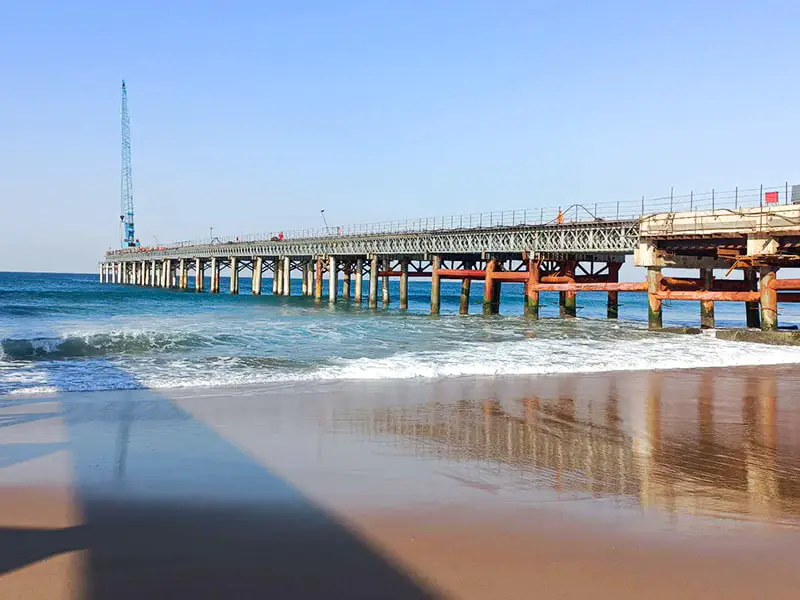
Customized Corrosion-Resistant Steel Gangway Bridge
1. The Strategic Role of a Mineral Logistics Gangway Bridge
In a mineral port or dock environment, the bridge between land and water is often part of a continuous logistics chain. Minerals may arrive by truck, rail, conveyor, or a combination of transport modes before being loaded onto vessels. Any interruption at the dock approach can affect loading schedules, storage capacity, vehicle circulation, and overall supply chain performance.
A dedicated steel trestle bridge helps create a controlled and clearly defined route for this transfer process. It can support heavy vehicles, material handling systems, inspection activities, service vehicles, and operational access. Depending on the project configuration, the structure may connect a shore-side road to a dock platform, link different work zones, or provide access across water, low-lying ground, drainage channels, or industrial obstacles.
The bridge supplied for the Mozambique mineral industry is intended to meet high-frequency operational demands. This means the design must consider not only a single maximum load but also repeated loading cycles, braking forces, vibration, lateral movement, environmental exposure, and continuous use. A bridge that performs well under occasional traffic may not be suitable for an industrial route used throughout the day. Repetitive heavy loading places greater demands on connection details, deck components, bearings, support points, and protective coatings.
The structure also forms part of the dock’s approach infrastructure. As a result, its performance influences the efficiency of the entire terminal. A robust approach bridge can help reduce vehicle queuing, improve traffic organization, simplify inspection procedures, and provide a stable platform for future operational development. Its value is therefore measured not only by its structural capacity but also by its contribution to the reliability of the logistics system.
1.1 Supporting Intermodal Transport
Intermodal mineral transport involves the coordinated use of multiple transportation methods. A mineral product may move from an inland location by truck or rail, enter a storage or transfer area, and then proceed to the dock for marine shipment. The bridge at the dock approach must integrate into this sequence without creating an unnecessary bottleneck.
The modular steel gangway bridge supports this integration by providing a stable, direct, and engineered route. Its steel structure can be adapted to the required span, width, clearance, alignment, and support arrangement. This flexibility is particularly useful where existing infrastructure, tidal conditions, water levels, or heavy industrial equipment limit the available construction space.
A properly designed bridge also improves operational separation. Heavy mineral traffic can be directed along a dedicated route, while maintenance personnel, inspection teams, and service vehicles use an organized access system. This reduces conflicts between different types of movement and helps improve safety at the terminal interface.
1.2 Designed for Repeated Industrial Use
Mineral logistics is generally more intensive than ordinary light-duty access. Loads can be large, traffic volumes can be high, and the operating environment may contain dust, moisture, salt, chemicals, and abrasive particles. The bridge must therefore be designed for long-term industrial service rather than temporary or occasional access alone.
The specified load requirements include HS-15, HS-20, HS-25, HL-93, and Tracked-50. These designations represent different loading criteria used for evaluating bridge performance under vehicle and tracked equipment conditions. The final structural design must determine how the applicable load cases interact with span length, roadway width, support conditions, dynamic effects, and local project standards.
By considering several load specifications during the engineering stage, the bridge can be configured for a broader range of operating requirements. This helps the project owner select a structure that is suitable for current mineral transport activities while retaining practical capacity for maintenance vehicles, emergency access, and future operational needs.
2. Customized Design for Complex Site Conditions
One of the main advantages of a customized steel gangway bridge is that the structure is developed around the project rather than selected as an inflexible standard product. Industrial sites rarely have identical conditions. A dock approach may involve uneven ground, tidal water, limited access for construction equipment, existing foundations, unusual clearances, or a connection to a nonstandard platform.
Customization allows the engineering team to evaluate the actual project requirements before defining the final bridge configuration. Important factors include the required span, bridge width, elevation, longitudinal slope, transverse slope, clearance, support spacing, deck arrangement, traffic direction, installation sequence, and access for inspection. The design may also need to account for wind, temperature variation, water movement, settlement, and local environmental exposure.
2.1 Geometry and Alignment
Bridge geometry affects both structural performance and logistics efficiency. The approach route must align with roads, transfer platforms, dock edges, storage yards, or loading equipment. Even a small mismatch in elevation or direction can create operational difficulties, especially for heavy vehicles and long-wheelbase equipment.
A customized modular system can accommodate a wide range of alignment requirements. The bridge may be configured with different panel arrangements, support positions, deck widths, and connection details. Where necessary, transition sections can be incorporated to provide a smoother connection between the bridge deck and adjacent ground or platform surfaces.
Careful alignment also assists drainage. Water should not accumulate on the deck or at the transition points. Effective drainage reduces slip hazards, limits standing water, and helps protect the steel structure and deck components from unnecessary moisture exposure.
2.2 Structural Loading and Stability
The design process must evaluate vertical loads, impact effects, lateral forces, braking forces, wind actions, and possible construction-stage conditions. Heavy vehicles do not apply static loads only. Acceleration, braking, turning, uneven surfaces, and repeated movement can produce additional effects in the deck and supporting system.
Modular bridge components are typically designed to transfer forces through standardized panels, chords, transoms, bracing members, deck beams, and connection systems. The exact arrangement depends on the project requirements. For a dedicated mineral logistics bridge, the design team can select appropriate member sizes, panel configurations, reinforcement details, and support conditions based on the required loading specifications.
Stability must also be considered during erection. A bridge that is stable in its completed condition may require temporary bracing, launching equipment, temporary supports, or controlled lifting procedures while being installed. Engineering support during the construction stage helps ensure that the structure remains stable throughout assembly and placement.
2.3 Integration with Existing Infrastructure
Many industrial projects are constructed around existing facilities. The new bridge may need to connect to a road built years earlier, a dock platform with fixed dimensions, or a support foundation that cannot be relocated. Customized fabrication makes it possible to develop connection details that respond to these constraints.
The bridge can include end arrangements, bearing layouts, approach plates, handrails, barriers, inspection walkways, and service access features suited to the existing infrastructure. This reduces the need for extensive modifications to surrounding facilities and can simplify the overall construction program.
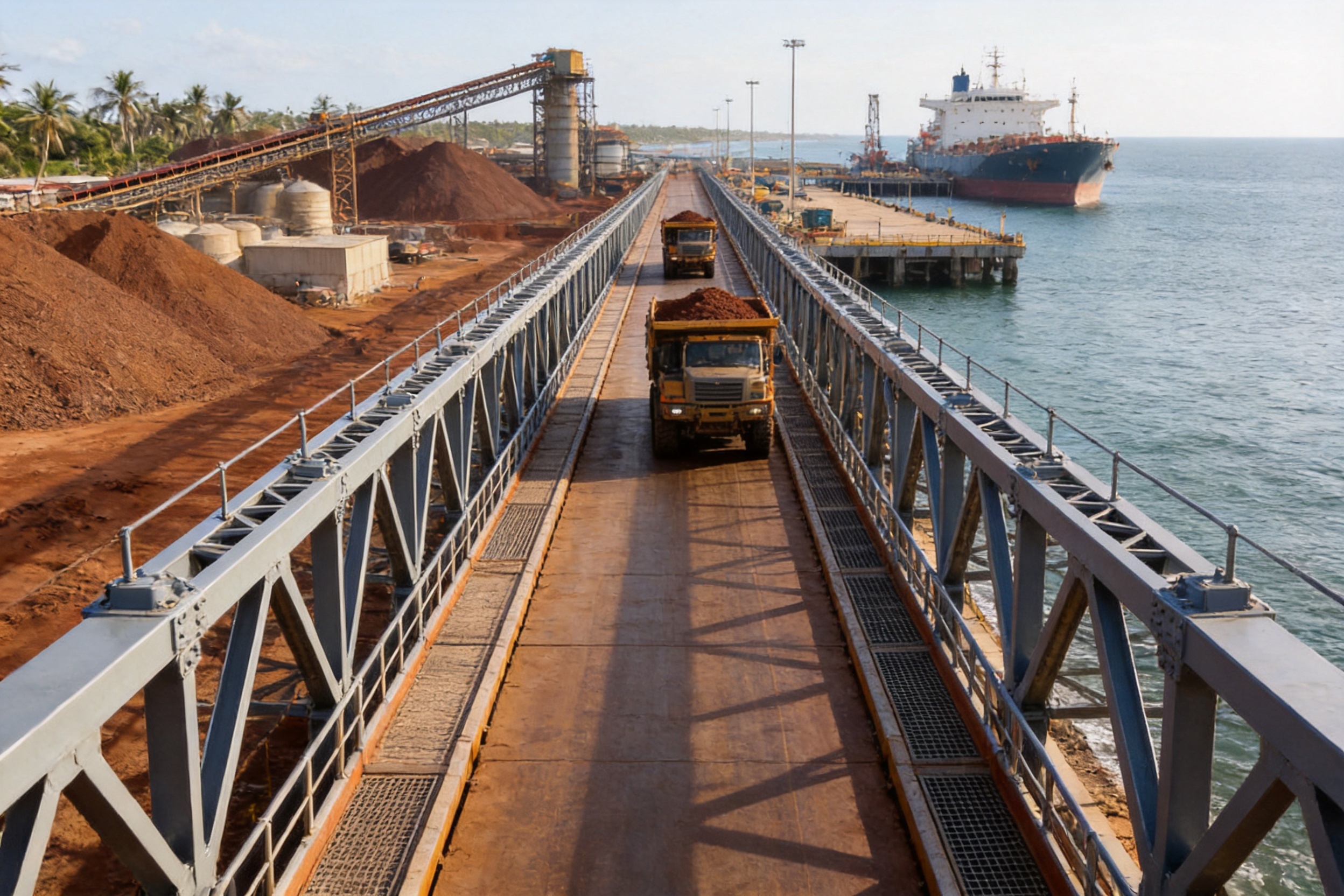
3. Corrosion Resistance in a Humid Dock Environment
Corrosion protection is one of the most important characteristics of a steel bridge installed near water. A dock environment may expose structural members to high humidity, salt-laden air, condensation, rainfall, splash, and fluctuating wet and dry conditions. Mineral dust and industrial residues may further retain moisture on steel surfaces and accelerate deterioration.
The corrosion-resistant treatment applied to the bridge is intended to support long-term stable operation under these conditions. Protection is not a single action. It involves material selection, surface preparation, coating design, fabrication quality, drainage, detailing, inspection, and maintenance planning.
3.1 Surface Preparation
Coating performance depends heavily on the condition of the steel surface before application. Rust, mill scale, oil, dust, welding residue, and other contaminants can weaken adhesion and create early failure points. A professional manufacturing process therefore includes controlled surface preparation before protective coating is applied.
Surface preparation may include cleaning, abrasive treatment, removal of welding spatter, edge treatment, and inspection of the prepared surface. Sharp edges and rough transitions can be smoothed where required so that the coating forms a more consistent protective layer. Welded areas receive particular attention because they may contain heat-affected zones, surface irregularities, or residues that require additional preparation.
3.2 Protective Coating Systems
The final coating system should be selected according to the exposure category, expected service life, maintenance strategy, and project specifications. A suitable system may include a primer, intermediate protective layer, and finishing coat. The purpose is to create a barrier between the steel and the surrounding environment.
Coating thickness, curing conditions, environmental temperature, humidity, and application quality all influence performance. Controlled factory application can provide more consistent results than uncontrolled field painting, particularly when the bridge components are fabricated and coated before transportation to the site.
Although protective coatings reduce corrosion risk, they do not eliminate the need for inspection. Areas near joints, drainage points, deck connections, support seats, and locations exposed to mechanical wear should be inspected at planned intervals. Damage caused by impact, abrasion, or maintenance activity should be repaired promptly to prevent localized corrosion from spreading.
3.3 Corrosion-Resistant Detailing
Structural detailing has a direct influence on durability. Water traps, narrow gaps, inaccessible cavities, and poorly drained surfaces can retain moisture even when the coating itself is properly applied. A durable bridge design aims to direct water away from vulnerable areas and make inspection and maintenance practical.
Drainage openings, accessible connection zones, suitable weld details, and properly treated edges help reduce the risk of moisture accumulation. Deck surfaces should also be designed to minimize standing water and facilitate cleaning where mineral dust or other residues may collect.
In a dock environment, the bridge must be evaluated as a complete system. Steel members, deck plates, fasteners, bearings, guardrails, expansion details, and support components may have different exposure conditions. Corrosion protection should therefore cover the full assembly rather than focus only on the primary truss members.
4. Modular Steel Construction and Its Competitive Advantages
Compared with a fully site-built bridge, a modular steel bridge offers significant benefits in manufacturing efficiency, transportation, installation, and future adaptability. Its components are produced according to a coordinated system of dimensions and connection details. This standardization supports quality control while retaining the ability to configure the bridge for a specific site.
4.1 Faster Project Deployment
Factory production can proceed while site preparation, foundation work, and access arrangements are underway. This parallel approach may shorten the overall project schedule because the structural components do not need to be fabricated entirely at the site.
Once the foundations and support areas are ready, the bridge components can be transported to the project location for assembly. The installation method depends on span, access, water conditions, lifting capacity, and local construction requirements. Possible methods include staged assembly, crane placement, incremental launching, or a combination of these techniques.
Faster deployment is particularly valuable in mineral logistics, where the completion of an approach bridge may directly affect the readiness of a dock or transfer facility. Reducing on-site fabrication also limits the amount of hot work, cutting, and welding required in a potentially difficult or hazardous environment.
4.2 Reduced Site Disruption
Site-based bridge fabrication can interfere with traffic, port activities, environmental controls, and neighboring facilities. Modular construction moves much of the manufacturing process into a controlled factory environment. The site then focuses on foundation preparation, component assembly, lifting, connection, and finishing work.
This approach can be useful where space is restricted or where the bridge crosses an active route, waterway, or industrial work zone. Shorter installation activities may reduce disruption to existing operations and simplify coordination with other contractors.
4.3 Transport and Handling Efficiency
Modular bridge components are designed to be transported in manageable sections. This is important for international projects, remote locations, and sites with limited heavy-haul access. Components can be packed, marked, and organized according to the erection sequence, helping the installation team identify parts and reduce handling errors.
Efficient packing also helps control transportation costs. Rather than shipping a complete bridge as a single oversized structure, the system can be divided into panels and associated members that are easier to load and move. The final packaging plan must still consider local road restrictions, port handling equipment, container dimensions, and protection against damage during transit.
4.4 Adaptability and Future Modification
Modular bridges are inherently adaptable. If site conditions change or operational requirements expand, certain components may be reinforced, replaced, or reconfigured. In some applications, the bridge can be extended, widened, strengthened, or relocated, subject to engineering review.
This flexibility provides a competitive advantage over structures that are difficult to modify after construction. Mineral terminals may experience changes in production volume, vehicle type, loading equipment, or transport routes. A modular approach can help the infrastructure respond to these changes without requiring complete replacement.
4.5 Maintainability
Standardized components simplify inspection and maintenance. Replacement parts can be identified through drawings, component markings, and an organized bill of materials. Damaged deck panels, connection elements, barriers, or secondary members may be repaired or replaced without dismantling the entire bridge.
Maintenance access can also be incorporated into the design. Inspection walkways, accessible connection zones, and clear drainage paths make it easier for maintenance teams to identify problems at an early stage. This supports a planned maintenance strategy and can reduce the risk of sudden operational interruption.
| Performance Requirement | Customized Modular Steel Bridge Response | Operational Benefit |
|---|---|---|
| Heavy and repeated vehicle loading | Engineering based on applicable HS, HL, and tracked-load specifications | Reliable support for mineral transport and service traffic |
| Humid and corrosive dock conditions | Surface preparation, protective coating, drainage, and corrosion-conscious detailing | Improved durability and reduced deterioration risk |
| Restricted construction space | Factory-fabricated components assembled through planned erection methods | Less site fabrication and reduced disruption |
| International transportation | Packable modular panels and organized component shipment | More efficient logistics and easier handling |
| Changing future requirements | Configurable components and potential for strengthening or modification | Greater lifecycle flexibility |
| Inspection and repair | Standardized members, accessible connections, and replaceable components | Simplified maintenance planning |
5. Advanced Manufacturing Processes
The quality of a modular steel bridge depends on the consistency of its manufacturing process. Engineering calculations establish the required performance, but the finished structure must accurately reflect the design intent. Dimensional accuracy, weld integrity, material traceability, coating quality, and assembly fit all influence the bridge’s reliability.
Jiangsu Zhonghai Bridge Equipment Co., Ltd. integrates engineering design, precision manufacturing, quality management, and international delivery support. Its factory uses automation and standardized production workflows to manufacture high-strength modular bridge systems and engineered structural components.
5.1 Engineering and Production Coordination
Manufacturing begins with coordinated engineering documentation. Drawings, material specifications, connection details, welding requirements, inspection points, coating requirements, and packing information should be reviewed before production starts. Effective coordination between design and production reduces uncertainty and limits avoidable changes during fabrication.
For a customized gangway bridge, the engineering team must translate site-specific requirements into a manufacturable system. This includes confirming member dimensions, connection locations, bolt arrangements, deck details, support interfaces, lifting points, and erection marks. Production planning should also consider how components will be assembled and inspected at the project site.
5.2 Automated and Controlled Welding
Welding is central to the fabrication of steel bridge components. Inconsistent welding can lead to dimensional distortion, surface defects, reduced fatigue performance, or coating problems. Automated welding and controlled welding procedures can improve repeatability, productivity, and quality consistency.
Before welding, steel components are cut and prepared according to approved drawings. Fit-up is checked to confirm alignment and gap requirements. Welding parameters, consumables, preheating, interpass temperature, and sequence are controlled according to the applicable procedure. After welding, visual inspection and other required tests are performed to verify the quality of the joints.
Controlled welding also helps reduce distortion. Excessive heat input or an unsuitable welding sequence may cause members to move out of tolerance. Production planning therefore considers the order in which welds are made and the methods used to restrain or correct components.
5.3 Precision Steel Cutting and Forming
Accurate cutting is essential for the correct assembly of modular components. Automated cutting equipment can produce consistent dimensions and repeatable connection features. Properly prepared edges support reliable fit-up and reduce the amount of adjustment required during assembly.
Where steel plates or sections require forming, the process must maintain the specified geometry without creating unacceptable defects. Dimensional checks are made throughout production so that errors can be identified before a component advances to the next stage.
5.4 Assembly Verification
Trial assembly or controlled fit-up checks can confirm that panels, transoms, braces, deck elements, and connection points align correctly. This is especially important for customized bridges, where the design may include nonstandard end sections, support interfaces, or transition components.
Assembly verification helps identify problems before shipment. It can confirm bolt-hole alignment, member orientation, component markings, clearances, and the sequence required for field erection. Detecting such issues at the factory is generally more efficient than correcting them at a remote dock site.
5.5 Quality Management and Traceability
A professional manufacturing system maintains records for materials, fabrication stages, inspections, welding activities, coating measurements, and final release. Traceability enables the project team to identify the source and production history of key components.
Material certificates can confirm the grade and origin of steel used in primary members. Inspection records can document dimensional checks, weld examinations, coating thickness, and corrective actions. These records support project acceptance and provide useful information for future maintenance.
5.6 Coating Application in Factory Conditions
Applying protective coatings in a controlled factory environment provides important advantages. Temperature, humidity, cleanliness, and application conditions can be managed more effectively than at an exposed construction site. Components can be prepared, coated, cured, inspected, and protected before they are transported.
Edges, welds, connection surfaces, and difficult-to-reach areas are easier to address before assembly. The coating process should still respect field connection requirements. Some connection zones may require specific treatment after erection, particularly where bolted or welded site connections are completed after factory coating.
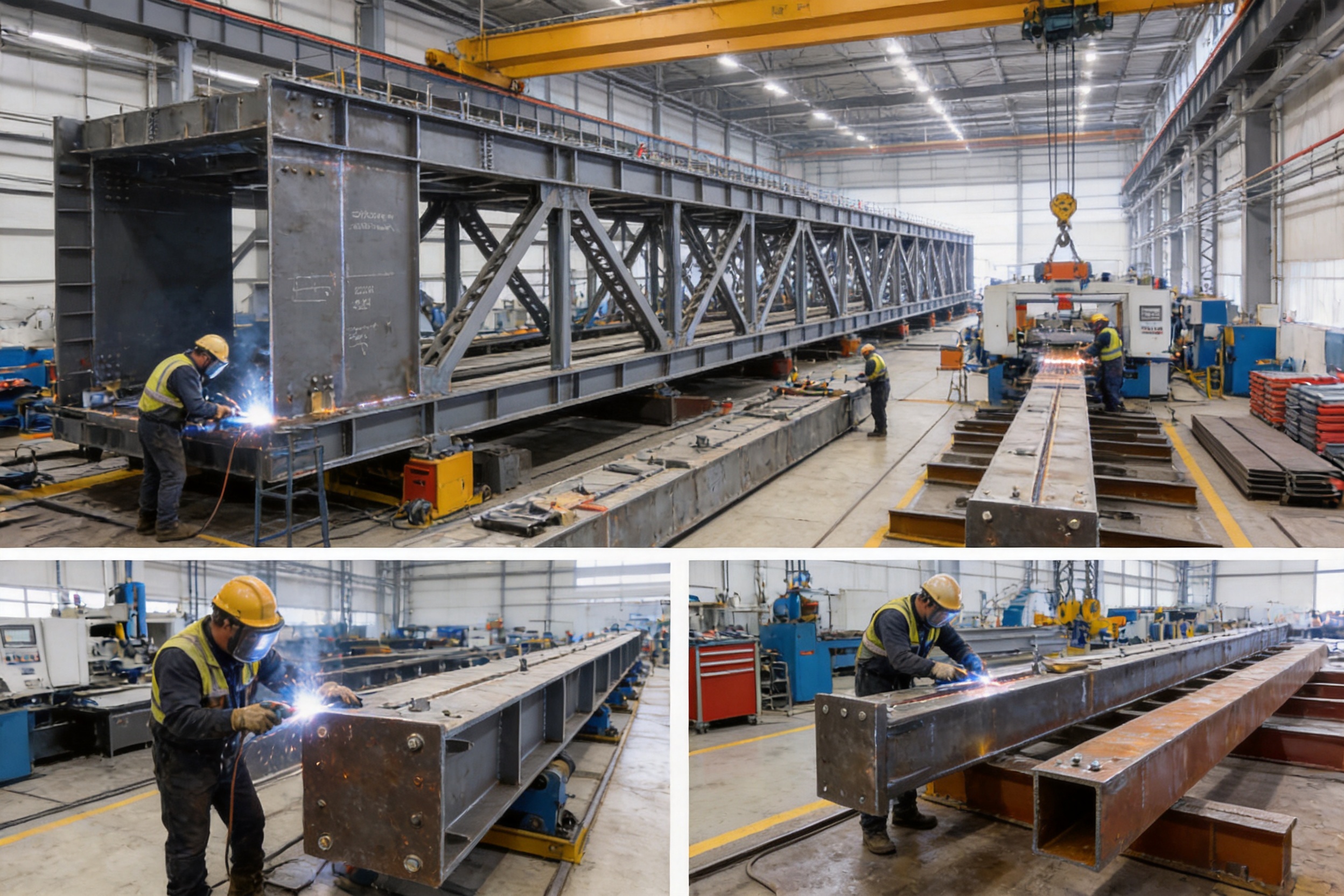
6. Company Engineering Strengths and International Project Experience
Jiangsu Zhonghai Bridge Equipment Co., Ltd. has developed its business around modular bridge systems, Bailey bridge structures, customized steel components, bridge erection support equipment, automated welding, and precision fabrication. The company’s location in Zhenjiang, Jiangsu Province, places it within an important industrial and transportation region with access to manufacturing resources, engineering expertise, and domestic and international logistics networks.
The company serves clients in transportation, water conservancy, military logistics, disaster relief, international development, and industrial construction. These sectors require different bridge configurations, but they share a common need for dependable engineering, consistent production, and practical delivery support.
Its project experience includes coastal engineering in the Maldives, temporary access bridges for the Shenzhen–Zhongshan Corridor, structural components for the Hangzhou Expo Center, multi-span Bailey bridges for the Lalin Railway, and emergency bridge deployments in multiple regions. These applications demonstrate experience with coastal exposure, transportation infrastructure, temporary access, complex structural components, and urgent deployment conditions.
6.1 Engineering-Oriented Manufacturing
The company’s strength is not limited to supplying individual steel members. Its service model combines design coordination, structural engineering, manufacturing, quality management, and support for site erection. This integrated approach is valuable when a bridge must respond to unusual dimensions, loading conditions, environmental exposure, or installation restrictions.
For international customers, a single coordinated supplier can simplify communication. Instead of separating design, fabrication, coating, packaging, and technical support among unrelated parties, the project can be managed through a connected workflow. This may reduce misunderstandings and make it easier to maintain consistency between drawings and manufactured components.
6.2 Standards and Technical Adaptability
The company reports that its products are manufactured to comply with ASTM, EN, and national specifications where applicable. The correct standard depends on the project contract, local regulations, design basis, and approval requirements. A technically capable manufacturer should be able to review the required criteria and align the production process with the relevant documentation.
Technical adaptability is especially important for projects outside the manufacturer’s home market. Load models, material grades, welding requirements, coating standards, bolt specifications, inspection procedures, and documentation expectations may differ between regions. Early review of these requirements helps prevent delays and ensures that the supplied bridge is compatible with the project’s approval process.
6.3 Support for Remote and International Projects
A bridge project in Mozambique may involve long-distance transport, international documentation, local contractors, limited site resources, and environmental conditions different from those at the factory. The supplier must therefore consider more than manufacturing alone.
Effective support may include component identification, packing lists, erection drawings, installation guidance, inspection documents, replacement-part information, and communication with the local construction team. Clear documentation is especially important when the bridge is assembled by personnel who were not involved in its factory production.
7. Installation and Site Erection Considerations
Bridge installation should be planned during the design stage rather than treated as a separate activity after fabrication. The erection method influences component dimensions, lifting points, temporary bracing, connection accessibility, transportation sequence, and the location of temporary supports.
7.1 Foundation and Support Preparation
Before bridge components arrive, the support foundations, bearing areas, anchor points, and approach surfaces should be checked. Elevation, alignment, bearing orientation, and support spacing must correspond to the approved drawings. Any discrepancy should be addressed before the bridge is assembled.
Foundations must be designed according to site conditions and structural reactions. Depending on the project, supports may be placed on concrete abutments, piers, steel stools, piles, or other engineered arrangements. The modular superstructure cannot compensate for inadequate or incorrectly positioned supports, so coordination between civil and structural works is essential.
7.2 Component Identification and Sequencing
Each component should be marked in a way that corresponds to the erection drawings and packing list. Proper identification reduces assembly time and helps prevent incorrect orientation. Components should be stored on stable supports and protected from unnecessary contact with standing water, mud, or damaging equipment.
The erection sequence should consider the order of panels, bracing, transoms, deck units, handrails, barriers, and secondary elements. If the bridge is launched or assembled in stages, temporary conditions must be evaluated for stability and member forces.
7.3 Bolted and Field Connections
Field connections must be assembled according to the approved procedures. Bolt grade, tightening method, washer arrangement, connection orientation, and inspection requirements should be clearly defined. Site connection surfaces must be protected from contamination and damage.
Where field welding is required, the construction team must provide suitable equipment, qualified welders, weather protection, inspection, and post-weld coating repair. Minimizing site welding through factory fabrication can be advantageous in humid or difficult locations, but any necessary field welds must still receive careful control.
7.4 Deck, Safety, and Access Features
The deck should provide an appropriate surface for the intended traffic. Depending on the design, it may include steel deck plates, modular deck units, anti-skid treatment, drainage features, curbs, barriers, and edge protection. The selected arrangement should reflect the expected vehicle type, mineral residues, maintenance practices, and weather conditions.
Handrails, guardrails, inspection walkways, and access ladders can be incorporated where personnel need to inspect or maintain the bridge. These features improve operational safety and help reduce the need for improvised access solutions after commissioning.
8. Lifecycle Maintenance and Operational Reliability
A bridge’s value is determined over its service life, not only at the time of installation. Planned maintenance protects the initial investment, preserves load-carrying performance, and reduces the risk of unexpected closure.
8.1 Routine Inspection
Routine inspections should examine the deck, truss members, bracing, fasteners, bearings, supports, expansion details, barriers, drainage openings, and coating condition. Particular attention should be given to areas where mineral dust, water, or debris may collect.
Inspection frequency should reflect the operating intensity and environmental exposure. A bridge used frequently by heavy mineral vehicles in a humid dock environment may require more regular observation than a lightly used access bridge in a dry inland area.
8.2 Coating Maintenance
Coating damage should be documented and repaired according to the approved maintenance system. Small areas of coating failure can often be treated before corrosion spreads beneath adjacent layers. Surface cleaning and preparation are necessary before touch-up materials are applied.
Maintenance teams should also monitor areas subject to impact from vehicles, loading equipment, tools, or transported materials. Mechanical damage can expose the steel even when the surrounding coating remains in good condition.
8.3 Connection and Support Checks
Bolted connections, bearing areas, support seats, and bracing joints should be checked for movement, looseness, deformation, corrosion, or abnormal wear. Any change in alignment, unusual vibration, or visible damage should be evaluated by a qualified engineer.
Support conditions are particularly important because settlement or movement can change the distribution of forces in the bridge. Drainage around foundations should be maintained so that water does not undermine support areas or create persistent moisture exposure.
8.4 Managing Heavy Traffic
Operational controls can extend bridge service life. Vehicle speed limits, lane discipline, load restrictions, and traffic management reduce impact and uncontrolled lateral forces. Where the bridge is used by different types of equipment, the owner should establish clear rules for vehicle access and abnormal loads.
Any change in vehicle type, gross weight, axle arrangement, or operating pattern should be reviewed against the original design basis. A bridge designed for specified HS, HL, and tracked-load cases should not automatically be assumed suitable for every future vehicle without engineering confirmation.
9. Advantages Over Conventional and Less Specialized Alternatives
The customized corrosion-resistant modular bridge offers several advantages over improvised steel structures, basic temporary crossings, and fully site-fabricated alternatives.
9.1 More Reliable Than Improvised Access Structures
Improvised access structures may lack consistent engineering calculations, certified materials, controlled welding, drainage provisions, and documented load capacity. They can appear economical initially but may create higher risks through premature deterioration, difficult inspection, and uncertain performance under repeated heavy traffic.
A purpose-designed bridge is developed around identified load cases, environmental conditions, geometry, and installation requirements. This provides a stronger basis for approval, operation, and maintenance.
9.2 More Adaptable Than Fixed Standard Products
A standard bridge product may be efficient when the site matches its predefined dimensions and loading assumptions. However, dock approaches often involve unusual alignments, restricted clearances, and special connection requirements. A customized modular bridge retains the efficiency of standard components while adapting the overall arrangement to the project.
9.3 More Efficient Than Entirely Site-Built Fabrication
Fabricating the whole bridge at the site can increase exposure to weather, labor variability, access restrictions, and quality-control challenges. Factory production provides better control over cutting, welding, coating, inspection, and component marking. Site work can then focus on assembly and installation rather than complete structural fabrication.
9.4 Better Suited to Corrosive Industrial Environments
A bridge specifically engineered for a humid dock environment can incorporate appropriate coating systems, surface preparation, drainage, detailing, and inspection access. These features are often overlooked when a basic steel structure is assembled primarily for initial access rather than long-term industrial service.
10. Why the Solution Fits Mozambique’s Mineral Industry
Mozambique’s mineral logistics infrastructure includes coastal and inland transport interfaces where reliable access to docks is essential. A bridge operating in such an environment must address both industrial loading and marine exposure. The customized steel gangway bridge is suited to this combination because it brings together structural capacity, modular construction, corrosion protection, and project-specific engineering.
The bridge can support a continuous movement pattern between land and sea. Its dedicated alignment helps organize mineral transport and provides a stable connection for heavy vehicles and service operations. The corrosion-resistant treatment responds to humidity and dock exposure, while the modular structure supports efficient international manufacturing and site assembly.
Its specified design basis includes HS-15, HS-20, HS-25, HL-93, and Tracked-50 loading requirements. This range indicates that the structure is intended to be evaluated against multiple vehicle and tracked-equipment conditions rather than a single narrow operating case. Final acceptance remains dependent on the approved engineering calculations, project specifications, local regulations, foundation design, and inspection requirements.
The bridge also provides a practical foundation for future logistics improvements. As dock operations evolve, the modular system may offer opportunities for component replacement, strengthening, reconfiguration, or extension, subject to a new engineering review. This can help protect the infrastructure investment over a longer operating period.
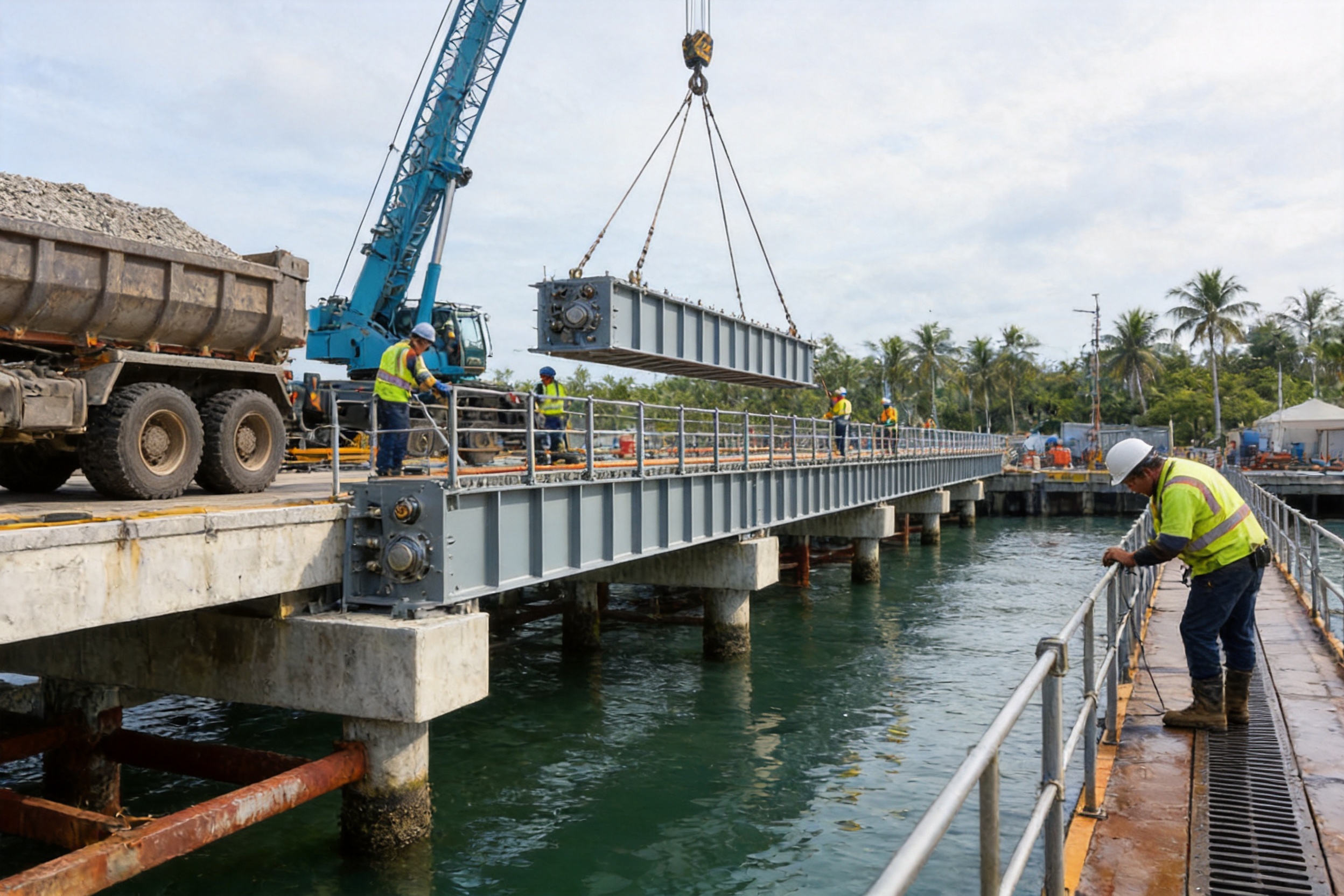
11. Frequently Asked Questions
Q1: What is a customized steel gangway bridge?
A customized steel gangway bridge is a project-specific bridge designed to connect separate land-based or marine work areas. It is engineered according to the required span, width, elevation, loading, environmental exposure, support arrangement, and installation method. Unlike a purely standard bridge, its configuration is adjusted to suit the actual project site.
Q2: What is the main purpose of this bridge in mineral logistics?
Its main purpose is to provide a stable approach connection between land-based transport infrastructure and a dock or marine terminal. It supports the transfer of minerals, vehicles, service equipment, and personnel between different parts of the logistics chain.
Q3: Why is corrosion protection important for a dock bridge?
Dock bridges are exposed to humidity, rainfall, condensation, salt-laden air, splash, and wet-dry cycles. Mineral dust and industrial residues may also retain moisture. Corrosion protection helps preserve the steel members, connections, deck system, and supporting components so that the bridge can operate reliably for a longer period.
Q4: Which load specifications are associated with this bridge?
The bridge is designed to carry load specifications including HS-15, HS-20, HS-25, HL-93, and Tracked-50. The applicable load cases and final capacity must be confirmed through project-specific engineering calculations and approval procedures.
Q5: Can the bridge be adapted to different spans and widths?
Modular steel bridge systems can generally be configured for different span arrangements, widths, support spacing, and access requirements. The exact possibilities depend on the structural system, design loads, transportation limitations, and site conditions. A qualified engineering review is required for every customized configuration.
Q6: How does modular construction reduce project time?
Many components can be manufactured, inspected, and coated in the factory while site preparation proceeds in parallel. Once the foundations are ready, the components can be transported and assembled using a planned erection method. This reduces the amount of fabrication required at the project site.
Q7: Is a modular bridge suitable for permanent use?
Yes, a modular bridge can be designed for permanent or temporary service. Permanent use requires appropriate structural design, corrosion protection, foundation engineering, inspection planning, and maintenance. The intended service life and operating conditions should be defined at the beginning of the project.
Q8: What manufacturing technologies are used?
The manufacturing process may include precision steel cutting, controlled fit-up, automated or semi-automated welding, dimensional inspection, trial assembly, surface preparation, protective coating, quality documentation, and organized packing. The specific process depends on the approved design and project specifications.
Q9: How can the bridge be transported to an international project site?
Modular components can be separated into transportable panels, beams, braces, deck units, and accessories. They can be marked and packed according to the erection sequence. The final transport plan should consider container dimensions, heavy-haul restrictions, port handling, packaging protection, and local delivery conditions.
Q10: What should be inspected after installation?
Post-installation inspection should cover alignment, support conditions, bearings, bolts, welds, deck components, barriers, drainage, coating condition, and the overall geometry of the bridge. A qualified engineer should verify that the completed structure matches the approved drawings and that any field modifications are properly documented.
Q11: Can components be replaced during maintenance?
One advantage of a modular system is that standardized or separately identifiable components can often be repaired or replaced without removing the entire bridge. The replacement must match the approved design and should be reviewed to confirm compatibility with the existing structure.
Q12: What information is needed to develop a quotation or preliminary design?
Useful information includes the required span, bridge width, road alignment, elevation, clearances, support arrangement, traffic type, load specifications, environmental conditions, corrosion category, deck requirements, installation method, delivery location, and expected service life. Site drawings, photographs, soil information, and local standards are also valuable.
12. Conclusion
The customized corrosion-resistant steel gangway bridge for Mozambique’s mineral industry is designed as a critical connection within an intermodal logistics system. Its purpose is to support the reliable transfer of minerals between land and sea while carrying repeated industrial traffic in a humid dock environment.
Its primary advantages come from the combination of customized engineering, modular steel construction, corrosion-conscious design, controlled factory manufacturing, and international project support. The structure can be adapted to site geometry, specified for multiple loading conditions, produced through standardized workflows, transported in manageable components, and assembled through an organized erection process.
Corrosion resistance is supported through surface preparation, protective coatings, drainage, durable detailing, and planned maintenance. Manufacturing quality is reinforced by precision cutting, controlled welding, dimensional verification, assembly checks, material traceability, and factory-based coating application. These features help distinguish a professionally engineered modular bridge from an improvised or lightly specified steel crossing.
Jiangsu Zhonghai Bridge Equipment Co., Ltd. brings together engineering design, modular bridge production, customized steel fabrication, automated welding, quality management, and project support. Its experience across transportation, coastal engineering, emergency response, rail infrastructure, and international development provides a foundation for delivering bridge solutions adapted to demanding operating environments.
For mineral terminals and dock approach infrastructure, the most valuable bridge is not simply the one that can be installed quickly. It is the one that combines structural reliability, environmental durability, installation efficiency, maintainability, and future adaptability. A customized corrosion-resistant modular steel gangway bridge addresses these requirements and provides a practical engineering foundation for efficient mineral logistics.
References
1. American Association of State Highway and Transportation Officials. Load and Resistance Factor Design Bridge Specifications.
2. European Committee for Standardization. Eurocode 3: Design of Steel Structures.
3. American Institute of Steel Construction. Specification for Structural Steel Buildings.
4. International Organization for Standardization. Quality Management Systems: Requirements.
5. International Organization for Standardization. Preparation of Steel Substrates Before Application of Paints and Related Products.
6. International Organization for Standardization. Paints and Varnishes: Corrosion Protection of Steel Structures by Protective Paint Systems.
7. American Welding Society. Structural Welding Code for Steel.
8. International Maritime Organization. Guidance on Port and Marine Infrastructure Safety Practices.
9. American Society of Civil Engineers. Design and Maintenance Principles for Steel Bridge Structures.
10. Manufacturer-provided project information for customized modular steel bridge systems and engineered structural components.
Product: Customized Corrosion-Resistant Steel Gangway Bridge

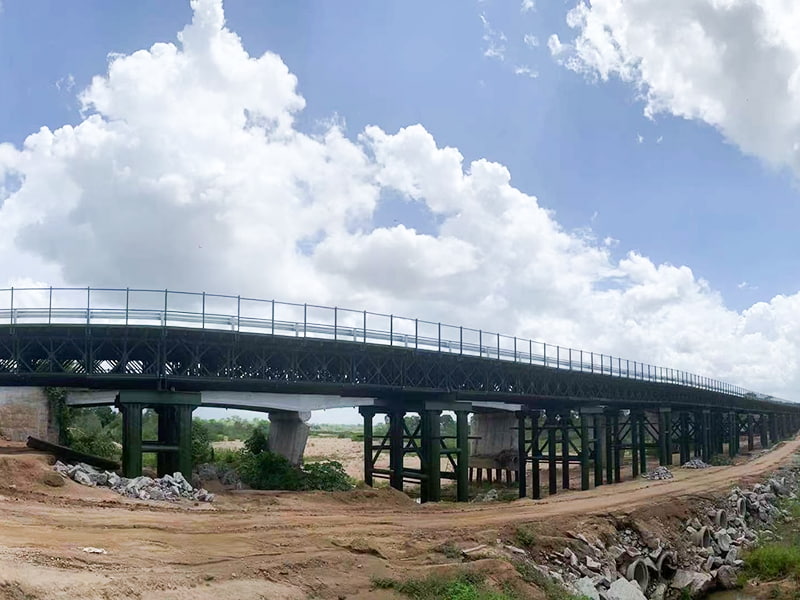
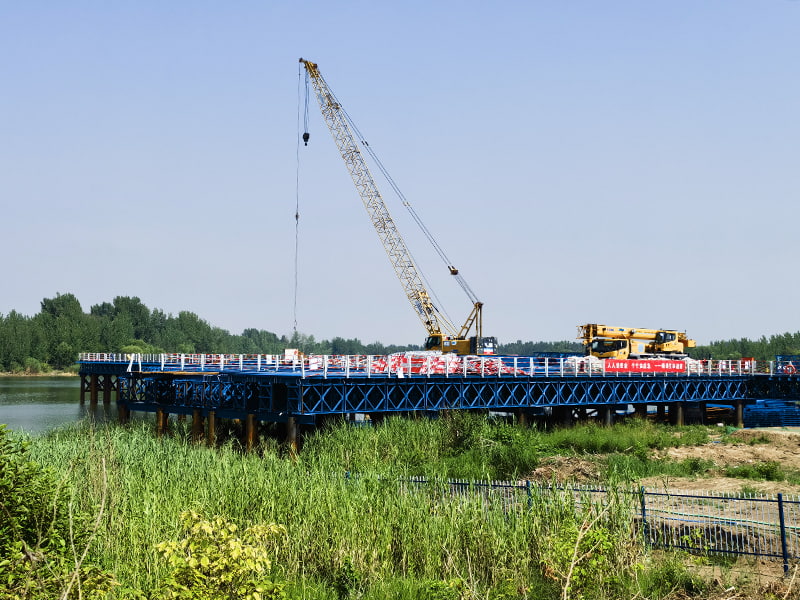
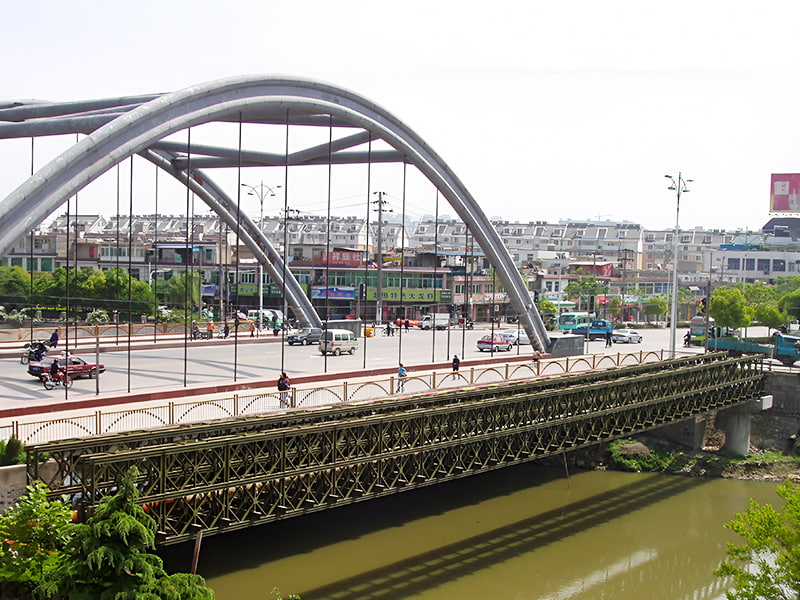
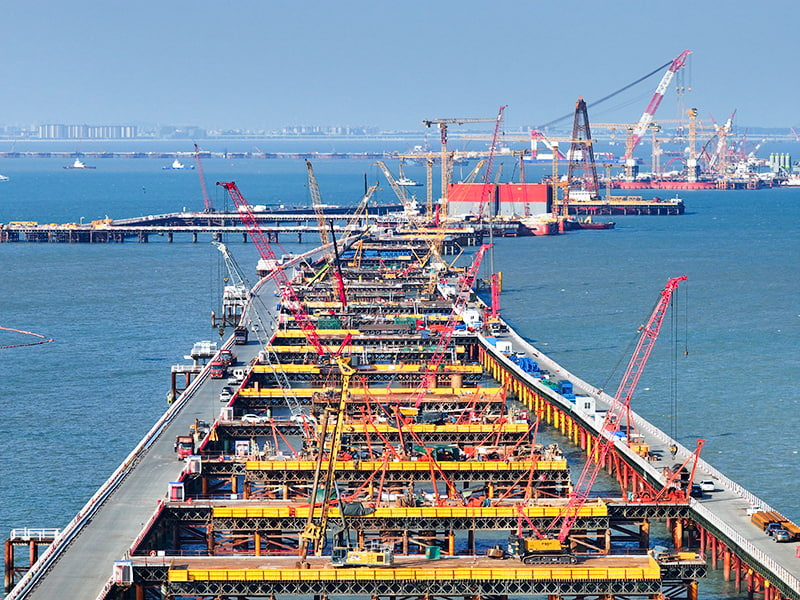

We respond quickly to all international requests and provide technical support when needed.
Product Category
Bailey Bridge/Modular Bridge Modular Steel Bridge Pedestrian Bridge Modular Pipe Bridge Truss Bridge Steel StructureContact Us

+86-511-84522866
+86-13921582699

zhwm@zjql.com

Building 1,83#, dantu New Town, Yanjiang Road, Dantu District, Zhenjiang, Jiangsu, China
Copyright © Jiangsu Zhonghai Bridge Equipment Co., Ltd. All
Rights
Reserved
China bailey bridge for sale
bailey bridge supplier from china
