
 English
 русский
 Español
 Português


Guo Zhenyi — Customer Support and Installation Coordinator
CB100 Bailey Bridge: Double-Lane, Triple-Row, Single-Layer Reinforced Galvanized Modular Bridge
Content
- 1 1. Project Overview and Application Purpose
- 2 2. Structural Configuration of the CB100 Bailey Bridge
- 3 3. Customized Load-Bearing Design
- 4 4. Why the Double-Lane and Independent Pedestrian Arrangement Matters
- 5 5. Hot-Dip Galvanizing for Demanding Environments
- 6 6. Manufacturing Strengths and Production Capability
- 7 7. Competitive Advantages of This Modular Bridge Solution
- 8 8. Installation and Erection Considerations
- 9 9. Inspection, Maintenance, and Service-Life Management
- 10 10. Manufacturing and Project Experience
- 11 11. Suitability for Different Infrastructure Applications
- 12 12. Selection Guidance for Buyers and Project Owners
- 13 13. Frequently Asked Questions
- 13.1 What is the main purpose of the CB100 Bailey Bridge?
- 13.2 Why is the bridge described as triple-row?
- 13.3 Is the bridge suitable for two-way traffic?
- 13.4 How are pedestrians accommodated?
- 13.5 What are the benefits of hot-dip galvanizing?
- 13.6 Which load standards can be considered?
- 13.7 Can the bridge be used as a permanent bridge?
- 13.8 Can the bridge be relocated?
- 13.9 Does galvanizing remove the need for maintenance?
- 13.10 What information should a customer provide for a quotation?
- 13.11 Why is factory manufacturing important for a modular bridge?
- 14 14. Conclusion
- 15 References
- 16 Product: CB 100 Bailey Bridge Double-Lane Triple-Row Single-Layer Reinforced Galvanized Bailey Bridge
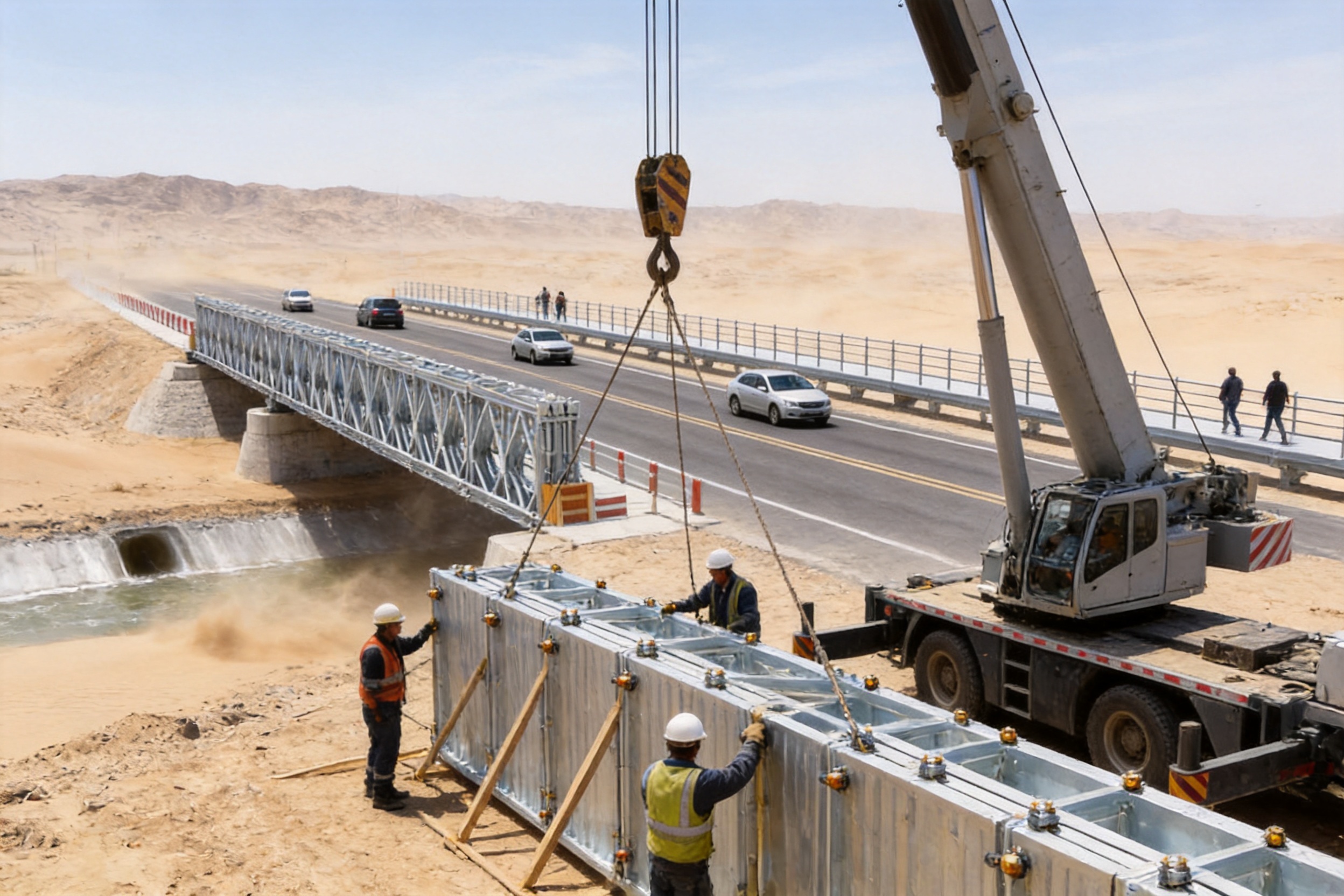
Modern infrastructure projects often require bridge systems that can be delivered quickly, adapted to demanding site conditions, and installed without the long construction schedules associated with conventional permanent bridges. The CB100 Bailey Bridge described in this article addresses these requirements through a modular steel configuration that combines rapid assembly, flexible engineering, high transport efficiency, and durable corrosion protection.
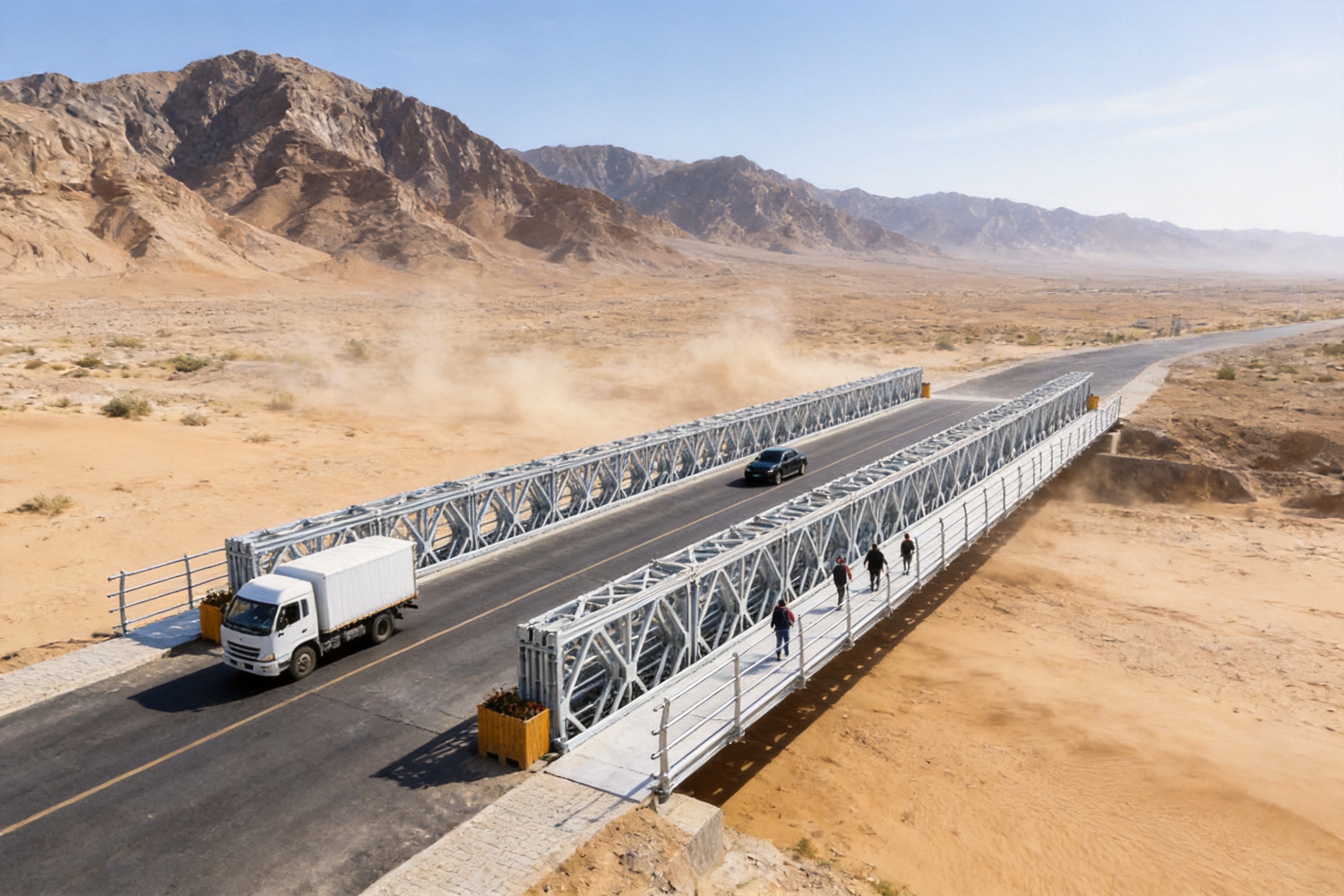
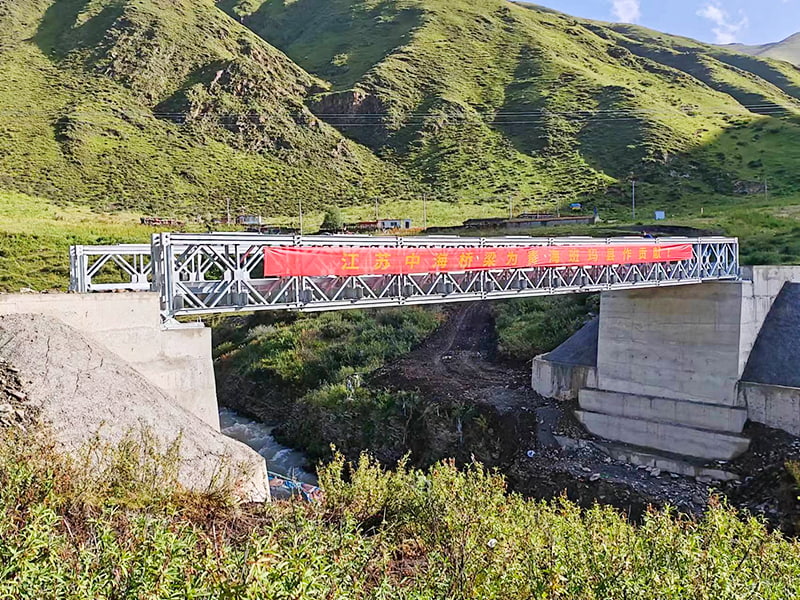
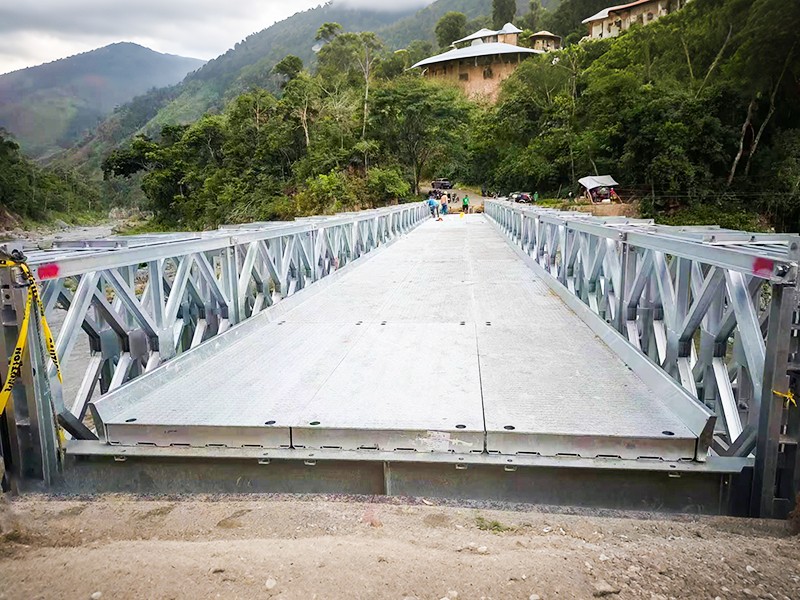
Designed for a 21-meter crossing in Chash County, Xinjiang, this bridge uses a reinforced single-layer, triple-row arrangement to provide substantial structural capacity within a compact modular system. Its configuration supports a double-lane vehicle crossing together with an independent pedestrian bridge arrangement, allowing pedestrian and vehicle traffic to be separated. This approach improves traffic organization, reduces conflict between different road users, and supports safer operation in locations where one bridge must serve several transportation functions.
The bridge is manufactured and supplied by Jiangsu Zhonghai Bridge Equipment Co., Ltd., a specialist in modular steel bridges, Bailey bridge systems, engineered steel components, bridge construction support equipment, and precision steel fabrication. The company combines engineering design, standardized production, automated welding, quality management, and international project support to provide bridge solutions for transportation, water conservancy, emergency response, military logistics, and development projects.
1. Project Overview and Application Purpose
The 21-meter CB100 Bailey Bridge was developed for a transportation environment requiring dependable daily access and reliable emergency passage. Chash County, located in Xinjiang, presents demanding service conditions. Sandstorms can expose steel structures to abrasive dust and airborne contaminants, while large differences between daytime and nighttime temperatures can produce repeated thermal expansion and contraction. These conditions make material protection and structural durability especially important.
Rather than using a basic temporary crossing intended only for short-term light traffic, the project applies a reinforced modular bridge arrangement customized to local transportation requirements. The bridge is designed to provide stable support for regular vehicle movement while also accommodating pedestrian access. Its modular construction allows the principal components to be manufactured under controlled factory conditions, transported to the project site, and assembled using a planned erection process.
The bridge’s 21-meter span is suitable for many local crossing applications, including roads over drainage channels, rivers, irrigation routes, construction corridors, flood-prone areas, and temporary diversions. Because the Bailey bridge system is based on repeatable structural modules, the same design philosophy can be adapted to longer or shorter spans, different traffic widths, and alternative support conditions after engineering review.
The project emphasizes three important objectives: traffic capacity, traffic separation, and environmental durability. The double-lane arrangement increases the usefulness of the crossing for local transportation. The independent pedestrian facility provides a safer route for people traveling on foot. The hot-dip galvanized finish helps protect the steel against corrosion and extends the expected service life when appropriate inspection and maintenance practices are followed.
2. Structural Configuration of the CB100 Bailey Bridge
The CB100 system belongs to the family of modular panel bridges commonly associated with the 321-type Bailey bridge design. Its principal structural members are assembled from standardized steel panels and connecting components. This arrangement allows bridge elements to be manufactured in repeatable dimensions and combined into different structural layouts according to span, width, loading, and site requirements.
The featured bridge uses a single-layer reinforced configuration with three rows of trusses. In practical terms, the triple-row arrangement increases the quantity of longitudinal load-carrying panel lines compared with a basic single-row configuration. The additional structural row improves load distribution and provides greater resistance to bending and other effects associated with vehicle traffic, subject to detailed design verification.
The reinforced single-layer arrangement is a useful solution when a project needs more capacity than a standard single-layer bridge but does not require the additional height and complexity of a double-layer configuration. It preserves many of the transportation and erection advantages of a single-level modular bridge while enhancing structural performance through additional truss rows and reinforcement components.
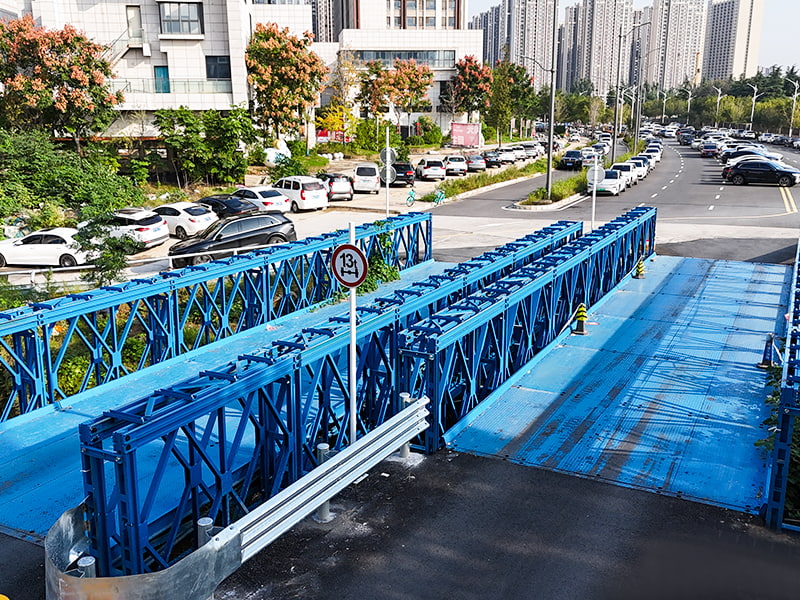
The double-lane layout is intended to support two-way vehicle movement or an organized two-lane traffic arrangement, depending on the final traffic management plan. The independent pedestrian bridge arrangement separates walking traffic from moving vehicles. This separation can reduce the risk of pedestrians entering active vehicle lanes and can improve the operational clarity of the bridge, especially in areas with mixed daily traffic.
A modular bridge must be evaluated as a complete structural system rather than as a collection of individual parts. Panel connections, transoms, stringers, deck units, bracing members, sway frames, end posts, bearings, approaches, foundations, and traffic barriers all contribute to performance. The CB100 solution is therefore produced as an engineered bridge package, with component selection and arrangement matched to span length, traffic use, site conditions, and load requirements.
2.1 Main Structural Features
The key structural features of the bridge include modular steel truss panels, reinforced longitudinal load paths, a double-lane deck arrangement, pedestrian traffic separation, standardized connection details, and a hot-dip galvanized surface treatment. These features work together to deliver a bridge that is practical to transport, efficient to assemble, and adaptable to changing project requirements.
Modular panels provide the primary truss geometry. Their standardized form helps simplify fabrication, storage, logistics, and replacement. If individual components are damaged during service or handling, the modular design can make inspection and component replacement more manageable than with a fully bespoke welded bridge.
Transoms and stringers support the bridge deck and transfer traffic loads toward the trusses. Bracing components help maintain the geometry and stability of the bridge during both erection and operation. Connection pins and associated fastening systems allow the bridge to be assembled in stages, which is one of the defining advantages of the Bailey bridge concept.
Pedestrian facilities require their own attention to width, guardrails, surface conditions, access points, and separation from vehicle traffic. By providing an independent pedestrian arrangement, the project avoids treating pedestrian movement as an afterthought. This is particularly valuable in communities where residents, workers, schoolchildren, and service personnel need to cross the same obstacle as vehicles.
3. Customized Load-Bearing Design
Bridge safety depends on the relationship between the structural system, the actual traffic, the site conditions, and the applicable design standards. For this reason, the CB100 bridge is described as having a customized load-bearing design. The customization process allows the bridge to be evaluated for project-specific vehicle requirements rather than being selected solely by span length or appearance.
The stated design references include HS-15, HS-20, HS-25, HL-93, and tracked-50 loading conditions. These designations represent different vehicle or load models used in bridge engineering. The appropriate model depends on the road classification, local regulations, expected traffic, and the type of vehicles that must cross the bridge.
HS-15, HS-20, and HS-25 loading categories are commonly associated with standardized highway vehicle loading concepts of different intensities. HL-93 is a widely recognized highway live-load model used in bridge design practice. Tracked-50 loading is relevant where tracked vehicles or concentrated military and heavy equipment movements may need to be considered. The final design must confirm the applicable load combination, dynamic effects, lane placement, impact factors, wind actions, braking forces, temperature effects, and other relevant conditions.
Load customization is one of the areas where an experienced modular bridge manufacturer can provide value beyond the supply of standard components. The manufacturer must understand how the selected panel arrangement, bridge width, deck system, reinforcement, support conditions, and traffic requirements interact. A bridge that appears similar externally may require substantially different components or reinforcement depending on the design load.
| Design Consideration | Relevance to the CB100 Project | Engineering Objective |
|---|---|---|
| Span length | Approximately 21 meters | Establish the main geometry and structural demand |
| Bridge arrangement | Single-layer, triple-row reinforced | Increase load-carrying capability within a compact configuration |
| Vehicle traffic | Double-lane vehicle access | Support organized local transportation and service movement |
| Pedestrian traffic | Independent pedestrian bridge arrangement | Separate walking traffic from vehicle lanes |
| Load models | HS-15, HS-20, HS-25, HL-93, and tracked-50 | Match structural design to project-specific traffic requirements |
| Environmental exposure | Sandstorms and major temperature variation | Improve durability and resistance to weather-related deterioration |
| Surface protection | Hot-dip galvanizing | Protect steel surfaces against atmospheric corrosion |
The presence of several possible load models does not mean that every bridge is simultaneously designed for every loading category. Instead, these models indicate the range of design conditions that can be considered when engineering a bridge for different customers and applications. The final structural drawings, calculations, and approved load limitations should always govern bridge use.
4. Why the Double-Lane and Independent Pedestrian Arrangement Matters
Many temporary or modular bridge projects are planned around vehicle access alone. That approach can create operational difficulties when local residents, construction workers, cyclists, or maintenance personnel must also use the crossing. Mixing pedestrians with trucks and passenger vehicles increases conflict points and can make traffic management more complicated.
The CB100 project addresses this challenge by combining a double-lane vehicle layout with an independent pedestrian bridge arrangement. This separation offers a clearer movement pattern. Vehicles remain within their designated traffic area, while pedestrians use a dedicated route protected from direct interaction with moving traffic.
Separate pedestrian access can be particularly useful for rural communities and industrial areas. A bridge may be used by agricultural vehicles, delivery trucks, emergency vehicles, and private cars at the same time that local residents need to cross on foot. A dedicated pedestrian facility improves convenience and can support safer access to homes, workplaces, schools, public services, and transport connections.
The arrangement also benefits emergency response. During floods, road closures, construction activities, or infrastructure failures, the bridge may serve as an important alternative connection. A design that preserves both vehicle movement and pedestrian access can help maintain community mobility even when normal routes are disrupted.
Traffic separation must be supported by appropriate design details. These may include pedestrian guardrails, vehicle barriers, transition treatments, warning signs, lighting provisions, controlled access points, anti-slip surfaces, and sufficient clearance. The exact details depend on the approved engineering design and local regulations, but the principle remains consistent: bridge users should be given routes suited to their mode of travel.
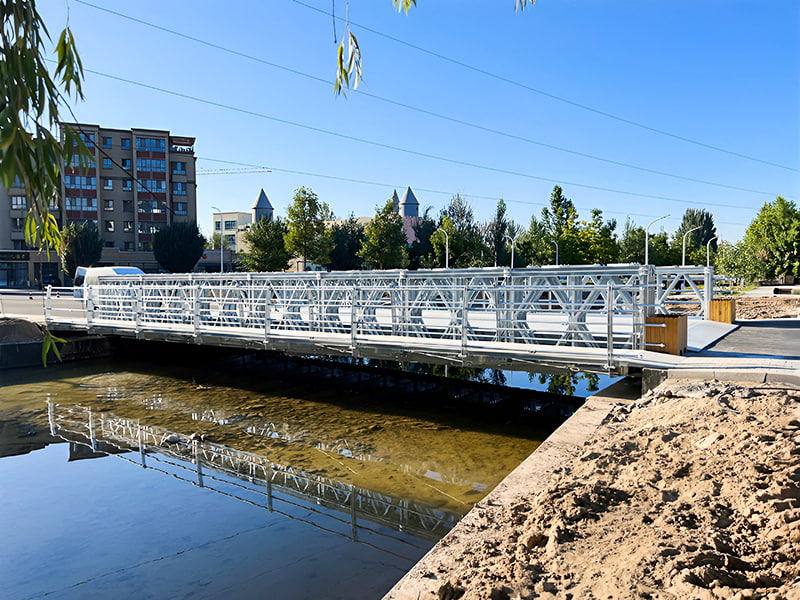
CB 100 Bailey Bridge Double-Lane Triple-Row Single-Layer Reinforced Galvanized Bailey Bridge
5. Hot-Dip Galvanizing for Demanding Environments
Corrosion protection is a critical consideration for bridges exposed to dust, moisture, temperature changes, and difficult maintenance conditions. The CB100 bridge receives hot-dip galvanizing over the entire steel structure. This treatment creates a metallurgically bonded zinc coating that provides both barrier protection and sacrificial protection to the underlying steel.
In a barrier-protection role, the zinc coating separates the steel from atmospheric oxygen and moisture. If the surface is scratched or locally damaged, the zinc can also provide cathodic protection to exposed areas near the damage. This characteristic is different from a simple paint film, which may lose protection rapidly when the coating is cut or abraded.
Hot-dip galvanizing is especially relevant to the conditions described for Chash County. Sandstorms can carry abrasive particles that repeatedly affect exposed surfaces. Temperature variation can place stress on coating systems through expansion and contraction. Dust can also accumulate on structural members and complicate inspection or maintenance. A robust metallic coating helps reduce the frequency and intensity of corrosion-related intervention.
Galvanizing does not eliminate the need for inspection. Bridge owners should still monitor drainage areas, connection zones, deck interfaces, areas exposed to standing water, and locations where components may rub against one another. Any field cutting, drilling, welding, or major repair should be followed by an approved repair treatment for the affected zinc coating.
The galvanizing process also requires proper preparation. Steel components must be cleaned, degreased, pickled, and fluxed before immersion in molten zinc. Vent and drain provisions may be required for certain hollow or enclosed members. Correct preparation supports coating adhesion, uniformity, and safe processing. A manufacturer with experience in galvanized bridge production can incorporate these requirements into component design and fabrication planning.
5.1 Durability Benefits Compared with Unprotected Steel
Unprotected carbon steel can begin to corrode quickly when exposed to moisture and contaminants. Corrosion reduces section thickness, creates rough surfaces, weakens connection areas, and increases the cost of long-term maintenance. For modular bridges that may be installed in remote areas, corrosion can also be difficult to address because access, equipment, and skilled labor may be limited.
A galvanized modular bridge offers several practical advantages. The coating is applied in a controlled industrial facility rather than relying only on site painting. It covers both broad surfaces and many edges more consistently than manual coating methods. The zinc layer is durable during transportation and erection when components are handled correctly. It also provides a visual indication of areas requiring inspection, such as white corrosion products, coating damage, or exposed steel.
Compared with a conventional painted system, hot-dip galvanizing can reduce the frequency of repainting under suitable environmental conditions. The actual service life depends on coating thickness, atmospheric exposure, traffic use, drainage, abrasion, and maintenance. Nonetheless, galvanizing is a strong choice for modular bridge applications where dependable corrosion resistance is a priority.
6. Manufacturing Strengths and Production Capability
The performance of a modular bridge begins long before the components reach the construction site. Engineering accuracy, steel quality, welding consistency, dimensional control, surface treatment, and final inspection all influence the reliability of the finished bridge. Zhonghai’s manufacturing approach integrates design, fabrication, quality management, and project support rather than treating production as an isolated activity.
The company operates from Zhenjiang, Jiangsu, an important industrial and transportation region in China. Its location supports access to manufacturing resources, skilled technical personnel, transportation networks, and supply-chain services. These conditions are beneficial for large steel structures that require substantial quantities of raw materials, fabricated components, surface treatment, packaging, and shipment coordination.
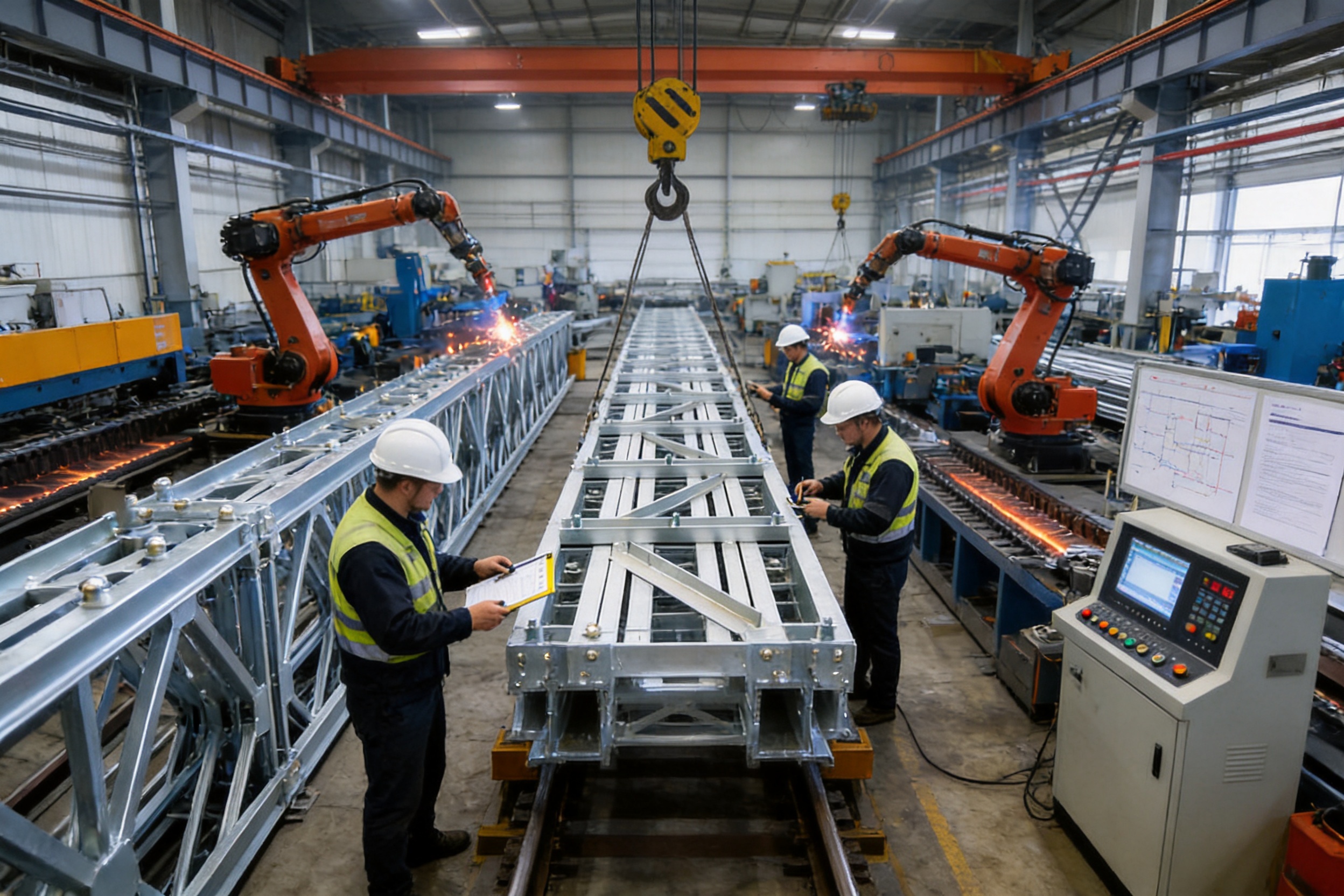
Standardized workflows are central to repeatable bridge production. Standardization allows engineering teams to establish controlled procedures for cutting, forming, drilling, welding, assembly, inspection, galvanizing, marking, and packing. It also reduces variation between components manufactured for different projects.
Advanced automation and automated welding can improve production consistency by controlling welding speed, heat input, position, and repeatability. Automated processes do not replace engineering supervision or inspection, but they can reduce avoidable variation and support stable production for large quantities of similar structural members.
Precision steel fabrication is equally important. Bailey bridge panels and connection components must maintain dimensional accuracy so they can be assembled correctly in the field. Poorly controlled dimensions may cause alignment problems, difficult pin installation, uneven deck support, or delays during erection. Precision fabrication helps ensure that modular parts fit together according to the approved design.
6.1 Engineering and Design Integration
Engineering integration starts with understanding the customer’s project. Important inputs may include the required span, road width, pedestrian requirements, design load, foundation conditions, waterway clearance, construction equipment, transportation restrictions, environmental exposure, installation schedule, and intended service period.
Based on these inputs, the engineering team can determine the appropriate panel arrangement, reinforcement, deck configuration, approach details, bracing requirements, connection components, protective systems, and erection method. This process is more reliable than selecting a standard bridge solely from a product catalog without reviewing the actual site.
Design integration also supports future modifications. A client may initially need a temporary access bridge but later require continued service for local traffic. A modular system can sometimes be strengthened, widened, relocated, or reconfigured, provided that the modification is reviewed and approved by qualified engineers. This adaptability is one of the major advantages of modular bridge technology.
6.2 Material and Fabrication Control
Material control involves verifying steel grades, certificates, dimensions, surface condition, and traceability. Structural steel must be suitable for the intended loads, welding procedures, galvanizing process, and environmental conditions. Maintaining traceability helps connect raw materials with fabricated components and quality records.
Fabrication control includes plate cutting, hole drilling, forming, fit-up, welding, dimensional inspection, and correction of any deviation. Components should be checked for geometry, hole spacing, connection alignment, weld appearance, and surface defects. Quality procedures may include visual inspection and additional non-destructive testing where required by the project specification.
Because modular bridges depend on repeated connections, hole accuracy and connection fit are particularly important. A small dimensional error repeated across many panels can become a significant alignment problem over a full span. Controlled jigs, fixtures, templates, and inspection tools help prevent these issues.
6.3 Galvanizing and Finishing Control
After fabrication and inspection, components can be prepared for hot-dip galvanizing. Surface preparation must remove oil, rust, scale, and other contaminants. The component design must allow molten zinc to reach the required surfaces and drain safely from enclosed areas.
Following galvanizing, the components should be inspected for coating continuity, appearance, adhesion, excessive zinc buildup, blocked holes, distortion, and handling damage. Threads, connection surfaces, and assembly interfaces require particular attention because excessive coating thickness may affect fit. Marking and packing should protect the finished components until they arrive at the site.
7. Competitive Advantages of This Modular Bridge Solution
The CB100 bridge competes with conventional cast-in-place bridges, conventional welded steel bridges, concrete structures, and other temporary access systems. Its advantages arise from the combination of modular construction, customized structural design, hot-dip galvanizing, traffic separation, and integrated manufacturing support.
7.1 Faster Deployment
Modular components can be manufactured before site work is complete. Once foundations, abutments, or support points are ready, the bridge can be assembled using a planned sequence. This reduces dependence on extended on-site fabrication and can shorten the period during which a road, waterway, or work area remains disrupted.
Faster deployment is especially valuable in emergency response, flood recovery, construction detours, remote access, and infrastructure replacement. A bridge that can be transported and assembled efficiently may restore connectivity sooner than a conventional structure requiring extensive formwork, curing, and site-based construction.
7.2 Reduced Site Work
Because major steel components are fabricated in a controlled factory environment, the site may require less welding, cutting, and complex assembly than a fully custom bridge. Reduced site work can lower labor requirements, improve safety management, and reduce exposure to weather-related delays.
This does not mean that installation is simple or that engineering supervision is unnecessary. Bridge erection involves lifting, temporary stability, alignment, connection installation, deck placement, and inspection. However, a well-designed modular system provides a clear sequence and repeatable components, making the construction process more predictable.
7.3 Logistics and Reusability
Modular panels and associated parts can be stacked, packed, transported, and stored more efficiently than many large one-piece bridge elements. Standardized dimensions can simplify shipping plans and inventory management. If the bridge is intended as a temporary structure, its components may be dismantled and reused at another location after inspection and approval.
Reusability can improve the life-cycle value of a modular bridge. The same component inventory may support several projects over time, provided that components remain within acceptable condition and are properly documented. Reuse also reduces material waste compared with systems that are difficult to dismantle or adapt.
7.4 Adaptability to Different Loads and Layouts
The CB100 family can be engineered for different loading conditions and bridge arrangements. The featured project uses a triple-row reinforced single-layer structure, but modular bridge systems can be configured in other ways when the design requires different capacity, width, span, or clearance.
This adaptability allows the supplier to serve highway access, rural roads, industrial facilities, water conservancy projects, emergency routes, military logistics, and construction works. The bridge can be designed around the project rather than forcing every customer to use one unmodified configuration.
7.5 Improved Durability through Galvanizing
The hot-dip galvanized finish gives the bridge an important advantage over unprotected or lightly protected steel. It supports long-term resistance to atmospheric corrosion and reduces dependence on frequent site painting. This is particularly useful in areas where maintenance access is difficult or where weather conditions accelerate deterioration.
7.6 Better Traffic Organization
The combination of double-lane vehicle access and independent pedestrian movement distinguishes this project from many basic temporary bridge solutions. It recognizes that a bridge can be both a transportation structure and a community access facility. By addressing pedestrian needs during the design stage, the bridge can provide a more complete and safer service solution.
8. Installation and Erection Considerations
Although modular bridges are designed for efficient assembly, erection must follow an approved method statement prepared for the specific site. The sequence may include foundation verification, bearing preparation, component inspection, staging, launch nose installation, panel assembly, incremental launching or lifting, deck installation, bracing, barrier installation, approach connection, and final inspection.
The selected erection method depends on the site geometry, available cranes, waterway or road clearance, ground conditions, environmental restrictions, and bridge configuration. Some bridges can be assembled beside the crossing and launched into position. Others may be lifted into place in sections. In all cases, temporary conditions must be checked because the bridge may experience different forces during erection than during normal operation.
Temporary bracing and erection equipment must be suitable for the planned loads. Workers must follow controlled procedures for lifting, pin installation, working at height, access, exclusion zones, and communication. A modular connection that is not fully secured can create serious risks, so connection verification is essential before the bridge is opened to traffic.
After erection, the bridge should be inspected for alignment, bearing seating, panel connections, deck condition, bracing, barriers, pedestrian access, approach transitions, drainage, and clearance. The owner should receive operating restrictions, inspection guidance, maintenance recommendations, and records of the installed configuration.
8.1 Foundation and Approach Requirements
A strong superstructure cannot compensate for inadequate supports. Abutments, piers, foundations, and bearing seats must be designed for the bridge reactions and site conditions. Soil capacity, settlement, scour, flood levels, seismic conditions, and approach stability should be reviewed by the responsible project engineer.
Approach roads require particular attention because abrupt changes in elevation or poor transitions can reduce driving comfort and create impact loads. Drainage should prevent water from accumulating near the abutments or flowing across the deck. Where the bridge crosses a watercourse, hydraulic behavior and debris impact should be considered.
8.2 Safety During Opening and Operation
Before opening, the bridge should have clearly defined load limits, lane controls, speed restrictions, pedestrian rules, and inspection responsibilities. Traffic barriers and pedestrian guardrails should be properly installed. Warning signs should communicate any restrictions to drivers and pedestrians.
Where the bridge is used by heavy trucks, construction equipment, or tracked vehicles, traffic management may need to control vehicle spacing and crossing speed. The permitted loading condition should correspond to the approved design. Operators should never assume that a reinforced modular bridge can carry unlimited loads simply because it is made from heavy steel components.
9. Inspection, Maintenance, and Service-Life Management
Regular inspection helps preserve the bridge’s structural performance and protective coating. Inspections should be scheduled according to traffic intensity, environmental exposure, bridge importance, and applicable regulations. More frequent inspections may be appropriate after floods, strong winds, collisions, unusual vibration, overloading, or other exceptional events.
Inspectors should examine panel members, top and bottom chords, diagonals, transoms, stringers, deck plates, pins, bolts, bracing, bearings, barriers, pedestrian surfaces, and approach connections. Areas that collect dust, water, mud, or debris deserve particular attention because contaminants can retain moisture and create localized corrosion conditions.
Galvanized surfaces should be checked for scratches, impact damage, white corrosion products, red rust, and areas where the coating has been worn by repeated contact. Small areas of damage can often be repaired using approved zinc-rich systems or other procedures compatible with the original coating. Larger damage should be evaluated by qualified personnel.
Connection components should be checked for movement, deformation, wear, missing retaining devices, or signs of abnormal stress. Any loose or damaged component should be addressed promptly. Deck surfaces and pedestrian routes should remain clean, even, and slip-resistant.
Maintenance records should identify inspection dates, observed defects, repair actions, traffic restrictions, and component replacements. Good records help the owner understand service trends and make informed decisions about strengthening, relocation, refurbishment, or replacement.
10. Manufacturing and Project Experience
Jiangsu Zhonghai Bridge Equipment Co., Ltd. has developed its business around modular bridge systems and engineered structural components for domestic and international infrastructure projects. Its stated project experience includes coastal engineering in the Maldives, temporary access bridges associated with the Shenzhen–Zhongshan Corridor, structural components for the Hangzhou Expo Center, multi-span Bailey bridges for the Lalin Railway, and emergency bridge deployments in several regions.
These applications represent different project environments and demonstrate the need for adaptable engineering and production capability. Coastal projects can involve salt exposure and difficult logistics. Major transport corridors require strict coordination and reliable delivery. Railway-related bridge applications demand careful control of geometry and construction sequence. Emergency deployments require speed, organization, and the ability to respond to changing field conditions.
The company’s production strengths include modular bridge fabrication, automated welding, precision steel processing, customized components, bridge erection support equipment, and integrated project assistance. By combining these functions, the supplier can support clients from initial technical discussion through manufacturing, packing, delivery, and on-site installation guidance.
For international customers, manufacturing capability must be matched by communication, documentation, packaging, and delivery discipline. Bridge components are often shipped over long distances and must arrive with clear identification, assembly information, and protection against handling damage. A supplier’s ability to organize these details can be as important as its ability to produce the steel itself.
11. Suitability for Different Infrastructure Applications
The CB100 modular bridge concept can be considered for many applications where a rapid, durable, and adaptable steel crossing is required. Potential uses include rural road access, industrial plant connections, construction detours, emergency replacement bridges, flood-response crossings, water conservancy access, mining and energy projects, military logistics, and temporary public transportation routes.
For rural roads, the double-lane arrangement can support daily movement of passenger vehicles, agricultural equipment, delivery trucks, and service vehicles. The independent pedestrian facility can improve access for residents who do not use motor vehicles.
For construction projects, the bridge can provide temporary access across excavation zones, rivers, transport corridors, and work areas. Its modular nature allows the bridge to be removed or relocated when the construction phase is complete, subject to inspection and engineering approval.
For emergency response, speed and logistics are central concerns. A pre-engineered modular bridge can help restore access after floods, washouts, landslides, bridge failures, or other disasters. Galvanizing provides additional value when the bridge must remain in service while permanent infrastructure is planned.
For industrial facilities, the bridge can connect separated operating areas and support controlled traffic movements. Load customization is important in these situations because industrial vehicles may produce concentrated wheel loads, unusual axle arrangements, or repetitive heavy traffic.
For military and tracked-vehicle applications, the tracked-50 design reference indicates that the system can be evaluated for specialized loading requirements. However, each project must be individually assessed for vehicle weight, track geometry, dynamic effects, traffic frequency, security requirements, and operational restrictions.
12. Selection Guidance for Buyers and Project Owners
When selecting a modular bridge supplier, project owners should evaluate more than the initial product price. A bridge is a safety-critical structure, and the supplier should be able to demonstrate engineering competence, manufacturing control, material traceability, surface-treatment capability, delivery reliability, and technical support.
Buyers should begin by defining the required span, clear roadway width, pedestrian requirements, design loads, service period, environmental exposure, support conditions, construction schedule, and transport limitations. Photographs, site surveys, topographic information, geotechnical data, water levels, and traffic projections can improve the accuracy of the preliminary design.
The supplier should then provide a technical proposal identifying the bridge arrangement, principal components, design assumptions, load model, corrosion protection, erection concept, and inspection requirements. The proposal should clearly distinguish between preliminary information and approved construction documentation.
Quality documentation may include material certificates, welding procedures, inspection records, dimensional reports, galvanizing records, packing lists, assembly drawings, installation instructions, and maintenance guidance. The exact documentation depends on the customer’s standards and regulatory requirements.
Buyers should also ask how the supplier manages component replacement, spare parts, future strengthening, and technical support. Modular bridges are valuable partly because their components can be managed over time. A reliable supplier should help the owner understand how to maintain that value throughout the bridge’s service life.
13. Frequently Asked Questions
What is the main purpose of the CB100 Bailey Bridge?
The bridge is designed to provide a reliable 21-meter modular crossing for vehicle and pedestrian traffic. The featured configuration uses a reinforced single-layer, triple-row arrangement and a double-lane vehicle layout with an independent pedestrian bridge arrangement.
Why is the bridge described as triple-row?
Triple-row refers to the arrangement of three longitudinal truss rows used in the reinforced structural system. This arrangement provides additional load-carrying paths compared with a basic single-row configuration. Final capacity must be confirmed through project-specific engineering calculations.
Is the bridge suitable for two-way traffic?
The double-lane layout is intended to support a two-lane vehicle arrangement. The exact traffic-control method, including whether lanes operate simultaneously in opposite directions, should be established by the approved design and local traffic-management plan.
How are pedestrians accommodated?
The project includes an independent pedestrian bridge arrangement. This separates pedestrian movement from vehicle traffic and can improve safety and operational efficiency when both modes use the crossing.
What are the benefits of hot-dip galvanizing?
Hot-dip galvanizing applies a bonded zinc coating to the steel. The coating provides barrier protection and sacrificial protection, helping the structure resist atmospheric corrosion. It is especially useful in exposed environments such as areas affected by sandstorms, dust, moisture, and temperature changes.
Which load standards can be considered?
The stated design references include HS-15, HS-20, HS-25, HL-93, and tracked-50 loads. The appropriate design model depends on the project’s traffic, regulations, vehicle types, and operating conditions. The final approved engineering documents govern the allowable loads.
Can the bridge be used as a permanent bridge?
Modular Bailey bridges can serve temporary, semi-permanent, or longer-term roles when properly designed, installed, inspected, and maintained. The suitability of a specific bridge for permanent service depends on structural calculations, foundations, environmental exposure, traffic demands, and local approval requirements.
Can the bridge be relocated?
One advantage of modular construction is that components can potentially be dismantled and reused at another location. Relocation requires inspection, engineering review, suitable foundations, and confirmation that the components remain within acceptable condition.
Does galvanizing remove the need for maintenance?
No. Galvanizing significantly improves corrosion resistance but does not eliminate inspection and maintenance. Owners should monitor connections, drainage areas, deck surfaces, impact zones, coating damage, and any areas exposed to standing water or abrasion.
What information should a customer provide for a quotation?
Useful information includes span, roadway width, pedestrian requirements, design load, expected vehicle types, site location, support conditions, waterway or road clearance, environmental exposure, installation method, project schedule, and desired corrosion-protection system.
Why is factory manufacturing important for a modular bridge?
Factory production provides better control over material verification, welding, dimensional accuracy, connection holes, inspection, surface treatment, marking, and packing. These controls help components fit together correctly and reduce avoidable work at the installation site.
14. Conclusion
The CB100 Bailey Bridge represents a practical modular solution for projects that require rapid deployment, dependable load capacity, traffic flexibility, and enhanced durability. Its 21-meter span, reinforced single-layer triple-row configuration, double-lane vehicle arrangement, and independent pedestrian bridge arrangement address both structural and operational requirements.
The customized design approach allows the bridge to be evaluated for loading conditions such as HS-15, HS-20, HS-25, HL-93, and tracked-50, depending on the specific project. This flexibility is important because bridge requirements vary between rural roads, industrial facilities, emergency routes, construction projects, and specialized logistics operations.
Hot-dip galvanizing adds valuable protection for harsh environments such as Chash County, Xinjiang, where sandstorms and large temperature differences can challenge exposed steel structures. With appropriate inspection and maintenance, the galvanized finish can contribute to a longer and more economical service life.
The manufacturing capabilities of Jiangsu Zhonghai Bridge Equipment Co., Ltd. further strengthen the solution. The company combines modular bridge engineering, automated welding, precision fabrication, standardized workflows, quality management, galvanizing, logistics support, and project assistance. This integrated capability helps ensure that the bridge is not merely a collection of steel parts, but a coordinated infrastructure system designed for transport, assembly, operation, and long-term management.
For project owners seeking a bridge that can be manufactured efficiently, transported economically, installed rapidly, adapted to different loading conditions, and protected against severe atmospheric exposure, the reinforced galvanized CB100 system provides a strong platform for customized engineering.
References
1. Bailey, D. and Callender, R. Modular Steel Bridge Design and Erection Principles.
2. American Association of State Highway and Transportation Officials. LRFD Bridge Design Specifications.
3. American Society for Testing and Materials. Standard Practice for Structural Steel Fabrication and Inspection.
4. American Society for Testing and Materials. Standard Specification for Zinc Coating on Iron and Steel Products by Hot-Dip Process.
5. European Committee for Standardization. Eurocode Principles for the Design of Steel Structures and Bridges.
6. International Organization for Standardization. Quality Management Systems and Welding Quality Requirements.
7. Highway bridge loading guidance for HS-series and HL-93 vehicle load models.
8. Technical guidance for tracked-vehicle loading, modular bridge erection, corrosion protection, and structural inspection.
Product: CB 100 Bailey Bridge Double-Lane Triple-Row Single-Layer Reinforced Galvanized Bailey Bridge


We respond quickly to all international requests and provide technical support when needed.
Product Category
Bailey Bridge/Modular Bridge Modular Steel Bridge Pedestrian Bridge Modular Pipe Bridge Truss Bridge Steel StructureContact Us

+86-511-84522866
+86-13921582699

zhwm@zjql.com

Building 1,83#, dantu New Town, Yanjiang Road, Dantu District, Zhenjiang, Jiangsu, China
Copyright © Jiangsu Zhonghai Bridge Equipment Co., Ltd. All
Rights
Reserved
China bailey bridge for sale
bailey bridge supplier from china
