
 English
 русский
 Español
 Português


Tang Yuwei — International Bailey Bridge Sales Manager
Customized Large-Span Heavy-Duty Bailey Construction Support for Complex Projects
Content
- 1 Understanding Customized Bailey Construction Support
- 2 Project Application at Zhangzhou Dongshan
- 3 Key Advantages Over Conventional Support Methods
- 4 Engineering Considerations for Large-Span Support
- 5 Advanced Manufacturing Processes
- 6 Why Industrial Manufacturing Capacity Matters
- 7 Comparison with Other Support Solutions
- 8 Technical and Operational Benefits for Contractors
- 9 Typical Product and Project Information
- 10 Inspection, Maintenance, and Safe Use
- 11 Project Coordination and Technical Support
- 12 Applications Beyond the Zhangzhou Dongshan Project
- 13 Manufacturing Strengths of the Supplier
- 14 Selection Guide for Project Owners and Contractors
- 15 Conclusion
- 16 Questions and Answers
- 16.1 What is customized Bailey construction support?
- 16.2 What panel configurations were supplied for the Zhangzhou Dongshan Project?
- 16.3 What load scenarios is the system intended to address?
- 16.4 Why are the panels painted different colors?
- 16.5 How does the anti-corrosion coating improve the system?
- 16.6 Can Bailey construction support be used for large spans?
- 16.7 Can the components be reused?
- 16.8 What manufacturing capabilities are important for this type of product?
- 16.9 Is onsite welding required?
- 16.10 What information should a buyer provide when requesting a quotation?
- 16.11 How should the system be inspected during use?
- 16.12 What makes an integrated manufacturer advantageous?
- 17 References
- 18 Product: Customized Large Span Super Bailey Construction Support
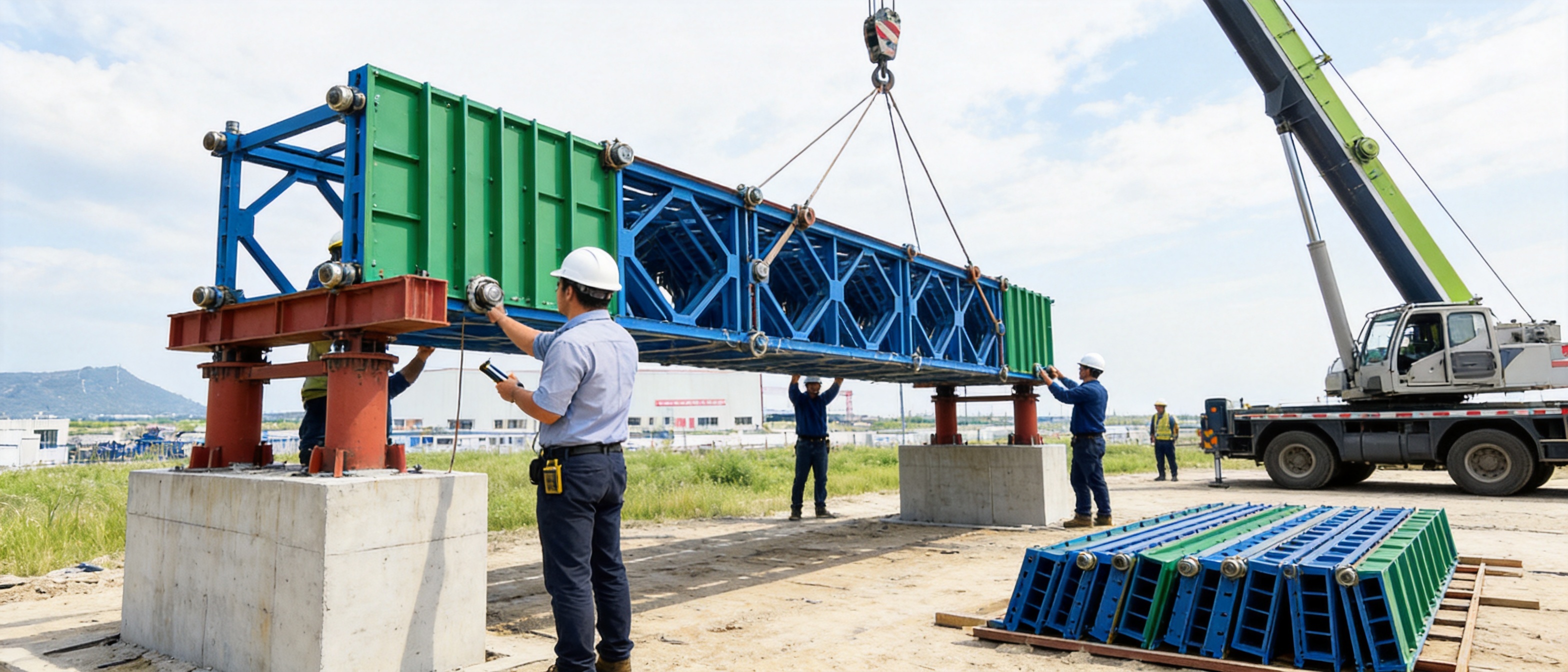
Large infrastructure projects often require temporary or semi-permanent support systems capable of carrying substantial construction loads while maintaining stability, speed, and flexibility. When a project involves long spans, difficult access conditions, changing construction sequences, and demanding outdoor exposure, a conventional support arrangement may not provide the necessary combination of strength and adaptability. Customized Bailey construction support offers an efficient alternative by combining modular steel components, engineered load paths, rapid assembly, and reusable structural elements.
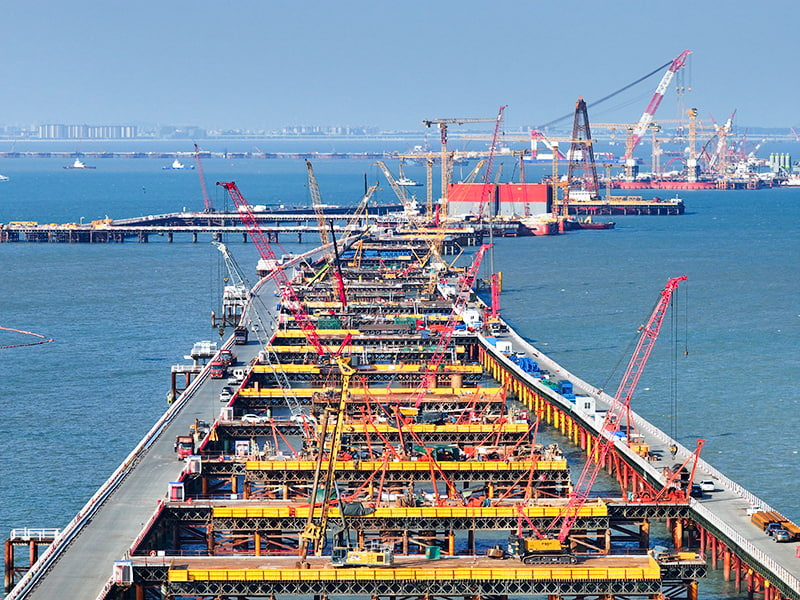
The customized system supplied for the Zhangzhou Dongshan Project demonstrates how Bailey technology can be adapted for large-span and heavy-load construction applications. The system uses specially manufactured Bailey panels in two configurations: 3 m × 1 m panels with green paint and 3 m × 6 m panels with blue paint. The color differentiation is more than an aesthetic feature. It assists with component identification, installation organization, inspection, and onsite management, especially when multiple panel types and support arrangements are used simultaneously.
Designed for demanding load-bearing scenarios such as HS-15, HS-20, HS-25, HL-93, and Track-50, this construction support system is intended for projects where reliable structural performance is essential. Its modular configuration allows the support arrangement to be planned around the project’s span, height, access limitations, and construction sequence. At the same time, its protective coating is designed to resist rust and corrosion in complex outdoor environments, helping extend service life and reduce maintenance requirements.
Manufactured by Jiangsu Zhonghai Bridge Equipment Co., Ltd., the system reflects a broader capability in modular steel bridge production, Bailey bridge engineering, steel component fabrication, automated welding, and construction support equipment. By combining design, manufacturing, quality management, and technical support, the supplier can provide more than individual steel panels. It can deliver a coordinated support solution tailored to the structural and operational needs of a specific project.
Understanding Customized Bailey Construction Support
Bailey construction support is based on the principle of modular steel assembly. Standardized panels, connecting components, bracing members, transoms, decks, and support accessories are combined to create a temporary or permanent structural arrangement. Depending on the project, the system may function as a bridge, a trestle, a temporary access route, a construction platform, a heavy-load support frame, or a structural support arrangement for staged construction.
A conventional bridge system is usually designed as a completed structure with fixed geometry and a defined service function. A construction support system has different priorities. It may need to be erected before the final structure is complete, adjusted as construction progresses, dismantled after use, and reused at another location. This makes modularity, transportability, assembly speed, and component interchangeability especially important.
Customized Bailey support extends the basic modular concept by adapting the panel arrangement and component specifications to project-specific requirements. Customization may involve panel dimensions, paint colors, load configuration, bracing layout, support spacing, connection details, deck arrangements, lifting points, or compatibility with existing construction equipment. The objective is to preserve the benefits of standardized production while providing a system that fits the actual project conditions.
For large-span applications, the support system must control deflection, distribute loads efficiently, resist lateral movement, and remain stable during erection. Heavy loads can be generated by construction vehicles, cranes, formwork, materials, concrete placement, temporary machinery, or railway-related equipment. The structural arrangement must therefore be considered as a complete system rather than as a collection of individual panels.
A properly configured Bailey support system transfers loads through a clear sequence. Applied loads move from the deck or working platform into transoms and longitudinal members, then into the main truss or panel lines, through the bracing and bearing points, and finally into the foundations or supporting ground. Each connection and support interface contributes to overall performance. This is why project-specific engineering and accurate fabrication are essential for large-span construction support.
Project Application at Zhangzhou Dongshan
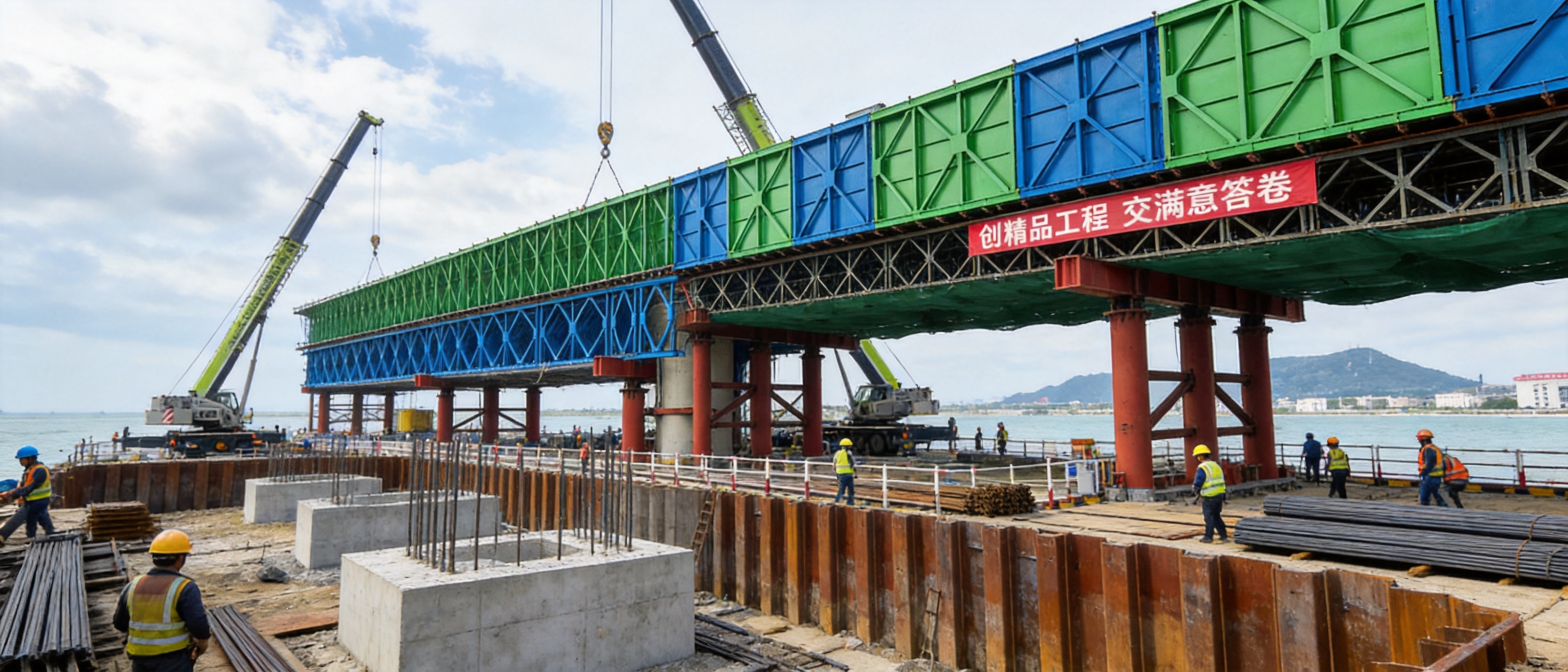
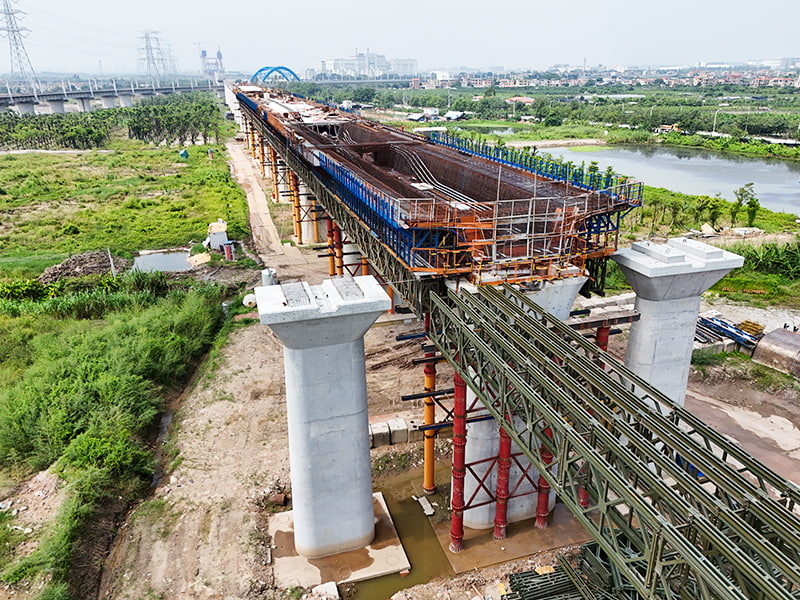
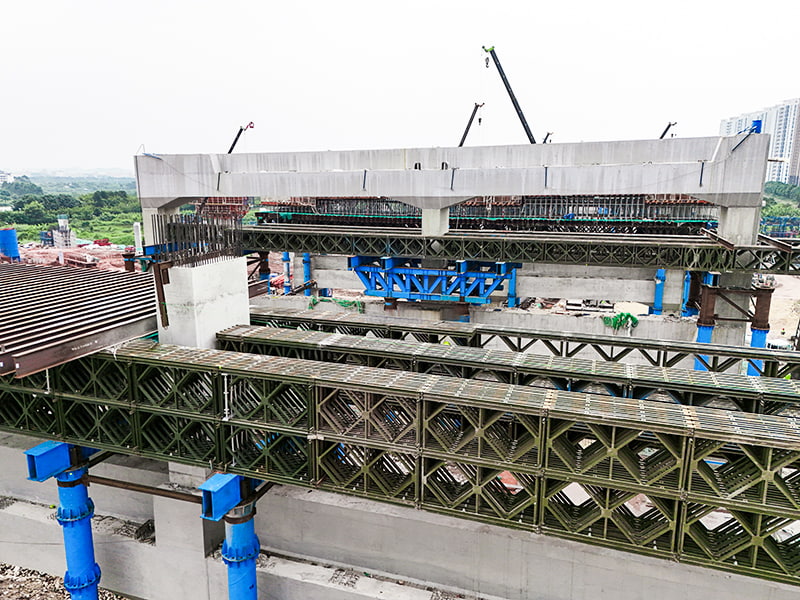
The Zhangzhou Dongshan Project required a customized Bailey construction support arrangement for large-span and heavy-load conditions. The supplied solution used two visually distinct panel configurations. The 3 m × 1 m green panels and 3 m × 6 m blue panels were manufactured and coated for use within the project’s support system.
Using different colors for different panel types improves onsite coordination. Large construction projects often involve multiple crews, work zones, delivery batches, and erection stages. When components are visually distinguishable, workers can identify the required panel type more quickly and reduce the risk of selecting an incorrect member. Color coding can also support inventory checks, installation records, dismantling plans, and maintenance inspections.
Color identification is particularly useful when the support system contains components with different dimensions or different structural functions. A clear visual system can help supervisors compare the installed arrangement with drawings and assembly instructions. It can also make it easier to identify missing components, incomplete bracing, or sections that require inspection before loading.
The system was prepared for load-bearing scenarios including HS-15, HS-20, HS-25, HL-93, and Track-50. These designations represent demanding loading references used in different transportation and construction contexts. The exact allowable load, span, configuration, and support spacing must always be confirmed through project-specific calculations and approved engineering documentation. Nevertheless, the range of scenarios illustrates the system’s intended role in heavy-duty support applications rather than light temporary access alone.
The project solution also emphasizes corrosion resistance. Construction support equipment is frequently exposed to rain, humidity, dust, mud, coastal air, sunlight, and repeated handling. Unprotected steel can develop surface rust, while corrosion at connections or bearing interfaces may affect inspection and long-term reliability. The exclusive anti-corrosion coating applied to the panels provides a protective barrier and contributes to a longer service life in outdoor construction environments.
For the Zhangzhou Dongshan Project, the combination of large-span capability, heavy-load suitability, visual panel identification, and protective coating created a support solution intended to improve construction efficiency without compromising structural reliability. The system helps contractors organize complex erection operations and provides a practical platform for demanding construction stages.
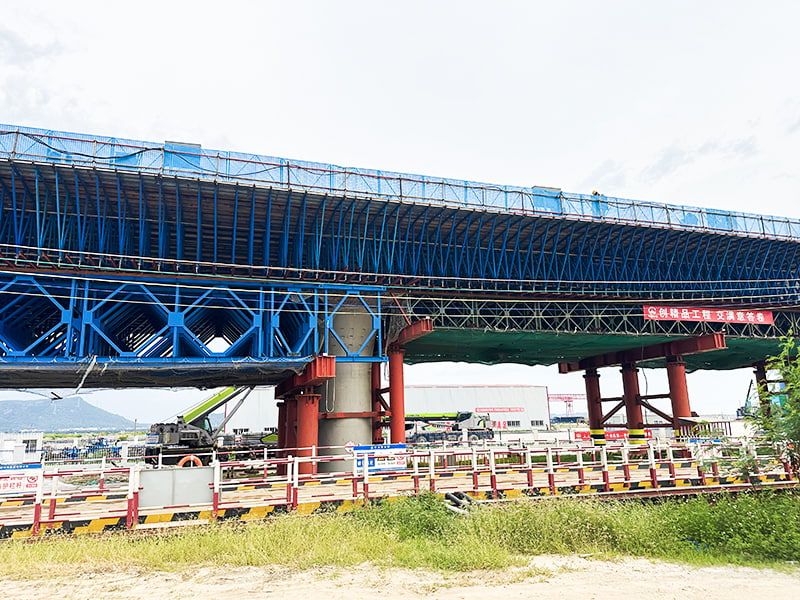
Customized Large Span Super Bailey Construction Support
Key Advantages Over Conventional Support Methods
Modular Adaptability
The primary advantage of a Bailey support system is its modular design. Components can be combined in different arrangements to accommodate changing span lengths, support heights, working widths, and load conditions. Instead of fabricating an entirely new support structure for every project, contractors can use compatible modular elements and adjust the configuration as required.
This adaptability is valuable when site conditions are uncertain or when the construction sequence may change. A support system may need to be extended, strengthened, shifted, or partially dismantled during the project. Modular components make these changes more practical than they would be with a fully welded, one-off structure.
Faster Assembly and Construction Progress
Bailey panels are manufactured with repeatable dimensions and prepared connection details. This allows erection crews to follow a defined assembly process instead of performing extensive onsite cutting, drilling, and welding. Reduced field fabrication can shorten installation time and reduce dependence on specialized hot-work operations at elevated or difficult-to-access locations.
Faster assembly can directly affect the overall construction schedule. Temporary support is often a prerequisite for subsequent activities such as formwork installation, concrete placement, steel erection, equipment movement, or structural inspection. If support installation is delayed, several downstream operations may also be delayed. A coordinated modular system helps contractors establish a stable working platform sooner.
Heavy-Load Performance
Large-span construction support must withstand more than its own weight. It may carry construction materials, temporary equipment, workers, vehicles, formwork, fresh concrete, or railway-related loads. The system supplied for the Zhangzhou Dongshan Project was prepared for load-bearing scenarios that include HS-15, HS-20, HS-25, HL-93, and Track-50 references.
Its heavy-duty performance comes from the combined action of the panels, transverse members, longitudinal members, bracing, connections, bearings, and foundations. Increasing capacity is not simply a matter of adding more steel. The complete arrangement must be assessed for compression, tension, bending, shear, buckling, vibration, lateral stability, and connection behavior. A properly engineered modular system provides a controlled load path and reduces the risk of local instability.
Large-Span Capability
Large spans create structural challenges because deflection and stability become increasingly important as the distance between supports increases. A support arrangement designed for a short span may not be appropriate for a long-span application, even if the individual panels appear similar. Large-span systems require careful consideration of panel lines, truss depth, bracing, bearing conditions, erection stages, and temporary restraint.
Customized Bailey construction support can be configured to address these conditions. Additional panel lines, deeper truss arrangements, stronger bracing patterns, or modified support spacing may be introduced according to engineering requirements. The modular format gives designers several options for improving capacity and controlling deformation without abandoning the basic system.
Reusability and Lifecycle Value
Many temporary support structures are used for a limited construction period but represent a significant investment. A modular Bailey system can be dismantled after completion and redeployed for another project, provided that the components remain within acceptable condition and are inspected before reuse. This improves lifecycle value and reduces the need to fabricate new temporary structures for every job.
Reusable components also support more sustainable construction practices. Steel panels and accessories can remain in circulation for multiple projects instead of becoming single-use materials. Standardized parts are easier to catalog, inspect, repair, repaint, and store than irregular one-off assemblies.
Clear Onsite Management
The green and blue panel finishes used for the Zhangzhou Dongshan Project provide a practical management benefit. Visual differentiation can support receiving inspection, component allocation, erection sequencing, and final inventory. It can also assist in identifying areas that require repair or replacement during dismantling.
On large worksites, communication errors can create substantial delays. A color-coded component system gives supervisors and installation teams an additional method of confirming that the correct member is being used in the correct position. Combined with drawings, marking systems, and inspection records, color coding can improve traceability from factory delivery through final dismantling.
Outdoor Durability
Temporary does not mean unprotected. Construction support may remain outdoors for months or even years, depending on the project schedule. It can be exposed to rainfall, high humidity, airborne pollutants, soil contact, repeated wetting and drying, and mechanical damage from handling.
The anti-corrosion coating applied to the customized panels is intended to provide resistance against rust and corrosion. A suitable coating improves the appearance of the structure while creating a protective layer between the steel substrate and the surrounding environment. Its effectiveness depends on proper surface preparation, application control, coating thickness, handling procedures, and maintenance during service.
Engineering Considerations for Large-Span Support
Large-span Bailey support should be designed as an engineered temporary works system. The fact that components are modular does not eliminate the need for structural calculations. Each project presents unique conditions involving span, height, foundation capacity, applied loads, wind exposure, erection sequence, and adjacent structures.
Load Identification
The first step is to identify all loads that may act on the support. These can include dead load from the Bailey panels and accessories, construction live load, vehicle load, crane load, material storage load, formwork load, fresh concrete load, impact load, wind load, temperature effects, and possible accidental or eccentric loading.
The HS-15, HS-20, HS-25, HL-93, and Track-50 references provide useful starting points for defining heavy-load scenarios. However, the final design should account for the actual vehicle or equipment dimensions, wheel spacing, axle configuration, dynamic effects, load position, and construction sequence. A load that is acceptable at the center of a span may produce a different response when placed near a support or close to an edge.
Deflection Control
Strength is only one part of performance. Excessive deflection may affect formwork alignment, concrete geometry, equipment operation, worker safety, and the quality of the final structure. Large-span support should therefore be checked for serviceability as well as ultimate capacity.
Deflection can be influenced by panel stiffness, truss depth, span length, connection slip, bracing effectiveness, bearing settlement, and load distribution. In some applications, controlled pre-camber may be considered to offset expected deformation. Any such measure must be included in the approved design and verified during erection.
Overall and Local Stability
Bailey panels carry axial and bending forces through slender steel members. The support system must be checked for local buckling of individual members and global buckling of the complete truss or support frame. Lateral bracing is essential because a system that is strong in its primary vertical plane may still be vulnerable to sideways movement or torsional instability.
Wind can be significant for elevated construction supports, especially when panels, formwork, screens, or deck systems create a large exposed surface. Temporary conditions during partial erection may be more critical than the completed arrangement. Stability measures should therefore be considered for every construction stage, not only for the final loaded configuration.
Foundations and Bearings
The performance of a steel support system depends on the ground or structure beneath it. Bearing points must transfer vertical and horizontal forces without excessive settlement, sliding, rotation, or local crushing. The foundation may consist of concrete pads, steel stools, piles, existing structural members, or another approved support arrangement.
Even a correctly fabricated Bailey system can experience unacceptable movement if its bearings are uneven or its foundations are weak. Site investigation, bearing pressure checks, drainage planning, and settlement monitoring are therefore important parts of the engineering process.
Erection Sequence
Construction support should be evaluated during erection, use, modification, and dismantling. Temporary cantilever conditions, partially braced panels, lifting operations, and incomplete connections may create force combinations that do not occur in the final arrangement.
A controlled erection sequence should identify lifting points, temporary restraints, access requirements, connection checks, bracing installation, and inspection hold points. The modular nature of the system helps simplify the sequence, but only when the components are assembled according to approved drawings and procedures.
Advanced Manufacturing Processes
The quality of a modular support system is strongly influenced by manufacturing consistency. Repeated components must maintain accurate dimensions so that they fit together during field assembly. Small deviations in hole positions, panel geometry, weld alignment, or connection details can accumulate over a long span and make installation more difficult.
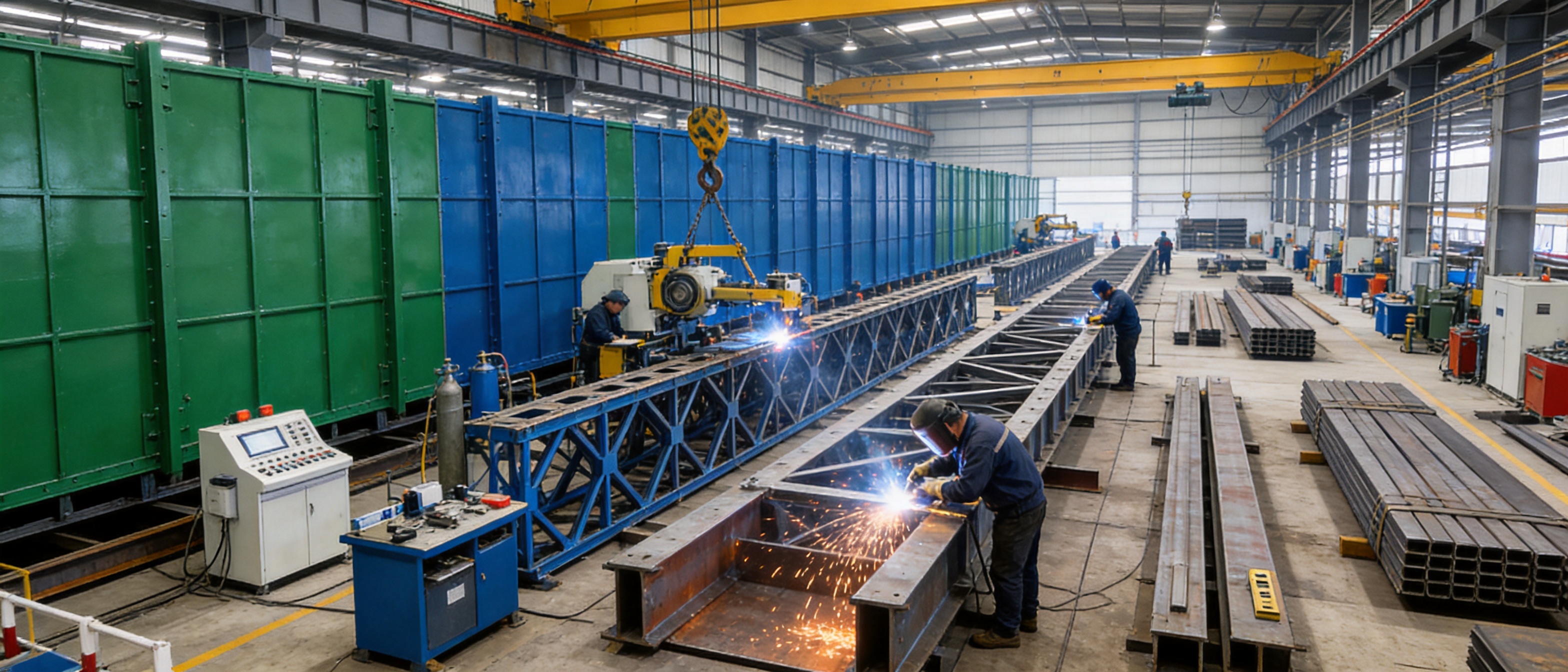
Jiangsu Zhonghai Bridge Equipment Co., Ltd. integrates engineering design, precision manufacturing, quality management, and technical support. Its production capabilities include modular steel bridge fabrication, Bailey bridge systems, customized steel components, automated welding, and precision steel fabrication. These capabilities are relevant to the production of customized construction support because the system requires both standardized repeatability and project-specific adaptation.
Engineering and Production Coordination
Manufacturing begins with a clear understanding of the project requirements. Drawings, load scenarios, panel configurations, connection details, coating requirements, and delivery conditions must be coordinated before production. This reduces the risk of producing components that meet a generic standard but do not suit the intended project arrangement.
Engineering and production teams can work together to identify practical fabrication details, optimize material usage, and plan inspection points. When the same organization manages design coordination and fabrication, technical questions can often be resolved more efficiently than when responsibilities are divided among unrelated suppliers.
Material Preparation and Cutting
Steel preparation affects the accuracy and reliability of the completed panel. Material should be received, identified, and prepared according to approved specifications. Cutting equipment and procedures should produce clean edges and consistent dimensions. Poorly controlled cutting may introduce distortion, excessive heat effects, or dimensional variation.
Precision preparation is especially important for components that must align with standardized connection holes or fit within a repeated panel arrangement. Accurate cutting reduces onsite adjustment and helps maintain consistent load transfer across the system.
Automated Welding
Automated welding contributes to repeatability and production efficiency. Compared with uncontrolled manual welding, automated processes can provide more consistent travel speed, weld size, heat input, and positioning when properly set up and monitored. This is valuable for repeated components produced in industrial quantities.
Automated welding does not replace inspection or skilled technical oversight. Welding parameters, joint preparation, consumables, equipment condition, and operator qualifications must still be controlled. Welded components should be checked for dimensional accuracy, visible defects, distortion, and conformity with the approved fabrication requirements.
Precision Assembly and Dimensional Inspection
After individual components are fabricated, trial assembly or dimensional verification may be used to confirm that parts align correctly. Inspection can include overall length and width, hole spacing, panel squareness, connection fit, weld appearance, and straightness of critical members.
Dimensional control is particularly important for large-span applications because small errors can become more significant when many panels are connected in series. Accurate factory production reduces the need for forced alignment onsite, protecting connection components and improving erection efficiency.
Surface Preparation and Coating
Corrosion protection depends on more than the final paint color. Surface preparation, cleaning, removal of mill scale or contaminants, environmental conditions, coating compatibility, and curing time all influence coating performance. The selected process should create a sound bond between the steel surface and the protective coating.
The customized Zhangzhou Dongshan panels use green and blue finishes for visual identification. The color system supports site organization while the anti-corrosion coating provides protection for outdoor service. Coating inspection may include visual examination, coverage assessment, thickness checks, and repair of areas affected by lifting, transport, or assembly.
Factory Quality Management
A structured quality management process helps ensure that the finished system meets project expectations. Typical controls may include material identification, process inspection, weld inspection, dimensional checks, coating checks, packing verification, and final documentation.
Quality management is most effective when it is integrated into production rather than applied only at the end. Early identification of dimensional or welding issues reduces rework, protects delivery schedules, and improves confidence in field assembly.
Why Industrial Manufacturing Capacity Matters
Large infrastructure projects require more than a product catalog. They require a supplier capable of maintaining delivery schedules, producing repeated components consistently, responding to engineering changes, and supporting logistics for large quantities of steelwork.
An industrial-scale manufacturing operation provides several advantages over small, purely project-based fabrication. It can use standardized workflows, dedicated production areas, repeatable tooling, organized material handling, and established inspection procedures. These features help reduce variation between batches and improve the predictability of delivery.
Industrial capacity is also important when a project requires customized components. Customization can sometimes slow production if every component is treated as a completely unique item. A capable manufacturer can combine standard modular parts with controlled customization, preserving production efficiency while meeting special requirements such as unusual panel sizes, color identification, added bracing, or project-specific accessories.
The supplier’s location in Zhenjiang, Jiangsu Province, places its operations within an important industrial and transportation region. Access to manufacturing resources, steel supply networks, transportation infrastructure, and skilled technical personnel can support efficient production and international delivery.
For overseas infrastructure projects, delivery performance is as important as fabrication quality. Bridge panels and support components must be packed to protect edges, connection points, coating surfaces, and small accessories during handling and transportation. Clear packing lists and component identification can simplify customs processing, receiving inspection, and onsite inventory control.
Comparison with Other Support Solutions
Compared with Conventional Scaffolding
Conventional scaffolding is useful for access, light platforms, and low-rise temporary work. However, it may not be suitable for long spans or heavy concentrated loads unless specially engineered. Bailey support systems generally offer a more deliberate structural load path and greater capacity potential for transportation-related construction loads.
Scaffolding systems often use many small members and connections. A modular Bailey system uses larger steel panels and organized truss lines, which can reduce the number of individual structural components required for a large-span arrangement. The appropriate choice depends on span, load, height, access, foundation conditions, and local regulations.
Compared with Cast-In-Place Temporary Supports
Cast-in-place temporary supports can provide strong and rigid arrangements, but they may require significant quantities of concrete, formwork, labor, curing time, and later demolition. They are also less reusable and may create more construction waste.
Modular steel support can be assembled more quickly and removed with less permanent alteration to the site. It can be reused after inspection, making it attractive for projects with tight schedules or repeated temporary works.
Compared with One-Off Welded Frames
A one-off welded frame can be designed for a specific location, but it may require extensive engineering, fabrication, onsite welding, and dismantling work. Once the project is complete, its reuse potential may be limited.
Customized Bailey support combines project adaptation with modular standardization. The panels can be configured for the required application while retaining a level of interchangeability for future projects. This can improve lifecycle value and shorten future procurement cycles.
Compared with Imported Generic Kits
Generic modular kits may be available quickly, but they may not match the project’s actual loading references, panel dimensions, coating requirements, color identification needs, or delivery schedule. A supplier capable of customization can adapt the system more closely to the client’s engineering and site-management requirements.
The key competitive distinction is not simply the presence of modular steel panels. It is the ability to coordinate design, manufacturing, quality assurance, protective coating, documentation, and technical support as one complete service.
Technical and Operational Benefits for Contractors
Contractors using customized Bailey construction support can benefit from improved planning. Before delivery, the panel arrangement can be organized around the construction sequence, lifting capacity, available access routes, and storage limitations. This helps reduce unexpected field modifications.
During assembly, standardized connection details and color-coded panel types can make the work easier to supervise. Installation teams can identify components rapidly, while project managers can compare the erected structure with the approved layout. A clear assembly process can also reduce idle time for cranes and other equipment.
During service, the steel support system can be inspected visually. Coating condition, connection pins, bolts, bracing members, bearing points, and deformation can be monitored. If a component is damaged, modular construction may allow replacement of the affected part rather than demolition of the entire support structure.
During dismantling, the same modular characteristics provide advantages. Components can be separated in a planned sequence, inspected, marked, and returned to storage or transported to another project. This is particularly useful for contractors operating multiple infrastructure sites.
Typical Product and Project Information
| Item | Customized Bailey Construction Support |
|---|---|
| Primary application | Large-span construction support, heavy-load temporary works, bridge and infrastructure construction |
| Project example | Zhangzhou Dongshan Project |
| Panel configuration | 3 m × 1 m green panels and 3 m × 6 m blue panels |
| Load references | HS-15, HS-20, HS-25, HL-93, and Track-50 scenarios |
| Structural material | Engineered modular steel components |
| Protection | Anti-corrosion coating for outdoor construction environments |
| Management feature | Color differentiation for component identification and onsite organization |
| Manufacturing capabilities | Precision steel fabrication, automated welding, modular bridge production, customized steel components |
| Lifecycle potential | Assembly, inspection, dismantling, maintenance, and reuse where engineering conditions permit |
Inspection, Maintenance, and Safe Use
A reliable support system requires proper inspection before, during, and after use. Before erection, components should be checked for transport damage, excessive corrosion, distortion, cracked welds, missing connection hardware, and coating damage. Any item that does not meet the project’s acceptance criteria should be isolated for assessment.
During erection, supervisors should verify panel orientation, connection completion, bracing installation, bearing position, support alignment, and conformity with the approved drawings. The structure should not be loaded until required inspections and approvals have been completed.
During operation, inspection frequency should reflect the project environment and loading intensity. Heavy construction traffic, vibration, wind, impact, settlement, or repeated changes to the support arrangement may require additional checks. Inspectors should look for unusual deflection, loosened connections, coating failure, local buckling, foundation movement, and unauthorized alterations.
Coating maintenance is also important. Scratches caused by transport or assembly should be repaired using a compatible system. Areas exposed to standing water, soil, chemical contamination, or salt-laden air may require particular attention. Keeping drainage paths clear can help reduce prolonged moisture exposure.
After dismantling, the components should be cleaned, inspected, and recorded. Damaged panels or accessories should be repaired or removed from service according to engineering judgment. A well-maintained inventory improves readiness for future projects and helps preserve the economic advantages of modular reuse.
Project Coordination and Technical Support
Customized construction support is most effective when the supplier is involved early. Early coordination allows the project team to provide span requirements, target loads, construction stages, site restrictions, foundation information, access conditions, and delivery expectations. The manufacturer can then recommend a practical configuration and identify issues before fabrication begins.
Technical coordination may include layout drawings, panel schedules, connection details, erection instructions, packing lists, coating specifications, inspection records, and maintenance guidance. These documents help link factory production with field installation.
For international projects, communication and documentation are especially important. Terminology, loading references, standards, units, packaging requirements, and local approval procedures should be clarified in advance. A supplier experienced in global infrastructure delivery can help reduce misunderstandings and coordinate production with export logistics.
Jiangsu Zhonghai Bridge Equipment Co., Ltd. serves transportation, water conservancy, military logistics, disaster relief, and international development applications. This range of applications reflects the need for adaptable structural products that can operate in both planned construction environments and urgent response situations.
Applications Beyond the Zhangzhou Dongshan Project
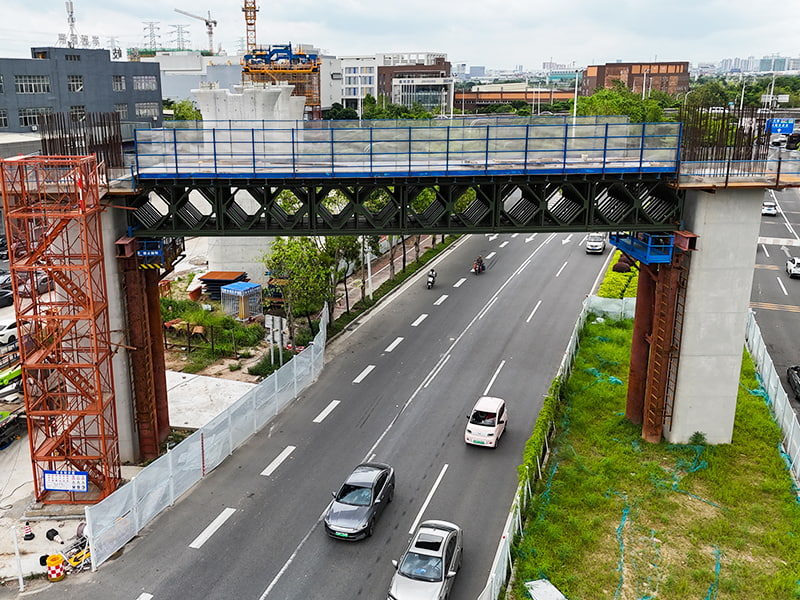
The same type of customized Bailey support can be considered for temporary access bridges, construction trestles, pier support, formwork support, material handling routes, heavy equipment crossings, and emergency logistics infrastructure. It may be suitable for road, railway, water conservancy, coastal, industrial, and civil engineering projects, subject to project-specific design.
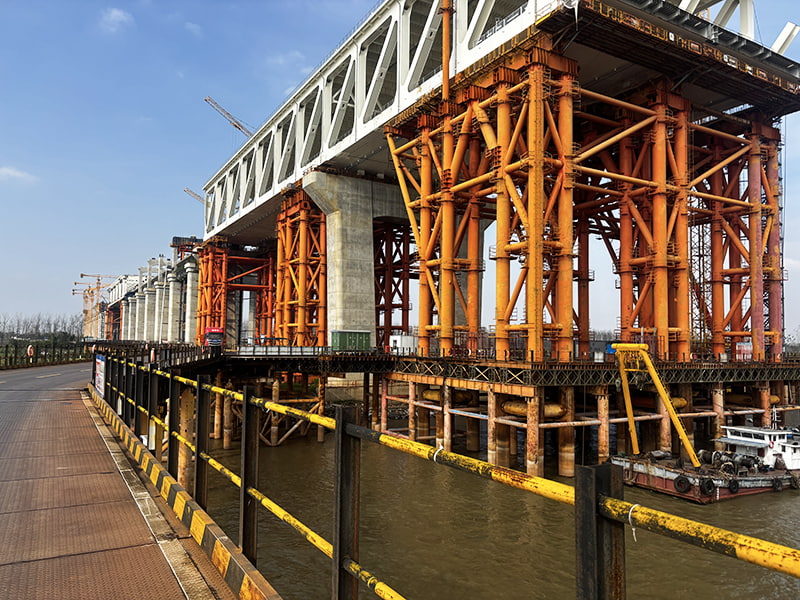
In water-related construction, modular support can provide access across channels or around active work zones. In railway construction, a heavy-duty configuration can support temporary access and construction operations where loading and alignment requirements are stringent. In disaster response, modular components can be transported and assembled quickly to restore access or establish temporary working routes.
For coastal or humid environments, corrosion protection becomes especially important. The anti-corrosion coating and inspection program should be selected with the exposure conditions in mind. In areas with salt spray, frequent rainfall, or high humidity, regular inspection and prompt repair of coating damage can help preserve performance.
In industrial construction, the system may be used to support temporary platforms, equipment access, pipe installation, or staged erection. Its modular design can be beneficial when the support arrangement must be adjusted as machinery, materials, and work fronts change.
Manufacturing Strengths of the Supplier
The company’s core strength is its integrated approach to modular steel infrastructure. Rather than focusing only on the sale of standard bridge panels, it combines engineering design, fabrication, quality control, and project support. This approach is important for customized systems because the final result depends on coordination across every stage.
Its product scope includes modular steel bridges, Bailey bridge systems, customized steel components, bridge erection and construction support equipment, automated welding, and precision steel fabrication. These capabilities allow the supplier to address both complete modular bridge requirements and specialized structural components.
The use of standardized workflows supports repeatable production, while industrial manufacturing capacity supports larger orders and consistent delivery. Automated welding and precision fabrication help improve dimensional reliability. Quality management provides a framework for controlling materials, welding, assembly, coatings, and final release.
The company has supplied products for major engineering applications in China and abroad, including coastal engineering in the Maldives, temporary access bridges for the Shenzhen–Zhongshan Corridor, structural components for the Hangzhou Expo Center, multi-span Bailey bridges for the Lalin Railway, and flood-response and emergency bridge deployments. These applications demonstrate experience across transportation, coastal, railway, exhibition, and emergency infrastructure contexts.
For buyers comparing suppliers, this combination of product breadth and manufacturing depth can be more valuable than a low unit price alone. A support system must perform in the field, arrive on schedule, fit its intended arrangement, and remain manageable throughout installation and removal. Integrated production helps address these requirements as a connected package.
Selection Guide for Project Owners and Contractors
When selecting a customized Bailey construction support system, project owners and contractors should begin with the intended function. Is the system required to carry vehicles, railway equipment, formwork, construction materials, cranes, or a combination of loads? Will it be temporary, semi-permanent, or reused across several projects? Clear answers help define the required configuration.
The next consideration is geometry. Important information includes clear span, total support height, working width, deck elevation, access restrictions, foundation locations, and available erection space. If the system must pass over a road, river, railway, or active work zone, clearance requirements should be identified at the beginning.
Environmental conditions should also be reviewed. Rain, humidity, coastal exposure, industrial pollutants, temperature variation, wind, flood risk, and soil conditions can affect material protection and foundation design. The coating system, inspection schedule, drainage arrangements, and storage plan should reflect the actual environment.
Buyers should request appropriate technical documentation, including general arrangement drawings, load information, component schedules, material details, inspection records, coating information, and erection guidance. The precise documentation required will depend on local regulations and the project’s approval process.
Finally, the supplier’s ability to provide after-sales support should be considered. Technical questions often arise during installation, especially when site conditions differ from preliminary assumptions. A responsive manufacturer can help resolve issues before they affect safety or the schedule.
Conclusion
Customized large-span Bailey construction support provides a practical combination of modularity, heavy-load capability, rapid assembly, corrosion protection, and lifecycle value. The system prepared for the Zhangzhou Dongshan Project demonstrates how standardized steel technology can be adapted to demanding project requirements through customized panel configurations, color-coded identification, and outdoor protective coating.
The use of 3 m × 1 m green panels and 3 m × 6 m blue panels supports both structural planning and onsite management. The ability to address HS-15, HS-20, HS-25, HL-93, and Track-50 load scenarios makes the system relevant to heavy construction applications, subject to project-specific engineering verification. Its large-span configuration helps contractors establish reliable temporary works where conventional support methods may be slower, less adaptable, or more difficult to reuse.
The supplier’s strengths extend beyond the finished panels. Engineering coordination, precision fabrication, automated welding, industrial production, quality management, coating control, and technical support contribute to a complete project solution. These capabilities help maintain dimensional consistency, improve delivery reliability, and reduce the risk of onsite modification.
For infrastructure contractors, bridge builders, civil engineering companies, emergency response organizations, and international development projects, a customized Bailey support system can provide a safe and efficient foundation for complex construction operations. When correctly designed, fabricated, inspected, and maintained, it can accelerate construction progress while offering the flexibility and durability required for challenging outdoor environments.
Questions and Answers
What is customized Bailey construction support?
Customized Bailey construction support is a modular steel support system adapted to the span, loading, geometry, environment, and construction sequence of a particular project. It may use standard modular principles while incorporating special panel sizes, colors, bracing arrangements, connection details, or accessories.
What panel configurations were supplied for the Zhangzhou Dongshan Project?
The project used specially manufactured 3 m × 1 m green Bailey panels and 3 m × 6 m blue Bailey panels. The different colors support component identification and onsite management.
What load scenarios is the system intended to address?
The system is suitable for load-bearing scenarios referenced as HS-15, HS-20, HS-25, HL-93, and Track-50. The final allowable loading and configuration must be confirmed through project-specific structural calculations and approved technical documentation.
Why are the panels painted different colors?
Color differentiation makes it easier to identify panel types during delivery, storage, erection, inspection, dismantling, and inventory management. It can reduce selection errors when several panel configurations are used on the same project.
How does the anti-corrosion coating improve the system?
The coating provides a protective barrier against moisture and environmental exposure, helping resist rust and corrosion. It can extend service life and reduce maintenance requirements, particularly when the system is used outdoors. Coating damage should still be repaired and inspected during service.
Can Bailey construction support be used for large spans?
Yes, Bailey systems can be configured for large-span applications when the panel arrangement, bracing, bearings, foundations, and erection sequence are properly engineered. Span length, applied load, deflection, lateral stability, and support conditions must all be checked.
Can the components be reused?
Modular Bailey components can often be dismantled, inspected, maintained, and reused when they remain within acceptable structural and dimensional condition. Reuse should be based on inspection results and engineering requirements for the next application.
What manufacturing capabilities are important for this type of product?
Important capabilities include engineering coordination, precision cutting, controlled welding, automated welding where appropriate, dimensional inspection, surface preparation, coating application, quality management, and organized packing. These processes help ensure that repeated components fit together correctly onsite.
Is onsite welding required?
The modular system is intended to minimize onsite fabrication by using prepared connections and standardized components. The exact installation method depends on the approved design. Any field welding or modification should be authorized and controlled by qualified technical personnel.
What information should a buyer provide when requesting a quotation?
Useful information includes the required span, support height, working width, target loads, construction equipment, site environment, foundation conditions, erection method, delivery location, desired coating, project schedule, and whether the system must be reusable. Drawings and load data improve quotation accuracy.
How should the system be inspected during use?
Inspection should cover panel condition, welds, connection pins or bolts, bracing, bearings, alignment, deflection, coating condition, foundation movement, and unauthorized modifications. Inspection frequency should reflect the project’s loading, environment, and construction activity.
What makes an integrated manufacturer advantageous?
An integrated manufacturer can coordinate engineering, production, inspection, coating, packing, and technical support through one organization. This can improve communication, reduce fabrication inconsistencies, and make it easier to respond to project-specific requirements.
References
1. American Association of State Highway and Transportation Officials, Load and Resistance Factor Design Bridge Design Specifications.
2. American Association of State Highway and Transportation Officials, Standard Specifications for Highway Bridges.
3. European Committee for Standardization, Eurocode 3: Design of Steel Structures.
4. European Committee for Standardization, Execution of Steel Structures and Aluminium Structures.
5. International Organization for Standardization, Quality Management Systems — Requirements.
6. International Organization for Standardization, Corrosion Protection of Steel Structures by Protective Paint Systems.
7. American Institute of Steel Construction, Specification for Structural Steel Buildings.
8. Temporary Works Forum, Guidance on the Design and Management of Temporary Works.
9. Manufacturer-provided product information for customized Bailey construction support used in the Zhangzhou Dongshan Project.
10. Manufacturer-provided information concerning modular steel bridges, Bailey bridge systems, precision steel fabrication, automated welding, and construction support equipment.
Product: Customized Large Span Super Bailey Construction Support


We respond quickly to all international requests and provide technical support when needed.
Product Category
Bailey Bridge/Modular Bridge Modular Steel Bridge Pedestrian Bridge Modular Pipe Bridge Truss Bridge Steel StructureContact Us

+86-511-84522866
+86-13921582699

zhwm@zjql.com

Building 1,83#, dantu New Town, Yanjiang Road, Dantu District, Zhenjiang, Jiangsu, China
Copyright © Jiangsu Zhonghai Bridge Equipment Co., Ltd. All
Rights
Reserved
China bailey bridge for sale
bailey bridge supplier from china
