
 English
 русский
 Español
 Português


Guo Zhenyi — Customer Support and Installation Coordinator
CB450 Large-Span Heavy-Load Galvanized Bailey Bridge: Engineering Performance, Manufacturing Quality, and Project Applications
Content
- 1 1. Product Overview
- 2 2. Main Technical Characteristics
- 3 3. Advantages Over Conventional and Competing Bridge Solutions
- 4 4. Engineering Design and Structural Configuration
- 5 5. Advanced Manufacturing Processes
- 6 6. Factory Pre-Assembly for the Sichuan Project
- 7 7. Installation and Erection Considerations
- 8 8. Application Areas
- 9 9. Manufacturer Capabilities and Project Support
- 10 10. Durability, Maintenance, and Lifecycle Value
- 11 11. Safety and Compliance Considerations
- 12 12. Procurement Guidance for Project Owners
- 13 13. Why the CB450 Is a Strong Choice for Demanding Projects
- 14 14. Questions and Answers
- 14.1 Q1: What is the CB450 bridge designed for?
- 14.2 Q2: What is the maximum span of the CB450?
- 14.3 Q3: How much load can the bridge carry?
- 14.4 Q4: What does the four-lane configuration provide?
- 14.5 Q5: Why is hot-dip galvanizing important?
- 14.6 Q6: Is the bridge suitable for temporary use?
- 14.7 Q7: What is the value of factory pre-assembly?
- 14.8 Q8: Can the bridge be customized?
- 14.9 Q9: What standards are referenced for the CB450?
- 14.10 Q10: What information should a buyer provide when requesting a quotation?
- 14.11 Q11: Does galvanizing remove the need for maintenance?
- 14.12 Q12: Can the CB450 be used in emergency response projects?
- 15 15. Conclusion
- 16 References
- 17 Product: CB450 Type Large Span Heavy Load Galvanized Bailey Bridge
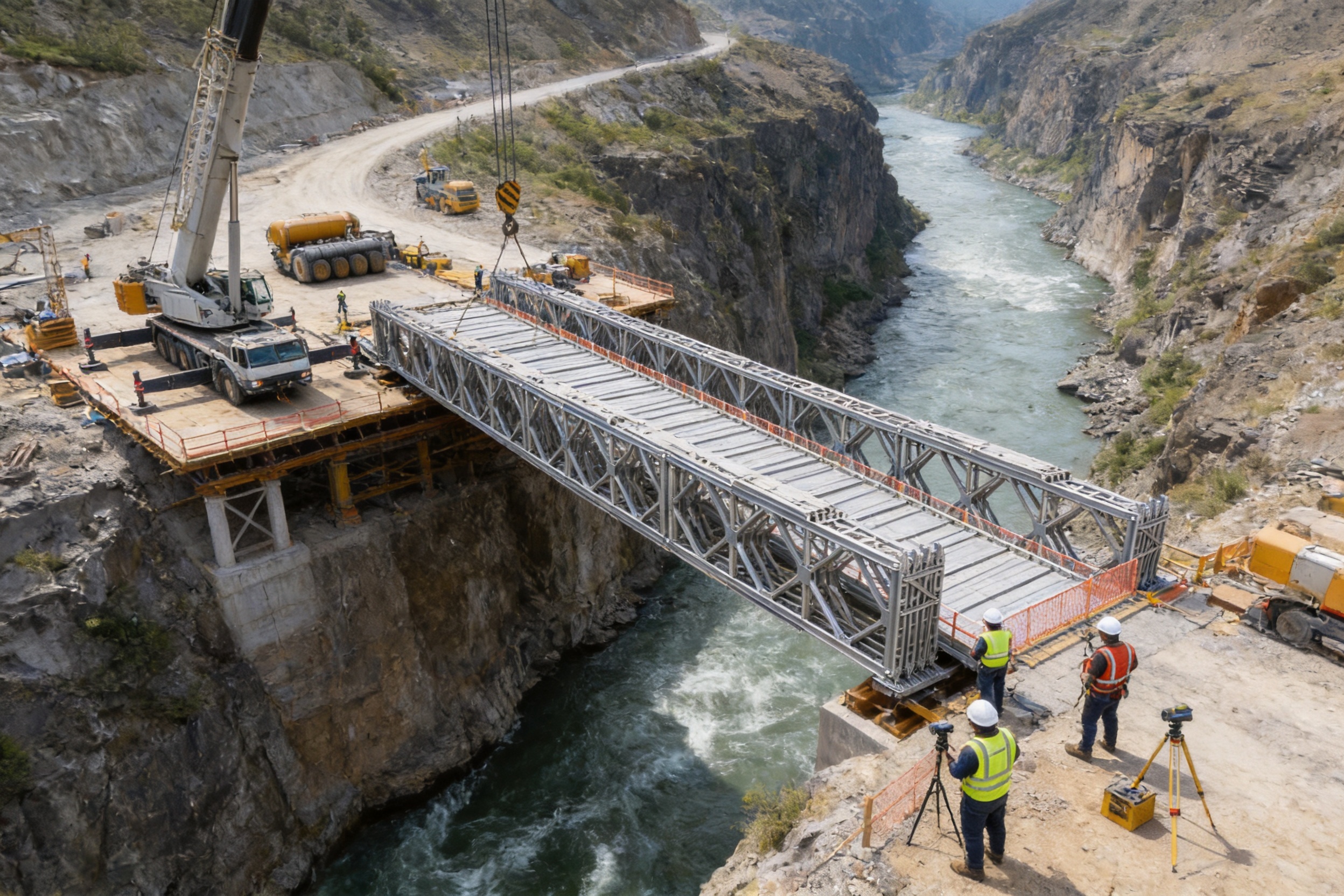
Modern infrastructure projects increasingly require bridge systems that can be delivered quickly, assembled efficiently, and adapted to demanding site conditions. Remote transportation corridors, emergency access routes, industrial facilities, military logistics networks, water conservancy projects, and temporary construction roads often need a bridge solution that combines the flexibility of modular construction with the strength of a permanent structural system. The CB450 Large-Span Heavy-Load Galvanized Bailey Bridge has been developed to address these requirements through a reinforced, modular steel configuration designed for substantial spans and heavy traffic loads.
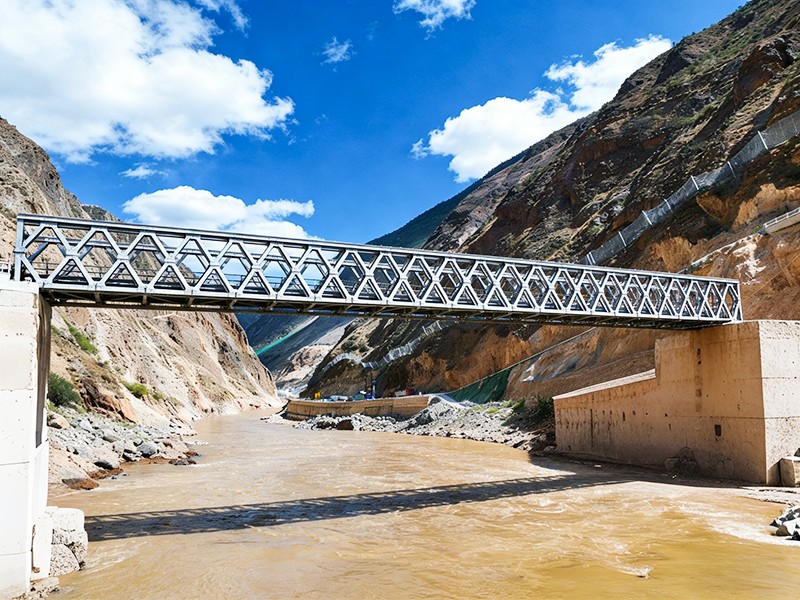
The CB450 is a four-lane, single-layer reinforced Bailey bridge with a maximum single span of 81 meters and a stated load capacity of up to 80 tons. It is manufactured with hot-dip galvanized steel components to improve corrosion resistance and extend service life in challenging environments. Unlike basic light-duty modular bridge systems that are primarily intended for temporary pedestrian or low-volume vehicle access, the CB450 is engineered for projects where span length, traffic capacity, erection efficiency, and structural reliability must be considered together.
This article examines the design characteristics, manufacturing advantages, technical considerations, transport benefits, installation process, application potential, and quality strengths of the CB450 system. It also explains why an experienced modular bridge manufacturer is essential when a project requires more than standardized components. Successful bridge delivery depends on accurate engineering, controlled fabrication, suitable protective treatment, reliable logistics, and practical support during erection.
1. Product Overview
The CB450 is a large-span heavy-load galvanized Bailey bridge developed for demanding infrastructure applications. Its configuration combines a modular panel-based structure with reinforced steel members capable of supporting a broad range of road and logistics loads. The bridge uses a single-layer structural arrangement while incorporating reinforcement to improve its capacity for long-span service.
A key feature of the system is its four-lane arrangement. Four-lane bridge configurations can be valuable for projects that require higher traffic throughput, bidirectional vehicle movement, construction access, or separation between different traffic flows. The exact road deck arrangement, lane width, barrier configuration, approach geometry, and traffic-control method should be finalized through project-specific engineering, but the four-lane concept provides a substantial capacity advantage over narrow single-lane modular bridges.
The maximum single span is 81 meters, which places the bridge in a large-span category for modular Bailey bridge systems. Long spans can reduce the need for intermediate piers, particularly where the bridge crosses rivers, channels, deep valleys, active roads, railways, restricted industrial areas, or environmentally sensitive zones. Reducing intermediate supports can simplify foundation construction and minimize obstruction within the crossing area.
The bridge is designed for a maximum stated load capacity of 80 tons. The final permissible load for any installed bridge must always be confirmed through structural calculations, site investigation, erection configuration review, foundation verification, and operating controls. Nevertheless, the stated capacity demonstrates that the CB450 is intended for heavy transport and industrial access rather than only light vehicles.
Hot-dip galvanizing provides the primary corrosion-protection treatment described for the bridge. During this process, prepared steel components are immersed in molten zinc, creating a metallurgically bonded zinc coating. This coating helps protect steel surfaces from atmospheric moisture, rain, salts, and other corrosive agents. It is particularly valuable for bridges installed in humid, coastal, tropical, industrial, or flood-prone environments.
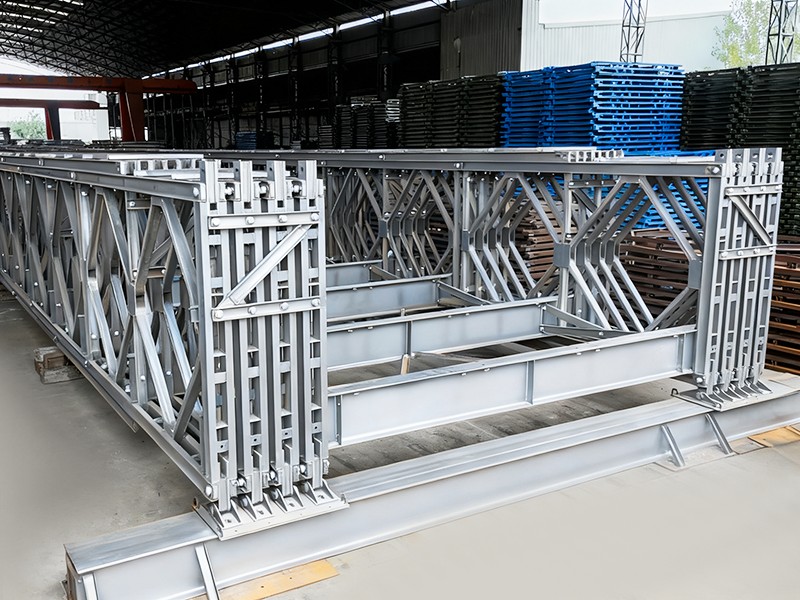
CB450 Type Large Span Heavy Load Galvanized Bailey Bridge
2. Main Technical Characteristics
The CB450’s principal engineering value comes from the way its characteristics work together. A long span alone is not enough for a successful bridge. A heavy load rating alone does not guarantee practical construction. A modular system alone does not ensure rapid delivery. The effectiveness of the CB450 results from combining long-span capability, reinforced steel construction, modular assembly, multi-lane traffic capacity, and corrosion protection within one coordinated solution.
| Characteristic | CB450 Description | Project Benefit |
|---|---|---|
| Bridge type | Large-span heavy-load modular Bailey bridge | Suitable for demanding temporary, semi-permanent, and infrastructure access applications |
| Structural arrangement | Four-lane, single-layer reinforced structure | Supports high traffic throughput while retaining modular construction principles |
| Maximum single span | Up to 81 meters | Can reduce the need for intermediate piers in suitable crossing conditions |
| Stated load capacity | Up to 80 tons | Supports heavy vehicles, construction equipment, logistics traffic, and industrial transport subject to engineering approval |
| Surface protection | Hot-dip galvanizing | Improves resistance to corrosion and reduces maintenance exposure |
| Design load references | HS-15, HS-20, HS-25, HL-93, and tracked-50 | Provides a basis for evaluating different vehicle and tracked-load requirements |
| Manufacturing approach | Factory fabrication and pre-assembly | Improves dimensional control and supports faster site installation |
The load references listed for the bridge include HS-15, HS-20, HS-25, HL-93, and tracked-50. These design references represent different vehicle and tracked-load scenarios used in bridge engineering and transportation planning. The correct design case depends on the project location, governing standards, traffic model, vehicle type, and client requirements. A qualified engineering team should confirm which load combination applies before fabrication and installation.
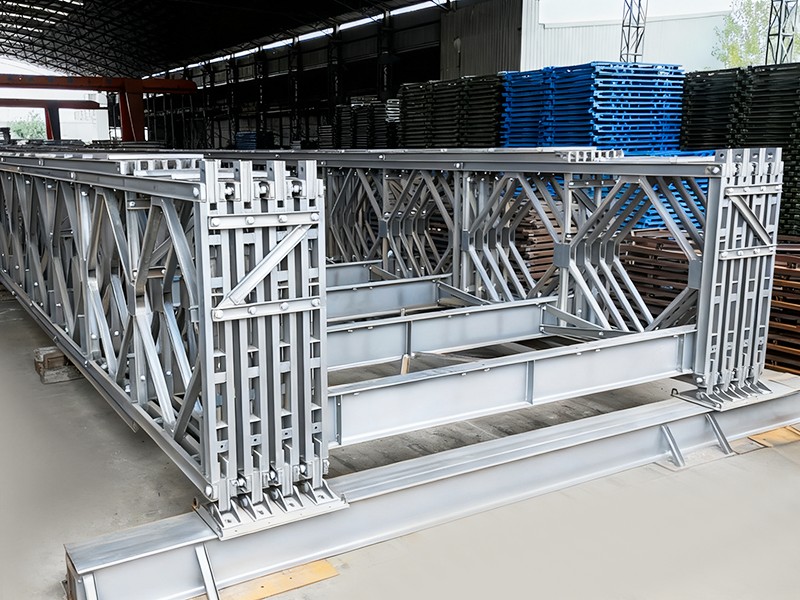
Factory pre-assembly is another important feature. The bridge has been pre-assembled at the manufacturing facility before being shipped to the Sichuan project site. Pre-assembly allows the manufacturer to check the fit of major components, verify connection interfaces, identify potential dimensional conflicts, and organize components for efficient dispatch. This reduces uncertainty during field erection and helps site teams understand the intended assembly sequence before the bridge arrives.
3. Advantages Over Conventional and Competing Bridge Solutions
3.1 Longer Modular Spans
Many conventional modular Bailey bridges are designed primarily for short or medium spans. When the crossing becomes longer, additional piers, intermediate supports, or multiple bridge units may be required. These supports increase construction work in the waterway or crossing zone and can create additional risks related to scour, navigation, flood flow, environmental disturbance, and foundation settlement.
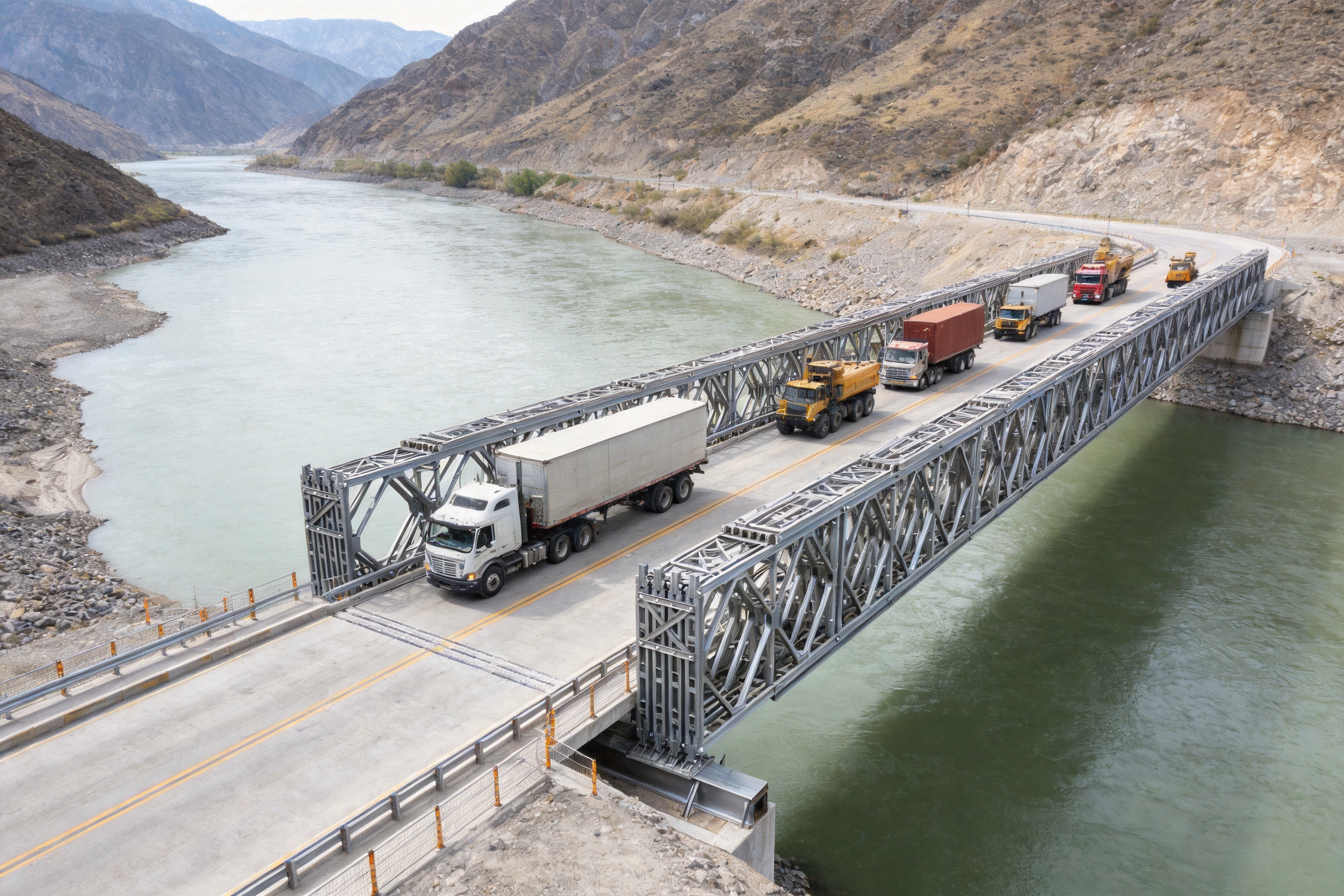
With a maximum single span of 81 meters, the CB450 provides a stronger option for projects seeking a long uninterrupted crossing. A single-span arrangement can be especially useful when the area below the bridge must remain clear. Examples include active waterways, railway corridors, highways, flood channels, industrial yards, and temporary construction zones where ground access is limited.
A longer span can also simplify project planning. Instead of coordinating several piers and multiple structural transitions, the project team may be able to focus on two main support locations and the associated foundations. The final feasibility depends on soil conditions, wind exposure, hydraulic forces, approach elevation, and structural analysis, but the long-span capability creates more design flexibility than ordinary narrow-span modular systems.
3.2 Higher Heavy-Load Potential
Light modular bridges can be appropriate for pedestrians, small vehicles, agricultural traffic, and emergency access. However, projects involving cranes, loaded trucks, military vehicles, mining equipment, prefabricated components, or construction machinery require much greater structural capacity. The CB450’s stated capacity of up to 80 tons places it in a more demanding category of modular bridge applications.
Heavy-load capability can reduce the need to construct a separate permanent access route before the main project begins. A bridge that can accommodate major equipment allows contractors to move materials and machinery across a river, ravine, or transportation barrier without waiting for a conventional bridge to be completed. This can improve construction sequencing and reduce the cost of indirect haul routes.
The load rating should not be interpreted as permission for unlimited traffic. Safe operation requires controls for axle configuration, wheel spacing, vehicle speed, traffic frequency, dynamic impact, lane placement, braking, turning, and simultaneous loading. A bridge engineer should verify the design for the actual fleet and operating conditions. The advantage of the CB450 is that it provides a strong structural platform for this analysis.
3.3 Multi-Lane Traffic Efficiency
A four-lane bridge can provide considerably more operational flexibility than a single-lane or narrow two-lane structure. It may allow simultaneous movement in both directions, separation of heavy and light vehicles, dedicated construction traffic, or controlled traffic during peak periods. In emergency response projects, multiple lanes can support the movement of relief supplies, rescue equipment, utility vehicles, and local traffic at the same time.
Four-lane capacity is also valuable in industrial and infrastructure projects where traffic demand changes over time. During early construction, the bridge may carry earthmoving equipment and delivery vehicles. During later phases, it may support workers, service trucks, maintenance vehicles, or public traffic. A wide deck provides more room for traffic management, safety barriers, inspection access, and controlled vehicle movement.
Compared with narrow modular bridges, the CB450 can help reduce queuing and crossing delays. This benefit is particularly important where the bridge serves a large worksite, a high-volume logistics corridor, or a community temporarily isolated by a damaged crossing. The actual usable roadway width and traffic arrangement should be confirmed through the project drawings.
3.4 Hot-Dip Galvanized Durability
Corrosion is one of the most persistent threats to steel bridge performance. Rainwater, humidity, salt spray, industrial pollutants, mud, standing water, and repeated wet-dry cycles can gradually deteriorate exposed steel. Painting systems can provide effective protection, but they require careful surface preparation, coating control, inspection, and periodic maintenance. Damage to the coating can expose local areas to corrosion.
Hot-dip galvanizing provides a durable zinc coating over appropriately prepared steel surfaces. The zinc layer acts as a barrier and also provides sacrificial protection if minor scratches or localized damage occur. Galvanized components can therefore offer a useful service-life advantage over untreated or inadequately protected steel, particularly in exposed environments.
For bridge owners, corrosion protection can reduce maintenance interruptions and lower the frequency of repainting operations. This can be important when a bridge is located over water, in a remote area, or in a high-traffic facility where maintenance closures are difficult. Galvanizing does not eliminate the need for inspection. Drainage, connections, deck surfaces, field cuts, and areas exposed to abrasion should still be monitored throughout the bridge’s service life.
3.5 Factory Pre-Assembly and Reduced Site Uncertainty
Traditional site-built steel structures may require extensive field fitting, welding, drilling, and adjustment. These activities depend heavily on weather, site access, workforce skill, temporary facilities, and inspection resources. They can prolong construction and introduce variability into the final structure.
The CB450 is pre-assembled at the factory before shipment to the project site. This approach allows major components and connection interfaces to be verified under controlled conditions. Factory assembly also supports better organization of parts, clearer marking, and more predictable installation procedures. The bridge can be disassembled after verification, packed for transport, and reassembled at the site according to the approved erection plan.
Pre-assembly does not replace field inspection, but it helps shift complex work from an unpredictable site environment to a controlled manufacturing facility. This is a significant advantage over systems that rely almost entirely on on-site fabrication.
4. Engineering Design and Structural Configuration
A Bailey bridge is based on modular structural principles. Repeated panels, transverse members, longitudinal members, bracing components, deck elements, connection pins, bolts, and support assemblies are combined to create a bridge of the required span and width. This modularity allows the system to be transported in sections and assembled with relatively limited specialized equipment compared with many conventional bridge types.
The CB450 uses a single-layer reinforced configuration. In a single-layer system, the main truss arrangement remains compact in depth and width while reinforcement is introduced to improve strength and stiffness. The engineering objective is to achieve an efficient balance among load capacity, span length, material consumption, transport dimensions, and erection requirements.
Long-span structures must be evaluated for more than vertical vehicle loading. Deflection, lateral stability, wind effects, vibration, fatigue, connection behavior, temperature movement, differential settlement, construction-stage forces, and accidental impact all require consideration. The bridge must be assessed in both its completed condition and its temporary erection stages.
At an 81-meter span, erection planning becomes especially important. Launching procedures, temporary supports, nose arrangements, lifting capacity, wind restrictions, and sequence control should be established before work begins. A modular bridge may be assembled on one side of a crossing and launched into position, or it may be lifted in sections depending on site access and available equipment. The selected method must be checked by competent engineers.
4.1 Connection Reliability
Modular bridge performance depends heavily on connection quality. Pins, bolts, gusset plates, bearing surfaces, transverse connections, and bracing interfaces transfer forces between repeated components. Manufacturing accuracy is therefore essential. Misaligned holes, inconsistent plate dimensions, inadequate weld quality, or damaged connection surfaces can create installation delays and compromise structural performance.
Precision fabrication helps ensure that components fit together as intended. Connection components should be manufactured according to approved drawings and inspected for dimensions, hole position, weld quality, surface condition, and identification. Components should also be protected during handling and transport so that galvanized surfaces and machined interfaces are not unnecessarily damaged.
4.2 Support and Foundation Interface
Even a strong superstructure depends on stable supports. Abutments, bearings, support stools, temporary foundations, ground beams, or other support arrangements must transfer bridge reactions safely into the ground. The foundation design should consider vertical reactions, horizontal braking forces, wind loads, seismic effects where applicable, scour, settlement, sliding, overturning, and construction-stage loads.
The CB450’s long-span capability may reduce the number of supports, but it does not eliminate the need for careful geotechnical and hydraulic evaluation. The project team should investigate soil bearing capacity, groundwater, river behavior, erosion risk, flood levels, access for construction equipment, and long-term settlement. A modular bridge manufacturer can provide structural reaction information and interface details, while local engineers typically confirm foundations and site-specific civil works.
5. Advanced Manufacturing Processes
The performance of a heavy-load modular bridge begins at the factory. A bridge is not simply a collection of steel pieces; it is a coordinated structural system in which every panel, connector, brace, deck component, and support must meet its intended dimensions and material requirements. Manufacturing quality directly influences installation time, structural alignment, durability, and lifecycle cost.
5.1 Engineering Preparation
Manufacturing begins with design review and production planning. Engineering personnel interpret the required span, lane arrangement, load cases, support conditions, transport limitations, and site-specific requirements. They prepare fabrication drawings, component schedules, assembly sequences, inspection points, and packing plans.
For a large-span bridge, engineering preparation must address both the final structure and the temporary states during assembly and launching. Component numbering and traceability are particularly important because a large bridge may contain many similar-looking parts that have different positions or orientations. Clear documentation reduces assembly errors and improves field efficiency.
5.2 Steel Preparation and Cutting
Steel plates, sections, and fabricated profiles are prepared using controlled cutting and forming processes. Accurate cutting improves fit-up and reduces the need for field correction. Edges should be checked for dimensional accuracy, distortion, burrs, and surface defects. Where components require holes, the hole locations must be controlled carefully because connection alignment is fundamental to modular bridge assembly.
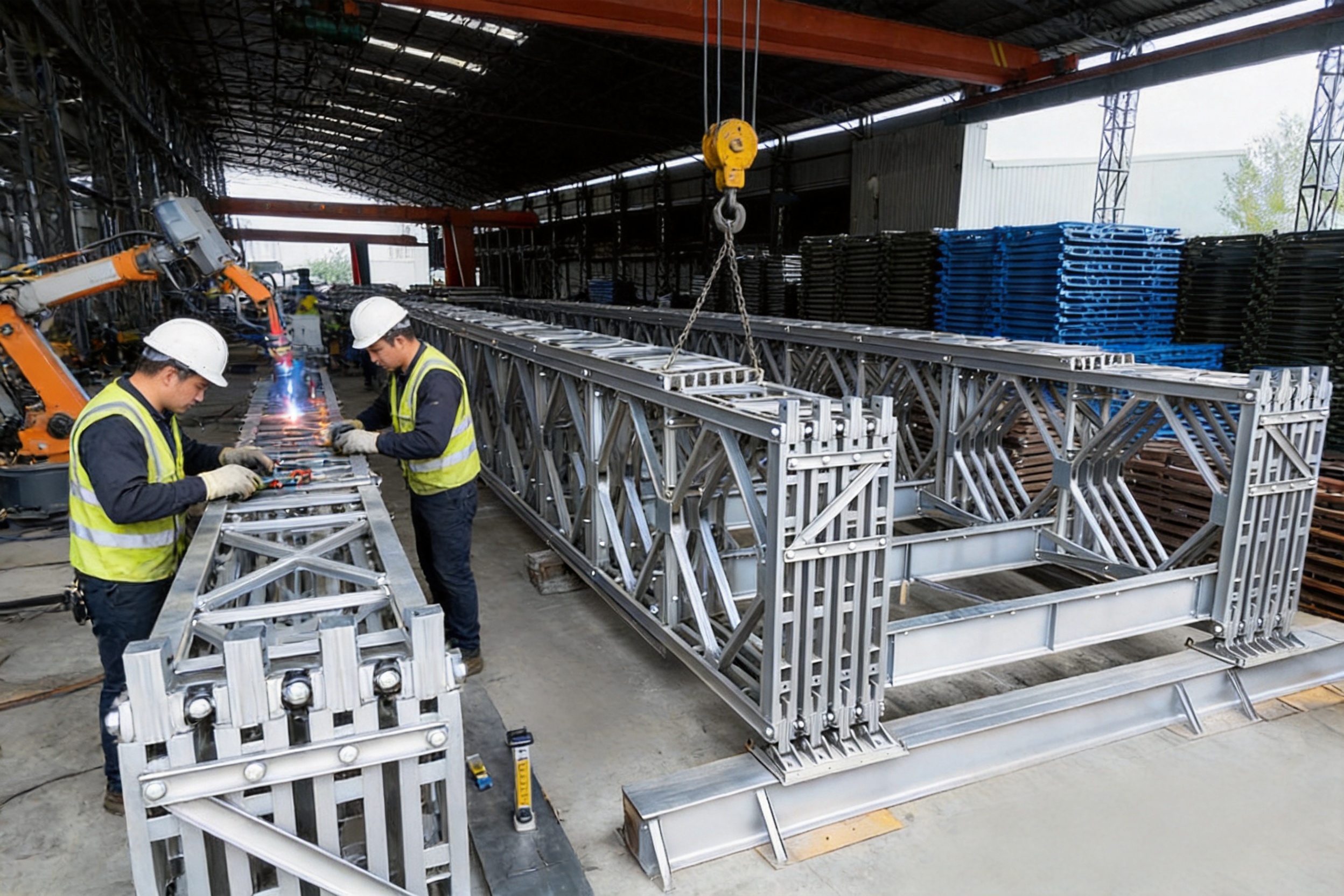
Automated and semi-automated production equipment can improve repeatability for high-volume components. Standardized workflows also reduce variation between production batches. This is one of the strengths of an industrial-scale manufacturer: repeated components can be produced under a defined process rather than being individually improvised.
5.3 Welding and Fabrication Control
Welding joins many of the steel elements used in bridge panels, stiffeners, connection assemblies, deck components, and supporting structures. Welding quality depends on approved procedures, suitable consumables, qualified personnel, correct heat input, proper joint preparation, and appropriate inspection.
Automated welding can improve consistency on repetitive joints by controlling travel speed, electrode position, weld size, and heat input. Manual welding remains important for complex geometries, repairs, and locations that cannot be reached by automated equipment. In both cases, welds should be inspected according to the project quality plan.
Good fabrication practice also includes control of distortion. Excessive welding heat can cause components to bend or twist, creating fit-up problems during assembly. Controlled welding sequences, temporary restraints, correction procedures, and dimensional checks help maintain the geometry required for long-span bridge erection.
5.4 Precision Assembly
Factory assembly is used to confirm that the manufactured components work together as a system. Workers assemble panels, bracing, transverse members, deck elements, and connection components according to the approved configuration. The process may include measurement of overall dimensions, cross-sectional alignment, connection fit, bearing interfaces, and component marking.
Pre-assembly is especially valuable for a bridge such as the CB450 because long spans and multiple lanes create a substantial number of interfaces. A small dimensional error repeated across many modules can become significant over the full bridge length. Factory checks help identify such issues before shipment.
5.5 Hot-Dip Galvanizing
Hot-dip galvanizing requires careful preparation. Steel surfaces are cleaned to remove oil, dirt, rust, mill scale, and other contaminants. The prepared components are treated so that molten zinc can bond effectively to the steel surface. After immersion, excess zinc is controlled and the components are cooled and inspected.
Component design should account for drainage and venting so that cleaning solutions and molten zinc can move through enclosed or hollow areas safely and effectively. Threaded components, bearing surfaces, holes, and connection interfaces require attention because excessive zinc buildup can affect fit. Post-galvanizing inspection should check coating continuity, visible defects, dimensional impact, and areas that may require approved repair treatment.
Galvanizing provides an important advantage for modular bridges that may be transported, assembled, disassembled, or relocated. A robust coating helps protect components during storage and repeated exposure to outdoor conditions. However, lifting, stacking, and transport must still be controlled to prevent impact damage and abrasion.
5.6 Quality Management and Traceability
Industrial bridge production benefits from a documented quality-management system. Material certificates, welding records, inspection reports, dimensional records, galvanizing information, and packing lists should be linked to component identification wherever required by the project.
Traceability is valuable for both initial construction and future maintenance. If a component needs inspection or replacement, clear identification allows the owner and manufacturer to locate the correct drawing, production record, and installation position. This is more reliable than treating every similar component as interchangeable without documentation.
Jiangsu Zhonghai Bridge Equipment Co., Ltd. integrates engineering design, precision manufacturing, quality management, and site support. Its manufacturing approach includes automated welding, standardized workflows, modular bridge fabrication, and precision steel production. These capabilities support consistent delivery for domestic and international infrastructure projects.
6. Factory Pre-Assembly for the Sichuan Project
The CB450 bridge described for the Sichuan project was pre-assembled at the factory before shipment. This project step demonstrates a practical quality-control strategy for a large modular bridge. Before a bridge leaves the factory, the manufacturer can review the arrangement of major members, check the compatibility of connection points, verify the packing sequence, and prepare installation guidance for the site team.
Sichuan contains diverse terrain, including rivers, mountainous corridors, valleys, industrial areas, and transportation routes with difficult access. A bridge intended for such a project may face constraints involving road width, lifting space, weather, river conditions, and limited staging areas. Factory pre-assembly helps reduce the amount of uncertain work that must be completed under these conditions.
Pre-assembly also improves logistics planning. Once components have been matched and identified, they can be grouped according to erection sequence. This reduces the risk that parts needed early in construction are buried under later deliveries or sent in separate shipments. Proper packing can shorten unloading time and simplify inventory control at the site.
The bridge is shipped after factory verification, but site teams should still conduct receiving inspections. They should check quantities, markings, coating condition, connection hardware, lifting points, and any signs of transport damage. Any discrepancy should be documented promptly and reviewed before erection begins.
7. Installation and Erection Considerations
One of the primary benefits of a Bailey bridge is its modular installation method. Components can be transported to the crossing, assembled in a planned sequence, and positioned using cranes, launching equipment, or a combination of techniques. The appropriate method depends on span length, terrain, water depth, access roads, available lifting capacity, wind, and the condition of the supports.
7.1 Site Preparation
Before erection, the site must be prepared. This may include construction of abutments, support platforms, temporary access roads, material staging areas, drainage works, lifting pads, and safety barriers. The ground should be inspected for bearing capacity and stability, particularly where heavy cranes or loaded transport vehicles will operate.
Surveying is required to confirm support elevations, centerlines, span dimensions, approach alignment, and clearance requirements. Small errors in support location or elevation can affect bridge alignment and bearing behavior. Survey control should be maintained throughout erection.
7.2 Component Inspection
All components should be checked before assembly. Inspection should identify bent members, damaged holes, missing bolts, damaged pins, coating defects, incorrect markings, and transport-related deformation. Galvanized components should be handled carefully, and approved repair procedures should be used for any coating damage.
Hardware should be organized so that the correct pins, bolts, washers, nuts, bracing members, and deck components are available at each stage. A detailed component checklist can save significant time and prevent interruptions during erection.
7.3 Assembly and Launching
The bridge may be assembled on a temporary platform or approach area and then launched across the gap. In a launching operation, a temporary nose or leading arrangement may be used to guide the bridge toward the opposite support. The assembly is advanced in controlled increments while temporary rollers or other devices support the structure.
Long-span launching requires careful control of unbalanced forces, cantilever behavior, deflection, wind, and temporary support reactions. The erection sequence must follow an approved method statement. Personnel should not improvise changes to the sequence without engineering review, especially when the bridge is partially assembled and has not yet reached its final structural configuration.
In other conditions, the bridge may be lifted into place in sections. This method can reduce launching requirements but demands sufficient crane capacity, stable lifting points, adequate working space, and accurate coordination between lifting operations and connection work.
7.4 Deck and Safety Elements
After the main truss structure is positioned, deck components, transverse members, barriers, curbs, access elements, and drainage details are installed. The deck must be checked for alignment, seating, connection security, and surface continuity. Traffic-control devices should be installed before the bridge is opened.
For a four-lane bridge, traffic separation and edge protection are especially important. The project should establish lane markings, speed limits, vehicle spacing rules, inspection access, emergency procedures, and restrictions for abnormal loads. The operating plan should be communicated clearly to all drivers and site personnel.
8. Application Areas
8.1 Highway and Road Diversions
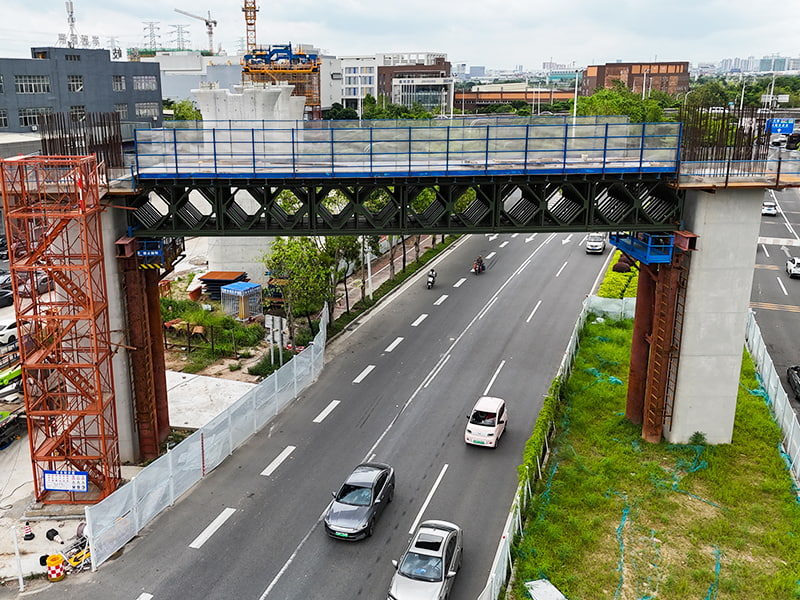
The CB450 can support temporary or semi-permanent road diversions where an existing bridge is being repaired, widened, or replaced. Its modular format can help maintain traffic while permanent works proceed. The four-lane arrangement is particularly relevant where traffic demand is too high for a narrow temporary crossing.
8.2 Construction Access
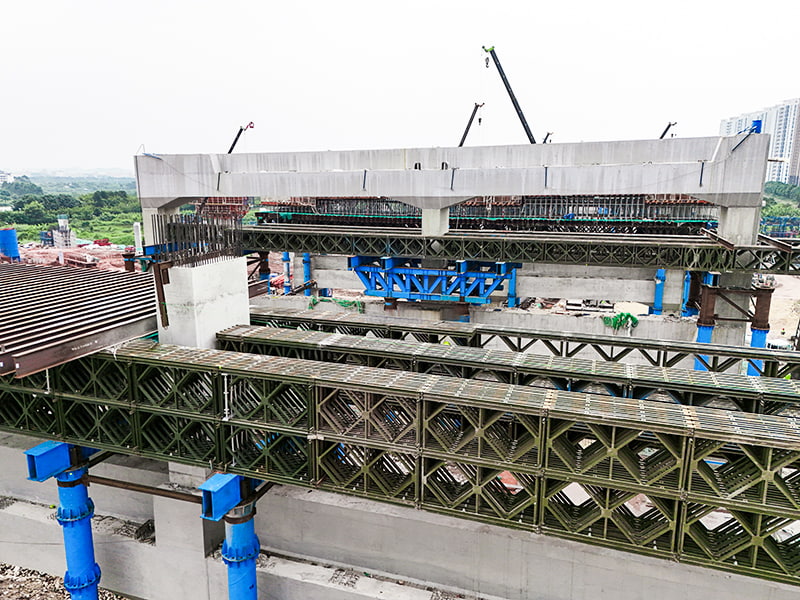
Large infrastructure projects often need temporary access across rivers, drainage channels, railways, or deep excavations. A heavy-load modular bridge can allow dump trucks, cranes, concrete equipment, and delivery vehicles to reach active work areas. The bridge can be designed for the project’s specific span and loading requirements, then removed or relocated after construction.
8.3 Emergency and Disaster Response
Floods, earthquakes, landslides, bridge failures, and extreme weather events can interrupt essential transport routes. A modular bridge can restore access faster than a conventional permanent structure because many components are standardized and can be transported to the affected area. Heavy-load capability allows relief trucks, utility vehicles, emergency equipment, and engineering machinery to cross safely when the approved design and site conditions permit.
8.4 Water Conservancy and Flood-Control Projects
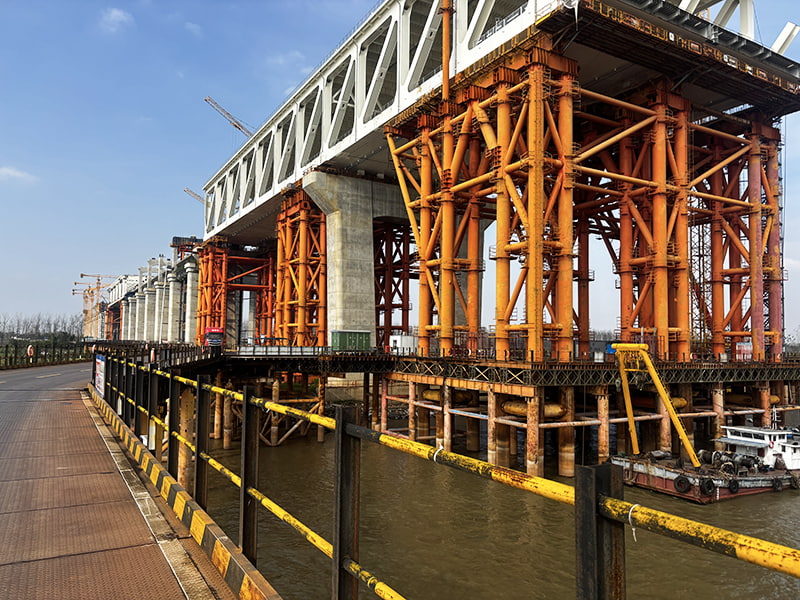
Water conservancy construction often involves channels, reservoirs, rivers, and flood-control works where ground access is interrupted. A single-span bridge can preserve water flow and reduce interference with construction zones. Galvanized protection is useful where the bridge is exposed to persistent humidity, splash, or fluctuating water levels.
8.5 Military and Strategic Logistics
Military logistics may require rapid deployment, heavy vehicle movement, and adaptable infrastructure. A multi-lane heavy-load modular bridge can support controlled movement of vehicles and supplies across difficult terrain. The bridge’s modular components can also be transported in stages and assembled where conventional construction resources are limited.
8.6 Industrial and Mining Facilities
Industrial sites frequently require bridges for heavy trucks, bulk material transport, equipment relocation, and access to remote production areas. The CB450’s heavy-load potential and large-span configuration can help cross industrial channels, storage yards, rail lines, and uneven terrain. Galvanization can provide useful protection in facilities exposed to moisture, dust, chemicals, or coastal air, subject to a project-specific corrosion assessment.
8.7 International Development Projects
Infrastructure projects in developing or remote regions may face limited construction equipment, difficult logistics, seasonal weather, and restricted access to replacement materials. A modular bridge system with factory production, organized packing, and technical support can provide a practical solution. The ability to manufacture major components in advance and ship them as an integrated package can simplify procurement and construction planning.
9. Manufacturer Capabilities and Project Support
Jiangsu Zhonghai Bridge Equipment Co., Ltd. is based in Zhenjiang, Jiangsu Province, an important industrial and transportation region in China. The company specializes in modular steel bridges, Bailey bridge systems, customized steel components, bridge erection support equipment, automated welding, and precision steel fabrication.
The company’s role extends beyond producing standard bridge panels. It integrates design, engineering, manufacturing, quality management, and on-site support. This integrated approach is valuable when a bridge must be adapted to a particular span, lane configuration, loading condition, transport method, or erection procedure.
Industrial-scale capacity allows the manufacturer to manage larger orders and repeated component production. Standardized workflows help maintain consistency, while engineering capability supports customized solutions. The company states that its factory produces high-strength modular bridge systems according to ASTM, EN, and national specifications, depending on project requirements.
Its project experience includes coastal engineering in the Maldives, temporary access bridges for the Shenzhen–Zhongshan Corridor, structural components for the Hangzhou Expo Center, multi-span Bailey bridges for the Lalin Railway, and flood-response and emergency bridge deployments in multiple regions. These applications represent different operating environments and demonstrate the importance of adaptable production and logistics capabilities.
For international customers, communication and documentation are also important. A reliable supplier should provide technical drawings, packing lists, assembly instructions, quality records, inspection support, and clear commercial coordination. Effective communication reduces misunderstandings between the manufacturer, contractor, consulting engineer, and owner.
10. Durability, Maintenance, and Lifecycle Value
A bridge’s economic value should be assessed over its entire lifecycle rather than only by initial purchase price. A low-cost bridge that requires frequent repair, extensive repainting, or repeated traffic closures may be more expensive in the long term than a well-protected system with higher initial quality.
The CB450’s galvanized finish can contribute to lifecycle value by reducing corrosion-related maintenance. However, owners should establish an inspection and maintenance program from the beginning. Inspections should examine truss members, connections, deck elements, bearings, support areas, drainage paths, barriers, and areas subject to vehicle impact or material accumulation.
Galvanized surfaces should be kept reasonably clean where deposits could retain moisture or corrosive substances. Abrasion from traffic, equipment, ice, debris, or repeated contact should be monitored. If zinc coating damage exposes steel, repairs should follow an approved procedure compatible with the galvanizing system.
Bolted and pinned connections should be checked for movement, wear, deformation, or missing hardware. Deck components may experience more direct wear than the main truss members and may require replacement or adjustment depending on traffic intensity. Support areas should be inspected for settlement, erosion, ponding water, and unauthorized modifications.
The modular nature of the bridge can simplify future repair. Individual panels, deck sections, braces, or connection elements may be replaceable without dismantling the entire bridge, provided the replacement work is engineered and carried out under controlled conditions. This can help reduce downtime and preserve the usefulness of the overall system.
11. Safety and Compliance Considerations
Heavy-load bridge safety depends on engineering, construction, operation, and maintenance. The bridge should be designed for the governing load standard and the actual vehicle population. References such as HS-15, HS-20, HS-25, HL-93, and tracked-50 provide useful design bases, but the project team must confirm the applicable standard and load combination.
Before opening the bridge, the owner should confirm that the foundations, bearings, connections, deck, barriers, drainage, and approaches are complete. A final inspection should verify that no temporary erection equipment remains in an unsafe position and that the bridge is aligned correctly.
Operational controls may include posted load limits, axle restrictions, speed limits, lane-use rules, vehicle spacing, one-way controls during special movements, and restrictions during high wind or flooding. Abnormal loads should be reviewed in advance. Drivers should not stop unnecessarily on the bridge, and heavy vehicles should maintain safe spacing to limit dynamic effects.
Emergency procedures should address vehicle breakdowns, accidents, flood warnings, fire, structural impact, and unexpected settlement. Inspection access should be planned so that the bridge can be checked without creating unnecessary traffic hazards.
12. Procurement Guidance for Project Owners
When purchasing a large-span modular bridge, project owners should provide the supplier with complete technical information. Important details include the required span, roadway width, number of lanes, design vehicle loads, pedestrian requirements, approach elevations, support conditions, environmental exposure, transport route, erection method, and expected service period.
The owner should also clarify whether the bridge is temporary, semi-permanent, or intended for long-term service. This affects corrosion protection, deck selection, maintenance planning, foundation design, inspection requirements, and spare-component strategy.
A detailed quotation should identify the scope of supply. It should state whether the package includes main bridge components, deck panels, barriers, bearings, support stools, launching equipment, bolts and pins, transport packing, assembly supervision, engineering drawings, and installation guidance. Clear scope definition prevents gaps between the manufacturer’s responsibility and the contractor’s responsibility.
Customers should request technical documentation suitable for review by the project engineer. This may include general arrangement drawings, component drawings, material information, load calculations, erection procedures, galvanizing records, welding documentation, inspection reports, and maintenance recommendations. Documentation requirements should be agreed before production begins.
It is also useful to review the manufacturer’s ability to manage production schedules and international logistics. A bridge project can be delayed if components are ready but packaging, customs documentation, transport coordination, or site support has not been planned. An experienced supplier should coordinate manufacturing and delivery as one complete process.
13. Why the CB450 Is a Strong Choice for Demanding Projects
The CB450 distinguishes itself through a combination of characteristics that are not always available in a single modular bridge product. Its 81-meter maximum single-span capability addresses crossings where ordinary modular systems may require additional supports. Its stated 80-ton capacity supports a broad range of heavy vehicles and construction equipment. Its four-lane, single-layer reinforced configuration provides a substantial traffic platform while retaining modular construction advantages.
Hot-dip galvanizing adds a layer of long-term protection that is particularly valuable for exposed bridges. Factory pre-assembly improves confidence in component fit and erection sequencing. Industrial manufacturing, automated welding, precision fabrication, and documented quality processes support consistency across the bridge system.
These advantages are strengthened when the supplier can provide engineering coordination and project support rather than only shipping loose components. A bridge is successful when it performs safely in its actual environment, arrives in the correct configuration, can be erected within the available site constraints, and remains maintainable throughout its service life.
For infrastructure owners, contractors, emergency agencies, and international development organizations, the CB450 offers a balance between structural capacity and construction flexibility. It can be considered for large-span access, temporary traffic diversions, industrial logistics, emergency restoration, water conservancy works, and other applications where speed and heavy-load performance are essential.
14. Questions and Answers
Q1: What is the CB450 bridge designed for?
The CB450 is designed as a large-span, heavy-load modular steel bridge for demanding road, construction, emergency, industrial, military logistics, and infrastructure applications. It is particularly suitable where a project requires a substantial span, high traffic capacity, and rapid or controlled assembly.
Q2: What is the maximum span of the CB450?
The maximum stated single span is 81 meters. The feasible span for a specific project must be confirmed through structural calculations, support design, site investigation, wind evaluation, erection analysis, and approval by the responsible project engineer.
Q3: How much load can the bridge carry?
The stated maximum load capacity is up to 80 tons. The actual allowable vehicle or equipment load depends on the final bridge configuration, axle arrangement, traffic frequency, dynamic effects, foundation conditions, and applicable design standard. The project team should not use the general capacity as a substitute for a site-specific operating approval.
Q4: What does the four-lane configuration provide?
The four-lane arrangement provides greater traffic throughput and operational flexibility than a narrow single-lane bridge. It can support bidirectional movement, separated traffic flows, construction logistics, or controlled emergency access. Lane dimensions and traffic-control details should be confirmed in the project design.
Q5: Why is hot-dip galvanizing important?
Hot-dip galvanizing protects steel with a bonded zinc coating that acts as a barrier against moisture and corrosion. Zinc also provides sacrificial protection in areas of minor surface damage. This treatment can reduce maintenance requirements and improve durability in humid, coastal, industrial, and flood-prone environments.
Q6: Is the bridge suitable for temporary use?
Yes. Its modular structure makes it suitable for temporary, semi-permanent, and potentially relocatable applications. Temporary use still requires proper foundations, engineering approval, erection control, traffic management, and regular inspection.
Q7: What is the value of factory pre-assembly?
Factory pre-assembly verifies the fit of major components before shipment. It can identify dimensional conflicts, confirm connection interfaces, improve component marking, and help establish the erection sequence. This reduces uncertainty and field adjustment work at the project site.
Q8: Can the bridge be customized?
Modular bridge systems can generally be configured or supplemented according to span, width, loading, deck, support, barrier, and erection requirements. Any customization should be developed through approved engineering drawings and confirmed before production.
Q9: What standards are referenced for the CB450?
The product information references HS-15, HS-20, HS-25, HL-93, and tracked-50 load designs. It also states that the manufacturer produces systems according to ASTM, EN, and national specifications depending on project requirements. The governing standard must be selected and verified for each project.
Q10: What information should a buyer provide when requesting a quotation?
A buyer should provide the span, bridge width, lane arrangement, design loads, site location, support elevations, foundation information, environmental conditions, traffic type, desired service period, delivery requirements, and erection method if known. Photos, survey drawings, geotechnical data, and access information can further improve quotation accuracy.
Q11: Does galvanizing remove the need for maintenance?
No. Galvanizing reduces corrosion risk but does not eliminate inspection and maintenance. Owners should inspect connections, deck surfaces, drainage, support areas, barriers, impact zones, and any damaged coating. Early maintenance helps preserve the bridge’s performance and service life.
Q12: Can the CB450 be used in emergency response projects?
Yes. Its modular format, heavy-load potential, large-span capability, and factory production approach make it suitable for emergency access and disaster-response projects. Emergency use still requires rapid but competent assessment of foundations, flood conditions, erection safety, traffic loading, and operational restrictions.
15. Conclusion
The CB450 Large-Span Heavy-Load Galvanized Bailey Bridge is a high-capacity modular bridge solution developed for projects that demand more than basic temporary access. Its four-lane, single-layer reinforced configuration, maximum 81-meter single span, stated 80-ton load capacity, and hot-dip galvanized finish provide a strong combination of structural capability, traffic efficiency, and durability.
Its advantages are supported by factory pre-assembly, precision fabrication, automated welding, standardized production, and integrated engineering support. These manufacturing strengths help reduce site uncertainty, improve component compatibility, simplify logistics, and support reliable erection. The system is suitable for construction access, highway diversions, emergency restoration, water conservancy, industrial transport, military logistics, mining, and international infrastructure projects.
The final success of any bridge depends on correct engineering, suitable foundations, controlled erection, responsible traffic management, and continuing inspection. When these elements are combined with a well-manufactured modular system, the CB450 can provide a practical and durable connection across difficult terrain, waterways, transport corridors, and project sites.
References
1. Product technical information for the CB450 Large-Span Heavy-Load Galvanized Bailey Bridge, including span, load capacity, structural arrangement, galvanizing treatment, and design load references.
2. Manufacturer company information regarding modular bridge engineering, precision steel fabrication, automated welding, quality management, project support, and international delivery.
3. General principles of modular steel bridge design, fabrication, erection, inspection, and maintenance.
4. Highway bridge design references for vehicle loading, including HS-series and HL-93 loading concepts.
5. Technical guidance on hot-dip galvanizing, zinc coating performance, corrosion protection, inspection, and repair of galvanized steel structures.
6. Standard engineering practices for temporary works, bridge launching, crane lifting, foundation verification, and construction-stage structural safety.
Product: CB450 Type Large Span Heavy Load Galvanized Bailey Bridge


We respond quickly to all international requests and provide technical support when needed.
Product Category
Bailey Bridge/Modular Bridge Modular Steel Bridge Pedestrian Bridge Modular Pipe Bridge Truss Bridge Steel StructureContact Us

+86-511-84522866
+86-13921582699

zhwm@zjql.com

Building 1,83#, dantu New Town, Yanjiang Road, Dantu District, Zhenjiang, Jiangsu, China
Copyright © Jiangsu Zhonghai Bridge Equipment Co., Ltd. All
Rights
Reserved
China bailey bridge for sale
bailey bridge supplier from china
